von der KIT-Fakultät für Wirtschaftswissenschaften des Karlsruher Instituts für Technologie (KIT) genehmigte Dissertation von
M.Sc. Aditya Mogadala
M U LT I - V I E W R E P R E S E N TAT I O N L E A R N I N G F O R U N I F Y I N G L A N G U A G E S , K N O W L E D G E A N D V I S I O N
a d i t ya m o g a d a l a
Tag der mündlichen Prüfung: 7. November,2018
Referent: PD Dr. Achim Rettinger
Korreferent: Prof. Dr. Volker Tresp
Korreferent: Prof. Dr. York Sure-Vetter
The growth of content on the web has raised various challenges, yet also pro-vided numerous opportunities. Content exists in varied forms such as text ap-pearing in different languages, entity-relationship graph represented as struc-tured knowledge and as a visual embodiment like images/videos. They are often referred to asmodalities. In many instances, the different amalgamation of modal-ities co-exists to complement each other or to provide consensus. Thus making the content either heterogeneous or homogeneous. Having an additional point of view for each instance in the content is beneficial for data-driven learning and intelligent content processing. However, despite having availability of such con-tent. Most advancements made in data-driven learning (i.e., machine learning) is by solving tasks separately for the single modality. The similar endeavor was not shown for the challenges which required input either from all or subset of them.
In this dissertation, we develop models and techniques that can leverage mul-tiple views of heterogeneous or homogeneous content and build a shared repre-sentation for aiding several applications which require a combination of modal-ities mentioned above. In particular, we aim to address applications such as content-based search, categorization, and generation by providing several novel contributions.
First, we develop models for heterogeneous content by jointly modeling di-verse representations emerging from two views depicting text and image by learning their correlation. To be specific, modeling such correlation is helpful to retrieve cross-modal content. Second, we replace the heterogeneous content with homogeneous to learn a common space representation for content catego-rization across languages. Furthermore, we develop models that take input from both homogeneous and heterogeneous content to facilitate the construction of common space representation from more than two views. Specifically, represen-tation is used to generate one view from another. Lastly, we describe a model that can handle missing views, and demonstrate that the model can generate missing views by utilizing external knowledge. We argue that techniques the models leverage internally provide many practical benefits and lot of immediate value applications.
From the modeling perspective, our contributed model design in this the-sis can be summarized under the phrase Multi-view Representation Learning (MVRL). These models are variations and extensions of shallow statistical and deep neural networks approaches that can jointly optimize and exploit all views of the input content arising from different independent representations. We show that our models advance state of the art, but not limited to tasks such as cross-modal retrieval, cross-language text classification, image-caption generation in multiple languages and caption generation for images containing unseen visual object categories.
A C K N O W L E D G M E N T S
"Starting strong is good. Finishing strong is epic.“ –Robin Sharma.
The successful completion of this thesis would not have been possible without the support of several people.
First, I would like to express my gratitude to Prof. Dr. Rudi Studer for giving me an opportunity to join his research group at the Institute AIFB. His skill of asking challenging questions has further shaped the topics of my research. In addition, I am grateful to PD Dr. Achim Rettinger and Prof. York Sure-Vetter who gave unprecedented support in the research projects and immense freedom to explore topics of my interest. Without their guidance, it is hard to imagine the completion of this thesis today.
I am thankful for my co-referent, Prof. Dr. Volker Tresp who readily agreed to read my dissertation. Also, I am happy that Prof. Dr. Lexing Xie and her group hosted me at the Australian National University in Canberra. I was warmly wel-comed there and was provided with all the resources to conduct my research.
My thanks to all colleagues and friends from theYordiversewho has made the Ph.D. journey a truly remarkable experience. Also, I want to thank my family for their support during this time.
Last but not least, I am deeply indebted to my wife Manasa, who has given constant encouragement and was always there with me in bad and good mo-ments to whom I dedicate this work.
The text as well as the pictures which are part of the thesis have been already published or under preparation. The thesis is written based on the following papers:
[1] Mogadala, Aditya and Rettinger, Achim. Multimodal Correlated Centroid
Space for Multilingual Cross-Modal Retrieval. Proceedings of the European
Conference on Information Retrieval (ECIR),2015.
[2] Mogadala, Aditya and Rettinger, Achim.Bilingual Word Embeddings from
Parallel and Non-parallel Corpora for Cross-Language Text Classification.
Proceedings of the North American Chapter of the Association for Compu-tational Linguistics (NAACL-HLT),2016.
[3] Mogadala, Aditya and Bista, Umanga and Xie, Lexing and Rettinger, Achim,
Knowledge Guided Attention and Inference for Describing Images
Containing Unseen Objects. Proceedings of the Extended Semantic Web
Conference (ESWC),2018.
Some of the ideas of this thesis have been presented in the doctoral consortium
[4] Mogadala, Aditya Polylingual Multimodal Learning. Proceedings of the Doctoral Consortium at The European Conference on Machine Learning and Principles and Practice of Knowledge Discovery in Databases (ECML PKDD),2015.
Research contributions during the Ph.D. study that are not part of this thesis:
[5] Paul, Christian and Rettinger, Achim and Mogadala, Aditya and Knoblock, Craig A. and Szekely, Pedro. Efficient graph-based document similarity. Processing of the Extended Semantic Web Conference (ESWC), 2016. Best
Research Paper Nominee.
[6] Zhang, Lei and Thalhammer, Andreas and Rettinger, Achim and Färber, Michael and Mogadala, Aditya and Denaux, Ronald. The xLiMe system: Cross-lingual and cross-modal semantic annotation, search and
recommen-dation over live-TV, news and social media streams. Web Semantics:
Sci-ence, Services and Agents on the World Wide Web ,2017.
[7] Mogadala, Aditya and Kanuparthi, Bhargav and Rettinger, Achim and Sure-Vetter, York. Discovering Connotations as Labels for Weakly Supervised
Image-Sentence Data. The Web Conference (Cognitive Computing Track),
2018.
[8] Mogadala, Aditya and Jung, Dominik and Rettinger, Achim.Linking Tweets
with Monolingual and Cross-Lingual News using Transformed Word
Em-beddings. International Journal of Computational Linguistics and
Applica-tions (IJCLA), To Appear.
1 i n t r o d u c t i o n 2
1.1 Motivation . . . 2
1.1.1 Heterogeneous and Homogeneous Content . . . 2
1.1.2 Heterogeneous and Homogeneous Content Applications . . 6
1.2 Heterogeneous and Homogeneous Content Characteristics . . . 8
1.2.1 Characteristic1: Cross-modal Content . . . 9
1.2.2 Characteristic2: Cross-language Content . . . 9
1.2.3 Characteristic3: Parallel Content . . . 9
1.2.4 Characteristic4: Non-parallel Content . . . 11
1.3 Research Questions and Span . . . 11
1.3.1 Research Questions . . . 11
1.3.2 Span of this Thesis . . . 13
1.4 Contributions . . . 14
1.5 Outline . . . 15
2 f o u n d at i o n s 18 2.1 Representation Learning . . . 18
2.1.1 Shallow Representation Learning . . . 18
2.1.2 Deep Representation Learning . . . 20
2.2 Multi-View Representation Learning . . . 25
2.2.1 Multi-View Shallow Representation Learning . . . 26
2.2.2 Multi-View Deep Representation Learning . . . 33
3 s tat e o f t h e a r t 40 3.1 MVRL for Cross-Lingual Tasks . . . 40
3.1.1 Retrieval . . . 40
3.1.2 Classification . . . 41
3.1.3 Generation . . . 41
3.2 MVRL for Cross-Modal Tasks . . . 42
3.2.1 Retrieval . . . 42 3.2.2 Classification . . . 43 3.2.3 Generation . . . 44 4 m v r l w i t h t w o v i e w s a n d c o r r e l at e d c e n t r o i d s pa c e 47 4.1 Introduction . . . 48 4.1.1 Motivation . . . 48
4.1.2 Background on Related Learning Methods . . . 49
4.2 Research Question and Contributions . . . 50
4.2.1 Research Question and Hypothesis . . . 50
4.2.2 Contributions . . . 51
4.3 Correlated Centroid Space Approach . . . 52
4.3.1 Problem Formulation . . . 52
c o n t e n t s viii
4.3.2 Correlated Space . . . 52
4.3.3 Correlated Centroid Space . . . 52
4.4 Evaluation . . . 54
4.4.1 Evaluation Setup . . . 54
4.4.2 Evaluation Results . . . 55
4.4.3 Evaluation Results Analyses . . . 58
4.5 Summary . . . 60
5 m v r l w i t h t w o v i e w s a n d c o-r e g u l a r i z at i o n 62 5.1 Introduction . . . 63
5.1.1 Motivation . . . 63
5.1.2 Background on Variable Length Distributed Representations 65 5.2 Research Question and Contributions . . . 66
5.2.1 Research Question and Hypothesis . . . 66
5.2.2 Contributions . . . 67
5.3 BRAVE Models . . . 67
5.3.1 Bilingual Paragraph Vectors (BRAVE) . . . 68
5.3.2 BRAVE with Sentence-Aligned Parallel corpora (BRAVE-S) 68 5.3.3 BRAVE with Non-Parallel Document Corpora (BRAVE-D) . 69 5.4 Evaluation . . . 71
5.4.1 Evaluation Setup . . . 71
5.4.2 Evaluation Results . . . 72
5.4.3 Evaluation Results Analyses . . . 75
5.5 Summary . . . 77
6 m v r l w i t h au x i l i a r y v i e w s a n d j o i n t m u lt i-ta s k o p t i m i z a -t i o n 79 6.1 Introduction . . . 80
6.1.1 Motivation . . . 80
6.1.2 Background on Multilingual Multimodal Representations . 83 6.2 Research Question and Contributions . . . 83
6.2.1 Research Question and Hypothesis . . . 83
6.2.2 Contributions . . . 84
6.3 Consistent Caption Generation in Multiple Languages . . . 84
6.3.1 Objective . . . 85
6.3.2 Single-task Attention-Based Image Description Model . . . 85
6.3.3 Multi-task Attention-Based Image Description Model . . . . 88
6.3.4 Training and Inference . . . 90
6.4 Evaluation . . . 91
6.4.1 Evaluation Setup . . . 91
6.4.2 Evaluation Results . . . 93
6.4.3 Evaluation Results Analyses . . . 96
6.5 Summary . . . 98
7 m v r l w i t h m i s s i n g v i e w s a n d k n o w l e d g e g u i d e d a s s i s ta n c e100 7.1 Introduction . . . 101
7.1.1 Motivation . . . 101
7.2 Research Questions and Contributions . . . 103
7.2.1 Research Question and Hypothesis . . . 103
7.2.2 Contributions . . . 104
7.3 Describing Images with Unseen Objects Using KGA . . . 104
7.3.1 Caption Generation Model . . . 105
7.3.2 KGA-CGM Training . . . 107
7.3.3 KGA-CGM Constrained Inference . . . 107
7.4 Evaluation . . . 109
7.4.1 Evaluation Setup . . . 109
7.4.2 Evaluation Results . . . 115
7.4.3 Evaluation Results Analyses . . . 120
7.5 Summary . . . 120 8 c o n c l u s i o n 126 8.1 Summary . . . 126 8.2 Future Work . . . 129 b i b l i o g r a p h y 132 List of Figures 155 List of Tables 157 List of Algorithms 159 Acronyms 160 Mathematical Notation 161 Glossary 163
I N T R O D U C T I O N
1
I N T R O D U C T I O N
Context of this Thesis. In this thesis, we are interested in understanding
het-erogeneous and homogeneous content which has multiple views for any given instance. This kind of data can support several applications in diverse domains. We show that our research about building multi-view representation learning models are useful for tasks such as cross-modal retrieval, cross-language text classification, consistent multi-language image caption generation and genera-tion of a capgenera-tion for those images which contain unseen visual object categories. 1.1 m o t i vat i o n
1.1.1 Heterogeneous and Homogeneous Content
There is tremendous growth in the usage of the Web over past decade. Almost 50% of the world population is already online1 using different devices such as desktops and mobiles to disseminate and access content. Most of the online content created and obtained by individuals and enterprises belong to varied forms and serve different real-world objectives such as content search, content categorization and content generation. However, varied forms of the content are highly unstructured [74] and require machine comprehensible representation to
facilitate such objectives.
.Example1
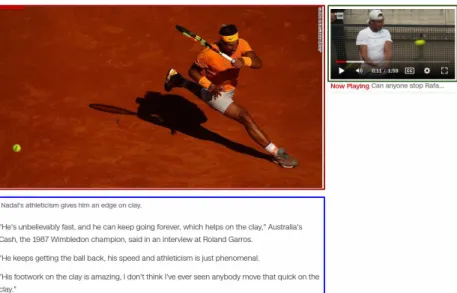
Consider an example page from the news websitea in the Figure1which
contain unstructured content in varied forms. A human reader under-stands that this page is about Tennis player Rafael Nadalb containing a textual description (Blue), image (Red Berry), and a video (Dark Green). However, for a machine, it is hard to comprehend such unstructured con-tent in varied forms without sophisticated processing.
ahttps://edition.cnn.com/
bhttps://en.wikipedia.org/wiki/Rafael_Nadal
When we deep dive and infer about varied forms of the unstructured content observed in the page, we understand that they represent various modalities. To apprehend what are modalities, we present their clip art representation in the Figure2. From the left, clip art in the first position represents a video modality
and the second position denote audio. Similarly, modality in the third position 1
https://thenextweb.com/insights/2017/01/24/digital-trends-2017-report-internet/
1.1 m o t i vat i o n 3
Figure1: News article containing textual description (Blue), Image (Red Berry), and a Video (Dark Green).
represents an image, and the fourth position denotes text. The last position de-notes linked data graph (e.g., DBpedia2
) constituting entities and their relation-ships.
Figure2: Varied forms of the content denoted by different modalities (video, audio, im-age, text in different languages and entity-relationship graph).
As mentioned earlier, modalities are highly unstructured as they do not fit neatly into a relational database. Also, as pointed in many surveys3
that the growth of unstructured content is more significant than the structured data, which is attributable to the ease of creation of unstructured content in contrast to the structured content.
.Example2
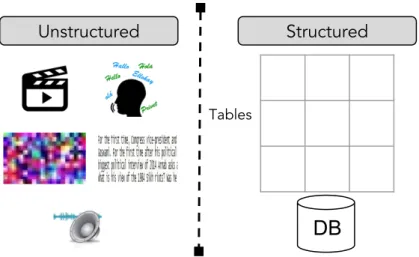
In the Figure 3, we present an example comparing the structured vs.
un-structured content. Most of the un-structured content represents discrete rows and columns with storage denoting relational databases (DB) and tables (e.g., spreadsheets). While, unstructured data usually have an unmanaged file structure having better semantics and require storage which is NoSQLa (e.g., MongoDB).
ahttps://en.wikipedia.org/wiki/NoSQL
Now to address the problem of representing each modality in a machine com-prehensible manner. Automatic learning of representations from each modality
2
http://wiki.dbpedia.org/
3
Unstructured Structured
DB
TablesFigure3: An example distinguishing structured against unstructured data.
is widely adopted with representation learning [25]. Howbeit, modalities do not
occur in isolation, but they usually co-exist and blend between themselves to add multipleviewsin representing a topic or concept, thus making the content ei-therhomogeneousorheterogeneous. A homogeneous instance contains views from the same modality while heterogeneous instance contains views from different modalities.
óDefinition1: View
A single view is a modality represented by either image, text, video or audio. Research conducted earlier [156] have shown that leveraging homogeneous or
heterogeneouscontent can exploit information that is more expressive than that of single view to learn representations having wide applicability. We find such con-tent footprints on the Web at many places like news websites, e-commerce web pages, social media sites (SNS) (e.g., Facebook4
, Twitter5
, Pinterest6
), Wikipedia7 , video streaming platforms (e.g., YouTube8
and Vimeo9
) and audio streaming platforms (e.g., SoundCloud10
, Spotify11
). Example3and Example4shows
sam-ple of heterogeneous and homogeneous content respectively.
.Example3
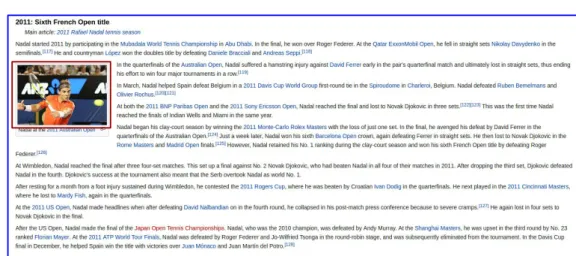
In the Figure4, we present an example ofheterogeneouscontent as observed
in Wikipedia. It provides the picture of Rafael Nadalat French Opena and a write-up about his participation in it.
ahttps://en.wikipedia.org/wiki/French_Open 4 https://www.facebook.com/ 5 https://twitter.com/ 6 https://www.pinterest.com/ 7 https://www.wikipedia.org/ 8 https://www.youtube.com/ 9 https://vimeo.com/ 10 https://soundcloud.com/ 11 https://www.spotify.com
1.1 m o t i vat i o n 5
Figure4: An example showing image and textual modalities about a common topic.
.Example4
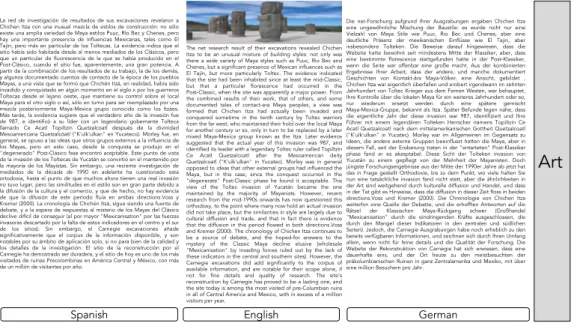
In the Figure5, we present an example ofhomogeneouscontent as observed
in Wikipedia. It provides a write-up in different languages (English and German) aboutRafael Nadal.
Figure5: An example constituting textual modality in different languages (Top: English, Bottom: German).
1.1.2 Heterogeneous and Homogeneous Content Applications 1.1.2.1 Overview
Many applications can be build by leveraging heterogeneous and homogeneous content. However, in this thesis, we target only that content which has theimage
andtextualmodalities. Also, we confine ourselves to following tasks:
À Content Search: It aims at satisfying information need of an end-user. That
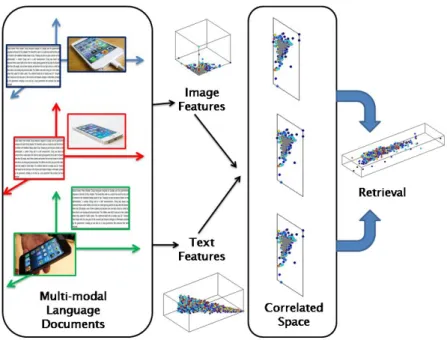
is, a user expresses an information need as an input query and the re-trieval engine attempts to discover data elements, which are assumed to satisfy that need. However, when the content is heterogeneous (e.g., image and text), input query and the retrieved data elements belong to different modalities, thus making the discovery of such relevant elements hard. Re-trieval across modalities can be supported by building representations that share information across modalities and help to improve heterogeneous content-based search significantly.
A similar challenge is also seen when the content is homogeneous, for in-stance, if the input query and the retrieved data elements belong to differ-ent languages, it makes the discovery of relevant elemdiffer-ents hard. Retrieval across languages can be supported by building representations that share information across languages and help to improve homogeneous content-based search significantly.
Á Content Categorization: The goal is to classify content into predefined
labels. For the heterogeneous content, label and the given data element belong to different modalities. However, for the homogeneous content, the data element and label belong to the same modality. A classical case for the heterogeneous content is discovering textual labels for the images while for the homogeneous content is learning label information from one language to port that knowledge to another language.
 Content Generation: The goal is to generate one modality from another
if the content is heterogeneous while generating one appearance from an-other if the content is homogeneous. In general, transformation of one form into another is a hard task to achieve.
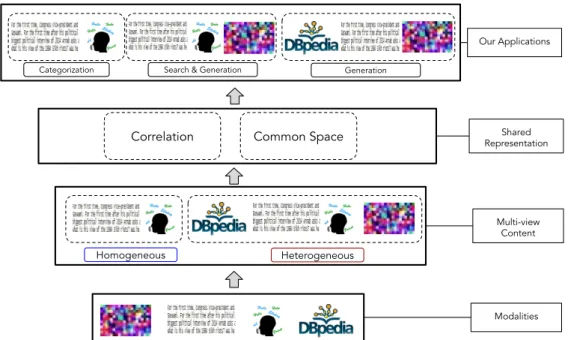
In the Figure6, the overall architecture is illustrated. Intuitively, it can be
ob-served that first, we need to find the combination of modalities that we want to handle. Next, depending on the modalities selected, views of the heterogeneous or homogeneous content is determined. Furthermore, using the multi-view con-tent, we produce machine comprehensible representations with two different techniques, i.e., correlation and common space learning to serve our applica-tions.
1.1.2.2 Challenges
A significant challenge in the Figure6is creating a representation of the
heteroge-neous and homogeheteroge-neous content. A useful representation captures the inherent meaning from each view and builds a shared representation from all existing
1.1 m o t i vat i o n 7
Homogeneous Heterogeneous
Categorization Search & Generation Generation
Our Applications
Multi-view Content
Modalities
Correlation Common Space RepresentationShared
Figure6: Overall Architecture.
views, which is an essential requirement for the applications mentioned above. Thus, the systems built for each of these applications must address the problem ofhow to effectively integrate multiple views in heterogeneous or homogeneous content depicting various languages or modalities into a shared space representation.
Problem1: Unifying Multiple Views of Content (i.e., heterogeneous or
homogeneous) by Identifying their Correlations
Build a shared space by identifying correlation among content.
One way to integrate multiple views is by finding their correlation among con-tent. A way to find the correlation is by calculating the joint dimensionality re-duction of the homogeneous or heterogeneous content representations. In fact, applications are also depended on the reduced dimensionality of representation which incorporates shared knowledge across content sources. Thus, systems that are built based on the correlated representations allow for a trade-off between re-sult accuracy and computation time. Hence, only shallow representation is built from the multiple views with less computational intensiveness.
Problem2: Unifying Multiple Views of Content (i.e., heterogeneous or
homogeneous) by Building their Common Space
Build a shared space by mapping content into a common space.
As presented in Section 1.1.2.1, there are several problems in dealing with
ho-mogeneous or heterogeneous content. However, in this thesis we are solely con-cerned with Problem1 and Problem 2. We also discuss the scope of this thesis
in Section1.3.2.
In the next paragraphs, let us briefly introduce the fields of research concerned with above problems.
1.1.2.3 Problem1: Unifying Multiple Views of Content with Correlation
Unifying multiple views emerging from either homogeneous or heterogeneous content by identifying their correlation, is especially crucial for supporting the application of content search. Here, the goal is to compute top-ranked query results, given the query and results from either different modalities or languages.
Unifying multiple views of the content target this problem by building a shal-low representation of views and then finding the correlation across views such that it supports ranking across views. More specifically, these strategies allow re-trieval engines to compute ranked results, with the textual modality of variable length. It can lead to significant efficiency across languages for the content-based search – as we will show in Chapter4.
1.1.2.4 Problem2: Unifying Multiple Views of Content with Common Space
Identifying correlations across multiple views is sometimes not possible due to the large size of datasets representing homogeneous or heterogeneous content. Here, building a common space representation is efficient concerning scalability and also crucial for supporting content categorization and generation.
We employ both shallow and deep neural networks to target the Problem 2.
They comprise a set of techniques, which allow scaling to larger datasets contain-ing multiple views by providcontain-ing effective optimization [47]. Neural networks are
also found to be effective in representing modalities in the machine comprehensi-ble manner. Recently, different architectures of the neural networks are employed byNLP,CVand semantic web communities for various challenges.
Generally speaking, we consider shallow and deep neural networks regarding two dimensions:
À Content Categorization
First, we consider shallow neural networks as an application to the cate-gorization of homogeneous content where views arise from different lan-guages. This way, joint modeling of languages is implemented to create a common space representation – as we will show in Chapter5.
Á Content Generation
Second, leveraging shallow neural networks for the generation of heteroge-neous content is not adequate. Hence, we employ deep neural networks to generate heterogeneous content. More specifically, we target the problem of generation of textual descriptions for images in multiple languages and also those images with novel visual object categories – as we will show in Chapter6and Chapter7respectively.
1.2 h e t e r o g e n e o u s a n d h o m o g e n e o u s c o n t e n t c h a r a c t e r i s t i c s In the section mentioned above, challenges that need to be addressed in cre-ating the representations from the heterogeneous and homogeneous content is reviewed. The further analysis shows that the content can have additional char-acteristics. Based on our overall aim and the research questions that we want to
1.2 h e t e r o g e n e o u s a n d h o m o g e n e o u s c o n t e n t c h a r a c t e r i s t i c s 9
contribute in this thesis, we split the essential characteristics broadly into four different categories. The Figure7shows the summary of different characteristics
of the heterogeneous and homogeneous content which we encountered in our work. Characteristic-2 Cross-language Content Characteristic-1 Cross-modal Content Characteristic-3 Parallel Content Characteristic-4 Non-parallel Content
Figure7: Characteristics of the heterogeneous and homogeneous content used in this thesis. The top row shows cross-modal and cross-language content which can be either parallel or non-parallel as shown in the bottom row.
1.2.1 Characteristic1: Cross-modal Content
A heterogeneous content containing any combination of modalities presented in the Figure 2 is considered cross-modal. A sample scenario considering
non-aligned image and textual modality is presented in the Figure4. However,
cross-modal content can exist in either parallel or non-parallel setup. There also exist other variations of the cross-modal content, where a view can have more than one example from the second view (e.g., multi-label textual annotation of an image).
Usually, homogeneous content containing is not considered cross-modal as both views emerge from the same modality.
1.2.2 Characteristic2: Cross-language Content
A homogeneous content containing textual modality in different languages is considered cross-language. Similar to the cross-modal content, cross-language content can also exist in either parallel or non-parallel setup.
There is no possibility of cross-modal content being cross-language as views emerge from different modalities. However, cross-language content can still align a modality different than the textual modality to become both cross-language and cross-modal.
1.2.3 Characteristic3: Parallel Content
The notion of content beingparallelemerge from the corpus analysis studied as a part of the corpus linguistics [169]. Cross-language or cross-modal content is
óDefinition2: Parallel Content
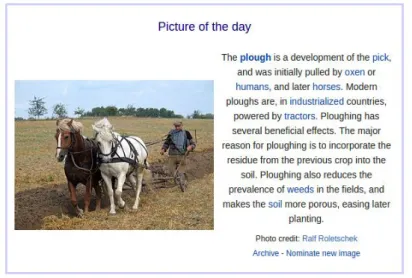
Any cross-modal or cross-language content that is specially formatted for side-by-side comparison or alignment is referred to as parallel content. In the Figure8, we show an example page acquired from Wikipedia picture of
the day12
constituting cross-modal content which is parallel.
Figure8: An example page constituting parallel cross-modal content.
However, datasets which are annotated by human annotators to create a per-fect alignment between either cross-modal or cross-language content is usually a prerequisite for many approaches. A typical example of the annotated cross-modal content that is parallel is image-caption pairs. In the Figure8, we show an
example acquired from the MSCOCO dataset13
constituting image and its five parallel textual descriptions (i.e., captions).
➔ a horse is standing next to a wooden fence.
➔ a horse standing at the edge of a fence.
➔ a brown and white horse standing inside of a fenced area.
➔ a horse stands in its enclosure near the ocean.
➔ a brown and white horse standing behind a wooden fence.
Figure9: Image and its parallel captions.
Similarly, a potential scenario where cross-language content is parallel is the precise translation of sentences existing in two different languages. This kind of data plays a critical role in building automatic translation system between two languages.
12
https://en.wikipedia.org/wiki/Wikipedia:Picture_of_the_day
13
1.3 r e s e a r c h q u e s t i o n s a n d s pa n 11
1.2.4 Characteristic4: Non-parallel Content
Opposite of theparallelcontent is thenon-parallelcontent. Cross-modal or cross-language content is considered non-parallel if it satisfies the following definition.
óDefinition3: Non-parallel Content
Any cross-modal or cross-language content that has no direct alignment or side-by-side comparison between intra- or inter-modalities is referred to as the non-parallel content.
However, in some cases, the content can be comparable, i.e., build from bilin-gual documents which are conceptually aligned. For instance, Wikipedia pages from two different languages describing same concept/topic are considered com-parable as shown in the Figure5. The situation perseveres for cross-modal
con-tent as well, where modalities are not the direct translation of each other, but there exists a weak alignment between them. For example, usually on the social media platforms, images are tagged with either hashtags or text with variable length. Sometimes this may not wholly depict the visual content present in an image. However, labels partially describe the visual content.
Heterogeneous and homogeneous content may have several other characteris-tics, which may motivate additional research questions. However, in this thesis, we concentrate on the above characteristics and present the overall scope of this thesis in the Section1.3.2.
1.3 r e s e a r c h q u e s t i o n s a n d s pa n
In this section, we present the span and research questions that will be addressed in the thesis.
1.3.1 Research Questions
Based on problems mentioned above, our overall research question is:
-Overall Research Question
How to unify subset of text, Entity Relationship graph, and image modality representing languages, relational knowledge, and vision respectively into a shared representation to assist homogeneous or heterogeneous content search, categorization, and generation.
Given the characteristics of heterogeneous and homogeneous content in Sec-tion1.2, the overall question breaks down into several research questions, which
ad-How to unify subset of text, Entity Relationship graph, and image modality representing languages, relational knowledge, and vision respectively into a shared representation to assist homogeneous or heterogeneous content search, categorization, and generation.
Homogeneous and Heterogeneous Content Characteristics Characteristic 1 Cross-modal Content Characteristic 2 Cross-language Content Characteristic 3 Parallel Content Characteristic 4 Non-parallel Content Research Question 4, Ch. 7 Future Work (FW1, FW2, FW3, FW4) Research Question 3, Ch. 6 Research Question 1, Ch. 4
Research Question 2, Ch. 5 Research Question 3, Ch. 6
Research Question 1, Ch. 4 Research Question 2, Ch. 5 Research Question 3, Ch. 6 Research Question 4, Ch. 7
Research Question 3, Ch. 6 Research Question 2, Ch. 5
Figure10: Overview of heterogeneous and homogeneous content characteristics, and research questions, which are addressed in this thesis.
dressed research questions and heterogeneous and homogeneous content char-acteristics are depicted in the Figure10.
-Research Question1
Given two different views of heterogeneous content depicting text and im-age modality, how can we build a shared representation to assistsearch by finding correlation among their input representations?
Research Question1 is driven by correlation principles of the heterogeneous
content and aims at supporting application ofsearchwith cross-modal retrieval. Notably, our task is to process parallel cross-modal content emerging from two views especially images and different languages text to learn their correlations.
We proposed a novel approach namedcorrelated centroid space for this task and extended previous works based on subspace learning to learn correlations across parallel cross-modal content in the Chapter4.
-Research Question2
Given two different views of homogeneous content depicting text from dif-ferent languages, how can we build a shared representation to assist catego-rizationby learning a common space by capturing regularities?
Here, we leverage homogeneous content where views emerge from two differ-ent languages of the textual modality. We addressed this Research Question2by
learning acommon spacerepresentation from both parallel or non-parallel cross-language content. The shared representation built bilingual distributed word representations, i.e., embeddings which learned regularities across languages. It has played a crucial role in supporting cross-language textual classification tasks as shown in the Chapter5.
1.3 r e s e a r c h q u e s t i o n s a n d s pa n 13
-Research Question3
Given two different views of heterogeneous content depicting text and im-age modality, how can we build a shared representation of all views if an auxiliary view depicting text in multiple languages is added to assist the generationof text from an image?
Adding an auxiliary view to the already existing views of the training in-stances of heterogeneous or homogeneous content has two inferences from the content prospect.
À Does the auxiliary view provide a novel modality? Á Does it match the modality of existing views?
We address the Research Question3by adding an auxiliary view matching the
modality of an existing view in the Chapter6. Our approach proposes to learn a
common spaceof all views and further use it to generate text given an image. For this, we leverage deep neural networks in the multi-task learning [37] setting to
jointly optimize three different views for delivering consistency among textual descriptions generated across languages.
-Research Question4
Given two different views of heterogeneous content depicting text and im-age modality, how can we build a shared representation to assist the genera-tionof text from an image if there are missing views?
Research Question4aims to address the learning from those instances which
contain missing views (e.g., missing modalities) and is discussed in the Chap-ter7. Our approach for handling missing views is achieved with external
guid-ance. To be specific, we leverage deep neural networks augmented with rela-tional knowledge. It is evaluated on the task of textual description generation for images containing visual object categories that are unseen during the train-ing phase.
1.3.2 Span of this Thesis
MVRLhas been addressed before in many contexts by various studies [156]. They
have leveraged modalities representing two different views to learn ashared rep-resentation. In particular, the recent dissertations concentrated separately on the language and vision [76] problems or addressed only language-specific
chal-lenges. There are also few works [299] which summarized MVRL from a
theo-retical perspective. In contrast to works as mentioned earlier, we will not focus purely on a theoretical perspective or concentrate separately on specific modali-ties.
Generally speaking, we target the above research questions in Chapter4,
Chap-ter5, Chapter6and Chapter7. Concerning those questions, this thesis provides
1.4 c o n t r i b u t i o n s
About the research questions mentioned above, this thesis provides the following contributions:
+Contribution for Research Question1
Cross-modal retrieval to assist content search by leveraging correlated cen-troid space.
Existing work for cross-modal retrieval was built using linear subspace learn-ing approaches such as Canonical Correlation Analysis (CCA) [110], where the
correlation between different modalities is captured. Also, they have leveraged only monolingual textual content to built representations which hinders the ac-cessibility of retrieving cross-modal content in multiple languages.
In Chapter4, we will show how to extend the kernel version of CCA technique
(i.e., KCCA) to capture correlated centroid space which is based on our previous publication [1] and target the cross-modal content, i.e., image and textual content
in multiple languages.
+Contribution for Research Question2
Cross-language text classification to assist content categorization by leverag-ing Billeverag-ingual Paragraph Vectors.
Based on our work in [2], we present a novel bilingual word embeddings
learn-ing approach in the Chapter 5. For this, we combine shallow neural networks
with the manifold alignment technique. More specifically, we extend existing work of paragraph vectors [144] to build bilingual word representations.
We propose two techniques to handle both parallel and non-parallel content for building bilingual word embeddings. On the one hand, we propose a model that operates on sentence-level parallel content. On the other hand, we propose an extension of the model which works with sentence-level parallel content to work with non-parallel content by leveraging manifold alignment technique.
+Contribution for Research Question3
Consistent multi-language image caption generation to assist content gener-ation given auxiliary views by leveraging multi-task attention.
We present an approach in the Chapter 6 which aims to jointly learn from
images and their caption pairs in multiple languages. This work helps to re-duce divergence across captions generated across languages. To achieve it, we propose deep neural network based attention models that leverage visual fea-tures extracted from images and their captions for optimizing a multi-task objec-tive. Learned models are further used to generate captions for images which are highly consistent across languages.
+Contribution for Research Question4
Unseen visual object categories caption generation to assist content genera-tion given missing views by leveraging knowledge guided assistance.
1.5 o u t l i n e 15
Based on our work in [3], we present the knowledge-guided assistance to
cap-tion generacap-tion for images containing unseen visual object categories in Chap-ter7.
Our approach combines ideas from fields such as semantic web and computer vision. First, knowledge graph entities are augmented with their learned em-beddings and are also used to annotate images as labels. Furthermore, during training of the image caption generation model, entity embeddings are lever-aged to capture attention from an image to calculate the attention weights w.r.t the caption words. Entity labels are also used, however only during the testing phase as a constrained inference. Overall, this approach for caption generation has shown to be compelling enough for scaling to visual object categories that usually lack parallel captions (i.e., missing views) during training.
1.5 o u t l i n e
The remainder of this thesis comprises six chapters, which aim at Research Ques-tions1-4and discuss Contributions1-4.
Ë Chapter2– Foundations
In the Chapter 2, we provide foundations to our approaches presented in
Chapter4, Chapter5, Chapter6and Chapter7. Particularly, we introduce
fundamentals of MVRL and outline its application for combining hetero-geneous or homohetero-geneous content to support several applications such as content search, categorization and generation.
Ì Chapter3– MVRL with Two Views and Correlated Centroid Space
In Chapter 4, we present a novel approach of MVRL to identify
correla-tions across two-views depicting cross-modal content. For this, we extend the traditional subspace learning technique such asKCCAby adding class specific clustering information such that it correlates semantically similar cross-modal content closer to each other in the shared representation. This work has shown to improve search, especially image retrieval given a tex-tual query and vice versa.
Í Chapter4– MVRL with Two views and Co-regularization
We introduce a novel approach to build bilingual embeddings with two views depicting cross-language content in the Chapter5. For this, we
lever-age manifold alignment theory and shallow neural networks to project two different languages that are either parallel or non-parallel into a shared rep-resentation such that linguistic regularities among them are construable. This work has shown to improve categorization, especially cross-language text classification.
Î Chapter5– MVRL with Auxiliary Views and Joint Multi-Task Optimization In Chapter6, we introduce a novel approach for image caption generation
in multiple languages using more than two views depicting both cross-modal and cross-language content. For this, we leverage multi-task learn-ing and deep neural networks to propose a slearn-ingle model which can gener-ate one modality from another. This work has shown to improve content
generation, especially image caption generation in multiple languages by making them consistent across languages.
Ï Chapter6– MVRL with Missing Views and Knowledge Guided Assistance When there are missing views, standard MVRLapproaches fail to predict during inference. In Chapter 7, we deal with the missing information in
the heterogeneous content, particularly the image-caption parallel content. We introduce a novel approach for generating captions for those images containing visual object categories that are unseen in the training phase. For this, we leveraged entity labels and their embeddings as constraints and external semantic attention respectively for building an image caption generation model. This work has shown to improve content generation, especially scalable to larger visual object categories usually observed on the web.
Ð Chapter7– Conclusion
Last, we summarize our contributions and results in Chapter8and give an
F O U N D AT I O N S
2
F O U N D AT I O N S
Context of this Chapter. In this chapter, we discuss the preliminaries for
re-mainder of the thesis. First, we present the challenges and advantages of rep-resenting homogeneous content with representation learning in Section2.1 and
later introduce the unified representation of heterogeneous and homogeneous content withMVRLin Section2.2.
2.1 r e p r e s e n tat i o n l e a r n i n g
The goal of representation learning is to learn useful representations of the con-tent. Efficient representations can identify and extricate the underlying multiple explanatory factors of variation behind the content [25]. Also, representation of
the content supports machine learning applications for building useful predic-tion models. Recently, attaining representapredic-tions is done with neural network-based approaches. However, Bayesian nonparametric methods [189] and other
hierarchical graphical model-based approaches [125] have also shown the ability
to learn rich representations of content. In the following, we review approaches used for learning representations and discuss their intricacies.
2.1.1 Shallow Representation Learning
We understand the shallow representation learning from the perspective of hand-crafted feature extraction. For many machine learning applications such as speech recognition, NLP, and CV, feature extraction plays a key role in building predic-tive models. Over the past decade, researchers have spent ample amount of time in extracting and selecting relevant shallow features with several feature engi-neering techniques. However, there are some problems observed with shallow representations such as:
À They can be task specific and hard to generalize to other tasks.
Á Cannot capture complex and highly structured dependencies observed in the content.
 Require some prior knowledge about the content which can be helpful for discarding irrelevant features (e.g., feature selection).
à They can be very inefficient regarding the number of computational units (e.g., bases, hidden units) [23], and also concerning examples required [24].
2.1 r e p r e s e n tat i o n l e a r n i n g 19
Depending on the application domain and data, handcrafted feature extraction methods vary. For example, scale-invariant feature transform (SIFT) [161] use
histograms of gradient orientations for extraction of visual data (e.g., images) features. Similarly, shallow features such as term frequency-inverse document frequency (TF-IDF) [224] is used to rank relevant textual documents for a given
query to support information retrieval. Natural Language Understanding (NLU) tasks supporting several applications [165] and divided based on syntax,
seman-tics, discourse, and speech are also dependent on feature extraction methods. For example, tasks which fall under the umbrella of “semantics” such as lexical semantics [51], natural language generation [208] and natural language
under-standing [5] are dependent on the shallow handcrafted feature extraction
meth-ods for many years to leverage machine learning methmeth-ods.
However, for learning useful representations, shallow representation learning usually combines feature extraction with dimensionality reduction techniques for selecting best features. Global or local methods [303] are techniques of
di-mensionality reduction, where global methods preserve global information of the content and local methods preserve the fundamental structure of high di-mensional data in learned representations. In the following, we briefly describe existing dimensionality reduction techniques which are diversified based on lo-cal or global methods.
2.1.1.1 Global Methods of Dimensionality Reduction
Many global methods are proposed for selection of features and reducing the dimensionality of extracted features. Principal component analysis (PCA) [277]
is one such method which makes linear dimensionality reduction by perform-ing an orthogonal transformation to convert a set of observations of possibly correlated variables into a set of linearly uncorrelated variables. Similarly, other approaches such as Independent Component Analysis (ICA) [117], Linear
Dis-criminant Analysis (LiDA) [213] also extract linear representations using both
unsupervised and supervised techniques. However, linear features are insuffi-cient for many real-world complex data scenarios, consequently demanding for more sophisticated techniques to get useful representations.
To assist such scenarios, linear methods were extended with non-linear niques to include non-linearity in the extracted features. However, these tech-niques still provide shallow representations. Techtech-niques such as kernel PCA (KPCA) [172] and Generalized Discriminant Analysis (GDA) [18] extends PCA
and LiDA respectively for nonlinear dimensionality reduction using the ker-nel trick [182]. While methods such as Gaussian Process Latent Variable Model
(GPLVM) [143] and Gaussian Process Latent Random Field (GPLRF) [302] are
designed in a manner to produce low dimensional representations by learning a nonlinear mapping.
Although representations generated by global methods are useful for many tasks, need for local methods which preserve the fundamental structure of high dimensional data are also required.
2.1.1.2 Local Methods of Dimensionality Reduction
Local methods that make dimensionality reduction preserve the structure by using local information. Manifold learning [116] methods are significant
contrib-utors to the structure-preserving dimensionality reduction techniques by lever-aging local information. However, there also exist other techniques such as Local-ity Preserving Projections (LLP) [99], Marginal Fischer Analysis [287] and
Non-negative Matrix Factorization (NMF) [149] which perform linear dimensionality
reduction by leveraging local information.
Sometimes, the content exists on the lower dimensional manifold, methods such as ISOMAP [251], local linear embedding (LLE) [218], Laplacian
Eigen-map [20] and local tangent space alignment (LTSA) [298] assist in performing
nonlinear dimensionality reduction by exploiting the local geometry around each data point. Local methods were proven to be useful for several applica-tions such as hyperspectral image processing [284], face recognition [100],
doc-ument processing [35] etc. Howbeit, they are still dependent on features which
are handcrafted. Hence, this created a necessity for a combined automatic fea-ture extraction and non-linear dimensionality reduction methods for effective representation of complex data.
2.1.2 Deep Representation Learning
The goal of deep representation learning is to automatically extract representa-tions of the content by making the learning algorithms less dependent on manual feature engineering. However, these representations are not extracted in a shal-low manner, but by stacking multiple nonlinear transformation layers above one another with a final goal of yielding more useful and abstract representations. These representations have achieved state of the art results in several domains such as speech recognition, computer vision, natural language processing and semantic web.
One significant advantage observed when dealing with representations is that they can express many general-purpose priors [25] such as smoothness, sparsity,
coherence, and manifolds. However, representation learning is usually achieved with deep architectures which are often difficult to train effectively [70].
Never-theless, deep architectures enable learning the hierarchy of features which are found to be exponentially more efficient as shown in several theoretical and empirical studies [227]. Also, deep representation learning provides abstract
fea-tures at higher layers of representations which make them invariant to most local changes of the input. It also makes these representations behave as highly non-linear functions of the raw input [25]. A learned representation is expected to
be good if it can distinguish between the related but distinct goals of learning invariant features and extricate explanatory factors for preserving relevant infor-mation needed for a specific task. However, it is often difficult to determine a priori which set of features are useful.
Many methods are proposed to learn deep representations. We broadly divide these methods into “Layerwise pretraining” and “Joint training” based on how new transformations are generated for features at each level of deep architectures.
2.1 r e p r e s e n tat i o n l e a r n i n g 21
The fundamental difference between “Layerwise pretraining” and “Joint training” is that the former learn a hierarchy of features one level at a time, while later train all levels jointly.
2.1.2.1 Layerwise Pretraining
The layerwise pretraining is a greedy approach to learn the hierarchy of features one level at a time of a deep architecture and can be applied in the unsupervised or supervised learning setting.
Unsupervised Setting: In this scenario, layerwise pretraining learns deep
fea-tures which can be used as an initialization to the standard prediction algorithms (e.g., support vector machines (SVM) [101]), to supervised layers of a neural
net-work or a generative model (e.g., deep Boltzmann machine (DBM) [223]).
How-ever, stacking of pretrained layers can be approached in several ways. In the following, we discuss some existing methods.
Deep Belief Network (DBN) [107] are built with pretrained Restricted Boltzmann
Machine (RBM) [104]. However, a standard belief network (BN) is a directed
acyclic graph composed of stochastic variables [192] which has a state of zero
orone. Similarly, RBM consists of stochastic variables and one hidden layer with no connection between hidden units. The major difference between the standard BN and RBM is that the former have directed edges between units, while RBM consists of undirected edges. However, to build DBN, several RBM in a pretrain-ing phase are stacked above one another with a directed connections between the layers and a feed-forward network (e.g., multi -layer perceptron (MLP)) is then used for fine-tuning.
Deep Boltzmann Machine (DBM)introduced by Salakhutdinov et al. [223] is a deep
multi-layer Boltzmann machine (BM) where each layer captures higher-order correlations between the activities of hidden features in the layer below. It has undirected connections in contrast with DBN directed connections for the better flow of information [128]. Connections are present only between hidden units
in adjacent layers, as well as between visible and the hidden units in the first hidden layer.
DBM has three major advantages.
À Similar to DBNs, the DBMs can learn internal representations by capturing complex structure in the higher layers. Usually, these high-level represen-tations are built with a large amount of unlabeled data and very limited labeled dataset for fine-tuning the model for a specific discriminative task. Á States of variables in DBM can be initialized efficiently by bottom-up pass
if DBMs are learned correctly.
 As opposed to DBNs and other deep feature learning approaches, DBMs approximate inference procedure can incorporate top-down feedback after first bottom-up pass. It allows DBMs to better use higher-level knowledge to resolve uncertainty about intermediate feature representations.
Stacked Denoising Autoencoders (stacked-DAE)[260] are initialized as a deep
net-work using denoising Autoencoders [259] in the same manner as RBMs stacked
into DBNs. A denoising autoencoder (DAE) is a variant of autoencoders [23,199]
that are trained to reconstruct a “repaired” input from the corrupted version of it. It is achieved with an architecture that first corrupts the initial input into a different representation using stochastic mapping. Furthermore, the corrupted input is then mapped as in basic autoencoder into a hidden representation from which the reconstruction of it is again obtained. Although the input is corrupted, DAE still minimizes the same reconstruction loss between a uncorrupted input and its reconstruction.
In stacked-DAE, it has to be noted that the corruption of input is only per-formed for the initial denoising-training of each layer. Once the hidden represen-tation is obtained, it will henceforth be used without corruption and is applied to produce the representation that will serve as clean input for training the next layer. Once the stacked encoder is built, its highest level output representation (i.e., pretrained) can be used as input to a standard supervised learning method (e.g., SVM) or can be leveraged for fine-tuning with a logistic regression layer added on top of it.
In general, the significant difference observed between Autoencoders and RBMs is that the Autoencoders consider the real-valued mean as their hidden represen-tation whereas the stochastic RBMs sample a hidden binary represenrepresen-tation from that mean. However, after their initial pretraining, the way layers of RBMs are typically used in practice may vary.
Supervised Setting:Observed in the previous sections show that training each
layer of deep architectures is performed in an unsupervised manner. However, a surrogate method for building deep representations is to train in a supervised manner with the greedy and layer-wise approach. In the following, we discuss some of the existing methods.
Deep Network[23] is a multi-layer neural network, where each new hidden layer
is trained as the hidden layer of a one-hidden-layer supervised neural network. Further, the output of the last of previously trained layers is considered as in-put by throwing away the outin-put layer of the supervised neural network. The parameters of the hidden layer of a neural network are used as the pretraining initialization of the new top layer of the deep network.
However, in different settings, it is observed that the purely supervised greedy layer-wise pretraining performs significantly worse than the unsupervised greedy layer-wise pretraining. A possible explanation is that the greedy supervised pro-cedure is too greedy: in the learned hidden units representation, it may discard some of the information about the target, information that cannot be captured easily by a one-hidden-layer neural network but could be captured by compos-ing more hidden layers.
Deep-Structured CRF [293] leverage probabilistic methods [215] to build
super-vised pretraining by using outputs of the previous layer which can be fed an extra input for the next layer along with the raw input. Deep-structured CRF
2.1 r e p r e s e n tat i o n l e a r n i n g 23
architecture is a hierarchy of linear-chain conditional random fields (CRFs) [139]
that do not use state transition features. The observation sequence at any layer is augmented with both previous layer’s observation sequence and marginal poste-rior probabilities. However, for many applications, the observation sequence of previous layer’s and the present layer is usually enough.
Training of deep-structured CRF is achieved by fixing the trained lower-layer CRF parameters and then computing corresponding marginal posterior proba-bilities so that they can be further fed to the next layer. This process is contin-ued until the model parameters of the highest or final layer of the model are optimized. The inference process is similar, howbeit with slight modifications. Deep-structured CRF make both train and inference on each layer independent which make the computational complexity linear w.r.t the layers used.
Context-Dependent Deep-Neural-Network Hidden Markov Model (CD-DNN-HMM)[52]
pretrains in a supervised way all the previously added layers at each step of the iteration. CD-DNN-HMM hybrid architecture contains a context-dependent Hid-den Markov Model (HMM) [202] combined with deep neural network (DNN). A
generative model such as HMM has the observable features are assumed to be generated from a hidden Markov process that transitions between states. While, DNN is a conventional multi-layer perceptron (MLP) [216].
CD-DNN-HMM adopts a discriminative pretraining approach in contrast with DBNs to reduce inaccuracies in the pretraining. They achieve it with a layer-wise backpropagation. Initially, a one-hidden-layer DNN is trained to full con-vergence using labels discriminatively with backpropagation. Then the softmax layer is replaced by another randomly initialized hidden layer, and again a new softmax layer is stacked on to the top so that it is again discriminatively trained to full convergence. This process is repeated until the required number of hidden layers is reached. However, this approach is similar to Deep Network [23], but
differs with it by adding updates only from newly added hidden layers achiev-ing accuracies close to those obtained with DBN pretrainachiev-ing.
Also, CD-DNN-HMM is closer to the standard ANN-HMM [210] architecture
which replaces Gaussian mixtures with DNN and computes HMM’s state emis-sion likelihoods by converting state posteriors from the DNN to likelihoods. 2.1.2.2 Joint Training
In the section mentioned above, we have seen how the layerwise pretraining is leveraged in an unsupervised and supervised setting with different architec-tures to learn deep representations. The success of layerwise pretraining (unsu-pervised or su(unsu-pervised) can be attributed to intermediate representations, which provide a more natural way to learn intermediary versions rather than learn-ing everythlearn-ing at once in a slearn-ingle go. Also, especially unsupervised pretrainlearn-ing additionally contributed to the regularization and optimization effect.
On the contrary, joint training of architectures which learn deep representa-tions face challenges such as ill-conditioning (e.g., symmetry breaking in neural networks [180]) and local minima (e.g., optimization difficulty [25]). Few
stud-ies [84] also highlighted other problems with joint training, mainly in the context
training also provide several advantages in a proper arrangement [45, 167, 85, 138, 246]. In the following, we explore advantages of architectures which learn
deep representations in one go by overcoming challenges as mentioned earlier. Convolutional Neural Network (CNN) [148, 145, 147] are deep architectures which
are specifically designed to deal with the topological structure (e.g. domain knowledge of the input) to learn better features. These multilayer networks can learn complex, high-dimensional, nonlinear mappings from a large collection of examples which make them a suitable candidate for joint training. Several re-cent studies [138,236,248,98,113] have shown that in a supervised setting with
large quantities of labeled data, proper initialization and choice of non-linearity, CNNs can outperform different approaches.
Conceptually, CNN exploits input topological structure and define local re-ceptive fields [115] such that each low-level features are extracted only using a
subset of the input (e.g., image patch) by adding topological locality constraint. It provides a gain of having a smaller number of parameters. Computation of local features is expected to be relevant to all positions of the receptive field. Therefore, a stride of such local low-level feature extractor over the subset of in-put corresponds to the transformation of an inin-put into a similarly shaped feature map [146] leading toconvolutionand sharing of same parameters. Also, local
fea-tures computed in the neighboring input locations are then summarized through an average [145,147] or max [118] poolingoperation supporting invariance to
in-put modifications.
Combination of convolution and poolingis crucial for the modern CNN archi-tectures which have produced state of the art results in various domains (e.g., object classification [138], semantic segmentation [160] in computer vision,
sen-tence classification [131], sentiment analysis [63] in natural language processing,
knowledge base completion [226] in Semantic Web etc.). Few approaches went
beyond convolution and pooling and extended CNNs with several other tricks. For example, usage of residual [98] and dense [113] connections or varied inputs
(e.g., character-level representations of the text [297]).
In general, final layers of CNN are fully connected after going through many convolutional and pooling layers. Usually, neurons present in the fully connected layer have connections to all activations in the previous layer, resembling stan-dard neural networks. Finally, training of CNNs is usually achieved with the forward pass over all layers and then backpropagation [220] to update
parame-ters.
Recurrent Neural Network (RNN) [69] was initially proposed to model time
se-ries or sequences. The network structure of RNN is similar to that of standard multilayer perceptron, but connections are also allowed between hidden units with a time delay. Hence, this network is capable of storing information emerg-ing from the past and enables it to discover temporal correspondences between events that are distant from each other in the data. Due to this memory efficiency, RNNs have found its application to many tasks which require modeling sequen-tial data such as Language Model (LM) [175], speech recognition [91], Machine
2.2 m u lt i-v i e w r e p r e s e n tat i o n l e a r n i n g 25
Although RNNs were found to be very effective in dealing with sequences, howbeit it has been found that they are difficult to train for long-term depen-dencies due to issues such as exploding and vanishing gradient [21]. Variants
of RNN such as Long Short-term Memory (LSTM) [108] and Gated Recurrent
Unit (GRU) [44] have mitigated the problems persisting in RNN. LSTM and GRU
can handle long sequences with efficient memory management. 2.2 m u lt i-v i e w r e p r e s e n tat i o n l e a r n i n g
Increase in the availability of data containing multiple views such as a combi-nation of image+text, audio+video, and text translations have lead to heteroge-neous and homogeheteroge-neous representations. Different views usually contain infor-mation which is complementary, consensus or combination of both. Exploiting multiple views for learning representations is more expressive than separately learning from either of views [186]. Therefore, representation learning with
mul-tiple views is very encouraging with broad applicability to many applications in varied domains.
Multi-view representation learning is built on following multi-view data prin-ciples [156]:
• Correlation– Aims to maximize the correlations among variables between multiple heterogeneous views.
• Consensus– Aims to maximize the agreement on the representations learned from multiple heterogeneous views.
• Complementarity– Aims to exploit the complementary knowledge contained in multiple views to effectively represent the data.
• Consensusand Complementarity – In general, combining both of aforemen-tioned principles simultaneously is required for better representations. In comparison to the representation learning (with single-view), multi-view representation learning acquires different representation (e.g., embedding) for each view and then jointly optimize all representations from multiple views to enhance succeeding learning tasks, such as retrieval, classification, and genera-tion. Howbeit, there is also a possibility of degradation of performance [164], if
learning objective cannot correctly capture the properties of the multi-view data. Therefore, careful selection of techniques is required based on characteristics of the multi-view data satisfying aforementioned underlying principles.
Many techniques are proposed to handle multi-view data which leverage fun-damentals of Probabilistic Graphical Model (PGM) [136], kernel machines [228]
and non-linear neural networks [92]. The fundamental difference between these
techniques is whether the architecture of learning models is to be interpreted as a PGM or as a computation graph [25]. This difference has shown an impact when
building shallow and deep architectures, where an exact inference of probabilis-tic models usually becomes intractable, while computation graphs have shown significant impact for learning from large-scale data.
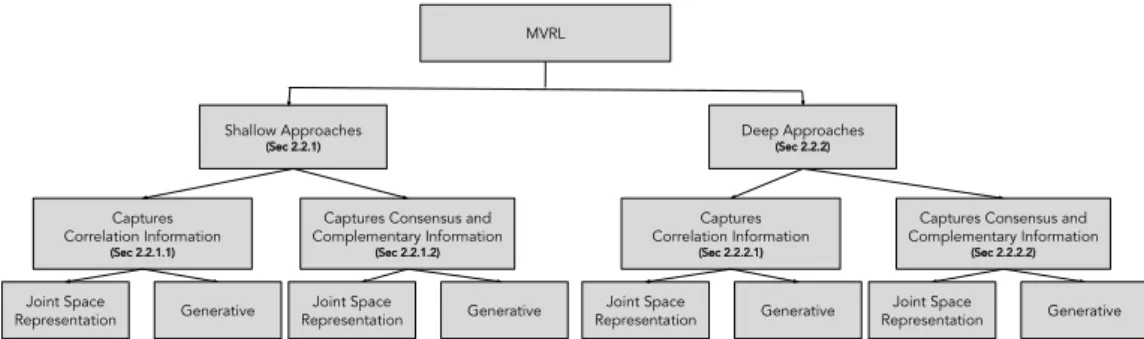
In the following, we explore multi-view representation learning from the per-spective of both paradigms as mentioned earlier and also multi-view data princi-ples which they leverage to build learning models. Figure11provides the overall
view of the sections.
MVRL Shallow Approaches (Sec 2.2.1) Joint Space Representation Deep Approaches (Sec 2.2.2) Captures Correlation Information (Sec 2.2.1.1)
Captures Consensus and Complementary Information
(Sec 2.2.1.2)
Captures Consensus and Complementary Information
(Sec 2.2.2.2)
Captures Correlation Information
(Sec 2.2.2.1)
Generative RepresentationJoint Space Generative RepresentationJoint Space Generative RepresentationJoint Space Generative
Figure11: Organization of the Sections. The left part shows the architecture of multi-view representation learning based on shallow approaches which is further divided based on correlation as well as consensus and complementarity prin-ciples. While on the right part displays the deep approaches.
2.2.1 Multi-View Shallow Representation Learning
Shallow approaches for multi-view representation learning do not leverage any ideas from deep representation learning presented in the Section2.1.2. However,
they are confined to the multi-view data principles and also partially affiliate themselves to the paradigms as mentioned earlier. In the following, we divide the techniques based on the multi-view data principles.
2.2.1.1 Correlation
As presented earlier, the goal of correlation principle is to maximize the correla-tions of variables among multiple heterogeneous views. In the following, those methods are presented which learn shallow representations by finding correla-tions across views. These approaches are further divided into two categories where the first set of methods learn direct joint representations, while the rest learns a generative model.
Joint Space Representation: Goal of joint space representation approaches is
to build a stable deterministic shallow representation from the multiple views of data. In the following, we explore some techniques that are based on the correla-tion principles and achieve joint space representacorrela-tion.
Canonical Correlation Analysis (CCA) proposed by Hotelling [110] work with two
views for finding the linear transformations of each single view such that the cor-relations between the transformed variables are mutually maximized. Consider-ing a two view data{X,Y}={(x1,y1), ....,(xn,yn)}whereX∈Rd1×n,Y ∈Rd2×n,
individ-2.2 m u lt i-v i e w r e p r e s e n tat i o n l e a r n i n g 27
ual instances inX,Y maximally correlated in the projected space and evaluated using the following correlation coefficientρ.
ρ= W T xCxyWy q (WTxCxxWx)(WTyCyyWy) (1) whereCxyis a cross-covariance matrix given by Equation2.
Cxy= 1 n n X i=1 (xi−µx)(yi−µy) (2)
Here,µx,µy represent mean of the two views X,Y andCxx,Cyy are covariance matrices.
Maximizing linear projections Wx,Wy of CCA is equivalent to solving a
pair of generalized eigenvalue problems [95] and optimization is posed as a
Lagrangian dual [245]. Finally, correlation between different views is provided
by the eigenvector corresponding to the largest eigenvalues. Besides successful application of CCA to multi-view data, it still fails to deal with non-linearity and sometimes overfit.
Kernel Canonical Correlation Analysis (KCCA)[3] provides a non-linear extension
of CCA and handle two views. Formalizing kernel CCA in line with CCA, dual representation is leveraged for representingWx,WyusingXα,Yβwhereαand
βare vectors of sizen. Correlation coefficientρis now provided by Equation3.
ρ= α
TXTXYTYβ q
αTXTXXTXα×βTYTYYTYβ
(3) If kernel matrices Kx,Ky of X,Y are provided by (XTX,YTY) respectively. Then
the Equation3is rewritten as follows:
ρ= α TK xKyβ q αTK2 xα×βTK2yβ (4) For maximizing linear projections, in contrast to the linear CCA which works by carrying out an Eigen decomposition of the covariance matrix. The eigen-value problem for kernel CCA degenerate solutions when either Kx or Ky is invertible [95].
Regularized Canonical Correlation Analysis (regularized CCA) [54] adds
regulariza-tion to CCA. It can be seen as a way to deal with overfitting and assist to general-ize better for the unseen samples. Now if CCA is observed from the perspective of an estimator of a linear system consuming data from two different views X
andY. Then regularized CCA aims to compute two normalized linear projections
Wx,Wy which makes the individual instances in X,Y maximally correlated in
the projected space and evaluated using the correlation coefficient ρ given by Equation5and optimized with the maximum likelihood estimator.
ρ= W T xCxyWy q (WTxCxxWx+τx||Wx||2)(WTyCyyWy+τy||Wy||2) (5)