E-learning in the Introductory Physics Lab
Clemens NagelBasic Experimental Physics Teaching, Faculty of Physics, University of Vienna Vienna, Austria
[email protected] Brigitte Wolny
Physics Education and eLearning, Faculty of Physics, University of Vienna Vienna, Austria
Abstract: E-learning in Physics Lab-Courses is part of the Faculty of Physics' project called eLearnPhysik at the University of Vienna. On the one hand, a new learning environment including content-based e-learning sequences in a blended-learning setup was developed and systematically implemented into 4 introductory lab courses. All preparation and instruction material for more than 40 course-days (90 experiments) was restructured and adapted for the use of web based digital media. This is a chance for the students to improve their understanding of technical terms and physical contexts even if they are lacking previous knowledge. Our learner centered learning environment is also a chance for a constructivist way to help students with different pre-concepts of physical contexts and different educational backgrounds. For criteria-based evaluation, a case study using qualitative social research methods was accomplished and another quantitative test setup will be finished in June 2008.
Furthermore, a second activity was started in December 2007 as a cooperation project aiming to reorganize the "phyiscs lab for nutritionists", using the "method of the didactical reconstruction of lab courses". To align the nutritionists' lab to their educational needs in physics, several investigations have been performed, which are the basis for the development of an adequate didactical concept including an e-learning strategy.
1.
The Project and its Initial Situation
The Introductory Physics Lab is an educational laboratory at the Faculty of Physics of the University of Vienna, and the lab courses held there are administrated and organized by the members of the research and working group “Basic Experimental Physics Teaching”. It is the place, where students of physics, physics science teaching and nutrition science gain their first intense experiences with hands-on experiments. The experiments are set up stationary and, during the semester, the laboratory rooms are used the all-day from Monday to Friday for the courses.
Five different laboratory courses are held in the Introductory Physics Lab. All of them are obligatory parts of the respective curriculum:
• Pre-lab for student teachers (3h/week/semester respectively 6 ECTS-credits)
• Lab for student teachers (6h/week/semester respectively 9 ECTS-credits)
• Physics lab 1 for bachelor students (6h/week/semester respectively 9 ECTS-credits)
• Physics lab 2 (6h/week/semester respectively 9 ECTS-credits)
• Physics lab for nutrition scientists (2h/week/semester respectively 2 ECTS-credits)
It is evident, that students’ previous knowledge differs due to the substantially different school careers and various other causes. The reported experiences of the course instructors showed that the former setup could not compensate for possible lacks in students’ previous knowledge. Students also had problems with grasping technical terms, physical principles and contexts. Furthermore, there were not enough possibilities in the courses to get in contact with modern ways of using soft- and hardware in science. Student teachers should acquire skills especially in e-learning-methods as early as possible. Computer-based equipment for data acquisition and processing of
measurements was not sufficiently used in the lab experiments. The preparatory work for an individual was restricted to paper copies of instruction texts which were frequently regarded as too complex.
At the beginning of the e-learning project in February 2006, there were already established some applications for new media in the Introductory Physics Lab:
The Lab’s Homepage was a helpful tool for orientation including a course-schedule, information about the experiments’ locations and organisation. Some computer workstations were already well equipped with adequate soft- and hardware for data acquisition, data processing including statistical tools and text processing. Internet access was provided for using your own notebook in the Laboratory. Computer-based experiments were successfully implemented into the science teacher students’ courses. Data acquisition systems and software were selected according to further usability in school teaching. The concept and the learning-objectives were evaluated over a period of 1 year using various methods of qualitative empirical social research (see Nagel 2005).
Furthermore, the lab courses for physics students include computer-based applications like one simulation-experiment and one Lab-View / Lab-Windows-based data collection.
1.1. Objectives
Considering the problems mentioned above, objectives for the project were defined.
The technical objectives were: Implementation of more computer-based experiments into the courses, provide better equipped and more work stations, a new computer lab for students, a new development lab to enhance experiments and the learning environment, provide more hardware for computer-based experiments, provide WLAN connectivity in all lab rooms.
The didactical objectives were more complex. A new learning environment had to be created. Students have to be well prepared for every course-day, using the provided materials. The preparation, usually lasting one week, should be done by e-learning in a self-organized way of learning. The new learning environment should help students to a better understanding of physical concepts. It should also help students to overcome the gap of possible lacks of previous knowledge and to be better prepared for the lab courses.
1.2. Project Development
The strategy for project development is geared to other published and reflected methods (see Reinmann-Rothmeier 2003). The present project is a kind of mission oriented action research study. All participating developers of content are at the same time researchers / evaluators and tutors / teachers in the lab courses. Moreover, the organisation and the learning objectives of the courses do not allow huge changes in educational design, so that the development activities were limited to narrow confines.
The project duration is 3 years. The first year (concept period) is focussed on educational design and development of materials, followed by the adaptation of the webpage and the development of an evaluation concept for the first implementation tests in one lab course.
The second year (testing period) is used to enhance and expand our concepts from the 1st year. For a widespread implementation, a number of additional materials are produced and adapted. A qualitative case study using various methods of qualitative empirical social research is carried out.
In the third year (implementation-period) a criteria-based evaluation (pre-test / post-test design) is carried out. The new learning environment and new structured courses are adapted.
2.
Educational Design and E-learning Content
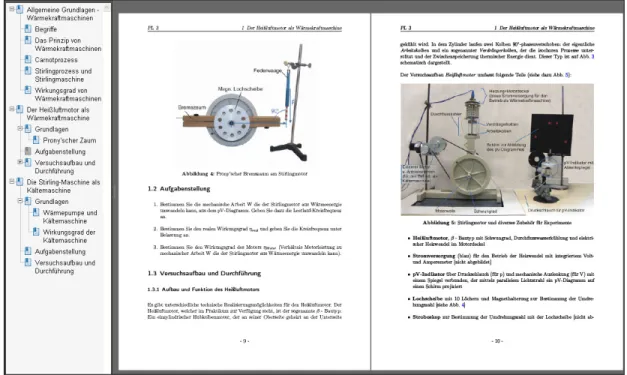
A new learning environment including content-based e-learning sequences in a blended-learning setup was developed (Fig. 1), which fitted to the common organisation of the courses (see Rinn 2004). One of the strengths of the courses always was the high proportion of coaching persons versus students (6 to 8 students for one tutor / assistant / professor). Therefore, we decided not to virtualise any part of the lab course, except the preparation. The homepage (Fig. 1) provides one page for each topic, where the students can view the “instruction”(a pdf-file) online, in which they can navigate similar to a web page due to the use of “hyperref-package” in LaTeX (Fig. 2). These text-files are all structured in the same way. They first give a theoretical overview of the respective experiment, then they contain a precise formulation of the problems to be solved and finally they introduce and
describe the equipment used in the experiment by edited photos. Within the text, students find eye-catching hints to extra information or to web-tools, linked at the homepage below the instruction file. The extra information provides detailed knowledge about such topics, where anecdotic evidence of tutors indicated large differences in previous knowledge of the students. The web tools, presented in modular design (Prenzel et al.) are, for example, links to external homepages (mostly of universities) which provide high quality and reviewed educational material for the experiment, or java-applets like physlets (see Christian 2004) for interactive learning, or videos of experiments, or even tasks / supporting-materials made by our team (Fig.1).
Figure 1: Example of e-learning homepage (left). Educational design of blended-learning setup (right, bottom).
3.
Evaluation and Implementation
3.1. Characterisation of the new e-learning Environment
After the first implementation process of the new e-learning setup into the Pre-Lab for Student Teachers, we closely examined the group of students attending the lab course. Therefore, a triangulation of 3 different methods of social and action research were used: instructors’ action research diaries (Altrichter, Posch 1994), group-interviews during and narrative interviews (Lamnek 1995) at the end of the course – completed by questionnaires to characterise the students’ educational background and previous knowledge as well as the usage and usability of the e-learning materials in the lab course (Meister et. al. 2004).
In this case study we found out, that student teachers tend to have highly diverse previous knowledge. The usage of our e-learning materials often seems to be reduced to the download of the instruction pdf file. Possibly, different types of learners combined with different motivations for studying physics result in different e-learning user types. The e-learning-environment seems not to be a very important factor for reaching the learning objectives of our lab courses. On the one hand, most of the students said that the offer of e-learning material (texts and web-tools) was very helpful and appropriate, but on the other hand only a small percentage used the materials for online-learning.
3.2. Criteria-based Evaluation of the e-learning Environment
Based on the findings of the characterising case study, a criteria-based evaluation started in Nov. 2007 in a pre-test / post-test design for scrutinising the learning success of student teachers. Questions of validated tests of basic physics knowledge and scientific working skills at end-of-high-school level were combined in one test paper containing 26 items. The students were tested in Nov. 2007 and again in June 2008 and during the lab courses they got 7 short questionnaires (about different experiments) to document their learning and using habits. Test papers and questionnaires are encoded anonymously, so it is possible to make causal connections between different ways of using the e-learning material and learning success.
To satisfy our criteria, the lab-courses for teacher students with blended-learning-setup shall effect students to improve cognitive skills in basic physics knowledge, to improve scientific working skills, to overcome the gap of lacks of previous knowledge and to effectively use the offer of e-learning material for self-organised learning and preparation of the lab courses.
4.
Development of a new e-learning Strategy for “Physics Lab for Nutrition Scientists”
Since December 2007 an additional project has been running aimed at improving the physics lab for nutrition scientists. There was a special situation within our group, which demanded a new e-learning strategy. The available context based e-learning environment was not appropriate because the prior knowledge and skills of nutrition science students was not at a high enough level. Contrary to other labs, we have about 120 students to be educated which presents a special challenge for the group. An intensive cooperation with Heinrich Heine University (Düsseldorf), where there is a best-practice-model for approximately 400 medical students helps us to find new solutions (www.univie.ac.at/anfpra/EW/eLearnEW.html)
4.1. Method
The team plans to reorganize the whole physics course using a new method. The concept of the Educational Reconstruction (Kattmann et al., 1997) of physics lab courses at the university (Theyßen, 1999) is a constructivist method of getting a lab going and has already been successfully implemented in physics for medical scientists at Heinrich Heine University. This model is based on three major steps:
Figure 3: The Model of Educational Reconstruction
1) Clarification and analysis of
science content 2) Investigation into students’ perspectives
3) Design of learning environments
There were several questions to be answered according to the educational reconstruction (Neumann, 2004):
“Experts’ Perspective”: Which aims should be achieved with the physics lab for nutrition scientists? Which contents should be covered in the physics lab?
“Students’ Perspectives”: What are the students’ understandings of scientific concepts? Which contents should be covered in the physics lab? Which aims should be achieved with the physics lab for nutrition scientists?
The “Construction of Instruction” is the result of a development process which combines the Experts’ and the Students’ perspectives.
This developmental schedule was the fundamental pattern used to start the project work (Fig. 3). Step one and two needed to be investigated at the same time as they both affect each other.
4.2. Preliminary query
First of all, we determined the actual situation through questionnaires to the supervising physics tutors, the nutrition scientists and the students starting the present course.
Supervising physics tutors were asked to report on the students’ attitudes at the beginning of the experiments, the differences between various experiments, and on the experiments they thought students have great issues with. Tutors were asked to comment on missing experiments and proposals for modifications.
nutrition scientists were asked to tell us about their lectures, their methods of working and especially to report on their equipment and measurement strategies. As we did not get so many responses, our working group developed proposals for experiments which were approved by responsible colleagues in nutrition.
Students’ previous knowledge was investigated through another questionnaire before they started the first experiment. We wanted them to reflect on their opinions towards physical experiments and mathematical data analysis. The mathematical and physical knowledge was tested by assigning one task for each subject.
4.3. First results
Through the first questionnaires we found that:
• the currently used experiments are suboptimal
• the students lack pre-knowledge in physics but especially in mathematics
• the lecture should be better coordinated with the lab
• there should be more of a connection to nutrition
• the student-lab documentation should be improved
• students are motivated to do experiments
• students are aware of the relevance of this physics lab
• students enjoy experiments
• students know about the relevance of analyzing data
• there are plenty of physics topics which may be interesting for nutritionists
4.4. Educational structure and e-learning
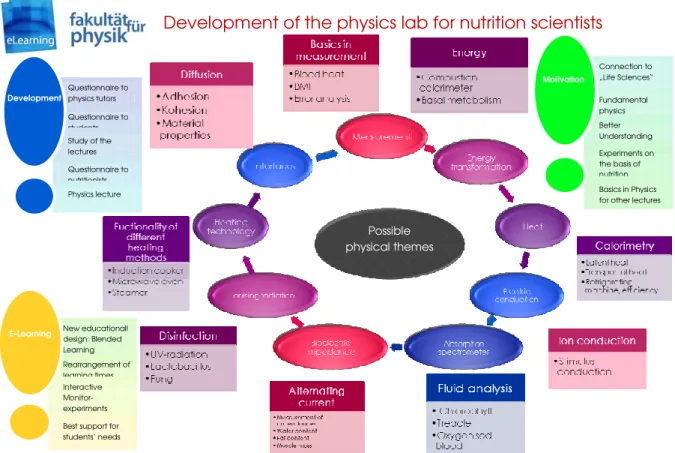
To design an adequate educational concept, the preliminary findings were used by our working group. Together we developed a proposal for future context aligned experiments which are possible within our technical and infrastructural conditions (see Fig. 4).
4.5. Purposes of a new educational structure
The physics lab for nutrition scientists shall engage students and help them to acquire a fundamental knowledge of physics. The relevance to students’ further studies should be apparent, as the context to “Life Sciences” is recognisable in the new experiments.
For example, the experiment “Fundamentals of Measurement” should be taught on the basis of the BMI (Body Mass Index) instead of an abstract pendulum-task which a nutritionist is unlikely to need in his studies.
A blended learning concept shall be used to give the students the opportunity of self-organised study times and learning places. To accomplish these goals, a hyper medial e-learning environment has been created by Heike Theyßen at Heinrich Heine University. This php and MySQL based environment may be used like a personal learning-book and will be applied for at least two or three experiments.
Figure 4: Development of the physics lab for nutritionists in Vienna
References
Altrichter H., Posch, P. (2007). Lehrerinnen und Lehrer erforschen ihren Unterricht. Bad Heilbrunn, Klinkhardt. Christian, W., Belloni, M. (2004). Physlet Physics. Upper Saddle River, New Jersey, Pearson Education, Inc.
Kattmann, U., Duit, R., Gropengießer, H. (2005). Towards science education research that is relevant for improving practice: The model of educational reconstruction. Developing Standards in Research on Science Education, London.
Lamnek, S. (1995). Qualitative Sozialforschung. Weinheim, Psychologie Verlags Union
Meister, D., Tergan, S., Zentel, P. (2004.) Evaluation von E-Learning. Münster, Waxmann-Verlag.
Nagel, C. (2005). Neue Ziele der Lehramtsausbildung. Diplomarbeit an der Fakultät für Physik, Universität Wien. Neumann K., (2004). Didaktische Rekonstruktion eines physikalischen Praktikums für Physiker. Berlin, Logos-Verlag Prenzel, M., Senkbeil, M., Ehmke, T., Bleschke, M. (2002). Didaktisch optimierter Einsatz neuer Medien im
naturwissenschaftlichen Unterricht. Kiel, IPN-Materialien
Reinmann-Rothmeier, G. (2003). Didaktische Innovationen durch Blended Learning. Bern, Verlag Hans Huber. Rinn, U., Meister, D. (2004). Didaktik und neue Medien. Münster, Waxmann-Verlag.
Theyßen H., (1999). Ein Physikpraktikum für Studierende der Medizin. Berlin, Logos-Verlag Possible
physical themes
Development of the physics lab for nutrition scientists
Questionnaire to physics tutors Questionnaire to students Study of the lectures Questionnaire to nutritionists Physics lecture Development Connection to „Life Sciences“ Fundamental physics Better Understanding Experiments on the basis of nutrition Basics in Physics for other lectures
Motivation New educationall design: Blended Learning Rearrangement of learning times Interactive Monitor-experiments Best support for students‘ needs