TopicThunder at SemEval-2017 Task 4: Sentiment Classification Using a
Convolutional Neural Network with Distant Supervision
Simon M ¨uller
Zurich University of Applied Sciences Switzerland
Tobias Huonder
Zurich University of Applied Sciences Switzerland
Jan Deriu
Zurich University of Applied Sciences Switzerland
Mark Cieliebak
Zurich University of Applied Sciences Switzerland
Abstract
In this paper, we propose a classifier for predicting topic-specific sentiments of En-glish Twitter messages. Our method is based on a 2-layer CNN. With a distant su-pervised phase we leverage a large amount of weakly-labelled training data. Our sys-tem was evaluated on the data provided by the SemEval-2017 competition in the Topic-Based Message Polarity Classifica-tion subtask, where it ranked4thplace. 1 Introduction
The goal of sentiment analysis is to teach the ma-chine the ability to understand emotions and opin-ions expressed in text. There are numerous chal-lenges which make this task very difficult, for in-stance the complexity of natural language which makes use of intricate concepts like irony, sar-casm, and metaphors to name a few. Usually we are not interested in the overall sentiment of a tweet but rather in the sentiment the tweet ex-presses towards a topic of interest. Subtask B in SemEval-2017 (Rosenthal et al.,2017) consists of predicting the sentiment of a tweet towards a given topic as either positive or negative.
Convolutional neural networks (CNN) have shown to be very efficient at tackling the task of senti-ment analysis, as they are able to learn features themselves instead of relying on manually crafted ones (Kalchbrenner et al.,2014;Kim,2014). Our work is based on the system proposed by (
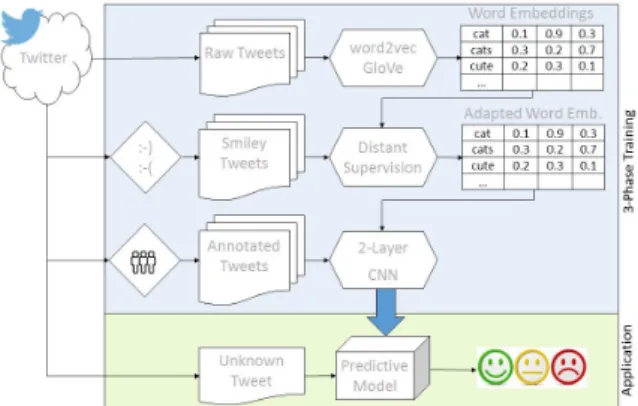
De-riu et al., 2016), which in turn is based on ( Sev-eryn and Moschitti,2015). CNNs typically have a large number of parameters which need sufficient data to be trained efficiently. In this work, we leverage a large amount of data to train a multi-layer CNN. The training is based on the follow-ing 3-phase procedure (see Figure1): (i) creation of word embeddings based on an unsupervised corpus of 200M English tweets, (ii) a distant su-pervised phase using an additional 100M tweets, where the labels are inferred by weak sentiment indicators (e.g. smileys), and (iii) a supervised phase, where the pre-trained network is trained on the provided data.
We evaluated the approach on the datasets of SemEval-2017 for the subtask B, where it ranked 4thout of 23 submissions.
Figure 1:Overview of the 3-Phase training proce-dure.
2 Model
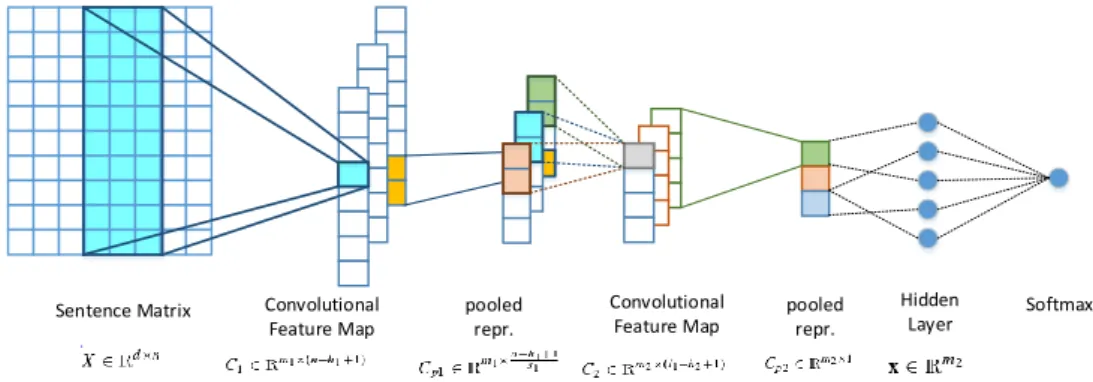
Our system is based on the 2-layer CNN proposed by (Deriu et al.,2016), as depicted in Figure2and described in details below. We refer to a layer as one convolutional and one pooling layer, thus, a 2-layer network consists of two consecutive pairs of convolutional-pooling layers.
Word embeddings. The word embeddings are initialized using word2vec (Mikolov et al.,2013) and then trained on an unlabelled corpus of 200M tweets. We apply a skipgram model of window size 5 and filter words that occur less than 15 times. The dimensionality of the vector represen-tation is set tod= 52. The resulting vocabulary is stored as a mappingV :t→iwhich maps a token to an index, where unknown tokens are mapped to a default index. The word embeddings are stored in a matrix E ∈ Rv×d wherev is the size of the vocabulary and the i-th row represents the embed-ding for the token with indexV(t) =i.
Preprocessing The preprocessing is done by: (i) lower-case the tweet, (ii) replace URLs and user-names with a special token, and (iii) tokenize the tweet using theNLTK-TwitterTokenizer1.
Input Layer. Each tweet is converted to a set of indices by applying the aforementioned prepro-cessing. The tokens are mapped to their respective indices in the vocabularyV.
Sentence model. Each word is associated to a vector representation, which consists in a d -dimensional vector. A tweet is represented by the concatenation of the representations of itsn con-stituent words. This yields a matrixX ∈ Rd×n, which is used as input to the convolutional neural network.
Convolutional layer. In this layer, a set ofm fil-ters is applied to a sliding window of lengthhover each sentence. LetX[i:i+h]denote the concatena-tion of word vectors xi to xi+h. A featureci is generated for a given filterFby:
ci:=
X
k,j
(X[i:i+h])k,j·Fk,j (1) A concatenation of all vectors in a sentence pro-duces a feature vectorc ∈ Rn−h+1. The vectors care then aggregated over allmfilters into a fea-ture map matrixC∈Rm×(n−h+1). The filters are
1http://www.nltk.org/api/nltk.tokenize.html
learned during the training phase of the neural net-work.
Max pooling. The output of the convolutional layer is passed through a non-linear activation function before entering a pooling layer. The lat-ter aggregates vector elements by taking the max-imum over a fixed set of non-overlapping inter-vals. The resulting pooled feature map matrix has the form: Cpooled ∈ Rm×
n−h+1
s , wheresis the
length of each interval. In the case of overlap-ping intervals with a stride value st, the pooled feature map matrix has the form Cpooled ∈
Rm×
n−h+1−s
st . Depending on whether the borders
are included or not, the result of the fraction is rounded up or down respectively.
Hidden layer. A fully connected hidden layer computes the transformationα(W∗x+b), where W ∈ Rm×m is the weight matrix, b ∈
Rm the bias, and α the rectified linear (relu) activation function (Nair and Hinton,2010). The output vec-tor of this layer,x∈ Rm, corresponds to the sen-tence embeddings for each tweet.
Softmax. Finally, the outputs of the final pool-ing layer x ∈ Rm are fully connected to a soft-max regression layer, which returns the classyˆ∈
[1, K]with largest probability. i.e., ˆ y := arg max j P(y=j|x,w,a) = arg max j ex|wj+aj PK k=1ex |w k+aj , (2)
wherewjdenotes the weights vector of classjand
ajthe bias of classj.
Network parameters. Training the neural net-work consists in learning the set of parameters Θ = {E,F1,b1,F2,b2,W,a}, where E is the sentence matrix, with each row containing thed -dimensional embedding vector for a specific word; Fi,bi(i={1,2})the filter weights and biases of the first and second convolutional layers; W the concatenation of the weightswj for every output class in the soft-max layer; and athe bias of the soft-max layer.
Training. We pre-train the word embeddings on an unsupervised corpus of 200M tweets. During the distant-supervised phase, we use emoticons to infer the polarity of a set of additional 100M tweets (Read,2005;Go et al., 2009). The result-ing dataset contains positive 79M tweets and 21M
Sentence Matrix Convolutional Feature Map pooled repr. Convolutional Feature Map pooled repr. Hidden Layer Softmax
Figure 2: The architecture of the CNNs used in our approach.
negative tweets. The neural network is trained on these 100M tweets for one epoch. Then, the neural network is trained in a supervised phase on the labelled data provided by SemEval-2017. To avoid over-fitting we employed early-stopping, where we stop the training if the score on the val-idation set did not increase for 50 epochs. The word-embeddingsE ∈ Rd×n are updated during both the distant and the supervised training phases, as back-propagation is applied through the entire network.
The network parameters are learned using
AdaDelta(Zeiler,2012), which adapts the learn-ing rate for each dimension uslearn-ing only first or-der information. We used the hyper-parameters
= 1e−6 andρ = 0.95as suggested by (Zeiler, 2012).
Computing Resources. The implementation of the system is written in Python. We used the Keras framework (Chollet, 2015) using the
Theano(Theano Development Team,2016) back-end. Theano allows to accelerate the computa-tions using a GPU. We used anNVIDIA TITAN X
GPU to conduct our experiments. To generate the word embeddings we used theGensimframework (Reh˚uˇrek and Sojkaˇ ,2010) which implements the word2vec model inPython. It took about 2 days to generate the word embeddings. The distant phase takes approximately 5 hours and the supervised phase up to 10 minutes.
3 Experiments & Results
3.1 Data
We evaluate our system on the datasets provided by SemEval-2017 for subtask B (see Table 3.1). The training-set is composed byTrain 2016,Dev 2016, andDevTest 2016, whereas we useTest 2016
as validation set. The training and the validation
set have 100 topics each. Since our dataset of 200M tweets for the word embeddings consists primarily of tweets from 2013, some of the top-ics are not covered by the vocabulary. Thus, we download an additional 20M tweets where we use the topic-names as search key. This reduced the percentage of unknown words from14%to13%.
Dataset Total Posit. Negat. Topics
Train 2016 5355 2749 762 60
Dev 2016 1269 568 214 20
DevTest 2016 1779 883 276 20 Test:Test 2016 20632 7059 3231 100 Table 1: Overview of datasets and number of tweets (or sentences) provided in SemEval-2016. The data was divided into training, development and testing sets.
3.2 Setup
We use the following hyper parameters for the 2-layer CNN: In both 2-layers we use 200 filters, a filter length of 6, and for the first layer we use a pooling length of 4 with striding 2.
In order to optimize our results, we varied the batch-sizes, we introduced class-weights to lessen the impact of the unbalanced training set, and we experimented with different schemes for shuffling the training set (see below). To determine the class-weight of classiwe used the following for-mula: c∗nn
i, where nis the total number of
sam-ples in the training set,cis the number of classes, namely 2, and ni is the number of samples that belong to classi.
3.3 Results
The following results are computed onTest 2016. We use the macroaveraged recall ρ as scoring mechanism for our experiments, which is more ro-bust regarding class imbalances (Rosenthal et al.,
2017;Esuli and Sebastiani,2015).
The results show that the usage of class weights in-creases the score by approximately2 points from 0.8225to0.8403points.
Figure3shows the score depending on the batch size used. The results show that higher batch sizes tend to give higher scores. This effect however subsides when batch sizes greater than 1200are used.
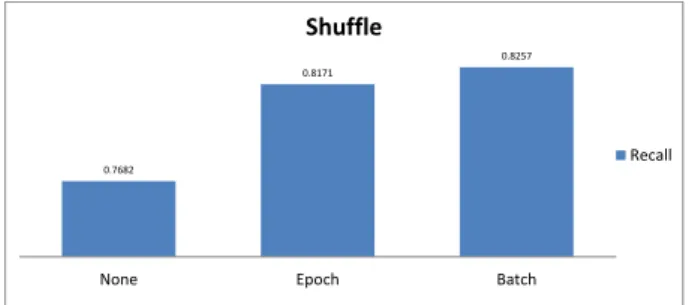
Figure4shows the result when different schemes for shuffling the training set before training are applied. When we do not shuffle the training set, themacroaveraged recall score drops by 4-5 points. We compare two schemes for shuffling: (i) the epoch based shuffling, where the training set is shuffled entirely before each epoch, (ii) batch based shuffling, where the training set is split into batches and each batch is shuffled separately. The results in Figure4show that there is just a small difference of1point among the two strategies.
0.7318
0.8258
1 200 400 600 800 1000 1200 1400 1600 1800 2000 Batch Sizes
Recall
Figure 3: The architecture of the CNNs used in our approach.
0.7682
0.8171
0.8257
None Epoch Batch
Shuffle
Recall
Figure 4: The architecture of the CNNs used in our approach.
Table 2 shows the results on the Test 2017 set, which is the official test set of the competition. The system achieves a macroaveraged recall of 0.846, thus, ranking at 4th place. The BB twtr
system, ranked 1st, outperforms our approach by 4points, whereas theDataStoriessystem and the
Tweestersystem outperform our system by only1
point. System ρ F1P N Acc TopicThunder 0.846 0.847 0.854 BB twtr 0.882 0.890 0.897 DataStories 0.856 0.861 0.869 Tweester 0.854 0.854 0.863 Table 2: Official results onTest 2017. We compare our system to the systems that ranked1st,2nd, and 3rd.
4 Conclusion
We described a deep learning approach to solve the problem of topic-specific sentiment analysis on twitter. The approach is based on a 2-layer Convolutional Neural Network which is trained using a large amount of data. Furthermore, we experimented with different parameters to fine tune our system. The system was evaluated at SemEval-2017 for the task of Topic-Based Mes-sage Polarity Classification, ranking at4thplace.
References
Franois Chollet. 2015. keras. https://github. com/fchollet/keras.
Jan Deriu, Maurice Gonzenbach, Fatih Uzdilli, Au-relien Lucchi, Valeria De Luca, and Martin Jaggi. 2016. Swisscheese at semeval-2016 task 4: Sen-timent classification using an ensemble of convo-lutional neural networks with distant supervision.
Proceedings of SemEvalpages 1124–1128.
Andrea Esuli and Fabrizio Sebastiani. 2015. Optimiz-ing text quantifiers for multivariate loss functions. ACM Transactions on Knowledge Discovery from
Data (TKDD)9(4):27.
Alec Go, Richa Bhayani, and Lei Huang. 2009. Twit-ter sentiment classification using distant supervision.
CS224N Project Report, Stanford1:12.
Nal Kalchbrenner, Edward Grefenstette, and Phil Blun-som. 2014. A Convolutional Neural Network for Modelling Sentences. InACL - Proceedings of the 52nd Annual Meeting of the Association for Com-putational Linguistics. Baltimore, Maryland, USA, pages 655–665.
Yoon Kim. 2014. Convolutional Neural Networks for Sentence Classification. InEMNLP 2014 - Empiri-cal Methods in Natural Language Processing. pages 1746–1751.
Tomas Mikolov, Quoc V Le, and Ilya Sutskever. 2013. Exploiting Similarities among Languages for Ma-chine Translation. arXiv.
Vinod Nair and Geoffrey E Hinton. 2010. Rectified linear units improve restricted boltzmann machines. InProceedings of the 27th International Conference on Machine Learning (ICML-10). pages 807–814. Jonathon Read. 2005. Using emoticons to reduce
de-pendency in machine learning techniques for senti-ment classification. InProceedings of the ACL stu-dent research workshop. Association for Computa-tional Linguistics, pages 43–48.
Radim ˇReh˚uˇrek and Petr Sojka. 2010. Software Frame-work for Topic Modelling with Large Corpora. In Proceedings of the LREC 2010 Workshop on New Challenges for NLP Frameworks. ELRA, Valletta, Malta, pages 45–50. http://is.muni.cz/ publication/884893/en.
Sara Rosenthal, Noura Farra, and Preslav Nakov. 2017. SemEval-2017 task 4: Sentiment analysis in Twit-ter. InProceedings of the 11th International Work-shop on Semantic Evaluation. Association for Com-putational Linguistics, Vancouver, Canada, SemEval ’17.
Aliaksei Severyn and Alessandro Moschitti. 2015. Twitter sentiment analysis with deep convolutional neural networks. In Proceedings of the 38th Inter-national ACM SIGIR Conference on Research and Development in Information Retrieval. ACM, pages 959–962.
Theano Development Team. 2016. Theano: A Python framework for fast computation of mathe-matical expressions.arXiv e-printsabs/1605.02688.
http://arxiv.org/abs/1605.02688.
Matthew D. Zeiler. 2012. ADADELTA: An Adap-tive Learning Rate Method. arXiv page 6.