-
~-~ Discussion
8414
1993
27
for
a er
~mic Research
~
I'
~nN
I~
I
I
~
N
U
~
I~
N
U
IIII
MII
IIII
IN
II
II
I
Economic Research
No. 9327
Bankruptcy Litigation and
Optimal Debt Contracts
by Joris P.J.F. Scheepens
May 1993
ïK. u.~. ~
E„~~.ïOTNEEK
T~~.~U~G
Joris P.J.F. Scheepens'
January 1993
Abstract
This paper considers a credit market where only the borrower directly observes the outcome of a debt-financed investment project. Successful borrowers may falsely. claim project failure and repudiate. Collateral and the option to file the borrower for bankruptcy provide repayment incentives. Feasibility of a debt contract depends on the effectiveness of these incentives. Given feasibility, the equilibrium debt contract is affected by the bank's commitment to exercise the bankruptcy option, the quality of the court's information and the penalty imposed on the borrower convicted for cheating. Collateral increases with project risk. The bank's probability of filing the defaulting borrower for bankruptcy depends on the successful entrepreneur's potential gain from cheating.
JELclassification numbers: D82, G21, G33.
' ABN AMRO Bank, Economics Department RP 142, P.O. Box 283, 1000 EA Amsterdam, The Netherlands, and CentER, Tilburg University, Tilburg, T'he Netherlands.
1 wish to thank professor Helmut Besterfor very helpful comments and discussions. T'he
usual disclaimer applies. The views expressed here are myown, and not necessarily those
1. Introduction
In this paper we study a credit mazket with asymmetric information in which bankruptcy not always leads to liquidation of the debtor's assets, as in the usual theoretical analysis of credit mazkets, but also allows for the possibility of reorgani7ation of the firm in trouble. When the creditor cannot directly observe project outcomes, a successful entrepreneur may falsely report failure of the investment project and repudiate. Two instruments may provide a threat against cheating: collateral, and the bank's option to file the borrower for bankruptcy. We study how the quality of the bankruptcy court's information and the penalty imposed on the borrower, if convicted for cheadng about the project outcome, influence the terms of the equilibrium debt contract (i.e. interest and collateral).
Bankruptcy plays a vital role in cn~it markets. T'he essential aspect of the bartlvuptcy mechanism is that it provides the possibility of a transfer of the debtor's assets to the creditor(s) in case the debtor fails to fulfill his obligations, thus acting as a payment incentive for the debtor. It usually involves deadweight cost. Gale and Hellwig (1985, p. 648) put it this way: "Bankruptcy is a costly business. But [..] without it contracts would be even more constrained' and welfare would be even lower." Liquidation of the debtor's assets is the basic bankruptcy procedure, which amounts to a sale of the firm or its assets. Direct (administrative) and indirect liquidation costs (lost sales, human capital, reputation, time, investment opportunities etc.) may add up to high percentages of remaining assets. As an alternative to liquidation, a procedure of reorganization can usually be followed. For instance in the United States firms filing for bankruptcy can be liquidated under Chapter 7 of the US banlwptcy code or be reorganized under Chapter 11 of the code. In the reorganization procedure the firm's creditors (including stockholders) retain the enterprise and exchange their claims against the company for new (usually lower) claims against the reorganized company. This may be especially valuable when the scrap value of the firm is much less than its value as a going concern, or when there are no outside buyers for the firm as a whole [see Bebchuk (1988)]. Reargani7ation may then significantly reduce deadweight loss. If bank and borrower fail to voluntarily agree on renegotiation of the loan, the bankruptcy court may in a later stage confirm a reorganization plan anyway, as long as each dissenting class is treated "fairly and
equitably" [see White (1989))2.
In the theory of credit markets, bankruptcy is usually modelled as liquidation of the debtor's assets [see Hellwig (1977), Diamond (1984), Gale and Hellwig (1985), Hart and Moore (1989), Bester (1990)]. The deadweight loss involved with liquidation may take
the form of a nonpecuniary penalty imposed on the borrower or some loss of value of the assets. In this literature there is no ezplicit role for a third party in the agency relationship, a"judge" responsible for implementing the bankruptcy procedure. One could say that in these models the bankruptcy court has the same information as the bank, since the liquidation decision is conditioned on an event that can be observed by the bank (non-repayment of the debt). Our assumption about how the judge's information compares to the principal's and the agent's differs from the usual assumption' in the credit market literature. If the borrower is filed for bankruptcy, the bankruptcy court is assumed to have the competency to oblige the borrower to release some imperfect signal correlated with the project outcome (e.g. it may hear some of the firm's personnel or scrutinize the
firm's books). The borrower cannot distort this signal. The distribution of information among parties involved is assumed to be as follows:
- There is symmetric information ex ante about the characteristics of the investment project.
- The borrower costlessly observes the project outcome.
- The bank only observes the project outcome after the borrower's assets are liquidated. It dces not observe any signals correlated with the project return.
- If the borrower is filed for bankruptcy, the court sees some imperfect signal L of the project return. It dces not observe the actual outcome of the project.
This information distribution allows us to model the process that starts after the borrower has claimed default in a way that is compatible with actual bankruptcy laws.
We assume that both the outcome of the project and the entrepreneur's ability to repay are independent of the terms of the loan agreement. If the project fails, the company is unable to repay i[s debt and must report default. If it succeeds, the entrepreneur has two oplions: either repay his debt, or cheat about the outcome of the project and report
dclault. In case of rcpayment, the borrower still yields positive profits. Shirking may be
profitable if there is a chance that the firm's assets will not be tiquidated subsequently, in which case the successful entrepreneur eams an extra profit. The bank may honor a claim
of default by offering debt renegotiation, amounting to partial debt forgiveness; alternatively, the borrower is filed for bankruptcy. This means that the entrepreneur is exposed to a legal procedure in which the bankruptcy court decides whether the firm will be reorganized, or whether its assets will be liquidated.
The court aims at increasing social welfare by discouraging false claims of default by successful entrepreneurs". If it finds a borrower guilty of cheating, the bormwer's financial obligation is redeemed by a transfer of the project's remaining assets to the bank. The bank will then liquidate the borrower's assets in order to maximize its return. Moreover, the borrower may be punished by some nonpecuniary penalty. If the defendant is acquitted of cheating, the firm will be reorganized. The reorganization procedure is described below. The bankruptcy court's judgement is contingent on the outcome of a costless but imperfect tesis, which is based on the imperfect signal L to be released on request by the borrower.
Reorganization amounts to partial debt forgiveness. Given that default is reported truthfully, bank and firm are best off if the firm pays the proceeds from the failed pmject (which are less than the firm's debt) to the bank. Now if the court decides that the borrower who claimed default is not cheating about the project outcome, bank and borrower are to act as if the borrower justly reported default. Therefore the reorganization procedure consists of the obiigation of the firm to pay the revenue of the failed project to the bank, in exchange for forgiveness of the remaining part of the debt. After the reorganization is finished, the entrepreneur will stay in control and continue his activitiesb. This procedure, with deadweight cost much lower than in case of liquidation, is righteous for the unsuccessful borrower. The successful borrower who is wrongly acquitted, however, yields an extra profit. Thus, the successful borrower's incentive to falsely claim default is negatively correlated with the preciseness of the court's decision.
Starting point of this paper is the credit market literature; the aim is to provide some insight into the role that actual bankruptcy procedures play for credit markets and debt contracts. Actual bankruptcy procedures are taken as given, and modelleri in a simplified and stylized way. The choice of a setting of just one creditor helps us evade many of the difficult problems of conflicts among creditors that are dealt with in bankruptcy law and
the law-oriented literature, in order not to unnecessarily complicate matters.
preciseness of the court's decision on the contents of the optimal contract, and on both bank's and borrower's equilibrium actions? What are the implications of imposing a nonpecuniary punishment on a borrower that is found guilty of cheating? How does the equilibrium amount of collateral depend on the risk of project failure, given the presence of the bankruptcy court? In section 2 we set out the basic model. We distinguish between the case of precommitment against renegotiation of the initial contract (section 3) and the renegotiation case in section 4. Section 5 concludes. All proofs are in the Appendix.
2. The model
Assume that a risk-neutral entrepreneur plans to undertake a profitable project that requires an initial investment of fixed size I. The project has two possible outcomes: with probability q the project will be successful, yielding positive return X5i and with complementary probability it will fail, yielding positive return XF c I c XS. The parameters of the firm's investment project are public knowledge. The entrepreneur has no liquid funds available to finance the investment; he needs to raise the amount I from an outside financier.
The realization of the firm's project is observed costlessly by the entrepreneur; the financier can only observe the project return after liquidation of the debtor's assets. Since the original entrepreneur is assumed to be a better manager of the project than outsiders, liquidation of the firm's assets is costly. The financier values the project's revenue X as ~X, with 0 ~~ ~ 1, thus losing an amount (1-a)X. Gale and Hellwig (1985) have shown that in this situation of asymmetric information about the project's return realization a standard debt contract is optimaL Therefore, the outside financial participation I takes the form of a bank loan.
The debt contract, denoted by D, specifies a fixed repayment obligation R 1 I and some amount of collateral C to be posted by the borrower. The borrower is assumed to possess a certain amount of private wealth, W, that cannot be used to finance the project, say because it is illiquid. This wealth may (partly) be posted as coilateral to secure the bank loan, so 0 s C 5 W. The collateral is confiscated by the bank whenever the borrower defaults on the loan. The transfer of collateral involves deadweight cost (1-B)C,
with 0 c B G l,so the bank values the collateral as BC. To enforce debt repayment the
contract specifies that the bank may file the borrower for bankruptcy if the borrower fails to pay his debt.
If a borrower is filed for bankruptcy, the court tests the null hypothesis Ho: the defendant is not guilty of cheating, against the alternative hypothesis H~: the defendant is
guilty, using a costless but imperfect test. The following table describes the test's stylized
form, by denoting the probabilities that the borrower's project is assigned to one of the categories S(success) and F (failure), given that it is of type s(success) and f(failure).
Test result
S F
~
s
r
1-r
f
1-r
r
We assume 'fz G r c 1. Thetest parameter is public knowledge.
The supplyof loanable funds is unlimited at some exogenously given deposit rate', say
zero, so that the initial investment I equals the end-of-period repayment obligation of the bank to its depositors. Both bank and borrower are assumed to be risk-neutral.
The following game will be adopted to analyze borrower and lender behavior. In the competition stage of the game, banks compete by offering debt contracts D-(R,C). The firm may find none of the contracts acceptable in which case the game ends and all parties get zero payoff. Alternatively, the entrepreneur's individual rationality constraint is satisfied and the entrepreneur accepts the most favorable offer. By competition, this offer generates zero expected profits to the chosen bank. This bank then transfers an amount of funds I from its depositors to the firm, and the wmpany undertakes the investment of size I. The banks whose offers have been turned down receive zero payoff. Subsequently, the following renegotiation game is played:
1. The project return is observed by the entrepreneur only.
2. The unsuccessful entrepreneur is by assumption unable to repay his debt R, as R 1 I ~ X,:, and is forced to report default. The successful entrepreneur has two options: he can either make his debt payment R c XS, or can falsely claim default. He adopts a
possibly mixed strategy with probability d of pretending project failure, 0 5 d 5 1, and so he repays his debt R with probability (1-d). In case of repayment, the game ends. The entrepreneur earns a profit of XS- R; the bank receives a positive payoff of
R- I. If default is reported (either by the unsuccessful entrepreneur or by the cheating
successful entrepreneur), the bank will take over the collateral posted by the entrepreneur and the game reaches its next stage:
3. The bank can choose either to file the defaulter for bankruptcy, or to offer a new
contract in which the entrepreneur's debt is reduced to the maximum amount that the unsuccessful borrower could repayXF. Thebank also adopts a possibly mixed strategy,
with probability f, 0 ~ f 5 1, of offeríng debt forgiveness. In case of debt
forgiveness, the bank earns XF f 13C - I; theborrower receives Xg - XF - C if he was
successful and - C else; the game ends.
4. Alternatively, if the borrower is filed for bankruptcy, in court an imperfect test will be performed to determine whether or not the borrower is really unable to make his debt payments. With probabili[y I' the court takes the right decision. If the firm is acquitted of cheating it will be reorganized, which is in both bank's and borrower's interests if the court is right; payoffs are the same as in the case of volun[ary debt forgiveness by the bank. If the court decides that the borrower is guilty of cheating, i.e. that he is able to meet his obligations and falsely reported defauit, the bank will take over the project in addition to the borrower's collateral and liquidate it; moreover, the borrower will be punished by a nonpecuniary amount P? 0. There is no room for ex post renegotiation of the court's decision. If filed for bankruptcy, the successful firm's expected profit is -I'(PfC) f(1-I')(X; XF C); the unsuccessful firm earns
-(1 1')(PfC) - PC."
The players' payoff's depend on the debt contract D-(R,C), the exogenous "court
parameters" P and P, and the equilibrium actions (d,f). Denote' the entrepreneur's expected payoffby U(R,C,P,P,d,f),and the bank's expected profitby V(R,C,P,P,d,~.
Any given debt contract D-(R,C) induces a subgame perfect equilibrium (d,f) in stages 1- 4 of the renegiotiation game. A contract D-(R,C) is said to befeasible if there is an equilibrium (d,f) such that U(R,C,I',P,d,f) ? 0 and V(R,C,I',P,d,f) ? 0.
'Che following assumptions are always maintained:
I 1 X,: t W (1)
aX, ~ X,. (2)
qXy f (I-q)X,: 1 I (3)
q[PaXs ~- (1-P)X~:] -f (I-q)[(1-P)a -f- P]X,. t I3W C [ (4)
Assumption (1) rules out the motive for collaterization in Barro (1976) and Benjamin
(1978), where the borrower repays only if the value of the collateral ezceeds his debt. As
R 1 I, it implies that the successful borrower would prefer to default if default would have no further consequences, thus pointing at the need for a bankruptcy procedure. Also it implies that default is a risk for the bank: the bank cannot recover the loan's face value I if the project fails. Assumption (2) states that the expected revenue to the creditor from
liquidation of the assets of a successful borrower exceeds the gain from renegotiation. If this inequality would not hold, then the bank would never file any borrowers for
bankruptcy, because it could only lose by doing so. Assumption (3) implies that the firm can operate profitably. If it were no[ satisfied, it would never be profi[able for the cnlrepreneur to execute the investment project as the project's ezpected revcnue would not exceed the initial investment. Assumption (4) refers to the situation in which the successful borrower would choose always to report default (d - I). The bank would respond to this by never offering debt forgiveness (f - 0). In this situation the bank is assumed to earn negative expected profits irrespective of the amount of collateral C s
W. As aconsequence of (4), the bank will offer a contract such that i[ is never optimal
for the entrepreneur to choose d- 1.
If we study the game that starts after the project return has been observed by the entrepreneur only, the bank's decision variable is f, the probability of offering debt forgiveness. The (successful) entrepreneur's decision variable is d, the probability of claiming default after the best outcome of the project XS is observed.
3. Commitmentagainst renegotiation
In this section, we consider the game described above under the condition that the bank is committed not to offer debt forgiveness. The probability of offering debt
forgiveness f is exogenousiy put equal to zero. We investigate how the accuracy of the court's test r and the nonpecuniary punishment P influence the equilíbrium debt contract D-(R,G) .
Proposition 1: There exist r, Í' with tsP such that the equilibrium in case of precommitment against renegotiation (f ~ 0) has the following features:
(a) !f r~r , there is no feasible contract.
(b) 1f ~r . a feasible deót contract D is signed such that V(12,C,I',P,a,f~0) -0 .
The equilibrium in the renegotiation subgame satisfies d-0 . The optimal amount of collutera! C is characterized asfollows:
(i) If r~l' , then the equilibrium amount of co[lateral C is positive and strictly decreasing in r and in P.
(ii) If r~Í' , then the optimal amoum of collateral is zero: C-0 .
The quality of the court's information, reflected by r, influences the equilibrium debt contract in an unambiguous way. Proposition 1 shows that if the court's information falls below some minimum quality standard, then the market for corporate debt may collapse. The reason is the adverse effect of the court on the borrower's incentive to repay his debt in case the project succeeds. If the court's information is sufficiently precise, however, then in equilibrium precommitment against renegotiation induces the successful borrower never to claim project failure. The higher the court's accuracy, the lower the amount of collateral required to withhold the successful borrower from repudiating.
The penalty P for cheating plays a dual role with regard to its effect on the equilibrium outcome of the model. On one hand, higher P increases the borrower's fear to be
convicted and lowers the amount of collateral needed in equilibrium, so there is a trade-off between collateral and punishment. On the other hand, P is a pure deadweight cost. If it is high, then the borrower's individual rationality constraint becomes binding or may even be violated. In the latter case no feasible contract exists. If the borrower's individual rationality constraint is binding, a rise in P reduces the area in which lending is feasible. In proposition 1, this dual role of P appears from the effect of P on the critical values t and Í' for I' and on ~. The upper critical value I' is decreasing in P, so for
higher P the region in which C equals zero is larger. To clarify how the lower critical value t depends on P, consider the borrower's individual rationality and wealth constraints. The borrower's individual rationality constraint is satisfied only if the equilibrium amount of collateral dces not exceed some upper bound C, which is decreasing in P'o. Clearly, the wealth and individual rationality constraints will not be binding at the same time. Now if the bormwer's individual rationality constraint is not binding and the wealth constraint is, then t is decreasing in P, so in this case higher P increases the region in which lending is feasible. However, as P gets too high, the borrower's individual rationality constraint will be binding ( C~W ). Then t is increasing in P, so the range in which lending is feasible starts to narrow. This illustrates P's dual role. Because of these two effects one could determine some welfare-maximizing value P' for P. P' would be dependent on the parameters of the model, of which the project's succes probability q is one. In order to attain P' the judge would have to discriminatc among borrowers. Entrcprcneurs with diffcrent success probabilities would face different penalties if convicted for cheating. This type of "class justice" of course violates a basic principle of justice. P' would be far from optimal according to other than strictly economic standards. Therefore we are not concemed with determining P' and assume P to be exogenous.
The equilibrium interest rate is not directly affected by the nonpecuniary penalty P, because the bank dces not directly benefit from a conviction. Only through the equilibrium amount of collateral, P may have an indirect effect on R. Higher P may reduce the required level of collateral. Lower collateral pushes up the equilibrium interest rate at which the bank earns zero profit. Therefore, ceteris paribus a higher nonpecuniary penalty may result in a higher equilibrium interest rate. Higher quality of the court's administration of justice (higher I~ leads to a lower equilibrium interest rate.
The wealthy entrepreneur may get a loan in situations in which he would not be financed if he were poorer, since the range for I' in which a feasible contract exists is larger if the borrower can bring in more wealth as collateral. This can be seen from proposition 1 by the fact that the lower bound P may be" decreasing in W. Conversely, borrowers may be denied credit if they face a binding constraint on the amount of collateral they can provide. In different contexts Bester (1987) and Besanko and Thakor (1987) derive a similar result.
PrQposition 2: Assume that the creditor is precommitted not to offer debt forgiveness. If 1,~P~Í' , then the equilibritun amount of collateral is strictly decreasing in the prnject's success probahiliry q.
The intuition for this result is that for higher risk of project failure, i.e. lower q, repudiation becomes more attractive. Given that default is reported, the (ex post) probability that the project actually has failed is the higher the lower q is. This increases the incentive for the successful firm to shirk. Given I' and P, this incentive may be counterbalanced by higher collateral requirements to induce truthtelling behavior.
Thus, our model provides a theoretical explanation for the soning-by-observed-risk paradigm [see Berger and Udell (1990)], referring to the situation that observably risky borrowers (i.e. borrowers with a relatively low probability to succceà) may be required to pledge collateral, while observably safe borrowers need not do so. Bester (1990) presents a model in which it is optimal for the borrower to bring in his total wealth as collateral if the risk of project failure is above some critical value; if the risk is less than the critical
value, zero collateral is optimal. This positive relation between the risk of project failure and the equilibrium amount of collateral is found only if renegotiation of the initial debt contract is possible. Our model extends Bester's result in two ways. Firstly, in our model
also11 in a si[uation without renegotiation there is a positive relationship between risk and collateral. This phenomenon occurs because in our model even without voluntary contract renegotiation there is still a chance that debt will be forgiven in the reorganization procedure of bankruptcy. In order to keep the successful firm from speculating on debt forgiveness in case of reorganization (because of inaccuracy of the court's decision), collateral may be needed to make voluntary default unattractive. Secondly, in our model the amount of collateral required depends continuously on the risk of project failure. The model explains not only why a certain type of borrower pledges collateral and another type dces not; it also shows that the optimal amount of collateral can take any value in the closed interval [O,W], depending on the succes probability q.
Contrary to the sorting-by-observed-risk paradigm, most theoretical studies consider the situation where banks are totally uninformed about borrower risks. Besanko and Thakor (1987), Bester (1985, 1987) and Chan and Kanatas (1985) show that low-risk entrepreneurs can then reveal themselves by accepting relatively high collateral requirements, that would be unattractive for firms with relatively high probabilities of default. As outside collateral may serve as an incentive or screening device, these studies predict that lower-risk borcowers pledge more collateral than higher-risk borrowers. This can be referred to as the sur~ing-by-privu~e-informution paradigm. In the banking community, conventional wisdom tends to favor the sorting-by-observed-risk paradigm to the sorting-by-private-information paradigm". Berger and Udell (1990) and Lceth and Scott (1989) present empirical evidence that supports this view.
4. Absence of precommitmentagainst renegotiation
In the previous section we assumed that the bank was committed not to offer debt forgiveness. In this section, the bank considers filing [he borrower for bankruptcy to be an option rather than a necessity after default is reported, i.e. f will be endogenized. First
we shall analyze whether the outcome (j,aj -(0,0) of thepast sectioncan be part of an equilibrium path, and whether other pure strategy equilibria exist.
P~r position 3: Assume that rhere is no commitment against renegotiation of the initial debt contract. Suppose a feasible contract D has óeen signed. Then (f,d) -(0,0) is a unique subgame perfect equilibrium of the renegotiation game only if the bankruptcy procedure imposes no deadweight loss, i.e. only if either a- 1 or I` - 1. ]f a C 1 or I' c 1, there is no pure-strategy equilfbrium of the renegotiation game.
In section 2, we restricted a and I' to be strictly smaller than 1. Under this assumption no pure-strategy equilibra exist, so we shall only look for mixed-strategy equilibria. As seen in the previous section, in case of precommitment against renegotiation the borrower's repayment behavior reveals his private information about the project outcome: only the unsuccessful borrowers report default. If renegotiation is possible, this no longer holds; in a mixed-strategy equilibrium, the bank cannot deduct the project outcome with certainty from the borrower's repayment behavior. After observing default, the bank updates its beliefs about the outcome of the investment project; its posterior probability G(d) that the project has been successful is given by Bayes' rule: G(d) - qdl(qdtl-q). In equilibrium the successful debtor picks the probability to repudiate d' such that after default is reported, the bank is exactly indifferent between offering debt forgiveness or filing the borrower for bankruptcy. Given this value d', in equilibrium the bank chooses the probability of offering debt forgiveness f such that the successful borrower is indifferent between repayment and repudiation.
Proposition 4: Assume rhat rhere is no commitment against renegotiation of the initial debt contract. Given that a feasible debt contract D- (R,C) issigned, the unique equilibrium ojthe renegotiarion game is given by
f'-1- R-XF-C d~-(1-q)(1-a)(1-1~XF I~(Xs-XF.tp) QI'(a.is-XF)
Of course, existence of a mixed-strategy equilibrium requires that both f and d' are in the range (0,1). In the proof of Proposition 5 rt will be shown that feasibility of a debt contract" automatically implies 0 c d' c 1 and 0 c f c 1.
Given U, the way in which according to Proposition 4 the accuracy of the court's decision inFluences the equilibrium of the renegotiation game is in accordance with intuition. The equilibrium probability of the successful borrower to report default d' is decreasing in I', because a higher probability to be caught cheating lowers the successful borrower's incentive to cheat about the project outcome. T'he bank will respond to this by offering debt forgiveness with relatively high probability, whích explains why the equi-librium probability f to offer debt forgiveness is increasing in I`.
According to Proposition 4 higher collateral increases the probability of debt forgive-ness f. So higher C reduces the probability of deadweight loss from liquidation. As can be seen from the specification of f, this effect of C will be more favorable for lower I'. This stems from the fact that lower I' makes d' go up and also the probability (qd'f i-q) that the collateral C is transferred. Thus, the impact of a given amount of collateral on the successful borrower's incentive to repay is higher for lower I'. On the other hand the use of C creates additional deadweight loss because the borrower's valuation of the collateral exceeds the lender's valuation by a fraction (1-B). Which of the two effects dominates the other depends on the probability that the court decides to liquidate, as well as on the nonpecuniary penalty P and on the relative costs a and (3. Lemma 3 in the Appendix shows that there is a unique critical value I`' for I' such that a higher amount of collateral increases total welfare for I' c P', and a higher amount of collateral decreases total welfare for I' ~ I". The amount of collateral specified in the optimal loan contract will therefore be the result of a minimization problem if I' 1 I", and [he result of a maximization problem elsewhere. Proposition 5 reFlects these considerations.
Proposition 5: There exist ~~, Í'i with L~sÍ`i , P' c 1 and I'" c 1 such that the
equilibrium in the absence ofprecommitment has the following features:
(b) If L~~I'~I" , a feasible debt contract D' is signed only if I' c I'' and if the
óorrower's wealth W is su„~`'iciently large. D' is such that V(R',C',I',P,df) - 0. The equilibrium in the renegotiation subgame is given by 0 c f c I and 0 c d'
c 1. The optimal amount of collateral equals C- W.
(c) If I'~Max[),~;I"] , a debt contract D' is signed such that V(R', C', I',P,d'fJ- 0.
The equilibrium in the renegotiation subgame is given by 0 c f c 1 and
0 c d' c 1. The optimal amount of collateral C' is characterized asfollows: (i) If rc r', then C' - w.
(ii) If I' ~ P' and I`~Í`i , then C' is positive, strictly decreasing in P and independent of P.
(iii) If P 1 P' and I'~Í'i , rhen C' - 0.
Analogous to the commmitment case, also in case of renegotiation low-quality information of the court may lead to collapse of the mazket for corporate debt, while sufficiently precise information allows a feasible con[ract to be signed. In proposition 5(c) the influence of I' on the equilibrium debt contract is straightforward: higher quality of the court's information leads to (equal or) lower collateral in equilibrium. The role of I'
in proposi[ion 5(a) and (c) is a bit more subtle than in the precommitment case
(proposition 1(a) and (b)) because of the occurrance of the critical value I". In case of
precommitment against renegotiation, higher collateral always leads to higher deadweight loss involved with collateral. In case of renegotiation, this is only the case for I' ~ I" as
we discussed above. If I' c I", higher collateral results in lower deadweight loss, so
collateral is maximized. We point out that this is possible only in case of renegotiation because the bank responds to the borrower's improved incentive to repay (due to higher collateral) by lowering the probability of filing the defaulter for bankruptcy; in case of precommitment against renegotiation the bank cannot respond in this way.
expected payoff is negative in case no collateral is pledged. In this case nonnegative expected profit can be attained by the borrower only if his profit increases with collateral
(I' c I"). The advantageous effect of high collateral on the successful borrower's incentive to repay allows a relatively high equilibrium probability of debt forgiveness in case default is reported. If the probability of debt forgiveness is high enough to outweigh
the deadweight cost of high collateral, lending is feasible (i.e. I`~L~ ) even if P c I'". In case of precommitment there is a tradeoff between collateral and the penalty P. In case of renegotiation P dces not directly affect the equilibrium amount of collateral, but higher P pushes up the equilibrium probability of voluntary debt forgiveness f. This reflects the bank's reaction to the effect of the penalty on the borrower's incentive to repay. T'hrough this channel higher P may increase welfare, in spite of the fact that it involves pure deadweight loss. Although we are not concerned with optimizing the court's actions, it is clear that for a satisfactory functioning of the market for corporate debt, the penalty for cheating about the project outcome should reflect a compromise between the two contrary effects that aze pursued: the effect on the successful borrower's incentive versus the aim to avoid unnecessary deadweight loss.
The borrower's wealth influences his ability to get a loan in two ways. Since L'~ is decreasing in W, the range for I' in which a feasible contract exists is larger if the borrower can put up more wealth as collateral. Moreover, proposition 5(b) describes a region for I' in which the borrower's wealth must be sufficiently large in order for lending to be feasible.
Progosition 6: Assume tha there is rto commitrnent against renegotiation of the initial debt
contract. !f Max(~,I`"]~I`~Í'~ , the equilibrium amount of collateral is decreasing in the
prnject'ssuccessprnbabilitv q.
theoretical explanation for the sorting-by-observed-risk paradigm.
What effect dces a"tough" position of the bank with regazd to its treatment of
defaul[ers (precommitment against renegotiation) have on the equilibrium amount of
collateral, compared to a"weaker" position of no precommitment? And how do such
positions affect feasibility of a debt contract? Tfiese questions are answered in proposition 7(a) and 7(b), respectively.
Proposition 7:
(a) !f lending is feasible in case of commitment and in case of renegotiation, then the equilibrium amount of collateral required is either smaller in case ojcommitment than in case of renegotiation, or equal to zero in both cases.
(b) (i) !f Pis not too large then if lending is feasible in case of renegotiation, it is also feasible in case of commitment.
(ii) For large P lending rnay be feasible in case of renegotiation, while in case of commitment against renegotiation itis not.
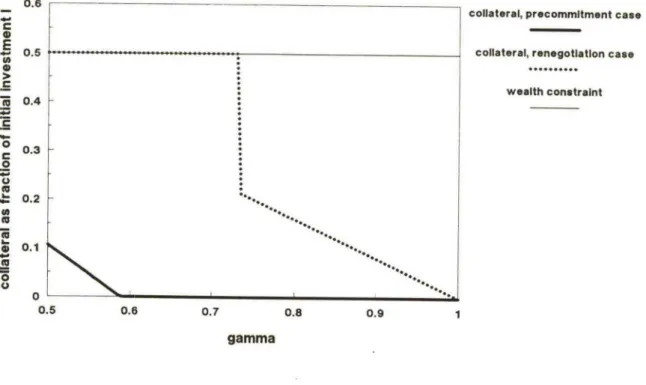
The intuition for proposition 7(a) is the following. The "tougher" position of the bank in case of precommitment against renegotiation reduces the successful borrower's incentive to cheat compazed to the situation of renegotiation. As a result, in case of commitment a lower amount of collateral suffices in equilibrium. Figure 1 illustrates this by drawing the equilibrium amount of collateral (given that the initial investment I equals l) as a function of P. The thin line represents the wealth constraint C 5 W. All
parameters are chosen such that the assumptions (I)-(4) aze satisfied. The boid line represents the equilibrium amount of collateral in case of precommitment, and the broken line represents the equilibrium amount of collateral in case of renegotiation.
[insert Figure 1]
Given 7(a), it seems logical that if borrowing is feasible with renegotiation, it is also
feasible with commitment because the borrower puts up less collateral in the latter case. The interesting thing about 7(b) is that this need not hold in general. Of course, the absence of precommitment decreases the borrower's incentive not to cheat; this has a welfare-lowering effect. However, for lazge P this negative effect may be outweighed by the decrease in deadweight cost due to dropping precommitment. In case of renegotiation
Figure 1. Equilibrium amount of collateral
Modest penalty for cheating
o.s 0.5 0.4 0.3 0.2 0.1 -0 0.5 0.8 0.7 0.8 0.9 1
collateral, precommltment case collateral, renegotiatlon case
wealth constralnt
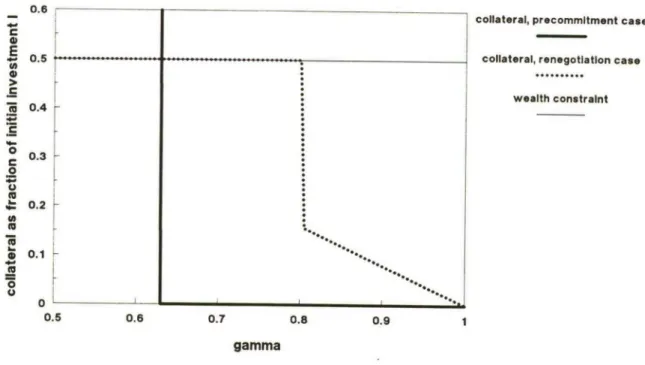
fraction f c 1 compared to the situation of precommitment, and also the probability that he is punished by P. The expected penalty may become sufficiently low so that borrowing is again profitable. Proposition 7(b.ii) is illustrated in Figure 2. Again the thin line represents the wealth constraint, the bold line represents collateral if renegotiation is impossible and the broken line represents collateral in case of renegotiation. The penalty P is twice as high as in Figure 1; all other parameters are the same. In the area where 'fi ~ r ~ r, lending is infeasible in case of precommitment, while in case of renegotiation it is feasible with C' - W.
[insert Figure 2]
Thus, the welfare effect of precommitment is not necessarily positive. If the social cost of the bankruptcy procedure is high relative to the court's accuracy, then precommitment may actually lower welfare.
5. Concluding remarks
This paper has examined the influence of the bankruptcy option on the borrower's incentives and on the equilibrium debt contract. Since only the borrower directly observes the investment's return, the successful borrower may falsely claim project failure and repudiate. The court aims at discouraging this type of improductive behavior. It contributes to welfare if its accuracy is high enough to compensate for its social cost. If its operation is relatively inefficient, debt renegotiation may increase welfare compared to precommitment against renegotiation because renegotiation prevents court involvement. The model also provides a theoretical explanation for the empirically relevant situation that observably risky borrowers pledge more collateral than observably safe borrowers.
In this paper the bankruptcy procedure takes a simple and stylized form. Several extensions can be made. However, if the penalty imposed on the borrower who is convicted for chea[ing would be endogenized, the optimal penalty P' would depend on [he success probability of the borrower's project. Entrepreneurs with different abilities would be penalized differently in case of conviction. This type of discrimination among borrowers violates a basic principle of justice. Therefore a penalty that is optimal to strictly economic standards may be far from optimal according to e.g. legal standards.
Figure 2. Equilibrium amount of collateral
High penalty for cheating
o. s O.5 0.4 0.3 0.2 0.1 0 ~ ~ 0.5 0.8 0.7 0.8 0.9 1
collateral, precommitment case collataral, renegotlatlon case
wealth constralnt
A more general testing technology could enable the accuracy of the court's test to vary with its cost. The court would be concerned with the optimal effort to be put into gathering information on the case. Again the court should not discriminate among borrowers. Alternatively the borrower could be allowed to be able to influence the outcome of the test. If the borrower after being filed for bankruptcy can either hire either a good but expensive lawyer or a bad lawyer at zero cost, in our model only the successful borrower who falsely claimed default has funds available fmm the project to hire a good lawyer. Given that the court cannot observe the funds spent on legal advice by the borrower, the cheating borrower's higher ability of influencing the court's decision could lower the effectiveness of the bankruptcy procedure. T'his would make a debt renegotiation offer by the bank more likely. Since the borrower would anticipate the higher probability of debt forgiveness, his increased incentive to repudiate if successful might be counterbalanced by higher collateral requirements.
Appendix 1. Precommitment against renegotiation
Before stating the proofs of propositions 1 and 2, we discuss some constraints to the problem that bank and borrower face, and give some definitions.
Given the equilibrium of the renegotiation subgame (determined in Proposition 1) and the amount of collateral C, the equilibrium interest rate is such that the bank earns zero expected profit: V(R,C,I',P,d-Of--0)-0 :
(A1) !i-I-(1-q)(XF{ 1-(1-a)(1-1~1 t ~ C) 4
The borrower's individual rationality constraint U(R,C,I`,P,d-0jL0)z0 is satisfied if
(A2) CsC - qXst(1-q)I1-(1-a)(1-I'jIXF-(I-q)(1-1~P-1 (1-q)(1-a)
(A3)
CsM-Min[C,WJ
Of course, a necessary condition for lending to be feasible for the borrower is Cz0 .
This is the case for
(A4) rzrw- 1-qXy.-(t-q)(aXS-~
-( t -q)-(1-a)Xft-(1-q)P
Two critical values for r, used in Proposition 1, are defined as: (AS) r- Max~~,rM] and Í' ~ Max[Í`e,I'y] , where rM isas in (A4) and the othertwo expressions are given by:
L - I-X~1-(1-q)(1-a)]-~a'q(1-a)] P - I-Xt.[1-(1-q)(1-a)]
A q(Xy.-XFtP)t(I-q)(1-a)Xf " - 9(XS-XFtP).(1-q)(1-a)XF Proof of Protwsition 1: First we show that if a contract D is feasible, one must
have d-0. Assume that a feasible contract exists. By assumption (4), the bank's individual rationality constraint is satisfied only if it offers a contract such that the
successful borrower picks a~l. The successful borrower will find repayment at least as favorable as shirking if
(A6) XS - R?(1-r)[XS - XF - C] - r(C t P)
If the inequality is strict, the successful entrepreneur repays and d-0. Suppose that the
equality holds, so that the successful borrower is indifferent between repayment and cheating. In this situation, suppose that the entrepreneur would not choose d - 0. Then the bank could increase itsprofit byslightly lowering R, thereby inducing the borrower to sclect d- 0. Therefore a-0 . Next the optimization problem to which D-(R,G) is the
solution is characterized. The optimal contract maximizes the entrepreneur's payoff subject to zero profit for the bank, nonnegative profit for the entrepreneur (individual
rationality) and the entrepreneur's wealth constraint. With regard to the objective function, note that since C involves deadweight cost, the en[repreneur's payoff is maximized if C is minimized. If (A6) holds, R ensures that the zero bank profit condition is satisfied. The borrower's individual rationality constraint requires U(D,I',P,d-0,f-0) z 0, i.e. q(XS - R) -(1-til{(I-I')(P-F-C) f I'C} ~ 0. By subs6tuting the equilibrium interest rate we obtain the upper bound (A2) on C. Combining this with the borrower's wealth constraint yields constraint (A3). A necessary condition for lending to be feasible is M? 0, and since W~ 0 this holds iff C20 , or equivalently iff
constraint (A4) is satisfied. Thus, the optimal contract picks R from (AI) and minimizes C subject tothe conditions0 5 C 5 M and (Atí). The latter condition can be restated in terms of C: substituting R and rearranging shows that(A6) is equivalent to
(A6') Cz~- I-4I`(XS-XF.~-Xr,[1-(1-q)(1-a)(1-~l
~ t4(1-P)
Since C is minimized, if lending is feasible in equilibrium C equals
C' - Max [0 ;~]. It can be checked easily that ~x0 i,~` I'sÍ'a and ~sM i,,d`'I'ztA . To prove part (a) of the proposition, note that the condition I' ~ I' incorporates conditions (A3) and (A4). Condition (A4) is necessary and sufficient for M nonnegative, which is necessary for C in [O,M], as we discussed above. If (A4) holds, i.e. given M nonnegative, the condition I'~r~ is necessary and sufficient for feasibility because it ensures that the equilibrium amount of collateral Max[0, ~] 5 M(condition A3). Therefore I'~t-Max[),~,I'M] is necessary and sufficient for feasible lending by the bank.
(b.i) is proven by noting that if I'~r in equilibrium a-0 . If collateral is positive, (A6) is binding or equivalently C'-~ . Collateral is positive for O~~sM , which is satisfied for rASI`~PB . Combining this with constraint (A4) proves that C'-~ for r~P~Í' .
(b.ii) is proven by noting that if IyÍ' ,(A6) holds for C- 0 because C c 0 if I'~Í'e .
Necessary for the borrower's individual rationality constraint (A2) to be satisfied is that (A4) holds; this is the case by definition of Í' . Q.E.D.
Proof of ProRosition 2: Proposition 1 states that for r~I`~Í' , C'-~ , which is strictly decreasing in q. Q.E.D.
Appendix 2. No precommitment against renegotiation
After the proofs of propositions 3 and 4, we define the expressions that appear in proposition 5 and state some lemma's. The proof of proposition 5 concludes the Appendix.
Proof of Proposition 3: First we consider the uniqueness problem. The four candidates for a pure-strategy equilibrium are (f,d) -(0,0), (1,1), (0,1), (1,0). Note that by assumpdon (4) d- 1 will never be part of an equilibrium path. Also f- 1 cannot yield an equilibrium, because by R~ I and (1) the successful entrepreneur will optimally choose d- 1 in response to f- I; but given that the successful entrepreneur always claims default, the bank will want to provide an incentive against cheating by lowering f. So the only remaining candidate for a pure-strategy equilibrium is (f,d) -(0,0). This proves uniqueness. We continue by showing that this is a subgame perfect equilibrium only if a - 1 or I' - 1. In proposition 1 it was already shown that d- 0 is the best response to f - 0. Dropping proposition 1's restriction f- 0, given that the successful entrepreneur
will never cheat (d - 0), the bank has an incentive to raise f to 1 unless the bankruptcy procedure in court involves no deadweight cost. Therefore f- 0 can only be the optimal response to d- 0 if a- 0 andlor I' - 1. Q.E.D.
Proof of ProQosition4: We derive the equilibrium of the renegotiation game, given that a
feasible contract has been signed. When the debtor reports default, from Bayes' rule the creditor calculates the following ex post probability that XS has been realized: G(d)
-qdl(qdt 1-c~. The optimal value d' follows directly from the condition that in equilibrium
the bank will be indifferent between forgiving or bringing the defaulter to court:
(A~ XF~-BC - G(d)[I'(aXs-~BC) -F (1-I')(XPfBC)] f (1-G(dp[(1-1~(aXPf-BC)tI'(XPfBC)]
The optimal value ffollows directly from the condition that the successful entrepreneur
must in equilibrium be indifferent between either reporting default or paying his debt R:
(A8) f(XS XPC) f(1-f){I'(-P-C) f(1-I')(Xg X,~C)} - Xs - R. Q.E.D.
Next we discuss some constraints to the problem that bank and borrower face, and give definitions. Given the equilibrium of the renegotiation subgame (d',t) and the amount of collateral C, in equilibrium the bank earns zero ezpected profit: V(R',C,P,P,d',f)- 0. Therefore
(A9) R , - I-(qd 't 1-q)(Xp{ ~~
q(1-d')
Using (A8) and substituting R', d' and P intoU(R,C,1',P,d,f)we can prove1ó
mm 1. Given the equilibrium interest rate R' and the equilibrium of the renegotiation
subgame (d'f), the entrepreneur's expected payo„~`' U(R', C,I',P,d'f)- B- A. C, where A - (qd'tl-q)(1-a)-d' - [q(1-d')}(qd'tl-q)~l(1-qxl-1~P
1-d' (1-d'MI`(XS-XF4~
B - X t-qs (qd'tl-q)XF - (1-q)(1-1~P(I-Xp) - I 1-d' qI'(XS-XFtP)(1-d') 1-d'
and
From Lemma 1 it follows that the entrepreneur's individual rationality constraint
l. If A~ 0and B ~ 0, B- A.C is nonnegative iff CsC~sB~A .
2. If A ~ 0 and B ~ 0, B- A.C is nonnegative for all C z 0. 3. If A 1 0 and B c 0, B- A.C is not nonnegative for any C z 0.
4. If A C 0 and B G 0, B- A.C is nonnegativeiff CZC'gB~A , Define MR as follows:
MR-Min[ C~ ,W]ifA ~O,B~O.
Ma ~ W either if A c 0, B~ 0
or i f A c 0, B c 0 and W 1 BIA.
MR ~- oo either ifif A~ 0, B ~ 0
or if A G 0, B c 0 and W c BIA.
Then the entrepreneur's individual rationality constraint B- A.C z 0 and wealth
constraint C 5 W are satisfied iffl': '
(A 10) C L MR
In Proposition 5 two critical values L~ and Í'i for I' are used; they are defined as:
(All)
and
(A 12)
r~- I-XFjI - (1-q)(1-a)]-(3MR
q(aXs-XF)t(I-q)( I -a)XF
I-XP[1-(1-q)(1-a)]
Í'~-q(aXs-Xf) t(1-q)(1-a)XF
Two more critical values for I' that appear in Proposition 5 are identified in Lemma's 2 and 3.
Lemma 2: Given the equilibrium of the renegotiation subgame and the equilibrium interest
rate R', there is a unique critical value I" c 1 for I' such that B 1 0 iff I' ~ I`", i.e.
such that the entrepreneur's payo,~`'in case no collateral is posted B is positive iff
P~ P". Ib is increasing in P.
G-(1-c~(I-XF)(a7{S-XF). Note that E,F,G ~ 0 by (3), XS1XF and (2) respectively.
Multiplicating B by qr(1-d~(XSXFfP)(aXs XF), substituting d' and rearranging, B~ 0
is equivalent to r~ r', with
r,- (XS-XPtP).FtP.G ~ 1 (XS-XF.PxEtF) tP.G It is verified easily that rois increasing in P. Q.E.D.
Lemma 3: Given rhe equilibrium of the renegotiation subgame and rhe equilibrium interest rate R', there is a unique critical value r' c 1 for r such that A~ 0 iff r ~ I'', i.e. such that a higher amount of collateral increases total welfare for r c r', and a higher amount of collateral decreases total welfare if r ~ r'. r' isincreasing in P.
Proof: If r- 1, A~ 0, so the critical value r' (as defined in the lemma) c 1. After some tedious calculations it can be shown that the first derivative of A with respect to r is positive, so A is strictly increasing in r. Therefore there is a unique r' c 1 such that A 1 0 iff r~ r'. To show that r' is increasing in P, note that from lemma 1 it is easy to check that the first derivative of A with respect to P is negative. Therefore for large P we need a relatively high r to have A~ 0, so r'is increasing in P. Q.E.D.
The following lemma gives an intermediate result used in the proof of Proposition 5. Before stating it, define
(A l3) ~~- I-XP-qI'(I -d ~)(aXs'Xp)
~
mm 4~ The optimal contract D' solves the following maximization problem:
Max~ B- A. C s. t.
(A10J C 5 MR
(A 14J C z MaxJO,~ ~~ J
Moreover, the solution to this problem implies 0 c d c 1 and 0 c f c 1.
Proof: Since the bank earns zero profit, the optimal contract maximizes the entrepreneur's payoff B - A.C. This expression is deducted in lemma 1 under the assumption that a
feasible equilibrium of the renegotiation subgame exists. Assumption (A10) is necessary and sufficient for borrowing to be feasible for the entrepreneur, as discussed above. Next
we show that lending is feasible for the bank (i.e. zero profit is attainable) if and only if assumption (A14) holds. The proofends by showing that (A14) implies0 c d' c 1 and 0 ~ t" c l. By assumption (4), if d- 1 lending is not feasible. Therefore d must be small enough in order to make lending feasible. From (A7) it follows thatin equilibrium
(A7') 4[I'aXs f(I-r)J{F] f(1-q)[(1-r)aX,: f rXF] - 9(1-d)r(aXg XF) f XF The left-hand sideof (A7') also appears in assumption (4). Replace this by the right hand expression of (A7') to see that assumption (4) is equivalent to
q(1-d')r(aXs XF) f XF f fSW c I. Since W z MR, if this holds then we also have
(4') 9(l-d')r(aXs XF) f XF f BMR C I I-xF-[~Á1R
Clearly, (4') holds only if d'~1-
Qr(~xs-xF)
. Thus, a necessary condition for lendingto be feasible for the bank is that (4') is not satisfied, or equivalently that the complement of (4') is satisfied. More general, given a value C in [0, MR], lending is feasible for the bank if and only if the following inequality is satisfied:
(A14') q(1-d')I'(aX5XF) f XF -i- 6C ~ I.
Restating (Al4') in terms of C and adding the condition C z 0, we obtain condition (A14). !f condition (A14) is satisfied, then by C ~ MR the complement of (4') holds, so
condition (A14) implies d' c 1 by (1) and (2).
The condition t' ~ 0 requires C~ R'-Xf I-Xp-qr(1-d')(XS-XF}p) . It can be
r(XS-xFtP) - ~'4(1-d')(1-~)
seen easily that this always holds if C~ C', so condition (A14) also implies t' ~ 0.
Note that d' 1 0 by 0 c q,a,r C 1, XF ~ 0 and (2); and that f c 1 by (1) and XS ~ R~ 1~ X,:. Thereforecondition (A14) implies 0 ~ d' C 1 and 0 c fc 1. Q.E.D. Proof of Proposition 5: Proposition 5 states the solution to the optimization problem in lemma 4. [n the lemma's 2 and 3, the critical values I'o and r' are defined. The other two critical values for r that appear in the proposition, defined in (All) and (A12), are such
of the proposition in the following way: Given R- R', d- d' and f- f, conditions (A l0) and (A 14) are both satisfied only if I`~r . Therefore, I'~C is necessary for the existence of a feasible contract. In the rest of the proof this inequality is assumed to hold. (b) Note that if r c r" (B c 0), the firm's individual rationality constraint B- A.C z 0 is not satisfied unless r c r' (A c 0). If r c Min[r',I'"j, B- A.C z 0 iff C 2 BIA. Since A C 0, welfare is maximized if C is maximized subject to C 5 W, so C- W. In order for the wealth constraint and the bormwer's individual rationality constraint to be satisfied at the same time we must have W~ BIA, so W"sufficiently large""
The conditions 0 c f c 1 and 0 c d' c 1 were shown to hold in lemma 4.
(c) If r 1 ro (B ~ 0), then if r C r' (A c 0) two remarks can be made. Firstly, the borrower's individual rationality constraint will not be binding for any C z 0, and secondly, welfare is maximized by maximizing C. The wealth constraint implies C' - W. This proves (c.i). (c.ii) Note that if r~ r', C will be minimized, so constraint (A14) of the optimization problem in Lemma 4 will be binding. ,Now if rcÍ`~, C~~O so C'-C~ .(c.iii) If I'~Í'~, GrcO so C'-0. . Q.E.D.
Proof of Proposition 6~ Proposition 5 states that for Max[r,I",I'7crcÍ`i , C' -~~ ,
which is strictly decreasing in q, as follows from substituting d" into (A13).
If Max~,r~crcr' , C' - W, which is non-increasing in q. So in the range
Max~,In]crcr we have C'(q) ? C'(q') for all 0 c q ~ q' c 1. Q.E.D.
Proof of Proposition 7- (a) Using propositions 1 and 5, we consider all cases where lending is feasible in case of commitment and in case of renegotiation. It is shown that in each case we have C s C'. First consider r G r'. By proposition 1, C''cR' . By propositions 1 and 5, if lending is feasible in both cases of precommitment and renegotiation and if r c r', then C' - W ~ C~ . Next consider r~ r'. Note that
there is no r c I'o such that a feasible contract exists(see prop. 5). If r~ Max[r', r~], lending is feasible in case of precommitment and in case of renegotiation iff I'~Max[C,r7-Max[r~,rM,CJ . Given that this holds, consider the following situations:
(1) r~Min[Í',Í'i] . Then C'~C' by ~~~~ . (2) P~r~Í'i . Now ~-0; C'~0 .
(3) Í'~~r~Í' . It can bechecked easily that Í'a~Í'i . Therefore in this case we necessarily
have Í'-ry . However, if r c rM then lending is not feasible in the precommitment
case. The condition I'~Max[C,L~j-Max[~A,I'M„r] is not satisfied. (4) I'~Max[Í',i'i] .
Now C-C'-0 . This concludes the proof of (a). (b.i) is proven if we show that for P not too large we have t~L~ . For P not too large we have rM c P (note that rM c 0 if P - 0 by (A4), (2) and (3)), so r-r by (AS). Compare ~ and (All). As for small P we will not have MR ~~ M, the inequality holds. This proves (b.i). Next weprove (b.2). Since r ~ r', (b.2) holds only if r- rM ~ r. rM is increasing in P, while I" is
independentof P ifMK - W. Then for P large enough we have LtiL~ , so lending may be infeasible with precommitment, while it is feasible without precommitment. Q.E.D.
References
Aghion, Philippeand Patrick Bolton, 1989, "The Financial Swcture of the Firm and
[he Problem of Control", European Economic Review 33, 286-293.
Barro, Robert J., 1976, "The Loan Market, Collateral, and Rates of Interest", Journal
of Money, Credit and Banking 8, 439-456.
Bebchuk, Lucian A., 1988, "A New Approach to Corporate Reorganizations", Harvard
Law Review 101, 775-804.
Beqjamin, Daniel, 1978, "The Use of Collateral to Enforce Debt Contracts", Economic
Inquiry 16, 333-359.
Berger, Allen N. and Gregory F. Udell, 1990, "Collateral, Loan Quality, and Bank
Risk", Journal of Monetary Economics 25,21-42.
Besanko, David and Aqjan V. Thakor, 1987, "Collateral and Rationing: Sorting
Equilibria in Monopolistic and Competitive Credit Markets", International Economic Review 28, 671-690.
Bester, Helmut, 1985, "Screening vs. Rationing in Credit Markets with Imperfect
Information",American Economic Review 57, 850-855.
Bester, Helmut, 1987, "The Role of Collateral in Credit Markets with Imperfect
Information", European Economic Review 31, 887-899.
Bester, Helmut, 1990, "The Role of Collateral in a Model of Debt Renegotiation",
Tilburg University, CentER Discussion paper no. 9060.
Brink, R.G.C. van den, 1981, "Bankkrediet", Nederlands Instituut voor het Bank- en
Effectenbedrijf, Amsterdam.
Broecker, Thorsten, 1990, "Credit-Worthiness Tests and Interbank Competition", Econometrica58, 429-452.
Chan, Yuk-Shee and George Kanatas, 1985, "Asymmetric Valuations and the Role of
Collateral in Loan Agreements", Journal of Money, Credit and Banking 17, 84-95.
Diamond, Douglas, 1984, "Financial Intermediation and Delegated Monitoring", Review
of Economic Studies 51, 393-414.
Gale, Douglas and Martin Hellwig, 1985, "Incentive-Compatible Debt Contracts: The One-Period Problem", Review of Economic Studies 52,647-663.
Debt", MIT Discussion Paper no. 520.
Hellwig, Martin, 1977, "A Model of Borrowing and Lending with Bankruptcy",
Econometricu45, 1879-1906.
Hermalin, Benjamin E. and Michael L. Katz, 1991, "Moral Hazard and Verifiability: The Effects of Renegotiation in Agency", Ecnnontrtrica59, 1735-1753.
Leeth, John D. and Jonathan A. Scott, 1989, "The Incidence of Secured Debt:
Evidence from the Small Business Community", Journal of Financial and Quantitative Analysis 24, 379-393.
Nalebuff, Barry and David Scharfstein, 1987, "Testing in Models of Asymmetric Information", Review nf Ecnru~mic Studies 54, 265-277.
P'ng, Ivan, 1983, "Strategic Behavior in Suit, Settlement and Trial", Bell Journal of
Economics 14, 539-550.
Schweizer, Urs, 1989, "Litigation and Settlement under Two-Sided Incomplete Information",Review of Economic Studies56, 163-178.
Stahl, Dale O., 1988, "Bertrand Competition for Inputs and Walrasian Outcomes", American Economic Review 78, 189-201.
Townsend, Robert M., 1979, "Optimal Contracts and Competitive Markets with Costly
State Verification",Journal of Economic Theory 21, 265-293.
White, Michelle, 1989, "The Corporate Bankruptcy Decision", Journal of Economic
Perspertives 3, 129-I51.
Yanelte, Marie-Odile, 1989, "The Strategic Analysis of Intermediation", European Econanic Review 33, 294-304.
Footnotes
1. See e.g. Barro (1976) and Benjamin (1978), where in the absence of bankruptcy a relatively high amount of collateral is needed, because the borrower repays only if the value of the collateral exceeds his debt.
2. In our setting the debtor will have received loans from only one creditor, so that situations of conflicts among creditors are not considered. In practice the regulation of such conflicts is an important concern of bankruptcy law, to prevent a costly race by individual creditors to be first to sue the firm for repayment of their own claims.
3. In this respect, our approach is related to Hermalin and Katz (1991).
4. Note that in our setting bankruptcy is not an instrument to eliminate firms that are economically inefficient, unlike a common presumption regarding bankruptcy (see White (1989)), as the firm can operate in an economically efficient way.
5. Unlike e.g. Nalebuff and Scharfstein (1987), we do not study possible economic tradeoffs between the accuracy of the test and its cost.
6. The only difference with debt renegotiation (voluntary debt forgiveness by the bank) is that in case of reorganization the court decides that part of the debt is forgiven. All payoffs are the same in both cases.
-7. The latter assumption is needed to rule out the situation described by Yanelle (1989). She shows that if banks would compe[e for loans as well as deposits, high deposit rates would push up interest rates to be paid by borrowers, which would benefit depositors but hurt final borrowers. If direct finance would be available (i.e. without banks intermediating between supplyers and demanders of funds), i[ might then happen that only equilibria without banks as intermediaries exist (see also Stahl(1988)).
8. Comparing the entrepreneur's expected payoff in case of renegotiation with the payoff if filed for bankruptcy, it is clear that an offer of debt renegotiation will be accepted by both the successful and [he unsuccessful entrepreneur.
9. The entrepreneur's expected profit is equal to
U(R,C,r,P,d,f) - q{ d[f(XS XFC)t(1-f){r(-P-C)f(1-r)(XS XFC)}] f(1-d)(XS - R)} f(1-q){ f(-C) f(1-F)[(1-r)(-P-C) f r(-C)] }
The bank's expected profit equals
V(R,C,r,P,d,f) - q(1-d)R t qd{ f[XFf6C] f(1-f)[r(aXSfBC) f(i-r)(XFtBC)) }
t(1-q){ f(XFtnc] f(I-t~[(1-r)(~xFftic) f r(xFt13C)] }- I
10. This tradeoff occurs because both collateral and punishment reduce the entrepreneur's
expected utility: If P is high, then the maximum amount of collateral for which borrowing
still is profitable to the entrepreneur will be relativelylow, and vice versa.
l l. I' is decreasing in W if I'M c~(see Appendix 1).
12. By using the word "also" we anticipate a result of the next section on renegotiation. 13. See Van den Brink (1981) and references in Berger and Udell (1990).
14. Given that default is reported, if the bank is not precommitted to file the borrower for bankruptcy it will only do so if its ezpected revenue from liquidation is higher than the revenue from debt forgiveness: a[G(d).I'XS f(1-G(d)).(1-I')XF] 1 XF. It can be easily verified from the proof of proposition 4(expression A7) that d' is such that this condition is satisfied in equilibrium. If it would not hold, then the bank would not file any bormwec for bankruptcy. This would induce succesful borrowers to report pmject failure in any case (d-1), and lending would be infeasible for the bank by assumption (4).
15. Note that I`o may well be below 'f~, making case (b) unattainable. 16. By (A8), U(R',C,I',P,d',f) - q(XS R') -(1-q)(Cf(1-f)(1-P)P].
17. If A ~ 0, B c 0 and W ~ BIA, the condition on C should be as follows: BIA s
C 5 W(Ma - W in this case). Welfare is maximized for A c 0 by maximizing C (lemma 1), so only the upper bound C 5 MR is relevant here.
18. Since W G I- X,: by assumption (1), a necessary condition for W~ BIA to be satisfied isB c([ - X,:)A.
(For previous papers please consult previous discussion papers.) No. Author(s)
9160 R.M.W.J. Beetsma
9161 A.M. Lejour and
H.A.A. Verbon
9162 S. Bhattacharya
9163 H. Bester,
A. de Palma,
W. Leininger,
E.-L. von Thadden
and J. Thomas 9164 J. Greenberg 9165 Q.H. Vuong and W. Wang 9166 D.O. Stahl II 9167 D.O.Stahl II
9168 T.E. Nijman and F.C. Palm 9169 G. Asheim 9170 H. Carlsson and E. van Damme 9201 M. Verbeek and Th. Nijman 9202 E. Bomhoff 9203 J. Quiggin and P. Wakker 9204 Th. vande Klundert and S. Smulders 9205 E. Siandra 9206 W. H~rdle 9207 M. Verbeek and Th. Nijman Title
Bands andStatistical Properties of EMS Exchange Rates: A Monte CarloInvestigationof Three Target Zone Models
Centralized and Decentralized Decision Making on Social
Insurance in an IntegratedMarket Multilateral Institutions
Sovereign Debt, Creditor-Country Governments, and
M ult ilateralInstitutions
The Missing Equilibriain Hotelling'sLocation Game
The Stable Value
Selecting Estimated Models Using Chi-Square Statisticx
Evolution of Smart, Players
Strategic Advertising and Pricing with Sequential Buyer Sear~ch
Recent Developments in ModelingVolatility inFinancial
Data
Individual and Collective Time Consistency
EquilibriumSelection in Stag Hunt Games
Minimum MSE Estimation of a Regression Model with Fixed Effects from a Series of Cross Sections
Monetary Policyand inflation
The AxiomaticBasis of AnticipatedUtility;A Clarification Strategies for Growthin a Macroeconomic Setting
Money andSpecialization in Production
Applied Nonparametric Models