AMERICAN JOURNAL OF MULTIDISCIPLINARY RESEARCH © 2017 AMERICANAJOURNALS | Volume 5 | Issue 2 | ISSN: 2356-6191
Hybridizing an Extended Technology Readiness Index with
Technology Acceptance Model (TAM) to Predict E-Payment
Adoption in Ghana
Patrick Acheampong1, 2, Li Zhiwen1, Henry Asante Antwi1, Anthony Akai Acheampong Otoo1, William Gyasi Mensah1, Patrick Boateng Sarpong1
1School of Management, Jiangsu University, 301 Xuefu Road, Zhenjiang 212013, Jiangsu, P.R., China 2
Ghana Technology University College, PMB 100, Tesano-Accra, Ghana Corresponding Author:[email protected]
ABSTRACT
At the heart of electronic commerce is the ability of a customer to be able to pay for goods and services unrestricted by location. Electronic payment system offers customers the convenience and flexibility to digitally pay online. Our study extended the technology readiness index and evaluated its influence on the technology acceptance model to predict user acceptance and use of e-payment technology. An online version of a questionnaire was administered to the population aged 1500 users of e-banking and mobile money users in six cities in Ghana (Accra, Tema, Kumasi, Cape Coast, Sekondi-Takoradi and Tamale) on the social media. A printed version of the questionnaire was self administered to other respondents largely, users of mobile transfer services in Ghana who did not have access to reliable internet services or computer. The post-data integrity results was analysed using a robust version of feed forward Radial basis function neural network. We observed a non-inflated overall incorrect prediction score between below 25% in both cases. It decomposed into a positive and significant relationship between personal innovativeness, personal optimism, high perceived convenience and perceived usefulness and perceived ease of use which positively influences e-payment adoption. The case of personal insecurity and personal discomfort returned negative effects and are consistent with the extant literature
.
Keywords: TRI; TAM; e-payment; electronic commerce; Ghana
INTRODUCTION
The dot.com bubble and the Internet revolution have dramatically changed the way goods and services are exchanged (Xiang et al. 2015). The exponential growth in information and communication technologies has ushered the world into a new era of plastic and other intangible forms that facilitate electronic payments. Ghana, a sub-Saharan country has seen a continual growth in her ICT and telecommunication sectors.
The growth in these sectors has boosted businesses’ global competitiveness and strategy. The radical changes in information communication technologies
hold the key to reducing business operation cost (Han et al. 2013), improves service delivery among others (Han et al. 2013). The services on the Internet are enormous; however, electronic commerce holds the promise for both businesses and customers since it offers inexpensive and direct way of exchanging goods and services. The growth and development of electronic commerce is rising steadily (McNabb 2016; Narang et al. 2016). This steady growth can be attributed to the proliferation of smart phones and tablets which has facilitated electronic payments (Davis et al. 2013; Flood et al. 2013; Kamel 2015). At the heart of electronic commerce is the ability of a
customer to be able to pay for goods and services unrestricted by location. Electronic payment system offers customers the convenience and flexibility to digitally pay online (Cimiotti et al. 2016; Huang 2017). Ghana’s quest to transition from cash-based to non-cash based system is pervasive. This proposition calls for having an efficient and robust financial sector regulation. Recently, there has been a total regeneration and overhaul of operations in the financial sector to lead the onslaught of attaining a cashless economy. Over the past few years, Ghana has witnessed some key innovative payment systems (Haruna 2012) like e-transact, sika card, money express, MTN mobile money, tiGo cash among others has also helped in financial inclusion.
Sumanjeet (2009) defines electronic payment as any payment to businesses, bank or public services from citizens or businesses, which are executed through a telecommunications or electronic networks using modern technology. Yaqub et al. (2013) defined e-payment as cash and associated transactions implemented using electronic means. The quest to have a cashless economy lies in the bosom of the central bank of Ghana since it’s the sole regulator and issuer of currency. This effort has mainly been driven by the fact that the traditional payment methods including cash and cheques are increasingly being seen as cumbersome, insecure, and not always available at the point of need (Sumanjeet 2009). The history of payment system in Ghana erupted in 1997 when MICR cheques were introduced (myjoyonline, 2017). In the subsequent years, the Bank of Ghana (BOG) introduced the e-zwich smart card which is a biometric payment system in 2008. The introduction of this payment instrument was to ensure financial inclusion since majority of people are so much engaged in the informal sector. In this paper, the researchers’ main pre-occupation is to investigate consumers’ readiness to adopt electronic payments using Technology Readiness Index theory (Parasuraman 2000). This theory has been extended to include convenience since it is one of the variables that can be used to measure consumers’ readiness to adopt e-payment (Chang et al. 2012a). Convenience can be defined as the extent to which an individual perceives the simplicity of using an e-payment technology (IGI Global). The concept of convenience influencing consumers’ quest to adopt a technology has been tested in the area of marketing and education. For instance, (Chang et al. 2012a) sampled 158 college students from Taiwan to test the relationship of perceived convenience with regards to English language mobile learning. At the end of their study, the result depicted that convenience had a
positive effect on students’ attitude towards mobile learning.
LITERATURE REVIEW
Theories of Technology Innovations
The contribution of technological innovations to economic growth can be realised when it is widely diffused and adopted (Frame et al. 2014; Van der Boor et al. 2014) . In harnessing the importance and effectiveness of accepting IT innovations, it is very important to say that IT innovations have been in existence for many years. The value of technology innovation is evidenced on how people adapt to new ways of doing things (Beaudry et al. 2005). The new ways of doing things create wealth and enhances firms’ global competitiveness. In our effort to fully appreciate the continual spread of Information technology, finding novel means of accomplishing tasks is of paramount importance. IT innovations uses computer based systems and telecommunication technologies to store, process, and communicate (Ariwa et al. 2014; Mahy et al. 2016). According to Organization for Economic Co-operation and Development (OECD, 2005) innovation is the implementation of a new or significantly improved product (good or service), or process, a new marketing method, or a new organizational method in business practices, workplace organization or external relations as cited by (Garcia et al. 2002). However, (Baldwin et al. 2011; King et al. 1994) define innovation as ‘a process whereby inventions move into usable forms’. A lot of theories have inspired consumers’ adoption and acceptance of a particular technology since its inception. Information Technology has changed the dynamics and daily work routines of individuals and businesses. Technology has the capacity to expand businesses by way of generating new capital investments. According to Mark Doms (2004), IT capital investments boomed in 1990s and 200s before plummeting in 2001.
On the contrary, consumers or employees must first accept a technology before it can be fully used. Many studies have investigated the determinants that inspires users acceptance of technology (Chen et al. 2004; Wang et al. 2009). Several theories have emanated from the research of technology adoption in the area of sociology, Information System, psychology and many more. For instance, a lot of studies on the MIS implementation have been performed to identify and assess organizational characteristics that lead to an information system success or failure Scherer (2002) as cited by (Yeboah et al.). Venkatesh et al. (2003) combined eight theories with respect to accepting a new technology. This include: Theory of Reasoned Action (TRA),
Technology Acceptance Model (TAM), Motivational Model (MM), Theory of Planned Behaviour (TPB), Model Combining the Technology Acceptance Model and Theory of Planned Behaviour (C-TAM-TPB), Model of PC Utilization (MPCU), Innovation Diffusion Theory (IDT), and Social Cognitive Theory (SCT). The TAM was first developed by Davis to explain user acceptance of technology in the workplace (Davis 1989; Davis et al. 1992). TAM adopts a causal chain of beliefs, attitudes, intention, and overt behaviour that social psychologists Fishbein and Ajzen (Ajzen 1991; Ajzen et al. 1975) have put forward, and that has become known as the Theory of Reasoned Action (TRA). Based on certain beliefs, a person forms an attitude about a certain object, on the basis of which he/she forms an intention to behave with respect to that object. The intention to behave is the prime determinant of the actual behaviour. The DOI theory has been used in broad variety of research fields such as political science, public health, communications, history, economics, and education. DOI theory has also been widely used as a theoretical framework in the area of technology diffusion and adoption (Straub 2009). In fact, much diffusion research involves technological innovation; as such, Rogers (2004) usually uses the words technology and innovation as synonyms. A technology is ‘a design for instrumental action that reduces the uncertainty in the cause effect relationships involved in achieving a desired outcome’. It has two parts: hardware and software. Hardware is ‘the tool that embodies the technology in the form of a material or physical object’, and software is ‘the information base for the tool’ (Rogers 2004).
Technology Readiness Index (TRI)
Parasuraman et al. (2000) postulated this theory to assess people’s readiness to adopt a new technology which has widely been used by many researchers. Technology Readiness Index (TRI) theory is a multiple-item scale theory used to gauging individual’s readiness to a new technology. TRI assesses individual’s willingness to embrace and use new technologies for accomplishing goals in home life and at work’ (Parasuraman et al. 2000). Most literature has used this theory to test individual’s tendency to use new technologies. TRI theory recounts the general readiness to adopt technology with much focus centered on individual’s personality to use a new technology. Cultural beliefs, behavioural intentions and differing character traits relates to adopting a new technology. According to (Dabholkar et al. 2002;Klaus 2013; Yang et al. 2013a) , consumers interacting directly with
technology simultaneously experience positive and negative feelings towards using new technology. In as much as there may be coexistence on individual character traits relative to having a positive or negative feeling about a new technology; they vary across individuals (Parasuraman 2000). Embracing a new technology with enthusiasm and openness does not mean competence to use it. With our extended theory of TRI, we include convenience to the main four constructs of TRI: innovativeness, optimism, discomfort, and insecurity. Technology readiness thrives on optimism, innovativeness and convenience while discomfort and insecurity inhibit people from accepting a new technology. Parasuraman (2000) empirically confirms the correlation between people’s technology readiness and their propensity to employ technology. (Aboelmaged 2014; Shambare 2013) study revealed that, individual’s with high optimism and innovativeness and little discomfort and insecurity are more likely to use a new technology. Moreover, (Abu-Assi et al. 2014) in their study predicted that technology readiness did not actually have any bearing on intention or behaviour, but merely provided a measure of how ready a market is to adopt new technologies.
Perceived convenience
The idea of convenience was first coined into marketing by Copeland in 1923 in his HBR article suggesting the now-classic product typology: convenience, shopping, and specialty goods (Venkatesh et al. 2003). Convenience is a variable that drives consumers’ adoption of technology. Consumers’ turn away from technology that they think can be difficult to operate. Perceived Convenience has generated a lot of attention since it is one of the variables that can be used to measure consumers’ readiness to adopt e-payment (Chang et al. 2012a). According to Gottschalk (2017), consumers’ will find an e-payment technology convenient if it does not waste their time and does not need much effort to operate. A product or service is considered to be convenient when it saves time for a user. Moreover, (Wong et al. 2016) identified five proxies with respect to convenience: time, place, acquisition, use, and execution. With that notwithstanding, a study conducted by (Yoon et al. 2007) cast a different picture. (Yoon et al. 2007) identified three dimensions of convenience (time, place and execution) in their study on wireless LAN. In the extant literature, studies on RFID and online shopping as carried out by (Hossain et al. 2008) and (Kim et al. 2007) respectively showed that convenience influences intention to use a mobile technology. In another study on ubiquitous computing conducted by (Yoon et al. 2007) had a
contrary view that perceived convenience has no causal effect on intention to use a technology. Perceived convenience could be a belief that individual’s hold concerning technology or system that helps to complete an assignment – self determination theory. As revealed by (Dennis et al. 2007; Zhou et al. 2007), convenience affects consumers’ motivation and intention to shop online. A research by Arndt (2012) investigated the effects of perceived convenience, compatibility and media richness on users’ attitudes toward dedicated e-book readers in a Taiwan university. A sample of 288 students was used in the study. The result revealed that perceived convenience influenced students’ intention to use a dedicated e-book reader. In an online shopping environment, perceived convenience is a very crucial consumer trait (Hand et al. 2009). Another study carried out by Jih (2009) examined the effect of convenience on customers intention of shopping via communication devices in a Taiwanese university. The research validated convenience to have a positive effect on consumers’ shopping intention. Recently, mobile devices like smart phones and tablets sales have increased because of its convergence and ease of use. It now serves as an effective platform for customers to develop habitual interactions with a retailer because they provide convenience, which reinforces customers' psychological and experiential state of being in a relationship with the firm (Kim et al. 2015; Okazaki et al. 2013; Yang et al. 2013b) as cited by (Groß 2015).
Collier et al. (2013) analyzed the importance of convenience in the evaluation process along with exploring what constructs ultimately influence customers’ need for human interaction with an self service technology (SST). The result of the study revealed that convenience had a strong positive effect on the perceived accuracy, speed, and exploration intentions of an SST.
Research Framework
The framework adopted for this research is depicted in the figure below:
Innovativeness Optimism Discomfort Insecurity Perceived Convenience e-Payment Adoption by Consumers Perceived Usefulness Perceived Ease of Use H1a H1b H2a H2b H3a H3b H4a H4b H5a H7 H8 H6 H5b
Figure 1: Extended Technology Readiness Index Hypotheses
Thirteen hypotheses were developed (see Figure 1) to gauge how the personality traits (i.e., innovativeness, optimism, discomfort, insecurity and convenience) that posit as e-readiness factors through the TAM’s cognitive dimensions (i.e., perceived ease of use and perceived usefulness) affect consumers’ intention to adopt e-payment. The first individual e-readiness factor is innovativeness.
Innovativeness in general is ‘a tendency to be a technology pioneer with respect to adopting a new technology’ (Liljander et al. 2006). Alternatively, it is the willingness of an individual to try out any new technologies released into the market (Lee et al. 2002; Liljander et al. 2006). Individuals who are high in technology innovativeness exhibits strong motivation to use and enjoy the stimulation of trying new technologies. On the contrary, less innovative individuals, highly innovative individuals are not greatly concerned about whether new technologies are easy to use and may still intend to try them despite the possible difficulties in using them (Dabholkar et al. 2002). Further, highly innovative individuals have less complex belief sets about new technologies (Agarwal et al. 1999). Hence, we hypothesize that:
H1a: High personal innovativeness about
technology in general leads to higher perceived ease of use of an e-payment technology.
H1b: High personal innovativeness about
technology in general leads to higher perceived usefulness of an e-payment technology.
The second personality trait or individual e-readiness factor is an individual’s personal optimism towards technology in general. Optimism is ‘a positive view of technology and a belief that technology offers people increased control, flexibility, and efficiency’ (Kuo et al. 2013; Yousafzai et al. 2012). Alternatively, optimism is ‘the tendency to believe that one will generally experience good versus bad outcomes in life’ (Peters et al. 2010;Walczuch et al. 2007; Xanthopoulou et al. 2009). A technology optimist believes that new technologies will offer people increased control, flexibility, and efficiency in their lives (Parasuraman 2000), which means that they have a pre-determined positive view of new technology before they are introduced to it. These strategies are more effective in achieving positive outcomes, and inversely related to emotional distress, worry, and concern about bad experiences, perceived
risk and perceived control (Carver et al. 2014). Optimists have more positive attitudes in general that help foster more positive attitudes towards new technology (Kundu et al. 2017). Since technology optimists generally expect things to go their way and consider that good rather than bad things will happen to them, they have an innate positive perception of new technologies due to their self-confidence in their ability to master new technologies (Carver et al. 2014). Based on the above arguments, we can deduce that optimists will perceive new technology as being more useful and easier to use because they worry less about possible negative outcomes. Hence, we hypothesize that:
H1: High personal optimism about
technology in general leads to higher perceived ease of use of an e-payment technology.
H2b: High personal optimism about
technology in general leads to higher perceived usefulness of an e-payment technology.
The third factor is insecurity, which refers to ‘distrust of technology and scepticism about its ability to work properly’ Lai (2008). Security is one of the most topical issues that have been discussed by many researchers. Insecurity in a system leads to avoidance of adopting a new technology. This may be due to scepticisms that people have towards new technologies (Hashim 2015). Individuals with high insecurity are not confident in the security level that new technologies possess and need assurances on its safety (Parasuraman et al. 1997) as cited by (Hung et al. 2013). They are only willing to take risks in adopting new technology if they believe that they will greatly benefit from it. Thus, we posit that people with a sense of insecurity will have lower perceived ease of use and perceived usefulness of a new technology. Hence, we hypothesize that:
H3a: High personal insecurity about
technology in general leads to lower perceived ease of use of an e-payment technology.
H3b: High personal insecurity about
technology in general leads to lower perceived usefulness of an e-payment
technology.
Discomfort, which refers to people who exhibit little or no control over technology and a sense of being overwhelmed by it (Parasuraman 2000; Walczuch et
al. 2007). People who are highly uncomfortable with technology believe that they are controlled by it and that it is not designed for ordinary people (Parasuraman 2000). Furthermore, individuals with a low comfort level in adopting new technology usually feel more complex and uncertain about trying out new things (Walczuch et al. 2007). Therefore, to achieve the same level of intention to adopt new technology with individual with high comfort level, someone uncomfortable with technology must find the new technology much easier to use. Similarly, to have the same level of behaviour intentions, these individuals must believe that adopting new technology is useful to a greater extent than those with a higher level of comfort (Yi et al. 2003). Hence, we hypothesize that:
H4a: High personal discomfort about
technology in general leads to lower perceived ease of use of an e-payment technology.
H4b: High personal discomfort about
technology in general leads to lower perceived usefulness of an e-payment technology.
The last personality trait is convenience, refers to the state of being able to proceed with something with little effort or difficulty (Wikipedia). Marriam Webster dictionary also defines convenience as a quality or a situation that makes something easy or useful for someone by reducing the amount of work or time required to do something. This construct relates to perceived ease of use in Technology Acceptance Model. Individual’s readiness to accept a new technology more or less hinges on perceived convenience. For example, (Hsu et al. 2013; Sánchez et al. 2010) in their study revealed that, convenience has a positive effect on attitude toward using Moodle. Mazurek et al. (2016) categorized convenience into time sharing and effort minimization. We hypothesize that:
H5a: Individuals with high perceived
convenience about e-payment leads to a high perceived ease of use of an e-payment technology.
H5b: Individuals with low perceived
convenience about e-payment leads to a low perceived usefulness of an e-payment technology.
Perceive Ease of Use and Perceived Usefulness Well diffused and accepted technological system will undoubtedly improve productivity and job performance. However, how people come to accept
and use a new technology is the question that needs to be answered. Perceived ease of use is a function of a person’s general view of how simple a new technology will be. Many research work have validated perceived ease of use e.g. (Aziz et al. 2005;Jahangir et al. 2008; Ologeanu-Taddeï et al. 2015; Ramayah et al. 2005). Rogers (1962) as cited by (San Martín et al. 2012) affirmed perceived ease of use is the term that represents the degree to which an innovation is perceived not to be difficult to understand, learn or operate. Another school of thought argue that perceive ease of use is the extent to which using a new technology will be of no cost to the individual (Jayasingh et al. 2015; Porter et al. 2006). Perceived ease of use relates well to optimism in technology readiness index (TRI).
(Davis 1989) defined perceived usefulness (PU) as "the degree to which a person believes that using a particular system would enhance his or her job performance as cited by (Calisir et al. 2014)". Perceived usefulness has been proved to be the most important factor for technology adoption (Yeh et al. 2012). These two cognitive constructs have been validated to have some relationship. To buttress this point studies like (Akturan et al. 2012; Chang et al. 2012b; Huang et al. 2012; Martins et al. 2014; McGowan et al. 2012; Morgan-Thomas et al. 2013) suggest that perceived ease of use has a positive influence on perceived usefulness. Hence we hypothesize that:
H6: perceive ease of use and perceived usefulness of an e-payment are positively related
H7: Perceived ease of use of e-payment adoption will have a positive relationship.
H8: perceived usefulness and adoption of an e-payment technology are positively related.
Materials and Methods Data Source
An online version of a questionnaire was administered to the population aged 1500 users of e-banking and mobile money users in six cities in Ghana (Accra, Tema, Kumasi, Cape Coast, Sekondi-Takoradi and Tamale) on the social media. A printed version of the questionnaire was self administered to other respondents largely, users of mobile transfer services in Ghana who did not have access to reliable internet or computer. The random sampling procedure was adopted in order to give every respondent a fair chance of gaining selection into the final sample. Further representation of respondents across gender, age groups and profession were necessary to allow for comparison among the respondents. This is in response to a recommendation
by (Antwi et al. 2014). Respondents had the opportunity to complete the questionnaire without assistance. While participants were selected randomly and dispersed equally across all indicated cities of the country, the researcher also looked out for any trends previously not cited in the literature such as differences the use by level of education, rural-urban dwellers etc. Of the expected sample, 1412 were successfully retrieved while the remainder were either not returned or filled inaccurately. Overall, it turned out that 32% of the success respondents were from Accra and Tema while 27% were from Kumasi. The remainder was retrieved from the remaining cities. Males and females were represented almost equally (49.25% females and 50.75% males) and education, age and profession were largely concentrated among the educated, middle age and middle class range respectively. The participants’ age were distributed across the interval from 18 to 65 years, with the median age of the respondents 25 years.
Analytical Procedure
The data integrity checks were successfully conducted and that involved sampling adequacy test, sampling adequacy test (Kaiser-Meyer-Olkin, Bartlett's test of sphericity), factor analysis (principal component analysis, factor rotation), reliability and validity test (Cronbalch alpha correlation co-efficient), normality (Kolmogorov Smirnov and Shapiro-wilks test), multicolinearity (correlation matrix and variance inflation factor) etc. The range of values recorded in the above analysis was within acceptable benchmarks. Following descriptive data analysis, an econometric analysis involving a redial basis function neural networks was designed and applied to establish relationships among the technology readiness index and the technology acceptance model. The use of RBF kernels, mainly Gaussian and its global acceptance into various applications cannot be over-emphasized. However the model carries additional power computational burden that is translated into cost.
The objective is to explore and remove this power computation burden, and apply it in an emergency rescue system. The section discusses many related works to the proposed approach, this include the Gaussian radial basis function (GRBF) neural network, Radial basis function neural network consists of the input layer, the hidden layer and the output layer. The inputs of hidden layer are the linear combinations of scalar weights and input vector, where the scalar weights are usually assigned as unit values i.e. the whole input vector appears to each neuron in the hidden layer. The incoming vectors are
being mapped by the radial basis functions in each hidden node. The output layer yields a vector by linear combination of the outputs of the hidden nodes to produce the final output. The structure of an n inputs and m outputs RBFN is depicted as
1 ( ) ( ), for 1,..., m g k j j k k y f u w u j
where u=[u1,u2,...,un] denotes the input vector for n inputs and y=[y1, y2, ..., ym] denotes the output vector for m outputs, wj
k
denotes the weight of the kth hidden nodes and the jth output node, and g is the total number of hidden nodes,
k (.) denotes theradial basis function of the kth hidden node. The final output of the jth output node, fj(u) is the linear combination of all hidden nodes. Using the summation as the denominator, expression (3.23) can be normalized as 1 1 (u) ( ) , for 1,..., . (u) n k j k k j g k k w y f u j m
A multi-dimensional function RBF describing the distance between a given input vector and a pre-defined center vector is given as
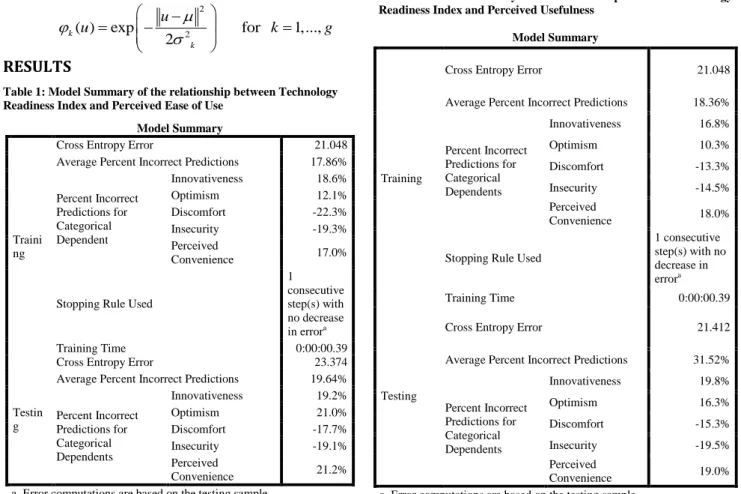
2 2 ( ) exp for 1,..., 2 k k u u k g RESULTS
Table 1: Model Summary of the relationship between Technology Readiness Index and Perceived Ease of Use
Model Summary
Traini ng
Cross Entropy Error 21.048 Average Percent Incorrect Predictions 17.86%
Percent Incorrect Predictions for Categorical Dependent Innovativeness 18.6% Optimism 12.1% Discomfort -22.3% Insecurity -19.3% Perceived Convenience 17.0%
Stopping Rule Used
1 consecutive step(s) with no decrease in errora Training Time 0:00:00.39 Testin g
Cross Entropy Error 23.374 Average Percent Incorrect Predictions 19.64%
Percent Incorrect Predictions for Categorical Dependents Innovativeness 19.2% Optimism 21.0% Discomfort -17.7% Insecurity -19.1% Perceived Convenience 21.2% a. Error computations are based on the testing sample.
In table 1, a summary of the neural network output linking the relationship between the extended technology readiness index and perceived ease of use is presented both for the training and testing components of the analysis. The emphasis is on the non-inflated testing results which indicates and overall incorrect prediction of 23.374. This means that overall all, the whole model posted an impressive prediction of 76% likelihood that high personal innovativeness about technology in general leads to higher perceived ease of use of an e-payment technology (incorrect prediction of 19.2%) and high personal optimism about technology in general leads to higher perceived ease of use of an e-payment technology (incorrect prediction of 21.0%). Similarly, the results indicate that high personal insecurity about technology in general leads to lower perceived ease of use of an e-payment technology (incorrect prediction of -17.7%) in the same way that high personal discomfort about technology in general leads to lower perceived ease of use of an e-payment technology (incorrect prediction of -19.1%). Finally, the analysis indicates that customers’ high perceived convenience about e-payment leads to a high perceived ease of use of an e-payment technology (incorrect prediction of 21.2%)
Table 2: Model Summary of the relationship between Technology Readiness Index and Perceived Usefulness
Model Summary
Training
Cross Entropy Error 21.048
Average Percent Incorrect Predictions 18.36%
Percent Incorrect Predictions for Categorical Dependents Innovativeness 16.8% Optimism 10.3% Discomfort -13.3% Insecurity -14.5% Perceived Convenience 18.0%
Stopping Rule Used
1 consecutive step(s) with no decrease in errora Training Time 0:00:00.39 Testing
Cross Entropy Error 21.412
Average Percent Incorrect Predictions 31.52%
Percent Incorrect Predictions for Categorical Dependents Innovativeness 19.8% Optimism 16.3% Discomfort -15.3% Insecurity -19.5% Perceived Convenience 19.0% a. Error computations are based on the testing sample.
The effect of technology readiness among the respondents as analysed is presented in table 2. The analysis indicates that there is an overall 79% likelihood that the independent variables predict the dependent variables. For example it is predicted that high personal innovativeness about technology in general leads to higher perceived usefulness of an e-payment technology (incorrect prediction of 19.8%) and high personal optimism about technology in general leads to higher perceived usefulness of an e-payment technology (incorrect prediction of 16.3%). Similarly, the results indicate that high personal insecurity about technology in general leads to lower perceived usefulness of an e-payment technology (incorrect prediction of -15.3%) in the same way that high personal discomfort about technology in general leads to lower perceived usefulness of an e-payment technology (incorrect prediction of -19.1%). Finally, the analysis indicates that customers’ high perceived convenience about e-payment leads to a high perceived usefulness of an e-payment technology (incorrect prediction of 19.0%)
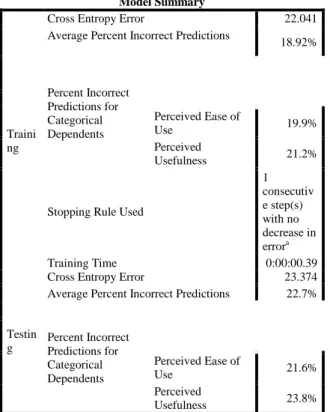
Table 3: Model Summary of the Relationship between Perceived Ease of Use and Perceived Usefulness and E-Payment Adoption
Model Summary
Traini ng
Cross Entropy Error 22.041 Average Percent Incorrect Predictions
18.92% Percent Incorrect Predictions for Categorical Dependents Perceived Ease of Use 19.9% Perceived Usefulness 21.2%
Stopping Rule Used
1 consecutiv e step(s) with no decrease in errora Training Time 0:00:00.39 Testin g
Cross Entropy Error 23.374 Average Percent Incorrect Predictions 22.7%
Percent Incorrect Predictions for Categorical Dependents Perceived Ease of Use 21.6% Perceived Usefulness 23.8% a. Error computations are based on the testing sample.
The information in table 3 on the other hand is intended to evaluate the extent to which perceived ease of use and perceived usefulness successfully predicts e-payment adoption. This is necessary to validate the final research hypotheses. The analysis
shows that in the case of both the testing and the training models, perceived ease of use and perceived usefulness positively and significantly predicts e-payment adoption. The prediction errors were 18.92% and 22.7% respectively.
Conclusion
At the heart of electronic commerce is the ability of a customer to be able to pay for goods and services unrestricted by location. Electronic payment system offers customers the convenience and flexibility to digitally pay online. Our study extended the technology readiness index and evaluated its influence on the technology acceptance model to predict user acceptance and use of e-payment technology. We observed a non-inflated overall incorrect prediction score between below 25% in both cases. It decomposed into a positive and significant relationship between personal innovativeness, personal optimism, high perceived convenience and perceived usefulness and perceived ease of use which positively influences e-payment adoption. The case of personal insecurity and personal discomfort returned negative effects and are consistent with the extant literature
References
[1]. Aboelmaged, M. G. 2014. "Predicting e-readiness at firm-level: An analysis of technological, organizational and environmental (TOE) effects on e-maintenance readiness in manufacturing firms," International Journal of Information Management (34:5), pp 639-651.
[2]. Abu-Assi, H. A., Al-Dmour, H. H., and Zu'bi, M. 2014. "Determinants of internet banking adoption in Jordan," International Journal of Business and Management (9:12), p 169.
[3]. Agarwal, R., and Prasad, J. 1999. "Are individual differences germane to the acceptance of new information technologies?," Decision sciences (30:2), pp 361-391.
[4]. Ajzen, I. 1991. "The theory of planned behavior," Organizational behavior and human decision processes (50:2), pp 179-211.
[5]. Ajzen, I., and Fishbein, M. 1975. "A Bayesian analysis of attribution processes," Psychological bulletin (82:2), p 261.
[6]. Akturan, U., and Tezcan, N. 2012. "Mobile banking adoption of the youth market: Perceptions and intentions," Marketing Intelligence & Planning (30:4), pp 444-459. [7]. Antwi, H. A., Yiranbon, E., Lulin, Z.,
Maxwell, B. A., Agebase, A. J., Yaw, N. E., and Vakalalabure, T. T. 2014. "Innovation Diffusion among Healthcare Workforce: Analysis of Adoption and Use of Medical ICT in Ghanaian Tertiary Hospitals," International Journal of Academic Research in Business and Social Sciences (4:7), p 63. [8]. Ariwa, E., Olaya, S., and Katono, I. W. 2014.
"Green Information Technology Audit and Digitalization in Small Medium Enterprise (SME): Factors That Influence Intentions to Use Hotel Websites," International Journal of Information Communication Technologies and Human Development (IJICTHD) (6:4), pp 14-20.
[9]. Arndt, T. S. 2012. "Perceived Convenience, Compatibility, and Media Richness Contribute Significantly to Dedicated E-book Reader Acceptance," Evidence Based Library and Information Practice (7:2), pp 84-86.
[10]. Aziz, M., and Macredie, R. D. Year. "Proposing a perceived ease of use factors taxonomy for information system use," SoutheastCon, 2005. Proceedings. IEEE, IEEE2005, pp. 468-476.
[11]. Baldwin, C., and Von Hippel, E. 2011. "Modeling a paradigm shift: From producer innovation to user and open collaborative innovation," Organization Science (22:6), pp 1399-1417.
[12]. Beaudry, A., and Pinsonneault, A. 2005. "Understanding user responses to information technology: A coping model of user adaptation," MIS quarterly), pp 493-524.
[13]. Calisir, F., Altin Gumussoy, C., Bayraktaroglu, A. E., and Karaali, D. 2014. "Predicting the intention to use a web‐based learning system: Perceived content quality, anxiety, perceived system quality, image, and the technology acceptance model," Human Factors and Ergonomics in
Manufacturing & Service Industries (24:5), pp 515-531.
[14]. Carver, C. S., and Scheier, M. F. 2014. "Dispositional optimism," Trends in cognitive sciences (18:6), pp 293-299. [15]. Chang, C.-C., Yan, C.-F., and Tseng, J.-S.
2012a. "Perceived convenience in an extended technology acceptance model: Mobile technology and English learning for college students," Australasian Journal of Educational Technology (28:5).
[16]. Chang, Y. P., and Zhu, D. H. 2012b. "The role of perceived social capital and flow experience in building users’ continuance intention to social networking sites in China," Computers in Human Behavior (28:3), pp 995-1001.
[17]. Chen, L.-D., and Tan, J. 2004. "Technology Adaptation in E-commerce:: Key Determinants of Virtual Stores Acceptance," European Management Journal (22:1), pp 74-86.
[18]. Cimiotti, G., and Dahl, C. N. 2016. "Paying in 2025: Scenarios for payment systems in Germany in 2025," Journal of Payments Strategy & Systems (10:3), pp 253-259. [19]. Collier, J. E., and Kimes, S. E. 2013. "Only
if it is convenient: understanding how convenience influences self-service technology evaluation," Journal of Service Research (16:1), pp 39-51.
[20]. Dabholkar, P. A., and Bagozzi, R. P. 2002. "An attitudinal model of technology-based self-service: moderating effects of consumer traits and situational factors," Journal of the academy of marketing science (30:3), pp 184-201.
[21]. Davis, B. L., and Rodriguez, T. F. 2013. "Methods and arrangements for smartphone payments," Google Patents.
[22]. Davis, F. D. 1989. "Perceived usefulness, perceived ease of use, and user acceptance of information technology," MIS quarterly), pp 319-340.
[23]. Davis, F. D., Bagozzi, R. P., and Warshaw, P. R. 1992. "Extrinsic and intrinsic motivation to use computers in the
workplace," Journal of applied social psychology (22:14), pp 1111-1132.
[24]. Dennis, C., King, T., Jayawardhena, C., Tiu Wright, L., and Dennis, C. 2007. "Consumers online: intentions, orientations and segmentation," International Journal of Retail & Distribution Management (35:6), pp 515-526.
[25]. Flood, D., West, T., and Wheadon, D. 2013. "Trends in mobile payments in developing and advanced economies," RBA Bulletin), pp 71-80.
[26]. Frame, W. S., and White, L. J. 2014. "Technological change, financial innovation, and diffusion in banking,").
[27]. Garcia, R., and Calantone, R. 2002. "A critical look at technological innovation typology and innovativeness terminology: a literature review," Journal of product innovation management (19:2), pp 110-132. [28]. Gottschalk, P. 2017. "Empirical Study of
Convenience Theory: A Student Elicitation on White-Collar Crime," Deviant Behavior), pp 1-11.
[29]. Groß, M. 2015. "Mobile shopping: a classification framework and literature review," International Journal of Retail & Distribution Management (43:3), pp 221-241.
[30]. Han, K., and Mithas, S. 2013. "Information technology outsourcing and non-IT operating costs: An empirical investigation," Mis Quarterly (37:1).
[31]. Hand, C., Dall'Olmo Riley, F., Harris, P., Singh, J., and Rettie, R. 2009. "Online grocery shopping: the influence of situational factors," European Journal of Marketing (43:9/10), pp 1205-1219.
[32]. Haruna, I. 2012. "Challenges of electronic payment systems in Ghana: The Case of e-ZWICH," American Journal of Business and Management (1:3), pp 87-95.
[33]. Hashim, J. 2015. "Information communication technology (ICT) adoption among SME owners in Malaysia," International Journal of Business and Information (2:2).
[34]. Hossain, M. M., and Prybutok, V. R. 2008. "Consumer acceptance of RFID technology: An exploratory study," IEEE transactions on engineering management (55:2), pp 316-328. [35]. Hsu, H.-h., and Chang, Y.-y. 2013. "Extended TAM model: Impacts of convenience on acceptance and use of Moodle," Online Submission (3:4), pp 211-218.
[36]. Huang, J. 2017. "How Mobile Payment Is Changing The World,").
[37]. Huang, Y.-M., Huang, Y.-M., Huang, S.-H., and Lin, Y.-T. 2012. "A ubiquitous English vocabulary learning system: Evidence of active/passive attitudes vs. usefulness/ease-of-use," Computers & Education (58:1), pp 273-282.
[38]. Hung, S.-W., and Cheng, M.-J. 2013. "Are you ready for knowledge sharing? An empirical study of virtual communities," Computers & Education (62), pp 8-17. [39]. Jahangir, N., and Begum, N. 2008. "The role
of perceived usefulness, perceived ease of use, security and privacy, and customer attitude to engender customer adaptation in the context of electronic banking," African Journal of Business Management (2:2), p 32. [40]. Jayasingh, S., and Eze, U. C. 2015. "An
empirical analysis of consumer behavioural intention towards mobile coupons in malaysia," International Journal of Business and Information (4:2).
[41]. Jih, W.-J. K. 2009. "Effects of consumer-perceived convenience on shopping intention in mobile commerce: an empirical study," in Mobile Computing: Concepts, Methodologies, Tools, and Applications, IGI Global, pp. 1840-1856.
[42]. Kamel, S. 2015. "Electronic commerce in Egypt," in Computing in Research and Development in Africa, Springer, pp. 125-141.
[43]. Kim, H.-W., Chan, H. C., and Gupta, S. 2007. "Value-based adoption of mobile internet: an empirical investigation," Decision support systems (43:1), pp 111-126.
[44]. Kim, M. J., Chung, N., Lee, C. K., and Preis, M. W. 2015. "Motivations and use context in mobile tourism shopping: Applying contingency and task–technology fit theories," International Journal of Tourism Research (17:1), pp 13-24.
[45]. King, J. L., Gurbaxani, V., Kraemer, K. L., McFarlan, F. W., Raman, K., and Yap, C.-S. 1994. "Institutional factors in information technology innovation," Information systems research (5:2), pp 139-169.
[46]. Klaus, P. 2013. "The case of Amazon. com: towards a conceptual framework of online customer service experience (OCSE) using the emerging consensus technique (ECT)," Journal of Services Marketing (27:6), pp 443-457.
[47]. Kundu, S. C., and Mor, A. 2017. "Workforce diversity and organizational performance: a study of IT industry in India," Employee Relations: The International Journal (39:2). [48]. Kuo, K.-M., Liu, C.-F., and Ma, C.-C. 2013.
"An investigation of the effect of nurses’ technology readiness on the acceptance of mobile electronic medical record systems," BMC medical informatics and decision making (13:1), p 88.
[49]. Lai, M.-L. 2008. "Technology readiness, internet self-efficacy and computing experience of professional accounting students," Campus-Wide Information Systems (25:1), pp 18-29.
[50]. Lee, J., and Allaway, A. 2002. "Effects of personal control on adoption of self-service technology innovations," Journal of Services marketing (16:6), pp 553-572.
[51]. Liljander, V., Gillberg, F., Gummerus, J., and Van Riel, A. 2006. "Technology readiness and the evaluation and adoption of self-service technologies," Journal of Retailing and Consumer Services (13:3), pp 177-191.
[52]. Mahy, Y., Ouzzif, M., and Bouragba, K. 2016. "Toward a Shared View of IT Governance," International Journal of Innovation, Management and Technology (7:4), p 125.
[53]. Martins, C., Oliveira, T., and Popovič, A. 2014. "Understanding the Internet banking adoption: A unified theory of acceptance and use of technology and perceived risk application," International Journal of Information Management (34:1), pp 1-13. [54]. Mazurek, G., and Tkaczyk, J. 2016. THE
IMPACT OF THE DIGITAL WORLD ON MANAGEMENT AND MARKETING, (Poltext.
[55]. McGowan, B. S., Wasko, M., Vartabedian, B. S., Miller, R. S., Freiherr, D. D., and Abdolrasulnia, M. 2012. "Understanding the factors that influence the adoption and meaningful use of social media by physicians to share medical information," Journal of medical Internet research (14:5), p e117. [56]. McNabb, D. E. 2016. "UK Commerce and
Industry in the New Millennium," in A Comparative History of Commerce and Industry, Volume II, Springer, pp. 55-76. [57]. Morgan-Thomas, A., and Veloutsou, C.
2013. "Beyond technology acceptance: Brand relationships and online brand experience," Journal of Business Research (66:1), pp 21-27.
[58]. Narang, B., and Arora, J. B. 2016. "Present and Future of Mobile Commerce: Introduction, Comparative Analysis of M Commerce and E Commerce, Advantages, Present and Future," in Securing Transactions and Payment Systems for M-Commerce, IGI Global, pp. 293-308.
[59]. Okazaki, S., and Mendez, F. 2013. "Exploring convenience in mobile commerce: Moderating effects of gender," Computers in Human Behavior (29:3), pp 1234-1242.
[60]. Ologeanu-Taddeï, R., Morquin, D., and Bourret, R. Year. "Understanding the Perceived Usefulness and the Ease of Use of a Hospital Information System: the case of a French University Hospital," MIE2015, pp. 531-535.
[61]. Parasuraman, A. 2000. "Technology Readiness Index (TRI) a multiple-item scale to measure readiness to embrace new
technologies," Journal of service research (2:4), pp 307-320.
[62]. Parasuraman, A., and Colby, C. Year. "Correlates and consequences of consumer attitudes toward new technologies: implications for marketing technology-based services," Frontiers in Services Conference, October, Nashville, TN1997.
[63]. Parasuraman, A., and Grewal, D. 2000. "The impact of technology on the quality-value-loyalty chain: a research agenda," Journal of the academy of marketing science (28:1), pp 168-174.
[64]. Peters, M. L., Flink, I. K., Boersma, K., and Linton, S. J. 2010. "Manipulating optimism: Can imagining a best possible self be used to increase positive future expectancies?," The Journal of Positive Psychology (5:3), pp 204-211.
[65]. Porter, C. E., and Donthu, N. 2006. "Using the technology acceptance model to explain how attitudes determine Internet usage: The role of perceived access barriers and demographics," Journal of business research (59:9), pp 999-1007.
[66]. Ramayah, T., and Ignatius, J. 2005. "Impact of perceived usefulness, perceived ease of use and perceived enjoyment on intention to shop online," ICFAI Journal of Systems Management (IJSM) (3:3), pp 36-51.
[67]. Rogers, C. R. 1962. "The interpersonal relationship," Harvard Educational Review (32:4), pp 416-429.
[68]. Rogers, E. M. 2004. "A prospective and retrospective look at the diffusion model," Journal of health communication (9:S1), pp 13-19.
[69]. San Martín, H., and Herrero, Á. 2012. "Influence of the user’s psychological factors on the online purchase intention in rural tourism: Integrating innovativeness to the UTAUT framework," Tourism Management (33:2), pp 341-350.
[70]. Sánchez, R. A., and Hueros, A. D. 2010. "Motivational factors that influence the acceptance of Moodle using TAM," Computers in human behavior (26:6), pp 1632-1640.
[71]. Scherer, M. J. 2002. Assistive technology: Matching device and consumer for successful rehabilitation, (American Psychological Association.
[72]. Shambare, R. 2013. "Technology readiness and EFTPoS usage in Zimbabwe," International Journal of Business and Economic Development (IJBED) (1:1). [73]. Straub, E. T. 2009. "Understanding
technology adoption: Theory and future directions for informal learning," Review of educational research (79:2), pp 625-649. [74]. Sumanjeet, S. 2009. "Emergence of payment
systems in the age of electronic commerce: The state of art,").
[75]. Van der Boor, P., Oliveira, P., and Veloso, F. 2014. "Users as innovators in developing countries: The global sources of innovation and diffusion in mobile banking services," Research Policy (43:9), pp 1594-1607. [76]. Venkatesh, V., Morris, M. G., Davis, G. B.,
and Davis, F. D. 2003. "User acceptance of information technology: Toward a unified view," MIS quarterly), pp 425-478.
[77]. Walczuch, R., Lemmink, J., and Streukens, S. 2007. "The effect of service employees’ technology readiness on technology acceptance," Information & Management (44:2), pp 206-215.
[78]. Wang, Y. S., Wu, M. C., and Wang, H. Y. 2009. "Investigating the determinants and age and gender differences in the acceptance of mobile learning," British journal of educational technology (40:1), pp 92-118. [79]. Wong, I. A., and Zhao, W. M. 2016.
"Exploring the effect of geographic convenience on repeat visitation and tourist spending: The moderating role of novelty seeking," Current Issues in Tourism (19:8), pp 824-844.
[80]. Xanthopoulou, D., Bakker, A. B., Demerouti, E., and Schaufeli, W. B. 2009. "Work engagement and financial returns: A diary study on the role of job and personal resources," Journal of occupational and organizational psychology (82:1), pp 183-200.
[81]. Xiang, Z., Magnini, V. P., and Fesenmaier, D. R. 2015. "Information technology and consumer behavior in travel and tourism: Insights from travel planning using the internet," Journal of Retailing and Consumer Services (22), pp 244-249.
[82]. Yang, B., Kim, Y., and Yoo, C. 2013a. "The integrated mobile advertising model: The effects of technology-and emotion-based evaluations," Journal of Business Research (66:9), pp 1345-1352.
[83]. Yang, K., and Forney, J. C. 2013b. "The moderating role of consumer technology anxiety in mobile shopping adoption: differential effects of facilitating conditions and social influences," Journal of Electronic Commerce Research (14:4), p 334.
[84]. Yaqub, J., Bello, H., Adenuga, I., and Ogundeji, M. 2013. "The cashless policy in Nigeria: prospects and challenges," International Journal of Humanities and Social Science (3:3), pp 200-212.
[85]. Yeboah, M. A., Aboagy, E. O., Ansong, M. O., Antwi, H. A., and Yiranbon, E. "Diffusion of E-Learning Technologies among Medical Students in Ghana: An Empirical Analysis,").
[86]. Yeh, R. K.-J., and Teng, J. T. 2012. "Extended conceptualisation of perceived usefulness: empirical test in the context of information system use continuance," Behaviour & Information Technology (31:5), pp 525-540.
[87]. Yoon, K. S., Duncan, T., Lee, S. W.-Y., Scarloss, B., and Shapley, K. L. 2007. "Reviewing the Evidence on How Teacher Professional Development Affects Student Achievement. Issues & Answers. REL 2007-No. 033," Regional Educational Laboratory Southwest (NJ1)).
[88]. Yousafzai, S., and Yani-de-Soriano, M. 2012. "Understanding customer-specific factors underpinning internet banking adoption," International Journal of Bank Marketing (30:1), pp 60-81.
[89]. Zhou, L., Dai, L., and Zhang, D. 2007. "Online shopping acceptance model-A critical survey of consumer factors in online
shopping," Journal of Electronic commerce research (8:1), p 41.