Marianne Ong
Jie Han
Nikos Mattheos
Bjarni E. Pjetursson
Alex Yi-Min Tsai
Ignacio Sanz
May C.M. Wong
Niklaus P. Lang
on Behalf of the ITI
Antibiotic Study Group
Effect of systemic antibiotics on
clinical and patient-reported outcomes
of implant therapy
–
a multicenter
randomized controlled clinical trial
Authors’ affiliations:
Wah Ching Tan, Marianne Ong,National Dental Centre Singapore, Singapore, Singapore
Jie Han,Peking University School of Stomatology, Beijing, China
Nikos Mattheos,Griffith University, Gold Coast, Queensland, Australia
Nikos Mattheos, May C.M. Wong, Niklaus P. Lang, Faculty of Dentistry, The University of Hong Kong, Hong Kong SAR, China
Bjarni E. Pjetursson,Faculty of Odontology, University of Iceland, Reykjavik, Iceland Alex Yi-Min Tsai,Department of Periodontology, School of Dental Medicine, National Taiwan University, Taipei, Taiwan
Ignacio Sanz,Universidad Complutense de Madrid, Madrid, Spain
ETEP Research Group Corresponding author:
Dr.Wah Ching Tan, BDS, MDS, Dr.med.dent. Consultant, National Dental Centre Singapore 5 Second Hospital Avenue
Singapore 168938 Singapore Tel.: +65 98553559 Fax: +65 64766071
e-mail: [email protected]
Key words: complications, dental implants, failures, implant dentistry, patient-reported outcomes, success, survival, systemic antibiotics
Abstract
Objectives: To determine the effect of various systemic antibiotic prophylaxis regimes on patient-reported outcomes and postsurgical complications in patients undergoing conventional implant installation.
Material and methods: Three hundred and twenty-nine healthy adults in need of conventional implant installation were randomly assigned to one of four groups: (i) preoperatively 2 g of amoxycillin 1 h before surgery (positive control, PC), (ii) postoperatively 2 g of amoxycillin immediately following surgery (test 1, T1), (iii) preoperatively 2 g of amoxycillin 1 h before and 500 mg thrice daily on days 2 and 3 after surgery (test 2, T2), (iv) preoperatively 2 g of placebo 1 h before surgery (negative control, NC). Subjects were examined clinically by blinded examiners over 8 weeks after implant installation. In addition, Visual Analogue Scales (VAS) for pain, swelling, bruising and bleeding were obtained over 14 days. ANOVA was performed for the VAS. Chi-square tests were applied for postsurgical complications.
Results: All VAS scores were low for all groups and decreased over time (P<0.001). There were no significant differences for the VAS scores between the various groups at any time point (P>0.05). There was only a significant difference in flap closure at week 4, where NC had 5% of the subjects not achieving complete wound closure compared to 0% for the three other groups (P=0.01), with no other significant differences for any postsurgical complications (P>0.05).
Conclusion: For standard single implant placement, prophylactic systemic antibiotics either before or after, or before and after the surgical procedure do not improve patient-reported outcomes or prevalence of postsurgical complications.
The use of prophylactic antibiotics against postsurgical infection has largely been advo-cated. However, the effects of such measures remain obscure, and controversial beneficial outcomes have been reported in randomized controlled clinical trials so far for oral surgi-cal procedures (Monaco et al. 2009; Siddiqi et al. 2010; Pasupathy & Alexander 2011). In the field of oral implant dentistry, the use of systemic antibiotics remains a controversial issue, and various antibiotic regimes have been propagated without providing scientific
evidence for them. Some authors (Laskin et al. 2000) reported higher survival rates with the application of preoperative antibiot-ics, while others (Gynther et al. 1998) found no difference in postoperative infection and survival rates of implants with pre- and post-treatment antibiotics when compared to a control group without them. Moreover, no additional benefits were found with the use of antibiotics when compared to controls in a recent randomized controlled clinical trial (Abu-Ta’a et al. 2008). No significant
advan-Conflicts of interest: The authors declare no conflict of interest.
Date:
Accepted 24 November 2012
To cite this article:
Tan WC, Ong M, Han J, Mattheos N, Pjetursson BE, Tsai AY-M, Sanz I, Wong MCM, Lang NP. Effect of systemic antibiotics on clinical and patient-reported outcomes of
implant therapy–a multicenter randomized controlled
clinical trial.
Clin. Oral Impl. Res.00, 2013, 1–9
tages pertaining to postsurgical infection were found with the use of perioperative antibiotics for implant surgeries, provided proper asepsis was established. Furthermore, a multicenter placebo-controlled randomized clinical trial (RCT) (Anitua et al. 2009) on antibiotic prophylaxis with placement of sin-gle dental implants confirmed no statistically significant differences for postsurgical infec-tion, adverse events, and implant failures between the groups.
These two RCTs were analyzed together with two further RCTs from Italy (Esposito et al. 2008, 2010a) in a recent Cochrane sys-tematic review (Esposito et al. 2010b) with a follow-up of at least 3 months comparing var-ious prophylactic antibiotic regimes against administration of a placebo. A statistically significantly higher number of patients with implant failures was reported in the placebo group, with a risk ratio of 0.4. The authors concluded that there is some evidence sug-gesting that the use of preoperative antibiotics may reduce implant failures. It has to be real-ized, however, that the degree of oral cleanli-ness prior to implant installation was not well documented in these studies.
At present, there is still a lack of large-scale multicenter studies to support or refute the need of antibiotic prophylaxis with con-ventional implant placement. Some authors recommended antibiotic prophylaxis with the procedure based on cohort studies and anec-dotal experience (Dent et al. 1997). With the increasing demand for oral implants world-wide and the development of antibiotic resis-tance due to indiscriminate usage, the use of antibiotics with conventional implant ther-apy should be reevaluated and proper guide-lines for implant installation established. The question of whether or not the potential benefit of antibiotic prophylaxis with conven-tional implant therapy outweighs the risk of developing antibiotic resistance remains to be determined. Moreover, there are no data on the effect of perioperative administration of systemic antibiotics in implant surgery on patient-reported outcomes.
As demonstrated in a retrospective cohort study (Powell et al. 2005), the prevalence of infection following periodontal surgery was low (2.09%). It was concluded that, although perioperative antibiotics were commonly used when performing regenerative and implant procedures, data from this and other studies suggested that there may be no bene-fit in using antibiotics for the sole purpose of preventing postsurgical infections. Likewise, it may be assumed that the use of periopera-tive antibiotics in implant installation may
be of questionable value owing to the low prevalence of infection associated with implant installation.
Based on the limitation of the present evi-dence available due to the lack of RCTs with a large subject pool, there is no clear evi-dence to recommend or contraindicate the use of antibiotics to prevent infections with oral implant placement. Neither is there any established protocol of pre-, peri-, or postop-erative administration of antibiotics.
Hence, the aims of the present multicenter RCT were to determine the effects of various systemic antibiotic prophylaxis regimes on patient-reported outcome measures (PROMs) and prevalence of postsurgical complications in patients undergoing conventional implant installation.
Material and methods
Subject populationThree hundred and twenty-nine healthy adults were consecutively admitted to seven study centers (National Dental Centre Singa-pore (NDC), SingaSinga-pore; The University of Hong Kong, Faculty of Dentistry, Hong Kong SAR; Peking University School of Stomatolo-gy, Beijing, PR China; Griffith University, Gold Coast, Queensland, Australia; Universi-dad Complutense de Madrid, Madrid, Spain; National Taiwan University, Taipei, Taiwan & University of Iceland, Reykjavik, Iceland) worldwide for conventional oral implant therapy. The subjects were recruited between August 2009 and October 2011.
Ethical aspects
The study protocol was submitted to and approved by the respective institutional review boards of the seven institutions. The subjects were all informed about the purpose of the study and the risks and benefits associ-ated with it. Informed consent was obtained for all patients.
The following admission criteria to the study were observed:
Inclusion criteria
a Medically healthy adults (ASA classifica-tion I–II), aged 19 years
b Preferably nonsmokers or previous smokers (quit 5 years), light smokers with <20 cigarettes/day
c No allergies to amoxycillin or penicillin antibiotics
d Single tooth edentulous space in the max-illa or mandible with adequate pristine bone for a standard oral implant placement
without the need of simultaneous bone augmentation (bucco-lingual dimension
7 mm, mesio-distal dimension 7 mm and height 8 mm)
Exclusion criteria
Subjects with any of the following exclusion criteria at baseline were excluded from the study:
a Medically compromised subjects (ASA clas-sification III–V)
b Subjects requiring antibiotic prophylaxis prior to dental treatment
c Subjects aged <19 years
d Heavy smokers or previous heavy smokers (quit <5 years; 20 cigarettes/day)
e Allergic to amoxycillin or penicillin antibi-otics
f Use of any form of antibiotics in the last 3 months
g Pregnant, intend to conceive or breast-feed-ing woman
h Single tooth edentulous space in the max-illa or mandible with inadequate pristine bone volume for standard oral implant placement, with a possible need for bone augmentation (bucco-lingual dimension <7 mm, mesio-distal dimension <7 mm, and height <8 mm).
The interventions involved conventional implant installation with or without antibi-otic prophylaxis. The oral implants were placed into pristine bone, without any simul-taneous bone augmentation. Only one implant system (StraumannâInstitute, Basel, Switzerland) was used to minimize confound-ing factors that might affect the outcome. The implants used had a moderately rough (SLA) surface and were in the range of 8–12 mm in length. The diameters of the implants were 3.3, 4.1 or 4.8 mm. The implants were either Standard Plusâ or Bone Levelâ implants. A one-stage implant installation protocol was employed with the placement of healing abut-ments, without the need for a second-stage procedure to expose the implant.
Investigator calibration
The study was a blinded randomized con-trolled clinical trial (RCT) with four treat-ment arms. Prior to commencetreat-ment of the study, a 2-day investigator and examiner standardization and calibration meeting was held at the National Dental Centre Singa-pore, Singapore.
Clinical procedures
The subjects were randomly assigned to one of four groups (2 test and 2 control groups):
Group 1 (positive control, PC): 2 g of amoxycillin preoperatively, 1 h prior to conventional implant placement.
Group 2 (test 1, T1): 2 g of amoxycillin immediately postoperatively.
Group 3 (test 2, T2): 2 g of amoxycillin preoperatively, 1 h prior to implant place-ment and 500 mg three times a day (8 hourly) on days 2 and 3.
Group 4(negative control,NC): 2 g of a pla-cebo preoperatively, 1 h prior to implant placement without any antibiotics. The medications were prescribed by a des-ignated clinical coordinator in each center, who was not involved as a surgeon or exam-iner. With this scheme, the investigators, the examiners and the surgeons were blinded, although the patients were not.
Randomization and Allocation concealment
All patients were recruited for comprehensive dental care. Periodontal and endodontic health was established prior to surgical inter-ventions. Following a hygienic phase, all patients were reevaluated for their oral health and healing response to periodontal therapy, and a surgical treatment plan was estab-lished. Following this, the patients were entered into the study using randomization tables allocating the patient a number with a corresponding envelope. The randomization tables were prepared for each center sepa-rately by a biostatistician (MCMW). Blocked randomization was performed in blocks of eight, whereby at every block of eight enroll-ments, there were two subjects randomly assigned to one of the four intervention groups. The envelope contained the alloca-tion to one of the four groups and was opened 1 h prior to the surgical intervention by a registered dental surgery assistant owing to the fact that one test and the two control groups had to take the medication prior to implant placement. In this way, the alloca-tion to one of the treatment groups remained obscure to the operating surgeon.
Outcome variables
Subjects were examined clinically by cali-brated examiners at week 1, 2, 4, and 8 follow-ing implant installation for postoperative complications. In addition, Visual Analogue Scales (VAS) on a score of 0-10 were obtained from the patients from day 1 through 7 and day 14.
The surgeons involved had no access to the data collection sheets or the group allocation, while the examiners had no access to the patients’ treatment records or group alloca-tion.
The parameters examined included:
•
Primary outcome variable: Patient-reported outcomes: VAS score on pain, swelling, bruising and bleeding.•
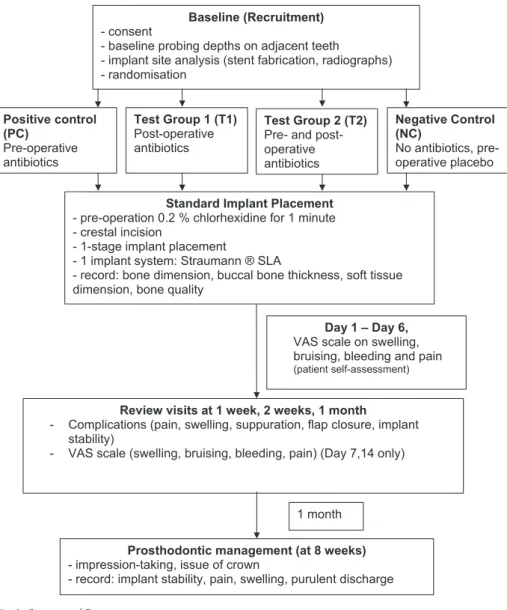
Secondary outcome variables: Clinical recordings of flap closure, pain, swelling, suppuration, and implant stability by cali-brated examiners.The sequence of events is presented in Fig. 1.
Statistical analysis
Sample size calculation and power analysis
For the sample size calculation, the power analysis was performed for a one-way fixed effects analysis of variance (ANOVA) with 4 levels. The criterion for significance was set ata=0.05 (type I error) and atb=0.20 (type II error). The analysis of variance is nondirec-tional (i.e., two-tailed) indicating that an
effect in either direction will be interpreted. If an effect of 2.5 VAS units difference (larg-est mean – smallest mean) among the four treatment groups is expected, the sample size is 45 cases per group. However, if an effect of 2.0 VAS units is expected, the sample size is 70 cases per group. Calculating a dropout rate of 20%,n=84 per group resulting in a power of 0.80 for an effect size of 2.0 VAS units at a level of significance ofa=0.05.
Statistical and analytical methods
Chi-square (or Chi-square exact) tests were used to compare the percentage distribution of postsurgical complications at weeks 1, 2, 4, and 8 among the 4 treatment groups. Repeated measures ANOVA were performed on the VAS scores with the use of multivari-ate tests (Wilk’s Lambda) for the effect of time and the interaction effect between treat-ment groups and time (all effects considered to be fixed). The above analyses were
per-Baseline (Recruitment) - consent
- baseline probing depths on adjacent teeth
- implant site analysis (stent fabrication, radiographs) - randomisation Positive control (PC) Pre-operative antibiotics Test Group 1 (T1) Post-operative antibiotics Negative Control (NC) No antibiotics, pre-operative placebo Standard Implant Placement
- pre-operation 0.2 % chlorhexidine for 1 minute - crestal incision
- 1-stage implant placement
- 1 implant system: Straumann ® SLA
- record: bone dimension, buccal bone thickness, soft tissue dimension, bone quality
Review visits at 1 week, 2 weeks, 1 month
- Complications (pain, swelling, suppuration, flap closure, implant stability)
- VAS scale (swelling, bruising, bleeding, pain) (Day 7,14 only)
Prosthodontic management (at 8 weeks) - impression-taking, issue of crown
- record: implant stability, pain, swelling, purulent discharge 1 month
Test Group 2 (T2) Pre- and post-operative antibiotics
Day 1 – Day 6, VAS scale on swelling, bruising, bleeding and pain
(patient self-assessment)
formed using SPSS. To analyze the possible center effect, a random effect for center (dif-ferent centers considered to be a random sample of centers) was added to the above repeated measures ANOVA using SAS.
Results
The surgical procedures of all 329 subjects were uneventful. 329 SLA Straumannâ implants were installed in a nonsubmerged healing modality. 81 subjects were positive control (PC), 82 subjects were test group 1 (T1), 86 subjects were test group 2 (T2), and 80 subjects were the negative control (NC).
Distribution of the subjects
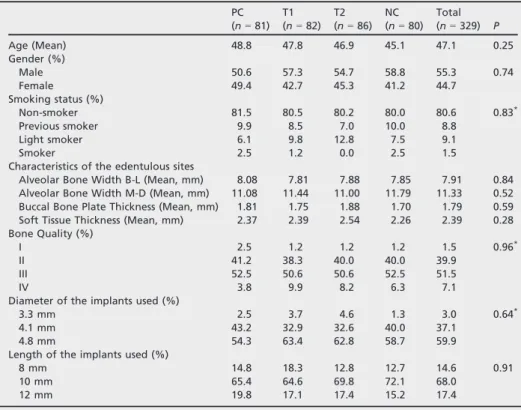
Upon analyzing the data, there were no sig-nificant differences (all P>0.05) in subject profile among the four treatment groups in terms of age, gender, smoking status, sites of implantation profile, and implant dimensions (Table 1).
The subjects were comparable in the four treatment groups in terms of demographic characteristics and clinical parameters as well.
The percentage of patients who took anal-gesics did not differ significantly (P>0.05) between the groups over the different postop-erative days (Table 2).
Postsurgical complications Flap closure
There was only one statistically significant difference (P=0.01) for flap closure at week 4, where NC had 5% of subjects not achiev-ing complete wound closure compared to 0% for the three other groups. There was no sig-nificant difference in the other time points (P>0.05) among the 4 groups either (Table 3).
Pain
There was no statistically significant differ-ence in the experidiffer-ence of pain between the 4 treatment groups at any time (P>0.05; Fig. 2). The experience of pain was present in 17.1% of all the subjects at 1 week. Pain per-ception decreased over time, and at week 8, none of the subjects complained of pain.
Swelling
There was no statistically significant differ-ence in swelling of the operation site between the four treatment groups at any time (P>0.05; Fig. 3). Swelling was present in 21.4% of all the subjects at 1 week, with T2 having the highest proportion of 27.1% and NC having the lowest proportion of 17.5%. This decreased over time, and at week 8, only 0.6% of the subjects had swell-ing noted clinically.
Suppuration
There was no statistically significant differ-ence in suppuration of the operation site between the four treatment groups at any time (P>0.05; Table 3). Less than 1% of all the subjects yielded suppuration of the opera-tion site. T1 and NC groups showed no sup-puration of the sites throughout the 8-week follow-up.
Implant stability
There was no statistically significant differ-ence in implant stability between the four groups at any time (P>0.05; Table 3). At week 1, one implant of the PC was slightly mobile, but became stable thereafter. In the NC group, two implants were slightly mobile after 2 weeks and one of them became stable thereafter. The second yielded slight mobility also after 4 weeks, but no more after 8 weeks. At 8 weeks, another implant in group NC was slightly mobile and was lost.
Patient-reported outcome measures
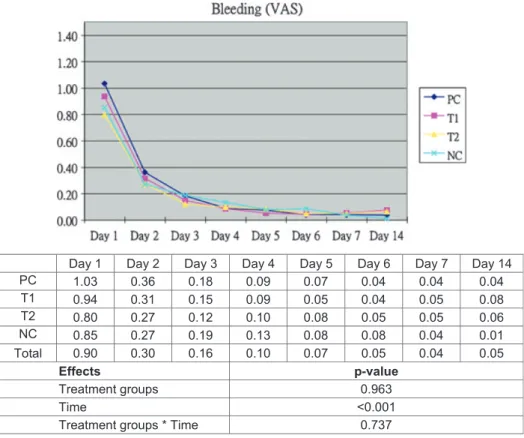
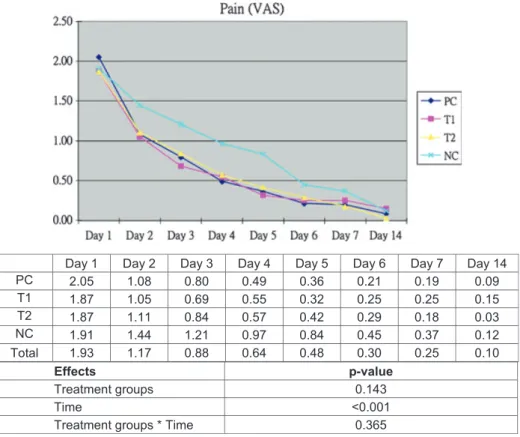
All the VAS scores reported by the patients were low. Results from the repeated measures ANOVA showed that there was no statisti-cally significant difference between the 4 treatment groups for bleeding, swelling, pain, and bruising (allP>0.05; Figs 4–7). There was a significant time effect, where the mean VAS scores decreased over time (P<0.001). How-ever, no significant interaction effect between the treatment groups and time suggested that the decrease in the mean VAS scores in differ-ent treatmdiffer-ent groups was not significantly dif-ferent from each other for all the variables assessed. When adjusted for the center effect, the same results remained that no statistically significant differences existed among the 4 treatment groups for all outcomes, but for a significant time effect (data not reported).
Discussion
The present study failed to identify any sta-tistically significant differences in patient-reported outcomes between the two treat-ment and the two control groups. This, in turn, means that the administration of pre-, peri-, or postsurgical prophylactic antibiotics did not influence the wound healing pattern and the subjective variables at all. It has to be kept in mind, however, that all the cen-ters participating in this study applied high standards of infection control practices for the implant surgical procedures. Moreover, the patients had been treated periodontally prior to the implant installation, and
chlorh-Table 1. Baseline characteristics of the subjects and clinical parameters in different groups
PC (n=81) T1 (n=82) T2 (n=86) NC (n=80) Total (n=329) P Age (Mean) 48.8 47.8 46.9 45.1 47.1 0.25 Gender (%) Male 50.6 57.3 54.7 58.8 55.3 0.74 Female 49.4 42.7 45.3 41.2 44.7 Smoking status (%) Non-smoker 81.5 80.5 80.2 80.0 80.6 0.83* Previous smoker 9.9 8.5 7.0 10.0 8.8 Light smoker 6.1 9.8 12.8 7.5 9.1 Smoker 2.5 1.2 0.0 2.5 1.5
Characteristics of the edentulous sites
Alveolar Bone Width B-L (Mean, mm) 8.08 7.81 7.88 7.85 7.91 0.84
Alveolar Bone Width M-D (Mean, mm) 11.08 11.44 11.00 11.79 11.33 0.52 Buccal Bone Plate Thickness (Mean, mm) 1.81 1.75 1.88 1.70 1.79 0.59
Soft Tissue Thickness (Mean, mm) 2.37 2.39 2.54 2.26 2.39 0.28
Bone Quality (%)
I 2.5 1.2 1.2 1.2 1.5 0.96*
II 41.2 38.3 40.0 40.0 39.9
III 52.5 50.6 50.6 52.5 51.5
IV 3.8 9.9 8.2 6.3 7.1
Diameter of the implants used (%)
3.3 mm 2.5 3.7 4.6 1.3 3.0 0.64*
4.1 mm 43.2 32.9 32.6 40.0 37.1
4.8 mm 54.3 63.4 62.8 58.7 59.9
Length of the implants used (%)
8 mm 14.8 18.3 12.8 12.7 14.6 0.91
10 mm 65.4 64.6 69.8 72.1 68.0
12 mm 19.8 17.1 17.4 15.2 17.4
exidine mouthrinses were applied prior to surgery. Consequently, a high degree of oral cleanliness was achieved.
Because there is no data on the effect of perioperative administration of systemic anti-biotics in implant surgery onpatient-reported outcomes in the literature, this study pro-vides evidence that perisurgical antibiotic
prophylaxis does not provide beneficial effects on bruising, swelling, bleeding, or pain. This statement applies to straightfor-ward implant installations in patients with no residual periodontal disease and in a clean oral environment.
The present study has further demon-strated that the perioperative administration of prophylactic antibiotics did not show any
statistically significant differences inclinical
parameters such as flap closures, suppura-tion, swelling, implant stability, and pain on palpation. Regarding implant stability, one implant in the NC group was mobile at 8 weeks and lost thereafter. Likewise, in the PC group, one implant was slightly mobile after 1 week and gained stability thereafter. While the two T1 and T2 groups did not reveal any mobile implants at any time, the NC group presented two more implants with slight mobility that reached stability thereaf-ter. Hence, it may be speculated that these slightly mobile implants were in the process of gaining biological bonding (osseointegra-tion) during the early weeks of healing, while mechanical stability was lost as a result of bone resorption in the area of implant threads (Abrahamsson et al. 2004; Lang et al. 2011). Because both positive and negative controls were affected by very few implants yielding slight mobility, this phenomenon may not be attributable to the administration of prophylactic antibiotics.
Moreover, these findings are in agreement with results from two RCTs (Abu-Ta’a et al. 2008; Anitua et al. 2009). One of these com-pared the effects of the T2 antibiotic regime in the present study to the NC group, and the second RCT compared the PC group anti-biotic regime of the present study to the NC group. In the first study (Abu-Ta’a et al. 2008), 40 patients received 1 g of amoxycillin one hour before and 2 g postoperatively for 2 days, while the control group (n=40) received a placebo drug. No significant advantages regarding postoperative infections were reported. The second RCT (Anitua et al. 2009) reported on 52 patients with and 53 patients without presurgical (one hour before) administration of 2 g of amoxycillin. Again, no statistically significant differences in post-surgical infection rates were observed.
The results of the present study were not identical to those of additional two RCTs. In the third RCT (Esposito et al. 2008), 158 patients were given 2 g of amoxycillin one hour prior to implant installment, thus repre-senting the PC group of the present study. They were compared with 158 placebo-controlled (NC) patients. Three patients in the antibiotic test group andtwo patients in the placebo group presented with postsurgical infections. However, eight patients in the control group lostnineimplants, while only
twoimplants intwopatients were lost in the test group. Although not statistically signifi-cant, a slight beneficial effect of perioperative antibiotic administration was claimed. The fact that 10 patients of 316 lost an implant
Table 2. Percentages of subjects who took analgesics.
Day 1 Day 2 Day 3 Day 4 Day 5 Day 6 Day 7 Day 14
PC 57.5 31.3 23.8 12.5 6.3 5.0 2.5 0.0 T1 46.9 27.2 16.0 13.6 7.4 6.3 5.0 1.3 T2 54.7 25.6 18.6 4.7 2.4 1.2 1.2 1.2 NC 60.8 36.3 27.5 16.3 12.5 10.0 8.8 3.8 Total 54.9 30.0 21.4 11.7 7.1 5.5 4.3 1.5 P-value 0.33 0.45 0.28 0.11 0.09 0.10* 0.07* 0.34*
*Chi-square exact test.
Table 3. Percentages of subjects with post-surgical outcome variables in the different groups at weeks 1, 2, 4, and 8 after surgery
PC (n=81) T1 (n=82) T2 (n=86) NC (n=80) Total (n=329) P Flap Closure 1 week 96.3 96.3 96.5 95.0 96.0 0.94 2 weeks 93.8 96.3 96.5 96.2 95.7 0.85 4 weeks 100.0 100.0 100.0 94.9 98.8 0.01* 8 weeks 100.0 100.0 100.0 98.7 99.7 0.24 Pain 1 week 19.8 13.6 17.6 17.5 17.1 0.78 2 weeks 3.7 2.5 2.3 1.3 2.4 0.88 4 weeks 0.0 0.0 0.0 1.3 0.3 0.24 8 weeks 0.0 0.0 0.0 0.0 0.0 N/A Swelling 1 week 21.0 19.8 27.1 17.5 21.4 0.48 2 weeks 4.9 3.7 5.8 2.5 4.3 0.80 4 weeks 2.5 1.2 3.5 1.3 2.2 0.81 8 weeks 1.2 1.3 0.0 0.0 0.6 0.61 Suppuration 1 week 0.0 0.0 0.0 0.0 0.0 N/A 2 weeks 1.2 0.0 1.2 0.0 0.6 1.00 4 weeks 1.3 0.0 0.0 0.0 0.3 0.49 8 weeks 0.0 0.0 1.2 0.0 0.3 1.00 Implant stability 1 week 98.7 100.0 100.0 100.0 99.7 0.47 2 weeks 100.0 100.0 100.0 97.5 99.4 0.38 4 weeks 100.0 100.0 100.0 98.7 99.7 0.47 8 weeks 100.0 100.0 100.0 98.7 99.7 0.47
*Statistically significant; Chi-square exact test.
Fig. 2. Percentages of subjects with pain during exami-nation at Weeks 1, 2, 4, and 8 after surgery.
Fig. 3. Percentages of subjects with swelling during examination at Weeks 1, 2, 4 and 8 after surgeries.
postoperatively represents a relatively high failure rate (3%) for the time being. The rea-sons for these infections may have been a
suboptimal periodontal infection control prior to implant installation or unsatisfactory oral hygiene practices. In the present study
with emphasis on comprehensive dental care and pre-implantation infection control, only one implant was lost of 329 resulting in a failure rate of 0.3%. Moreover, initial implant losses failing a successful incorpora-tion may be attributed to other reasons than infection, such as confounders from the sur-gical procedure. The high failure rate (3%) would suggest that this was the case in the study discussed (Esposito et al. 2008), and hence, implant losses should not be taken as evidence for the beneficial effect of prophy-lactic antibiotic coverage.
In the fourth and last RCT cited (Esposito et al. 2010a), a total of 252 test and 254 con-trol patients were enrolled, again, testing the regime of the PC group in the present study against negative controls (NC) receiving pla-cebo. Four patients in the test and eight patients in the control group experienced signs of infection with no statistically signifi-cant difference. Five patients in the test group experienced the loss of seven implants, and 12 patients with 13 implant losses were encountered in the control group. Again, it has to be realized that the failure rate through infection was 4% in that study. As mentioned above, initial implant losses may be attributed to other reasons than infection, such as confounders from the surgical proce-dure. Hence, implant losses should not be taken as evidence for a beneficial effect of prophylactic antibiotic coverage as well, even though “trends clearly favoured the antibiotic group” (Esposito et al. 2010a).
Although the prophylactic antibiotic regime was not the same in the four RCTs (one study compared T2 of the present study to NC, three studies compared PC to NC), they were meta-analyzed in a recent systematic review (Esposito et al. 2010b) for the survival (incor-poration) rate of implants under prophylactic antibiotics. The number needed to treat (NNT) to prevent one patient from losing an implant was calculated as NNT=33.
In light of the fact that early implant fail-ures may be attributed to a variety of aspects including host–parasite, surgical or even pros-thetic factors, one implant loss in the present study of over 300 implants may have occurred entirely by chance, and hence, a pre-ventive effect of the perisurgical antibiotic regimen may be highly questionable.
Because implant survival (incorporation rate) is very high in today’s clinical practice, most of the studies addressing this parameter in relation to perioperative antibiotic prophy-laxis must be considered as underpowered (Esposito et al. 2010b). Only the meta-analy-sis of four underpowered studies (Abu-Ta’a
PC T1 T2 NC
Day 1 Day 2 Day 3 Day 4 Day 5 Day 6 Day 7 Day 14
1.03 0.36 0.18 0.09 0.07 0.04 0.04 0.04 0.94 0.31 0.15 0.09 0.05 0.04 0.05 0.08 0.80 0.27 0.12 0.10 0.08 0.05 0.05 0.06 0.85 0.27 0.19 0.13 0.08 0.08 0.04 0.01 Total 0.90 0.30 0.16 0.10 0.07 0.05 0.04 0.05 e u l a v -p s t c e f f E 3 6 9 . 0 s p u o r g t n e m t a e r T 1 0 0 . 0 < e m i T 7 3 7 . 0 e m i T * s p u o r g t n e m t a e r T
Fig. 4. Mean VAS of bleeding (Bleeding-VAS) from Day 1 to Day 14.
PC T1 T2 NC
Day 1 Day 2 Day 3 Day 4 Day 5 Day 6 Day 7 Day 14
2.10 1.82 1.28 0.83 0.52 0.31 0.26 0.12 1.99 1.83 1.45 0.98 0.59 0.34 0.23 0.11 2.05 1.91 1.21 0.80 0.56 0.32 0.27 0.03 2.15 2.10 1.61 1.20 0.81 0.49 0.32 0.08 Total 2.07 1.92 1.39 0.95 0.62 0.36 0.27 0.09 e u l a v -p s t c e f f E 4 6 5 . 0 s p u o r g t n e m t a e r T 1 0 0 . 0 < e m i T 9 1 7 . 0 e m i T * s p u o r g t n e m t a e r T
et al. 2008; Esposito et al. 2008, 2010a; Ani-tua et al. 2009) revealed a risk ratio of 0.4 (95% CI: 0.19–0.84) for early implant failures.
As indicated above, these implant failures cannot be taken as evidence of the beneficial effect of perisurgical prophylactic antibiotics,
owing to the presumptive surgical confound-ers. In the meta-analysis of the four studies mentioned, the risk ratio for postsurgical infection was 0.74 (95% CI: 0.37–1.47). In this relevant parameter for the effect of peri-operative antibiotic administration, statistical significance was not reached indicating basi-cally a lack of benefit from the antibiotic regimes.
Because the primary goal of the present study was to determine the effects of various systemic antibiotic prophylaxis regimes on patient-reported outcome measures (PROMs) and postsurgical complications in patients undergoing conventional implant installa-tion, the power calculation had to be based on clinically meaningful differences in the patient-reported outcome measures rather than on survival rates of implants.
In the present study, no technical compli-cations were diagnosed within the observa-tion period irrespective of the group allocation of the patients. This may be due to the fact that only one implant system was used, thus minimizing the various possibili-ties of technical complications. On the other hand, biological complications (mucositis, peri-implantitis) have to be considered as generic and not related to implant systems (Abrahamsson et al. 1998; Albouy et al. 2008, 2009). In the present study, one case of surgi-cal complication (flap opening), one case of suppuration, two cases of swelling, and one case of implant mobility were identified in over 300 implant installations amounting to a short-term success rate of 98.5%. This may be testimony of a very meticulous presurgical periodontal and carefully performed surgical procedures leaving the oral cavity in a status of cleanliness.
In the present study, three regimens of amoxycillin were chosen as this drug is a suitable first-line antimicrobial agent demon-strating a high level of antimicrobial activity in patients with dento-alveolar infections (Kuriyama et al. 2007). Amoxycillin is indi-cated in the treatment of patients with mild to moderate infections caused by susceptible strains of microorganisms. The preoperative dosage is 2 g, one hour before treatment (Wil-son et al. 2007).
The preoperative dosage of amoxycillin applied in the present study was based on the antibiotic dosage recommendation by the American Heart Association (AHA) for pre-vention of infective endocarditis (Wilson et al. 2007). The single-dose regime used postoperatively was to test whether a postop-erative dose is equally effective compared to the positive control. The regime used in the
e u l a v -p s t c e f f E 3 4 1 . 0 s p u o r g t n e m t a e r T 1 0 0 . 0 < e m i T 5 6 3 . 0 e m i T * s p u o r g t n e m t a e r T PC T1 T2 NC
Day 1 Day 2 Day 3 Day 4 Day 5 Day 6 Day 7 Day 14
2.05 1.08 0.80 0.49 0.36 0.21 0.19 0.09
1.87 1.05 0.69 0.55 0.32 0.25 0.25 0.15
1.87 1.11 0.84 0.57 0.42 0.29 0.18 0.03
1.91 1.44 1.21 0.97 0.84 0.45 0.37 0.12
Total 1.93 1.17 0.88 0.64 0.48 0.30 0.25 0.10
Fig. 6. Mean VAS of pain (Pain-VAS) from Day 1 to Day 14.
PC T1 T2 NC
Day 1 Day 2 Day 3 Day 4 Day 5 Day 6 Day 7 Day 14
0.82 0.64 0.42 0.32 0.18 0.13 0.12 0.04 0.54 0.49 0.39 0.37 0.27 0.22 0.15 0.04 0.74 0.62 0.44 0.32 0.22 0.18 0.14 0.03 0.78 0.68 0.62 0.51 0.36 0.25 0.19 0.03 Total 0.72 0.61 0.47 0.38 0.26 0.19 0.15 0.03 Effects p-value Treatment groups 0.679 1 0 0 . 0 < e m i T 0 9 8 . 0 e m i T * s p u o r g t n e m t a e r T
T2 group was modified from the old AHA recommendation for prevention of infective endocarditis.
None of the patient-reported or clinical out-comes differed in any of the three antibiotic groups. This, in turn, means that there was no superiority for any of the prophylactic regimes. This is in agreement with previous studies (Morris et al. 2004; Binahmed et al. 2005), where the authors reported that the use of various antibiotic regimes did not affect clinical outcomes after implant installation. Up to now, predominantly 2 g of amoxycillin one hour prior to surgery has been recom-mended without scientific evidence. The results of the present study suggest that the post- and perisurgical administration of prophylactic antibiotics may elicit the same subjective and clinical effects.
In conclusion, the results of the present study question the necessity of applying peri-surgical antibiotic prophylaxis either before, at the time of or after implant installation. Because most of the patients recruited for the study belonged to the category of straightfor-ward difficulty for surgical implant installa-tion, the conclusions have to be limited to such patients.
To what extent antibiotics may be indi-cated for augmentation procedures (advanced
category) remains to be explored. Likewise, the potential influence of antibiotic prophy-laxis in patients with untreated periodontitis and poor oral hygiene or poor operation room asepsis has to be determined.
Acknowledgements:
This study hasbeen supported by a research grant of the ITI Foundation (Project 616-2009) and the Clinical Research Foundation (CRF) for the Promotion of Oral Health, Brienz,
Switzerland.
The cooperation of the staff of the centers involved in the study is highly appreciated: National Dental Centre Singapore, Department of Restorative Dentistry, ACORN secretariat; The University of Hong Kong, Faculty of Dentistry, Implant
Dentistry; Peking University School of Stomatology, Beijing, PR China, Department of Periodontology; National Taiwan University, Taipei, Taiwan, Department of Periodontology; Griffith University, Gold Coast, Queensland, Australia, Department of Periodontology; University Complutense of Madrid, Spain, Department of
Periodontology; University of Iceland, Reykjavik, Department of Reconstructive Dentistry. The cooperation of Mr. Martin
Wacker, Straumann AG, Basel, Switzerland, is gratefully acknowledged.
Appendix
The ITI Antibiotic Study Group
National Dental Centre Singapore, Singapore: Wah Ching Tan, Chu Guan Koh, Mervyn Ng, Marianne Ong, Ching Ching Tan, Li Beng Wong, Gui Feng Shen, Jia Yin Chen, Ping Liang, Audrey Ho
The University of Hong Kong, Hong Kong SAR PR China: Niklaus P. Lang, Martina Lulic, Boyd W.K. Tsang, May C.M. Wong
Peking University School of Stomatology, Beijing PR China: Jie Han, Huang Xin Meng
Griffith University, Gold Coast, Queens-land, Australia: Nikos Mattheos
Universidad Complutense de Madrid, Spain: Ignacio Sanz, David Herrera, Mariano Sanz, Fabio Vignoletti
National Taiwan University, Taipei, Taiwan: Alex Yi-Min Tsai, Cheing-Meei Liu, Po-Yao Chang, Che-Chang Tu
University of Iceland, Reykjavik, Iceland: Bjarni E. Pjetursson
References
Abrahamsson, I., Berglundh, T., Linder, E., Lang, N. P. & Lindhe, J. (2004) Early bone formation adja-cent to rough and turned endosseous implant sur-faces. An experimental study in the dog.Clinical Oral Implants Research15: 381–392.
Abrahamsson, I., Berglundh, T. & Lindhe, J. (1998) Soft tissue response to plaque formation at differ-ent implant systems. A comparative study in the dog. Clinical Oral Implants Research 9: 73–79, 281.
Abu-Ta’a, M., Quirynen, M., Teughels, W. & van Steenberghe, D. (2008) Asepsis during periodontal surgery involving oral implants and the useful-ness of peri-operative antibiotics: a prospective, randomized, controlled clinical trial. Journal of Clinical Periodontology35: 58–63.
Albouy, J.P., Abrahamsson, I., Persson, L.G. & Berglundh, T. (2008) Spontaneous progression of peri-implantitis at different types of implants. An experimental study in dogs. I: clinical and radio-graphic observations. Clinical Oral Implants Research19: 997–1002.
Albouy, J.P., Abrahamsson, I., Persson, L.G. & Berglundh, T. (2009) Spontaneous progression of ligatured induced peri-implantitis at implants with different surface characteristics. An experi-mental study in dogs II: histological observations. Clinical Oral Implants Research20: 366–371.
Anitua, E., Aguirre, J.J., Gorosabel, A., Barrio, P., Errazquin, J.M., Roman, P., Pla, R., Carrete, J., de Petro, J. & Orive, G. (2009) A multicentre pla-cebo-controlled randomised clinical trial of anti-biotic prophylaxis for placement of single dental implants.European Journal Oral Implantology2: 283–292.
Binahmed, A., Stoykewych, A. & Peterson, L. (2005) Single preoperative dose versus long-term prophylactic antibiotic regimens in dental implant surgery.International Journal Oral Max-illofacial Implants20: 115–117.
Dent, C.D., Olson, J.W., Farish, S.E., Bellome, J., Casino, A.J., Morris, H.F. & Ochi, S. (1997) The influence of preoperative antibiotics on success of endosseous implants up to and including stage II surgery: a study of 2,641 implants.Journal Oral Maxillofacial Surgery55: 19–24.
Esposito, M., Cannizzaro, G., Bozzoli, P., Checchi, L., Ferri, V., Landriani, S., Leone, M., Todisco, M., Torchio, C., Testori, T., Galli, F. & Felice, P. (2010a) Effectiveness of prophylactic antibiotics at placement of dental implants: a pragmatic multicentre placebo-controlled randomised clini-cal trial.European Journal Oral Implantology 3: 135–143.
Esposito, M., Cannizzaro, G., Bozzoli, P., Consolo, U., Felice, P., Ferri, V., Landriani, S., Leone, M.,
Magliano, A., Pellitteri, G., Todisco, M. & Tor-chio, C. (2008) Efficacy of prophylactic antibiotics for dental implants: a multicentre placebo-con-trolled randomised clinical trial.European Jour-nal Oral Implantology1: 23–31.
Esposito, M., Grusovin, M.G., Loli, V., Coulthard, P. & Worthington, H.V. (2010b) Does antibiotic prophylaxis at implant placement decrease early implant failures? A Cochrane systematic review. European Journal Oral Implantology3: 101–110. Gynther, G.W., Kondell, P.A., Moberg, L.E. &€
Heimdahl, A. (1998) Dental implant installation without antibiotic prophylaxis.Oral Surgery Oral Medicine Oral Pathology Oral Radiology End-odontics85: 509–511.
Kuriyama, T., Williams, D.W., Yanagisawa, M., Iwahara, K., Shimizu, C., Nakagawa, K., Yamam-oto, E. & Karasawa, T. (2007) Antimicrobial sus-ceptibility of 800 anaerobic isolates from patients with dentoalveolar infection to 13 oral antibiot-ics.Oral Microbiology Immunology22: 285–288. Lang, N.P., Salvi, G.E., Huynh-Ba, G., Ivanovski, S.,
Donos, N. & Bosshardt, D.D. (2011) Early osseo-integration to hydrophilic and hydrophobic implant surfaces in humans. Clinical Oral Implants Research22: 349–356.
Laskin, D.M., Dent, C.D., Morris, H.F., Ochi, S. & Olson, J.W. (2000) The influence of preoperative
antibiotics on success of endosseous implants at 36 months. Annuals Periodontology 5: 166– 174.
Monaco, G., Tavernese, L., Agostini, R. & March-etti, C. (2009) Evaluation of antibiotic prophylaxis in reducing postoperative infection after mandib-ular third molar extraction in young patients. Journal Oral Maxillofacial Surgery 67: 1467– 1472.
Morris, H.F., Ochi, S., Plezia, R., Gilbert, H., Dent, C.D., Pikulski, J. & Lambert, P.M. (2004) AICRG, Part III: the influence of antibiotic use on the sur-vival of a new implant design.Journal Oral Im-plantology30: 144–151.
Pasupathy, S. & Alexander, M. (2011) Antibiotic prophylaxis in third molar surgery.Journal Cra-niofacial Surgery22: 551–553.
Powell, C.A., Mealey, B.L., Deas, D.E., McDonnell, H.T. & Moritz, A.J. (2005) Post-surgical infec-tions: prevalence associated with various peri-odontal surgical procedures. Journal Periodontology76: 329–333.
Siddiqi, A., Morkel, J.A. & Zafar, S. (2010) Antibi-otic prophylaxis in third molar surgery: a random-ized double-blind placebo-controlled clinical trial using split-mouth technique. International Jour-nal Oral Maxillofacial Surgery39: 107–114. Wilson, W., Taubert, K.A., Gewitz, M., Lockhart, P.
B., Baddour, L.M., Levison, M., Bolger, A., Cabell, C.H., Takahashi, M., Baltimore, R.S., Newburger, J.W., Strom, B.L., Tani, L.Y., Gerber, M., Bonow, R.O., Pallasch, T., Shulman, S.T., Rowley, A.H., Burns, J.C., Ferrieri, P., Gardner, T., Goff, D. & Durack, D.T.; American Heart Association
Rheu-matic Fever, Endocarditis and Kawasaki Disease Committee, Council on Cardiovascular Disease in the Young; Council on Clinical Cardiology; Council on Cardiovascular Surgery and Anesthe-sia; Quality of Care and Outcomes Research Interdisciplinary Working Group; American Den-tal Association. (2007) Prevention of infective endocarditis: guidelines from the American Heart Association: a guideline from the American Heart Association Rheumatic Fever, Endocarditis and Kawasaki Disease Committee, Council on Car-diovascular Disease in the Young, and the Coun-cil on Clinical Cardiology, Council on Cardiovascular Surgery and Anesthesia, and the Quality of Care and Outcomes Research Interdis-ciplinary Working Group.Journal American Den-tal Association138:739–745, 747-760.