Title On Pricing Basket Credit Default Swaps
Author(s) GU, J; Ching, WK; Siu, T; Zheng, H
Citation Quantitative Finance, 2013, v. 13, p. 1845-1854
Issued Date 2013
URL http://hdl.handle.net/10722/193594
Rights
PREPRINT
This is a preprint of an article whose final and definitive form has been published in the
[JOURNAL TITLE] [year of publication] [copyright Taylor & Francis]; [JOURNAL TITLE] is
available online at: http://www.informaworld.com/smpp/ with the open URL of your article
POSTPRINT
‘This is an electronic version of an article published in [include the complete citation information for the final version of the article as published in the print edition of the journal]. [JOURNAL TITLE] is available online at:
http://www.informaworld.com/smpp/ with the open URL of your article.
arXiv:1204.4025v1 [q-fin.PR] 18 Apr 2012
On Pricing Basket Credit Default Swaps
Jia-Wen Gu
∗Wai-Ki Ching
†Tak-Kuen Siu
‡Harry Zheng
§Abstract
In this paper we propose a simple and efficient method to compute the ordered default time distributions in both the homogeneous case and the two-group het-erogeneous case under the interacting intensity default contagion model. We give the analytical expressions for the ordered default time distributions with recursive formulas for the coefficients, which makes the calculation fast and efficient in finding rates of basket CDSs. In the homogeneous case, we explore the ordered default time in limiting case and further include the exponential decay and the multistate stochastic intensity process. The numerical study indicates that, in the valuation of the swap rates and their sensitivities with respect to underlying parameters, our proposed model outperforms the Monte Carlo method.
Keywords: Basket Credit Default Swaps; Interacting Intensity; Ordered Default Time Distribution; Analytic Pricing Formula; Recursive Formula; Stochastic Intensity.
∗Advanced Modeling and Applied Computing Laboratory, Department of Mathematics, The
Univer-sity of Hong Kong, Pokfulam Road, Hong Kong. Email:[email protected].
†Advanced Modeling and Applied Computing Laboratory, Department of Mathematics, The
Univer-sity of Hong Kong, Pokfulam Road, Hong Kong. E-mail: [email protected]. Research supported in part by RGC Grants 7017/07P, HKU CRCG Grants and HKU Strategic Research Theme Fund on Computational Physics and Numerical Methods.
‡Department of Applied Finance and Actuarial Studies, Faculty of Business and Economics,
Mac-quarie University, MacMac-quarie University, Sydney, NSW 2109, Australia. Email: [email protected], [email protected],
§Department of Mathematics, Imperial College, London, SW7 2AZ, UK. Email:
1
Introduction
Modeling portfolio default risk is a key topic in credit risk management. It has important applications and implications in pricing and hedging credit derivatives as well as risk measurement and management of credit portfolios. There are two strands of literature on credit risk analysis, namely, the structural firm value approach pioneered by Black and Scholes (1973) and Merton (1974), and the reduced-form intensity-based approach introduced by Jarrow and Turnbull (1995) and Madan and Unal (1998). In the classical firm value approach the asset value of a firm is described by a geometric Brownian motion and the default is triggered when the asset value falls below a given default barrier level. In the reduced-form intensity-based approach, defaults are modeled as exogenous events and their arrivals are described by using random point processes.
The reduced-form intensity-based approach has been widely adopted for modeling portfolio default risk. Two major types of reduced-form intensity-based models for de-scribing dependent defaults are bottom-up models and top-down models. Bottom-up models focus on modeling default intensities of individual reference entities and their aggregation to form a portfolio default intensity. Some works on the bottom-up ap-proach for portfolio credit risk include Duffie and Garleanu (2001), Jarrow and Yu (2001), Sch¨onbucher and Schubert (2001), Giesecke and Goldberg (2004), Duffie, Saita and Wang (2006) and Yu (2007) etc. These works differ mainly in specifying default intensities of individual entities and their portfolio aggregation. Top-down models concern modeling default at portfolio level. A default intensity for the whole portfolio is modeled without reference to the identities of the individual entities. Some procedures such as random thinning can be used to recover the default intensities of the individual entities. Some works on top-down models include Davis and Lo (2001), Giesecke and Goldberg (2005), Brigo, Pallavicini and Torresetti (2006), Longstaff and Rajan (2007) and Cont and Minca (2008).
One of the major applications of portfolio default risk models is the valuation of credit derivatives written on portfolios of reference entities. Typical examples are collateralized debt obligations (CDOs) and basket credit default swaps (CDSs). The key to valuing these derivatives is to know the portfolio loss distribution function. The kth to default basket Credit Default Swap (CDS) is a popular type of multi-name credit derivatives. The protection buyer of a kth to default basket CDS contract pays periodic premiums to the protection seller of the contract according to some pre-determined swap rates until the occurrence of thekth default in a reference pool. Whereas, the protection seller of thekth to default basket CDS pays to the protection buyer of the contract the amount of loss due to thekth default in the pool when it occurs. Different approaches have been proposed in the literature for pricing the kth to default basket CDS under the intensity-based default contagion model. Herbertsson & Rootz´e (2006) introduce a matrix-analytic approach
to value the kth to default basket CDS. They transform the interacting intensity default process to a Markov jump process which represents the default status in the portfolio. This makes it possible to apply the matrix-analytic method to derive a closed-form expression for the kth to default CDS. Yu (2007) adopts the total hazard construction method by Norros (1987) and Shaked & Shanthikumar (1987) to generate default times with a broad class of correlation structure. He also compares this approach with the standard reduced-form models and alternative approaches involving copulas. Zheng & Jiang (2009) use the total hazard construction to derive the joint distribution of default times. They give a closed-form expression for the joint distribution of the general interacting intensity default process and an analytical formula for valuing a basket CDS in a homogeneous case.
Here we propose a simple and efficient method to derive the kth default time distri-bution under the interacting intensity default contagion model. We give the recursive formulas for the ordered default time distributions, and further derive the analytic solu-tions in a group of homogeneous entities and in two groups of heterogeneous entities. In the homogeneous case, we discuss the ordered default time in limiting case and further include the exponential decay and the stochastic intensity process. We derive the pricing formula under a two-state, Markovian regime-switching stochastic intensity model. In addition, we show that our proposed method is superior to the simulation method in studying the sensitivities of the swap rates to changes of underlying parameters.
The rest of the paper is organized as follows. Section 2 gives a snapshot for the in-teracting intensity-based default model. Section 3 discusses the homogeneous case and applies the recursive method to characterize the ordered default time distributions de-rived in Zheng & Jiang (2009). Section 4 extends the method to study the multi-state stochastic intensity process. Section 5 addresses the two-group heterogeneous case. Sec-tion 6 presents numerical experiments for the evaluaSec-tion of the basket CDS under various scenarios and the sensitivity analysis. Section 7 concludes the paper.
2
A Snapshot for Interacting Intensity-Based Default
Model
In this section, we give some preliminaries for the paper to facilitate our discussion. Let (Ω,F,{Ft}t≥0, P) be a complete filtered probability space, where we assume P is a
risk-neutral martingale measure (such a P exists if we preclude the arbitrage opportunities), and {Ft}t≥0 is a filtration satisfying the usual conditions, (i.e., the right-continuity and
P-completeness). We consider a portfolio with n credit entities. For each i= 1,2,· · ·, n, let τi be the default time of name i. Write Ni(t) = 1{τi≤t} for a single jump process
associated with the default time τi, and {Fti}t≥0 is the right-continuous, P-completed,
the common factor process for joint defaults. Write {FX
t }t≥0 for the right-continuous,
P-completed, natural filtration generated by the process {Xt}t≥0. For each t≥0, write
Ft=FtX ∨ Ft1∨. . .∨ F n t .
Here Ft represents the minimal σ-algebra containing information about the processes X
and {Ni}ni=1 up to and including time t.
We assume that for eachi= 1,2,· · ·, n,Nipossesses a nonnegative,{Ft}t≥0-predictable,
intensity process λi satisfying
E
Z t
0 λi(s)ds
<∞, t ≥0,
such that the compensated process:
Mi(t) :=Ni(t)−
Z t∧τi
0 λi(s)ds , t≥0 ,
is an ({Ft}t≥0, P)-martingale. We further assume that the stochastic process X is
“ex-ogenous” in the sense that conditional on the the whole path of X, (i.e., FX
∞), λi are
{W
iFti}t≥0-predictable.
To model the interacting intensity default process, we consider the following form:
λi(t) =ai(t) +
X
j6=i
bij(t)e−dij(t−τj)1{τj≤t}, i= 1,2, . . . , n, (1)
whereai(t) andbij(t) areFX-adapted processes, and dij are positive constants
represent-ing the rates of decay. The introduction of exponential decay into the intensity-based default process is of practical significance, which indicates once a default occur in the portfolio, its effect on the other surviving entities will decrease at a rate proportional to its present impact. Intensity rate processes in (1) determine the probability laws of the default times. To price the kth to default basket CDS, the distribution of thekth default time has to be known.
3
Homogeneous Case
In this section, we present a simple method to derive the distribution of the kth default time in a group of homogeneous entities under the interacting intensity default model. Our method is based on the kth default rate and the distribution of the random duration between two defaults, where the contagion intensity process follows:
λi(t) =a 1 + X j6=i ce−d(t−τj)1 {τj≤t} , i= 1,2, . . . , n , (2)
We note that the Markov chain approach (Herbertsson & Rootz´e(2006)) cannot solve this kind of processes with exponential decay (d > 0). Zheng & Jiang(2009) adopt the total hazard construction method to give the joint distribution of default time τk, k =
1,2, . . . , n, while finding the ordered default time distributions remains to be intractable. Here we give the recursive formula of the joint distribution of the ordered default times by our proposed method. Let λk+1(t) be the (k+ 1)th default rate at timet that triggers
τk+1. Then λk+1(t) will be the sum of the default rates of the surviving entities afterτk.
Under the homogeneous situation, given the realization of τi, i = 1, . . . , k, the (k+ 1)th
default rate is:
λk+1(t) =a(1 +Xk
i=1
ce−d(t−τi)
)(n−k),
where τk < t≤τk+1. Then we have
P(τk+1 −τk > t |τi, i= 1, . . . , k) = exp {− Z t 0 λ k+1(τk+s)ds } Thus, P(τk+1 > t | τi, i= 1, . . . , k) = exp {− Z t τkλ k+1(s)ds },
where t≥τk, which implies
fτk+1 |τi,i=1,...,k(t) =a(1+ k X i=1 ce−d(t−τi))(n−k) exp{− Z t τka(1+ k X i=1 ce−d(s−τi))(n−k)ds}, (3)
wherefτ1(t) =nae−nat.One can apply (3) to derive the joint density function ofτ1, τ2, . . . , τk+1
with the following recursion:
fτ1,τ2,...,τk+1(t1, t2, . . . , tk+1) = fτk+1|τi=t
i,i=1,...,k(tk+1)fτ1,τ2,...,τk(t1, t2, . . . , tk),
where t1 < t2 < . . . < tk+1. The unconditional density function of τk is given by the
integral: fτk(t) = Z t 0 Z tk−1 0 · · · Z t2 0 fτ 1,τ2,...,τk−1,τk(t1, t2, . . . , tk−1, t)dt1· · ·dtk−2dtk−1 (4)
Example 1 If n= 2, then the joint density function of τ1 and τ2 is:
fτ1,τ2(t1, t2) = 2a2(1 +ce−d(t2−t1)) exp{−a(t 1+t2) + acd(e−d(t2−t1)−1)}, t1 ≤t2 0, t1 > t2.
The unconditional density function of τ1 is given by
fτ1(t) = 2ae−2at,
and that of τ2 is given by
fτ2(t) = 2a2 Z t 0 (1 +ce −d(t−t1)) exp {−a(t+t1) + ac d(e −d(t−t1) −1)}dt1.
If we simplify our model by assuming that d= 0, we have the following proposition.
Proposition 1 Suppose there arenentities in our portfolio, where the contagion intensity process follows λi(t) =a 1 + X j6=i c1{τj≤t} , i= 1,2, . . . , n . (5)
The kth default time τk is the sum of k independent exponential random variables, i.e.,
τk = k−1
X
i=0
Xi,
where Xi are independent exponential random variables with ratesa(1 +ic)(n−i)
respec-tively. The the unconditional density function of τk, k=1,2,. . . ,n, satisfy the following
recursive formula:
fτk+1(t) = a(1 +kc)(n−k)
Z t
0 fτ
k(u)e−a(1+kc)(n−k)(t−u)du, (6)
where the initial condition is:
fτ1(t) =nae−nat.
Proof: We note that τk+1 −τk is independent of τi for i = 0,1, . . . , k, where τ0 is
assigned to be 0. Due to the homogeneous and symmetric properties of the entities in our portfolio, we have λk+1(t) =a(1 +kc)(n−k) for τk < t ≤τk+1. Therefore P(τk+1 −τk > t) =e−a(1+kc)(n−k)t
and this implies
fτk+1−τk(t) =a(1 +kc)(n−k)e−a(1+kc)(n−k)t. Let Xi =τi+1 −τi, then τk = k−1 X i=0 Xi,
where Xi are independent exponential random variables with rates a(1 +ic)(n−i). By
convolution, fτk+1(t) = Z t 0 fτ k(u)fτk+1−τk(t−u)du = a(1 +kc)(n−k) Z t 0 fτ k(u)e−a(1+kc)(n−k)(t−u)du, for k = 1,2, . . . , n−1, where fτ1(t) =fτ1−τ0(t) = nae−nat.
Corollary 1 Assume thatc6= 1/ifor i= 1,2, . . . , n−1. Then the unconditional density function of τk is given by:
fτk(t) =
k−1
X
j=0
αk,jae−βjat, (7)
where the coefficients are given by:
αk+1,j= αk,jβk βk−βj , j = 0,1, . . . , k−1 − k−1 X u=0 αk,uβk βk−βu , j =k βj = (n−j)(1 +jc) and α1,0 =n.
Applying the recursive formula (4) iteratively gives the above corollary in which the analytic expression are given with recursive formulas for the coefficients. From the view point of computational convenience, we can see the advantage of the recursive formulas for the coefficients. The same result is also obtained in Zheng & Jiang (2009), with
αk,j = (−1)k−1−jn!(Qk−1 m=1(1 +mc)) (n−k)!j!(k−1−j)!(Qk−1 m=0,m6=j(1 + (m+j−n)c)) .
We remark that the method to derive the recursive formula ofτk stated here is related
to the total hazard construction method adopted by Yu (2007) and Zheng & Jiang (2009). Assume we first enter the market right after thekth default of then entities. Thenτk+1−
τk is the first default time being observed. We draw a collection of independent standard
exponential random variables E1, E2, . . . , En−k. By using the total hazard construction
method, we have τk+1 −τk = min ( E1 a(1 +kc), E2 a(1 +kc), . . . , En−k a(1 +kc) ) ,
which implies that
P(τk+1 −τk > t) = n−k Y i=1 P(Ei > a(1 +kc)t) =e−a(1+kc)(n−k)t .
We note that the computational cost for the density of τk can grow up quickly, when k
is getting large. The following propositions demonstrate the behavior of τk when k and
n are large. In Propositions 2 and 3, we temporarily define τk(n) as kth default time in
a portfolio of n names.
Proposition 2 For a fixed k, when n → ∞, τk(n)
Proof: For any given ǫ >0, by Markov’s inequality, P(τk(n) ≥ǫ)≤ E[τ k(n)]2 ǫ2 From Proposition 1, E[τk(n)] = k−1 X i=0 E[Xi] = k−1 X i=0 1 a(1 +ic)(n−i) < k a(n−k), V ar[τk(n)] = k−1 X i=0 V ar[Xi] = k−1 X i=0 1 (a(1 +ic)(n−i))2 < k a2(n−k)2. Since ∞ X n=k+1 E[τk(n)2]< ∞ X n=k+1 k2 a2(n−k)2 + ∞ X n=k+1 k a2(n−k)2 <∞,
then from Borel-Cantelli Lemma, we have with probability 1, for all large n, τk(n) < ǫ.
Hence τk(n)→0 almost surely.
Proposition 3 Letk → ∞(due ton > k, in this case, n→ ∞),τk(n)→0almost surely
and in particular, τn(n)→0 almost surely as n → ∞.
Proof: From Proposition 1,
E[τk(n)] = k−1 X i=0 E[Xi] = k−1 X i=0 1 a(1 +ic)(n−i) < k−1 X i=0 1 a(1 +ic)(k−i) < 2c+ 2 a(ck+ 1)(1+ ln(1 +ck) c ). Indeed, k−1 X i=0 1 a(1 +ic)(k−i) = k−1 X i=0 1 a(ck+ 1)[ 1 k−i + c 1 +ci] = k−1 X i=0 1 a(ck+ 1)[ 1 i+ 1 + c 1 +ci] < 2c+ 2 a(ck+ 1) k−1 X i=0 1 1 +ci < 2c+ 2 a(ck+ 1)(1 + Z k 0 1 1 +cxdx) = 2c+ 2 a(ck+ 1)(1 + ln(1 +ck) c ). Similarly, V ar[τk(n)] = k−1 X i=0 V ar[Xi]< k−1 X i=0 1 (a(1 +ic)(k−i))2 < (2c+ 2)2 a2(ck+ 1)2 ∞ X i=0 1 (1 +ic)2. Since ∞ X k=1 (E[τk(n)])2 < X∞ k=1 (2c+ 2)2 a2(ck+ 1)2(1 + ln(1 +ck) c ) 2 < ∞, and ∞ X k=1 V ar[τk(n)]<X∞ k=1 (2c+ 2)2 a2(ck+ 1)2 ∞ X i=0 1 (1 +ic)2 <∞,
we have ∞ X k=1 E[τk(n)2]< ∞.
Using the same argument in the proof of Proposition 2, we can deduce that τk(n)
→ 0
almost surely when k→ ∞.
The above two propositions give us some insight about the infectious contagion, when the portfolio size becomes large, with entities inside the portfolio being associated by infection, the contagion becomes more intensive.
3.1
Stochastic Intensity
In this subsection, we extend the homogeneous contagion intensity process to the case that the constant intensity rate a is replaced by an “exogenous” stochastic process X, i.e., λi(t) =X(t) 1 + n X j=1,j6=i c1{τj≤t} . (8)
Proposition 4 Suppose there aren entities in our portfolio, where the contagion stochas-tic intensity process follows (8). Then the unconditional density functions of τk, k =
1,2, . . . , n, given the realization of (X(s))0≤s<∞, satisfy the following recursive formula: fτk+1|(X(s)) 0≤s<∞(t) = (n−k)(1 +kc)X(t) Rt 0fτk|(X(s)) 0≤s<∞(u)e −(n−k)(1+kc)RutX(s)ds du, (9) for k = 1,2, . . . , n−1, where fτ1|(X(s)) 0≤s<∞(t) =nX(t)e −nR0tX(u)du .
Proof: We note that in this case, τk+1−τk depends on the kth default time τk, in the
way that the (k+ 1)th default rate λk+1(t) follows:
λk+1(t) =X(t)(1 +kc)(n
−k) for τk < t
≤τk+1.
Then we have the following key relationship
P(τk+1−τk> t |τk,(X(s)) 0≤s<∞) = e− Rt 0λ k+1(τk+s)ds = e−(1+kc)(n−k)R0tX(τ k+s)ds .
Therefore, the density function of τk+1−τk given the realization of τk and (X(s))
0≤s<∞ is fτk+1−τk|τk,(X(s)) 0≤s<∞(t) = − dP(τk+1−τk > t|τk,(X(s)) 0≤s<∞) dt = (n−k)(1 +kc)X(τk+t)e−(n−k)(1+kc)R0tX(τ k+s)ds .
Thus the density function of τk+1 given the realization of (X(s)) 0≤s<∞, is given by fτk+1|(X(s)) 0≤s<∞(t) = Rt 0fτk|(X(s)) 0≤s<∞(u)(n−k)(1 +kc)X(t)e −(n−k)(1+kc)R0t−uX(u+s)ds du = (n−k)(1 +kc)X(t)Rt 0fτk|(X(s)) 0≤s<∞(u)e −(n−k)(1+kc)Rt uX(s)dsdu, (10) for k = 1,2, . . . , n−1, where fτ1 |(X(s))0≤s<∞(t) = fτ1−τ0|(X(s))0≤s<∞(t) =nX(t)e −nRt 0X(u)du.
Again, applying the recursive formula (10) iteratively gives the following corollary, which was obtained in Zheng & Jiang (2009).
Corollary 2 Assume that c 6= 1/i for i = 1,2, . . . , n−1. Then the density function of
τk, given FX ∞, is given by fτk|(X(s)) 0≤s<∞(t) = k−1 X j=0 αk,jX(t)e−βj Rt 0X(u)du, (11)
where αk,j and βj are given in Corollary 1.
4
Multi-state Stochastic Intensity Process
In this section, we consider the stochastic intensity process to be a multi-state Markov process. Here the state spaceS ={1,2, . . . , N}represents the set of all exogenous states. For simplicity, we reduce the number of states to two. Then the stochastic intensity process X(t) alternates between x1 and x2, so that
X(t) =
x1, when the exogenous state lies in 1
x2, when the exogenous state lies in 2.
Letηi denote the rate of leaving state i andπi the random time to leave state i, whereπi
is an exponential random variable, i.e.,
P(πi > t) =e−ηit, i= 1,2.
In this case, we consider a two-state, Markovian regime-switching, intensity-based model for portfolio default risk. Guo (1999) considers a two-state, Markovian regime-switching, model for option valuation. Here we follow her idea to derive the unconditional density function of τk. Let T
i(t) be the total time between 0 and t during which X(s) = x1,
starting from X(0) = xi. We then draw exponential random variables ξ1 with intensity
η1 and ξ2 with intensity η2 independent ofX. Therefore
T1(t) ˆ= ξ1+T2(t−ξ1), ξ1 ≤t t, ξ1 > t , T2(t) ˆ= T1(t−ξ2), ξ2 ≤t 0, ξ2 > t , (12)
where “ ˆ=” means “equals in distribution”. Let ψi(l, t) =E(e−lTi(t)), i= 1,2, l ∈ R. By Equation (12), we have ψ1(l, t) = Rt 0η1e−(η1+l)uψ2(l, t−u)du+e−(η1+l)t, ψ2(l, t) = Rt 0η2e−η2uψ1(l, t−u)du+e−η2t.
Taking the Laplace transform on both sides gives:
L(ψ1(l, t))(·, s) = l+s1+η1 + l+sη+1η1L(ψ2(l, t))(·, s), L(ψ2(l, t))(·, s) = s+1η2 +s+η2η2L(ψ1(l, t))(·, s). Therefore, L(ψ1(l, t))(·, s) = s+η1+η2 s2+sη 1+sη2+sl+lη2 .
By taking the inverse Laplace transform of the above equation, we have
ψ1(l, t) = e−αt[cos(√ωt) + β √ωsin(√ωt)], ω >0 e−αt(1 +βt), ω = 0 e−αt[cosh(√−ωt) +√β −ωsinh( √ −ωt)], ω <0, where α= η1+η2 +l 2 , β= η1+η2−l 2 , ω=lη2−α 2. Similarly we have L(ψ2(l, t))(·, s) = s+η1+η2+l s2+sη 1+sη2+sl+lη2 , and ψ2(l, t) = e−αt[cos(√ωt) + √α ωsin( √ωt)], ω >0 e−αt(1 +αt), ω = 0 e−αt[cosh(√ −ωt) +√α −ωsinh( √ −ωt)], ω <0.
We proceed with the derivation of the unconditional density function ofτk. GivenX(0) =
xi, E(e−LR0tX(s)ds) =E(e−L(x1Ti(t)+x2(t−Ti(t)))) =e−Lx2tψi(L(x1 −x2), t), L >0 . Then E(X(t)e−LR0tX(s)ds) = −1 L d(e−Lx2tψ i(L(x1 −x2), t)) dt .
Combining the results in Corollary 2, the unconditional density function of τk can be
obtained: when X(0) =xi, fτk(t) =− k−1 X j=0 αk,j βj d(e−βjx2tψ i(βj(x1−x2), t)) dt . (13)
5
The Heterogeneous Case
In this section, we present our method in obtaining the unconditional distribution of the
kth default time in the heterogeneous case of the interacting intensity default process. For simplicity of discussion, we consider a two-group case. The first group(G1) consists
n1 obligors and λi(t) denotes the default rate of name iinG1 at time t, while the second
group(G2) consists n2 obligors and ˜λi(t) denotes the default rate of namei inG2 at time
t. The interacting intensity process of the two-group case is assumed as follows:
λi(t) =a 1 +b X j6=i 1{τj≤t}+c X j 1{˜τj≤t} , ˜ λi(t) = ˜a 1 + ˜b X j 1{τj≤t}+ ˜c X j6=i 1{τ˜j≤t} , (14)
where τj and ˜τj denote the default time of name j in G1 and G2, respectively, a,˜a are
positive constants andb, c,˜b,˜care nonnegative constants. LetNibe the number of defaults
in G1 right after the ith default of our portfolio, where N0 is assigned to be 0.
Proposition 5 Suppose our portfolio has two groups of entities G1 and G2, where G1 and G2 consist of n1 and n2 obligors, respectively, and n = n1+n2. For each t ≥ 0, let
λi(t) and ˜λi(t) denote the default rates of name i in G1 and G2 at time t, respectively. These default rates follow (14). For each i = 1,2,· · ·, n, let Ni denote the number of
defaults in G1 right after the ith default of our portfolio. Then the recursive formula of the joint distribution of τk and Nk is given by:
fτk+1,Nk+1(t, m+ 1) = ˜ζk,m+1 Z t 0 fτ k,Nk(u, m+ 1)e−(ζk,m+1+˜ζk,m+1)(t−u)du +ζk,m Z t 0 fτ k,Nk(u, m)e−(ζk,m+˜ζk,m)(t−u)du, (15) where fτk,Nk(t, m) = − dP(τk> t, Nk =m) dt , ζk,m =a(n1−m)[1 +bm+c(k−m)], ˜ ζk,m = ˜a(n2−(k−m))[1 + ˜bm+ ˜c(k−m)], and fτ1,N1(t,1) =n1ae−(n1a+n2˜a)t, fτ1,N1(t,0) =n2ae˜ −(n1a+n2˜a)t, fτ1,N1(t, m) = 0, m6= 0,1.
Proof: Note that both τk+1 −τk and Nk+1 are independent of τk, but depend on Nk.
Conditioning on Nk, τk+1 −τk and Nk+1 are independent. The (k + 1)th default rate
λk+1(t) that triggers τk+1, given Nk, is given by
Hence, we have the following relations: P(τk+1 −τk> t |Nk) =e−(ζk,N k+˜ζk,N k)t and fτk+1−τk|Nk(t) = (ζk,Nk+ ˜ζk,Nk)e−(ζk,N k+˜ζk,N k)t.
On the other hand,
P(Nk+1−Nk= 1
|Nk) = P(the (k+ 1)th default happens in G
1 |Nk) = ζk,Nk ζk,Nk + ˜ζk,Nk , and similarly, P(Nk+1 −Nk= 0 |Nk) = ζ˜k,Nk ζk,Nk + ˜ζk,Nk ,
then the result follows.
Corollary 3 Assume that βk,m 6=βi,j for 1 ≤k ≤ n,max{0, k−n2} ≤m ≤ min{k, n1} and i= 0, . . . , k−1, j = 0, . . . , m. Then the joint density function of τk and Nk is given
by: fτk,Nk(t, m) = k−1 X i=0 m X j=0 αk,m,i,je−βi,jt, (16)
where the coefficients are given by the recursive formula:
αk+1,m+1,i,j = αk,m+1,i,jζ˜k,m+1 βk,m+1−βi,j +αk,m,i,jζk,m βk,m−βi,j , i= 0,1, . . . , k−1, j = 0, . . . , m αk,m+1,i,jζ˜k,m+1 βk,m+1−βi,j , i= 0,1, . . . , k−1, j =m+ 1 − k−1 X u=0 m+1 X v=0 αk,m+1,u,vζ˜k,m+1 βk,m+1−βu,v , i=k, j =m+ 1 − k−1 X u=0 m X v=0 αk,m,u,vζk,m βk,m−βu,v , i=k, j =m 0, otherwise
βi,j =ζi,j+ ˜ζi,j
and the boundry conditions are as follows:
α1,0,0,0 =n2˜a, α1,1,0,0 =n1a, α1,1,0,1 = 0, α1,m,i,j = 0, m6= 0,1, and αk+1,0,i,0 = ˜ ζk,0αk,0,i,0 βk,0−βi,0 , i= 0. . . . , k−1 − k−1 X u=0 ˜ ζk,0αk,0,u,0 βk,0−βu,0 , i=k.
As a result, the unconditional density function of τk is given by
fτk(t) =
min{k,n1}
X
m=max{0,k−n2}
6
Evaluation of Basket CDS and Sensitivity Study
Consider akth to default basket CDS with maturity T. Assume Sk is thekth swap rate,
and R is the recovery rate and r is the annualized riskless interest rate. The protection buyer A pays a periodic fee Sk∆i to the protection seller B at time ti, i = 1,2, . . . , N,
where 0 = t0 < t1 < . . . < tN =T and ∆i = ti−ti−1. If the kth default happens in the
interval [tj, tj+1], A will also pay B the accrued default premium up to τk. On the other
hand, ifτk ≤T, B will pay A the loss occurred atτk, that is, 1−R. Then the swap rate
Sk is given by Sk = (1−R)E(e−rτk 1{τk≤T}) PN i=1E(∆ie−rti1{τk>t i}+ (τ k−t i−1)e−rτ k 1{ti−1<τk≤ti}) . (17)
We remark that one can reproduce the results in Zheng & Jiang (2007) with our proposed methods in a reasonably high accuracy.
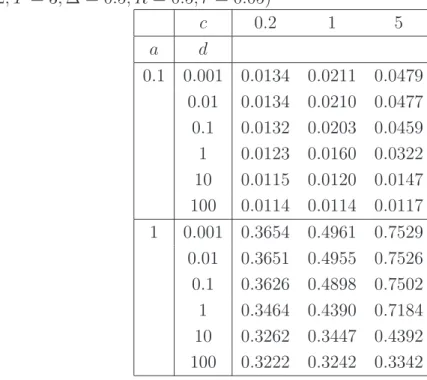
In Table 1, we present the swap rates under the intensity-based default contagion model with exponential decay. We compute the swap rates withn= 2, k= 2, by selecting different values of the parameters. One can see that when we fix a, d, the swap rate decreases while c decreases. And when a, c are fixed, the swap rate falls down while d
goes up. When c, dare fixed, the swap rate increases when a does.
Table 2 presents the swap rates under the two-state, Markovian regime-switching, intensity-based default contagion model. Condition 1 is equivalent to the homogeneous case as x1 = x2. And we can see that if x1 < x2, swap rates increase when η1 increases,
while swap rates decrease whenη2 increases.
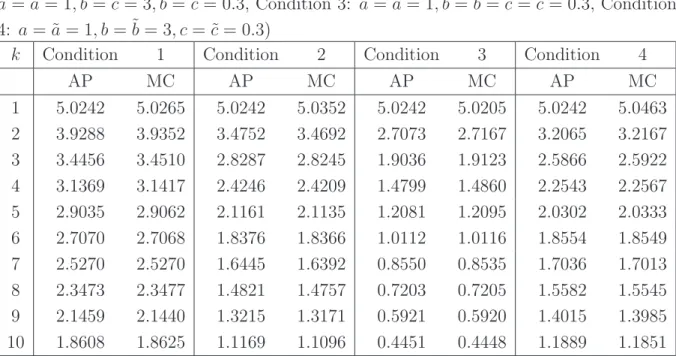
We present the swap rates under the heterogeneous intensity-based default contagion model in Table 3, where there are two groups of entities and the intensity process follows (14). We conduct our numerical experiments via selecting different value of the param-eters. As shown in Table 3, Conditions 1, 3 are equivalent to the homogeneous case for
b= ˜b =c= ˜c. Condition 2 means that defaults in each group have a significant impact on the entities of the same group, but have a marginal impact on the other group. Condition 4 shows the infection caused by entities in G1 is much more intense than those in G2.
We also make comparison on the analytic pricing approach (AP) presented previously and Monte Carlo approach (MC) in this case. The analytic approach takes less than one second to compute all the swap rates of one column with MATLAB on a computer with an Intel 3.2 GHz CPU, while the Monte Carlo approach takes more than 5 minutes to run 100,000 simulations.
To study the sensitivities of the swap rates to a change in underlying parameters, we presents the derivatives representing the sensitivities in the homogeneous case with the intensity (5). Note that
∂fτk(t) ∂a = k−1 X j=0 αk,j(1−βjat)e−βjat,
0 0.2 0.4 0.6 0.8 1 0 1 2 3 4 5 6 a theta(a) k=1 k=2 k=5 k=10 0 0.2 0.4 0.6 0.8 1 0 1 2 3 4 5 6 a theta(a) k=1 k=2 k=5 k=10
Figure 1: The derivatives of swap rates Sk with respect to a [left:AP, right:MC] (n=10,
c=0.3) and ∂fτk(t) ∂c = k−1 X j=0 (αk,j′ −αk,j(n−j)jat)ae−βjat, where α′k+1,j = αk,jγ ′ k,j+α ′ k,jγk,j, j = 0,1, . . . , k−1 − k−1 X u=0 αk,uγ ′ k,u+α ′ k,uγk,u, j =k γk,j= βk βk−βj , γk,j′ = ∂γk,j ∂c ,
and α1′,0 = 0, αk,j and βj are given in Corollary 1. Then combining (17), One can have
θk(a) =
∂Sk
∂a and θk(c) =
∂Sk
∂c .
We present the derivatives θk(a), θk(c) by using the recursive formula(AP) above (Figure
1, 2 (Left)), while we also use Monte Carlo method (MC) and difference quotient to find derivatives (Figure 1, 2 (Right)), where we select step size as 0.1 in MC for difference quotient and 100,000 simulations have been done. We remark that using the Monte Carlo method to compute the derivatives is very time consuming, and the results are unsatisfying, i.e.,θ1(c) is constant zero by definition, while the results are quite fluctuating
by Monte Carlo.
7
Concluding Remarks
In this paper we propose a simple recursive method to compute the kth default time distribution under the interacting intensity default contagion model (1). We simplify the
0 0.5 1 1.5 2 2.5 3 −0.02 0 0.02 0.04 0.06 0.08 0.1 0.12 0.14 0.16 c theta(c) k=1 k=2 k=5 k=10 0 0.5 1 1.5 2 2.5 3 −0.05 0 0.05 0.1 0.15 c theta(c) k=1 k=2 k=5 k=10
Figure 2: The derivatives of swap rates Sk with respect to c [left:AP, right:MC] (n=10,
a=0.1)
Table 1: Basket CDS rates with exponential decay intensity-based default model (n = 2, k= 2, T = 3,∆ = 0.5, R = 0.5, r= 0.05) c 0.2 1 5 a d 0.1 0.001 0.0134 0.0211 0.0479 0.01 0.0134 0.0210 0.0477 0.1 0.0132 0.0203 0.0459 1 0.0123 0.0160 0.0322 10 0.0115 0.0120 0.0147 100 0.0114 0.0114 0.0117 1 0.001 0.3654 0.4961 0.7529 0.01 0.3651 0.4955 0.7526 0.1 0.3626 0.4898 0.7502 1 0.3464 0.4390 0.7184 10 0.3262 0.3447 0.4392 100 0.3222 0.3242 0.3342
Table 2: Basket CDS rates in two-state stochastic intensity process case (n = 10, T = 3,∆ = 0.5, R = 0.5, r = 0.05, c = 3, X(0) = x1, Condition 1: x1 = 1, x2 = 1, η1 = 1, η2 =
1, Condition 2: x1 = 1, x2 = 2, η1 = 1, η2 = 1, Condition 3: x1 = 1, x2 = 2, η1 = 1, η2 = 2,
Condition 4: x1 = 1, x2 = 2, η1 = 2, η2 = 1)
k Condition 1 Condition 2 Condition 3 Condition 4 1 5.0242 5.2507 5.2409 5.4575 2 3.9288 4.1170 4.1087 4.2891 3 3.4456 3.6184 3.6106 3.7766 4 3.1369 3.3005 3.2930 3.4503 5 2.9035 3.0605 3.0532 3.2043 6 2.7070 2.8588 2.8516 2.9979 7 2.5270 2.6743 2.6672 2.8093 8 2.3473 2.4904 2.4833 2.6214 9 2.1459 2.2847 2.2775 2.4114 10 1.8608 1.9945 1.9870 2.1159
Table 3: Basket CDS rates in heterogeneous case with 2 groups (n1 = 5, n2 = 5, T =
3,∆ = 0.5, R = 0.5, r = 0.05, Condition 1: a = ˜a = 1, b = ˜b = c = ˜c = 3, Condition 2:
a= ˜a = 1, b = ˜c= 3,˜b=c= 0.3, Condition 3: a = ˜a = 1, b = ˜b=c= ˜c= 0.3, Condition 4: a = ˜a = 1, b= ˜b= 3, c= ˜c= 0.3)
k Condition 1 Condition 2 Condition 3 Condition 4
AP MC AP MC AP MC AP MC 1 5.0242 5.0265 5.0242 5.0352 5.0242 5.0205 5.0242 5.0463 2 3.9288 3.9352 3.4752 3.4692 2.7073 2.7167 3.2065 3.2167 3 3.4456 3.4510 2.8287 2.8245 1.9036 1.9123 2.5866 2.5922 4 3.1369 3.1417 2.4246 2.4209 1.4799 1.4860 2.2543 2.2567 5 2.9035 2.9062 2.1161 2.1135 1.2081 1.2095 2.0302 2.0333 6 2.7070 2.7068 1.8376 1.8366 1.0112 1.0116 1.8554 1.8549 7 2.5270 2.5270 1.6445 1.6392 0.8550 0.8535 1.7036 1.7013 8 2.3473 2.3477 1.4821 1.4757 0.7203 0.7205 1.5582 1.5545 9 2.1459 2.1440 1.3215 1.3171 0.5921 0.5920 1.4015 1.3985 10 1.8608 1.8625 1.1169 1.1096 0.4451 0.4448 1.1889 1.1851
problem in the homogeneous case with exponential decay (2) and with Markovian regime switching stochastic intensity (8). We further consider the problem in a two-group het-erogeneous case (14). We then present the numerical results for the basket CDS rates and sensitivity study using the proposed method. The main advantage of this method is that, by using the kth default rate, one can deduce the distributions of kth default times by recursive formulas with which one can easily compute CDS rates. Moreover, the proposed method can also be applied to the heterogeneous case to obtain the analytic expressions of CDS rates. Another key advantage is that, one can have the analytic formulas of the derivatives of the swap rates to the underlying parameters. The analytic formulas are fast and accurate while the Monte Carlo method is slow and inaccurate as the numerical experiment reveals.
Acknowledgment: The authors would like to thank Prof. Mark H.A. Davis for his helpful discussions and suggestions.
References
[1] F. Black and M.S. Scholes, The pricing of options and corporate liabilities, Journal of Political Economy, 81(3), 637-654, 1973
[2] D. Brigo, A. Pallavicini & R. Torresetti, Calibration of CDO tranches with the dy-namical generalized-Poisson loss model, Working Paper, Banca IMI, 2006.
[3] R. Cont and A. Minca, Reconstructing portfolio default rates from CDO tranche spreads, Working Paper, Columbia University, 2008.
[4] S. Das, D. Duffie, N. Kapadia and L. Saita, Common failings: How corporate defaults are correlated, Journal of Finance, 62, 93-117, 2007.
[5] M. Davis and V. Lo, Modeling default correlation in bond portfolios, in C. Alexander (Ed.), Mastering Risk Volume 2: Applications, Prentice Hall, 141-151, 2001.
[6] D. Duffie and N. Garleanu, Risk and valuation of collateralized debt obligations, Fi-nancial Analysts Journal, 57(1), 41-59, 2001.
[7] D. Duffie, L. Saita and K. Wang,Multi-period corporate default prediction with stochas-tic covariates, Journal of Financial Economics, 83(3), 635-665, 2006.
[8] K. Giesecke and L. Goldberg,Sequential defaults and incomplete information, Journal of Risk, 7(1), 1-26, 2004.
[9] K. Giesecke and L. Goldberg, A top down approach to multi-name credit, Working Paper, Stanford University, 2005.
[10] Guo, X. (2001), Information and option pricing, Quantitative Finance, 1(1), pp. 38-44.
[11] Herbertsson, A. and Rootzen, H.(2006), Pricing kth-to-default swaps under de-fault contagion: the matrix-analytic approach. Working paper. 11(2). http :
//www.math.chalmers.se/ rootzen/papers/Herbertsson Rootzen 2006.pdf.
[12] R.A. Jarrow and S.M. Turnbull, Pricing derivatives on financial securities subject to credit risk, Journal of Finance, 50, 53-86, 1995.
[13] R.A. Jarrow and F. Yu, Counterparty risk and the pricing of defaultable securities, Journal of Finance, 56(5), 555-576, 2001.
[14] F. Longstaff and A. Rajan, An empirical analysis of collateralized debt obligations, Forthcoming, Journal of Finance, 2007.
[15] D. Madan and H. Unal, Pricing the risks of default, Review of Derivatives Research, 2(2-3), 121-160, 1998.
[16] R.C. Merton, On the pricing of corporate debt: the risk structure of interest rates, Journal of Finance, 29(2), 449-470, 1974.
[17] Norros, I. (1986), A compensator representation of multivariate life length distribu-tions, with applications, Scand. J. Stat., 13, pp. 99-112.
[18] P. Sch¨onbucher and D. Schubert, Copula-dependent default risk in intensity models, Working paper, Universit at Bonn, 2001.
[19] Shanked, M. and Shanthikumar, G. (1987), The multivariate hazard construction, Stoch. Proc. Appl, 24, pp. 241-258.
[20] Yu, F. (2007), Correlated defaults in intensity-based models, Mathematical Finance, 17(2), pp. 155-173.
[21] Zheng, H. and Jiang, L. (2009), Basket CDS pricing with interacting intensities, Finance and stochastics, 13, pp. 445-469.
![Figure 1: The derivatives of swap rates S k with respect to a [left:AP, right:MC] (n=10, c=0.3) and ∂f τ k (t) ∂c = k −1X j=0 (α k,j′ − α k,j (n − j)jat)ae −β j at , where α ′ k+1,j = α k,j γ k,j′ +](https://thumb-us.123doks.com/thumbv2/123dok_us/1180448.2658405/16.918.154.765.130.381/figure-derivatives-swap-rates-respect-left-ap-right.webp)