Maejo International
Journal of Science and Technology
ISSN 1905-7873 Available online at www.mijst.mju.ac.th Review
Current STR-based techniques in forensic science
Phuvadol Thanakiatkrai* and Thitika Kitpipit
Department of Applied Science, Faculty of Science, Prince of Songkla University, Thailand * Corresponding author, e-mail: [email protected]; [email protected]
Received: 30 April 2012 / Accepted: 28 December 2012 / Published: 2 January 2013
Abstract: DNA analysis in forensic science is mainly based on short tandem repeat (STR) genotyping. The conventional analysis is a three-step process of DNA extraction, amplification and detection. An overview of various techniques that are currently in use and are being actively researched for STR typing is presented. The techniques are separated into STR amplification and detection. New techniques for forensic STR analysis focus on increasing sensitivity, resolution and discrimination power for suboptimal samples. These are achieved by shifting primer-binding sites, using high-fidelity and tolerant polymerases and applying novel methods to STR detection. Examples in which STRs are used in criminal investigations are provided and future research directions are discussed.
Keywords: forensic science, DNA, STRs, STR amplification, STR detection
INTRODUCTION
Since the beginning of forensic DNA in 1985, the non-coding regions of DNA have been used for forensic identification due to the variation between individuals found in these regions [1]. Four things contribute to making DNA an excellent source of information that aids individualisation in forensic science: (1) almost no difference in DNA between cell types, (2) individual’s DNA do not generally change throughout his or her lifetime, (3) resistance of DNA to degradation as compared to proteins and (4) high variations among individuals and between species [2-5].
The variations mainly used in forensic science are microsatellites or short tandem repeats (STRs). They occupy about three per cent of the human genome and occur on every 10,000 nucleotides [6]. STRs selected for forensic purposes have been shown to have minimal linkages with diseases and are mainly in non-coding regions [7]. Other conditions include high heterozygosity, distinguishable alleles and the ability to be robustly amplified. The current forensic STRs are a
combination of traditionally selected ones and the ones recommended by national and international organisations through a more detailed study of the STRs for favourable characteristics [8].
The aim of this review is to provide an overview of the techniques that are currently available for STR typing in forensic science as well as the applications of STR typing to actual casework. Techniques for STR typing are divided into two parts – amplification and detection. Although there is an overlap in some techniques, the ultimate goal of a forensic STR analysis is a rapid, robust, cheap and portable amplification with simple interpretation. The polymerase chain reaction (PCR) is the vital support for all amplification techniques, from low copy number to rapid and direct amplification. Regarding detection, sequencing techniques such as pyrosequencing, next-generation sequencing and mass spectrometry have become increasingly cheaper by the year and could replace fragment length analysis, which is the current standard, in the future. The applications of STR typing are also highlighted.
TECHNIQUES FOR FORENSIC STR TYPING
STR Amplification
PCR is a technique that enzymatically multiplies a target region of the DNA template, generating millions or more copies of a particular DNA sequence [9]. PCR consists of cycles of repeated heating and cooling for DNA melting and enzymatic replication of the DNA, leading to an exponential increase of the target region. This targeting is achieved by specific primers which are single-stranded oligonucleotides designed to bind to the complementary DNA sequence on template DNA.
The success of PCR amplification depends on both DNA template quantity and quality. Degraded DNA samples, such as those exposed to the environment, give a distinctive allele and/or locus dropout at the larger loci [10, 11]. A mixture of repair enzymes, e.g. ligase, could theoretically repair these DNA damages. Westen and Sijen [12] evaluated two commercial repair mixes and reported minimal improvements, but modifications by Diegoli et al. resulted in a two to three times increase in peak heights and recovery of lost alleles [13].
Another inevitable problem faced by forensic scientists during the PCR process is the presence of PCR inhibitors such as heme in blood, humic acid from soil and calcium from bones [14-16]. These inhibitors are usually removed from DNA samples during the purification process, although they can be carried over into subsequent reactions. The mechanisms of inhibition have only been characterised recently [15, 16]; for example, humic acid binds DNA and produces sequence-specific inhibition, while calcium interferes with the binding of magnesium by the Taq polymerase.
Another problem associated with PCR amplification is stutter formation – an artefact peak usually seen at one unit shorter in length than the true allele. Even though stutters are well known and documented [10, 17, 18], the factors that influence their formation have not been studied until recently. Brookes et al. [19] found that increased repeat number and A-T content of synthetic oligomers are correlated with increased stutter formations, while interruption to the repeat units decrease stutters. As one can see, forensic scientists are not only pushing the technology but also trying to explain the mechanisms of the phenomena associated with the STR typing process.
Low Copy Number (LCN) / Low Template DNA (LT-DNA)
Low copy number (LCN) analysis, first proposed by Gill et al. [17], involves using 34 PCR cycles instead of the manufacturer’s recommendation of 28 cycles (SGM Plus kit, Applied Biosystems, USA). Optimally 0.5 to 2 ng of DNA is needed for a full STR profile but with LCN techniques suboptimal amounts (<0.1 ng) can be analysed. Nevertheless, there are many caveats associated with the utilisation of this technique [20]. The most common problems tied to LCN analysis are increased stutters, allelic and locus dropout, and allelic dropin and complexity in interpretation of the results [17, 21]. Other techniques such as whole genome amplification [22] and post-PCR purification [23, 24] have been tried to overcome these problems, although they also suffer from the same analytical difficulties. In addition, Thanakiatkrai and Welch [25, 26] explored the possibility of nucleosome protection on forensic STRs as an alternative to LCN, but they did not find any significant difference between the protected and unprotected STR loci.
There is also much confusion about the term LCN analysis among reporting scientists, judicial personnel and the media whether it refers to a specific technique (34 cycles), specific interpretation criterion or the stochastic effect observed [27]. Due to these issues, the UK court questioned the reliability, reproducibility and lack of validation of LCN method in the landmark Omagh trial [28], sparking a review of the LCN method [29]. The forensic science community has responded feverishly to these issues [30, 31]. A wider term called “low template DNA” (LT-DNA) has been proposed when referring to samples with low amount of DNA, in which a stochastic effect is expected and seen regardless of the method used to generate STR profiles [29, 31].
Recent attempts have been made to clarify ambiguous terms and to introduce statistics-based interpretation criteria [10, 31, 32]. Gill and Buckleton [33] have suggested that a single universal interpretation rule be accepted and used without referring to the term LCN. However, a few forensic scientists believe ‘general acceptance’ has not been reached and implementation of the proposed statistical frameworks is not widely carried out [34]. Currently, there is no indication of the debate abating [35-37]. Even though some scientists oppose the use of LCN, the general consensus among prominent forensic scientists is acceptance of the technique but care must be taken in interpreting the results. The judicial system is also in favour of LCN analysis in recent years [38, 39].
Mini-STRs
Conventional STR kits fail to yield desirable results in the case of highly degraded samples such as those from burnt human remains, stains or remains exposed to the environment and DNA samples co-mingled with environmental contaminants [40-44]. In order to amplify successfully, the DNA sequence targeted must be intact [45]. Reducing the size of the PCR products by redesigning the primers to bind as close to the repeat sequence as possible has shown an improvement with these types of samples [42, 44, 46, 47]. This is due to the fact that the amount of flanking region in the target sequence that must be intact is kept to a minimum and thus is less prone to random degradation. The minimum size limit of a mini-STR is therefore the repeat units themselves plus the forward and reverse primers. Nonetheless, the regions closer to the repeat units are more prone to mutation (base polymorphism, partial repeat, mononucleotide stretches and insertion/deletion [41, 48]). Therefore, concordance and validation studies are necessary with new mini-STRs.
Larger STR multiplexes (e.g. PowerPlex® 16) move the primers away from the repeat regions in order to avoid overlapping sizes and thus one dye can be used for many loci. This allows
more than ten loci to be amplified and detected simultaneously for a very low match probability of less than one in a billion. Mini-STR multiplexes – generating products in the regions of 100-200 bp – sacrifice discrimination power for higher success rates in amplifying inhibited or degraded DNA samples [6]. Because most of the amplicons are the same size, only one to two loci can be tagged with one of the five dyes available. This means that a maximum of about ten loci can be amplified and detected simultaneously with conventional capillary electrophoresis. Table 1 shows the discrimination power and number of loci for mini-STR and STR commercial kits.
Table 1. The number of loci (excluding amelogenin), the number of fluorescent dyes used, the size standard, the longest amplicon and the discrimination power (for US Caucasian) of some commercial STR and mini-STR kits
Kit STR loci Dyes Size standard Max amplicon
size Discrimination power S5 4 3 ROX 600 260 bp 1 in 1.9 x 10⁵ MF 8 5 LIZ 500 260 bp 1 in 1.2 x 10¹⁰ SGM+ 9 4 ROX 500 353 bp 1 in 3.3 x 10¹² NGM 15 5 LIZ 500 352 bp 1 in 4.5 x 10¹⁸ ESI 15 5 LIZ 500 383 bp 1 in 1 x 1018 ESX 15 5 LIZ 500 410 bp 1 in 1 x 10¹⁸ Q-ESS 15 5 BTO 550 440 bp 1 in 6.25 x 10¹⁸ PP-16 15 4 CXR 600 474 bp 1 in 1.8 x 10¹⁷
Note: S5 = PowerPlex® S5, MF = ABI MiniFiler™, SGM+ = ABI SGM Plus®, NGM = ABI NGM™, ESI/ESX = PowerPlex® ESI/ESX, Q-ESS = Qiagen Investigator ESSplex Plus and PP-16 = PowerPlex® 16 (information from each kit’s manual)
Rapid Thermal Cycler and Direct PCR
In order to lessen the amount of time required for a DNA profile to be generated, recent shifts have been made towards fast (rapid) thermal cycler. Without any backlog, a DNA profile can be obtained in about 8-12 hours using conventional method. The major part of this is taken by PCR amplification (usually about 3-4 hours) while Vallone et al. [49] could complete it in about 36 minutes. This protocol did not significantly affect intra- and inter-locus balance but there was a decrease in sensitivity and increase in incomplete adenylation products (-A). Verheij et al. [50] have shown that the whole STR typing process can be completed in two to three hours by employing direct PCR with a fast PCR protocol in combination with regulating sample input through mini-tape. They have validated the technique and it is currently available to the police [50].
These rapid processes would not have been successful without the change in the polymerase enzyme. Many alternatives to AmpliTaq Gold, the current standard in forensic genetics, have been proposed by various researchers. For example, Vallone et al. [49] used PyroStart and SpeedSTAR, while Verheij et al. [50] favoured Phusion® Flash polymerase. Other mutant polymerases have been shown to overcome PCR inhibitors better than wildtype Taq [51] and AmpliTaq Gold [52, 53].
All these involve the use of direct amplification, in which samples are added directly to the PCR process without prior purification. Widely used in microbiology, direct amplification has only
recently found its way to forensic samples due to alternative polymerases and buffer [54]. Blood on FTA papers as well as DNA deposited on various substrates (glass, plastic, ceramic and stainless steel) have been successfully amplified and profiled using direct PCR [55, 56]. The reason why direct PCR works well for trace samples is the inefficiency of the extraction process, in which only 16% of DNA presented in the pre-extracted sample is recovered [56-58]. With the aid of inhibitor resistant polymerases and enhanced buffer, it will not be surprising to find more direct PCR commercial kits replacing the current ones, at least with reference samples [59].
STR detection
Fluorescent-based fragment analysis
Primers in STR kits are labelled with dyes of different colours. These dyes are excited by laser and the emission spectra are detected via a sensor in an automated gel analyser such as the ABI 3130. The passing of fluorescent dye-labelled products through the capillary depends on the size of the PCR products, with smaller products moving quicker through the polymer in the capillary than larger ones. Size separation of mini-STRs can be aided by the addition of non-nucleotide linkers (NNL), oligomeric hexaethyleneoxide (HEO) molecules that change the mobility characteristics of PCR products [60]. As a consequence, similar-size mini-STR products can be visualised in an electropherogram as if they had different sizes [6]. The MiniFiler™ and the NGM™ kit from Applied Biosystems utilise NNLs in order to amplify and visualise many mini-STR loci using five dyes [61]. Fragment analysis, peak heights in particular, has been shown to be dependent upon the genetic analysers used [62].
Pyrosequencing
Pyrosequencing is a real-time sequencing method for a short strand of DNA based on the synthesis of its complementary strand [63]. It is achieved by the combination of a sequencing primer, four deoxynucleotide triphosphates (dNTPs), adenosine 5’ phosphosulfate (APS), luciferin, four enzymes DNA polymerase, ATP sulfurylase, luciferase and apyrase. First, the four deoxyribonucleotide triphosphates (dNTPs) are added to the reaction one base at a time. The correct complementary dNTP is incorporated with the DNA template by the DNA polymerase and produces pyrophosphate (PPi) as a by-product. ATP sulfurylase then converts PPi to ATP, which is then used to change luciferin to oxyluciferin. This generates a chemiluminescent signal (visible light) proportional to the amount of ATP. The light is detected by camera and interpreted as a peak on the pyrogram. Apyrase is added to degrade excess dNTPs and the reaction can start again with a new dNTP. Pyrosequencing has been used to genotype 10 STRs of 114 Swedish individuals [64]. The advantage over current capillary detection system is the ability to detect the actual sequence and variant alleles [64].
Mass spectrometry
Mass spectrometry (MS) was first used to separate STR alleles but the size limitation (100 bp) of the instrument at that time made the analysis difficult [65]. Using electrospray ionisation (ESI) instead of matrix-assisted laser desorption-ionisation (MALDI) has allowed up to 250 bp of products to be injected [66]. In mass spectrometry, the mass-to-charge ratios (determined via time of flight) of
PCR products that have been heated into gas phase and ionised by ESI or MALDI are measured in a vacuum. Because this detection is carried out using mass rather than size, there is better separation of STR alleles with internal sequence polymorphisms [66]. An automated ESI-MS system that is backward compatible with capillary electrophoresis and capable of analysing all 13 CODIS loci has been developed recently [67].
Microchip device
The ultimate goal for DNA analysis is to achieve a rapid result using a portable device. Recently this goal is being realised via the use of rapid PCR and a microfluidic system, in which all the steps of a conventional DNA analysis is performed in a small microchip [68-70]. These systems use miniaturised circuitry to automate the extraction and PCR cycling in their dedicated chambers [71]. These devices have been shown to work with whole blood and semen, both of which are complex samples, and with commercial STR kits [70].
APPLICATIONS
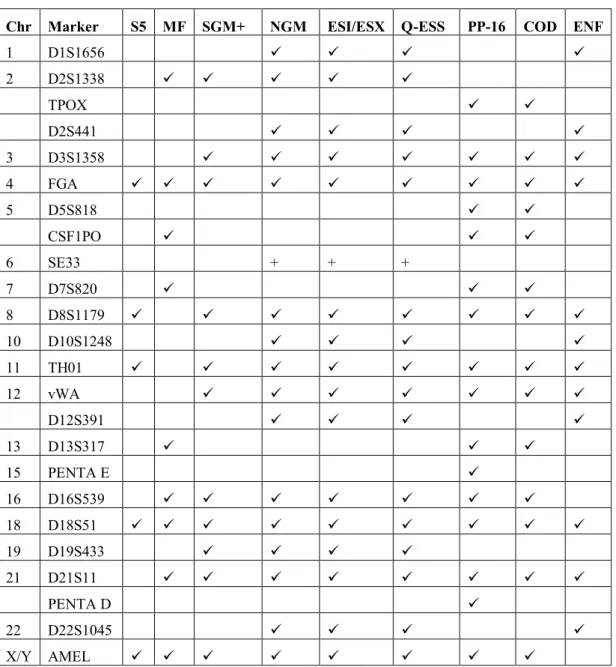
Commercial STR typing kits are available from companies such as Promega Corporation (WI, USA) and Applied Biosystems (CA, USA) [72-74]. The kits currently in use include PowerPlex® 16, PowerPlex® Y, AmpFlSTR® Identifiler®, AmpFlSTR® SEfiler™ and AmpFlSTR® SGM Plus® (SGM+). These kits are different in the STR loci that they amplify (Table 2). They have been validated to be very sensitive and are capable of STR typing from aged and degraded samples [75, 76].
In the past few years, commercial manufacturers worked closely with the forensic DNA community to develop two next-generation kits, viz. AmpFlSTR® Next Generation Multiplex™ (Applied Biosystems) and PowerPlex® ESX/ESI (Promega Corporation), both of which utilise mini-STR technology and have been validated for casework [75, 76]. Tvedebrink et al. [77] compared the performance of the two kits and found no substantial differences.
The intended purpose of the kit should be considered when selecting and adopting an STR kit. For instance, if extra discrimination power is required, the NGM™, ESX and ESI kits should be the first choices [78]. Nonetheless, the MiniFiler™ kit works well as an adjunct kit for degraded samples, as the loci in the kit are mini-STRs of the largest loci in the SGM+ and Identifiler® kits, plus additional CODIS loci. In the case of cross-border data sharing in Europe, the NGM™, ESX, ESI and ESSplex kits are most appropriate because they all amplify the same loci, all of which overlap with both CODIS and ENFSI recommendations (Table 2). In contrast, the S5 kit, which is the least discriminatory but at the same time the cheapest, is perfect for screening samples to exclude individuals in casework scenarios, in preliminary mass screenings and mass disaster screenings.
Table 2. The markers of each next-generation and mini-STR kit compared to two current standard kits (SGM Plus® and PowerPlex® 16) and two recommendations (COD = CODIS and ENF = ENFSI). A tick mark () indicates inclusion in the set. Plus (+) is optional inclusion. Chr = chromosome
Chr Marker S5 MF SGM+ NGM ESI/ESX Q-ESS PP-16 COD ENF
1 D1S1656 2 D2S1338 TPOX D2S441 3 D3S1358 4 FGA 5 D5S818 CSF1PO 6 SE33 + + + 7 D7S820 8 D8S1179 10 D10S1248 11 TH01 12 vWA D12S391 13 D13S317 15 PENTA E 16 D16S539 18 D18S51 19 D19S433 21 D21S11 PENTA D 22 D22S1045 X/Y AMEL
The Innocence Project, a non-profit law clinic whose main objective is to exonerate wrongfully convicted individuals, has used STR and mini-STR kits. As of January 31, 2012, there have been 289 post-conviction DNA exonerations, with an average of 13.5 years served by the exonerees [65]. Mini-STRs mainly feature in mass disasters and cases where DNA is limited. They have been used for identification of 19,963 human remains from the World Trade Centre incident [66, 79]. There have been over 10 mass disasters, both natural and man-made, where STRs have played a major role [66]. A staggering 20,000 remains have been analysed and the number is rapidly increasing with each passing year [66]. Other difficult sample types successfully amplified include charred femur [80], buried and exposed femurs and a tibia [81], severely degraded skeletons [82], and human telogen hairs [47].
An alternative to autosomal STRs, especially in the case of paternity testing, are Y-STRs and X-STRs. Numerous population studies have been carried out, for example in China, Brazil, Italy, Spanish-Portuguese speaking countries, Japan and the United States [83-85]. A reference database for Y-STR haplotypes was established in 2000 and currently houses nearly 100,000 haplotypes from all over the world [86]. Y-STRs are useful for separating the male component from a mixed stain and also in paternity testing [87, 88]. Commercial kits that type the minimal Y haplotype (minHt), SWGDAM recommended loci, and other highly polymorphic markers are currently available [89]. X-STRs have been demonstrated that they can be used in degraded DNA found in real casework [84].
In addition to human applications, STRs of other organisms have aided criminal investigations. Fifteen canine STRs were used to assess 52 cases of canine bites [90]. Another ten canine STRs were used in a case involving the death of a 7-year-old by dog attack [91]. Similarly, the death of a 3-month-old baby by a miniature dachshund was aided by the use of STRs [92]. A very recent panel of 16 bovine STRs, as well as 17 equine STRs, have been recommended for use in forensic identification (e.g. paternity testing and breed identification) and a population study subsequently carried out [93, 94]. Another study demonstrated that equine STRs can be typed from blood, urine and hair for controlling doping of racehorses [95]. Cannabis sativa, an important plant in forensic science, has its STRs characterised and an STR kit developed validated [96]. An Australian DNA database for tracking C. sativa specimens is even available [97].
CONCLUSIONS
Forensic DNA analysis has come a long way since its inception by Sir Alec Jeffreys. With the advent of PCR, miniscule amounts of body fluid and even skin flakes can now be used to link crimes and individuals. STRs are the de facto standard due to their being established in national DNA databases worldwide; thus, they are here to stay. Methodologies from other fields of science have made their way to the forensic community, resulting in an ever better method for STR genotyping. Undoubtedly, some of the techniques described here will find their way to mainstream uses while others will fall out of favour. With the current focus on quicker analysis time and portability, we envision that STR typing will be developed in three areas: (1) a portable system for on-scene analysis, (2) high-throughput analysis of reference samples using direct PCR, and (3) more sensitive and inhibitor tolerant protocols for use with casework samples.
REFERENCES
1. A. Jeffreys, V. Wilson and S. Thein, "Hypervariable minisatellite regions in human DNA", Nature, 1985, 314, 67-73.
2. A. Linacre, "Forensic Science in Wildlife Investigations", 1st Edn., CRC Press, Boca Raton, 2009, p. 178.
3. A. M. T. Linacre, "Application of mitochondrial DNA technologies in wildlife investigations– species identification", Forensic. Sci. Rev., 2006, 18, 1-8.
4. G. J. Adcock, E. S. Dennis, S. Easteal, G. A. Huttley, L. S. Jermiin, W. J. Peacock and A. Thorne, "Mitochondrial DNA sequences in ancient Australians: Implications for modern human origins", Proc. Natl. Acad. Sci. U. S. A., 2001, 98, 537-542.
5. I. V. Ovchinnikov, A. Gotherstrom, G. P. Romanova, V. M. Kharitonov, K. Liden and W. Goodwin, "Molecular analysis of Neanderthal DNA from the northern Caucasus", Nature, 2000, 404, 490-493.
6. J. Butler, "Forensic DNA Typing: Biology, Technology, and Genetics of STR Markers", 2nd Edn., Elsevier, Burlington, 2005, p. 660.
7. M. Klintschar, U. D. Immela, M. Kleiber and P. Wiegand, "Physical location and linked genes of common forensic STR markers", Int. Congr., 2006, 1288, 801-803.
8. P. Gill, L. Fereday, N. Morling and P. M. Schneider, "The evolution of DNA databases--recommendations for new European STR loci", Forensic Sci. Int., 2006, 156, 242-244.
9. K. Mullis, F. Ferre and R. Gibbs, "PCR: The Polymerase Chain Reaction", Birkhäuser Boston Inc., Cambridge (MA), 1994, p. 480.
10. D. Balding and J. Buckleton, "Interpreting low template DNA profiles", Forensic Sci. Int. Genet., 2009, 4, 1-10.
11. T. Tvedebrink, P. S. Eriksen, H. S. Mogensen and N. Morling, "Statistical model for degraded DNA samples and adjusted probabilities for allelic drop-out", Forensic Sci. Int. Genet., 2012, 6, 97-101.
12. A. A. Westen and T. Sijen, "Degraded DNA sample analysis using DNA repair enzymes, mini-STRs and (tri-allelic) SNPs", Forensic Sci. Int. Genet. Suppl., 2009, 2, 505-507.
13. T. M. Diegoli, M. Farr, C. Cromartie, M. D. Coble and T. W. Bille, "An optimized protocol for forensic application of the PreCR™ Repair Mix to multiplex STR amplification of UV-damaged DNA", Forensic Sci. Int. Genet., 2012, 6, 498-503.
14. A. Akane, K. Matsubara, H. Nakamura, S. Takahashi and K. Kimura, "Identification of the heme compound copurified with deoxyribonucleic acid (DNA) from bloodstains, a major inhibitor of polymerase chain reaction (PCR) amplification", J. Forensic Sci., 1994, 39, 362-372.
15. S. B. Seo, H. Y. Lee, A. H. Zhang, H. Y. Kim, D. H. Shin and S. D. Lee, "Effects of humic acid on DNA quantification with Quantifiler® Human DNA quantification kit and short tandem repeat amplification efficiency", Int. J. Legal Med., 2012, 126, 961-968.
16. M. E. Funes-Huacca, K. Opel, R. Thompson and B. R. McCord, "A comparison of the effects of PCR inhibition in quantitative PCR and forensic STR analysis", Electrophoresis, 2011, 32, 1084-1089.
17. P. Gill, J. Whitaker, C. Flaxman, N. Brown and J. Buckleton, "An investigation of the rigor of interpretation rules for STRs derived from less than 100 pg of DNA", Forensic Sci. Int., 2000, 112, 17-40.
18. P. S. Walsh, N. J. Fildes and R. Reynolds, "Sequence analysis and characterization of stutter products at the tetranucleotide repeat locus vWA", Nucleic Acids Res., 1996, 24, 2807-2812. 19. C. Brookes, J.-A. Bright, S. Harbison and J. Buckleton, "Characterising stutter in forensic STR
multiplexes", Forensic Sci. Int. Genet., 2012, 6, 58-63.
20. P. Gill, "Application of low copy number DNA profiling", Croat. Med. J., 2001, 42, 229-232. 21. M. A. Jobling and P. Gill, "Encoded evidence: DNA in forensic analysis", Nat. Rev. Genet.,
22. K. N. Ballantyne, R. A. H. van Oorschot, I. Muharam, A. van Daal and R. John Mitchell, "Decreasing amplification bias associated with multiple displacement amplification and short tandem repeat genotyping", Anal. Biochem., 2007, 368, 222-229.
23. P. J. Smith and J. Ballantyne, "Simplified low-copy-number DNA analysis by post-PCR purification", J. Forensic Sci., 2007, 52, 820-829.
24. L. Forster, J. Thomson and S. Kutranov, "Direct comparison of post-28-cycle PCR purification and modified capillary electrophoresis methods with the 34-cycle "low copy number" (LCN) method for analysis of trace forensic DNA samples", Forensic Sci. Int. Genet., 2008, 2, 318-328.
25. P. Thanakiatkrai and L. Welch, "Evaluation of nucleosome forming potentials (NFPs) of forensically important STRs", Forensic Sci. Int. Genet., 2011, 5, 285-290.
26. P. Thanakiatkrai and L. Welch, "An investigation into the protective capabilities of nucleosomes on forensic STRs", Forensic Sci. Int. Genet. Suppl., 2011, 3, e417-e418.
27. P. Gill, R. Brown, M. Fairley, L. Lee, M. Smyth, N. Simpson, B. Irwin, J. Dunlop, M. Greenhalgh, K. Way, E. Westacott, S. Ferguson, L. Ford, T. Clayton and J. Guiness, "National recommendations of the Technical UK DNA working group on mixture interpretation for the NDNAD and for court going purposes", Forensic Sci. Int. Genet., 2008, 2, 76-82.
28. H. Orde, "DNA test halted after Omagh case", BBC News, 2007, http://news.bbc.co.uk/ 2/hi/uk_news/7156051.stm, (Accessed: 25 November 2011).
29. B. Caddy, G. R. Taylor and A. M. T. Linacre, "A review of the science of low template DNA analysis", Police Home Office, United Kingdom, 2008, p. 1-35.
30. S. Petricevic, J. Whitaker, J. Buckleton, S. Vintiner, J. Patel, P. Simon, H. Ferraby, W. Hermiz and A. Russell, "Validation and development of interpretation guidelines for low copy number (LCN) DNA profiling in New Zealand using the AmpFlSTR SGM Plus multiplex", Forensic Sci. Int. Genet., 2010, 4, 305-310.
31. J. Buckleton, "Validation issues around DNA typing of low level DNA", Forensic Sci. Int. Genet., 2009, 3, 255-260.
32. T. Tvedebrink, P. Eriksen, H. Mogensen and N. Morling, "Estimating the probability of allelic drop-out of STR alleles in forensic genetics", Forensic Sci. Int. Genet., 2009, 3, 222-226. 33. P. Gill and J. Buckleton, "A universal strategy to interpret DNA profiles that does not require a
definition of low-copy-number", Forensic Sci. Int. Genet., 2010, 4, 221-227.
34. B. Budowle, A. J. Eisenberg and A. van Daal, "Low copy number typing has yet to achieve ‘general acceptance’", Forensic Sci. Int. Genet., 2009, 2, 551-552.
35. J. Buckleton and P. Gill, "Further comment on ‘Low copy number typing has yet to achieve general acceptance’ by Budowle, B., et al, 2009. Forensic Sci. Int. Genetics: Supplement Series 2, 551–552", Forensic Sci. Int. Genet., 2011, 5, 7-11.
36. B. Budowle, A. J. Eisenberg and A. van Daal, "Comment on ‘A universal strategy to interpret DNA profiles that does not require a definition of low copy number’ by Peter Gill and John Buckleton, 2010, Forensic Sci. Int. Genetics 4, 221-227", Forensic Sci. Int. Genet., 2011, 5, 15. 37. T. Caragine and M. Prinz, "Comment on ‘Low copy number typing has yet to achieve general acceptance’ by Budowle, B., et al., 2009. Forensic Sci. Int. Genetics: Supplement Series 2, 551-552", Forensic Sci. Int. Genet., 2011, 5, 3-4.
38. H. Glazebrook and E. France, "Michael Scott Wallace vs. the Queen", Hearing before Court of Appeal of New Zealand, 2010.
39. R. J. Hanophy, "The People of the State of New York vs. Hemant Megnath", Hearing before Supreme Court - State of New York, 2010.
40. L. A. Dixon, C. M. Murray, E. J. Archer, A. E. Dobbins, P. Koumi and P. Gill, "Validation of a 21-locus autosomal SNP multiplex for forensic identification purposes", Forensic Sci. Int., 2005, 154, 62-77.
41. J. M. Butler, Y. Shen and B. R. McCord, "The development of reduced size STR amplicons as tools for analysis of degraded DNA", J. Forensic Sci., 2003, 48, 1054-1064.
42. K. Opel, D. Chung, J. Drabek, J. Butler and B. McCord, "Developmental validation of reduced-size STR Miniplex primer sets", J. Forensic Sci., 2007, 52, 1263-1271.
43. K. Tsukada, K. Takayanagi, H. Asamura, M. Ota and H. Fukushima, "Multiplex short tandem repeat typing in degraded samples using newly designed primers for the TH01, TPOX, CSF1PO, and vWA loci", Leg. Med., 2002, 4, 239-245.
44. P. Wiegand and M. Kleiber, "Less is more–length reduction of STR amplicons using redesigned primers", Int. J. Legal Med., 2001, 114, 285-287.
45. J. Watterson, V. Blackman and D. Bagby, "Considerations for the analysis of forensic samples following extended exposure to the environment", The Forensic Examiner, 2006, 15, 19-25. 46. M. D. Coble and J. M. Butler, "Characterization of new miniSTR loci to aid analysis of
degraded DNA", J. Forensic Sci., 2005, 50, 43-53.
47. A. Hellmann, U. Rohleder, H. Schmitter and M. Wittig, "STR typing of human telogen hairs–a new approach", Int. J. Legal Med., 2001, 114, 269-273.
48. B. Rolf, N. Bulander and P. Wiegand, "Insertion-/deletion polymorphisms close to the repeat region of STR loci can cause discordant genotypes with different STR kits", Forensic Sci. Int. Genet., 2011, 5, 339-341.
49. P. Vallone, C. Hill and J. Butler, "Demonstration of rapid multiplex PCR amplification involving 16 genetic loci", Forensic Sci. Int. Genet., 2008, 3, 42-45.
50. S. Verheij, J. Harteveld and T. Sijen, "A protocol for direct and rapid multiplex PCR amplification on forensically relevant samples", Forensic Sci. Int. Genet., 2011, 6, 167-175. 51. Z. Zhang, M. B. Kermekchiev and W. M. Barnes, "Direct DNA amplification from crude clinical
samples using a PCR enhancer cocktail and novel mutants of Taq", J. Mol. Diagn., 2010, 12, 152-161.
52. J. Hedman, A. Nordgaard, B. Rasmusson, R. Ansell and P. Rådström, "Improved forensic DNA analysis through the use of alternative DNA polymerases and statistical modeling of DNA profiles", Biotechniques, 2009, 47, 951-958.
53. M. B. Kermekchiev, L. I. Kirilova, E. E. Vail and W. M. Barnes, "Mutants of Taq DNA polymerase resistant to PCR inhibitors allow DNA amplification from whole blood and crude soil samples", Nucleic Acids Res., 2009, 37, e40.
54. S. J. Park, J. Y. Kim, Y. G. Yang and S. H. Lee, "Direct STR amplification from whole blood and blood- or saliva-spotted FTA without DNA purification", J. Forensic Sci., 2008, 53, 335-341.
55. D. Y. Wang, C.-W. Chang, R. E. Lagacé, N. J. Oldroyd and L. K. Hennessy, "Development and validation of the AmpFℓ STR® Identifiler® Direct PCR Amplification Kit: a multiplex assay for the direct amplification of single-source samples", J. Forensic Sci., 2011, 56, 835-845. 56. Y. C. Swaran and L. Welch, "A comparison between direct PCR and extraction to generate
DNA profiles from samples retrieved from various substrates", Forensic Sci. Int. Genet., 2012, 6, 407-412.
57. A. Colussi, M. Viegas, J. Beltramo and M. Lojo, "Efficiency of DNA IQ System® in recovering semen DNA from cotton swabs", Forensic Sci. Int. Genet. Suppl., 2009, 2, 87-88.
58. R. Kishore, W. Reef Hardy, V. J. Anderson, N. A. Sanchez and M. R. Buoncristiani, "Optimization of DNA extraction from low-yield and degraded samples using the BioRobot EZ1 and BioRobot M48", J. Forensic Sci., 2006, 51, 1055-1061.
59. B. A. Myers, J. L. King and B. Budowle, "Evaluation and comparative analysis of direct amplification of STRs using PowerPlex® 18D and Identifiler® Direct systems", Forensic Sci. Int. Genet., 2012, 6, 640-645.
60. P. D. Grossman, W. Bloch, E. Brinson, C. C. Chang, F. A. Eggerding, S. Fung, D. M. Iovannisci, S. Woo, E. S. Winn-Deen and D. A. Iovannisci, "High-density multiplex detection of nucleic acid sequences: Oligonucleotide ligation assay and sequence-coded separation", Nucleic Acids Res., 1994, 22, 4527-4534.
61. R. A. van Oorschot, K. N. Ballantyne and R. J. Mitchell, "Forensic trace DNA: A review", Invest. Genet., 2010, 1, 14.
62. A. Debernardi, E. Suzanne, A. Formant, L. Pène, A. B. Dufour and J. R. Lobry, "One year variability of peak heights, heterozygous balance and inter-locus balance for the DNA positive control of AmpFℓ STR© Identifiler© STR kit", Forensic Sci. Int. Genet., 2011, 5, 43-49. 63. M. Ronaghi, S. Karamohamed, B. Pettersson, M. Uhlén and P. Nyrén, "Real-time DNA
sequencing using detection of pyrophosphate release", Anal. Biochem., 1996, 242, 84-89. 64. A.-M. Divne, H. Edlund and M. Allen, "Forensic analysis of autosomal STR markers using
pyrosequencing", Forensic Sci. Int. Genet., 2010, 4, 122-129.
65. TheInnocenceProject, "Facts on post-conviction DNA exonerations", Benjamin N. Cardozo School of Law at Yeshiva University, 2012, http://www.innocenceproject.org/Content/ Facts_on_PostConviction_DNA_Exonerations.php, (Accessed: January 2012).
66. A. Alonso, P. Martin, C. Albarrán, P. Garcia, L. Fernandez de Simon, M. Jesús Iturralde, A. Fernández-Rodriguez, I. Atienza, J. Capilla, J. García-Hirschfeld, P. Martinez, G. Vallejo, O. García, E. García, P. Real, D. Alvarez, A. León and M. Sancho, "Challenges of DNA profiling in mass disaster investigations", Croat. Med. J., 2005, 46, 540-548.
67. J. V. Planz, K. Sannes-Lowery, D. D. Duncan, S. Manalili, B. Budowle, R. Chakraborty, S. Hofstadler and T. Hall, "Automated analysis of sequence polymorphism in STR alleles by PCR and direct electrospray ionization mass spectrometry", Forensic Sci. Int. Genet., 2012, 594-606. 68. P. Liu, S. H. I. Yeung, K. A. Crenshaw, C. A. Crouse, J. R. Scherer and R. A. Mathies,
"Real-time forensic DNA analysis at a crime scene using a portable microchip analyzer", Forensic Sci. Int. Genet., 2008, 2, 301-309.
69. K. M. Horsman, J. M. Bienvenue, K. R. Blasier and J. P. Landers, "Forensic DNA analysis on microfluidic devices: a review", J. Forensic Sci., 2007, 52, 784-799.
70. J. M. Bienvenue, L. a. Legendre, J. P. Ferrance and J. P. Landers, "An integrated microfluidic device for DNA purification and PCR amplification of STR fragments", Forensic Sci. Int. Genet., 2010, 4, 178-186.
71. K. J. Shaw, D. A. Joyce, P. T. Docker, C. E. Dyer, G. M. Greenway, J. Greenman and S. J. Haswell, "Development of a real-world direct interface for integrated DNA extraction and amplification in a microfluidic device", Lab. Chip, 2011, 11, 443-448.
72. E. A. Cotton, R. F. Allsop, J. L. Guest, R. R. E. Frazier, P. Koumi, I. P. Callow, A. Seager and R. L. Sparkes, "Validation of the AMPFlSTR SGM Plus™ system for use in forensic casework", Forensic Sci. Int., 2000, 112, 151-161.
73. P. J. Collins, L. K. Hennessy, C. S. Leibelt, R. K. Roby, D. J. Reeder and P. A. Foxall, "Developmental validation of a single-tube amplification of the 13 CODIS STR loci, D2S1338, D19S433, and amelogenin: the AmpFlSTR Identifiler PCR Amplification Kit", J. Forensic Sci., 2004, 49, 1265-1277.
74. S. Greenspoon, J. Ban, L. Pablo, C. Crouse, F. Kist, C. Tomsey, A. Glessner, L. Mihalacki, T. Long, B. Heidebrecht, C. Braunstein, D. Freeman, C. Soberalski, B. Nathan, A. Amin, E. Douglas and J. Schumm, "Validation and implementation of the PowerPlex 16 BIO System STR multiplex for forensic casework", J. Forensic Sci., 2004, 49, 71-80.
75. V. C. Tucker, A. J. Hopwood, C. J. Sprecher, R. S. McLaren, D. R. Rabbach, M. G. Ensenberger, J. M. Thompson and D. R. Storts, "Developmental validation of the PowerPlex((R)) ESI 16 and PowerPlex((R)) ESI 17 Systems: STR multiplexes for the new European standard", Forensic Sci Int Genet, 2011, 5, 436-448.
76. A. Barbaro, P. Cormaci and A. Agostino, "Validation of AmpFLSTR NGM SElect™ PCR amplification kit on forensic samples", Forensic Sci. Int. Genet. Suppl., 2011, 3, e67-e68.
77. T. Tvedebrink, H. S. Mogensen, M. C. Stene and N. Morling, "Performance of two 17 locus forensic identification STR kits–Applied Biosystems's AmpFℓ STR® NGMSElect™ and Promega's PowerPlex® ESI17 kits", Forensic Sci. Int. Genet., 2012, 6, 523-531.
78. Forensic News, "The AmpFlSTR NGM™ PCR amplification kit: The perfect union of data quality and data sharing", Applied Biosystems, 2009, http://marketing.appliedbiosystems.com/ images/Product_Microsites/NGM/downloads/PCRAmplificationKit_SS_v2.pdf, (Accessed: October 2012).
79. L. G. Biesecker, J. E. Bailey-Wilson, J. Ballantyne, H. Baum, F. R. Bieber, C. Brenner, B. Budowle, J. M. Butler, G. Carmody, P. M. Conneally, B. Duceman, A. Eisenberg, L. Forman, K. K. Kidd, B. Leclair, S. Niezgoda, T. J. Parsons, E. Pugh, R. Shaler, S. T. Sherry, A. Sozer and A. Walsh, "Epidemiology. DNA identifications after the 9/11 World Trade Center attack", Science, 2005, 310, 1122-1123.
80. M. Fondevila, C. Phillips, N. Naveran, L. Fernandez, M. Cerezo, A. Salas, A. Carracedo and M. V. Lareu, "Case report: identification of skeletal remains using short-amplicon marker analysis of severely degraded DNA extracted from a decomposed and charred femur", Forensic Sci. Int. Genet., 2008, 2, 212-218.
81. K. L. Opel, D. T. Chung, J. Drábek, N. E. Tatarek, L. M. Jantz and B. R. McCord, "The application of miniplex primer sets in the analysis of degraded DNA from human skeletal remains", J. Forensic Sci., 2006, 51, 351-356.
82. J. A. Irwin, R. S. Just, O. M. Loreille and T. J. Parsons, "Characterization of a modified amplification approach for improved STR recovery from severely degraded skeletal elements", Forensic Sci. Int. Genet., 2012, 6, 578-587.
83. L. Gusmão, P. Sánchez-Diz, C. Alves, I. Gomes, M. T. Zarrabeitia, M. Abovich, I. Atmetlla, C. Bobillo, L. Bravo, J. Builes, L. Cainé, R. Calvo, E. Carvalho, M. Carvalho, R. Cicarelli, L. Catelli, D. Corach, M. Espinoza, O. García, M. Malaghini, J. Martins, F. Pinheiro, M. João Porto, E. Raimondi, J. A. Riancho, A. Rodríguez, A. Rodríguez, B. Rodríguez Cardozo, V. Schneider, S. Silva, C. Tavares, U. Toscanini, C. Vullo, M. Whittle, I. Yurrebaso, A. Carracedo and A. Amorim, "A GEP-ISFG collaborative study on the optimization of an X-STR decaplex: data on 15 Iberian and Latin American populations", Int. J. Legal Med., 2009, 123, 227-234. 84. H. Asamura, H. Sakai, K. Kobayashi, M. Ota and H. Fukushima, "MiniX-STR multiplex system
population study in Japan and application to degraded DNA analysis", Int. J. Legal Med., 2006, 120, 174-181.
85. I. Gomes, M. Prinz, R. Pereira, C. Meyers, R. S. Mikulasovich, A. Amorim, A. Carracedo and L. Gusmão, "Genetic analysis of three US population groups using an X-chromosomal STR decaplex", Int. J. Legal Med., 2007, 121, 198-203.
86. S. Willuweit and L. Roewer, "Y chromosome haplotype reference database (YHRD): Update", Forensic Sci. Int. Genet., 2007, 1, 83-87.
87. B. Rolf, W. Keil, B. Brinkmann, L. Roewer and R. Fimmers, "Paternity testing using Y-STR haplotypes: assigning a probability for paternity in cases of mutations", Int. J. Legal Med., 2001, 115, 12-15.
88. D. Corach, L. Filgueira Risso, M. Marino, G. Penacino and a. Sala, "Routine Y-STR typing in forensic casework", Forensic Sci. Int., 2001, 118, 131-135.
89. J. J. Mulero, C. W. Chang, L. M. Calandro, R. L. Green, Y. Li, C. L. Johnson and L. K. Hennessy, "Development and validation of the AmpFlSTR Yfiler PCR amplification kit: a male specific, single amplification 17 Y-STR multiplex system", J. Forensic Sci., 2006, 51, 64-75. 90. C. Eichmann, B. Berger, M. Reinhold, M. Lutz and W. Parson, "Canine-specific STR typing of
saliva traces on dog bite wounds", Int. J. Legal Med., 2004, 118, 337-342.
91. Z. Pádár, B. Egyed, K. Kontadakis, S. Füredi, J. Woller, L. Zöldág and S. Fekete, "Canine STR analyses in forensic practice. Observation of a possible mutation in a dog hair", Int. J. Legal Med., 2002, 116, 286-288.
92. A. Tsuji, A. Ishiko, H. Kimura, M. Nurimoto, K. Kudo and N. Ikeda, "Unusual death of a baby: a dog attack and confirmation using human and canine STRs", Int. J. Legal Med., 2008, 122, 59-62.
93. L. H. P. van de Goor, M. T. Koskinen and W. A. van Haeringen, "Population studies of 16 bovine STR loci for forensic purposes", Int. J. Legal Med., 2011, 125, 111-119.
94. L. H. P. van de Goor, W. A. van Haeringen and J. A. Lenstra, "Population studies of 17 equine STR for forensic and phylogenetic analysis", Anim. Genet., 2011, 42, 627-633.
95. J.-W. Chen, C. E. Uboh, L. R. Soma, X. Li, F. Guan, Y. You and Y. Liu, "Identification of racehorse and sample contamination by novel 24-plex STR system", Forensic Sci. Int. Genet., 2010, 4, 158-167.
96. C. Howard, S. Gilmore, J. Robertson and R. Peakall, "Developmental validation of a Cannabis sativa STR multiplex system for forensic analysis", J. Forensic Sci., 2008, 53, 1061-1067.
97. C. Howard, S. Gilmore, J. Robertson and R. Peakall, "A Cannabis sativa STR genotype database for Australian seizures: forensic applications and limitations", J. Forensic Sci., 2009, 54, 556-563.
© 2013 by Maejo University, San Sai, Chiang Mai, 50290 Thailand. Reproduction is permitted for noncommercial purposes.