Homomorphic Encryption
and Database Query Privacy
by
c
⃝ Sudharaka Palamakumbura
A thesis submitted to the School of Graduate Studies in partial fulfillment of the requirements for the degree of
Master of Science
Department of Mathematics and Statistics Memorial University of Newfoundland
April 2016
Homomorphic encryption is a particular type of encryption method that enables computing over encrypted data. This has a wide range of real world ramifications such as being able to blindly compute a search result sent to a remote server without revealing its content.
In the first part of this thesis, we discuss how database search queries can be made secure using a homomorphic encryption scheme based on the ideas of Gahi et al. Gahi’s method is based on the integer-based fully homomorphic encryption scheme proposed by Dijk et al. We propose a new database search scheme called the Homomorphic Query Processing Scheme, which can be used with the ring-based fully homomorphic encryption scheme proposed by Braserski.
In the second part of this thesis, we discuss the cybersecurity of the smart electric grid. Specifically, we use the Homomorphic Query Processing scheme to construct a keyword search technique in the smart grid. Our work is based on the Public Key
iii Encryption with Keyword Search (PEKS) method introduced by Boneh et al. and a Multi-Key Homomorphic Encryption scheme proposed by L´opez-Alt et al.
A summary of the results of this thesis (specifically the Homomorphic Query Processing Scheme) is published at the 14th Canadian Workshop on Information Theory (CWIT) [39].
Abstract ii
List of Tables vii
List of Figures ix
Acknowledgments ix
1 Introduction 1
1.1 Motivation . . . 2 1.2 Contribution and Organization . . . 4
2 Background 7
2.1 Homomorphic Encryption . . . 8 2.2 Fully and Partially Homomorphic Encryption Schemes . . . 9
v
2.3 Partial Homomorphism - RSA Cryptosystem . . . 12
2.4 Fully Homomorphism . . . 14
2.4.1 Overview of Fully Homomorphic Encryption . . . 15
3 Integer Based Fully Homomorphic Encryption (DGHV Scheme) 17 3.1 DGHV Scheme . . . 17
3.2 Bootstrapping . . . 21
4 Query Processing Using the DGHV Scheme 24 5 Homomorphic Query Processing 32 5.1 Ring Based Fully Homomorphic Encryption . . . 33
5.2 Converting the Plaintext Space into a Field . . . 35
5.3 Homomorphic Query Processing . . . 36
5.4 Comparison of Our Scheme vs. Gahi’s Scheme . . . 41
6 Homomorphic Encryption and Smart Grid 43 6.1 Smart Grid and Cybersecurity . . . 44
6.2 Cryptography-Based Data Exchange Schemes for Smart Grid . . . 50
6.2.1 Encryption Schemes for Total Consumption . . . 54
7 Query Processing in the Smart Grid 67
7.1 Encrypted Data Querying Techniques . . . 68
7.2 Order-Preserving Encryption . . . 69
7.3 Searchable Encryption Techniques . . . 69
7.4 Keyword Search in the Smart Grid . . . 70
7.4.1 Public Key Encryption with Keyword Search (PEKS) . . . 72
7.4.2 Multi-Key Fully Homomorphic Encryption . . . 76
7.5 Query Processing Scheme for Smart Grid . . . 80
8 Challenges and Future Research Directions of the Smart Grid 86 8.1 Hardware Limitation Challenges . . . 87
8.2 Cryptographic Protocol Challenges . . . 88
8.3 Future Research Directions . . . 89
8.3.1 Improvements to Homomorphic Query Processing . . . 91
8.3.2 Query Processing in the Smart Grid . . . 92
List of Tables
4.1 Example database and corresponding Ir and Sr values . . . 27
5.1 Example database and corresponding Fi and Gi values . . . 39
2.1 Fully and Partially Homomorphic Schemes . . . 10
2.2 Additive Homomorphic Scheme . . . 11
2.3 Alice, Bob, and Fully Homomorphic Encryption . . . 13
4.1 Calculation ofIr values . . . 26
4.2 Alice, Bob, and Gahi’s Protocol . . . 29
6.1 Residential Power Usage to Personal Activity Mapping . . . 47
6.2 Smart Grid and its Stockholders . . . 52
6.3 Partitioning the Smart Meter Readings . . . 58
6.4 Calculation of Partial Aggregations . . . 59
6.5 Kursawe’s Protocol for Data Aggregation . . . 62
6.6 Erkin and Tsudik’s Protocol for Data Aggregation . . . 64
6.7 Acs and Castelluccia’s Protocol for Data Aggregation . . . .´ 65
Acknowledgments
This project would not have been a success if not for some incredible people whose help I will never forget. In this spirit, I would like to thank my supervisor Prof. Hamid Usefi for his valuable support and constant encouragement; couldn’t have done it without you. Brad Sheppard for the valuable conversations we had about mathematics, computer science and every other random thought that came to our mind. Faith Lee for being there when I needed the most, O’saf Gayas for providing encouragement when I lacked hope, and Hugo Morales and Nishani Perera whose constant support and kind words encouraged me during the sleepless nights that I spent on this thesis.
Introduction
With the advent of the digital era in the 1980s, there was a rapid growth in commu-nication and networking all over the globe. This was followed by the trend of minia-turization of digital equipment, and current standards allow us to use a smartphone with the same computational power as the whole of NASA back in the 1970s [29]. The fast-moving trend of digitalization has enabled access of most services from dis-tant locations. For example, a recent study shows that 74% of smartphone users use a location based service (such as Google Maps) to find directions and other lo-cation based information [48]. Moreover, the adaptation of these kind of services in healthcare are becoming increasingly common with cloud-based health recording and genomic data management tools such as Microsoft Health. However, the widespread
1.1 Motivation 2
adaptation of location-based services poses a threat to users because their personal data, such as location, health records, and sometimes even genomic data, is shared on the web without any guarantee of privacy.
The privacy of data sent via the web can be guaranteed if they are encrypted before sending. However, encryption also makes server side computations impossible unless the data center is provided with the decryption key. This problem can be addressed by fully homomorphic Encryption schemes, which enable operations on encrypted data such that, when decrypted, will output a corresponding plaintext.
1.1
Motivation
Existing database systems use various query processing technologies to process database queries. For example most databases use Structured Query Language (SQL) to han-dle user defined queries, whereas query processing schemes such as Java Persistence Query Language (JPQL) is used by database administrators for programatically han-dle database queries. The processing of database records by users as well as admin-istrators is subjected to a wide range of privacy issues. On the part of the user, the most common privacy concern is that queries they send could be viewed at the server side. For example a query that is sent to a search engine could be viewed, stored
or manipulated by a malicious party (i.e., a malicious database administrator) after it is received by the server. This is a major privacy concern, and currently the only practical solution that is being used is defining strict privacy laws that govern appro-priate usage of user data. Cryptographic solutions that are being used can protect data during trasmit, but once it reaches its destination, to process the queries the data packets need to be decrypted. This is the main motivation of homomorphic encryption. As we shall discuss homomorphic encryption can be used to prevent data breaches during storing as well as during query operations.
This work attempts to improve upon a method proposed by Gahi et al. [19] to homomorphically encrypt database queries. Their work specifically uses the DGHV fully homomorphic encryption scheme [15]. The DGHV scheme operates on plaintext bits separately, and thus Gahi’s method requires a large amount of computations to perform even a simple operation such as integer multiplication. We propose an alternative to Gahi’s method, which we call Homomorphic Query Processing. Our method is not restricted to the DGHV scheme and can be used with more modern fully homomorphic encryption schemes. For example, using our Homomorphic Query Processing technique with the more recent ring based fully homomorphic encryption scheme proposed by Braserski et al. [12], which work on blocks of data (such as integers) rather than single bits (as in Gahi’s scheme), the number of computations
1.2 Contribution and Organization 4
can be greatly reduced.
In addition to this goal, we also look at recent approaches in integrating homomor-phic encryption schemes for aggregating measurements in the smart grid. The “smart electric grid” can be defined as the next generation electric grid network that uses information technology to deliver electricity efficiently, reliably, and securely. Specif-ically we summarize the methods introduced by Garcia [21], Kursawe [31], Erkin [16] and ´Acs [3]. We then discuss methods of processing queries over encrypted data in the smart grid and propose a new keyword search scheme based on our Homomorphic Query Processing method. The proposed method also uses Public Key Encryption with Keyword Search (PEKS), introduced by Boneh et al. [9], and Multi-Key Ho-momorphic Encryption introduced by L´opez-Alt et al [33]. This scheme can be used along with the previously mentioned aggregating schemes to make smart meter data encrypted as well as queryable. Finally, we conclude with a brief discussion of the challenges faced by each proposed protocol and future research directions.
1.2
Contribution and Organization
In the first part of this thesis, we focus on improving a specific database query pro-tocol suggested by Gahi et al [19]. This scheme uses the DGHV fully homomorphic
encryption scheme to compute encrypted database queries. The chapters are orga-nized as follows. In Chapter 2, we summarize the background material, discuss the notions of full and partial homomorphisms, and formally define what it means to be fully homomorphic. In Chapter 3, we look closely at the integer based fully homo-morphic encryption scheme (commonly known as the DGHV scheme) introduced by Dijk et al. [15], which is a conceptually simpler version of Gentry’s original blueprint. We also introduce Gentry’s idea of “bootstrapping”, which transforms a somewhat homomorphic encryption scheme (such as the DGHV scheme) to a fully homomorphic one. The DGHV scheme has a wide variety of practical applications including loca-tion based privacy [20], database security [19], and privacy preserving in healthcare applications [45], among many others. Chapter 4 gives a detailed description of the models proposed by Gahi et al. [19, 20] to preserve location and database privacy us-ing the DGHV scheme. In Chapter 5, we introduce our new protocol, Homomorphic Query Processing method, to process database queries. Our protocol does not rely on the DGHV scheme and can be used with more modern fully homomorphic encryp-tion schemes like the ring based fully homomorphic encrypencryp-tion scheme proposed by Braserski et al [12]. In Chapter 6, we summarize recent integrations of homomorphic encryption schemes to preserve privacy in aggregation calculations in the smart grid. In Chapter 7, we discuss querying data in the smart electric grid and propose a new
1.2 Contribution and Organization 6
scheme that can be used to query smart meter data with respect to a given set of keywords. Finally, in Chapter 8, we conclude with a discussion of challenges faced by each proposed aggregation protocol, as well as our proposed schemes and future research directions.
A summary of results of this thesis (specifically the Homomorphic Query Pro-cessing scheme) is published at the 14th Canadian Workshop on Information Theory (CWIT) [39].
Background
In this section, we present the background material needed to study the DGHV encryption scheme and Gahi’s protocol. We start with an introduction to fully and partially homomorphic encryption schemes. Then, we define what it means to be fully homomorphic based on the definition proposed by Rivest et al [42]. We also give a high level overview of the construction of a fully homomorphic encryption scheme, as proposed by Gentry [22].
2.1 Homomorphic Encryption 8
2.1
Homomorphic Encryption
Homomorphic encryption is a novel method that allows computations to be carried out on the ciphertext such that after decryption, the result would be the same as carrying out identical computations on the plaintext. This has novel implications such as being able to carry out operations on database queries in the form of cipher-text and returning the result to the user so that no information about the query is revealed at the server’s end [10].
The idea of homomorphic encryptions is not new, and even the oldest of ciphers, ROT13 developed in ancient Rome, had homomorphic properties with respect to string concatenations [26]. Certain modern ciphers such as RSA and El Gamal also support homomorphic multiplication of cipher texts [26]. The idea of a “fully” ho-momorphic encryption scheme (or privacy homomorphism) which supports two ho-momorphic operations was first introduced by Rivest, Adleman, and Dertouzous in 1978 [42]. After more than three decades, the first fully homomorphic encryption scheme was founded by Gentry in 2009 with his breakthrough construction of a lat-tice based cryptosystem that supports both homomorphic additions and multiplica-tions [22]. Although the lattice based system is not used in practice, it paved the way for many other simpler and more efficient fully homomorphic models constructed
afterwards.
2.2
Fully and Partially Homomorphic Encryption
Schemes
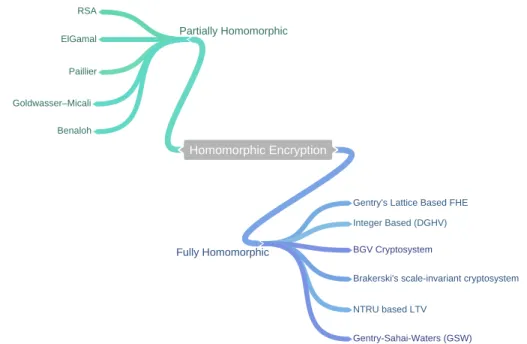
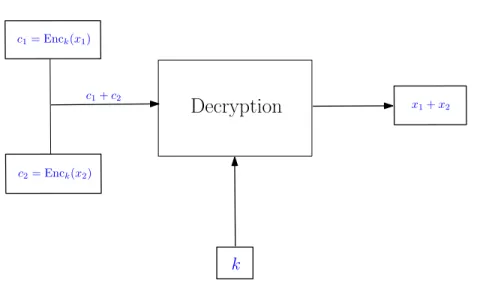
Homomorphic cryptosystems can be broadly categorized into fully homomorphic and partially homomorphic schemes (Figure 2.1). Partially homomorphic encryption schemes are homomorphic with respect to one operation such as multiplication in the case of the RSA cryptosystem. A schematic diagram of an additive homomor-phic encryption scheme is given in Figure 2.2. Here, we have an encryption scheme (denoted by Enc) that outputs two ciphertexts c1 and c2 when operated on the two plaintexts x1 and x2 (with key k), respectively. Since the scheme is additively homo-morphic, we have the following relation between the plaintexts and ciphertexts.
Enck(x1) + Enck(x2) = Enck(x1+x2)
Fully homomorphic encryption schemes, on the other hand, support two operations (addition and multiplication). Up to date, there is quite a number of partially homo-morphic encryption schemes that are well understood and practically used. However, the field of fully homomorphic encryption is quite recent, and the currently avail-able fully homomorphic encryption schemes are mostly proof of concept and can only
2.2 Fully and Partially Homomorphic Encryption Schemes 10
Figure 2.1: Fully and Partially Homomorphic Schemes
be carried out with respect to a small number of operations or with very high end laboratory settings [36]. One of the main reasons for the impracticality of fully ho-momorphic encryption schemes is that the ciphertext size and the computation time increases rapidly as the security level increases.
As much as we would like to have a cryptosystem that is homomorphic with respect to one operation, the application of such a scheme is limited by the fact that not every computation of our liking can be performed with only one operation. For example, to find the mean or average value of a sample, we would need a homomorphic encryption scheme that supports one multiplication at the very least. Moreover, the
Decryption
k c1= Enck(x1) c2= Enck(x2) c1+c2 x1+x2Figure 2.2: Additive Homomorphic Scheme
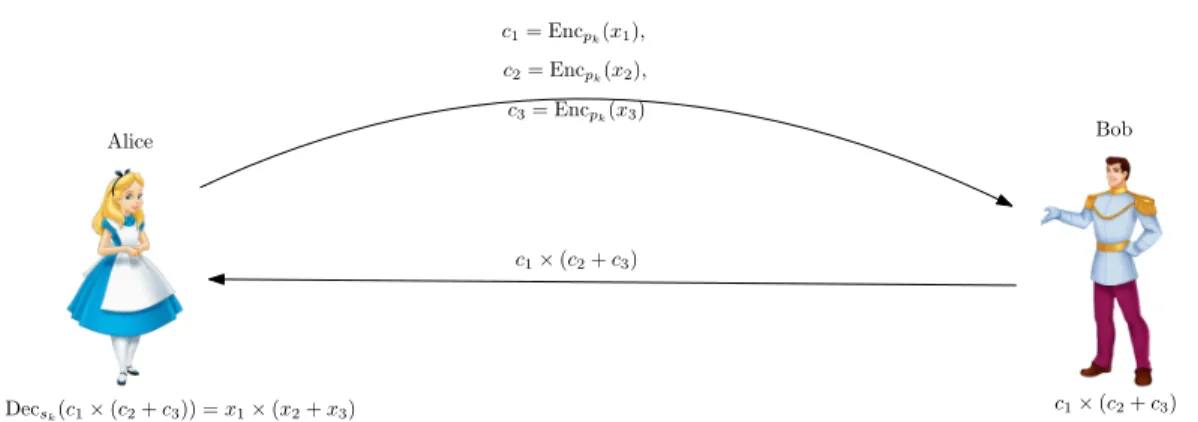
fact that any computation on a computational device (computers, calculators, etc.) can be designed through a Boolean circuit (a circuit that consists of addition and multiplication gates), makes fully homomorphic encryption schemes highly appealing. With a fully homomorphic encryption scheme, we can outsource computations to cloud with reasonable guarantee (upto the hardness of breaking the scheme) that the computations will be performed blindly. For example, consider the case where two parties, Alice and Bob, want to communicate with each other (Figure 2.3). Alice would like to send Bob three numbersx1, x2, andx3, and get the result of a calculation performed by Bob. However, Alice does not want Bob to know the three numbers she sends. Therefore, she would like to encrypt these numbers using an appropriate encryption scheme before sending it to Bob. However, Alice also want Bob to be able
2.3 Partial Homomorphism - RSA Cryptosystem 12
to perform the calculation even though the numbers are encrypted. This problem is solved using a homomorphic encryption scheme. Alice encrypts her numbers using a homomorphic encryption scheme that is then sent to Bob. Bob can perform his calculation on the encrypted numbers as though they are not encrypted. However, Bob will only see the ciphertexts and not the actual numbersx1, x2, and x3. Finally, Bob will send the result of the calculation back to Alice to decrypt and obtain the result. This process is illustrated in Figure 2.3. Currently, it is common practice to decrypt the data at the server-side before doing any calculation. However, this places the user’s privacy in jeopardy because the user is forced to assume that the server is trusted. Hence, using a fully homomorphic encryption scheme is the key to successfully ensuring many security and privacy assumptions that are prevalent in current communication protocols.
We will first look at the RSA cryptosystem as a typical example of a partially homomorphic encryption scheme.
2.3
Partial Homomorphism - RSA Cryptosystem
The RSA Cryptosystem was introduced by Ron Rivest, Adi Shamir, and Leonard Adleman in 1977. Although not intentionally introduced as a homomorphic
encryp-c1= Encpk(x1), c2= Encpk(x2), c3= Encpk(x3) c1×(c2+c3) Decsk(c1×(c2+c3)) =x1×(x2+x3) Alice Bob c1×(c2+c3)
Figure 2.3: Alice, Bob, and Fully Homomorphic Encryption
tion scheme, the RSA scheme shows homomorphic qualities with respect to multipli-cation. The RSA scheme operates as follows:
• KeyGen: Select two random large prime numbers, p and q. Compute their product, n=pq. Choose esuch that 1 < e < ϕ(n) and gcd(e, ϕ(n)) = 1, where
ϕ is the Euler’s Totient function. Compute d such that ed≡1(mod ϕ(n)).
Public Key: (e, n), Private Key: (d, ϕ(n))
• Enc: For a messagem, compute c=me (mod n).
• Dec: For a ciphertextc, compute m=cd (mod n).
where KeyGen, Enc, and Dec denote the key generation, encryption, and decryp-tion algorithms, respectively. Now, consider two plaintexts x1 and x2 encrypted by
2.4 Fully Homomorphism 14
the RSA scheme.
Enc(x1) =xe1 (mod n) and Enc(x2) =xe2 (mod n) Therefore,
Enc(x1)×Enc(x2) =xe1×xe2 (mod n) = (x1x2)e (mod n) =Enc(x1×x2) Therefore, the RSA scheme is clearly homomorphic with respect to multiplication.
2.4
Fully Homomorphism
The importance of fully homomorphic encryption schemes and the question of whether such schemes actually exist was first proposed by Ronald Rivest, Len Adleman, and Michael Dertouzos in 1978, immediately following the introduction of the RSA cryp-tosystem [42]. In their own words the question statement was as follows.
“A schemeE with an efficient algorithm EvaluateE such that, for any valid
public key pk, any circuit C, and any ciphertexts ψi ← EncryptE(pk, πi)
outputs,
ψ ←EvaluateE(pk, C, ψ1, . . . , ψt)
Here, πi denotes the plaintext. For more than three decades, it was an open problem
whether such schemes exist. However, as we will see in the next chapter, this problem was answered by Craig Gentry in 2009.
2.4.1
Overview of Fully Homomorphic Encryption
At a high level, Gentry’s idea can be described by the following general model. This is the blueprint that is used in all homomorphic encryption schemes that followed.
1. Develop a Somewhat Homomorphic Encryption Scheme that is restricted to evaluating a finite number of additions or multiplications. In other words, the somewhat homomorphic encryption scheme that we construct is only limited to evaluating low-degree polynomials.
2. Modify the somewhat homomorphic encryption scheme to make it Bootstrap-pable, that is, modifying it so that it could evaluate its own decryption circuit plus at least one additional NAND gate.
The somewhat homomorphic encryption scheme usually introduces a noise when-ever a homomorphic operation is carried out, and when the noise exceeds a certain threshold, the scheme loses its homomorphic ability. The idea behind constructing a bootstrappable scheme is that whenever the noise level is about to reach the
thresh-2.4 Fully Homomorphism 16
old, we can bootstrap it so that the resulting ciphertext will give the same encrypted value but with a lower noise. In this way, if the ciphertext is bootstrapped from time to time, an arbitrary number of operations can be carried out.
In the next chapter, we will define a fully homomorphic encryption scheme com-monly known as the DGHV scheme, which is used to process database queries se-curely.
Integer Based Fully Homomorphic
Encryption (DGHV Scheme)
3.1
DGHV Scheme
The DGHV scheme was introduced by Marten van Dijk, Craig Gentry, Shai Halevi, and Vinod Vaikuntanathan in 2010, and this scheme operates on integers as opposed to lattices in Gentry’s original construction. The scheme follows Gentry’s original blueprint by first constructing a somewhat homomorphic encryption scheme. The key generation, encryption and decryption algorithms of the DGHV scheme are given below.
3.1 DGHV Scheme 18
Let λ ∈ N be the security parameter and set N = λ, P = λ2 and Q = λ5. The
scheme is based on the following algorithms;
• KeyGen(λ): The key generation algorithm that randomly chooses a P-bit integer p as the secret key.
• Enc(m, p): The bit m∈ {0,1} is encrypted by
c=m′+pq,
where m′ ≡ m (mod 2) and q, m′ are random Q-bit and N-bit numbers,
re-spectively. Note that we can also write the ciphertext asc=m+ 2r+pq since
m′ =m+ 2r for some r∈
Z.
• Dec(c, p): Output (c mod p) mod 2 where (cmod p) is the integerc′in (−p/2, p/2)
such that pdivides c−c′.
The valuem′ is called thenoise of the ciphertext. Note that this scheme, as it is given
above, is symmetric (i.e., it only has a private key). We can define the public key as a random subset sum of encryptions of zeros, that is, the public key is a randomly choosen sum from a predefined set of encryptions of zeros: S = {2r1 +pq1,2r2 +
pq2, . . . ,2rn+pqn}. A typical encryption of the plaintext m would be, c = m+∑ i∈T (2ri+pqi) = m+ 2∑ i∈T ri+p ∑ i∈T qi,
where T ⊆ S. From here on we shall use m′ to denote m+∑
i∈Tri and q to denote
∑
i∈T qi.
This scheme is homomorphic with respect to addition and multiplication and decrypts correctly as long as the noise level does not exceed p/2 in absolute value. That is, |m′| < p/2. Let c
1 and c2 be two ciphertexts obtained using the DGHV scheme, that is,
c1 =m′1+pq1 and c1 =m′2+pq2,
where m′1 =m1(mod 2) and m
′
2 =m2(mod 2). Addition of c1 and c2 results in,
c1+c2 = (m′1+m
′
2) +p(q1+q2).
Thus,
Enc(m1, p) + Enc(m2, p) = Enc(m1⊕m2, p).
Decryption works as long as,
|m′1+m
′
2|< p
3.1 DGHV Scheme 20
Similarly, multiplying c1 and c2 results in,
c1c2 = (m′1+pq1)(m′2+pq2) = m′ 1m ′ 2 +p(m ′ 1q2+m′2q1+pq1q2) Hence,
Enc(m1, p)×Enc(m2, p) = Enc(m1 ×m2, p) Here, decryption works as long as,
|m′1m
′
2|< p
2.
Hence, this is a somewhat homomorphic encryption scheme in the sense that once the noise level exceedsp/2, the scheme loses its homomorphic ability. In other words, this scheme can evaluate any function that is composed of a collection of additions and multiplications as long as the p/2 threshold is not reached. Since any computation can be expressed as a collection of additions and multiplications (i.e., a Boolean Circuit), this would imply that extending this scheme to perform an arbitrary amount of additions and multiplications would allow us to compute any Boolean function without decrypting the ciphertext. This is the breakthrough idea of Gentry called Bootstrapping, discussed in the next section.
We shall illustrate the DGHV scheme mentioned previously through a small ex-ample. Let N = λ= 2. Then, P =λ2 = 4 and Q=λ5 = 32. Suppose the plaintext
bit that we would like to encrypt is 1. Choose p= 10 as the secret key, q = 15 and
m′ = 3 so that,
c= 3 + (10×15) = 153.
Thus the ciphertext for this particular choice of parameters is 153. The decryption is given by,
(cmod p) mod 2 = (153 mod 10) mod 2 = 3 mod 2 = 1.
And therefore we can see that decryption works as expected.
3.2
Bootstrapping
Suppose we have two ciphertexts c1 and c2 encrypted using the DGHV scheme. That is,
c1 ←Enc(m1, pk1) and c2 ←Enc(m2, pk1)
wherem1, m2 ∈ {0,1}are the corresponding plaintexts and pk1 is the public key that has the corresponding secret key sk1. Encrypt the secret key sk1 by a second public key pk2. We will denote the vector of encrypted bits of sk1 by sk1. That is each bit
sk1i of sk1 is encrypted by the DGHV scheme:
3.2 Bootstrapping 22
Denote the decryption function augmented by an addition as DecAdd and the
decryp-tion funcdecryp-tion augmented by a multiplicadecryp-tion as DecM ult. The two functions DecAdd
and DecM ult can be defined as follows:
DecAdd(c1, c2) =m1 +m2 and
DecM ul(c1, c2) =m1m2
Encrypt each ciphertext c1 and c2 by the second public key pk2. Since c1 and c2 are integers we have to perform the encryption over each bit separately as before.
c1i ←Enc(c1i, pk2) and c2i ←Enc(c2i, pk2) Finally output,
c←Evaluate(pk2,DecAdd, sk1, c1, c2),
where Evaluate denotes evaluating the DecAdd function homomorphically (in other
words, evaluating the Boolean circuit corresponding to the DecAdd function). Note
thatsk1, c1, andc2 are all encrypted bypk2. Since the Evaluate algorithm can evaluate DecAdd, it will take the cipher texts c1, c2, and sk1 and evaluate the function DecAdd
homomorphically. Therefore,
c = c1+c2
= Enc(m1, pk1) + Enc(m2, pk1) = Enc(m1⊕m2, pk1)
Similarly the function DecM ul can be evaluated homomorphically to obtain,
c′ ←Evaluate(pk2,DecM ult, sk1, c1, c2), where c′ = Enc(m
1m2, pk1). Hence, whenever the noise level is about to reach its threshold value (i.e. p/2) we can perform a homomorphic decryption on the cipher-text, which will give us a re-encryption of the same ciphertext with a lower noise level. Thus, any arbitrary function (precisely a Boolean function) can be evaluated by bootstrapping the ciphertext periodically.
In the next chapter, we look at how the DGHV scheme can be used to process queries in a database. This is useful when queries have to be processed secretly such that only the user knows what he is searching for. For example, a typical application of this kind of scheme would be a medical database, where the database should not know what the user is searching for in order to preserve privacy of the users.
Chapter 4
Query Processing Using the
DGHV Scheme
The DGHV scheme can be used to create a protocol that establishes blind searching in databases. This method was proposed by Gahi et al. [19].
Suppose we need to retrieve a particular record(s) from the database. Typically, we send a query to the database encrypted using the DGHV scheme. Let vi be the
ith bit of the query v and c
i be the ith bit of a record R in database D. Both the
query and the database record is encrypted using the DGHV scheme. Suppose the plaintext bit corresponding tovi ismi and the plaintext bit corresponding toci ism′i.
Then, vi =mi+ 2ri+pqi and ci =m′i + 2r ′ i+pq ′ i,
where ri, ri′, qi and qi′ are random numbers and p is the secret key. The server shall
compute the following sum for each record:
Ir =
∏
i
(1 +ci+vi), for every R ∈D, (4.1)
wherer denotes the index of record R. If mi =m′i, thenmi+m′i = 0 or mi+m′i = 2
since mi, m′i ∈ {0,1}: 1 +ci+vi = 1 + (m′i+ 2r ′ i+pq ′ i) + (mi+ 2ri +pqi) = 1 + (mi+m′i) + 2(ri+ri′) +p(qi+q′i) Case 1: mi+m′i = 0, 1 +ci+vi = 1 + 2(ri+ri′) +p(qi+qi′) = Enc(1) Case 2: mi+m′i = 2, 1 +ci+vi = 1 + 2(1 +ri+r′i) +p(qi+qi′) = Enc(1)
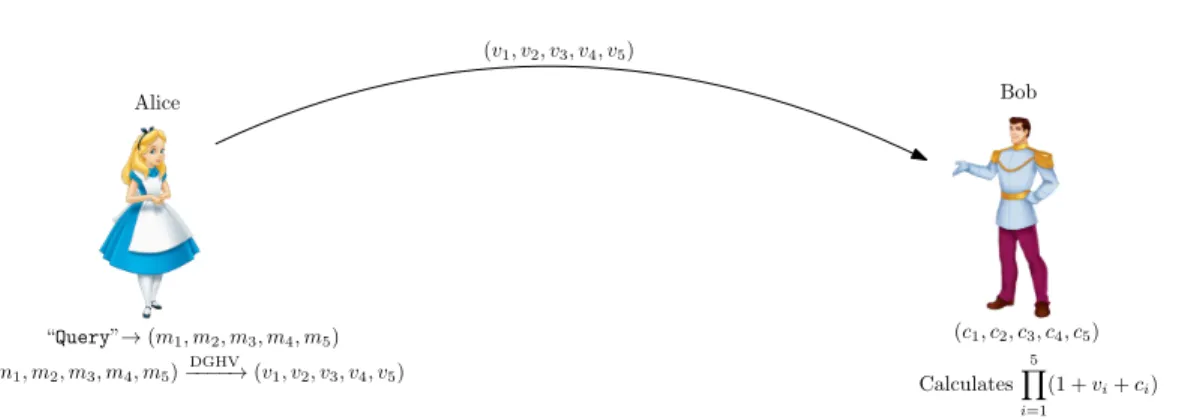
Query Processing Using the DGHV Scheme 26 (v1, v2, v3, v4, v5) “Query”→(m1, m2, m3, m4, m5) Alice Bob (c1, c2, c3, c4, c5) (m1, m2, m3, m4, m5)−−−−→DGHV (v1, v2, v3, v4, v5) Calculates 5 Y i=1 (1 +vi+ci)
Figure 4.1: Calculation of Ir values
This results in Ir = Enc(1). On the other hand, ifmi ̸=m′i, then mi+m′i = 1 since
mi, m′i ∈ {0,1}. Therefore, 1 +ci+vi = 1 + (m′i+ 2r ′ i+pq ′ i) + (mi+ 2ri +pqi) = 1 + (mi+m′i) + 2(ri+ri′) +p(qi+q′i) = 1 + 1 + 2(ri+ri′) +p(qi+qi′) = 2(1 +ri+r′i) +p(qi+qi′) = Enc(0)
This results in Ir = Enc(0). Hence, for each record in the database we will have an
Ir value that is equal to Enc(1) or Enc(0) depending on whether the search query
matches the corresponding record or not (Figure 4.1). Secondly, we calculate the partial sums of the Ir values (Table 4.1).
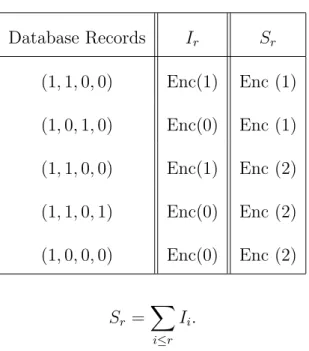
Table 4.1: Example database and correspondingIr and Sr values Database Records Ir Sr (1,1,0,0) Enc(1) Enc (1) (1,0,1,0) Enc(0) Enc (1) (1,1,0,0) Enc(1) Enc (2) (1,1,0,1) Enc(0) Enc (2) (1,0,0,0) Enc(0) Enc (2) Sr = ∑ i≤r Ii. (4.2)
As an example, let us consider a database that has five records, each encoded with 4 bits. If the query sent by the user is (Enc(1),Enc(1),Enc(0),Enc(0)), we obtain the corresponding Ir and Sr values, as shown in Table 4.1. Using these partial sums,
we can then calculate the sequence (I′
r,j) for every record R with index r and every
positive integer j ≤r:
Ir,j′ =Ir
∏
i
(1 + ¯ji+Sr,i) for every R∈D, (4.3)
where Sr,i is the ith bit of Sr and ¯ji represents the ith bit of the encryption of j,
where j ≤ r. Hence, these sequences have the property that whenever Ir = Enc(1)
Query Processing Using the DGHV Scheme 28
example, we would have,
(I1′) = (Enc(1))
(I′
2) = (Enc(0),Enc(0)) (I3′) = (Enc(0),Enc(1),Enc(0))
(I4′) = (Enc(0),Enc(0),Enc(0),Enc(0))
(I5′) = (Enc(0),Enc(0),Enc(0),Enc(0),Enc(0))
Finally, we calculate,
(R′) =∑
k
Enc(Rk)(Ik′), (4.4)
whereRk is the kth record inD. So, (R′) is a sequence containing only the encrypted
records that matches our search query. Note that the definition of (R′) relies on
adding vectors of different lengths. This is done in the natural way, whereby all the vectors are made the same length by padding with zeros prior to addition. In the above example, we obtain,
(R′) = (Enc(R1),Enc(R3),Enc(0),Enc(0))
At this point the sequence (R′) will contain all the records that match our query, but
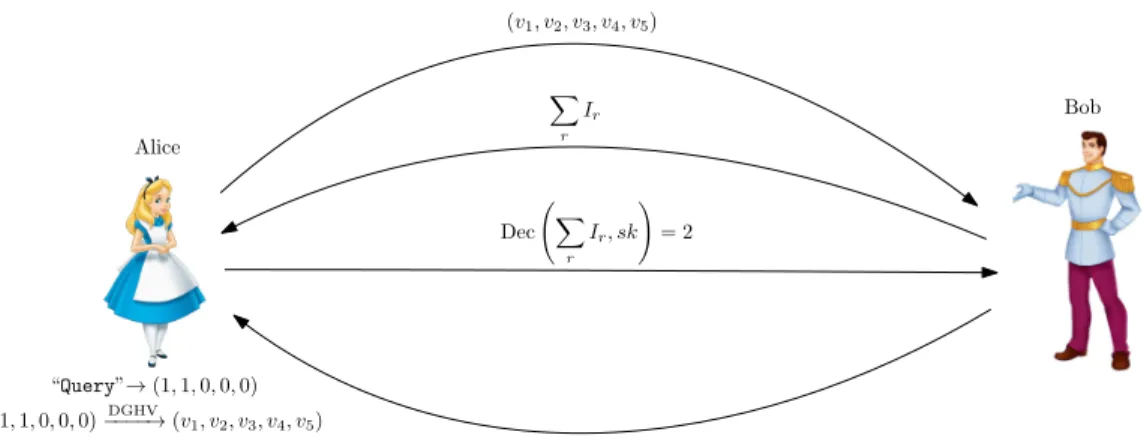
(v1, v2, v3, v4, v5) “Query”→(1,1,0,0,0) Alice Bob (1,1,0,0,0)−−−−→DGHV (v1, v2, v3, v4, v5) X r Ir Dec X r Ir, sk ! = 2 (Enc(R1),Enc(R3))
Figure 4.2: Alice, Bob, and Gahi’s Protocol
at the server side to determine the number of terms that are useful in the sequence:
n =∑
r
Ir
This result can be returned to the user and decrypted to obtain the number of records that match the search query. Hence, the sequence (R′) can be truncated at the
appropriate point and returned to the user for decryption. The whole process is illustrated in Figure 4.2. An update query can be performed by,
Rnew = (1 +Ir)R+IrU, for every R ∈D,
whereU is the new value that we wish to insert whenever the query matchesR(or Ir=
Enc(1)). A deletion of a record can be performed by,
Query Processing Using the DGHV Scheme 30
To perform all these operations without exceeding the maximum noise permitted (p/2), it is necessary to choose the parameters N, P, and Q appropriately.
Remark
Although according to Gahi’s original paper [19] both the query and the database records are encrypted when calculating Ir in equation 4.1, we note that it is not
strictly necessary. We show below that only encrypting the query is sufficient. Letvi
be theith bit of the queryv, and let the plaintext bit corresponding to v
i ismi. Now
suppose only the query is encrypted:
vi =mi+ 2ri+pqi,
where ri, qi are random numbers and pis the encryption key. Let ci be the ith bit of
the database record. Now, the database is not encrypted and therefore if ci = mi,
then ci+mi = 0 orci+mi = 2.
Case 1: ci +mi = 0,
1 +ci+vi = 1 +ci+ (mi+ 2ri+pqi)
= 1 + 2ri+pqi
Case 2: ci +mi = 2,
1 +ci+vi = 1 +ci+ (mi+ 2ri+pqi)
= 1 + 2(1 +ri) +pqi
= Enc(1)
On the other hand, if ci ̸=mi then ci+mi = 1, since ci, mi ∈ {0,1},
1 +ci+vi = 1 +ci+ (mi+ 2ri+pqi)
= 1 + (ci+mi) + 2ri+pqi
= 2(1 +ri) +pqi
= Enc(0)
Therefore, we note that for the purpose of equation 4.1, the database records need not be encrypted.
Gahi’s method works on plaintext bits and thus requires significant computational ability on the part of the server. This is due to the fact that it is restricted to the DGHV scheme which processes plaintext bits separately. In the next chapter we propose an alternative protocol called the Homomorphic Query Processing Scheme. This protocol enables us to process database queries using more modern fully homo-morphic encryption schemes such as the ring based scheme proposed by Braserski et al. [12], which act on blocks of plaintext rather than single bits.
Chapter 5
Homomorphic Query Processing
The main drawback in Gahi’s method is that it requires an enormous number of ho-momorphic operations because it employs the DGHV encryption scheme, which uses bitwise encryption. We propose an alternative protocol called Homomorphic Query Processing that is compatible with the more recent ring-based fully homomorphic encryption scheme introduced by Braserski et al. [12]. The major advantage is that Braserski’s method works on plaintext and ciphertext blocks and thus the number of homomorphic operations required can be greatly reduced.
We first give a brief introduction to the ring based fully homomorphic Encryption Scheme proposed by Braserski, and then proceed to define our Homomorphic Query Processing method.
5.1
Ring Based Fully Homomorphic Encryption
This encryption scheme was introduced by Braserski, et al [12] and operates on the polynomial ring R = Z[X]/⟨f(x)⟩; the ring of polynomials with integer coefficients modulof(x), wheref(x) =∏ 1≤k≤n gcd(k,n)=1 ( x−e2iπk n )
is thenth cyclomatic polynomial. The plaintext is defined on the ring Rt = Zt[x]/⟨f(x)⟩, where t is an integer. The
key generation and encryption functions make use of two distributions χkey and χerr
onR for generating small elements. The uniform distribution χkey is used in the key
generation, and the discrete Gaussian distribution χerr is used to sample small noise
polynomials. Specific details can be found in [11] and [12]. The scheme is based on the following algorithms.
• KeyGen(n, q, t, χkey, χerr): Operating on the input degree n and moduli q and
t, this algorithm generates the public and private keys (pk, sk) = (h, f), where
f = [tf′ + 1]
q and h = [tgf−1]q. Here, the key generation algorithm samples
small polynomials from the key distributionf′, g
→χkeysuch thatfis invertible
modulo q and [.]q denotes coefficients of polynomials in R reduced by modulo
q.
• Encrypt(h, m): Given a message m∈R, the Encrypt algorithm samples small error polynomials s, e→χerr and outputs, c= [⌊q/t⌋[m]t+e+hs]q ∈R, where
5.1 Ring Based Fully Homomorphic Encryption 34
⌊.⌋ denotes the floor function.
• Decrypt(f, c): Given a ciphertextc, this algorithm outputs,m =[⌊qt[f c]q
⌉]
t∈
R.
• Add(c1, c2): Given two ciphertextsc1andc2, this algorithm outputscadd(c1, c2) = [c1+c2]q.
• Mult(c1, c2): Multiplication of ciphertexts is performed in two steps. First, compute ˜cmult =
[⌊
t qc1c2
⌉]
q. However, this result cannot be decrypted to the
original plaintext using the decryption key f. Therefore, a process known as key switching is done to transform the ciphertext so that it can be decrypted with the original secret key. For more details, we refer to [11].
This encryption scheme is homomorphic with respect to addition and multipli-cation of plaintexts modulo t. The main advantage in using Braserski’s encryption scheme is that it can be used to encrypt blocks of plaintext instead of dealing with single bits, as in the DGHV scheme [15]. For example, consider the block of plaintext bits, 10100. The integer representation of this block is the value 20. We can represent this integer using the polynomialX2+X4 =∑4
i=02izi, wherezi is theith bit of 10100.
In general, ifzis an integer and its binary representation is,z = (±1)∑li=02iz
i, where
zi ∈ {0,1}and l =⌈log2|z|⌉, then we can encode the number z as
∑l i=0ziX
5.2
Converting the Plaintext Space into a Field
As we shall see, in our Homomorphic Query Processing method, we invert certain plaintext elements and thus the plaintext space should be a field. Therefore, we now discuss how to convert the plaintext ring in Braserski’s method to a field. Note that the plaintext space in Braserski’s method is defined on the polynomial ring,
Rt = Zt[x]/⟨f(x)⟩. We shall select t = p, where p is a prime number. Then Rp is
a field if and only if f is irreducible over Zp. Recall that f is the nth cyclomatic
polynomial defined as follows:
f(x) =∏ 1≤k≤n
gcd(k,n)=1
(
x−e2iπnk)
Let f(x) = (x− α1)(x −α2). . .(x− αn) be a polynomial defined on Q[x]. The
discriminant of f, denoted by ∆(f), is defined [25] as,
∆(f) =∏
i<j
(αi−αj)2
It has been proved in [25] that the nth cyclotomic polynomial reduces modulo all primes if and only if the discriminant of thenth cyclotomic polynomial is a square in
Z. Hence, by choosing a cyclotomic polynomial whose discriminant is not a square we
can find a primep such thatf is irreducible overZp. Furthermore, it is shown in [25]
5.3 Homomorphic Query Processing 36
exist infinitely many primes such thatf is irreducible overZp. Thus, we can choose a
cyclotomic polynomial with non-square discriminant and check for irreducibility using a standard polynomial irreducibility test such as Rabin’s test, until we obtain a prime for which the cyclotomic polynomial is irreducible. For example, even if we consider a large cyclotomic polynomial with non-square discriminant like the 107th cyclotomic (which has degree 106), and consider the primes less than 100, it can be seen that it is irreducible over many primes: Z2,Z5,Z7,Z17,Z31,Z43,Z59,Z67,Z71,Z73 and Z97.
We now propose our Homomorphic Query Processing scheme, which is compati-ble with the Braserski’s ring based fully homomorphic encryption scheme mentioned previously.
5.3
Homomorphic Query Processing
We begin by defining the value Fi for theith record (denoted byRi) in the database.
We write Enc(m) for the Enc(m, pk), where pk is the public key of the user. Then the user sends Enc(m) to the server to search for the records that match m. Now, the server computes the following:
Fi = ( ∏ Rk̸=Ri Enc(m−Rk) ) ( ∏ Rk̸=Ri Enc (Ri−Rk) −1 ) , (5.1)
where each of the products above is over all the records Rk such that Rk ̸= Ri.
Since we are dealing with a fully homomorphic encryption scheme, we can compute Enc(m−Rk) values by computing Enc(m)−Enc(Rk). Also, since all theRi values are
known to the server, the term ∏R
k̸=RiEnc (Ri−Rk)
−1
can be reduced to a simpler form using the homomorphic property of the encryption scheme in order to perform a single encryption. Hence,
Fi = ( ∏ Rk̸=Ri Enc(m−Rk) ) Enc ( ∏ Rk̸=Ri (Ri−Rk) )−1 .
Note that whenever m=Ri (query being equal to the record we are comparing),
we have Fi = Enc(1) and Fi = Enc(0), otherwise. Note that here we are assuming
that the query is contained somewhere in the database. If the query is not contained anywhere in the database, an encryption of something other than 1 or 0 will be the output. This special scenario is discussed later.
Now, we define Gi’s, the partial sums of theFi values, as follows:
Gi =
∑
j≤i
Fj. (5.2)
Using these partial sums, we can then calculate the sequence (F′
i,k) corresponding
to each record as follows,
Fi,k′ = (Fi) ( ∏ j̸=k (Gi−Enc(j)) ) ⎛ ⎝Enc ( ∏ j̸=k (k−j) )−1⎞ ⎠, (5.3)
5.3 Homomorphic Query Processing 38
where 1≤ k ≤i. It can be seen that F′
i,k = Enc(1) if Fi = Enc(1) and Gi = Enc(k)
are both satisfied. Hence, the sequences (F′
i,k) have the property that whenever
Fi = Enc(1) (i.e., the ith record matches the query), we have an Enc(1) at the kth
position of the sequence where Gi = Enc(k). All other entries of the sequence are
encryptions of zero. Therefore,
(R′) =∑
k
Enc(Rk)(Fk′), (5.4)
whereRkis thek-th record inDwill give us a sequence containing only the encrypted
records that match our search query. Note that the definition of (R′) relies on adding
vectors of different lengths. This is done in the natural way, whereby all the vectors are made the same length by padding with zeros prior to addition.
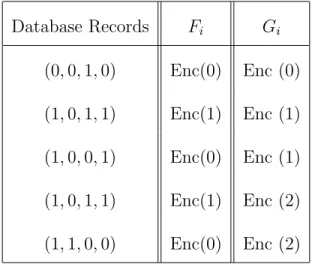
To further illustrate our scheme, let us consider an example where the database contains five records, each with 4 bits of data. Also, let our encryption scheme encrypt 2 bits at a time. Then, if the search query is (Enc(2), Enc(3)), the corresponding Fi
and Gi values are given in Table 2.
The resulting sequences (F′
i) would be similar as in Gahi’s scheme,
(F1′) = (Enc(0))
(F2′) = (Enc(1),Enc(0)) (F3′) = (Enc(0),Enc(0),Enc(0))
Table 5.1: Example database and correspondingFi and Gi values Database Records Fi Gi (0,0,1,0) Enc(0) Enc (0) (1,0,1,1) Enc(1) Enc (1) (1,0,0,1) Enc(0) Enc (1) (1,0,1,1) Enc(1) Enc (2) (1,1,0,0) Enc(0) Enc (2)
(F4′) = (Enc(0),Enc(1),Enc(0),Enc(0))
(F5′) = (Enc(0),Enc(0),Enc(0),Enc(0),Enc(0))
Therefore, the sequence (R′) would be,
(R′) = (Enc(R
2),Enc(R3),Enc(0),Enc(0),Enc(0))
At this point, the sequence (R′) will contain all the records that match our query
but with trailing encryptions of zeros which we do not need. Hence, a second sum is calculated at the server side to determine the number of terms that are useful in the sequence:
n=∑
r
5.3 Homomorphic Query Processing 40
Then n will be returned to the user and decrypted to obtain the number of records that match the search query. Hence, the sequence (R′) can be truncated at the
appropriate point and returned to the user for decryption.
It should be noted that the server will know the number of records that match the user’s query. We believe that this information is not sufficient for the server to gain any additional information about the search query. Alternatively, we could return the whole sequence without truncation, keeping the number of matching records private from the server. However, the communication overhead will be increased significantly in this case, since the length of the sequence will be equal to the number of records in the database.
As promised previously, we now look at the special case where the record that is searched for is not contained anywhere in the database. In this case the value
Fi will be something other than an encryption of 1 or 0. These garbage encrypted
values will carry themselves into the rest of the protocol, resulting in equation 5.4 with a nonsensical sequence. Hence, if the user receives a nonsensical sequence as the final result, it implies that the record that was searched is not contained in the database. As an alternative approach, we can compute ∏i(Enc(m)−Enc(Ri)) prior
to computingFi (equation 5.1) and send it to the user to decrypt. If the result is zero
database and therefore the user can send a message to the server to abort the search.
5.4
Comparison of Our Scheme vs. Gahi’s Scheme
Our scheme has the main advantage of having the potential to be used with more recent fully homomorphic encryption schemes rather than being restricted to the DGHV scheme. This gives the flexibility to use our method with block based en-cryption schemes such as Braserski’s [12], which reduces the number of enen-cryption steps. For example, referring back to equation 4.1, we can see that the Ir values are
calculated by comparing the query with each record bit-wise. If there aremrecords in the database and each of them are encrypted using n bits, the number of operations that are required to calculate all the Ir values will be O(nm). In our Homomorphic
Query Processing method, equation 5.1 acts as the analog of equation 4.1. How-ever, the encryptions are done block-wise in our scheme, and hence the number of operations it would take to calculate the Fi value in equation 5.1 will be O(m). For
equation 4.2 in Gahi’s method, the number of operations that should be performed to calculate all the partial sums will be O(nm2), since there areO(m2) multiplications and each multiplication should be done bit-wise; whereas the calculation of partial sums in our scheme (equation 5.2), the number of operations is reduced to O(m2).
5.4 Comparison of Our Scheme vs. Gahi’s Scheme 42
Similarly, equations 4.3 and 4.4 in Gahi’s method use O(nm) and O(nm2) number of operations, respectively, but their counterparts in our scheme, (equations 5.3 and 5.4) haveO(m) andO(m2) operations, respectively. Thus, it can be seen that in each step of our scheme, the number of operations performed is reduced by a factor of n
Homomorphic Encryption and
Smart Grid
In this chapter, we give an introduction to the smart electric grid as well as the cryptographic protocols that are being used in it. We look at several proposed cryp-tographic schemes that can be used to compute the total consumption function which is the commonly needed calculation on the part of the utility provider.
6.1 Smart Grid and Cybersecurity 44
6.1
Smart Grid and Cybersecurity
Smart grids are a new class of communication grids that has recently gained widespread attention, mainly in the field of electricity distribution. Conventional power grids con-sist of two main components: the infrastructure that make up the electric network and the manpower needed to carry out the associated operations. The infrastruc-ture consists of physical components that makes up the nuts and bolts of the grid such as power plants, cable lines, transformers, substations, etc. Along with these components workers are needed for metering and to collect data to adjust tariff rates accordingly. However, with the surge of complex consumption patterns, mainly due to the wide range of electric devices that are commonplace in modern households, appropriate billing according to the level of consumption of users is necessary. The fixed tariff scheme that is commonplace was no longer suitable to meet the demands of highly variable consumption patterns.
Due to these insufficiencies, a new innovative electric grid, emerged during the 21st century, commonly known as the “smart grid.” It can be defined as an electric grid with embedded digital processing and communications. Rather than the traditional one-way electricity distribution from the power plant to consumers, the smart grid acts more like a communication network that automatically collects user data and
sends it to the distributor, where the distributor adjusts the tariffs and loads according to the collected data [37]. In addition, the ultimate goal of implementing the smart grid is that it will possess the following qualities [13]:
• Intelligent: The capability to sense system failure and perform automated prevention measures. It is also believed that the smart grid will be able to respond to these situations faster than a human operator.
• Efficient: Due to optimization of load balancing, it will have the capacity to meet increased consumer demand without additional infrastructure.
• Accommodating: The ability to easily integrate and include different energy sources to the grid. This is very important since there is evidence that new energy sources, such as solar and wind energy, are rapidly coming online.
• Motivating: The ability to connect the consumer and utility in real time so that users can fine-tune their energy usage based on individual preferences. For example, having the ability to track daily energy usage informs the consumer about where most of the energy is spent, and the consumer may opt to change their lifestyle accordingly.
• Opportunistic: The ease of integration into the market with capabilities such as plug-and-play devices (e.g., smart meters).
6.1 Smart Grid and Cybersecurity 46
• Quality Focused: The ability to provide power with the desired quality stan-dards. For example, with the increasing trend in using electronic devices, con-sumers demand uninterrupted and very stable power signals without any spikes and disturbances.
• Resilient: The smart grid is more distributed and hence there is a need for increased resilience to attacks and disaster recovery measures.
• Green: More environmentally friendly and providing an optimized power man-agement scheme which contributes to a greener economy.
Although the smart grid is an innovative technological breakthrough, there are many challenges associated with the collection and dissemination of user data. Most of the data sent are related to usage patterns of electricity. For example, a household can have a certain pattern of electricity usage, and this can be used to determine personal behavioral patterns [6]. This idea is explained in more detail in the following example. Figure 6.1, taken from [6], shows how the power usage of a typical household fluctuates in accordance with personal activity. The spikes in the graph represent occasions where the greatest amount of power is used. Looking at the intensity and the distribution of energy fluctuations, the devices in operation at that specific time can be inferred. This is possible because each device that uses a significant amount
Figure 6.1: Residential Power Usage to Personal Activity Mapping
of power has its own signature power fluctuation. This type of load monitoring is known as non-intrusive load monitoring (NALM) and it can be used to infer the number of consumers living within a household and their behaviors [2]. The privacy risk associated with this kind of load monitoring process is immense, as it provides an attacker a chance to predict things such as the time at which people are present in the house and an estimate of the number of people present.
Hence, the need for smart grid cyber security arises. The smart grid consists of millions of electronic devices that have varying levels of hardware and software con-straints. Thus blindly applying protocols of IT security may not prove to be useful. For example, a typical encryption scheme used in IT such as the Advanced
Encryp-6.1 Smart Grid and Cybersecurity 48
tion Standard (AES) might be too cumbersome for smart grid devices with limited computational ability. The AES was originally designed for 8-32 bit processors, mak-ing it less effective when used with constrained devices [7]. Thus, it is necessary to have dedicated protocols that are tailored specifically for the smart grid. The security challenges of the smart grid are based on the following properties [6]:
• Scalability: The size of smart grid grows and involves cross linking of multiple diverse networks. Compatibility issues integrating such diverse protocols is an ongoing challenge.
• Mix of legacy and modern devices: The smart grid consist of many devices that are used not only in the generation and distribution of electricity but also in communication networks. Therefore, all devices used in the smart grid might not correspond to the same level of functionality as a modern device. Hence, it is important that protocols are designed in a way that unifies all the new and old devices.
• Hybrid model of management: The security of the grid should be distributed and centralized, that is, a device should have the ability to locally authenticate if the communication network fails for some reason. Hence, a local authenti-cation system is necessary, along with a centralized database that synchronizes
credentials.
• Evolving standards and regulations: The standards and regulations that are currently in place for smart grid cybersecurity are rapidly changing in accor-dance with new innovations and technologies. Hence, building utilities with implementation standards that are valid for prolonged periods of time is a chal-lenge.
In addition to these challenges, the current security goals for the smart grid have been outlined by the National Institute of Standards and Technology (NIST) smart grid interoperability panel [2]. Smart grid security goals can be condensed into three main categories: Confidentiality, Integrity, and Availability.
• Confidentiality: Confidentiality refers to using access controls to restrict data access by unauthorized entities. For example, smart meter data should only be accessed by the grid operators, not other consumers.
• Integrity: Integrity is the prevention of unauthorized modification of data. Loss of integrity can lead to incorrect decisions regarding power management.
• Availability: Availability is the reliable and timely access to information by authorized entities. Denial of Service (DOS) attacks attempt to block or corrupt
6.2 Cryptography-Based Data Exchange Schemes for Smart Grid 50
communication in the smart grid. Loss of availability can lead to incorrect tariff calculations and power failures.
Thus, it is evident that there is a need for smart grid security protocols that allow secure transmission and storage of data. In the next section, we examine a few recently proposed encryption protocols that offer improvements to smart grid cybersecurity.
6.2
Cryptography-Based Data Exchange Schemes
for Smart Grid
The transmission of information in the smart grid makes it susceptible to information leakage and to unauthorized access to sensitive information. To know more about where information leakage can occur, we consider the parties involved in a smart grid [16].
• Consumers/Customers: The consumers of a smart grid are its end users. Each customer has aSmart Meter, which is used to measure their energy usage and report it to the energy supplier at a specified frequency. For example, the smart meters implemented by Hydro One send measurements hourly [38]. Smart meters should be cost efficient and thus have limited computational power.
Consumers should have access to their energy usage patterns via smart meter readings.
• Grid Operators: Grid operators are the companies that manage the distri-bution of electricity. Operators can be part of an energy producer or separate entities. The distributor will use the smart meter data to efficiently distribute electricity to its consumers. Electricity distribution uses smart meter data for load balancing.
• Communication Network: This is the network in which all parties involved exchange data. The communication channel should be secured to maintain the privacy of data.
• Electricity Producer: This is the company that produces electricity and dis-tributes it via the grid operator’s infrastructure. The producer should manage power production according to the demand and also set tariffs according to customer usage patterns.
• Aggregator: The aggregator collects all the smart meter data from consumers and aggregates it to obtain values that the electricity producer can use. For example, the aggregator can compute the average power consumption of con-sumers in a certain area at a given time frame. This will help the producer and
6.2 Cryptography-Based Data Exchange Schemes for Smart Grid 52
Figure 6.2: Smart Grid and its Stockholders
the distributor to balance the loads efficiently. A schematic representation of the contributing parties is shown in Figure 6.2 (taken from [16]).
One of the obvious ways to entrust security in the smart grid is to have a cen-tralized grid management system where the smart meters only measure and send the data in an encrypted format to a centralized server. The centralized server acts as the aggregator and communicates with each smart meter to calculate total consumption, handle load balancing, etc. Since the grid operator controls the cryptographic keys for each smart meter, it is free to perform any function on the data. However, this places a universal trust on the grid operator/aggregator, which is undesirable [21].
If the grid operator is compromised, the whole smart grid will be compromised as well. Hence, recent proposals focus on grid management that is more widely dis-tributed [14, 40]. Rather than relying on a centralized grid operator for total security, the goal is to distribute trust to smart meters and substations and to design them to be independent of the grid operator.
One of the novel methods of preserving privacy in the smart grid is to use homo-morphic encryption schemes. Since homohomo-morphic encryption schemes allow comput-ing on encrypted data, the grid operator does not require handlcomput-ing of smart meter data in plaintext format. Before looking into how homomorphic encryption schemes can be used in the smart grid context, we specify the types of statistical functions that the grid operator wants to compute. The most typical and important calculations that any grid operator wants to perform is the total consumption CT(t) and billing
B(t) at a given time t. Both values can be represented by the general summation of the smart meter readings mi,t:
GS(t) =∑
Ms
f(mi,t),
where iindicates the smart meter index and t indicates the time slot. Here,Ms
rep-resents index i or timet, depending on whether the total consumption or the billing function is being calculated. In the case of the total consumption, we are interested in calculating the summation over all smart meters and therefore the summation
6.2 Cryptography-Based Data Exchange Schemes for Smart Grid 54
becomes ∑if(mi,t). For billing of a single household over a given time t, the
sum-mation is ∑tf(mi,t). In the case of total consumption, f is the identity function
(i.e., f(mi,t) = mi,t); for billing, f is an appropriate billing function [16]. Typically,
the billing function is calculated by multiplying the energy rate designated by the power provider with the total consumption during the given period. We now look into privacy preserving schemes that aim to compute these aggregation functions.
6.2.1
Encryption Schemes for Total Consumption
In this section, we examine several encryption protocols that aim to protect privacy in calculating the total consumption, namely:
CT(t) = ∑ Ms f(mi,t) = ∑ i mi,t
We assume that smart meters have the following capabilities.
• The ability to communicate with the utility provider as well as each other. The connections can be wired or wireless. For example, currently implemented smart meter protocols use Bluetooth and ZigBee [5, 47].
• Every smart meter on the network has the ability to provide a valid digital cer-tificate for authentication. This automatically assumes that there is a cercer-tificate authority.
• Smart meters can perform cryptographic operations. Due to hardware con-straints, it is generally agreed that they can only perform fairly simple cryp-tographic protocols. The exact type of crypcryp-tographic protocols that a smart meter is allowed to carry out varies according to different sources, but they can typically perform hash functions, pseudorandom number generators, sym-metric (e.g., Advanced Encryption Standard), and asymsym-metric encryption (e.g., Rivest-Sharmir-Adleman (RSA), Paillier, and El Gamal) [16].
Secret Sharing, first proposed by Shamir [43], is one of the first methods for preserving privacy in smart meter data. Its basic operating principle is to divide a secret S into
n pieces such that, with alln pieces, the secret can be reconstructed, but any number of pieces less than n is inadequate to find the secret. The method that we are going to look into was proposed by Garcia and Jacobs and it uses Shamir’s Secret Sharing as well as the Paillier additive homomorphic encryption scheme [21].
First, we briefly describe the Paillier cryptosystem. The Paillier encryption scheme consist of the following algorithms:
• KeyGen(p, q, g): The key generation phase takes two large primes p and q as inputs and computesn =pqandλ(n) = lcm(p−1, q−1), where lcm(p−1, q−1) denotes the least common multiple of p−1 and q−1. Then, select a random integerg ∈Z∗n2, where Z∗n2 denotes the invertible elements of Zn2 and the order
6.2 Cryptography-Based Data Exchange Schemes for Smart Grid 56
of g is a multiple of n. Note that since g ∈ Z∗n2, g and n2 are relatively prime.
Therefore g is relatively prime to n. Thus by Carmichael’s Theorem, gλ(n) ≡ 1 mod n. For calculating the decryption function the value gλ(n) modn2 is necessary. Note that,gλ(n) mod n2 ≡gλ(n) modn and therefore by the previous result, gλ(n) modn2 ≡ 1 mod n. Thus, subtracting one from gλ(n) mod n2 will give a number divisible by n. Define,
L(u) = u−1
n ,
and compute L(gλ(n) mod n2). Notice that since gλ(n) is calculated in mod n2, it is greater than zero and strictly less than n2. Thus dividing gλ(n) modn2 by n results in a value greater than or equal to zero, but strictly less than n. That is, L(gλ(n) modn2)∈
Zn. Sincen=pq, as long as L(gλ(n) modn2) is not
congruent to a multiple of p or q mod n, then L(gλ(n) mod n2) has an inverse. This existence of inverse is crucial for decryption, and therefore if the inverse does not exist, choose a new value for g before proceeding further. Finally calculate µ = (L(gλ(n) modn2))−1 mod n. The public key of this scheme is (n, g) and the private key is (λ, µ).
and a random number r∈Z∗n and computes the ciphertext,
E(m, r) = gmrnmodn2
• Dec(c, p, q): The decryption of the ciphertextc is given by,
m =L(cλ mod n2).µ mod n
The Paillier scheme is additively homomorphic sinceE(m1, r)E(m2, r) = gm1+m2r2n=
E(m1+m2, r). Further details on this scheme can be found in [41].
The basic goal of Garcia’s protocol is to divide a smart meter measurement into shares that are equal to the number of participants in the protocol. We will explain the protocol using a three party scenario. Suppose Alice, Bob, and Charles have smart meters and their smart meter readings aremA, mB, and mC, respectively. Each party
will acquire three shares from their measurements. For example, Alice will have the shares mA(1), mA(2), and mA(3).
Alice: mA=mA(1) +mA(2) +mA(3)
Bob: mB=mB(1) +mB(2) +mB(3)
Charles: mC =mC(1) +mC(2) +mC(3)
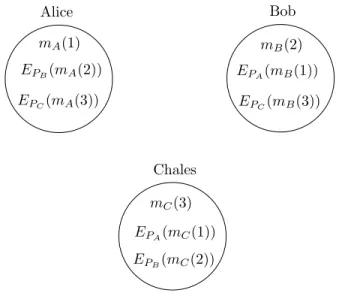
Then, Alice will keep one share and encrypt the other two shares with the Paillier encryption scheme using the public keys of Bob and Charles, respectively (Figure
6.2 Cryptography-Based Data Exchange Schemes for Smart Grid 58 mA(1) EPB(mA(2)) EPC(mA(3)) mB(2) EPA(mB(1)) EPC(mB(3)) mC(3) EPA(mC(1)) EPB(mC(2)) Alice Bob Chales
Figure 6.3: Partitioning the Smart Meter Readings
6.3). Each party then sends their encrypted shares to the utility provider/aggregator, keeping the unencrypted value to themselves. The aggregator will multiply the shares, which are encrypted using the same key and due to the homomorphic nature of the Paillier encryption scheme, we have,
Alice: EPA(mB(1)).EPA(mC(1)) =EPA(mB(1) +mC(1))
Bob: EPB(mA(2)).EPB(mC(2)) =EPB(mA(2) +mC(2))
Charles: EPC(mA(3)).EPC(mB(3)) =EPC(mA(3) +mB(3))
The aggregator sends these values to the respective party that owns the correspond-ing private key, who then decrypts the value and adds their share to it (Figure 6.4).
mA(1) EPB(mA(2) +mC(2)) EPC(mA(3) +mB(3)) mB(1) EPA(mB(1) +mC(1)) mC(1) Alice Bob Chales
Figure 6.4: Calculation of Partial Aggregations
Finally, each party sends their value to the aggregator to calculate the total consump-tion value by adding all the values it receives. This protocol can be extended to n
parties easily. Letmi denote the smart meter value of the ith party and let pi denote
his public key. Let mj,i denote the jth share of mi. That is, mi =
∑
jmj,i. The
aggregator will calculate, Ei = ∏ j̸=i Epi(mj(i)) = Epi ( ∑ j̸=i mj(i) ) ,
which he sends to theith party for decryption. Upon decryption he can add m
i(i) as
usual to obtain the sum of all the values encrypted under pi.
This method uses a simple protocol to establish smart data privacy; however, in the case ofn parties, each party will have to performn−1 encryptions and therefore the total number of encryptions will be n(n−1) =O(n2). Similarly, it can be shown
6.2 Cryptography-Based Data Exchange Schemes for Smart Grid 60
that the number of multiplications for ann-party protocol is also O(n2). Due to this quadratic running time, this protocol is not quite scalable.
Hence, a second approach is presented by Kursawe et al. [31]. Kursawe’s approach is based on comparison protocols where the aggregator knows a rough estimate of the total consumption (e.g., from past measurements). Each of the parties computes
gm1+r1
i , g m2+r2
i , g m3+r3
3 and so forth, where gi is a unique identifier based on a serial
number or the date and time of the measurement. The values r1, r2, and r3 are computed in random such that their sum is equal to zero. The aggregator can take the product of all the smart meter outputs to obtain,
∏ j gmj+rj i =g ∑ j(mj+rj) i =g ∑ jmj i .
Since the aggregator has an approximate value, CT ot of the total consumption he can
now compute gCT ot
i , g CT ot−1
i , g CT ot+1
i , . . . and compare for equality. The authors also
propose several protocols that describe ways to generate rj and gi. We consider a
protocol that is based on the Diffie-Hellman Key Exchange scheme.
In this scheme, we assume that each meter j has a secret key X = Rj and a
corresponding public key Pubj. For each round i, a generatorgi of the Diffie-Hellman
group is chosen.
• First, each smart meter j computes a round-specific public key, Pubi,j = g Rj
based on its secret key and the generator.
• The round keys are certified and distributed among all the smart meters in-cluded in the aggregation.
• Each smart meter computes the value,
grj i = ∏ k̸=j Pub(−1)k<jRj i,k ,
where k < j takes the value 1 if k is less than j, and is 0 otherwise. It can be seen that the summation of a