Security Services Using Blockchains: A State
of the Art Survey
Tara Salman ,
Student Member, IEEE
, Maede Zolanvari ,
Student Member, IEEE
, Aiman Erbad,
Member, IEEE
,
Raj Jain ,
Fellow, IEEE
, and Mohammed Samaka,
Member, IEEE
Abstract—This paper surveys blockchain-based approaches for several security services. These services include authentication, confidentiality, privacy and access control list, data and resource provenance, and integrity assurance. All these services are crit-ical for the current distributed applications, especially due to the large amount of data being processed over the networks and the use of cloud computing. Authentication ensures that the user is who he/she claims to be. Confidentiality guarantees that data cannot be read by unauthorized users. Privacy pro-vides the users the ability to control who can access their data. Provenance allows an efficient tracking of the data and resources along with their ownership and utilization over the network. Integrity helps in verifying that the data has not been modified or altered. These services are currently managed by centralized controllers, for example, a certificate authority. Therefore, the services are prone to attacks on the centralized controller. On the other hand, blockchain is a secured and distributed ledger that can help resolve many of the problems with centraliza-tion. The objectives of this paper are to give insights on the use of security services for current applications, to highlight the state of the art techniques that are currently used to provide these services, to describe their challenges, and to discuss how the blockchain technology can resolve these challenges. Further, several blockchain-based approaches providing such security ser-vices are compared thoroughly. Challenges associated with using blockchain-based security services are also discussed to spur further research in this area.
Index Terms—Blockchains, public key cryptography, prove-nance, data privacy, access control list, integrity assurance, blockchain challenges.
I. INTRODUCTION
A
BLOCKCHAIN is a secured, shared and distributed ledger that facilitates the process of recording and tracking resources without the need of a centralized trusted authority. It allows two parties to communicate and exchange resources in a peer-to-peer network where distributed decisions are made by the majority rather than by a single centralizedManuscript received August 29, 2017; revised February 18, 2018 and June 14, 2018; accepted July 17, 2018. Date of publication August 7, 2018; date of current version February 22, 2019. This work was supported in part by the NPRP award from the Qatar National Research Fund (a member of The Qatar Foundation) under Grant NPRP 8-634-1-131, and in part by NSF under Grant CNS-1547380.(Corresponding author: Tara Salman.)
T. Salman, M. Zolanvari, and R. Jain are with the Computer Science and Engineering Department, Washington University in St. Louis, St. Louis, MO 63130 USA (e-mail: [email protected]; [email protected]; [email protected]).
A. Erbad and M. Samaka are with the Computer Science and Engineering Department, Qatar University, Doha, Qatar (e-mail: [email protected]; [email protected]).
Digital Object Identifier 10.1109/COMST.2018.2863956
authority. It is provably secure against attackers who try to control the system by compromising the centralized controller. Resources can be tangible (e.g., money, houses, cars, lands) or intangible (e.g., copyrights, digital documents, and intellectual property rights). In general, anything that has a value can be tracked on a blockchain network to reduce its security risks and save the cost of security monitoring for all involved [1].
Recently, the blockchain technology has attracted tremen-dous interest from both academia and industry. The technology started with Bitcoin, a cryptocurrency that has reached a cap-italization of 180 billion dollars as of January 2018 [2], [3]. According to the Gartner report in 2016, the blockchain technology is receiving billions of dollars in research and enterprise investments and much more is expected to come in the near future [5]. The technology currently spans sev-eral applications that are popular and driving the networking research. Such applications include healthcare [6], Internet of Things (IoT) [7], [8], and cloud storage [9]. Generally, the blockchain technology has proven its potential in any appli-cation that currently requires a centralized ledger. A practical example that employs blockchains is the Interbank Information Network provided by JP Morgan which provides fast, secured, and cheap international payments [10]. In addition, supply chain systems by IBM is exploring the potential of using blockchains in their services [11].
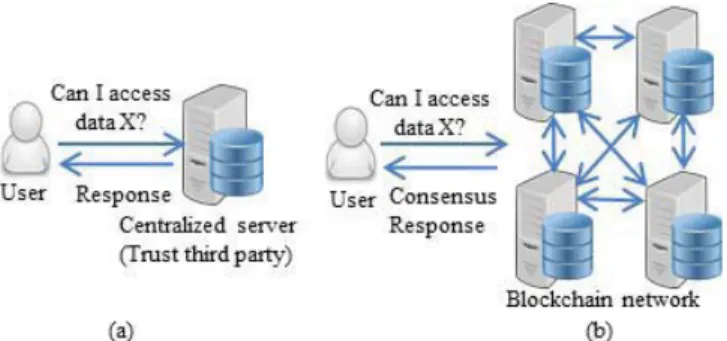
Among the blockchains’ promising applications are network monitoring and security services including authentication, con-fidentiality, privacy, integrity, and provenance. Currently, these services are provided by trusted third-party brokers or using inefficient distributed approaches. As a result, security is a major challenge for current applications. On the other hand, the blockchain technology can provide security guarantees that resolve many traditional challenges in addition to providing a fully distributed, provably secure, and consensus solution. Fig. 1 illustrates the differences between the traditional and the blockchain-based access control. The same concept can be applied to the other security guarantees.
This survey focuses on the use of the blockchain technol-ogy to provide network security services and applications. We present the use of these services in the current applica-tions, discuss the conventional techniques that provide these security services, and illustrate their challenges and prob-lems. Then, we present how the blockchain technology can be used to resolve the associated challenges and highlight several proposed blockchain-based approaches that provide the desired security services. Finally, we discuss the current
1553-877X c2018 IEEE. Translations and content mining are permitted for academic research only. Personal use is also permitted, but republication/ redistribution requires IEEE permission. See http://www.ieee.org/publications_standards/publications/rights/index.html for more information.
Fig. 1. (a) Traditional centralized access control guarantees (b) Blockchain-based access control guarantees.
challenges faced with blockchain and some of the potential future research directions in this field. It should be noted that the details of the blockchain technology and how it is used in other domains are out of the scope of this paper. We refer the readers to [1] and [2] for more details on the blockchain technology.
A. Related Work
With the current growing interest in the blockchain technol-ogy, many new platforms and applications have been proposed. Several survey papers have been written to highlight the ben-efits of this technology for the current applications. Examples of such surveys include the blockchain technology for IoT [8], healthcare [6] and decentralized digital currencies [12]. Other surveys have discussed blockchain challenges, opportunities, and future visions. For example, Lin and Liao [13] discuss the blockchain security issues and challenges. The work in [14] presents a thorough survey on blockchain security and pri-vacy issues including possible attacks and countermeasures. Moreover, a recent special issue of IEEE spectrum is dedicated to blockchains and their potential uses [15].
This paper investigates the use of the blockchain technology in a different set of applications with rising interests that have not been discussed in the prior surveys. We aim to provide a comprehensive survey on the use of the blockchain tech-nology in security services. The services can be offered by an enterprise and verified globally, offered by an enterprise but not verified, or presented as a research work. We strive these services to give insights on the current state-of-the-art technology and its challenges and discuss how the blockchain technology can be used to resolve these challenges.
B. Security Services and Mechanisms
According to the X.800 family of standards [16], security services can be defined as the services that aid the open system interconnection protocols in providing adequate security to the transferred data over the system. These services can be divided into six categories: authentication, data privacy, data integrity, data confidentiality, non-repudiation and data provenance. The authentication service includes data origin authentication and entity authentication. The mechanisms to achieve this ser-vice include encryption and digital signature schemes. These mechanisms can be provided using public key cryptography,
which will be explained later in Section III. The data privacy service can be achieved by access control mechanisms. The data confidentiality service can also be obtained by encryp-tion and; therefore, public key cryptography can be used. The data integrity service can be achieved by message authentica-tion codes using the secret key or the public key cryptography. The integrity mechanisms include replicating of the data and validating that replicas match. The non-repudiation ser-vice assures that no one can deny his/her action later and this can be provided using digital signature schemes; there-fore, public key cryptography techniques can be employed. Further, we add the data provenance as another service to achieve tracking and monitoring of the data or resources. TableIsummarizes these security services and their associated mechanisms.
In this paper, we consider the blockchain-based security ser-vices. Therefore, our discussion will include services such as authentication, data privacy, data integrity, and data confiden-tiality. Authentication and confidentiality are both provided by the public key cryptography; hence, these two will be combined in the same section. Privacy and integrity will be discussed in separate sections. It should be noted that non-repudiation is already provided by blockchain as will be explained later in Section II; therefore, we will not consider it among the services discussed later in the paper.
C. Paper Organization
The rest of the paper is organized as follows: Section II gives a brief background on the blockchain architecture and its key properties and platforms. Section III discusses both the traditional and the blockchain-based approaches in providing authentication and encryption by public key cryptography and key management techniques. Section IV describes both the traditional and the blockchain-based approaches to provide pri-vacy and access control lists (ACL). Section V presents both the traditional and the blockchain-based approaches to pro-vide provenance services that track and report the data and resources shared in the network. Both the traditional and the blockchain-based approaches for integrity services to check for correctness and reliability of the data are discussed in Section VI. Section VII focuses on the challenges currently faced with the use of the blockchain technology and their effect on security services. Finally, Section VIII summarizes the discussion and highlights the main presented points.
II. BLOCKCHAINBACKGROUND
In this section, a brief introduction to the blockchain tech-nology is first presented. Following that, mining or block construction techniques are explained. The appealing charac-teristics of blockchains are also discussed along with a com-parison of different open-source blockchain implementations. The objective of this section is to introduce the readers to the blockchain technology and its key principles.
A. Blockchain Architecture
A blockchain consists of a database and a network of nodes, as illustrated in Fig. 2. A blockchain database is
TABLE I
SECURITYSERVICESVERSUSSECURITYMECHANISMS
Fig. 2. Blockchain network, database, blocks, and transactions.
a shared, distributed, fault-tolerant and append-only database that maintains the records in blocks. Although the blocks are accessible by all the blockchain users, they cannot be deleted or altered by them. The blocks are connected to each other in a chain as each block has a hash value of its predecessor. Each block contains several verified transactions. Also, each block includes a timestamp indicating the creation time of that block, and a random number (nonce) for cryptographic operations. The blockchain network consists of nodes that maintain the blockchain in a peer-to-peer, distributed fash-ion. All nodes have access to the blocks, but they cannot completely control them.
The blockchain technology allows the communicating par-ties to interact in the absence of a trusted third-party. The interactions are recorded in the blockchain database provid-ing the desired security requirements. When a blockchain user needs to interact with another user, it broadcasts its “transac-tion” to the blockchain network. Several nodes in the network check if the interactions are valid and construct a new block of valid transactions by mining (i.e., combining several valid transactions). The making of the blocks will be discussed fur-ther in the next subsection. If the new block is found valid, it is attached to the blockchain database and cannot be deleted or altered later. Otherwise, the block is dropped. Both the
transactions and the blocks are signed; hence, they cannot be reverted or denied in the future.
The blockchain technology has three generations that sup-port money transactions, assets, and smart contracts, respec-tively. The first generation was published by Satoshi Nakamoto in 2009 [1]. The application of this generation was restricted to money transactions and was implemented as a part of the Bitcoin cryptocurrency, which was the first application uti-lizing the blockchain concept. The second generation of the blockchain technology had broader use cases that exchanged assets rather than just money. In this generation, users own “shares” or “assets” and they can exchange any type of assets, including goods, properties and even votes [2]. In the third generation of the blockchain, smart contracts were introduced. A smart contract is a programmable contract that is checked by everyone in the network; thus, it compels both communica-tion parties to strictly follow the contracts. The capabilities of blockchains were enhanced significantly within the third gen-eration which led to its worldwide popularity and an increasing interest in its applications for several other critical services [7].
B. Mining a Block in a Blockchain
Mining is the process of creating blocks that will be attached to the database. In some of the blockchain applications, such as in Bitcoin, the miner who creates the first valid block is rewarded. This reward is given by the system and is generally in terms of money for financial applications. Mining is one of the critical concepts in the blockchain technology. It allows nodes to create blocks which will be validated by others as well. If the new block is found as valid, it is attached to the blockchain database. Nodes that try to create blocks are called “mining nodes.”The mining nodes race to validate the trans-actions and create a new block as fast as they can to win the reward.
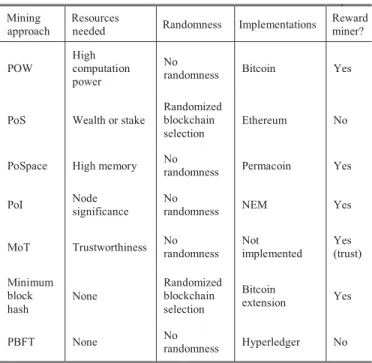
Several approaches exist to decide which miner wins, including proof of work (PoW) [17], proof of Stake (PoS) [18], Proof of Space (PoSpace) [19], Proof of Importance (PoI) [20], Measure of Trust (MoT) [21], minimum block hash [22], and Practical Byzantine Fault Tolerance (PBFT) [23]. In the following, we summarize these major mining approaches (see also TableII).
• Proof of Work: PoW is the mining technique used in Bitcoin and is currently used by many other blockchain
TABLE II
COMPARISON OFDIFFERENTMININGTECHNIQUES
technologies. It requires the mining nodes to solve a hard-mathematical puzzle that is changed frequently and has been agreed by all the miners. Once a node validates the transactions and solves the puzzle, the block is sub-mitted to the blockchain network. Other mining nodes validate the block to make sure that the submitter is not falsifying. Once it is agreed among the miners that the block is legit, it will be added to the blockchain and the submitter will be rewarded. The agreement here is based on a majority consensus. Thus, it is difficult to fake unless the attackers compromise more than 50 per-cent of the mining nodes. The problem with this approach is that high computational power is wasted in solving the mathematical puzzle [17].
• Proof of Stake: Unlike PoW, PoS does not require the mining nodes to solve a computationally expensive math-ematical puzzle. Instead, the next block creator or miner is chosen in a pseudo-random way. The chance of a node being chosen to create the new block depends on the node’s wealth or stake. In other words, the more money a node has, the higher its chances to mine a block. The native version of PoS does not award the miner; however, the extended versions award and punish the creators based on their performance. Selection based on the wealthiest account may result in a single account handling all the creations; hence, it may lead to an unfair distribution or even centralization. Therefore, a randomized node selec-tion and a coin age-based selecselec-tion have been proposed. In coin age-based method, the users that have not cre-ated any block for the past 30 days are considered for mining [18].
• Proof of Space: PoSpace is similar to PoW except that the puzzle requires a lot of storage. A miner proves its
ability to create a new block by allocating the required storage space to perform mining. In other words, instead of having a high computational capability, the mining node needs to have a high storage capability. Several the-oretical and practical implementations of PoSpace have been released; however, the required high memory space is a challenge similar to the computation challenge of PoW [19].
• Proof of Importance:PoI is a mining technique that cal-culates the significance of an individual node based on the transaction amount and the balance of that node. It assigns a priority with a hash calculation to the more sig-nificant nodes. Further, the node with the highest priority is chosen for the next block creation [20].
• Measure of Trust: Another way to perform mining is to use dynamic trust measurements and select the node with the highest trust level as the block initiator [21]. The trustworthiness is based on the nodes’ behaviors; there-fore, good behaving nodes that follow the protocols are rewarded. More specifically, the trustworthiness could be formulated as the expected value of the node’s behavior in the future. This, the trustworthiness is approximated by the history of good and bad actions that the node has taken so far. The MoT approach could be subject to malicious attacks if a specific node plans to increase its trustworthiness for several iterations in order to attack the network later. Zyskind et al. [21] proposed several mechanisms to handle such attacks.
• Minimum Block Hash: Paul et al. [22] proposed an approach for mining where the miner is chosen randomly and not based on its resources. The system selects the miners based on a generated minimum hash value across the entire network. Thus, the selection of the next miner is randomized and the probability of selecting the same miner is low. This approach was implemented on a mod-ified Bitcoin network and it was shown to offer energy savings for mining. However, it has not been adopted by the Bitcoin community.
• Practical Byzantine Fault Tolerance: Unlike others, PBFT [23] is a consensus approach that does not include any type of resources but utilizes the blockchain con-sensus based on the Byzantine fault tolerance approach. In this approach, first, a leader is selected and agreed among the nodes. The leader decides on the transac-tions’ validation and publishes a block to all the nodes in the blockchain network. A transaction is committed to a new block only if two-thirds of the mining nodes verify its correctness. The leader changes frequently; therefore, the approach is not considered as centralized. PBFT has been shown to be faster than other methods; however, it suffers from scalability issues due to the resulting communication overhead as discussed in [24].
C. Key Properties of Blockchains
Key properties of the blockchain technology include their distributed nature, decentralized consensus, trustless system, cryptographic security, and non-repudiation guarantees. In
TABLE III
KEYPROPERTIES OFBLOCKCHAINS
Table III, we briefly summarize these properties and the problems they try to solve.
D. Blockchain Open-Source Implementations
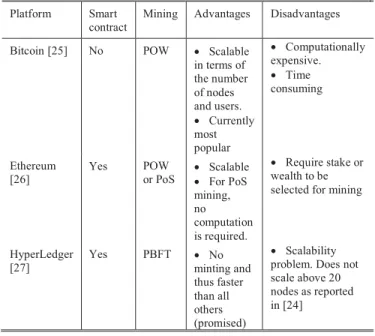
As there are many open-source implementations of the blockchain technology, the choice of which implementation to use is challenging. In TableIV, we compare different aspects of several popular blockchain implementations. We will be referring to these implementations throughout this paper when we discuss the blockchain-based security services. It is impor-tant to keep these features in mind to highlight the properties of each implementation. It should be noted that these are not the only implementations and many others exist in the liter-ature. However, these are the most popular ones used in the majority of the blockchain applications.
E. Summary
A blockchain is a distributed, shared, append-only, and permanent database that was first utilized by Bitcoin for cryp-tocurrency applications. Its key properties include distributed
TABLE IV
OPEN-SOURCEIMPLEMENTATIONS OFBLOCKCHAINSCOMPARISON
nature, consensus, trustless system, cryptographic security and non-repudiation guarantees. These properties make the blockchain technology a potential approach for the current dis-tributed applications including IoT, healthcare, and automated supply chains. Several variations of the blockchain technology exist in the literature to solve the challenges introduced in the first generation. One of the critical challenges in Bitcoin min-ing is the computational capability that is required to perform mining. Alternatives to PoW mining include: PoS, PoSpace, PoI, MoT, minimum block hash, and BPFT. These alterna-tives resulted in many open-source blockchain platforms that developers can choose depending on the application. In the remainder of this paper, we assume that the reader has the knowledge of the discussed platforms and their variations, as well as the advantages, and disadvantages of each.
III. ENCRYPTION AND THEAUTHENTICATIONSERVICES
Encryption and authentication are two of the most impor-tant security services that must be provided in any network system. In general, these services can be granted using public key cryptography as one of the well-known security frame-works. The public key cryptography techniques require the entities to have private and public information. They need an infrastructure to create, revoke, manage, distribute, use, and store the generated keys or the generated information. In this section, the public key cryptography and its uses in today’s applications are first discussed. Following that, an introduction to the public key management techniques and their challenges are presented. Then, an overview of how the blockchains can be used to solve these challenges and some blockchain-based key management techniques are discussed and compared. A. Public Key Cryptography and Its Services
Public key cryptography, also known as asymmetric cryp-tography, is a cryptographic technique that uses a pair of keys:
Fig. 3. Illustration of public key services.
public keys which are distributed over the system and private keys which are kept secret. It was introduced initially by Diffie and Hellman in 1975 and is still widely adopted. The basic idea is to use one of the keys to do a task (encryption or sig-nature) and use the other key to do the reverse of that task (decryption or validation). In this way, every entity can verify the message coming from a certain user by the user’s public key. The reply message can also be encrypted before sending it back. Only that specific user can sign/decrypt the message with its private key.
The public key cryptography can be used for many security services including the entity authentication and the confiden-tiality. As illustrated in Fig.3, the entity authentication service can be provided by the signature/verification procedure. An entity sends a message signed with its private key and everyone can verify/authenticate that entity by validating the signature with the entity’s public key. Since the private key is kept confi-dential, no one can sign the message except the entity itself or someone who has access to the private key. On the other hand, the verification is done with the public keys. Thus, everyone with the user’s public information can verify and authenticate that user.
The confidentiality service can be achieved by encryp-tion/decryption, which is a similar procedure. The encryption is done by the sender with the receiver’s public key. The decryption is done by the receiver with his private key. Only the receiver, or someone who has the receiver’s private key, will be able to decrypt and understand the data. Therefore, the confidentiality is guaranteed.
B. Services’ Importance for the Current Applications Entity authentication and message confidentiality are the most critical services in almost all of the current network appli-cations. A smart healthcare environment is a typical example of the importance of these services. The system is required to secure the transmitted data in order to keep patients’ privacy from intruders. Further, it is crucial to authenticate the right doctor, the hospital and the pharmacy and secure their access to the data.
To generate the private/public keys for the system, many algorithms have been proposed, including RSA [29],
ElGamal [30], and elliptic curve [31]. Discussing these algo-rithms is out of the scope of this paper. However, in general, these are complex and need an infrastructure to generate and manage the public/private keys. The certificate author-ities (CA), the Web of trust (WoT) and the entity-based cryptosystem have been introduced to create, manage, use, store, and distribute the keys. In the following subsections, we discuss both the traditional and the blockchain-based key management approaches, including CA and the Web of trust. In a later subsection, we discuss the entity-based cryptosystem which is the current trend that extends the CA mechanisms to make a better use of the public key cryptography.
C. Key Management by the Public Key Infrastructure (PKI) The public key infrastructure (PKI) is one way to pro-vide the key management for the public key cryptography. Traditionally, there are two conventional approaches to achieve PKI, centralized by a CA and decentralized by WoT. The CA-based PKI is the most commonly used approach and it has been standardized in the X.509 standard [32]. In this approach, the CA is a third-party entity that is trusted by all members in the system. The CA issues “certificates,” which authen-ticate users and bind each user to a public key. A signed certificate, binding a user to its public key, will authenticate the ownership of that public key to that specific user. The other traditional approach is WoT, which was proposed in 1992 by Phil Zimmerman. This technique utilizes a decen-tralized approach in which the keys are generated locally and will be trusted if they are verified by at least one other trusted user in the system [33].
D. Problems With the Traditional PKI Systems
Both of the traditional techniques suffer from several chal-lenges which are discussed in this subsection.
The CA-based PKI comes with three major challenges: a trusted third party, a single-point-of-failure, and cost. The users of the systems must trust the CA in generating and man-aging their public keys which imposes high-security risks if the CA is compromised. This architecture has a single point of failure as the whole system fails if the CA fails. Furthermore, the management of the public keys by one centralized CA can be both expensive and inefficient, especially with the current massively distributed applications where a large number of users are involved [34].
On the other hand, in the WoT-based PKI, the signers need to build trustworthiness. The users join the network only if they are trusted by another “trusted” member. In other words, new members joining the network need to build prior trust with other members who are already in the system. This can lead to a barrier for new members entering the network [34]. Moreover, both the CA-based and the WoT-based PKI are unable to provide identity retention. That is, it is possible for a user to impersonate the identity or the public key of an already registered user. Some proposals have been offered to solve this problem; however, they are mostly log-based, which could be highly complex, especially in the case of the worldwide distribution of the users [34].
TABLE V
THETRADITIONALPKI PROBLEMS AND THE BLOCKCHAIN-BASEDSOLUTIONS
E. Blockchain-Based PKI Concept
The distributed, the event-recording and non-reproducibility features of the blockchain technology make it a desirable tech-nique for several applications. Particularly, these properties prove the blockchains’ suitability for PKI and domain name services (DNS). Since the blockchain-based PKI solutions are distributed; they have no centralized point of failure. The trust is built based on the majority vote of the miners; hence, there is no single trusted third-party and it does not require prior trust-worthiness in the system. More importantly, the blockchain technology has several open-source implementations, which helps build cost-effective and efficient solutions. The prob-lems with the traditional approaches and how the blockchains can solve them is summarized in TableV.
In the following, we discuss several approaches to achieve blockchain-based PKI.
1) Instant Karma PKI (IKP): The Instant Karma PKI (IKP) framework extends the traditional CA approach by recording the CA behavior to the blockchain database. In this way, mis-behaving or compromised CAs can be detected by the network and a riposte must happen. The event recording feature of the blockchains facilitates the CA tracking and monitoring by the blockchain users and helps detect the misbehaving CAs. This approach can reduce the trust problem in the traditional CA-based algorithm as eventually misbehaving CA can be detected.
IKP is a research work that was proposed in 2017 and ver-ified in terms of cost saving and distribution. An open source implementation was also promised but has not come available at the time of this writing [35]. However, having a CA in the system still lead to a single point of failure system. Trying to solve this matter by having several CAs imposes cost; thus, leading to even a more expensive solution.
2) Pemcor: Pemcor utilizes the blockchain database as a distributed and secure data store [36]. The idea is to let the CA issue a certificate which is not signed. Instead, the hash value of the certificate is stored in the blockchain which is controlled by authorities, like by banks or governments. Such authorities share two blockchain databases, one for
Fig. 4. The architecture of Gan’s approach.
the generated certificates and one for the revoked certifi-cates. When verifying, the authority checks its maintained blockchain data stores. If the hash of the certificate exists in the generated certificate blockchain and is not in the revoked certificates blockchain, the certificate is valid; otherwise, it is not. This idea is simple and provides several advantages such as an easy verification with low delay guarantees.
Pemcor is part of a project that aims to find a solution for identity proofing and replaces the traditional knowledge-based verification. The project was proposed and documented theoretically by several white papers in 2016, however, it still lacks the complete implementation and the evaluation of the system. Given other approaches presented in this section, this work is not expected to contribute further to the blockchain-based PKI systems.
3) Gan’s Approach: Gan [37] propose a key-based authen-tication system dedicated to the IoT environments. The idea is to use a private blockchain for storing the nodes’ latest public keys, validating the keys, and allowing others to request the nodes’ keys. The architecture of this approach is illustrated in Fig.4, where a Centralized CA (CCA) is assumed to be fully secured. Several validators, donated as Device Manufacturer Validators (DMVs), are connected to the CCA.
The DMVs are hosted by the IoT manufacturers and they are required to have the computational capabilities to generate the public/private keys, to perform mining and to maintain the blockchain database. The IoT devices are connected to these validators and are assumed to be simple without any computa-tional capability. Initially, a DMV joins the blockchain network by requesting the CCA to authenticate it. The CCA validates the DMV and constructs a transaction that contains the DMV public key, the validator address, and the CCA’s signature. The transaction is submitted to the blockchain and the DMV is now known to the others. Accordingly, the DMV can add a new IoT node by submitting a transaction containing the node’s public key and address to the blockchain. Furthermore, the DMVs can update or revoke their IoT devices’ public keys by submitting transactions.
This work has an open-source implementation that is avail-able on GitHub and referenced in [37]. The implementation utilizes Network Simulator version 3 (NS3) to build and eval-uate their proposed approach. Even though the approach was initially applied to the IoT platforms, the idea can be imple-mented in any other networking applications including sensor networks, health care, or even micro clouds platforms.
It should be noted that these previously discussed three approaches use the blockchains only as distributed databases to share and validate the keys. In other words, they do not benefit from the other important properties of the blockchains including the distributed consensus and the non-repudiation guarantees. In addition, as it was mentioned before, having a CA that generates the keys does not resolve the problems of centralization; hence, the single point of failure in the traditional PKI approaches.
4) Distributed PKI (DPKI): Allen et al. [38] sketch the principles of an appropriate blockchain-based PKI, which is referred to as Distributed PKI (DPKI). The DPKI uses the blockchain technology as a distributed, trustless database that eliminates the need for a CA and gives the users the direct control and ownership of their data. This work uses a Web registration domain, where the user spawns its public/private key and submits the public key to the blockchain network as a transaction. In this work, it is claimed that the blockchain technology can resolve the traditional problems and protects the network against man in the middle attacks. This protection is granted by linking the most recent key of the user to his/her identity.
The paper did not include any implementation-related aspects; nevertheless, it introduced the possibility of blockchain-based PKI, which was later implemented in many other works as will be discussed next.
5) Blockstack: Blockstack ID is an appropriate blockchain-based approach that uses Namecoin to build a distributed PKI system. Namecoin, [40], is a fork of Bitcoin that allows data storage within the blockchain transactions. It is imple-mented by defining a name-value pair that is used to store usernames and can be recorded in the transactions. Namecoin was originated to store the DNS names, allowing users to reg-ister their human-readable name and associating names with the corresponding public keys.
Blockstack ID modifies Namecoin by adding another name-value pair dedicated for the public keys. The advantage of using Namecoin is that it already supports the name-value pairs in its transactions. Thus, the public key is the value and the name is the identity of the owner. Blockstack imple-mentation binds the user identity to an elliptic curve public key which is one of the strongest public key cryptography mechanisms to date.
Blockstack was released as an open-source software in 2014 and is currently serving as a PKI system for 55,000 users. It is probably the most popular blockchain-based PKI among other techniques discussed in this section. However, some issues such as how the system would handle the public key updates, the lookups, and the revocations have not been considered in Blockstack. Also, the identity retention problem is not been resolved.
6) Certcoin: Certcoin, [41], is another fully decentralized PKI that relies on Namecoin to build its platform. Unlike Blockstack ID, this platform provides the identity retention guarantee. As in the traditional PKI approaches, this system is composed of 5 functions: registration, update, lookup, ver-ification and revocation. During the registration, the owner originates its own private and public keys locally. It keeps the private key to itself and submits a transaction of the pub-lic key and its signature to the blockchain. The blockchain network verifies the transaction signature and the fact that this ownership was not registered before in the system. If the veri-fication is successful, the (ID-public key) tuple is added to the blockchain; otherwise, it is dropped. To update the public key, the owner submits a transaction containing the identity along with the previous public key, the new public key, and the sig-nature. Miners need to verify that the signature is correct, the identity exists in the blockchain, and it is associated with the previous public key. Then the mined blocks are broadcasted to the network to be verified. The verification follows a similar process where the owner submits a transaction requesting the blockchain network to verify the key which can be done by the miners and other blockchain nodes.
Certcoin has 3 versions, numbered 0, 1, and 2. The first version (version 0) required complex computations and oper-ations while the second and the third versions tried to reduce this complexity by accelerating the blockchain processing. Version 0 had all the five functions submitted and mined by the blockchain network as in Bitcoin. However, those func-tions are complex and result in a computationally expensive process. Thus, versions 1 and 2 tried to reduce this complexity by a cryptographic accumulator and a distributed hash table, respectively. A cryptographic accumulator is a space-efficient data structure that is used to reduce the time and the complex-ity of the verification process [42]. A distributed hash table supports fast look-ups for the public key queries; hence, the complexity of the lookup and the verification is reduced [43]. Therefore, the verification, the lookup and the update functions have been simplified in both versions 1 and 2.
Similar to Blockstack, Certcoin is an open-source imple-mentation that was first released in 2014. The project was one of the first blockchain-based PKI and is offered by MIT [41]. However, Certcoin is less popular compared to Blockstack due to the lack of proper documentations and the lack of updates to the software.
7) Guardtime Solution: Guardtime provides another solu-tion for secure authenticasolu-tions of the IoT devices using the blockchains and physically unclonable functions (PUFs). A PUF is a digital fingerprint hardware that serves as a unique identifier of the devices. The PUFs use the unique charac-teristics of each device to generate its unique private/public keys. Guardtime employs PUFs to generate the public/private keys. The public keys are submitted to the blockchain in transactions. IoT devices have limited memory; hence, they cannot store large private/public keys [44]. In other words, the solution provided by PUF and Guardtime helps such devices regenerating the same key each time it is needed.
Guardtime is an enterprise that currently offers blockchain-based solutions for several industries including the insurance
companies, the physical supply chains, the cloud providers, and many others. Guardtime Federal is a fork from Guardtime that started in 2014 and is dedicated to providing cyber-security solutions for the U.S. department of Defense, the U.S. Intelligence Community, and other U.S. Government departments. All solutions offer the confidentiality and authen-tication services. However, these solutions are mainly dedi-cated to supply chains and their integrity assurance, as will be discussed in Section VI-E.
8) Blockchain-Based Trust and Authentication for Decentralized Sensor Networks: Moinet et al. [45], propose an approach of using the blockchain technology as a database to store the public keys, the digital signatures and some peers’ information in a wireless sensor network. This approach is similar to Certcoin, since it allows the nodes to verify and authenticate each other using the blockchain network. Initially, when a node wants to join the network, it submits a credential transaction, or a credential payload as referred in the paper. This transaction has the master public key and a signed hash value that is used to authenticate the node. A node can submit a transaction to renew or revoke its own public key. In addition, this approach introduces a “blame transaction” which defines the trust level of all nodes in the network. A node is blamed whenever its trustworthiness goes below a certain defined level. The blame transaction includes the node that generated the blame, the blamed node and the block that had the node ID and the public key included. Furthermore, all the blocks must have a miner’s approval transaction to be valid. A miner’s approval transaction would include the miner ID, a nonce, the new node’s public key, and the signature of the miner.
It should be noted that this approach is an extension of the Web of trust traditional approach, where a node can join the network only if another node (miner) approves it. Also, this is mainly a research work that does not include any proper blockchain implementation, thus, is not getting practical and popular compared to Blockstack or Certcoin.
F. Identity-Based Cryptography (IBC)
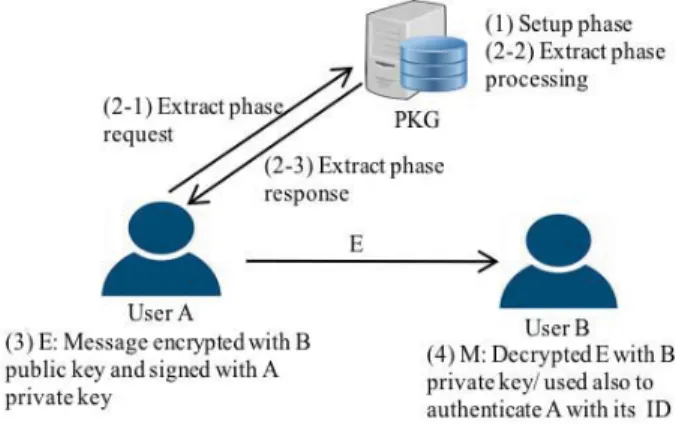
Recently, identity-based cryptography (IBC) has gained interest in the network security community. IBC is a public key mechanism that uses the node’s ID as the public key rather than generating the traditional lengthy public keys. A node’s ID can be the node’s name or any arbitrary string that can be used as the public key. The encryption approach, as depicted in Fig. 5, consists of four phases: setup, extract, encrypt, and decrypt.
In the setup phase, a private key generator (PKG) generates a master secret key along with some public system parameters. The secret key is kept private while the system parameters are made public. To extract the keys, the generator uses the system parameter in addition to its master secret key and the user’s ID. These parameters are used to construct a secret key which is sent back to the user. For other nodes to encrypt a mes-sage, they use the ID and the public parameters to generate a ciphertext. The user uses its own private key to decrypt the message. A similar approach is used for the signature and the
Fig. 5. Identify-based encryption phases.
verification, where the signature is generated with the node’s secret key while the verification is done with the node’s ID and the public system parameters [46].
A generalization of the IBC is to build a Hierarchal IBC (HIBC) where the public key has a hierarchal identity basis that can be represented by a tree. For example, the pub-lic key of Apub-lice at organization X is Apub-lice@X rather than Alice. The encryption phases of HIBC are the same as the four phases in the IBC with an additional phase, called del-egation. This phase allows an entity to generate secret keys for its children. In other words, the system needs one PKG to generate the secret key for the root. Others secret key can be driven from that key [47].
G. Problems With the Current IBC-Based Approaches The problem with both the IBC and the HIBC approaches is that they require the PKG to generate the private keys. Therefore, the system is centralized which makes it a single point of failure and imposes a third-party trust requirement. It is centralized as the PKG is the only authority that can gener-ate key pairs. If the PKG is compromised, the whole system is compromised. In other words, the IBC and the HIBC have the same limitation as the CA-based PKI traditional approach. Moreover, the PKG generates the users’ private keys; hence, all the users should trust the PKG not to misuse their private keys.
H. Blockchain-Based IBC
Similar to the blockchain-based PKI approaches, the blockchain technology can be used as a distributed database to resolve the problems of the traditional IBC approaches. Since, the blockchain technology has a decentralized database, it solves the problems of centralization and the single point of failure. It does not require a third-party trust as the users can generate their own master keys. However, if a user has limited resources and cannot generate its own key, it can delegate that to any other node that it trusts.
The basis of the blockchain-based IBC systems is to let the users generate their own keys. This indicates that the setup and the extract phases are done at the user level. Then, the public parameters are submitted to the blockchain as a transac-tion. The blockchain nodes check whether these parameters are
TABLE VI
BLOCKCHAIN-BASEDPKI APPROACHESCOMPARSION
valid and they have not been used before. Any user can later query the blockchain network for other users’ public param-eters which are used to authenticate the user and encrypt the confidential messages.
1) Blockchain-Based IBE for Information-Centric Networking (ICN): The blockchain-based IBC can be applied to secure the Information-Centric Networking (ICN) which considers “content names” as the main element for security, i.e., as the basis for inter-network communication. Therefore, it is practical to utilize the HIBC approach to secure the ICN, as the contents are designed to be hierarchical [47]. Fotiou and Polyzos [48] utilize the blockchain-based IBC to provide distributed security for the ICN networks, where a content owner wishes to share some data with the sub-scribers. This approach consists of two phases: setup and retrieval. In the setup phase, the owner generates the public parameters and a secret key that are required by the HIBC. In other words, the owner acts as a PKG for itself. It registers the public parameters to the blockchain network by submitting a new transaction. Then, when a subscriber wants to access the data, it queries the network for the public parameters of the corresponding content. This means that instead of consulting the centralized PKG in the traditional HIBC algorithm, the subscriber consults the distributed blockchain. These activities are recorded in the transactions; hence, cannot be denied once the transactions are committed to the blockchain database. Thus, the blockchain technology can provide both the integrity and the provenance services, in addition to solving the centralized architecture challenges.
This scheme can be applied to any ICN or other simi-lar applications. However, the initial implementations of this scheme showed a high level of complexity in generating the public keys. This problem resulted in restricting the scheme’s practicality and popularity among the resource-limited ICN applications that are emerging.
I. Summary
The public key cryptography is an important security frame-work that is used widely to provide the authentication and the
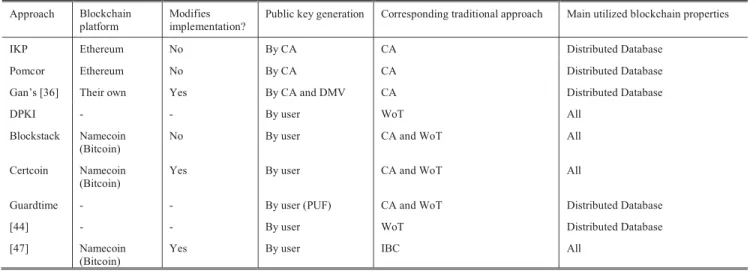
confidentiality services. Such services are critical for most of the current applications including IoT and healthcare. A man-agement system is required to provide a proper infrastructure for such services. PKI is a framework to generate, distribute and manage public keys for the entities in the system. In this section, we discussed the traditional PKI systems and how the blockchains can be used to resolve their problems. We further presented several proposed approaches providing blockchain-based PKI solutions. Furthermore, we discussed the IBC technique which is a recent popular technique in pro-viding security services. We presented the traditional IBC, their problems, the blockchain-based IBC, and a proposed approach for a blockchain-based IBC. Table VI shows the comparisons among the discussed approaches from different perspectives. It should be noted that even though these systems exist and are open-source, only few are utilized in real-world applications.
IV. PRIVACYSERVICES
A privacy service offers the user the rights to control and set rules for its data and resources accessed by the network. In other words, it enables the data or resource owners to con-trol the disclosure of their information. This is generally done by letting the user define his access control list (ACL). In this section, we investigate the requirements of providing the data privacy, its importance for the current applications, the traditional techniques for privacy, and the challenges currently faced in providing the privacy service efficiently. Then, we give an overview on how the blockchains can be used to pro-vide privacy and summarize a few existing blockchain-based privacy providing systems.
A. Data Privacy and ACL
The data privacy requires that all personal and sensitive information remain confidential (not public) and access to them can be controlled by the data owners. The ACL assures that by defining a set of rules stating who can access a spe-cific set of data and when. To illustrate the privacy problem,
consider the users in organizations such as Facebook, Google, banks and government surveillance. Each user must provide his/her personal information. Thus, these organizations have a massive amount of personal data that should not be made public. Individuals have little or no control over the storage and the access to their information. Therefore, the data privacy can be violated. Many controversial incidents have been reported, especially with banks and government surveillance [49], [50]. The privacy concerns exist whenever the data is collected, stored, used, destroyed, or even deleted. In other words, pri-vacy applies to the data in motion and at rest. Several federal laws have been developed to prevent information leakage; as an instance, the healthcare information privacy laws [51]. For all these reasons, privacy is a major concern for application and network developers.
B. Importance of Privacy in Current Applications
The data privacy is a prominent interest in the era of cloud computing and networking systems where many users share the same physical storage or network. Application devel-opers migrate their storage and computations to the clouds and require the data privacy to be granted. Moreover, IoT, healthcare, smart grids, and several other popular networking applications need to process and store a massively large amount of data, generally using cloud computing. Privacy is a critical requirement for most of these applications that are involved with personal information or location knowledge. The problem of privacy is intesified in case of using multiple clouds and internetworking among them.
C. Traditional Techniques for Data Privacy
Generally, the data privacy can be provided by delegating the ACL definitions to the data owners and using encryption techniques to prevent others from accessing the data. Hence, the organizations who amass or process the data have no rights to access the if the ACL does not permit. Design and imple-mentation techniques to provide the privacy service is among the most active research topics, and several techniques have been proposed so far. For example, homomorphic encryption, which allows the computation and the processing the encrypted data and returns encrypted results, is one way to provide the data privacy service [52].
Another privacy aspect, which is out of the scope of this paper, is hiding the user’s identity. Data anonymization and differential privacy mechanisms hide the identity of the user and make it difficult to link the data to its owner. For example, K-anonymity, a common way to anonymize the datasets, requires the sensitive information to be similar to at least K-1 other records [53]. L-diversity, an extension of the K-anonymity approach, guarantees that the sensitive infor-mation is stored in “diverse enough” possible locations [54]. T-closeness is another approach that looks at the distribution of sensitive data [55]. Differential privacy uses data pertur-bation techniques or adds noise to them before sharing the data [56]. Most blockchain implementations provide pseudo-anonymous user privacy. For example, Bitcoin utilizes the hashes to identify the users, rather than their real names. The
users stay hidden from others and remain anonymous to the system unless sophisticated attack actions are taken [1]. D. Problems With the Traditional Techniques
Despite the fact that several research efforts exist, provide an efficient data privacy service is still challenging. Some of the challenges include efficiency, scalability, data ownership and lack of systematic data lifecycle approach. In the following, we briefly summarize these problems and refer the readers to [57] for more detailed discussion.
• Efficiency and Scalability:Most of the data privacy tech-niques rely on complex cryptographic algorithms; hence, they are inefficient and difficult to scale with large applications. Recent research tries to reduce the com-plexity and enhance the efficiency of these cryptographic techniques [58]. However, the proposed approaches still lack practicality in most cases. Further, most algorithms fail to scale with the massive amount of data processing required in the current networks.
• Data Ownership and Control:The questions of who owns the data and who can modify it are critical in privacy. The owner generally is the party that decides the access control rules for the data. Unfortunately, the traditional techniques discussed in the previous subsection still lack an answer to the ownership question.
• Systematic Data Lifecycle Approach: A framework for the data privacy needs to be constructed to systematically define the lifecycle of the data. This framework should identify the phases, define their privacy requirements, and allow flexibility in the lifecycle changes. These phases can include the acquisition, the sharing and the deletion of the data and the resources involved in the system . However, a systematic approach is still missing in most of the proposed privacy techniques.
E. Blockchain-Based Data Privacy Techniques
The blockchain technology can be used to provide decen-tralized end-to-end data privacy guarantees that can resolve some of the problems discussed in the previous subsection. Specifically, it can provide the data ownership solutions and dynamically change the access rights when needed. However, since the blockchains depend on cryptographic techniques, the blockchain-based techniques are still complex. The prob-lems associated with the traditional approaches and how the blockchain technology can solve them are presented in TableVII.
The idea behind the ideal blockchain-based data privacy is to build a blockchain layer over the data storage layer, let the owner define the desired ACL through smart contracts, and publish the ACL and the data to as the blockchain transactions (encrypted using sophisticated encryption techniques). In this way, organizations such as Facebook or Google will not own the data as happens in the traditional techniques. However, they will be a part of the blockchain network and they will be able to process the data only when the ACL allows them. This type of blockchains is called the permissioned blockchains. Policies to define the data access are either based on the smart
TABLE VII
TRADITIONALDATAPRIVACYPROBLEMS AND BLOCKCHAIN-BASEDSOLUTIONS
contracts or on the data management messages. Further, an off-chain database can be used to store the encrypted data as the blockchain memory is limited and cannot store massive amounts of data. In the following, we discuss several recent approaches that utilize the blockchain technology to provide the privacy service.
1) Zyskind’s Approach: Zyskind et al. [21], propose a decentralized data privacy approach that ensures the users’ control over their data and uses the blockchain blocks to store the data and the ACL. As illustrated in Fig. 6, the system is composed of three main components: users, providers and the blockchain network. The users are nodes interested in downloading an application or using a service. Providers, who hold such services or applications, need to process the users’ personal data for operational and business purposes. The blockchain nodes are the untrusted entities that constitute the blockchain network and have a distributed data store (off-chain data store). The data is distributed and replicated among the data stores to ensure the privacy and the high availability services.
The blockchain network accepts two types of transactions:
Taccess and Tdata. The Taccess is used for the control and
the management operations on the data, such as defining the ACL and modifying the access rights. The Tdata is used for
Fig. 6. Zyskind’s proposed system components.
data storage and retrieval. The owner can change the permis-sion and the access controls by sending a policy set in the
Taccess transaction, which is checked for correctness by the
blockchain nodes. Similarly, a user or a service provider can access the data by sending a Tdata transaction which will be approved by the blockchain nodes if the policies specified earlier are met. The returned response (access information or denial) is encrypted; hence, unauthorized users cannot have access the data.
Zyskind’s Approach is a research work that has been veri-fied theoretically and practically in their paper [21]. However, the open-source implementation of the proposed approach is still missing thus, practicality and suitability of the proposed approach are still to be testified.
2) Blockchain-Based Data Sharing (BBDS): Blockchain-based data sharing (BBDS) is another approach proposed to provide privacy for the medical records in a cloud environment [59]. It uses a simplified blockchain architecture that is scalable and efficient for lightweight communication systems. The system is composed of three layers: the user layer, the management layer, and the storage layer. In the following, we briefly explain the rules for each layer:
• The user layer:The user layer includes the individuals or the organizations who want to access or store their data and services.
• The management layer: The management layer includes issuers, verifiers, and consensus nodes. The issuers authenticate the users when they first come and han-dle their registrations. The verifiers authenticate the users later and manage their keys. The consensus nodes con-struct the blockchain network and process the new blocks the same way as in Bitcoin processing.
• The storage layer:The storage layer includes cloud-based data storage and processing infrastructures to securely store and process the data.
The block structure in the BBDS is simplified by modifying the transaction and block header fields to meet the health-care records requirements. Furthermore, the interactions in the system are secured by identity-based authentication and encryption techniques which are simple, efficient, provably secure, and lightweight.
Fig. 7. FairAccess resource request process.
BBDS is implemented in a private permissioned blockchain that does not rely on any of the open-source blockchains discussed earlier in Section II-D. The theoretical and the ini-tial implementation of the proposed approach showed a good performance compared to Bitcoin complexity. However, the full system is under development and thus it is not yet popular at the time of this writing.
3) FairAccess: FairAccess utilizes the smart contracts to define the access control policies and make authorization decisions [60]. The system uses the blockchain transactions to define authorization tokens. These tokens are used by the sender to authorize the receiver in accessing parts of the sender’s data. Functions in FairAccess include: resource registration, grant access, request access and revoke access.
This approach is not implemented in the paper; however, the theoretical analyses showed that the data privacy could be preserved by the provided integrity, authentication, encryption and consensus access control monitoring.
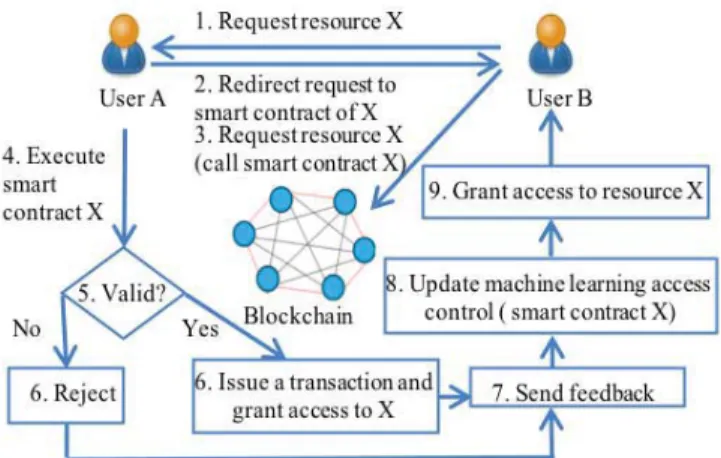
4) Dynamic Access Control for IoT Using FairAccess: FairAccess has been utilized to provide a distributed, secured, and adaptive ACL management for the IoT environments [61]. The proposed idea is to let the users register their new resources and define their access policies through the smart contracts associated with these resources. The process of requesting a resource, as depicted in Fig. 7, involves sev-eral steps. First, when a request is made for a resource that is held by user A, it is directed to the blockchain network. In turn, the blockchain network allows/denies the access request based on the associated resource’s smart contract. The network sends a feedback to the requester granting or denying his access request. Further, the owner can update his/her access policy based on the received feedback from the blockchain network using deep reinforcement learning, an adaptive machine learning mechanism.
This approach is implemented and testified for a specific IoT use-case. The implementation is done on top of Bitcoin and the results show the feasibility of the proposed approach in providing the right access control list management. However, the lack of real-time support, the block complexity and the inflexible implementation are still drawbacks that burden the practicality and the widespread of the proposed approach.
5) Decentralized Runtime Access Monitoring System (DRAMS): Ferdous et al. [62] utilize the blockchain technology to verify access control logs for clouds in a federated cloud environment. The key idea is to use the smart contracts in defining the access rights and collecting the access logs from different clouds. The blockchain miners compare the access rights to the access logs. If a violation is detected, an alert is raised to be further handled by the system.
This approach was implemented on top of the Ethereum platform. Results show that the system is resilient to many threats, including compromising the communication channel to modify the access rights, compromising the policy evaluation to allow unauthorized accesses, and compromising the logs to alter or delete them. However, latency, cost and scalability are the challenges that need to be considered for this platform to become practical.
6) Data Privacy for IoT Data Storage and Sharing: IoT is witnessing a rapid increase in the number of innovative appli-cations; however, security is still a major concern. Most current ACL mechanisms are delegated to a trusted, centralized con-troller that maintains and manages the access controls. On the other hand, the blockchain-based data privacy can help resolve the problems with centralization and provide decentralized, resilient, and auditable privacy guarantees. Shafaghet al.[63] use the blockchain network to securely store and manage the access permissions. The blockchain transactions are com-posed of the ownership of the data and the corresponding access permissions. Initially, the owner submits a transaction that includes the data stream identifier. A new transaction is issued when the owner wants to share the data with other users or with the service providers. Further, the owner can revoke his data sharing by submitting a revoke transaction. When a provider or another user wants to retrieve a specific set of data, they send a request to the storage node which queries the blockchain network for the access rights. Data, in both the blockchain database and the storage nodes, is encrypted and highly distributed. This mitigates the threats of malicious stor-age nodes that grant service access rights without consulting the blockchain.
An initial implementation of this scheme was built on top of the Bitcoin platform. Results showed a reasonable overhead due to the routing loads, the point-to-point communication and the distributed storage. However, the latency and the scalabil-ity challenges are not resolved, especially for real-time IoT applications.
F. Summary and Comparisons
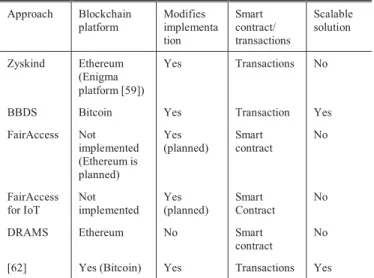
The data privacy is a critical security aspect that guar-antees the user’s control over their data disclosures and prevents unauthorized access and processing. In this section, we discussed several blockchain-based approaches providing the data privacy. Such approaches define the ACL either by the smart contracts or by special management transactions. Monitoring of the access rules and the violations can be done by the blockchain nodes to fully eliminate centralization. Table VIII compares the different discussed approaches. It
TABLE VIII
BLOCKCHAIN-BASEDDATAPRIVACYAPPROACHESCOMPARISON
should be noted that these approaches handle the data privacy rather than the user privacy. Most blockchain implementations provide a pseudo-anomalous user privacy using the hashes to identify the users rather than their actual names.
V. PROVENANCESERVICES
Data or resource provenance is another security service that deals with the tractability and the auditability of the resources. In this section, we discuss the traditional techniques provide the data provenance and highlight their problems. Following that, we discuss how the blockchains can help in providing a provenance architecture, highlight some of the proposed approaches that utilize the blockchain technology to provide the data provenance services and give a brief comparison among the different discussed blockchain-based provenance approaches.
A. Data and Resource Provenance
Data provenance refers to the metadata that tracks and reports the originality of the data and the operations associated with them. The metadata includes records of the inputs, the entities, the systems, and the processes that accessed or manip-ulated the data of interest. An example would be the tracking of the data ownership and the accessing of some information in a cloud environment. When dealing with clouds, the data are massively scaled, and the resources are shared by many differ-ent differ-entities. It is important to track the origin of the data and the operations happened on them, including the reading, the processing and the writing of the data or the resources. This is not only applied to the data, but also to any type of resources such as the network devices, the workflows, the Web services, and the processes.
Providing provenance guarantees resource tractability, forensic capabilities, and auditability. In other words, it helps the network administrators in detecting any access violation or any malicious operation. However, this service comes with two issues, complexity and privacy violation. Keeping track of
the resources is challenging and complex, especially for the distributed applications. Data or resources can be replicated in different areas to provide availability and they might follow different paths to provide resilience guarantees. Furthermore, the amount of data is massively increasing, which makes tracking complex and inefficient. Further, such tracking may violate privacy if the information about the data ownership and the data originality is exposed. Due to this reason, guar-anteeing the data provenance without violating the privacy is a challenge to be resolved in the current applications. B. Importance of Provenance
In the age of social networking, cloud computing, IoT, and other distributed applications, data is an acute resource that is open and vulnerable to intrusions. The owners need to know not only the data originality, but also the manipulations and the accesses to the data along its lifecycle. For example, in IoT applications, the sensor data has to be tracked so that they get to the consumers without any unauthorized modification. Further, the consumers need to know how accurate the infor-mation is and what time it was sent. This can be achieved only by proper data provenance techniques. The same provenance requirements are applied to the healthcare data, the financial data, the governmental resource, or even scientific applica-tions. Such applications are worldwide, generating massive amounts of data that need to be tracked. Hence, the provenance guarantees are crucial for these applications.
C. The Traditional Techniques
State-of-the-art techniques in providing the data provenance in the cloud environments are based on logging and auditing techniques. Most of these approaches are used at the central-ized authority that manages the system resources. Examples of the data provenance approaches include PASS [64], S2Logger [65], and SPROVE [66]. PASS was one of the first approaches to provide the data provenance service by collect-ing and maintaincollect-ing information about the operations done at the system level [64]. S2Logger is a tracking tool that provides an end-to-end resource monitoring in a cloud envi-ronment at the file level [65]. SPROVE is a technique that provides confidentiality and integrity of the data provenance through encryption and signature techniques [66]. In addition, Asgharet al. [67] propose a secure data provenance technique that utilizes encryption techniques to enhance the privacy of the data provenance.
D. Problems With the Traditional Techniques
The techniques discussed in the previous subsection have several challenges, including ineffectiveness, complexity, lack of privacy and centralized controllers. The cloud hardware and software are distributed by nature and have several layers of interoperability, which makes the logging techniques ineffi-cient. Tracking resources can be complex in nature as the cloud resources may move to provide load balancing and to ensure resilience. Further, employing security techniques like encryption and digital signature can add an additional level of complexity to the system. However, not having encryption and
TABLE IX
TRADITIONALDATAPROVENANCEPROBLEMS AND BLOCKCHAIN-BASEDSOLUTIONS
signature may break the data privacy if the data’s origin and the data ownership are exposed to a third party. Finally, to store the logging information or to monitor the data in a system, a centralized controller is needed, which requires a trusted third party that is complex, expensive and a single point of failure.
E. Blockchain-Based Data Provenance
The blockchain technology can be viewed as a shared immutable ledger that record the events in the system. Thus, it is a potential approach to provide the data provenance service by recording the evidence of the data originality and the oper-ations in the blockchain transactions. However, the integrity and the confidentiality of the blocks should be granted by any blockchain-based data provenance. The problems with the tra-ditional approaches and how the blockchains can resolve them are presented in TableIX.
In the following, we discuss several approaches that uti-lize the blockchains to provide the data provenance service. Further, we discuss some other supply chain provenance approaches and how they can be applied to provide the data provenance service.
1) ProvChain: ProvChain is a blockchain-based data prove-nance system that offloads encrypted proveprove-nance records to the blockchain database in the form of transactions [68]. It utilizes the blockchain database as a distributed database that provides the integrity and non-reputability guarantees. The validation of the data provenance is done off-chain by a centralized provenance auditor (PA). The system consists of five com-ponents: users, cloud service providers, blockchain network, provenance database, and the PA. The users are the resource owners or the data accessors. The providers offer storage services and are responsible for the users’ registration. The blockchain network consists of nodes that participate in the system and keep the data provenance records in the blocks.
Fig. 8. ProvChain system interactions.
The provenance database records all the provenance data on the blockchain network and locally at the cloud level. Finally, the auditor retrieves the provenance data from the blockchain database and validates the blockchain receipt. The interactions among the various system components are depicted in Fig.8. ProvChain has been implemented and evaluated in [68]. The results demonstrated the feasibility of the proposed approach and the ability to supply all the security features provides by the blockchains. ProvChain utilizes a blockchain database to store the data provenance records. However, the verifica-tion of the operaverifica-tions and the records is done locally outside the blockchain network, at a centralized PA. In other words, ProvChain does not utilize the consensus property of the blockchain technology.
2) DataProv: DataProv is another platform that uses the blockchain technology and the smart contracts to provide data provenance services for the sensitive cloud information [69]. It is built on top of the Ethereum plat-form and uses an off-chain JavaScript module to interact with the users. There are two types of smart contracts: Document_Track and Vote. A Document_Track contract is an Ethereum smart contract and is initiated for each document in the system. The documents can be shared data or any type of assets shared by the system. The Document_Track con-tract includes functions such as add a document, grant a user access, revoke an access, and track the changes in the docu-ment. TheVotecontract records the miners’ votes and includes functions such as initiate a vote, record a vote and terminate a process. An overview of the system architecture is illus-trated in Fig.9. Initially, the user submits any changes in the data to the blockchain network and submits a vote contract. The blockchain network asks the miners, or the voters, of the system to verify the changes and to report back. The voting is done based on the majority votes from the miners involved and the votes are recorded for each change. At the end of the voting phase, the changes to the document are either accepted or rejected. If the changes are accepted by the voters, then the Document_Track contract is updated, and the changes are