Roland T. Rust, Katherine N. Lemon, & Valarie A. Zeithaml
Return on Marketing:
Using Customer Equity to Focus
Marketing Strategy
The authors present a unified strategic framework that enables competing marketing strategy options to be traded off on the basis of projected financial return, which is operationalized as the change in a firm’s customer equity rel-ative to the incremental expenditure necessary to produce the change. The change in the firm’s customer equity is the change in its current and future customers’ lifetime values, summed across all customers in the industry. Each customer’s lifetime value results from the frequency of category purchases, average quantity of purchase, and brand-switching patterns combined with the firm’s contribution margin. The brand-switching matrix can be esti-mated from either longitudinal panel data or cross-sectional survey data, using a logit choice model. Firms can ana-lyze drivers that have the greatest impact, compare the drivers’ performance with that of competitors’ drivers, and project return on investment from improvements in the drivers. To demonstrate how the approach can be imple-mented in a specific corporate setting and to show the methods used to test and validate the model, the authors illustrate a detailed application of the approach by using data from the airline industry. Their framework enables what-if evaluation of marketing return on investment, which can include such criteria as return on quality, return on advertising, return on loyalty programs, and even return on corporate citizenship, given a particular shift in cus-tomer perceptions. This enables the firm to focus marketing efforts on strategic initiatives that generate the great-est return.
Roland T. Rust is David Bruce Smith Chair in Marketing, Director of the Center for e-Service, and Chair of the Department of Marketing, Robert H. Smith School of Business, University of Maryland ([email protected]. edu). Katherine N. Lemon is Associate Professor, Wallace E. Carroll School of Management, Boston College (e-mail: [email protected]). Valarie A. Zeithaml is Roy and Alice H. Richards Bicentennial Professor and Senior Associate Dean, Kenan-Flagler School of Business, University of North Carolina, Chapel Hill (e-mail: [email protected]). This research was supported by the Marketing Science Institute, University of Maryland’s Center for e-Service, and the Center for Service Marketing at Vanderbilt University. The authors thank Northscott Grounsell, Ricardo Erasso, and Harini Gokul for their help with data analysis, and they thank Nevena Koukova, Samir Pathak, and Srikrishnan Venkatachari for their help with background research.The authors are grateful for comments and suggestions provided by executives from IBM, Sears, DuPont, General Motors, Unilever, Siemens, Eli Lilly, R-Cubed, and Copernicus. They also thank Kevin Clancy, Don Lehmann, Sajeev Varki, Jonathan Lee, Dennis Gensch, Wagner Kamakura, Eric Paquette, Annie Takeuchi, and seminar participants at Harvard Business School, INSEAD, London Business School, University of Maryland, Cornell University, Tulane University, Uni-versity of Pittsburgh, Emory UniUni-versity, UniUni-versity of Stockholm, Norwe-gian School of Management, University of California at Davis, and Mon-terrey Tech; and they thank participants in the following: American Marketing Association (AMA) Frontiers in Services Conference, MSI Cus-tomer Relationship Management Workshop, MSI Marketing Metrics Work-shop, INFORMS Marketing Science Conference, AMA A/R/T Forum, AMA Advanced School of Marketing Research, AMA Customer Relationship Management Leadership Program, CATSCE, and QUIS 7.
The Marketing Strategy Problem
T
op managers are constantly faced with the problem of how to trade off competing strategic marketing initia-tives. For example, should the firm increase advertis-ing, invest in a loyalty program, improve service quality, ornone of the above? Such high-level decisions are typically left to the judgment of the chief marketing or chief executive officers, but these executives frequently have little to base their decisions on other than their own experience and intu-ition. A unified, data-driven basis for making broad, strate-gic marketing trade-offs has not been available. In this arti-cle, we propose that trade-offs be made on the basis of projected financial impact, and we provide a framework that top managers can use to do this.
Financial Accountability
Although techniques exist for evaluating the financial return from particular marketing expenditures (e.g., advertising, direct mailings, sales promotion) given a longitudinal his-tory of expenditures (for a review, see Berger et al. 2002), the approaches have not produced a practical, high-level model that can be used to trade off marketing strategies in general. Furthermore, the requirement of a lengthy history of longitudinal data has made the application of return on investment (ROI) models fairly rare in marketing. As a result, top management has too often viewed marketing expenditures as short-term costs rather than long-term investments and as financially unaccountable (Schultz and Gronstedt 1997). Leading marketing companies consider this problem so important that the Marketing Science Insti-tute has established its highest priority for 2002–2004 as “Assessing Marketing Productivity (Return on Marketing) and Marketing Metrics.” We propose that firms achieve this financial accountability by considering the effect of strategic marketing expenditures on their customer equity and by relating the improvement in customer equity to the expendi-ture required to achieve it.
1For expositional simplicity, we assume throughout much of the article that the firm has one brand and one market, and therefore we use the terms “firm” and “brand” interchangeably. In many firms, the firm’s customer equity may result from sales of several brands and/or several distinct goods or services.
Customer Equity
Although the marketing concept has reflected a customer-centered viewpoint since the 1960s (e.g., Kotler 1967), mar-keting theory and practice have become increasingly customer-centered during the past 40 years (Vavra 1997, pp. 6–8). For example, marketing has decreased its emphasis on short-term transactions and has increased its focus on long-term customer relationships (e.g., Håkansson 1982; Stor-backa 1994). The customer-centered viewpoint is reflected in the concepts and metrics that drive marketing manage-ment, including such metrics as customer satisfaction (Oliver 1980), market orientation (Narver and Slater 1990), and customer value (Bolton and Drew 1991). In recent years, customer lifetime value (CLV) and its implications have received increasing attention (Berger and Nasr 1998; Mulhern 1999; Reinartz and Kumar 2000). For example, brand equity, a fundamentally product-centered concept, has been challenged by the customer-centered concept of cus-tomer equity (Blattberg and Deighton 1996; Blattberg, Getz and Thomas 2001; Rust, Zeithaml, and Lemon 2000). For the purposes of this article, and largely consistent with Blat-tberg and Deighton (1996) but also given the possibility of new customers (Hogan, Lemon, and Libai 2002), we define
customer equity as the total of the discounted lifetime values summed over all of the firm’s current and potential
customers.1
Our definition suggests that customers and customer equity are more central to many firms than brands and brand equity are, though current management practices and met-rics do not yet fully reflect this shift. The shift from product-centered thinking to customer-product-centered thinking implies the need for an accompanying shift from product-based strategy to customer-based strategy (Gale 1994; Kordupleski, Rust, and Zahorik 1993). In other words, a firm’s strategic oppor-tunities might be best viewed in terms of the firm’s opportu-nity to improve the drivers of its customer equity.
Contribution of the Article
Because our article incorporates elements from several liter-ature streams within the marketing literliter-ature, it is useful to point out the relative contribution of the article. Table 1 shows the contribution of this article with respect to several streams of literature that influenced the return on marketing conceptual framework. Table 1 shows related influential lit-erature streams and exemplars of the stream, and it high-lights key features that differentiate the current effort from previous work. For example, strategic portfolio models, as Larreché and Srinivasan (1982) exemplify, consider strate-gic trade-offs of any potential marketing expenditures. How-ever, the models do not project ROI from specific expendi-tures, do not model competition, and do not model the behavior of individual customers, their customer-level brand switching, or their lifetime value. Our model adds to the
strategic portfolio literature by incorporating those elements.
Three related streams of literature involve CLV models (Berger and Nasr 1998), direct marketing–motivated models of customer equity (e.g., Blattberg and Deighton 1996; Blat-tberg, Getz, and Thomas 2001), and longitudinal database marketing models (e.g., Bolton, Lemon, and Verhoef 2004; Reinartz and Kumar 2000). Our CLV model builds on these approaches. However, the preceding models are restricted to companies in which a longitudinal customer database exists that contains marketing efforts that target each customer and the associated customer responses. Unless the longitudinal database involves panel data across several competitors, no competitive effects can be modeled. Our model is more gen-eral in that it does not require the existence of a longitudinal database, and it can consider any marketing expenditure, not only expenditures that are targeted one-to-one. We also model competition and incorporate purchases from com-petitors (or brand switching), in contrast to most existing models from the direct marketing tradition.
The financial-impact element of our model is foreshad-owed by two related literature streams. The service profit chain (e.g., Heskett et al. 1994; Kamakura et al. 2002) and return on quality (Rust, Zahorik, and Keiningham 1994, 1995) models both involve impact chains that relate service quality to customer retention and profitability. The return on quality models go a step farther and explicitly project finan-cial return from prospective service improvements. Follow-ing both literature streams, we also incorporate a chain of effects that leads to financial impact. As does the return on quality model, our model projects ROI. Unlike other mod-els, our model facilitates strategic trade-offs of any prospec-tive marketing expenditures (not only service improve-ments). We explicitly model the effect of competition—an element that does not appear in the service profit chain or return on quality models. Also different from prior research, our approach models customer utility, brand switching, and lifetime value.
Finally, we compare the current article with a recent book on customer equity (Rust, Zeithaml, and Lemon 2000) that focuses on broad managerial issues related to customer equity, such as building a managerial framework related to value equity, brand equity, and relationship equity. The book includes only one equation (which is inconsistent with the models in this article). Our article is a necessary comple-ment to the book, providing the statistical and implecomple-menta- implementa-tion details necessary to implement the book’s customer equity framework in practice. The current work extends the book’s CLV conceptualization in two important ways: It allows for heterogeneous interpurchase times, and it incor-porates customer-specific brand-switching matrices. In sum-mary, the current article has incorporated many influences, but it makes a unique contribution to the literature.
Overview of the Article
In the next section, on the basis of a new model of CLV, we describe how marketing actions link to customer equity and financial return. The following section describes issues in the implementation of our framework, including data options, model input, and model estimation. We then present
T
ABLE 1
Comparing the Return on Marketing Model with Existing Marketing Models
Strategic Brand T rade-R O I Can Be Net Present Switc hing offs of An y Modeled Explicitl y Applied to V alue of Modeled at T ype of Marketing and Models Calculation Most Re ven ues and Customer Statistical Model Ex emplar s Expenditures Calculated? Competition? of CL V? Industries? Costs? Le vel? Details? Strategic Larreché and Y e s N o N o N o Y es Y e s N o Y es portfolio Srinivasan (1982) CL V Berger and No No No Y e s N o Y es No Y e s Nasr (1998) Direct Blattberg and No Y e s N o Y es Y e s Y es No Y e s
marketing: Deighton customer (1996); equity Blattberg, Getz, and
Thomas (2001)
Longitudinal
Bolton, Lemon, and
Y e s Y es No, unless Y e s N o Y es No, unless Y e s database V e rhoef (2004); panel data panel data marketing
Reinartz and Kumar (2000)
Service profit Heskett et al. No No No No No No No Y e s chain (1994); Kamakura et al. (2002) Return on Rust, Zahorik, No Y e s N o N o Y es Y e s N o Y es quality and Keiningham (1994,1995) Customer Rust, Zeithaml, Y e s Y es Y e s Y es Y e s Y es No No equity book and Lemon (2000) Return on Current paper Y es Y e s Y es Y e s Y es Y e s Y es Y e s marketing
an example application to the airline industry, showing some of the details that arise in application, in testing and validat-ing our choice model, and in providvalidat-ing some substantive observations. We end with discussion and conclusions.
Linking Marketing Actions to
Financial Return
Conceptual Model
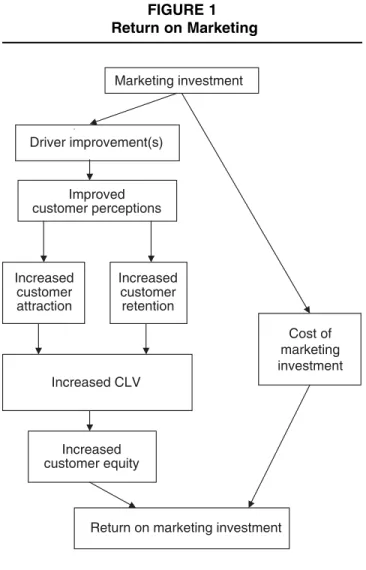
Figure 1 shows a broad overview of the conceptual model that we used to evaluate return on marketing. Marketing is viewed as an investment (Srivastava, Shervani, and Fahey 1998) that produces an improvement in a driver of customer equity (for simplicity of exposition, we refer to an improve-ment in only one driver, but our model also accommodates simultaneous improvement in multiple drivers). This leads to improved customer perceptions (Simester et al. 2000), which result in increased customer attraction and retention (Danaher and Rust 1996). Better attraction and retention lead to increased CLV (Berger and Nasr 1998) and customer equity (Blattberg and Deighton 1996). The increase in cus-tomer equity, when considered in relation to the cost of
mar-keting investment, results in a return on marmar-keting invest-ment. Central to our model is a new CLV model that incor-porates brand switching.
Brand Switching and CLV
It has long been known that the consideration of competing brands is a central element of brand choice (Guadagni and Little 1983). Therefore, we begin with the assumption that competition has an impact on each customer’s purchase decisions, and we explicitly consider the relationship between the focal brand and competitors’ brands. In con-trast, most, if not all, CLV models address the effects of marketing actions without considering competing brands. This is because data that are typically available to direct marketers rarely include information about the sales or pref-erence for competing brands. Our approach incorporates information about not only the focal brand but competing brands as well, which enables us to create a model that con-tains both customer attraction and retention in the context of brand switching. The approach considers customer flows from one competitor to another, which is analogous to brand-switching models in consumer packaged goods (e.g., Massy, Montgomery, and Morrison 1970) and migration models (Dwyer 1997). The advantage of the approach is that competitive effects can be modeled, thereby yielding a fuller and truer accounting of CLV and customer equity.
When are customers gone? Customer retention histori-cally has been treated according to two assumptions (Jack-son 1985). First, the “lost for good” assumption uses the customer’s retention probability (often the retention rate in the customer’s segment) as the probability that a firm’s cus-tomer in one period is still the firm’s cuscus-tomer in the fol-lowing period. Because the retention probability is typically less than one, the probability that the customer is retained declines over time. The implicit assumption is that cus-tomers are “alive” until they “die,” after which they are lost for good. Models for estimating the number of active cus-tomers have been proposed for relationship marketing (Schmittlein, Morrison, and Columbo 1987), customer retention (Bolton 1998), and CLV (Reinartz 1999).
The second assumption is the “always a share” assump-tion, in which customers may not give any firm all of their business. Attempts have been made to model this by a “migration model” (Berger and Nasr 1998; Dwyer 1997). The migration model assigns a retention probability as pre-viously, but if the customer has missed a period, a lower probability is assigned to indicate the possibility that the customer may return. Likewise, if the customer has been gone for two periods, an even lower probability is assigned. This is an incomplete model of switching because it includes purchases from only one firm.
In one scenario (consistent with the lost-for-good assumption) when the customer is gone, he or she is gone. This approach systematically understates CLV to the extent that it is possible for customers to return. In another scenario (consistent with the migration model), the customer may leave and return. In this scenario, customers may be either serially monogamous or polygamous (Dowling and Uncles FIGURE 1 Return on Marketing Marketing investment Driver improvement(s) Improved customer perceptions Increased customer attraction Increased customer retention Increased CLV Increased customer equity Cost of marketing investment
2It is also possible to model the share-of-wallet scenario that is common to business-to-business applications by using the concept of fuzzy logic (e.g., Varki, Cooil, and Rust 2000; Wedel and Steenkamp 1989, 1991).
3The Pfeifer and Carraway (2000) Markov model considers only one brand and does not capture brand switching. Its states pertain to recency rather than brand.
1997), and their degrees of loyalty may vary or even change. We can model the second (more realistic) scenario using a
Markov switching-matrix approach.2
Acquisition and retention.Note that the brand-switching matrix models both the acquisition and the retention of cus-tomers. Acquisition is modeled by the flows from other firms to the focal firm, and retention is modeled by the diag-onal element associated with the focal firm. The retention probability for a particular customer is the focal firm’s diag-onal element, as a proportion of the sum of the probabilities in the focal firm’s row of the switching matrix. Note that this
implies a different retention rate for each customer ×firm
combination (we show the details of this in a subsequent section). This describes the acquisition of customers who are already in the market. In growing markets, it is also important to model the acquisition of customers who are new to the market.
The switching matrix and lifetime value. We propose a general approach that uses a Markov switching matrix to model customer retention, defection, and possible return. Markov matrices have been widely used for many years to model brand-switching behavior (e.g., Kalwani and Morri-son 1977) and have recently been proposed for modeling customer relationships (Pfeifer and Carraway 2000; Rust, Zeithaml, and Lemon 2000). In such a model, the customer has a probability of being retained by the brand in the sub-sequent period or purchase occasion. This probability is the retention probability, as is already widely used in CLV mod-els. The Markov matrix includes retention probabilities for all brands and models the customer’s probability of
switch-ing from any brand to any other brand.3This is the feature
that permits customers to leave and then return, perhaps repeatedly. In general, this “returning” is confused with ini-tial “acquisition” in other customer equity and CLV approaches. The Markov matrix is a generalization of the migration model and is expanded to include the perspective of multiple brands.
To understand how the switching matrix relates to CLV, consider a simplified example. Suppose that a particular customer (whom we call “George”) buys once per month, on average, and purchases an average of $20 per purchase in the product category (with a contribution of $10). Suppose that George most recently bought from Brand A. Suppose that George’s switching matrix is such that 70% of the time he will rebuy Brand A, given that he bought Brand A last time, and 30% of the time he will buy Brand B. Suppose that whenever George last bought Brand B he has a 50% chance of buying Brand A the next time and a 50% chance of
buy-4Actually, George’s CLV also depends on word-of-mouth effects (Anderson 1998; Hogan, Lemon, and Libai 2000), because George may make recommendations to others that increase George’s value to the firm. To the extent that positive word of mouth occurs, our CLV estimates will be too low. Similarly, negative word of mouth will make our estimates too high. Although these two effects, being of the opposite sign, tend to cancel out to some extent, there will be some unknown degree of bias due to word of mouth. However, word-of-mouth effects are notoriously difficult to measure on a practical basis.
ing Brand B. This is enough information for us to calculate
George’s lifetime value to both Brand A and Brand B.4
Consider George’s next purchase. We know that he most recently bought Brand A; thus, the probability of him pur-chasing Brand A in the next purchase is .7 and the ity of him purchasing Brand B is .3. To obtain the probabil-ities for George’s next purchase, we simply multiply the vector that comprises the probabilities by the switching matrix. The probability of purchasing Brand A becomes
(.7×.7) + (.3 ×.5) = .64, and the probability of purchasing
Brand B becomes (.7 ×.3) + (.3 ×.5) = .36. We can
calcu-late the probabilities of purchase for Brand A and Brand B as many purchases out as we choose by successive multipli-cation by the switching matrix. Multiplying this by the con-tribution per purchase yields George’s expected concon-tribution to each brand for each future purchase. Because future pur-chases are worth less than current ones, we apply a discount factor to the expected contributions. The summation of these across all purchase occasions (to infinity or, more likely, to a finite time horizon) yields George’s CLV for each firm. Note that if there are regular relationship maintenance expenditures, they need to be discounted separately and sub-tracted from the CLV.
The bridge of actionability. We assume that the firm can identify expenditure categories, or drivers (e.g., advertising awareness, service quality, price, loyalty program) that influence consumer decision making and that compete for marketing resources in the firm. We also assume that man-agement wants to trade off the drivers to make decisions about which strategic investments yield the greatest return (Johnson and Gustafsson 2000). The drivers that are pro-jected to yield the highest return receive higher levels of investment. Connecting the drivers to customer perceptions is essential to quantify the effects of marketing actions at the individual customer level. Therefore, it is necessary to have customer ratings (analogous to customer satisfaction rat-ings) on the brand’s perceived performance on each driver. For example, Likert-scale items can be used to measure each competing brand’s perceived performance on each driver; perceptions may vary across customers.
The firm may also want to assemble its drivers into broader expenditure categories that reflect higher-level resource allocation. We refer to these as “strategic invest-ment categories.” For example, a firm may combine all its brand-equity expenditures into a brand-equity strategic investment category, with the idea that the brand manager is responsible for drivers such as brand image and brand awareness.
5To the extent that heterogeneity in the regression coefficients exists, the state dependence effect will likely be overestimated (Degeratu 1999; Frank 1962). This would result in underestimation of the effects of the customer equity drivers, which means that the effect of violation of this assumption would be to make the projec-tions of the model more conservative. However, it has been shown that our approach to estimating the inertia effect performs better than other methods that have been proposed (Degeratu 2001). Modeling the Switching Matrix
Thus, the modeling of CLV requires modeling of the switch-ing matrix for each individual customer. Usswitch-ing individual-level data from a cross-sectional sample of customers, com-bined with purchase (or purchase intention) data, we model each customer’s switching matrix and estimate model para-meters that enable the modeling of CLV at the individual customer level.
The utility model. In addition to the individual-specific customer-equity driver ratings, we also include the effect of brand inertia, which has been shown to be a useful predic-tive factor in multinomial logit choice models (Guadagni and Little 1983). The utility formulation can be conceptual-ized as
(1) Utility = inertia + impact of drivers.
To make this more explicit, Uijkis the utility of brand k
to individual i, who most recently purchased brand j. The
dummy variable LASTijkis equal to one if j = k and is equal
to zero otherwise; X is a row vector of drivers. We then model
(2) Uijk= β0kLASTijk+ Xikββ1k+εijk,
where β0kis a logit regression coefficient corresponding to
inertia, ββ1k is a column vector of logit regression
coeffi-cients corresponding to the drivers, and εijkis a random error
term that is assumed to have an extreme value (double
expo-nential) distribution, as is standard in logit models. The β
coefficients can be modeled as either homogeneous or
het-erogeneous.5 For the current exposition, we present the
homogeneous coefficient version of the model. In a subse-quent section, we build and test alternative versions of the model that allow for heterogeneous coefficients. The model can also be estimated separately for different market segments.
The individual-level utilities result in individual-level switching matrices. Essentially, each row of the switching matrix makes a different assumption about the most recent brand purchased, which results in different utilities for each row. That is, the first row assumes that the first brand was bought most recently, the second row assumes that the sec-ond brand was bought most recently, and so on. The utilities in the different rows are different because the effect of iner-tia (and the effect of any variable that only manifests with repeat purchase) is present only in repeat purchases.
Consistent with the multinomial logit model, the proba-bility of choice for individual i is modeled as
6To simplify the mathematics, we adopt the assumption that a customer’s volume per purchase is exogenous. We leave the mod-eling of volume per purchase as a function of marketing effort as a topic for further research.
(3) Pijk*= Pr[individual i chooses brand k*, given that brand j was most recently chosen] = exp(Uijk*)/
Thus, the individual-level utilities result in individual-level switching matrices, which result in an individual-level CLV.
Brand switching and customer equity. To make the CLV calculation more specific, each customer i has an associated
J ×J switching matrix, where J is the number of brands, with
switching probabilities pijk, indicating the probability that
customer i will choose brand k in the next purchase, condi-tional on having purchased brand j in the most recent
pur-chase. The Markov switching matrix is denoted as Mi, and
the 1 ×J row vector Aihas as its elements the probabilities
of purchase for customer i’s current transaction. (If
longitu-dinal data are used, the Aivector will include a one for the
brand next purchased and a zero for the other brands.)
For brand j, djrepresents firm j’s discount rate, fiis
cus-tomer i’s average purchase rate per unit time (e.g., three
pur-chases per year), vijtis customer i’s expected purchase
vol-ume in a purchase of brand j in purchase t,6 π
ijt is the
expected contribution margin per unit of firm j from
cus-tomer i in purchase t, and Bitis a 1 ×J row vector with
ele-ments Bijtas the probability that customer i buys brand j in
purchase t. The probability that customer i buys brand j in purchase t is calculated by multiplying by the Markov matrix t times:
(4) Bit= AiMit.
The lifetime value, CLVij, of customer i to brand j is
(5) CLVij= –t/fiv
ijtπijtBijt,
where Tijis the number of purchases customer i is expected
to make before firm j’s time horizon, Hj(e.g., a typical time
horizon ranges from three to five years), and Bijtis a
firm-specific element of Bit. Therefore, Ti= int[Hjfi], where int[.]
refers to the integer part, and firm j’s customer equity, CEj,
can be estimated as
(6) CEj= meani(CLVij)×POP,
where meani(CLVij) is the average lifetime value for firm j’s
customers i across the sample, and POP is the total number of customers in the market across all brands. Note that the CLV of each individual customer in the sample is calculated separately, before the average is taken.
It is worth pointing out the subtle difference between Equation 5 and most lifetime value expressions, as in direct marketing. Previous lifetime value equations have summed over time period, and the exponent on the discounting factor becomes –t. However, in our case, we are dealing with dis-tinct individuals with disdis-tinct interpurchase times (or
equiv-alently, purchase frequencies fi). For this reason, we sum
(1 ) 0 + =
∑
dj t Tij exp(Uijk). k∑
7If standard marketing costs (e.g., retention promotional costs) are spent on a time basis (e.g., every three months), they may either be discounted separately and subtracted from the net present value or be assigned to particular purchases (e.g., if interpurchase time is three months, and a standard mailing goes out every six months, the mailing cost could be subtracted on every other purchase).
8We should also note that the expression implies that the first purchase occurs immediately. Other assumptions are also possible.
over purchase instead of time period.7 The exponent –t/f
i reflects that more discounting is appropriate for purchase t if purchasing is infrequent, because purchase t will occur
fur-ther into the future. If fi= 1 (one purchase per period), it is
clear that Equation 5 is equivalent to the standard CLV
expression. If fi> 1, the discounting per purchase becomes
less than the discounting per period, to an extent that exactly equals the correct discounting per period. For example, for
fi= 2, the square root of the period’s discounting occurs at
each purchase.8
We can also use the customer equity framework to derive an overall measure of the company’s competitive standing. Market share, historically used as a measure of a company’s overall competitive standing, can be misleading because it considers only current sales. A company that has built the foundation for strong future profits is in better com-petitive position than a company that is sacrificing future profits for current sales, even if the two companies’ current market shares are identical. With this in mind, we define
customer equity share (CES, in Equation 7) as an alternative to market share that takes CLV into account. We calculate customer equity share for each brand j as
ROI
Effect of changes. Ultimately, a firm wants to know the financial impact that will result from various marketing actions. This knowledge is essential if competing marketing initiatives are to be evaluated on an even footing. A firm may attempt to improve its customer equity by making improve-ments in the drivers, or it may drill down further to improve subdrivers that influence the drivers (e.g., improving dimen-sions of ad awareness). This requires the measurement of customer perceptions of the subdrivers about which the firm wanted to know more.
A shift in a driver (e.g., increased ad awareness) pro-duces an estimated shift in utility, which in turn propro-duces an estimated shift in the conditional probabilities of choice (conditional on last brand purchased) and results in a revised Markov switching matrix. In turn, this results in an improved CLV (Equations 4 and 5). Summed across all cus-tomers, this results in improved customer equity (Equation 6). We assume an equal shift (e.g., .1 rating points) for all customers, but this assumption can be relaxed if appropriate, because our underlying modeling framework does not require a constant shift across customers.
( )7 CESj CEj/ CEk. k
=
∑
Projecting financial impact. It is often possible to devote a strategic expenditure to improve a driver, but is that invest-ment likely to be profitable? Modern thinking in finance suggests that improved expenditures should be treated as capital investments and viewed as profitable only if the ROI exceeds the cost of capital. Financial approaches based on this idea are known by such names as “economic value-added” (Ehrbar 1998) or “value-based management” (Cope-land, Koller, and Murrin 1996). The increased interest in economic value-added approaches has attracted more atten-tion to ROI approaches in marketing (Fellman 1999).
The discounted expenditure stream is denoted as E,
dis-counted by the cost of capital, and ∆CE is the improvement
in customer equity that the expenditures produce. Then, ROI is calculated as
(8) ROI = (∆CE – E)/E.
Operationally, the calculation can be accomplished by using a spreadsheet program or a dedicated software package.
Note, though, that even if ∆CE is negative, the ROI
expres-sion still holds.
Implementation Issues
Cross-Sectional Versus Longitudinal DataOur approach requires the collection of cross-sectional sur-vey data; the approach is similar in style and length to that of a customer satisfaction survey. The survey collects cus-tomer ratings of each competing brand on each driver. Other necessary customer information can be obtained either from the same survey or from longitudinal panel data, if it is available. The additional information collected about each customer includes the brand purchased most recently, aver-age purchase frequency, and averaver-age volume per purchase. The logit model can be calibrated in two ways: (1) by observing the next purchase (from either the panel data or a follow-up survey) or (2) by using purchase intent as a proxy for the probability of each brand being chosen in the next purchase.
Obtaining the Model Input
The implementation of our approach begins with manager interviews and exploratory research to obtain information about the market in which the firm competes and informa-tion about the corporate environment in which strategic decisions are made. From interviews with managers, we identified competing firms and customer segments; chose drivers that correspond to current or potential management initiatives; and obtained the size of the market (total number of customers across all brands) and internal financial infor-mation, such as the discount rate and relevant time horizon. In addition, we estimated contribution margins for all com-petitors. If there was a predictable trend in gross margins for any firm in the industry, we also elicited that trend. From exploratory research, using both secondary sources and focus group interviews, we identified additional drivers, which we reviewed with management to ensure that they were managerially actionable items. On the basis of the combined judgment of management and the researchers, we
reduced the set of drivers to a number that allows for a sur-vey of reasonable length. The drivers employed typically vary by industry.
Estimating Shifts in Customer Ratings
The calculation of ROI requires an estimate of the rating shift that will be produced by a particular marketing expen-diture. For example, a firm may estimate that an advertising campaign will increase the ad awareness rating by .3 on a five-point scale. These estimates can be obtained in several ways. If historical experience with similar expenditures is available, that experience can be used to approximate the ratings shift. For example, many marketing consulting firms have developed a knowledge base of the effects of market-ing programs on measurable indexes. Another way, analo-gous to the decision calculus approach (Blattberg and Deighton 1996; Little 1970), is to have the manager supply a judgment-based estimate. The manager may reflect uncer-tainty by supplying an optimistic and a pessimistic estimate. If the outcome was favorable for the optimistic estimate, but unfavorable for the pessimistic estimate, the outcome would be considered sensitive to the rating shift estimate, indicat-ing the need for more information gatherindicat-ing. Another lim-ited cost approach is to use simulated test markets (Clancy, Shulman, and Wolf 1994; Urban et al. 1997) to obtain a pre-liminary idea of market response. Finally, the marketing expenditure can be implemented on a limited basis, using actual test markets, and the observed rating shift can be monitored (e.g., Rust et al. 1999; Simester et al. 2000). Calibrating the Data
It is typical in many sampling plans to have respondents
with different sampling weights, wi, correcting for
varia-tions in the probability of selection. We can use the sampling weights directly, in the usual way, to generate a sample-based estimate of market share, which we denote as MSsample. If the sample is truly representative, MSsample
should be equal to the actual market share, MStrue. To make
the sample more representative of actual purchase patterns,
we can assign a new weight, wi,new= (MStrue/MSsample) ×wi
to each respondent, with market shares corresponding to that respondent’s most recently chosen brand, which will correct for any sampling bias with respect to any brand. The implied market share from the sample will then equal the actual mar-ket share.
If purchase intent rather than actual purchase data is used, the application must be done with some care. Previous researchers have long noted that purchase-intention subjec-tive probabilities occasionally may be systematically biased (Lee, Hu, and Toh 2000; Pessemier et al. 1971; Silk and Urban 1978). We assume that the elicited purchase inten-tions, pij, of respondent i purchasing brand j in the next pur-chase need to be calibrated. In general, we assume that there
is a calibrated probability, p*ij, that captures the true
proba-bility of the next purchase. These probabilities can be cali-brated in two possible ways. First, if it is possible to follow up with each respondent to check on the next purchase, we
can find a multiplier Kj for each brand that best predicts
choice. (We set Kjfor the first brand arbitrarily to one,
with-out loss of generality, to allow for uniqueness.) The K’s can
be quickly found using a numerical search. If p*ij is the
stated probability of respondent i choosing brand j in the
next purchase, the calibrated choice probability is p*ij =
Kjpij/ΣkKkpik. Second, if checking the next purchase is not
possible, it is still possible to calibrate the purchase inten-tions by making an approximating assumption. Assuming that the market share (as the percentage of customers who prefer a brand) for each brand in the near future (including each respondent’s next purchase) is roughly constant, we
employ a numerical search to find the Kj’s (again setting
K1= 1) for which MStrue= meani(p*ij).
Model Estimation
Principal components regression. In this application, as in customer satisfaction measurement, multicollinearity is an issue that needs to be addressed (Peterson and Wilson 1992). For this reason, we adopt an estimation approach that addresses the multicollinearity issue. Principal components regression (Massy 1965) is an approach that combats multi-collinearity reasonably well (Frank and Friedman 1993), yet it can be implemented with standard statistical software. Principal components regression is a two-stage procedure that is widely known and applied in statistics, econometrics, and marketing (e.g., Freund and Wilson 1998; Hocking 1996; Naik, Hagerty, and Tsai 2000; Press 1982). Principal components multinomial logit regression has been used suc-cessfully in the marketing literature, leading to greater analysis interpretability and coefficient stability (e.g., Gess-ner et al. 1988).
The idea is to reduce the dimensionality of the indepen-dent variables by extracting fewer principal components that explain a large percentage of the variation in the predictors. The principal components are then used as independent vari-ables in the regression analysis. Because the principal com-ponents are orthogonal, there is no multicollinearity issue with respect to their effects. In addition, eliminating the smallest principal components, which may be essentially random, may reduce the noise in the estimation. Because the principal components can be expressed as a linear combina-tion of the independent variables (and vice versa), the coef-ficients of the independent variables can be estimated as a function of the coefficients of the principal components, and the coefficients (after the least important principal compo-nents are discarded) may result in better estimates of the dri-vers’ effects. Estimation details are provided in Appendix A.
Importance of customer equity drivers. The results from the model estimation in Equation 2 provide insight into which customer equity drivers are most critical in the indus-try in which the firm competes. When examining a specific industry, it is useful to know what the key success factors are in that industry. Ordinarily, this might be explored by calcu-lating market share elasticities for each driver. However, that approach is not correct here, because the drivers are inter-vally scaled rather than ratio scaled. This means that it is incorrect to calculate percentages of the drivers, as is neces-sary in the calculation of elasticities. Moreover, our focus is customer equity rather than market share. To arrive at the impact of a driver on customer equity, we need to determine the partial derivative of choice probability, with respect to the driver, for each customer in the sample. That is, if a
dri-ver were improved by a particular amount, what would be the impact on customer choice and, ultimately, on CLV and customer equity? Appendix A provides details of these com-putations and significance tests for the drivers.
An Example Application
Data and SamplingSurvey items. We illustrate our approach with data col-lected from customers of five industries. We assume three strategic investment categories: (1) perceived value (Para-suraman 1997; Zeithaml 1988), (2) brand equity (Aaker and Keller 1990), and (3) relationship management (Anderson and Narus 1990; Gummeson 1999). The three categories span all major marketing expenditures (Rust, Zeithaml, and Lemon 2000). We drew heavily on the relevant academic and managerial literature in these areas to build our list of drivers and ensured that the drivers could be translated into actionable expenditures. The resulting survey contained questions pertaining to shopping behavior and customer rat-ings of each driver for the four or five leading brands in the markets we studied. In addition, several demographics ques-tions were asked at the end of the survey. We selected indus-tries (airlines, electronics stores, facial tissues, grocery, and rental cars) that represented a broad set of consumer goods and services. To save space, we present the details for the airline industry analysis only; however, our approach was similar across the other four industries. The complete list of the survey items used in our analysis of the airline industry appears in Appendix B.
Population. We obtained illustrative data from two com-munities in the northeastern United States: an affluent small town/suburb and a medium-sized city that adjoins a larger city. Respondents were real consumers who had purchased the product or service in the industry in question during the previous year. Demographic statistics suggest that the sam-ple is representative of similar standard metropolitan statis-tical areas in the United States, with the exception of gener-ally high levels of education and income. For example, in the small town (with a population of approximately 20,000), the average age of the respondent was 47, the average household had two adults and one child, the average house-hold income was $91,000, and the average years of educa-tion was 17. In the larger city, the average age was somewhat lower (39 years), the average household had two adults and one child, the average household income was $70,000, and the average years of education was similar to that of the small town.
Sampling. We obtained respondents from three random samples. The first sample, drawn from the city population, answered questions about electronics stores and rental car companies. The second sample, also drawn from the city population, addressed groceries and facial tissues. The third sample, drawn from the small town, focused on airlines. Potential respondents were contacted at random by recruiters from a professional market research organization (by telephone solicitation or building intercept). The screen-ing process consisted of two criteria: (1) the respondent had purchased from the industry in the past 12 months, and (2)
9Mean substitution can result in biased estimates, but in our judgment, the additional effort of employing a more sophisticated missing values procedure (e.g., data imputation) was not justified in this case, given the relatively low percentage of missing values. 10This decision was based solely on the researchers’ best judg-ment. Our model does not require this.
the respondent had a household income of at least $20,000 per year. Respondents agreed to participate and received $20 compensation for completing the questionnaire. In the elec-tronics stores and rental cars survey, 246 consumers were approached: 153 were eligible, 144 cooperated, and 7 were disqualified, resulting in a total of 137 total surveys com-pleted. In the groceries and facial tissues survey, 177 con-sumers were approached: 124 were eligible, 122 cooperated, and 4 were disqualified, resulting in a total of 118 surveys completed. In the airline survey, 229 consumers were approached: 119 were eligible, 105 cooperated, and 5 were disqualified, resulting in a total of 100 surveys completed.
Data collection and preliminary analysis. Data were collected in December 1998 and January 1999 at the firm’s offices in each location. The respondents came to the facil-ity to complete the pencil-and-paper questionnaire, which took about 30 minutes. They were then thanked for their par-ticipation and compensated. In addition, we obtained aggre-gate statistics on the small town and city (e.g., percentage of population that uses rental cars, average spent at grocery store) from secondary sources and used them in subsequent analysis. For purposes of financial analysis, we used local population and aggregate usage statistics for predominantly local industries (electronics stores and groceries) and national statistics for predominantly national industries (air-lines, facial tissues, and rental cars). Although our random samples may not be fully representative of U.S. users, we extrapolated to the national market for national industries to show the type of dollar magnitudes that can arise given a large population. Because our examples are illustrative, truly precise dollar estimates are unnecessary.
Data were cleaned to eliminate obvious bad cases and extreme outliers. Because listwise deletion of cases would have resulted in too many cases being removed (even though only a relatively small percentage of responses were missing for particular items), we employed mean substitution as our
missing data option for all subsequent analyses.9Because
we suspected that the relationship drivers would affect pri-marily repeat purchasers, we collected relationship items
only for the brand most recently purchased.10 We
mean-centered the relationship-related drivers for the cases in which the brand considered was the previously purchased brand, and we set them equal to zero for the cases in which the brand considered was different from the previously pur-chased brand. This enabled the “pure” inertia effect to be separated from the relationship effect of the drivers. Choice Model Results
Principal components analysis results. We reduced the dimensionality of the predictor variables in each industry by conducting a principal components analysis. We used an eigenvalue cutoff of .5, which we judged to provide the best
11The 1.0 eigenvalue cutoff (Kaiser 1960) is typically employed in marketing, but it is just one of many possible cutoff criteria (for two alternatives, see Cattell 1966; Jolliffe 1972). As Kaiser (1960, p. 143), who proposed the 1.0 cutoff, points out, “by far [the] most important viewpoint for choosing the number of factors [is] … psy-chological meaningfulness.” In other words, the cutoff should be chosen such that the results are substantively meaningful, which is our justification for using the particular cutoff level that we chose.
trade-off between parsimony and managerial usefulness.11
The airline analysis began with 17 independent variables, and we retained 11 orthogonal factors. Table 2 shows the loadings on the rotated factors. The resulting factor structure is rich. All the factors are easily interpretable. The few neg-ative loadings are small and insignificant; they are zero for all practical purposes. All drivers load on only one factor, and many (e.g., inertia, quality, price, convenience, trust, corporate citizenship) load on their own unique factor.
There is some degree of discrimination among the value, brand, and relationship strategic investment categories in that drivers in the three strategic action categories of differ-ent drivers do not correlate highly on the same factors. As we expected, the strategic investment categories, value, brand, and relationship are not unidimensional. The drivers that constitute the categories can be grouped for managerial purposes as managers consider them, but drivers in a partic-ular strategic investment category may be quite distinct in the customer’s mind.
Logit regression results. Using the resulting factors as independent variables, we conducted multinomial logit analyses, using the analysis we described previously. Table 3 shows the coefficients that arise from the multinomial logit regression analysis, highlighting the significant factors. Using Equations A1–A9, we converted the factor-level results to the individual drivers. The resulting coefficients, standard errors, and test statistics are shown in Table 4. All
12This nested chi-square was also insignificant in the other four industries that we studied (electronics = 6.79, facial tissues = 1.00, grocery = 5.82, and rental cars = .28).
the drivers are significant and have the correct sign, but some drivers have a larger effect than others. The most important drivers span all three strategic investment cate-gories. In addition to the drivers, inertia has a large,
signifi-cant impact (.849, p< .01). Among the value-related drivers,
convenience has the largest coefficient (.609), followed by quality (.441); for brand-related drivers, direct mail infor-mation has the largest impact (.638), followed by ad aware-ness (.421) and ethical standards (.421). The loyalty pro-gram (.295) and preferential treatment (.280) are the most important relationship-related drivers.
Model Testing and Validation
We tested and validated the core choice model in several dif-ferent ways. We tested for brand-specific effects, hetero-geneity of response, a more general covariance matrix, and the reliability of the coefficient estimates.
Brand-specific effects. The model in Equation 2 assumes that there are no brand-specific effects. We tested the valid-ity of this assumption by including brand-specific constants in the model of Equation 2. Testing the significance of the more complicated model can be accomplished through the use of a nested-likelihood-ratio chi-square test (in the airline application, this involves three degrees of freedom, reflect-ing a number of brand-specific constants that is equal to the number of brands minus one). The resulting nested model
comparison was not significant (χ23= .977), from which we
conclude that brand-specific constants are not required.12
Heterogeneity of response. It is reasonable to suspect that there may be unobserved heterogeneity of response
TABLE 2
Factor Loadings: Airline Industry
Driver F1 F2 F3 F4 F5 F6 F7 F8 F9 F10 F11 Inertia –.013 –.004 .033 .038 .015 .116 –.024 .984 .029 .043 .002 Quality .097 .058 .174 .076 .147 .212 .014 .049 .068 .904 .083 Price .044 –.007 .128 .054 .078 .023 .039 .030 .975 .059 .034 Convenience .078 .068 .219 .161 .043 .830 .066 .163 .018 .260 –.015 Ad awareness –.031 .130 .038 .938 –.010 .022 .048 –.011 .074 .101 .058 Information .216 –.077 .248 .656 .322 .299 –.207 .125 –.038 –.058 .016 Corporate citizenship .011 .122 .150 .093 .880 .001 .256 .021 .077 .137 .006 Community events .021 .100 .188 –.042 .226 .051 .921 –.026 .041 .011 .029 Ethical standards –.016 .044 .605 .105 .458 .266 .028 –.034 .104 .109 .218 Image fits my personality .098 .112 .878 .107 .069 .092 .203 .058 .110 .142 .081 Investment in loyalty program .921 .044 .090 .032 –.007 –.060 .018 .014 –.003 .137 –.103 Preferential treatment .898 .087 .082 –.002 .022 –.071 –.029 .032 –.007 .077 .104 Know airline’s procedures .708 .232 –.022 .116 .029 .166 .058 –.033 .010 –.069 .240 Airline knows me .681 .309 –.073 –.059 –.001 .356 –.012 –.061 .136 –.075 .219 Recognizes me as special .214 .851 .069 .077 –.036 .042 .138 –.004 –.044 .118 .092 Community .175 .876 .065 .031 .166 .035 –.015 .001 .036 –.042 .129 Trust .246 .227 .179 .069 .041 –.003 .031 .006 .038 .091 .889 Notes: Loadings greater than .5 are shown in bold.
TABLE 3
Logit Regression Results: Airline Industry
Independent Variable Coefficient Standard Error b/s.e. p
F1 .325** .122 2.65 .008 F2 –.031 .118 –.26 .795 F3 .421* .210 2.00 .045 F4 .459 .285 1.61 .107 F5 .212 .228 .93 .352 F6 .331* .159 2.08 .037 F7 –.081 .279 –.29 .771 F8 .633** .100 6.36 .000 F9 .034 .164 .21 .835 F10 .184 .147 1.26 .209 F11 –.033 .115 –.29 .772 Log-likelihood = –98.46 Chi-square (11 degrees of freedom) = 69.246**
*p< .05. **p< .01.
TABLE 4
Driver Coefficients: Airline Industry
Driver Coefficient Standard Error b/s.e.
Inertia .849 .075 11.341* Quality .441 .041 10.871* Price .199 .020 9.858* Convenience .609 .093 6.553* Ad awareness .421 .099 4.242* Information .638 .082 7.819* Corporate citizenship .340 .045 7.617* Community events .170 .024 6.974* Ethical standards .421 .053 7.901* Image fits my personality .390 .050 7.874* Investment in loyalty program .295 .027 10.956* Preferential treatment .280 .026 10.857* Know airline’s procedures .238 .027 8.779* Airline knows me .249 .041 6.108* Recognizes me as special .167 .017 9.771* Community .151 .016 9.412*
Trust .203 .023 8.725*
*p< .01.
across the respondents. That is, expressed in terms of
Equa-tion 2, the βs may be different across respondents. To test
this, we employed a random coefficients logit model (Chin-tagunta, Jain, and Vilcassim 1991) in which we permitted the driver coefficients to be distributed as an independent multivariate normal distribution. The log-likelihood improved from –97.58 to –93.24, which is an insignificant
improvement (χ2
11= .8.68). Therefore, we conclude that the
random coefficients logit formulation does not produce a better model and that it is not worthwhile in this case to model unobserved heterogeneity in the parameters.
Correlated errors. Another way the independence from irrelevant alternatives property can be violated is if the error terms in Equation 2 are correlated. For example, it is possi-ble that people who prefer American Airlines more than the model predicted will systematically dislike Southwest Air-lines more than the model predicted. To address this issue, we turned to a multinomial probit model (Chintagunta 1992). In this model, the error terms in Equation 2 are assumed to be normally distributed rather than extreme value, and they are permitted to have a general covariance matrix.
FIGURE 2
Distribution of CLV: American Airlines
0% 10% 20% 30% 40% 50% 60% 70% Relative Frequency 0–99 100–199 200–299 300–399 400–499 500+ CLV ($)
Our original logit model is no longer a constrained ver-sion of the more complicated model, so we cannot do the nested likelihood-ratio chi-square test. However, by com-paring the general multinomial probit model with a multin-omial probit model in which the error terms are assumed to be independent, we can address the issue of whether model-ing the more general covariance matrix is useful. This results in a nested test. We found that the uncorrelated errors version of the model resulted in a log-likelihood of –98.46 (slightly worse than the multinomial logit log-likelihood) and that the more general model produced a log-likelihood
of –97.57. The improvement is insignificant (χ23= .82). We
also can compare the general multinomial probit model with the original multinomial logit model by using the Akaike information criterion. The improvement from –97.58 to –97.57 does not compensate for the additional three esti-mated parameters (we would need a log-likelihood improvement of at least 3.0), suggesting that the general multinomial probit model is not better than our multinomial logit model. Thus, we conclude that the more general covariance matrix is not warranted.
Coefficient reliability. Given our relatively small sample size (96 usable data points after the data are cleaned), we were unable to pursue split-half tests or complete holdout samples. However, to further understand the reliability of our model estimates, we randomly split our sample into three parts (A, B, and C) and estimated our model on AB, AC, and BC. The mean range (and median range) of the coefficient estimates across the 11 factors was .14; that is, on average, the swing between the largest and smallest coeffi-cient estimate across the three samples was .14, which comes out to about .6 standard errors, on average. Thus, the model appears to produce reasonably stable coefficient estimates.
CLV
Using Equation 5, we calculated CLV for American Airlines for each respondent in our airline sample. To operationalize the equation, we assumed a time horizon of three years, a discount rate of 10%, and a contribution margin of 15%. The 15% figure was approximately equal to the average operat-ing margin for the industry for the five years precedoperat-ing the survey, according to annual reports of the four firms we studied (since our study, airline industry operating margins have declined). We also based our contribution margin fig-ures in the other four industries on financial data from annual reports. To extend the CLV figures to the firm’s U.S. customer equity, we used U.S. Census data to determine the number of adults in the United States (187,747,000), and we then combined this with the percentage of U.S. adults who were active users of airline travel (23.3%), yielding a total number of U.S. adult airline customers of 43,745,051. To approximate the total customer equity, we multiplied this number by the average CLV across our respondents. Note that though we used average CLV to project customer equity, we calculated CLV at the individual customer level for each customer in the sample.
Customer loyalty and CLV. Some insights can be
obtained from examining American Airlines’ CLV
distribu-tion. For example, Figure 2 shows the distribution of CLV across American Airlines’ customers. The $0–$99 category includes more than 60% of American’s customers, and the $500-plus category includes only 11.6% of customers, indi-cating that the bulk of American’s customers have low CLV. Figure 3 also indicates that American’s customers are fickle. Almost half of American’s customers have a 20% or less share-of-wallet (by CLV) allocated to American. Only 10.5% give more than 80% of their CLV to American. This percentage shows dramatically that the vast majority of American’s customers cannot be considered monogamously loyal. Figure 4 shows a startling picture of the percentage of American’s customer equity that is contributed by each CLV category. The $0–$99 category, though by far the largest (more than 60% of American’s customers), produces less than 10% of American’s customer equity. In contrast, the $500-plus CLV category, though only 11.6% of American’s customers, produces approximately 50% of American’s cus-tomer equity.
Comparison with the lost-for-good CLV model. Previ-ously, we proposed that some models of CLV that do not account for customers’ returning systematically
underesti-FIGURE 3
Distribution of CLV Share (Share of Wallet): American Airlines 0% 10% 20% 30% 40% 50% Relative Frequency 0%–20% 21%–40% 41%–60% 61%–80% 81%–100% CLV
0 10 20 30 40 50
Percentage (%) of Customer Equity
0–99 100–199 200–299 300–399 400–499 500+
CLV ($)
FIGURE 4
Percentage Customer Equity by CLV Category: American Airlines
mate CLV and customer equity (for an exception, see Dwyer 1997). Using the airline sample, we explored the degree to which this was true. The lost-for-good model is simply a constrained version of our switching model, such that all probabilities of switching from another brand to the focal brand are zero. In other words, to calculate the results, we considered only the customers who were retained from the first purchase. When the customer chose another brand, we gave a probability of zero to any further purchase from the focal brand. For American Airlines, our brand-switching model gives a customer equity of $7.303 billion. Without accounting for switching back, the estimated customer equity declines to $3.849 billion. Thus, the lost-for-good model provides a systematic underestimation of customer equity that, in this case, is an underestimation of 47.3%.
Customer equity and the value of the firm. It has been suggested (Gupta, Lehmann, and Stuart 2001) that customer equity is a reasonable proxy for the value of the firm. Our analysis of American Airlines provides some support for this
idea. Multiplication of American’s average CLV ($166.94) by the number of U.S. airline passengers (43,745,051) yields a total customer equity for American of $7.3 billion. Given American’s opening share price for 1999 ($60) and its number of shares outstanding at that time (161,300,000) (AMR Corporation 1999), we calculate a market capitaliza-tion of $9.7 billion. Because our projeccapitaliza-tion ignores profits from international customers and nonflight sources of income, our customer equity calculation is largely compati-ble with American’s market capitalization at the time of the survey.
Projected Financial Return
Our framework enables the financial impact of improvement efforts to be analyzed for any of the usual marketing expen-ditures. For example, American Airlines recently spent a reported $70 million to upgrade the quality of its passenger compartments in coach class by adding more leg room. Is such an investment justified? To perform an analysis such as this, we estimated the amount of ratings shift and the costs incurred in effecting the ratings shift. We then used the rat-ings shift to alter (for each respondent) the focal brand’s utility, switching matrix, and CLV (see Equations 2–5), which, when averaged across respondents and projected to the size of the population (see Equation 6), resulted in a revised estimate for the firm’s customer equity. In this way, and using the discount rate and contribution margin we dis-cussed previously, we analyzed the recent American Airlines seating improvement. We used the $70 million cost figure reported by the company.
If we assume that the average for the item that measures quality of the passenger compartment (a subdriver of qual-ity) increases by .2 rating points on the five-point scale, our analysis (see Table 5) indicates that customer equity will improve by 1.39%, resulting in an improvement in customer equity of $101.3 million nationally, or an ROI of 44.7%, which indicates that the program has the potential to be a large success. Table 5 shows the results of similar analyses from the other four industries. For example, a $45 million expenditure by Puffs facial tissues to improve ad awareness
TABLE 5
Projected ROI from Marketing Expenditures
Percentage Dollar Improvement Improvement
Company Area of Geographic Amount in Customer in Customer Projected
(Industry) Expenditure Region Investment Improved Equity Equity ROI
American Passenger United States $70 million .2 rating point 1.39% $101.3 million 44.7% (airlines) compartment
Puffs Advertising United States $45 million .3 rating point 7.04% $58.1 million 29.1% (facial tissues)
Delta (airlines) Corporate United States $50 million .1 rating point 1.68% $85.5 million 71.0% ethics
Bread & Circus Loyalty Local market $100,000 .5 rating point 7.04% $87,540 –12.5% (groceries) programs in two measures
13To conserve space, we show the details only for the airline example, but the details of the other industry examples are similar. by .3 rating points would result in a $58.1 million
improve-ment in customer equity and an ROI of 29.1%.13
It is even possible to measure the financial impact of cor-porate ethical standards or corcor-porate citizenship. For exam-ple, if Delta spent $50 million to improve customers’ per-ceptions of Delta’s ethical standards by .1 rating points, this would project to a customer equity improvement of $85.5 million (a 1.68% increase). Such findings may cause some airlines to reconsider practices such as canceling flights that are not full in order to be profitable.
Not all investments will project to be profitable. For example, suppose that the grocery store Bread & Circus decides to spend $100,000 in the local retail area to improve its loyalty program ratings across two measures by .5 points. The projected benefit is not enough to justify the expendi-ture, and the ROI is –12.5%.
The preceding examples illustrate only some of the mar-keting expenditures that can be evaluated by means of the customer equity framework. Any marketing expenditure can be related to the drivers of customer equity, measured, and evaluated financially. This capability enables a firm to screen improvement ideas either before application or after a test market has nailed down the expected degree of improvement.
Model Sensitivity
The preceding analyses are based on point estimates, but how sensitive is the ROI model to errors of estimation or measurement? Sensitivity to errors of estimation can be
ana-lyzed by considering the sampling distribution of βx.
Appendix A shows how to construct confidence intervals for
βx. Then, by applying the end points of the confidence
inter-val to the ROI model, it is possible to analyze the sensitivity of ROI to estimation error. In general, this error is of more concern on the low side, because overoptimism may result in inappropriate expenditures. With this in mind, we suggest
calculation of a coefficient, βx, which will be greater than
the true value only 5% of the time. Assuming that there is a large n, this is calculated as
(9) βx= βx– 1.645(standard error of βx).
Then, βxcan be used to produce “conservative” projections
of the customer equity change and the ROI. This can be
done by inserting βxdirectly into the customer equity
calcu-lations. For example, if we calculate a conservative estimate of customer equity impact for the American Airlines exam-ple in Table 5, we obtain a $93.9 million increase in cus-tomer equity, or a 1.29% increase. This would result in a 34.2% ROI, indicating that even a conservative estimate shows a quite favorable return.
Sensitivity to errors of measurement can be addressed by considering the sampling distribution of the sample mean. In Equation A5 in Appendix A, unlike the case in regression analysis, the level of a variable affects the extent to which a change in the variable affects choice and thus utility, CLV, and customer equity. By evaluating the end points of the
confidence interval for the sample mean of a variable to be improved, we can thus obtain a confidence interval for the ROI that will result from a shift in that variable. We per-formed this analysis for the Delta Airlines corporate ethics example in Table 5. A 95% confidence interval for the mean
on the corporate ethics variable was 3.346 .188, which
results in a 95% confidence interval for corporate ethics improvement of $83.1 million/$87.8 million and a 95% con-fidence interval for ROI of 66%/76%.
If the projected rating shift results from a test market, the sampling distribution of the rating shift can also be employed to generate a confidence interval. Under the assumption that the sources of error are independent, which is not unreasonable, it would then be straightforward to sim-ulate an all-inclusive confidence interval for ROI, incorpo-rating errors in the model coefficient estimate, estimated sample mean, and estimated shift that are based on an assumption of a multivariate normal distribution with orthogonal components.
Discussion and Conclusions
Contributions to Theory and PracticeWe make several contributions to marketing theory and practice. First, we identify the important problem of making all of marketing financially accountable, and we build the first broad framework that attempts to address the problem. We provide a unified framework for analyzing the impact of competing marketing expenditures and for projecting the ROI that will result from the expenditures. This big-picture contribution extends the scope of ROI models in marketing, which to date have focused on the financial impact of par-ticular classes of expenditure and have not addressed the general problem of comparing the impact of any set of com-peting marketing expenditures. Our work is the first serious attempt to address this issue in its broadest form: the trading off of any strategic marketing alternatives on the basis of customer equity. Marketing Science Institute member com-panies have identified this research area as the most impor-tant problem they face today.
Second, we provide a new model of CLV, incorporating the impact of competitors’ offerings and brand switching; previous CLV models have ignored competition. We also discount according to purchase rather than time period. Pre-vious CLV models have been limited to the consideration of purchases made in prespecified time units, which is realistic for some businesses (e.g., subscription services, sports sea-son tickets) but not for others (e.g., consumer packaged goods). By discounting according to purchase, at the indi-vidual level, our model is more widely applicable. The approach set out previously considers customer equity for the entire relevant competitive set, which has two advan-tages over existing approaches. First, this approach consid-ers the expected lifetime value of both existing customconsid-ers and prospective customers, thereby incorporating acquisi-tion and retenacquisi-tion (for the focal firm and competitors) in the same model. Second, by explicitly considering competitive effects in the choice decision, it is possible to use the model