4.1
Work Done by a constant Force
Studying can feel like a lot of work. Imagine studying several hours for a difficult test or spending all afternoon writing a report for class. While this is a significant amount of hard work, in the scientific sense of the word, you have done no work at all. In physics, work
is the energy that a force gives to an object when the force moves the object. When you read your notes, you do no work because you do not exert a force on an object to move it. Your everyday life, however, is filled with examples of work in the scientific sense. You do work on a backpack when you lift it to your shoulders. You do work on the classroom door when you push it open or pull it closed. You do work on a basketball by bouncing or throwing it. In these cases, a force does work on an object to move it.
You may notice that you do more work lifting a backpack filled with heavy books than lifting an empty one, and more work lifting a backpack from the floor than from a desk because the distance from the floor to your shoulder is greater than the distance from a desk to your shoulder. The scientific definition of work is consistent with these experiences.
work
Work depends on the magnitude of the force applied to an object and the distance the object moves. In fact, work depends only on the object’s displacement in the direction of the applied force and not displacement perpendicular to the force. In other words, the work depends only on the component of force in the direction of motion and not the force perpendicular to the motion.
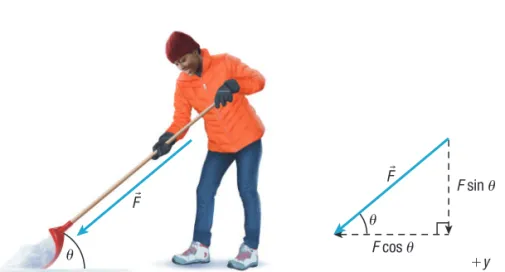
Suppose, for example, you are shovelling snow. You might push on the snow at an angle θ to the ground, but the snow moves horizontally (Figure 1). The component of force directed into the ground does not help move the snow across the ground. Only the component of force along the ground moves the snow.
In any situation, only the force in the direction of an object’s displacement does work on the object. The equation for calculating the work, W, that a constant force, F>, does to cause the displacement, Dd>, of an object is
W5F∆d cos θ
where F is the magnitude of the force, ∆d is the magnitude of the object’s displace-ment, and θ is the angle between the force and the displacement. The component of the force in the direction of the motion is F cos θ (Figure 2).
displacement direction u F (a) F cos u y x F sin u F ∆d u (b)
Figure 2 (a) A force acts at an angle to the displacement. (b) Only the component parallel to the displacement does work.
work the product of the magnitude of an object’s displacement and the component of the applied force in the direction of the displacement
Figure 1 The force of the shovel does work on the snow. Only the horizontal force component contributes to the work.
Th e work done by a force depends on two vectors: the applied force and the resulting displacement. Th e work done on an object is proportional to both force,
F>, and displacement, Dd>. However, the amount of work done is a scalar quantity, not
a vector.
Th e SI units of work are newton-metres (N?m), or kilograms times metres
squared per second squared (kg?m2/s2). Th is unit is called a joule (J). In the
fol-lowing Tutorial, you will explore how to use the work equation to determine the work done in different situations.
joule the SI unit of work and energy; a force of 1 N acting over a displacement of 1 m does 1 J of work; symbol J
You can determine the amount of work done on an object if you know the applied force, the displacement of the object, and the angle between the force and the displacement.
The displacement of an object is often in the same direction as the applied force. In this case, the equation for calculating the work done by the force is simplifi ed. Suppose a hockey player slides a puck along the ice with a constant force of 85 N in the forward direction (Figure 3). The puck moves a horizontal distance of 0.20 m while in contact with the hockey stick. Calculate the amount of work done on the puck by the stick.
F = 85 N F = 85 N F Dd = 0.20 m Figure 3 Given: F5 85 N; ∆d5 0.20 m Required: W
Analysis: Use the equation for work, W5F∆d cos u. F and ∆d are in the same direction, so the angle between them is zero, u5 0. Solution: W5F∆d cos u
5 (85 N)(0.20 m) cos 08 5 (17 N?m)(1)
5 17 N?m W5 17 J
Statement: The hockey stick does 17 J of work on the puck. Note that the stick only does work on the puck while the stick is in contact with the puck, applying force.
Sample Problem 1:
Calculating the Work Done When the Force Is Parallel to the Displacement
Sample Problem 2:
Calculating the Work Done When the Force Is at an Angle to the Displacement
The applied force and the displacement can be at an angle to eachother. For example, a student pushes a lawnmower forward with a constant force of 48 N for a distance of 7.5 m (Figure 4). The angle between the force and the displacement of the lawnmower is 32°. Calculate how much work is done on the lawnmower by the student.
displacement direction u ∆d Fsin u Fcos u y x F Figure 4 Given: F5 48 N; ∆d5 7.5 m; u5 328 Required: W
Analysis: The work done on the lawnmower by the student depends only on the component of force in the direction of the mower’s displacement. Use the equation for work, W5F∆d cos u. F and ∆d are at an angle of 328 to each other. Solution: W5F∆d cos u
5 (48 N)(7.5 m) cos 328 5 (360 N?m)(0.848)
W5 3.1 3 102 J
Statement: The student does 3.1 3 102 J of work on the lawnmower.
Suppose you carry books with a weight of 22 N a distance of 3.8 m across a room (Figure 5). Determine the work done on the books. displacement direction F Figure 5 Given: F5 22 N; ∆d5 3.8 m; u5 908 Required: W
Analysis: By Newton’s third law, the upward force you exert on the books is equal to the weight of the books, 22 N. Use the equation for work, W5F∆d cos u. F and ∆d are at an angle of 908 to each other. Solution: W5F∆d cos u
5 (22 N)(3.8 m) cos 908 5 (22 N)(3.8 m)(0) 5 0 N?m
W5 0 J
Statement: No work is done on the books.
Sample Problem 3:
Calculating the Work Done When the Force Is Perpendicular to the Displacement
Practice
1. A weightlifter uses a force of 275 N to lift weights directly upward through a distance of 0.65 m. Determine the work done on the weights by the weightlifter. T/I A [ans: 1.8 3 102 J]
2. Calculate the work done on a wall if you push on it with a constant force of 9.4 N and the wall does not move. T/I A [ans: 0 J]
3. A pool cue stick strikes a ball with a constant force of 0.73 N, causing the ball to move 0.65 m in the direction of the force. The ball moves 0.080 m while the cue stick is in contact with it. Calculate the work done on the ball by the cue stick. T/I A [ans: 0.058 J]
4. A tow truck uses a winch with a rope attached to pull a car that is stuck in a ditch. The rope exerts a force of 9.9 3 103 N on the car body, and the angle between the rope and the direction the car moves is 12°. Determine the amount of work done on the car by the tow truck to move the car 4.3 m. T/I A [ans: 4.2 3 104 J]
Positive and negative work
Th e force of the hockey stick on the puck in Sample Problem 1 resulted in positive work that caused the puck’s speed to increase. What if the puck slides to rest? Th e displacement of the puck and the force on the puck by friction are in opposite direc-tions. When an object moves in a direction opposite to an applied force, the force does negative work. Negative work will cause a loss of kinetic energy.
Forces that cause negative work are exerted at an angle between 908 and 1808,
opposite to the object’s direction. As you read in Chapter 2, friction is the force resisting the motion of objects moving against each other. Tutorial 2 gives you an opportunity to calculate the negative work that occurs when a force, such as friction, and displacement are in opposite directions.
Tutorial
2
Calculating Negative Work
Suppose a car is moving along a straight road when the driver suddenly applies the brakes. The force of friction between the ground and the car tires is opposite to the car’s direction of motion and decreases the car’s speed. Calculate the work done by a constant frictional force of 1.4 kN over a distance of 1.2 3 102 m.
Given: F5 1.4 kN 5 1.4 3 103 N; Dd5 1.2 3 102 m; u5 1808 Required: W
Analysis: W5FDd cos θ
An ice skater slides to a stop by pushing her blades against the ice (Figure 6). The ice exerts a constant force of 95 N on the skater, and the skater stops in 1.2 m. The angle between the force and the skater’s direction of motion is 1408. Calculate the work done on the skater by the ice.
1.2 m 95 N 95 N 95 N 95 N 95 N 95 N 95 N 95 N 140° Figure 6 Given: F5 95 N; Dd5 1.2 m; u5 1408 Required: W
Analysis: Use the work equation, W5FDd cos u. Remember that cos u is negative for angles between 908 and 1808. Solution: W5FDd cos u
5 (95 N)(1.2 m) cos 1408 5 287 N?m
W5287 J
Statement: The ice does –87 J of work on the skater.
Sample Problem 2:
Calculating Negative Work in Two Dimensions
Practice
1. A drop tower ride lifts riders at a constant speed to a height of 78 m and suddenly drops them. T/I A
(a) Determine the work done on a 56 kg rider by the machine as she is lifted to the top of the ride. [ans: 4.3 3 104 J] (b) Determine the work done on the rider by gravity as she is lifted to the top of the ride. [ans: 24.3 3 104 J] 2. As a passenger airplane touches down it skids across the runway to a stop. Friction between the ground
and the plane’s wheels applies a constant force of 5.21 kN as the plane slides a distance of 355 m. T/I A
(a) Calculate the work done on the airplane by friction. [ans: 21.85 3 106 J]
(b) Determine the distance the plane would slide if friction applied the same force but did 21.52 3 106 J of work. [ans: 292 m]
3. A skier slides down a snowy hill and then stops by pressing his skis at an angle to the snow. The snow exerts a constant force of 5.9 N on the skier at an angle of 1508 to the skier’s displacement. The skier moves a distance of 3.5 m. Calculate the work done on the skier by the snow. [ans: 218 J]
You observed in Tutorial 1 that a force does positive work on an object when the object’s displacement is in the same direction as the force. Th e work is also positive when the direction of the object’s displacement is at an angle between 08 and 908 to
the applied force. Similarly, Tutorial 2 showed that a force does negative work on an object when the object’s displacement is opposite to the direction of the force, at an angle between 908 and 1808 to the applied force. Recall that zero work is done on
an object when the object’s displacement is exactly 908 to the applied force. Are there
other situations involving an applied force in which zero work is done?
zero work
When the direction of an object’s displacement is exactly 908 to the applied force, the force
does no work on the object. Look back at Sample Problem 3 in Tutorial 1. As the student walks across the room, he pushes up on the books, but the books move to the right. Th e angle between the force and the displacement is 908. Since W5FΔd cos θ
and cos 9085 0, the student does no work on the books.
Th e work also equals zero when the force on an object is zero. Consider a probe travelling in space far from any gravitational forces. Th e probe’s motion is due to
Solution: W5FDd cos u
5 (1.4 3 103 N)(1.2 3 102 m) cos 1808 5 (1.4 3 103 N)(1.2 3 102 m)(21) 5 21.70 3 105 N?m
W521.70 3 105 J
Statement: Friction does 21.7 3 105 J of work on the car to slow it down. The negative sign indicates that the force is opposing the motion.
The third variable in the work equation is the displacement of the object. Have you ever tried to twist the lid off a jar, but the lid was stuck? Regardless of how much force you exert on the lid, you do zero work unless the lid moves. The work on an object is zero when any of the force, the displacement, or the cosine of the angle between the force and the displacement is zero. In the following Tutorial, we will examine another example of a force that does zero work.
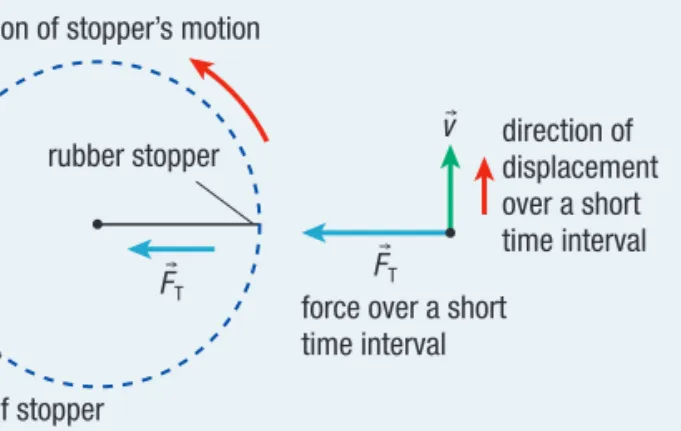
In Tutorial 3, the work does not depend on the magnitude of the tension force or the total distance the stopper moves. We treated the stopper’s orbit as a series of tiny displacements perpendicular to the tension force. For each tiny displacement, the tension force does zero work on the stopper. We conclude that the work done by the centripetal force acting on an object in circular motion is zero.
Tutorial
3
Work and Centripetal Acceleration
When a centripetal force acts on an object moving along a circular path, the direction of the force is perpendicular to the direction of the object’s motion.
A student attaches one end of a string to a rubber stopper. She then holds the other end of the string and twirls the rubber stopper in a horizontal circle around her head. The string exerts a tension force on the stopper directed toward the centre of the circle (Figure 7). Determine the work done on the stopper by the string during a revolution.
direction of stopper’s motion
path of stopper
rubber stopper
FT
(a)
Figure 7 (a) The circular path of the rubber stopper, seen from above. (b) During a very short time interval, the displacement of the stopper is perpendicular to the tension force.
direction of displacement over a short time interval force over a short
time interval v FT (b) Given: u5 908 Required: W
Analysis: The tension force, F>T, causes the stopper’s centripetal acceleration. At each moment, the stopper’s instanta neous velocity is at an angle of 908 to the tension force. During a very short time interval, the very small displacement of the stopper is also at an angle of 908 to the tension force. We can break one loop around into a series of many small displacements, each occurring during a very short time interval. During each time interval, the tension and the displacement are perpendicular. The total work done during one loop around will equal the sum of work done during each small displacement. For each small displacement, use the work equation, W5FDd cos u, with u5 908. Solution: W5FDd cos u
5FDd cos 908 5 FDd (0) W5 0 J
Statement: Summing the work done during all the small displacements of the loop gives a total of W5 0 J during each revolution. The tension force exerted by the string does zero work on the stopper during the revolution.
Sample Problem 1:
Calculating the Work Done on an Object Moving in a Circular Path
Practice
1. Earth exerts a gravitational pull that causes the Moon to experience a centripetal acceleration during its orbit. Assume that the Moon’s orbit around Earth is circular. Determine the work done by Earth’s gravitational pull on the Moon. As part of your solution, include a diagram that illustrates Earth, the Moon, the direction of travel, and the force at one instant in time. K/u T/I C [ans: 0 J]
work done by Multiple Forces
Almost all real-world examples of work involve friction plus other forces. Tutorial 4 explores how the presence of multiple forces affects the work done on an object.
Tutorial
4
Calculating Work Done by Multiple Forces
Sample Problem 1:
Calculating the Work Done by Multiple Forces on a Dragged Object
Figure 8 shows a long-distance hiker pulling a sled acrossa snowy field.
The hiker exerts a constant force of 135 N on the sled at a 48.08 angle to the sled’s displacement. At the same time, a constant 67.0 N frictional force on the sled from the snow opposes the motion. The sled also experiences the force from gravity and the normal force from the snow, but these forces do not contribute to the work. Calculate the work done by the hiker (h), the work done by friction (f), and the total (T) work done on the sled when the hiker pulls the sled 345 m over the snow.
Given: Fh5 135 N; Ff5 67.0 N; Dd5 345 m; uh5 48.08; uf5 1808 Required: Wh; Wf; WT
Analysis: W5FDd cos u. The total work done is the sum of the work done by the individual forces.
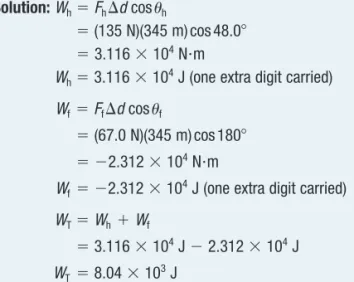
Solution: Wh5Fh Dd cos uh
5 (135 N)(345 m) cos 48.08 5 3.116 3 104 N?m
Wh5 3.116 3 104 J (one extra digit carried) Wf5Ff Dd cos uf
5 (67.0 N)(345 m) cos 1808 5 22.312 3 104 N?m
Wf522.312 3 104 J (one extra digit carried) WT5Wh1 Wf
5 3.116 3 104 J 2 2.312 3 104 J WT5 8.04 3 103 J
Statement: The hiker does 3.12 3 104 J of work on the sled. Friction does 22.31 3 104 J of work on the sled. The total work done on the sled is 8.04 3 103 J.
Figure 8 y FNFh h Fg Ff x
Practice
1. A hiker pulls a sled a distance of 223 m with a constant force of 122 N exerted at an angle of 378. Friction acts on the sled with a constant force of 72.3 N. Calculate the work done on the sled by the hiker and by friction, and the total work done on the sled. T/I A
[ans: 2.2 3 104 J; 21.6 3 104 J; 5.6 3 103 J]
2. If together the hiker and friction do 2.42 3 104 J of total work on the sled in Figure 8, how far did the hiker pull the sled? T/I A [ans: 963 m]
A frictional force is present in many parts of the hiker and sled problem in Tutorial 4. Friction acts, for example, between the hiker’s hands and the rope, between the rope and the sled, and between the hiker’s boots and the snow.
A frictional force acts and does work on any surfaces that slide past each other. In each case, the frictional force transfers energy to surfaces, increasing their kinetic energy. The energy does not disappear. The increase in temperature occurs because of the motion of atoms at the surfaces. All substances are composed of particles in constant motion. When friction heats two surfaces, the vibrations of the particles become larger, and the particles move more quickly. The faster-moving particles have more energy, and the energy stored in the chemical bonds increases.
In summary, when analyzing the total work done on an object, all forces that are present, including friction, must be considered. The net effect of these forces can result in either positive, negative, or zero total work done on the object.
Questions
1. Two ropes pull on a crate toward the left with forces of equal magnitude, F, causing the crate to move horizontally (Figure 9). Which rope does more work on the crate? Explain. K/u
F1
F2
Figure 9
2. A toy consists of a small plastic tube connected at the centre to one end of a long string. A girl holds the other end of the string and swings the toy in a horizontal, circular path above her head. Is work done on the toy by the string during each revolution? Explain your reasoning. K/u
3. A shopper pushes a loaded grocery cart with a force of 12.6 N. The force makes an angle of 21.88 above
the horizontal. Determine the work done on the cart by the shopper as he pushes the cart 14.2 m. T/I A
4. The horse in Figure 10 pulls a rider on a sleigh across a snowy horizontal field. The force of the rope is 22.8 N, and the horse does 9.53 3 102 J of work
pulling the sleigh a distance of 52.6 m. Calculate the angle between the rope and the horizontal. T/I A
Summary
• Work occurs when a force F> is applied to move an object a displacement Dd>.
• The work done on an object is given by W5FDd cos u, where u is the angle
between F> and d>. The SI unit of work is the joule (J).
• When an object moves at an angle to an applied force, only the component of the force in the direction of the displacement does work on the object. • When an object moves in a direction opposite to an applied force, the force
does negative work on the object.
• A force does zero work on an object when the angle between the force and the object’s displacement is 908. Zero work is also done when either the force or
the displacement is zero.
review
4.1
5. A warehouse worker pushes a crate of mass 24 kg up a ramp (Figure 11). Assume that the friction between the crate and ramp can be ignored. K/u T/I
u 5 30.0° Figure 11
(a) Determine the component of gravitational force directed along the ramp’s surface.
(b) Calculate the force required to move the crate at a constant speed up the ramp.
(c) Calculate the work done in pushing the crate 23 m as measured along the ramp. Assume the crate moves at a constant velocity.
(d) Assume the coefficient of kinetic friction between the crate and the ramp is μK5 0.25.
Calculate the work done on the crate by the worker and by friction, and calculate the total work done as the worker pushes the crate 16 m up the ramp.
6. A boy and a girl pull and push a crate along an icy horizontal surface, moving it 13 m at a constant speed. The boy exerts 75 N of force at an angle of 328 above the horizontal, and the girl exerts a force
of 75 N at an angle of 228 above the horizontal.
Calculate the total work done by the boy and girl together. T/I
u F Figure 10