Gowri Meena.S et al, International Journal of Computer Science and Mobile Applications, Vol.4 Issue. 5, May- 2016, pg. 16-20 ISSN: 2321-8363
Impact Factor: 4.123
SURREPTITIOUS INFORMATION
SHARING SCHEME USING LEGITIMATE
DELEGACY IN CLOUD COMPUTING
Gowri Meena.S
1, Dr. R.Indra Gandhi
21
P.G Scholar, E-mail: [email protected], 2Professor, E-mail: [email protected]
1, 2
G.K.M.College of Engineering and Technology, Chennai, Tamilnadu, India
Abstract
In the cloud, for achieve access authority and keeping information private, the information proprietors could embrace credit based hide to encode the set away data. Clients with constrained registering force are however more liable to delegate the co ver of the repair task to the cloud servers to diminish the figuring cost. Accordingly, traits based encipher with consultation asce nd. Stock-still, there are provisos and inquiries staying in the past pertinent works. They strength likewise dupe the qualified clients by act them that they are ineligible with the end goal of cost frugal. Besides, among the encryption, the access arrangements may not be sufficiently adaptable also. Since arrangement for general circuits authorize to achieve the almost all grounded type of access control, a development for recognize circuit cipher text-plan quality based half and half encryption with undeniable appointment has been review in our work. In such a structure, joined with visible calculation and encode then-Macintosh component, the information organization, the fine-grained access control and the value of the designated processing results are all around guard in the interruption. Furthermore, our project accomplishes security against picked plaintext assaults under the k-multi linear Decisional Diffie-Hellman conclusion. In addition, a broad restoration battle affirms the possibility and proficiency of the proposed arrangement.
Index Terms- Cipher text policy, Verifiable authorization, Combination code, Evolutionary map
1.
Introduction
Development of distributed computing conveys a progressive advancement to the administration of the information assets. Inside of this processing situation, the cloud servers can offer different information administrations, for example, remote information stockpiling and outsourced appointment calculation. For information stockpiling, the servers store a lot of shared information, which could be gotten to be approved clients. For appointment calculation, the servers could be utilized to handle and compute various information as per the client's requests. As applications move to distributed computing stages, cipher text-strategy characteristic based encryption (CP-ABE) and evident designation (VD) are utilized to guarantee the information classification and the irrefutability of assignment on exploitative cloud servers. Taking medicinal information sharing with the expanding volumes of restorative pictures and therapeutic records, the social insurance associations put a lot of information in the cloud for lessening information stockpiling expenses and supporting therapeutic participation.
Gowri Meena.S et al, International Journal of Computer Science and Mobile Applications, Vol.4 Issue. 5, May- 2016, pg. 16-20 ISSN: 2321-8363
Impact Factor: 4.123
2.
Proposed System
A special type of public-key encryption. In KAC, users encrypt collection not simplyin a public-key and also with private-key. Secret keys in public-key cryptosystems which maintainentrustment of furtive keys for different cipher text classes in cloud storage. No matter which one among the power set of classes, the delegation can always get an aggregate key of constant size. Our approach is more flexible than hierarchical key assessment which can only save spaces if all key-holders share a similar set of privileges.
2.1 Architecture
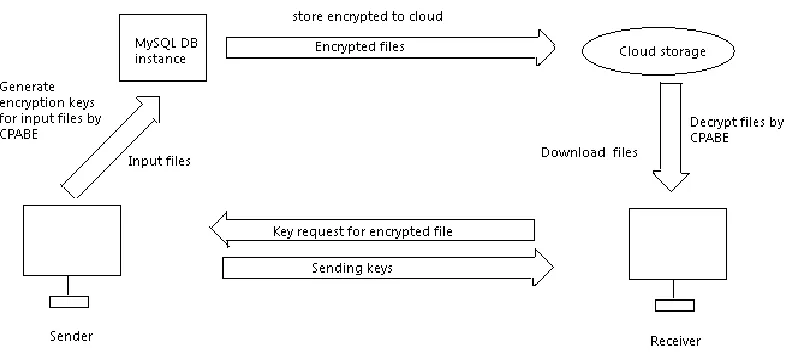
The sender can send the input files in encrypted format. The files stored in a cloud storage with the help of MySQL DB instance, then the file transmitted to the cloud and then we can download a file which is in is un readable format. The Unauthorized users should not be able to access the data at any given time. While receiver send the key request to the sender through mail, then the sender send both the secret keys i.e., Public key and Private key. The authorized receiver only can receive the secret key from the authorized sender. The receiver access the file with the help of secret key and download the folder in decrypted format.
Fig 1. Encryption and Decryption Architecture
2.2 Advantages of Proposed System
The advantage of this system is toshare in a private and secured way with the help of Cloud computing. It will also ensure these properties.
Security issue will not be there.
Privacy issues are minimized.
Key size will be decreased.
3.
Implementation
Gowri Meena.S et al, International Journal of Computer Science and Mobile Applications, Vol.4 Issue. 5, May- 2016, pg. 16-20 ISSN: 2321-8363
Impact Factor: 4.123
3.1 Authentication and Authorization
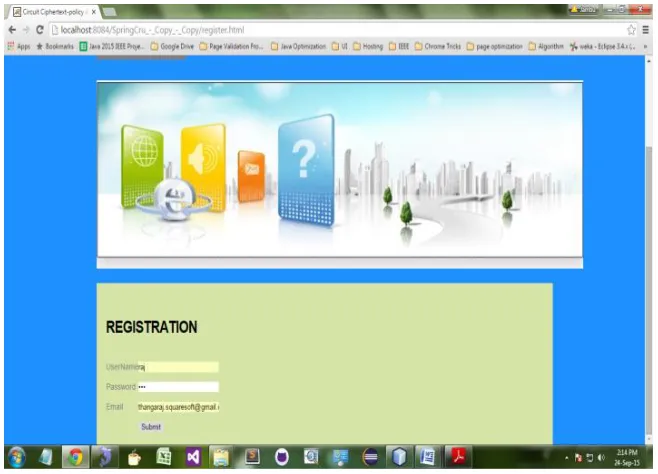
In this element the User have to inventory first, then only he/she has to access the data base. After registration the user preserve login to the position. The endorsement and substantiation process facilitates the system to protect itself and besides it protects the whole instrumentfrom unconstitutional usage. The Registration involves in getting the details of the users who wants to use this application.
Fig 2. User Authentication and Authorization
3.2 File Encryption and Data Storing to Cloud
In this module, User Upload the files which he wants to share. At first the uploaded files are stored in the Local System. Then the user upload the file to the real Cloud Storage (In this application, we use crash box). While uploading to the obscure the file get encrypted by using AES (Advanced Encryption Standard) Algorithm and generates Private Key. Again the Encrypted Data is converted as Binary Data for Data security and Stored in Cloud.
Gowri Meena.S et al, International Journal of Computer Science and Mobile Applications, Vol.4 Issue. 5, May- 2016, pg. 16-20 ISSN: 2321-8363
Impact Factor: 4.123
3.3 File Sharing
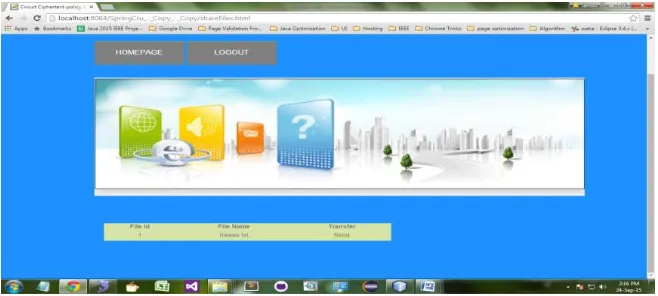
In this module, the uploaded files are shared to the friends or users. In this, the Data Owner set the time to expire the data in Cloud. The Private Key of the Shared Data will be send through Email.
Fig 4. File Sharing process between sender and receiver
3.4 Decryption and Download starting Cloud
In this Module, the user can download the data by decrypting by using AES (Advanced Encryption Standard) Algorithm. The user should give corresponding Private Keys to decrypt the data. The data will be deleted if the user enters the Wrong Private Key for Three times. If the file got deleted then the intimation email will be sent to the Data owner. The Downloaded Data will be stored in Local Drive.
Fig 5. File Authentication using Decryption Key
4.
Conclusion
Gowri Meena.S et al, International Journal of Computer Science and Mobile Applications, Vol.4 Issue. 5, May- 2016, pg. 16-20 ISSN: 2321-8363
Impact Factor: 4.123
5.
Future Enhancements
A drawback in our work is the predefined vault of the number of maximum cipher text classes. In cloud storage, the number of cipher texts usually grows rapidly. So I have to reserve enough cipher text classes for the future extension.
Although the restriction can be downloaded with secret message texts, it would be better if its size is independent of the maximum quantity of cipher text module. On the other hand, when one carries the delegated keys around in a mobile device without using unique trusted hardware, the key is timely to escape, designing a leakage-resilient cryptosystem yet allows efficient and stretchy key entrustment is also an exciting direction.
References
[1] M. Armbrust, A. Fox, R. Griffith, A. D. Joseph, R. H. Katz, A.Konwinski, G. Lee, D. A. Patterson, A. Rabkin, I. Stoica an d M.Zaharia, ”
[2] M. Green, S. Hohenberger and B. Waters, ”Outsourcing the Decryption of ABE Ciphertexts,” in Proc. USENIX Security Symp., San Francisco, CA, USA, 2011.
[3] J. Lai, R. H. Deng, C. Guan and J. Weng, ”Attribute-Based Encryption with Verifiable Outsourced Decryption,” in Proc. IEEE Transactions on information forensics and security, vol. 8, NO. 8, pp.1343-1354, 2013.
[4] A. Lewko and B. Waters, ”Decentralizing Attribute-Based Encryption,” in Proc. EUROCRYPT, pp.568-588, Springer-Verlag Berlin, Heidelberg, 2011.
[5] B. Waters, ”Ciphertext-Policy Attribute-Based Encryption: an Expressive, Enficient, and Provably Secure Realization,” in Proc. PKC, pp.53-70, Springer-Verlag Berlin, Heidelberg, 2011.
[6] B. Parno, M. Raykova and V. Vaikuntanathan, ”How to Delegate and Verify in Public: verifiable computation from attribute-based encryption,” in Proc. TCC, pp.422-439, Springer-Verlag Berlin, Heidelberg, 2012.
[7] S. Yamada, N. Attrapadung and B. Santoso, ”Verifiable Predicate Encryption and Applications to CCA Security and Anonymous Predicate Authentication,” in Proc. PKC, pp.243-261, Springer-Verlag Berlin, Heidelberg, 2012.
[8] J. Han, W. Susilo, Y. Mu and J. Yan, ”Privacy-Preserving Decentralized Key-Policy Attribute-Based Encryption,” in Proc.IEEE Transactions on Parallel and Distributed Systems, 2012.
[9] S. Garg, C. Gentry, S. Halevi, A. Sahai and B. Waters,”Attribute-Based Encryption for Circuits from MultilinearMaps,” in Proc. CRYPTO, pp.479-499, Springer-VerlagBerlin,Heidelberg, 2013.
[10] S. Gorbunov, V. Vaikuntanathan and H. Wee, ”Attribute-BasedEncryption for Circuits,” in Proc. STOC, pp.545-554, ACM New York, NY, USA, 2013.
[11] A. Sahai and B. Waters, ”Fuzzy Identity Based Encryption,”in Proc. EUROCRYPT, pp.457-473, Springer-Verlag Berlin, Heidelberg,2005.
[12] V. Goyal, O. Pandey, A. Sahai and B. Waters, ”Attribute-based Encryption for Fine-grained access control of encrypted data, “in Proc. CCS, pp.89-98, ACM New York, NY, USA, 2006.