An Analysis of the Potential Applications of Big Data Analytics
(BDA) in Supply Chain Management: Emerging Market
Perspective
Arifur Rahman* Ather Yeasir Fahim
University of Dhaka, Shahbag, Dhaka-1000, Bangladesh Abstract
Big Data is defined as the techniques, technologies, systems, practices, methodologies, and applications that analyze critical business data to help an enterprise better understand its business and market and make timely business decisions. Big Data can be utilized to gain critical and fundamental insights towards optimizing the supply chain decisions more effective and efficient. In the recent years, therefore, researchers and practitioners have tried to measure the capabilities of Big Data to optimize Supply Chain Management (SCM) efficiency. This research attempts to provide a clear understanding of Big Data applications on Supply Chain Management in emerging markets, especially in Bangladesh, primarily focusing on four key areas: reducing inventory cost, attaining cost leadership, improving customer service and enhancing speed of delivery. To investigate the potential application of Big Data in supply management, a qualitative research has been conducted. Ten in-depth interviews and a case study have been conducted to collect the relevant information from the supply chain experts of the selected firms. Thematic analysis and Hermeneutic iterative methods of analyses have been used. The results indicate that the supply chain of both physical products and services can be benefited from Big Data analytics. The study also revealed that Big Data can be applied in SCM for operational and development purposes including value discovery, value creation and value capture. This study would help the decision makers and practitioners of Supply Chain Management of diverse fields to adopt Big Data to improve the organizations performance and sustainability.
Keywords: Big Data analytics, Supply Chain Management, applications, emerging markets. 1. Introduction
The concept of Big Data—the huge volume of data handled daily by organizations—has become increasingly important over the past years in both academic and practitioner worlds. It has been defined as 'the techniques, technologies, systems, practices, methodologies, and applications that analyze critical business data to help an enterprise better understand its business and market and make timely business decisions"(Chen, Chiang, & Storey, 2012, p.1166),but according to Mayer-Schonberger and Cukier (2013) and Song, Fisher, Wang (2016), there is no universally accepted definition of Big data. Researchers commonly describe Big Data using 'V' descriptors: volume, that is the amount of data; velocity, referring to the frequency or speed of data generation and delivery; variety, referring to the different sources that Big Data can be obtained from; veracity, referring to the quality data and their extraction from trustworthy sources; and value, which highlights the importance of its economic benefits (Wamba, Akter, &Edwards, 2015).
As the name suggests, ‘size’ was conceived as its main characteristic, but Gartner Inc. observed that to consider data as ‘Big Data’, size cannot be the only standard. Both Gobble (2013) and Strawn (2012) see Big Data as the dominant revolution of the “fourth paradigm of science”. According to McKinsey & Co. (2011) Big Data acts as a consequent perimeter, for productivity, competition and innovation. This paradigmatic transformation of data and information is considered as Big Data, which discovers diverse fields of knowledge in business environments. McAfee and Brynjolfsson (2012) viewed Big Data as the process that increases the clarity of companies' operationsand develops the technique of performance measurement. In this case, Brown, Chui & Maniyka (2011) tried to identify the causes behind the ability of ‘Big Data’ to adapt competition by making adjustments to corporate ecosystems, reshaping operational processes, and expediting innovation” .Big Data influences competition and growth for individual companies, as well as enhances productivity, innovation, and competitiveness for different sectors and economies.
Big Data significance can be outlined in the way that it can modify the whole business operation to increase a firm’s competitive advantage. This depends on the data extraction propensity of Big Data to gain actionable business insights (Wong 2012), and allows companies to surpass their competitors in the market (Oh, Teo, Ramamurthy, 2012). McKinsey and Company (2011) claimed that it has a remarkable value for world economy that will increase productivity and rivalry by gaining insights through collecting, storing, and mining data for consumers and public sectors. In this process consumers enjoy an opposite fluctuating economic surplus (Manyika Brown, Byers, 2011).
It has been noted that Big Data facilitates companies by social media and customers’ loyalty cards so that companies can identify customers' needs and preferences (Tsai, Raghu, Shao, 2013). For example, SPEC, a
renowned eyeglass manufacturing firm, collects, stores and analyses Big Data from social media like Facebook, Google, etc. to generate new product offerings and ideas for their customers (Tan, Zhan, Chang, 2015). Further, Thibeault and Wadsworth (2014) pointed out that every day, Facebook users send around 10 billion messages, videos, and photos, click “share” 4.5 billion times, and upload 350 million new pictures. 60 percent of operating margins can be increased by Big Data if retailers literally analyze unrevealed Big Data values (Werdigier, 2009). Though establishing platforms and procedures of Big Data requires a large amount of resources and time, companies gain competitive advantage which facilitates them by providing enduring benefits over competitors (Terziovski, 2010).
Big Data has potential value that is yet to be explored. In 2011, a survey conducted by Oxford Economics found that only 25% of industry executives believed that conversion of technologies will highly influence manufacturing sectors in the next five years. Yet it has been noticed that manufacturers have huge amounts of data sets, and it is hard to believe that they are put in reserve without being put to use. When manufacturers do manage to gather, evaluate and fix the data sets to business outcomes, they are surprised with the outcomes (Records and Fisher 2014). For example, Manyika et al., (2011) calculated that an effective resourceful use of Big Data will enhance quality and efficiency in US health care by cutting off 300 billion dollars a year. Annually 600 billion dollars’ worth of commercial value can be achieved over the world through analysing consumers' personal location data (Davenport and Harris, 2007; LaValle, 2011).The White House considered Big Data “national priority task” for contributing to national security and healthcare (Mervis, 2012).
Big Data can be used in various sectors including manufacturing, retail, medicine, logistics, finance, and telecommunications (Feng 2013). Previous research (Chen 2012; Fosso-Wamba, 2015; Dubey, Wamba, Papadopalous 2015, Wang, 2016; Song, 2016) has tried to identify different dimensions of Big Data applications to grab the potentiality of supply chain management (SCM). A company's supply chain manager needs to realize the significance of Big Data to increase the company's profitability and operational efficiency. In the SCM field, companies that are using Big Data and predictive analysis comprehensively are enhancing their proficiency in operations and discovering new potentialities (Waller & Fawcett, 2013). Past research has indicated that Big Data and predictive analysis generates a competitive strategic dimension and cost saving business process for companies.
Though the proper utilization of Big Data has potential values in SCM, the application of Big Data is rather evasive in operations (Schoenherr and Speier-pero, 2015), and actionable insights and empirical research are insufficient (Zailani and Shaharudin, 2016).
1.1 Aims of the study
This study aims to find out how Big Data and predictive analysis can be used to improve the potentiality of SCM, especially in emerging markets such as Bangladesh. In addition, this study is also interested to examine, at least theoretically, to what extent Big Data can increase the efficiency of SCM.
2. Literature 2.1. Big Data
Although the term ‘Big Data’ is ubiquitous these days, its origin dated back to the mid-1990s. Diebold (2012) noted that the term “Big Data . . . probably originated in lunch-table conversations at Silicon Graphics Inc. (SGI) in the mid-1990s, in which John Mashey figured prominently”. The popularity of Big Data can be attributed to the fact that this topic was Google-searched 252,000 times in November 2011 (Flory 2012) and then reached the impressive number of 801,000,000 hits in October 2015 (Mishra et al. 2016). McKinsey Global Institute (2011) defined Big Data as the “data sets whose size is beyond the ability of typical database software tools to capture, store, manage and analyse”. This definition is not confined to data size, since data sets will increase in the future. It highlights the necessity of technology to cope with the rapid growth in available data. Other characteristics have been put forward to define the Big Data concept (Mishra, Gunasekaran, and Dubey 2016) and these will be reviewed below.
2.2 Characteristics of Big Data
Traditional data management techniques are inadequate to accumulate, store, control and process the extensive and complex data sets that is generally defined as big data (Hu et al., 2014; Madden 2012; Manyika et al., 2011). This definition of big data does not quantify the data size in any particular amount. In order to be considered as big data this huge data sets requires technological advancement which will also increase in size.
According to Mayer-Schönberger and Cukier (2013) bag data has no particular definition. As there is absence of any concrete theoretical definition, academicians and practitioners have accepted the most widely aspects of big data that can be bound up with three Vs: Volume, Velocity and Variety. Another explanations of Big data can be acknowledged from Chen, Chiang, and Storey 2012; Dijcks 2012; Gantz and Reinsel 2012; Kwon, Lee, and Shin 2014; Kwon and Sim 2013; Russom 2011; Turner et al. 2014; White 2012; Zikopoulosand
Eaton 2011) . Many researchers studied the proficiencies which can be derived from utilizing big data in O& SCM. Research conducted by Gobble (2013); Strawn (2012); Manyika et al., (2011), McAfee and Brynjolfsson (2012); Brown, Chui, and Manyika (2011) can be referred for more details.
Volume refers to the immensity of data, which has increased radically over recent years. Big Data size may be diversified from terabytes to petabytes. Fosso-Wamba et al. (2015) defined volume as “a huge amount of data sets that requires huge storage or imply a large number of recorded data”. For example, from customer transactions, Walmart collects more than 2.5 petabytes of data every hour (McAfee and Brynjolfsson, 2012).
Velocity refers to the speed and rate by which data are produced, analyzed and acted upon on business operations (Gandomi and Haider 2015). A SCM example can be that every day Amazon manages a consistent flow of products, promotions, customers, suppliers relying on the variables simultaneously (Fosso-Wamba et al., 2015).
Variety refers to the structural heterogeneity of the data (Gandomi and Haider, 2015). In Russom's (2011 b) study, variety is illustrated by the data sets that have multi-faceted field of formats generated from different sources (Fosso-Wambaet al., 2015). As an example in SCM, every month Tata Motors checks and analyses approximately 4 million text messages about service appointment, product assertion reminders, advertisements for new products and an overall inspection of customer satisfaction (Fosso-Wamba et al., 2015).
Besides the above mentioned “3Vs”, three more characteristics, namely, veracity, variability and value have been introduced. The fourth V, Veracity, reflects the “unreliability inherent in some sources of data” (Gandomi and Haider 2015, p. 139). According to White (2012) veracity acts on data quality and its importance, the level of reliability depends on the source of data.
Statistical Analysis Software (SAS) introduced Variability (and Complexity) that are the two dimensions of Big Data. Generally, the velocity of Big Data is incompatible and it varies in data flow rates, which is named as ‘variability’ of Big Data (Gandomi and Haider, 2015). When big data originates from immeasurable sources it ensues complexity and so that these data sources requires to connect, match, clarify and change data (Gandomi and Haider, 2015). For instance, in the prior example of Amazon, in order to deal with variety, the company demands to understand and to deal with variability it requires clarifying the data for a meaningful interpretation of it. IBM has also stated that for Big Data , the quality of data is substantial since the intrinsic unreliability and complexity of data cannot be eliminated by even the best data cleansing methods.
Economic advantages derived from big data reflects the characteristics named Value (Forrester 2012; Oracle 2012). It is important for firms to acknowledge the substantial amount of data and from this data, what is meaningful to be extracted for further analysis. In an example of SCM, Tesco has enhanced their operating margins by analyzing Big Data. Here, this data is connected to temperature and weather patterns, Tesco conducted a far better forecasts of temperatures which enabled them to predict (weather) associated changes in consumer needs and demand (Patil, 2014).
2.3 Role of Big Data: Organizational performance and supply chain management
In the SCM sector, Waller and Fawcett (2013) identify Big Data as a data science that can utilize huge data sets to resolve SCM problems and spot solutions that ensure quality data and availability of data issues. Those Big Data can applied through quantitative and qualitative methods to resolve problems. Recently, Chae (2015) observed that in the Supply Chain Management sector, the implications of Big Data and social media have not been studied thoroughly. As social media helps to gather Big Data, there is a significance of exploring this potential arena.
Companies faces competition within supply chain industries rather than competition between individual firms in the SCM sector (Craighead, Hult, Ketchen 2009; Ketchen and Hult 2007; Slone 2004; Whipple and Frankel, 2000). As outcomes from this competition raise awareness among firms about SCM, managers are realizing that their competitive strategies need to be re-examined (Zacharia, Sanders, and Mix 2011). Managers have to decide how they utilize the available data and technology to win the competition (Hopkins et al., 2010).
Supply chain managers are getting increasingly dependent upon data for gaining visibility on expenditure, identifying trends in costs and performance, and for supporting process control, inventory monitoring, production optimization, and process improvement efforts. As a matter of fact, there are several companies that are flooded with data and try to capitalize on data analysis in an attempt to gain competitive advantage (Davenport, 2006).
Having an ability to exploit data, firms such as Google, Amazon outperform their competitors by developing potential business models. Barton and Court (2012) observed that by using Big Data, companies can alter their operational strategy and produce performance gains. They also claimed that in near future the acquisition of data-driven strategies will bring a remarkable differentiation in competition. McAfee and Brynjolfsson (2012) observed that if companies integrate their operations with Big Data and analytics their profit margin and productivity rates can be increased up to 5% or 6%.
2.4 Theories of Big Data
Important theories of Big Data can be applied to different sectors. Among them, a few are worth mentioning here: Actor-Network Theory
It is said that network provides the mechanism by which information, data, and analysis may be shared across multiple firms and can be used in the application within SCM. Macintosh and Maclean (2001) suggest this theory for application within SCM. It can be assumed that from the supply chain standpoint, this actor network theory can help to explain the interaction and flows of information, finance and physical products (kinder, 2003). Social Capital Theory
Social capital theory was first defined as "the aggregate of the actual or potential resources which are linked to possession of a durable network of more and less institutionalized relationships of mutual acquaintance of recognition" (Bourdieu,2011, p.81). This social capital theory has been applied into SCM and had been found that this theory can help to explain product innovation (Reagans and Zuckerman, 2001) and supplier Development (Krause, Handfield, and Tyler, 2007). They argued that supply chain functions may be improved by this formula. This theory actually improves the overall performance of the network which may create a competitive advantage for a firm.
Institutional Theory
This theory explains that how a company's external environment directly impacts the structure and process of an organization. Mainly every organization acts as an individual, so they face different types of environmental disorders. If organizations get combined as an institution to prevent environmental impacts then those organization will face less problems. Researchers suggested that this theory is also useful in the context of supply chain. When individual or an institution of supply chain struggle to make rational decision then this theory can help a lot in supply chain management (March and Olsen, 1983).
Resource Dependency Theory
This resource dependency theory proposes that when any organization has lack of resources then it will develop good relations with the other organizations in order to use resources. Then they will have a great control over the resources and the network will be much more effective. This theory has been applied in SCM and found useful (Ulrich and Barney, 1984).
Transaction cost economics
This focuses on the amount of effort and cost expended in a transaction between two entities with a goal of maximizing performance and minimizing cost. This theory has been applied in many organizations and observed that the short term application of this theory in SCM results in losing revenue and opportunity; however long term application of the same theory helps in building trusted relationships.
2.5 Big Data applications in SCM
The management of a network of relationships within a firm and between interdependent organizations and business units consisting of material suppliers, purchasing, production facilities, logistics, marketing and related systems that facilitate the forward and reverse flow of materials, services, finances and information from the original producer to final customer with the benefits of adding value, maximizing profitability through efficiencies, and achieving customer satisfaction (Stock and Boyer, 2009, p.694).
This research followed the Stock and Boyer’s definition of SCM.
By analyzing 145 survey responses, Sengupta and Cook (2006) found that Big Data in supply chain management generates more employees and higher revenues in manufacturing companies. Supply chain of both physical products and service deliveries can both benefit from Big Data. Therefore Big Data can be applied in SCM for operational and development purposes, value discovery, value creation and value capture. Wang et al., (2016) have established a five-level analytic maturity framework for analytic applications in strategic SCM processes. 2.6 Supply chain and operational efficiency
In the light of previous studies, the author understands that supply chain and operational efficiency may depend on many factors. However, the following four factors are more influential in terms of their priority:
First priority :(a) reducing inventory cost; (b) attaining cost leadership. Second priority:(c) improving customer service;(d)enhancing speed of delivery 3. Method
The entire research process has been divided into four main stages: questionnaire design, data collection through in depth interviews & case study, data analysis, and reporting findings.
To investigate the potential application of Big Data in supply management, qualitative research method has been used. In-depth interviews and a case study were conducted to collect the relevant information from the supply chain experts of the selected firms. This in-depth interview method was used for two main reasons: the two-way communication during the interview helped in seeking more detailed and in-depth information; and it
allowed the researcher to ask questions outside the semi-structured questionnaire for clarification and for asking follow-up questions. Thematic analysis and hermeneutic iterative methods of analyses have been used to analyze the data.
The data collection involved around ten interviews with SCM experts from diverse backgrounds of Dhaka city. The respondents were IT consultants, senior executives and managers involved in Supply Chain Management. Respondents have been selected through judgmental sampling technique based on the knowledge and years (at least 10 years) of working experience in the field of Supply Chain Management. Among them, 3 were the head of supply chain in their respective organizations, 2 of them were Supply Chain consultants, 3 of them were senior executives and rest of them were IT consultants and practitioners. The interviews were taken in respondent’s workplace and the typical interview length ranges from 60 minutes to 90 minutes.
Every interview seeks to find out the current scenario of what types of data they are using and whether they have been actually using Big Data or not, based on the definitions and understanding of Big Data. Once, that is established, further questions have been asked to check if the respondents are aware about the Big Data or not. Later, in case of non-awareness of Big Data, the benefits of using Big Data are explained in the line of their work in an informal discussion. Then, the possibility and scope of applying Big Data in the respective fields are explored and an informal cost-benefit scenario have been discussed.
This research has conducted a case study on Lin Trade International to learn the potential applications of Big Data in their Supply Chain Management (See section 4.3 for details about Lin international). “Case study is one of many qualitative methods that can be adopted to collect data for research. Such method represents part of what is referred to as the research strategy that details the design and data collection, approaches to be used in the research” (Fowler and Mangione, 1990). Triangulation has been done where interview data and case study data have been cross verified to increase the credibility and validity of the research to gain valuable research insights.
4. Findings and Discussion
This section presents the findings on the role of Big Data in SCM based on the analysis of the SCM expert’s responses. Based on the expert interviews, this research tried to explore the potential applications of Big Data in the four basic areas of Supply Chain Management.
4.1. SCM Experts’ insights about the application of Big Data Reducing delivery time
Organizations should adopt Big Data analytics so that it can enhance the capacity to connect with millions of their customers to reduce delivery time (Sing, Mehta, Agarwal, 2016, p.12).By using Big Data, a delivery company can save valuable time and excessive effort because they store all the products in the same warehouse; then they sort all the products according to the customers’ demands, which is really a time consuming and effortful job. Instead, if the delivery company pack the products according to the order and then deliver different types of products in the nearest warehouse then the customer can receive the product without any delay which can bring a greater efficiency in reducing delivery time. By using Big Data, a company can gain information about better local service which can compete efficiently in markets and can provide specific locations of the manufacturer which can give consistent quality (Berrios, David and Madison, 2014). This information has been found from the following interview.
“I firmly believe that if an organization uses Big Data it can refer better maintenance systems for the organization. As an organization produces various types of products and maintain different scheduled delivery system so, unplanned system can create a severe damage which will result in late package and loosing customer loyalty. But by using Big Data the special types of algorithms will help to maintain production, delivery vehicles and customer service which will create an unaffected timely delivery” ( Md. Ali Imam, Supply Chain Management Executive at impress Group, Personal interview , March 21, 2018).
The interview strongly revealed that by using Big Data, supply chain maintenance would be more predictive resulting in a shorter delivery time and satisfied customers. To be sustainable, a business organization must create value for the customer. If they make delay in packaging and late to deliver the products, then customers are dissatisfied. To solve this problem, Big Data analytics can give the quickest feedback, because only Big Data analytics is able to make accurate and planned delivery schedule; and with that it can create greater customer loyalty with greater benefit. Otherwise, the unplanned system will diminish customer loyalty, leading to loss of revenue for the firm.
Improving customer service
To gain customer loyalty, newer services and offers are to be made according to customers’ choice, consumption habits, mode of delivery etc., (Singh, Mehta, Agarwal, 2016).
To ensure sustainability in the market and to face competition, industries are establishing themselves in supply chain industry by more customer service offerings and it must be followed by other companies (Singh et
al, 2016, p.16).
This has been echoed in the following interview:
“When we offer our products to our customer we try to grab the insights about their choice, lifestyles and consumption patterns. We observe and record how they make payments either cash or card, in which time they choose to buy different categorized products; in case of home delivery, how they order and receive products. Based on all these information, we serve customers in a way that each of them feel like they are receiving an extra personal care" (Mohammed Alamgir, Supply Chain Management Professional, Personal Interview, March 23, 2018).
Based on the interview, this research exhibits that customers are influenced by the services and caring offered by organizations; this service lead to grow a positive preference in customers’ minds to buy the products from the same company in future. It is somewhat obvious that if an organization failed to improve their customer service, it is deemed to sacrifice their bottom line. To improve customer service, company should monitor customers buying behavior very carefully. Without paying proper attention to the customer, it is almost impossible to improve customer service. It should be kept in mind that every customer wants an extra personal attention and extra care. Thus organization should observe and can keep a record of all interactions that they encounter with their customers. Analyses of these interactions using Big Data analytics can help organizations to properly design and improve customer services.
Reducing Operational Cost
To increase profits and greater productivity, an organization’s reducing operational cost has a greater influence on its revenue. Mainly reducing operational cost is a combination of numerous variables such as raw materials, transportation, machinery maintenance, inventory etc. These variables are interlinked in characteristics. Any alteration of the variable can cause an adverse effect to the others variables (Singh et al., 2016).
This has been found from the following interviews:
"A decrease in our inventory of raw materials will cause a reduction in inventory cost, but if we decrease raw materials beyond the range it will increase our transportation cost. To overcome this complex situation, we try to select a standard margin of variables which can be modified when it requires to be decreased without any increase of other related costs. To avoid resource wastage, we collect data from the variables to balance their decreased costs that may not incur another expansion of cost" (AKM Asiful Alam, Executive-Supply Chain Management at Epyllion Group, personal interview, March 27, 2018).
"We try to balance all these variables based on their priority to ensure a proper ratio in the reduction of overall costs. Using Big Data, we try to identify the individual and independent variable that can be changed according to our necessity" (Nafis Ahmed Chowdhury, IT Manager, personal interview, March 31, 2018)
The study revealed that reducing operational cost can play a very vital role in any organization. Operational cost depends on many controllable and uncontrollable variables. As it is hard to control all the operational variables by the decision makers (as suggested in the previous studies), Big Data can play a vital role by controlling all the variables by identifying dependent and independent variables. It can be said that by reducing operational cost a firm can gain cost leadership. Therefore, in order to gain cost leadership in various sectors, especially those that are directly related to SCM, organizations should employ Big Data.
Reducing Inventory Costs
Inventory costs may depend on an accidental increase of demand, an instant shortage of essential raw materials, or a manufacturing stoppage due to machinery fault. But using Big Data can greatly reduce the amount of inventory (Sing, Mehta, Agarwal, 2016, p.12). Big Data analytics can create short life cycle of products and help to look for alternate markets for the products. Forecasting can be done considering reality based future sales, which would ultimately help to reduce the level of inventory and inventory cost (Dean, David, and Zug, 2017).These have been echoed in the following interviews.
“Actually, if a company can maintain Big Data properly then inventory will be reduced drastically. Because Big Data can relate with the past demand of the customer to forecast actual future demands”(Tanim Ahsan, Executive - Supply Chain Management, personal interview, April 5, 2018).
“We can say that if the whole supply history of a particular supplier can be analyzed then we can predict future supply accurately. Also if we analyze the performance of a machine then we can predict before the break down of machine”(Abu Sohel Rasel, Executive - Supply Chain Management (SCM) at Fakir Fashion Ltd., Personal interview, April 8, 2018).
The interview revealed that if any organization wants to reduce its inventory level, it can use these techniques of Big Data to save money and space. The Head of Supply chain of OTOBI (A Bangladeshi Furniture Company) and an executive from Lin Trade International both claimed that information provided by Big Data can reduce inventory cost with shorter lead time, which improves customer service and speed of product delivery to markets leading to an improved relationship with supply chain.
Finally, the experts’ responses revealed that in inventory management system, Big Data has a great deal of influence. For example, for the distribution of non-perishable items, use of Big Data can increase operational
efficiency by ensuring short time delivery and thus help to make extended profit. Therefore, the utilization of Big Data analytics in Supply Chain Management is revealed to be the primary concern of forward thinking leaders of SCM.
4.2 Results from the Case study Lin Trade International
Lin Trade International, a supply chain company founded in 2009, sells 15,000 product categories of office equipment directly to its customers bypassing distributors and retailers. Lin Trade International`s supply chain consists of only two stages – suppliers and customers. Lin Trade International integrates its supply chain with its major customers and delivers more than 100 orders of customers per day nationally.
From 01 March, 2018 to 31 March, 2018 they had been using Big Data to analyze a huge amount of data sets to collect information about product delivery and customer experience. In this period, Lin Trade International directly contact with their customers. The use of Big Data assists Lin Trade International to analyze costs of inventory, the requirements and profitability from customers and increase the speed of product delivery in real time.
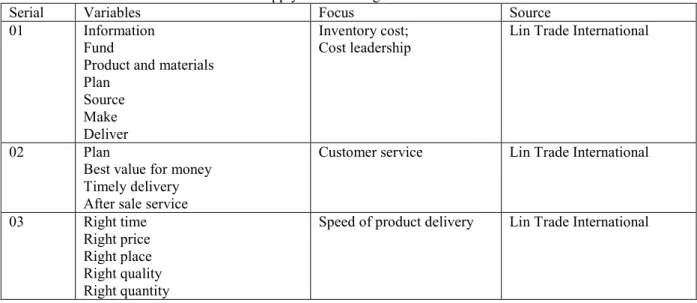
Lin Trade International follows Omni channel strategy to receive orders from customers. After using Big Data analytics, they have a real-time overview of their operations. Officials can identify inventory levels and match them to customer orders and demands more accurately which increases customer satisfaction. Mainly, Lin Trade International focus on important factors which they believe significantly affect important areas of Supply Chain Management (see Table 1).
Table 7.Variables that affect the areas of Supply chain Management of Lin Trade International.
Serial Variables Focus Source
01 Information Fund
Product and materials Plan
Source Make Deliver
Inventory cost;
Cost leadership Lin Trade International
02 Plan
Best value for money Timely delivery After sale service
Customer service Lin Trade International
03 Right time Right price Right place Right quality Right quantity
Speed of product delivery Lin Trade International
4.3 Potential outcomes
The results from the interview and case study revealed following potential outcomes of the application of Big Data in supply chain management.
Increased profits and sales
If the organization has the access to relevant data, then it can accurately forecast the customer demand which would help them to estimate the optimum level of inventory to stock in the ware house or distribution center. It is revealed from Lin Trade International that utilizing this information, firms would be able to increase profit margins by preventing overstocking or reduced fewer stock outs of a product or category of products. Therefore, by using Big Data, supply chain managers can maximize their profits because of efficient management of inventory.
Cost reduction
Big Data can reduce costs because no hardware is needed in the organization to preserve data. Therefore, there is no maintenance and installations cost for hardware and software. This is possible because data services are fully cloud based [that means it is software-as a-service (SAAS)]. Cloud based means all the data will be stored in online and there will be no hard drive to save this data. There will be only a software in a personal computer or Smartphone and it will analyze all the data. After a certain time, continuously it will update the analyses to provide it to the manager. This entire process is called software-as-a- service (SAAS).
It has been revealed from Lin Trade International that data service can be achieved at a low cost and it can be integrated seamlessly within the existing system. Now-a-days gathering data needs less time and effort from a single transaction. It is also a way to reduce cost by using Big Data.
Determine target audience
Big Data helps to figure out the target audience more accurately, as can be seen from the following interview. “In the past companies collected data by direct interactions, observations or personal communication. By this technique it is very tough to aggregate the information and to get the real picture. But by using Big Data company can get information about the customer very easily and can be examined neatly to get their target audience” (Rahela Jabin, IT consultant, personal interview, April 5, 2018).
Understand the entire customer journey
Big Data can help an organization to realize entire customer journey in order to increase target audience. Previously, the organizations had a limited client interaction but now they can use Big Data in order to examine customer behavior. Like, now data can be gathered from the internet browsing behavior of the customers by using cookies and the company can easily get those from their websites. This has been found from the following interview.
“From the website they are able to see in which link the customer clicked, which product customer chooses to buy or they need anything else. These sorts of data can be provided by Big Data for greater business plan” (Nafis Ahmed Chowdhury, IT Manager, personal interview, March 31, 2018).
Operational efficiency
Warehouse operations managers now have real time overview of their operations with Big Data which makes their operations more proactive than traditional data collection methods. Lin Trade International believes that this extended access to more detailed information about operations helps them to reduce congestion in operations and improve their efficiency.
Improved customer satisfaction
The case study revealed that in Lin Trade International, operations managers can easily identify the factors motivating customers to buy products by analyzing series of past purchase behavior of their customers using Big Data analytics. Big Data collects all types of information about customers such as spikes or depressions, color choice, specific demands, seasonal trends etc. and therefore firms can predict customers demands and able to manage adequate inventory levels. These information balance them to customer orders and preferences more accurately which raises the level of customer satisfaction. The similar type of information has been revealed from the in-depth interviews of |SCM experts, as discussed earlier.
Know customer needs before they ask
Customer needs and priorities are always changing because customers are not always aware of their choice. With Big Data analytics, the huge amount of information can be analyzed properly. Build on that organization can determine customer needs more accurately without interacting with them.
Personalized customer service
Big Data analyses different individual customers’ necessities to get a deeper insight about them. This information has been revealed from the following interview.
“It is not worthwhile to use same strategy to different customers. Providing individual customer service increases the probability of increasing loyal customer base. For this, Big Data can be used to correctly analyze the past buying behaviors of the customers” (Mohammed Alamgir, Supply Chain Management Professional, Personal Interview, March 23, 2018).
Increase problem-solving efficiency
Big Data technology has an outstanding ability to detect user problems and effective solutions. Lin Trade International believes that Big Data can provide the most preferable explanations for customer inquiry and from these, organizations can try to find out insights to make an updated customer service guideline to enrich problem solving efficiency.
5. Conclusions and Implications
This study has utilized thematic and hermeneutic iterative approaches to provide a more thorough understanding of the applications of Big Data in the supply chain by assessing four areas of Supply Chain Management. The findings revealed that Big Data reduces inventory costs, increases customer service by providing right time speedy delivery at the right place. Almost similar results have been found from the cases study on Lin Trade International Ltd. Therefore, a unique contribution of this paper is that the findings are triangulation based, where information gained from in-depth interview and case study were cross verified to increase the credibility and validity of the paper to gain actionable insights. The results of this study would provide a guideline to the Supply Chain Management practitioners. Building on the results of this research, opportunities to explore the potential application of Big Data in Supply Chain Management can be identified. This research infers that, the structure of supply chain can be transformed rapidly by using Big Data which abates the complexity of supply chain in the area of inventory management, customer service and delivery speed of a company. The interview results along with the successful story of the Lin Trade International provide supports the Big Data application in Supply Chain Management. Though the analyses discussed in this paper are based on limited knowledge and
information, despite the limitations, this paper provides encouragement for researchers to further investigate the application of Big Data on Supply Chain Management.
6. Limitations and Scope of future research
Some limitations should be kept in mind when interpreting its results. Firstly, this study has used particular keywords and it may be that the use of other keywords may have yielded different results. Secondly, this research has utilized thematic and iterative approaches, other interpretative approaches of data analysis may have brought different results. Thirdly, this paper utilized qualitative research method where SCM experts put forwarded their thoughts about the potential applications of Big Data in Supply Chain Management. Instead, Action Research (AR) or experimental research would help to better understand the phenomenon with more clarity. Future research can incorporate these important aspects when conducting research in this relatively unexplored area in the context of emerging markets.
References
Barton, D., & Court, D. (2012). Making advanced analytics work for you. Harvard business review, 90(10), 78-83.
Berrios, David, (2014). Challenges in supply chain management. Madison: Wisconsin School of Business. Bourdieu, P, (2011). The forms of capital in cultural theory: an anthology, pp.81-93.
Chen, H., Chiang, R. H. L., & Storey, V. C. (2012). Business intelligence and analytics: From Big Data to big impact. MIS Quarterly, 36 (4), 1165–1188.
Chae, B., & Olson, D. (2013). Business analytics for supply chain: a dynamic-capabilities framework. International Journal of Information Technology & Decision Making, 12 (9), 9–26.
Craighead, C.W., Hult, G.T.M., & Ketchen Jr., D.J. (2009). The effects of innovation—cost strategy, knowledge, and action in the supply chain on firm performance. Journal of Operations Management, 27 (5), 405–421. Davenport, T.H. (2006). Competing on analytics. Harvard Business Review, 84 (1), 84–93.
Davenport, T.H., & Harris, J.G. (2007). Competing on analytics: The new science of winning. Boston. Harvard Business School Press
Diebold, F. X. (2012). A personal perspective on the origin(s) and development of “Big Data”: The phenomenon, the term, and the discipline. Scholarly Paper No. ID 2202843, Social Science Research Network. Retrieved from http://papers.ssrn.com/sol3/papers.cfm?abstract id=2202843
Dijcks, Jean Pierre.( 2012). “Oracle: Big Data for the Enterprise.” Oracle White Paper, http://www.oracle.com/us/products/database/big-data-forenterprise- 519135.pdf
Dubey, R., Gunasekaran, A., Childe, S. J., Wamba, S. F. & Papadopoulos, T. (2015). The impact of Big Data on world-class sustainable manufacturing. The International Journal of Advanced Manufacturing Technology, pp.1-15.
Feng, Z. Y., Guo, X. H. &Zeng, D. J. (2013). On the research frontiers of business management in the context of Big Data. Journal of Management Sciences in China, 16 (1), pp.1–9.
Flory, M.M. (2012). The big kahuna. Marketing Research 24 (2), 3.
FossoWamba, S., Akter, S., Edwards, A., Chopin,G., and Gnanzou, D. (2015). How ‘Big Data’ can make big impact: Findings from a systematic review and a longitudinal case study. International Journal of Production Economics 165, pp. 234–246.
Fowler, F. J. J & Mangione , T. W. (1990). Standard survey interviewing: Minimizing interview- related error. Newbury Park CA: Sage.
Forrester (2012), The Big Deal about Big Data for Customer Engagement Business: Leaders Must Lead Big
Data Initiatives to Derive Value”,
http://www.forrester.com/The+Big+Deal+About+Big+Data+For+Customer+Engagement/fulltext/-/E-RES722
Gandomi, A., & Haider, M. (2015). Beyond the hype: Big Data concepts, methods, and analytics. International Journal of Information Management, 35 (2), pp. 137-144.
Gantz, John, and David Reinsel. (2012). “The Digital Universe in 2020: Big Data, Bigger Digital Shadows, and Biggest Growth in the Far East.” IDC IView: IDC Analyze the Future: 1–16.
Gobble, M. M., (2013). Big Data: the next big thing in innovation. Research Technology Management, 56 (1), pp.64–66.
Hopkins, M.S., Lavalle, S., & Balboni, F. (2010). The new intelligent enterprise: 10 insights: a first look at the new intelligent enterprise survey. MIT Sloan Management Review, 52 (1), 22.
Hu, W.C., and Kaabouch, N. (2014). “Big Data Management, Technologies, and Applications.” IGI Global, Information Science Reference, pp.1-509.
KetchenJr, D.J., & Hult, G.T.M., (2007). Bridging organization theory and supply chain management: the case of best value supply chains. Journal of Operations Management, 25 (2), 573-580.
Kinder,T.(2003). Go with the flow- A conceptual framework for supply relations in the area of the extended enterprise. Research policy. 32, 503-523http.//dx.doi.org/10.1016/s0048-7333 (02)00021-5.
Krause, D. R Handfield, R. B & Tyler, B. B. (2007). The relationship between supplier development, commitment, social capital accumulation and performance improvement. Journal of operations management, 25(2), pp.528-545
Kwon, Ohbyung, Namyeon Lee, and Bongsik Shin. (2014). “Data Quality Management, Data Usage Experience and Acquisition Intention of Big Data Analytics.” International Journal of Information Management 34 (3), pp.387-394
Kwon, Ohbyung, and Jae Mun Sim. (2013). “Effects of Data Set Features on the Performances of Classification Algorithms.” Expert Systems with Applications 40 (5), pp.1847–1857.
Macintosh, R, & Maclean, D. (2001) Conditioned emergence: Researching change and changing research .International journal of production and operations management. 21(9/10)1343
Mayer-Schönberger, V., & Cukier, K. (2013). Big Data: A revolution that will transform how we live, work, and think. Houghton Mifflin Harcourt, New York.
Manyika, J., Chui, M., Brown, B., Bughin, J., Dobbs, R., Roxburgh, C. and Byers, A.H. (2011) Big Data:The Next Frontier for Innovation, Competition, and Productivity. McKinsey Global Institute, Seattle, May 2011. - References - Scientific Research Publishing. (2018). Retrieved from http://www.scirp.org/reference/ReferencesPapers.aspx?ReferenceID=1868156
March, J., & Olsen, J. (2006). 6. James G. March and Johan P. Olsen. 1984. “The New Institutionalism: Organizational Factors in Political Life.” American Political Science Review, 78 (September): pp. 734–49 Cited 456 times. American Political Science Review, 100(04), 675. doi: 10.1017/s0003055406272563 McAfee A., & Brynjolfsson E. (2012). Big Data: The management revolution. Harvard Business Review, 90
(10), pp. 60-66.
Mervis, J. (2012). Agencies Rally to Tackle Big Data. Science, 336(6077), 22-22. doi: 10.1126/science.336.6077.22
Mishra, D., Gunasekaran, A., Childe, S., Papadopoulos, T., & Dubey, R. (2016a). Vision, applications and future challenges of Internet of Things: A biblio-metric study of the recent literature. Industrial Management and Data Systems (Accepted Paper).
Oh, L., Teo, H., & Sambamurthy, V. (2012). The effects of retail channel integration through the use of information technologies on firm performance. Journal of Operations Management, 30 (1), 368–381. Kim, Y., You, E., Kang, M., & Choi, J. (2012). Does Big Data Matter to Value Creation? : Based on Oracle
Solution Case. Journal Of The Korea Society Of IT Services, 11(3), 39-48. doi: 10.9716/kits.2012.11.3.039 Patil, R., Carter, S., Mirvis, S., Minkus, K., Carter, S., & Mirvis, S. et al. (2018). Supermarket Tesco pioneers
Big Data - Dataconomy. Retrieved from http://dataconomy.com/2014/02/tesco-pioneers-big-data/
Reagans , R& Zuckerman,E.W. (2001). Networks, diversity & productivity: The social capital of corporate and R&D teams. Organization science,12(4), pp. 502-517
Russom, P. (2011b). Big Data Analytics, Best Practices Report, Fourth Quarter, The Data Warehouse Institute, Renton, WA, September 18, 2011 (available at tdwi.org).
Schoenherr, T., & Speier-Pero, C. (2015). Data science, predictive analytics, and Big Data in supply chain management: Current state and future potential. Journal of Business Logistics, 36(1), pp. 120-132.
Sengupta, K., Heiser, D., & Cook, L. (2006).Manufacturing and service supply chain performance: A comparative analysis. Journal of Supply Chain Management, 42(4), pp.4–15.
Slone, R.E. (2004). Leading a supply chain turn around. Harvard Business Review, 82 (10), pp.114–121
Song, M., Fisher, R., Wang, J-L., & Cui, L-B. (2016). Environmental performance evaluation with Big Data: Theories and methods. Annals of Operations Research. doi: 10.1007/s10479-016-2158-8.
Strawn, G.O. (2012). Scientific research: how many paradigms? Educause Review, 47 (3), 26-34.
Stock, J.R. and Boyer, S.L. (2009). Developing a consensus definition of supply chain management: a qualitative study. International Journal of Physical Distribution & Logistics Management, 39(8), pp.690–711.
Tsai, J., Raghu, T. S., & Shao, B. B. M. (2013). Information systems and technology sourcing strategies of e-Retailers for value chain enablement. Journal of Operations Management, 31(6), pp. 345–362
Tan, K.H., Zhan, Y., Ji, G., Ye, F., & Chang, C. (2015). Harvesting Big Data to enhance supply chain innovation capabilities: an analytic infrastructure based on deduction graph. International Journal of Production Economics, 165, pp. 223–233.
Thibeault, J., & Wadsworth, K. (2014). Delivering Digital Experiences That People Want to Share. Wiley, Hoboken.
Turner, Vernon, John F. Gantz, David Reinsel, and Stephen Minton. (2014). “The Digital Universe of Opportunities: Rich Data and the Increasing Value of the Internet of Things.” IDC Analyze the Future. http://idcdocserv.com/1678.
research agenda. Lecture Notes in Business Information Processing, 231, pp. 61-72
Wang, G., Gunasekaran, A., Ngai, E.W.T., & Papadopoulos, T. (2016). Big Data analytics in logistics and supply chain management: Certain investigations for research and applications. International Journal of Production Economics, 176, pp. 98-110.
Waller, M.A., and Fawcett, S.E. (2013a). Click Here for a Data Scientist: Big Data. Predictive Business Logistics, 34(4), pp. 249–52.
Whipple, J.M., & Frankel, R. (2000). Strategic alliance success factors. Journal of Supply Chain Management, 36 (3), pp. 21–28
Wong, D. (2012). Data is the Next Frontier, Analytics the New Tool: Five Trends in Big Data and Analytics, and Their Implications for Innovation and Organizations. Big Innovation Centre, London.
Singh Jain, A., Mehta, I., Mitra, J., & Agrawal, S. (2016). Application of Big Data in Supply Chain Management. Materials Today: Proceedings, 4(2), 1106-1115. doi: 10.1016/j.matpr.2017.01.126
Terziovski, M. (2010). Innovation practice and its performance implications in small and medium enterprises (SMEs) in the manufacturing sector: a resource based view. Strategic Management Journal, 31(8), 892‐ -902.
Ulrich, D., and Barney, J. B. (1984). Perspectives in organizations: Resource dependence, efficiency, and population. Academy of Management Review. 9(3). pp. 104-113
Werdigier, J. (2009). Tesco, British grocer, uses weather to predict sales, New York Times, p.1
White, Martin. 2012. Digital Workplaces Vision and Reality. Business Information Review, 29 (4), pp. 205–214 Zailani, S.H., Subaramaniam, K.S., Iranmanesh, M., and Shaharudin, M.R. (2016). A global exploration of Big
Data in the supply chain. International Journal of Physical Distribution& Logistics Management 46(8), pp.710–739.
Zacharia, Z.G., Sanders, N.R., & Nix, N.W. (2011). The emerging role of the third-party logistics provider (3PL) as an orchestrator. Journal of Business Logistics, 32 (1), pp. 40–54.
Zikopoulos, Pauland Chris Eaton. (2011). Understanding Big Data: Nalytics for Enterprise Class Hadoop and Streaming Data. New York: McGraw-Hill Osborne Media.
First Author: Dr Arifur Rahman is an Associate Professor in the Department of Marketing, Faculty of Business Studies, University of Dhaka, Shahbag, Dhaka-1000, Bangladesh. His research interests include tourism marketing, tourism temporal decision making, and application of framing postulates in travel and tourism decision-making contexts. He has had papers published in leading tourism journals including Tourism
Management, Tourism Analysis. Also he has had working papers accepted and presented for CAUTHE, TTRA
conferences, drawn from sections of his PhD dissertation, in particular the original methodology.
Second Author: Ather Yeasir Fahimhas completed his Bachelor of Business Administration from the Faculty of Business Studies, University of Dhaka, Shahbag, Dhaka-1000, Bangladesh. His research interests include Big Data Analytics and its applications, supply chain management, inventory management, outsourcing policy, and consumer decision making.