Practices and Challenges in Cyprus
Soulla Louca and Angelika Kokkinaki
Information Communication Technologies, University of Nicosia, 1700 Nicosia, Cyprus; e-mail: [email protected]; [email protected]
Abstract
The rapid advancements of Information Communications Technology (ICT) are leading to extreme improvements in computing power and to the design and development of innovative products and new improved versions of the existing ones. As a result, ICT products become obsolete more quickly and in increased quantities resulting to ever-increasing waste of electrical and electronic equipment (e-waste). Therefore, greater emphasis is required for integrating environmentally sound choices into supply chain management research and practice. Green supply chain management has developed into an important and growing area of strategic advantage for many countries and companies. Closed-loop supply chains are being used to recover assets that would otherwise be lost. This paper presents best practices and challenges faced by Cyprus regarding its closed loop in the ICT industry. It investig-ates the performance and satisfaction regarding closed-loop supply chains in Cyprus. The findings and interpretations are summarized, the main research issues and opportunities are highlighted, and recommendations are made for improvements.
Keywords:green supply chain management, reverse logistics.
Journal of Green Engineering, 165–177. c
1 Introduction
Environmental problems such as global warming, toxic substance usage, and decreasing in non-replenish resources are growing continuously. In addition, the rapid growth of Waste Electrical and Electronic Equipment (WEEE) volumes, as well as the hazardousness of obsolete information and com-munication technology (ICT) products, render e-waste a priority. Regulatory bodies are formulating regulations to meet societal and ecological concerns to facilitate growth of business and economy and promote public aware-ness (Directive 2002/95/EC, Directive 2002/96/EC) [19, 20]. Green supply chain management is an emerging field that strands out of the traditional supply chain perspective pushing businesses, governments and people to be-come environmentally conscious. Its attractiveness increases continuously in research, in academia, in policy makers, in businesses, and individuals in the challenge of reducing waste and preserving the environment and the natural resources while keeping the quality of product-life. Eco-efficiency and remanufacturing processes have become important assets to achieve best practice while key themes of green supply chain management that came out in the literature over the last 20 years are the concepts of green design, green operations, reverse logistics, waste management and green manufacturing [13].
EU member states are at different levels of compliancy to environmental legislation. Member states in continental Europe and Scandinavia have im-plemented the required infrastructure and operate accordingly. For some countries, like EU member states in the European Mediterranean Region, compliance with EU legislation is subject to additional strains. For example, the volume of WEEE is small and the design of a closed-loop supply chain network is a prerequisite for its sustainable existence. For Cyprus, an EU member state and an island in the Eastern Mediterranean Sea, the challenges are augmented for one more reason. The Republic of Cyprus has de juris sovereignity over the whole island but de facto has no control over the north-ern part, which is occupied by Turkey. All these constitute major challenges for governmental and private organizations that are involved in closed-loop supply chain management as they have to face externalities imposed by the geopolitical situation. The challenge becomes even more acute for local au-thorities in remote communities, where the required expertise and resources to address such complex issues are scarce and limited.
Several organizations are responding by applying green principles to their corporation, such as using environmental friendly raw materials, reducing
CO2emissions, promote recycling and applying aspects of green supply chain management in their operations. The idea of the green supply chain man-agement transcends manufacturing processes from product design to recycle and can be applied in various business sectors such as manufacturing, gov-ernment, education and services [7]. Furthermore, closed-loop supply chain may extend supply chain management after the point of consumption and examine how to extend the end-of-use period through resell, refurbishment and recycling [15].
In this paper, we examine the legislative framework, the involved stake-holders and followed practices regarding closed-loop supply chains for ICT products in Cyprus. The next section gives an overview on the current literat-ure. Section 3 gives an overview on of the corresponding EU legislation and Section 4 describes the approach to the investigation of the problem. Section 5 considers the case of Cyprus and discusses the findings along with further recommendations for approaching this problem. In Section 6, we conclude with some suggestions on future work.
2 Closed-Loop Supply Chains
According to the European Working Group on Reverse Logistics, closed-loop supply chain management examines five basic questions related to reverse logistics [11]:
1. What alternatives are available to recover products, product parts, and materials?
2. Who should perform the various recovery activities? 3. How should the various activities be performed?
4. Is it possible to integrate the activities that are typical for reverse logistics with classical production and distribution systems?
5. What are the costs and benefits of reverse logistics, both from an economical as an environmental point of view?
Beyond the conventional aspects, closed-loop supply chains also incorporate returns of end-of-life products from end-users to retailers, manufacturers, and suppliers for refurbishment, remanufacturing or recycling. In this way, they enable recapturing of a significant share of the original value added and/or material value, thereby opening the route to extended profits [1, 9, 14, 15].
At large, the term stands for all operations related to the reuse of used products, excess inventory of products and materials including collection, disassembly and processing of used products, product parts, and/or materials.
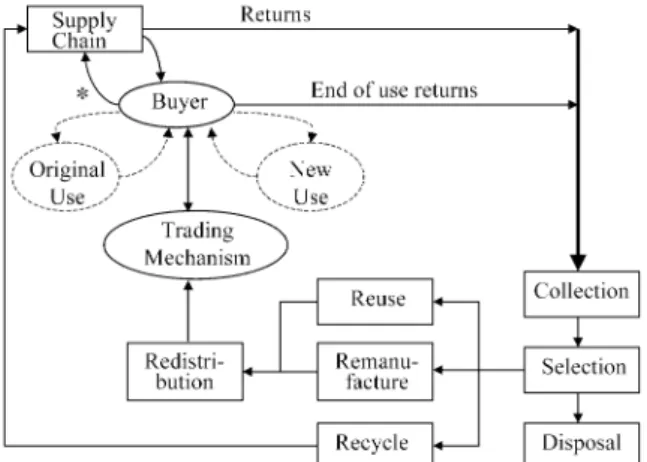
Figure 1 A closed-loop supply chain
Figure 1 illustrates a reverse logistics network. Regardless of the channel used to bring the products in market, the majority of products are used in their original functionality; i.e. a company buys a state of the art computer for their virtual reality project. After a while, the product is not useful to the original user. The product is then traded in a marked down price once or several times. In Figure 1, this is denoted by the loop between “original use” and “trading mechanism”. It is worth to point out that through the repetitive changes of ownership, the product is still used in its original functionality. In our example, the computer might be bought for personal use or for enter-tainment, before it actually reaches the end-of-use return flow. As the main idea for reverse logistics is to promote and support alternative uses for the product, we could apply this principle in our example and have the computer’s keyboard directly re-used, its motherboard remanufactured in an electronic toy, whereas other parts (i.e. casing) can be recycled.
With the new or old functionality the product (or parts of it) enters the market again where it may also go through several trading cycles. This concept is denoted by the closed-loop between “other use” and “trading mechanism” in Figure 1. Certainly, at some future point in time, the product will reach again the end-of-use return in the reverse logistics network.
Companies and other stakeholders have been discovering used products as a valuable resource. The initial theory of six computers covering all the needs of the world has been overthrown years ago. ICT products are found in abundance with their life-cycles ending as new products and innovations
come into place continuously leading to an increased need of reverse logistics applications. End-of-life products such as mobile phones computers and peri-pherals contain toxic substances such as bromide, mercury, and lead that are hazardous to the environment. Thus, throwing away these products in various garbage collector grounds is not a feasible solution as most of these scrapped ICT products can be recycled or remanufactured or sold to other markets to recapture value and avoid endangering the environment further.
The economic and environmental benefits from recycling have trans-formed reverse logistics into a vital strategic matter. In recent years, reverse logistics popularity has been fueled both by accelerating environmental con-cern and strong financial incentives. The environmental sensitivity is so high in certain EU countries, like Germany and the Netherlands that it has already matured into specific legislation acts, also called “producer responsibility laws”. These legislation acts require from manufactures to collect and reuse their products at the end of their life cycle in an environmental friendly way. In the USA, the driving power for reverse logistics is associated with the real-ization of the potential value that can be regained from reusing products, parts or materials. Daniel et al. [3] stated that the EU has been mainly concerned with the end-of-life take back regulation (e.g., Waste Electronics and Elec-trical Equipment Directive, WEEE) and environmental consciousness. The US, on the other hand, has shown little inclination to adopt legislation since the remanufacturing industry is well-established and financially attractive. Its development was driven by profitability rather than environmental concerns. The WEEE mandates recycling rather than value-added recovery and this has actually been a deterrent to the growth of remanufacturing in the EU. This may have been a difference between the EU and US which is diminishing. The Electronic Waste Company, established in Cornwall in 2007, remanufac-tures up to 1,000 tonnes of waste electrical and electronic equipment a year. The business took off after the introduction of the European Waste Electrical and Equipment Directive, the objective of which is to increase the recycling and/or re-use of such electrical products. Each remanufactured PC contributes to saving the 240 kg of fossil fuels, 22 kg of chemicals and 1500 litres of water which the UN estimates is required to make a new computer. The company manages every aspect of electronic and electrical waste, from collection and data-scrubbing to a full WEEE Compliance service and integrated supply chain solutions [16]. ICT distribution company Zycko offers fully refurbished networking products for up to 90% less cost than the normal list price. The company is currently assisting many recession-hit companies, who lack the budget for new hardware, to obtain high quality business equipment. In
ad-dition to offering savings of 60–90%, each item is subjected to a rigorous 28-point check, and is also covered by Zycko’s standard 12-month warranty [17].
3 The EU Legislation
WEEE has been identified as a very important domain which required spe-cific measures and regulations at the European Union (EU) level. The EU legislation restricting the use of hazardous substances in electrical and elec-tronic equipment (Directive 2002/95/EC) [19] and promoting the collection and recycling of such equipment (Directive 2002/96/EC) [20] on Waste Electrical and Electronic Equipment (WEEE) has been in force since Feb-ruary 2003. The legislation provides for the creation of collection schemes where consumers return their used e-waste free of charge. The objective of these schemes is to increase the recycling and/or re-use of such products. It also requires heavy metals such as lead, mercury, cadmium, and hexavalent chromium and flame retardants such as polybrominated biphenyls (PBB) or polybrominated diphenyl ethers (PBDE) to be substituted by safer alternat-ives. The core mechanism the WEEE Directive is the principle of producer responsibility. Even though the Directive is addressed to Member States, it is the producers or third parties acting on their behalf that are responsible for collection, treatment, recovery and environmental disposal [5]. The manufac-turers are required to collect and reuse their products at the end of their life cycle in an environmental friendly way.
In December 2008, the European Commission proposed to revise the directives on electrical and electronic equipment in order to tackle the fast increasing waste stream of such products. The aim is to increase the amount of e-waste that is appropriately treated and to reduce the volume that goes to disposal. The proposals also aim to reduce administrative burdens and ensure coherency with newer policies and legislation covering, for example, chemicals and the new legislative framework for the marketing of products in the EU.
The EU states concentrate on transposing the WEEE 2002/96/EC Direct-ive into their regulations. Emphasis is gDirect-iven among others on the following [8]:
• the prevention of WEEE waste generation by re-use, recovery and recycling,
• improving the environmental performance of all operators involved in the life cycle of electrical/electronic equipment,
• encouraging the design and production of electrical and electronic equipment which take into account and facilitate dismantling and recovery,
• creating waste collection/sorting and recycling systems,
• promoting the “polluters pay” principle and “producers responsibility”, and
• promoting environmental awareness.
4 Methodology
For this research, the inductive approach was adopted with the aim to in-vestigate the existing reverse logistic networks in Cyprus. The population for the research includes the major stakeholders in reverse logistics related to ICT in Cyprus. With respect to research design, the three principal ways of conducting exploratory research as described by Saunders et al. [12], were employed; namely, literature review, interviewing experts in the subjects and conducting focus group interviews. The following secondary data sources have been employed:
• Paper-based sources like books, journals, research reports and annual reports.
• Electronic libraries including ACM, AIS, Emerald Management Xtra and Sage Publishing.
• The University of Nicosia library online databases and e-books.
• Ministry of Ministry of Agriculture, Natural Resources and Environ-ment reports on waste.
• Green Dot – Cyprus records.
• European Union (Community) legislation records.
The implementation of this research was divided into three phases, outlined as follows:
• During the introductory phase, several meetings took place for discus-sion with the officers of the involved organizations on the conditions of the study. At this stage the main issues including all available data and all actions necessary for the successful implementation of the study were identified.
• Based on the study aims and objectives, a questionnaire was initially prepared, pilot tested and revised driven by issues related to research
methodology and validation methods. Several changes were proposed so as to prepare an easy to fill questionnaire by the representatives (presidents) of the community councils.
• Interviews were conducted with representatives of organizations in-volved in ICT reverse logistics aiming to address various issues. During interviews with stakeholders, attempts were made for the identification of Cyprus specific issues on ICT reverse logistics, their positions and views on adequacy of infrastructure, organization and awareness of the population, as well as estimates regarding the volume and condition of returned ICT goods, suggestions for the improvement of the reverse lo-gistics network as well as any particular problems that are particular to Cyprus due to its geographical location and geopolitical status.
5 Closed-Loop Supply Chains and ICT in Cyprus
Cyprus is the third largest island in the Mediterranean after Sicily and Sardinia with an area of 9,251 km2, situated at the north-eastern end of the East Mediterranean basin. Its estimated population (est. September 2009) is 796.8 thousands. The area of the Republic of Cyprus under government con-trol has a market economy dominated by the service sector, which accounts for 78% of GDP. As mentioned in Section 1, the Republic of Cyprus has de juris sovereignity over the whole island but de facto has no control over the northern part, as it is occupied by Turkey. As a result, the challenges faced by governmental and private organizations involved in the reverse logistics supply chain are even greater.
As a result of globalization and the accession of Cyprus to the European Union, on May 1, 2004, new conditions were created which dictate appro-priate orientation of development in the ICT sector. Technological progress, especially in the sector of communications, and the development of the In-ternet creates the infrastructure for the expansion of entrepreneurial activities beyond the traditional geographical boundaries.
The Cyprus legislation on waste management and special management of packaging waste was prepared based on relevant European legislation and dir-ectives and implemented in 2002. It is obligatory, by law, that every company which puts on the market packaged goods to collect back the packaging and recycle it. It was not, however, put into force till late 2009 with the formation of Green Dot. As instructed by the WEEE Directive, Member States are to adopt appropriate measures in order to minimize the disposal of WEEE. The Directive requires Member States to create systems allowing final holders
and distributors to return WEEE free of charge. Cyprus, being subject to the WEEE Directive places responsibility for the disposal of e-waste on the producer. According to the EU Directives enforceable laws, regulations and directives to motivate organizations follow them have been placed. Thus, Green Dot was formed. Green Dot is a non-profit organization which under-takes to collect the packages from manufacturers. This is allowed by law and is called “collective system”. The charge is based on packaging material and the quantity put on the market. Even though Article 4 of the WEEE Directive calls upon the Member States to encourage the design and production of e-waste taking into account and facilitate dismantling and recovery, in par-ticular the reuse and recycling of WEEE, their components and materials, Cyprus has not taken such measures as there is no ICT manufacturing [5].
The majority of the industry in Cyprus follows the Green Dot collective system as it is the only Collective legal entity in Cyprus. It offers Companies, based on a fee, to settle their recovery and recycling obligations. The Green Dot Cyprus is a member of the big global family of collective management of packaging, the Packaging Recovery Organization, Europe (PRO – EUROPE) [18], which now houses under the umbrella of the 26 relevant organizations from Europe and America. Companies that are no member of Green Dot may follow an independent system, being still subject to the same regulations.
Cyprus Strategic Plan for the management of waste led to the establish-ment of four regional centers for integrated manageestablish-ment of solid waste as well as the restoration of existing uncontrolled landfills. The first regional centers, in Larnaca and Famagusta Districts became operational in 2010. Based on the report prepared by the Ministry of Agriculture, Natural Re-sources and Environment [4] for 2008 and delivered in August of 2010, there is no data on e-waste. The categories described in the report concern paper, plastic, metals, glass, wood, mixed and other with the total number of tonnes being collected reaching approximately 87,466. The “other” category reaches 4606 tonnes and we assumed that part of it is the e-waste collected for 2008. While interviewing the Green Dot representative, it was clarified that e-waste was not collected in 2008 and it amounted to 150 tonnes in 2009. However, this is not a good indicator for the expected yearly e-waste. Rather, it in-cluded a one-off return of obsolete ICT equipment previously owned by the government of the Republic of Cyprus.
In addition, economic support (i.e. in the form of tax waives) could further promote practices related to reverse logistics. Public awareness of environmental protection is improving continuously. The Government has released campaigns to promote this problem to people. Several organizations
responded to this by applying green principles to their company, such as using environmental friendly raw material, reducing the usage of petroleum power, and using the recycle papers for packaging. The green principles were expanded to many departments within organizations. Green supply chain management (GSCM) was emerging in the last few years. This idea covers every stage in manufacturing from the first to the last stage of life cycle, i.e. from product design to recycle. Not only manufacturing, but GSCM can also be used to other business sectors such as government, education and services. In Cyprus, the major challenge for closed-loop supply chain management in ICT is the existence of an illegal network of actors who intercept the col-lection points and take the collected e-waste It is speculated that they sell it into black or gray markets or retrieve reusable parts of raw materials through unlicensed sites and uncontrolled processes. The whole operation cannot be easily identified due to the division of the island. This illegal trade of e-waste ends up in countries such as Nigeria, Ghana, Pakistan or India which are being used as e-waste dumping grounds [6]. It has been documented that workers, in many cases children, are forced to work breaking apart the ICT devices being exposed to highly toxic chemicals, such as mercury, lead, and cadmium, which cause severe health problems, in addition to environmental overheads.
The underdevelopment of recycling technologies within the country is also one of the major obstacles to widespread reverse logistics implementa-tion. Reverse logistics are driven by several forces like competition motives, economic ones and environmental concerns. The emerging information tech-nologies may provide future opportunities to add value to recovered materials and to support the recovery process. Payaro [10] proposes a solution with a radio frequency tag (RFID) to assist in the recovery process of electronic devices. Product traceability may be implemented through the RFID techno-logy. In order to achieve that, modifications might be required to the reverse logistics information systems, as a unique central database will be required to collect the products code and the technical characteristics. At end-of-life the product will be recovered to a Collection and Sorting Center, where the RFID tag would be read and the necessary updates and data collection for its recovery process is made.
The findings suggest despite the potential profitability and the existing le-gislative requirements, there are no integrated decision frameworks to advise decision-makers about the economic viability of various reuse options. On the other hand, this has also created a window of opportunity for new business models, which employed e-commerce as a revolutionary decision-support
means. Customers inheriting knowledge and increasing involvement into value creation processes provided a self-regulatory framework that enables selection and evaluation of used products and the development of new pros-perous markets for promoting what was originally conceived in the fringes of traditional trade.
6 Conclusions
E-waste is a new term claimed by the market of hazardous substances. Proper e-waste management – from efficient sourcing and collection right up to ex-traction and disposal of materials – has ensured that this huge pile of junk turns into a lucrative business opportunity. The continuous evolvement of ICT is leading to ICT products become obsolete at an accelerating rate. The challenges faced in e-waste management include the necessary infrastructure for waste management, the appropriate legislation dealing specifically with e-waste, a reverse logistics framework for dealing with the end-of-life product cycle. The problems regarding the safe transportation, handling and disposal of e-waste have to be embarked upon avoiding the illegal trade of electrical and electronic waste to non-EU countries that continues to be a major issue at EU borders. In this paper, we outlined a roadmap of existing closed-loop supply chains in Cyprus and identified best practices and challenges. It is the first step towards implementing specific actions that address these issues and resolve the problem. It appears that RFID technology may be utilized to tackle the problem of illegal activities in collecting end-of-use ICT products. Further research will concentrate on the external factors affecting reverse logistics implementation within the country and the potential of a technical solution for tracking e-wasted and its proper handling. It would also be inter-esting to explore how social networking and other web 2.0 technologies may be used as tools for promoting awareness and practices.
References
[1] F.T.S. Chan and H.K. Chan. A survey on reverse logistics system of mobile phone industry in Hong Kong. Management Decision, 46(5):702–708, 2008.
[2] CIA Fact Book, https://www.cia.gov/library/publications/the-world-factbook/index.html (accessed November 2010).
[3] V. Daniel, R. Guide Jr. and N. Van Wassenhove. Response to commentary on “The evolution of closed loop supply chain research”. Operations Research (Online Forum Commentary), 57(1), January–February 2009.
[4] Appropriate description of the data used according to the Article 1 of Commission Decision 2005/270/EC on packaging waste, Department of Environment, Ministry of Agriculture, Natural Resources and Environment, 9 August 2010.
[5] ECO-Logic, A report on the implementation of Directive 2002/96/EC on Waste Elec-trical and Electronic Equipment (WEEE), Institute for European Environmental Policy, April 2009.
[6] Greenpeace International, Undercover operation exposes illegal dumping of e-waste in Nigeria, http://www.greenpeace.org/international/en/news/features/e-e-waste- http://www.greenpeace.org/international/en/news/features/e-waste-nigeria180209/ (accessed November 2010).
[7] S.E. Khiewnavawongsa and K. Schmidt. Green power to the supply chain, Indus-trial Technology, http://www.tech.purdue.edu/it/GreenSupplyChainManagement.cfm (accessed November 2010).
[8] G. Kirkos. Greek Cypriot community recycling profile, http://www.undp-act.org/ data/articles/presentation recycling gcc%20recycling%20profile.pdf (accessed Novem-ber 2010).
[9] X. Li and F. Olorunniwo. An exploration of reverse logistics practices in three compan-ies. Supply Chain Management: An International Journal, 13(5):381–386, 2008. [10] A. Payaro. The role of ICT in the reverse logistics. A hypothesis of RFID implementation
to manage the recovery process. In Proceedings of e-Challenges, Vienna, 2004. [11] RevLog, The European Working group on Reverse Logistics, http://www.fbk.eur.nl/
Z/REVLOG/Introduction.htm (Accessed November 2010).
[12] M. Saunders, P. Lewis and A. Thornhill. Research Methods for Business Students, Pearson Prentice Hall, Essex, 2007.
[13] S. Srivastava. Green supply-chain management: A state-of-the-art literature review.
International Journal of Management Reviews, 9(1):53–80, 2007.
[14] S.K. Srivastava. Network design for reverse logistics, Omega, 36(4):535–548, 2008. [15] M.C. Thierry, M. Salomon, J. Van Nunen and L. Van Wassenhove. Strategic issues in
product recovery management. California Management Review, 37(2):114–135, 1995. [16] Web1, http://www.electronicwastecompany.com (accessed November 2010).
[17] Web2, http://www.themanufacturer.com/uk/content/10118/Regeneration through remanufacture (accessed November 2010).
[18] Web3, http://www.pro-e.org/ (accessed November 2010).
[19] Web4, http://eur-lex.europa.eu/LexUriServ/LexUriServ.do?uri=OJ:L:2003:037:0019: 0023:en:PDF (accessed December 2010).
[20] Web5, http://eur-lex.europa.eu/LexUriServ/LexUriServ.do?uri=OJ:L:2003:037:0024: 0038:en:PDF (accessed December 2010).
Biographies
Soulla Louca received her Ph.D. in Computer Science in 1994 from Illinois Institute of Technology in Chicago. Prior to that, she had received a B.A in Computer Science and Mathematics, and a M.Sc. in Computer Science from Kalamazoo College, and Western Michigan University respectively. She has participated and coordinated numerous projects including NSF,
European, and local (RPF) research programs and has served as a reviewer for various international conferences/journals as well as an IST expert for the European Commission. Her research interests include socio-economic aspects of Green ICT, e-learning, social integration and digital divide and e-business. Since June 2008, she is the Chair of the Domain Committee for Information Communication Technologies for the European program COST (Co-operation for Science and Technology, www.cost.eu).
Angelika Kokkinaki’s research interests include inter- and intra-organizational information systems. She has worked as researcher and lec-turer in USA, UK and the Netherlands. She has participated in many national and EU funded programs and has published extensively. She has received her Ph.D. in Computer Science from University of Louisiana at Lafayette (ULL), Lafayette, LA, USA, in 1995, her M.Sc. in Computer Science from Northeastern University, Boston, MA, USA in 1991 and a 5-year curriculum Diploma in Computer Engineering and Informatics from Patras University in 1987. She is a Chartered Engineer (Technical Chamber of Greece, 1987), an accredited Project Manager (MIT Professional Programs, 1998) and a founding member and president of the Local Chapter of AIS-Cyprus.