Analysis of processes of cooperation and
knowledge sharing in a community of practice with
a diversity of actors
Diane-Gabrielle Tremblay and Valéry Psyché
Abstract. According to some literature, communities of practice should normally stem from a voluntary initiative within an organization, whose members share some knowledge or expertise they wish to improve. However, over time, we have seen that communities tend to be created within organizations, in order to attain objectives of learning and knowledge development. This represents a challenge in the context of a community of practice taking the form of a research network in partnership that brings together members with common interests certainly, but spread out in different organizations and even several countries in which they perform different types of work. Also, the community does not exist in a vacuum and the explanation for what happens within it does not lie solely within the way the group interacts; indeed the individuals are part of different organizations and thus have different priorities, in relation with these affiliations. In this context, our research objective was to determine the factors that facilitate or hinder cooperation within a community of practice composed by two groups of actors, community and university actors. We thus found that individuals’ different work affiliations might not facilitate the work within the CoP and that ICT/web 2.0 tools are not always a solution to increase participation in a CoP. Although participants are somewhat familiar with the tools, they mostly seem content with receiving and accessing information, not searching for a more active participation. Some explications and solutions will be proposed.
Keywords: community of practice, collaborative research, cooperation, knowledge sharing, time, trust.
1.
Introduction
Sustained participation among members is a major challenge for many research projects in partnership, since many of them have the goal not only to perform research projects, but to achieve them in collaboration and support exchanges among the organizations represented (academic, community, or other as appropriate).
This paper presents our observations on the evolution of a community of practice (CoP) created to share knowledge within a research program in partnership, through the use of web 2.0 tools (website, blog, newsletter, RSS feed, etc.) developed with and for members of this network to promote the collaboration between them. The research aimed to identify the challenges and difficulties in knowledge-sharing. If communities of practice are more often described and considered as spontaneous phenomena, more recently, many firms and organizations have wanted to create Communities of practice (CoPs) altogether, from scratch, in order to foster learning and knowledge exchanges in various contexts. We thus decided to observe a network of collaborative research which was created with a view to develop research exchanges and partnerships, from the perspective of a community of practice. We will show that it is not as easy as the literature seems to indicate to create a CoP in a research partnership context. The fact that members come from different organizations, are not as strongly bound by the same objectives, and need time to build trust between them explains the difficulties in creating a CoP. Also, while many participants say they feel committed to the CoP, they do not participate as actively as could be expected, in information and knowledge sharing, given this commitment to the CoP. This time element and the distinction between commitment and active participation in the CoP do not appear to have been put forward in previous literature and this would be important to take into account in future endeavors to create active, engaged CoPs in various work environments. Some explications and solutions will be proposed.
To start, we present the context of this research; then we expose our research questions. In a second part, we will report on theoretical aspects. We then present our methodology, our results and, finally, we discuss the elements that we can learn from this analysis in view of the literature on communities of practice. We will highlight a few elements which, in our view, have been previously neglected, especially in a context of analysis of more spontaneous CoPs, and which need to be taken into account today, when we study CoPs in various contexts, but especially when one wants to create a CoP.
2.
Research Context and questions
2.1. The domain
practice with a diversity of actors issues). The network of partners brings together researchers, business people, community associations, trade unions, sectoral committees essentially, and is targeted to conduct joint research, but also to share research findings and other information or knowledge developed by its members. The research partnership also aims to create learning resources, tools, as well as to foster knowledge transfer and information exchange between community partners (as they are called in the project) and university researchers.
2.2. The Community
The governance structure of the research network consists of several clusters (5) of thematic research partnerships co-chaired by a member of each, a community investigator and a university researcher, to ensure equal representation of both communities in the governance bodies. The community researchers are usually persons who are responsible for research or socio-economic issues within their organization (association, union, etc.). They have worked on research projects, and are thus familiar with research issues, but do not work in the same context and do not have exactly the same objectives in research (knowledge and publication for university researchers, more knowledge and action for community actors, even if all are interested in some form of publication and action. The clusters meet at will to discuss research issues and to develop research projects and propose activities to the advisory committee. The advisory committee brings together the chairs of the sub-groups and the director of the research partnership, that is 11 persons for the decisions and discussions on research projects, but also on the roles and responsibilities of each in projects, on knowledge tools and all elements of the project.
Management and collaboration are supposed to flow freely, based on the clusters’ activity and ideas. Over two years, there were over fifteen meetings between the members – often within specific clusters or sub-groups. There were also 3 large conferences, and some 8 symposia and meetings open to all since the beginning, but at the time of the research, only 2 conferences had been held, one was in planning, and 4 symposia or meetings had been held.
The equal treatment of partners from the community and from university in the conduct of research is, in principle at least, ensured by the joint management of projects, and meetings involving at least one community partner and a university researcher, in addition to at least one student to conduct the research. This pattern is designed to foster a sense of belonging among members and develop direct cooperation between them on specific issues and research projects.
for new partners (2 community groups and 2 researchers) they have been submitted to the Executive for approval.
A person is responsible for coordinating exchanges between all members, keeping track of activities and emails. Another person has devoted at least the equivalent of a part-time to the implementation of a website, which includes a blog, to facilitate direct knowledge exchanges between members. Also, members are encouraged to provide information or documents they wish to upload on this site to share with others, and websites of the members are also present on the site, so that members can get to know each other’s activities better.
2.3. The practice
The objective of this CoP is for community and academic researchers to exchange information, to learn from each other and to develop skills and practices of collaborative research as a result of their participation in this research network. It is also that they develop collaborations even outside of the projects and research discussed in the network for other activities (conferences, research) or on other topics that they may find they have a common interest in.
Collaborative working and knowledge sharing1 (as well as see [1]) already exists among several community and academic researchers, since a number have worked together for many years, but this is more the case between university researchers from different universities, or bilateral relations between one professor and one community group in previous research. Some researchers also collaborated in teams of two or three for about four years. These researchers collaborate essentially by peer-to-peer emails, and were not very familiar with blogs or other formats. However, the research network has developed new tools for exchange and sharing on the web, to promote exchange and dissemination of knowledge on a wider scale, and give access to exchanges to all members. Notably, there is a website which can receive information and documents from the members (news section, PowerPoint and videos from conferences, documents, research notes, etc.) but also a blog which should favors interactive collaboration between partners and researchers. This was planned to enable members to exchange information and just allow anyone (even non-members) to have access to the web and send in information. Joint development of knowledge, as well as knowledge
1 Which can be defined as is an activity through which knowledge (that is information, skills, or expertise) is exchanged among people, such as members of a department, an organization or another type of group.
practice with a diversity of actors sharing between partners and researchers was thought to happen in the way it is presented in CoP literature, through spontaneous exchanges and learning, with the collaborative tools developed for the project.
Most academic researchers and the community actors present here have had relatively extensive experience with collaborative research and many knew at least one tool for sharing knowledge other than email. The challenge for everyone, especially those of the community sector, associations and unions, appears to be to find time to attend meetings and to participate in exchanges, as we will see further on. The network has sometimes had to split the meetings to discuss issues with everyone concerned, and thus the interest in developing new forms and tools for collaboration is high in this case, as in many other partnerships where learning and exchanging knowledge are the objective.
3.
Research Problem
While communities of practice are generally viewed as being spontaneous groupings of people, many recent initiatives have been derived from an intentional initiative; indeed, over the years, more and more studies in management and education deal with the creation of communities of practice that can be described as intentional [2], but still, the literature tends to indicate that knowledge sharing is quite spontaneous, which is something we wanted to look into in more detail. How and why does this happen or not?
A “classical” or spontaneous community of practice [3] should actually come from a voluntary initiative within an organization, whose members share some knowledge or expertise they want to improve. Although the CoP studied here expected to see relatively spontaneous knowledge exchanges, once the tools were in place (website and blog) this was not the case.. We also find relevant interest in the conditions under which there is or there is no participation leading to the reification of activities for collaborative research partnerships and learning in this context [4, 5].
This objective of co-construction of knowledge2 through exchanges with peers is obviously a challenge. While bringing together members with common interests in a given social issue was expected to spontaneously
2 Which can be defined as the development knowledge within a group,
foster knowledge exchanges, this did not happen as expected. We therefore set out to understand why the common interest in the issue did not suffice to foster active exchanges on the blog and important contributions in terms of information and documents to be put on the website. As we will see further on, people coming from different organizations (unions, companies, associations, public administrations, etc.) have other commitments, they assume different functions and are often busy elsewhere. This represents a great challenge for research in partnership and collaborative exchanges to be developed, while at the same time it is often said that the diversity of actors participating in a community make it more creative and innovative [6].
In this particular case, we had thought that the fact that people were spread out in several countries on two continents (Canada, France, Belgium, Sweden, etc.) would to a certain extent force them to use the web and blog to exchange information easily, while CoPs within an organization often find that people don’t use the digital tools put at their disposal and continue meeting in the corridors to exchange information [7], thus limiting the exchanges to a more limited number and also making it difficult to trace the knowledge exchanges and learning that do occur. While the international distribution of members (although the majority are in Montreal and second, in Ottawa, Canada) had been expected to foster more activity on the blog, this was not the case. In principle, strategies, tools, innovative technologies of the social web can promote and facilitate exchanges of information and documents, as well as collaboration among members. Given that this was not the case, we decided to try to understand the reasons that made it difficult to foster knowledge sharing within this community.
The research was thus designed to determine the factors that facilitate or hinder cooperation within a community of practice, provided that the bulk of publications on communities of practice focus on successful communities and very few try to explain why things work or don’t work in terms of the knowledge exchanges and learning. It therefore appeared necessary to identify the obstacles to collaboration in the context of this emerging community of practice in order to identify factors that may be a source of mobilization and commitment of the actors, or otherwise encourage more active participation. This research should help better understand the actual dynamics of communities of practice, and the factors that favor or hinder knowledge exchanges and learning. This is a form of action-research [8-10] and one that involves actors from different environments who have much to learn from each other. Although this does present some challenges, it is not uncommon since it is in such a context that new information can be acquired and learning can occur [8].
practice with a diversity of actors since it seems this issue is rather new on the agenda, now that we are looking more and more at intentional communities, and not at CoPs that appeared spontaneously, as was the center of interest for many years (and still is) in research on CoPs.
4.
Theoretical framework
The basic definition of a community of practice is as follows: Communities of practice are groups of people who share a passion for something they already do or practice and who interact regularly to learn how to improve this practice [11].
4.1. Communities of Practice: Definitions
Coined by [12], the term community of practice refers to a group of people with a common area of expertise or professional practice, and who meet to exchange, share and learn from each other, face to face or virtually [3]. The group usually evolves naturally due to the common interest of members in a particular area, but there is more and more interest recently in CoPs that can be created specifically for the purpose of acquiring and exchanging knowledge related to a given field. What has been called the intentional [7] creation of communities is becoming more common in various organizations and more open environments as well.
The members of the CoP are usually bound by a common interest in a field of knowledge (...) a desire and a need to share problems, experiences, models, tools and best practices [13]. It is through the process of sharing information and experiences with the community that members learn from each other, and have the opportunity to grow personally and professionally [12].
Note that communities of practice are different from teamwork on several points. Thus, in principle, teams are generally defined by the results they must deliver, while communities rarely have a specific outcome to provide to the organization. Similarly, in principle, the team members are bound by a given objective; while those of a community are united by the knowledge they share and develop together. In operational terms, communities, unlike teams, rarely have a defined work plan [15]. After reaching their goals, the teams would normally disintegrate, whereas communities of practice are created to last, continuing to develop skills and knowledge over time.
In practice, however, boundaries are sometimes blurred between these two organizational forms that are the teams and communities of practice [15-18].
Also, the development of any community is obviously influenced by its environment, and the past of the sponsoring organization (a form of path dependency), but it can also be influenced by the cultural, economic and political environment in which it is embedded, the environment being more or less favorable to its development [11]. The degree of recognition of the work done within the CoP by each organization may also influence its development, as well as financial, material and human resources available to it, especially as regards the animation resource, more often put forward now, in the context of intentional CoPs.
4.2. Communities of practice and learning
According to [19], learning is a function of the activity, context and culture in which it occurs. It is "located" as opposed to learning based on presential activities, in classrooms, where knowledge is often abstract and out of context.
For [12], learning is acquiring knowledge in a social setting, in situations of co-participation or joint venturing. Social interaction and collaboration are two key components of situated learning, engaging learners in a community of practice, which embodies certain beliefs and behaviors to be acquired [20]. Literature indicates that as the beginner or new participants move from the periphery of the community to its center, they become more active and engaged in community culture, and indeed more likely to assume the role of expert or “knowledgeable person” in the CoP. These ideas are what [12] call the process of “legitimate peripheral participation”.
practice with a diversity of actors
4.3. Factors of success of communities of practice
It is difficult to find in the literature a clear definition of a successful community of practice (CoP), let alone a virtual community of practice (VCoP), operating remotely, using technologies. In most cases, the CoP seeks to share knowledge within an organization or network of organizations [7], and success is usually evaluated based on the achievement of this knowledge-sharing objective. Some authors also consider a community of practice is successful when it achieves the objectives it sets itself, whatever the nature of these objectives [22].
In various studies, we found a few indicators of success: the achievement of various goals, member satisfaction, interest in continued participation in a CoP, as well as various forms of knowledge sharing [6, 21].
Among the factors that contribute to success, we can also mention individual attitudes towards other members of the community (their social presence, motivation, collaborative culture ...), and their common interest (common goals, shared practice in the community ...), [21, 23-28].
Communicating with others in a CoP is to create a social presence. [27] defines social presence as “the degree of salience of another person in an interaction and the consequent salience of an interpersonal relationship" (p. 38). Social presence would affect the likelihood that an individual will participate in a CoP, especially if it is virtual [27].
The motivation to share knowledge is essential to success in communities of practice. They are even more active if they have a return on investment. This "return" can be tangible (promotion, bonus ...), intangible (reputation enhancement, increased self-esteem ...) or of interest to the community (exchange of best practices related to knowledge, interaction and common goal). Members are encouraged to become active participants in a CoP when they consider that the information has meaning for the public good and represents a moral obligation or a collective interest [23]. Collaboration is essential to ensure that communities of practice develop. This is a key success factor identified in the literature, especially in places where the level of education is high and among the more experienced members [26]. Among the factors limiting the success of CoPs, obstacles such as ego, personal attacks, or time constraints have been identified as possibly preventing participants from engaging in knowledge sharing [28].
4.4. Factors for developing successful communities of practice?
rhythm for the community. We are particularly interested in the last five points, which inspired us in our research project, including an attempt to develop partnership and sense of belonging to the CoP.
These elements presented by [29] and the literature presented above lead us to think that it is actually quite easy to get people engaged in a community and in its exchanges and learning activities. However, it seems the literature on CoPs presents a somewhat idealized view of the way such groups function. It seems to often ignore or underplay the role of exogenous factors such as external power or work relationships, the fact that people belong to organizations who impose constraints on their time and activities and cannot necessarily be as active as they might like in the CoP. In this article, we want to take into account this dimension, which has been highlighted in recent work [30], but is not often put forward. Indeed, communities do not exist in a vacuum and the explanation for what happens within them does not lie solely within the way the group interacts3. The community we studied is composed of many members coming from a variety of organizations, which should theoretically lead to richer knowledge sharingfor the participants, although it may present challenges. Which factors play a role? This is the main question we will address here.
5.
Research Methodology: a participatory
design
approach
Our research project therefore aims to identify the factors that can explain the degree of knowledge sharing within a CoP. We selected a methodology that would: (1) take into account the particularity of the research partnership (based on participation of researchers and practitioners), (2) contribute to the emergence of conditions conducive to learning from the perspective of a community of practice, (3) through the design of tools adapted to the practice of research partnerships.
It is of course simplistic to equate the process of emergence or creation of a community of practice to a process of design tools, be they technological, and social. However, collaboration and knowledge sharing cannot be done without support of technological tools, especially when community members are in different places and organizations [31].
The participatory design is an approach derived from the participatory action research [32]. This approach is defined as an iterative process of negotiation between a diversity of actors - different from each other in terms of their disciplines, their concerns and interests - in order to effectively influence the design process [31]. This flexible approach does apply to our configuration of actors that includes a multidisciplinary group composed of researchers
practice with a diversity of actors involved in the study (from universities and enterprises), designers and developers. In this configuration, the role of 'participatory' designers is a role of facilitators whose goal is to give control to users (researchers) so they can make their own decisions [33], while facilitating effective participation in the design process. This role was held by a post-doc student hired specifically to work on the development of the CoP and to analyze its functioning and results.
The Participatory Action Research (PAR) can be used to define a methodology that promotes the effective participation of diverse actors in the design process. Effective participation, the one that really influences the design process must be organized around participatory activities (debate of ideas, prototype demonstration, role play, etc.) leading to the production of boundary objects [34, 35]. These objects "to-think-with" (model, scenario, cases, etc.) facilitate mutual understanding and trust among participants from various backgrounds. The idea of boundary object is closely linked to that of reification which, in shaping the experience of participants, produces objects and thereby tends to create points of interest around which the negotiation of meaning is organized” [11]. Thus, reification is an indispensable collective anchor to sharing and capitalization of knowledge [36].
While respecting the cycle of PAR methodology, we relied on three phases of participatory design: (1) Exploration and discovery (requirements definition, storyboarding), (2) Prototyping (modeling, testing and experimentation), and (3) Evaluation (dissemination of results in a format understandable by the participants). This methodological approach has resulted in several participatory discussions, demonstrations, and documentation. In what follows, we present some of the techniques used in all three phases.
5.1. Exploration and discovery
This first phase of the methodology aimed to capture needs. It has allowed us to identify quickly the services of potential interest for the participants. Among the techniques and tools used for exploration, we have: observation, online questionnaires, paper questionnaires, debates, interviews and scenarios of collaborative practices, research in partnership.
Storyboards (of collaboration in research partnership) have been made. They come from the data collected and were used later as inputs for the phase 2.
In addition, the participants discussed their needs for socio-technical tools for research collaboration. This debate was guided by facilitators with a questionnaire.
Questionnaires and scenarios
We distributed three questionnaires during the first year of the network. The first data collection was carried out during the launch of the research network in June 2009. It focused on community needs in terms of tools and technologies. We distributed paper versions of the questionnaire, called Q1, in the conference room, at the first meeting of the network where most members were present. There was tracking and follow-up throughout the two days to recover a maximum of responses.
The second data collection was performed immediately after a meeting of the advisory committee in February 2010. It focused on how members situate themselves towards the others. To perform this, we sent an email and referred people to an online questionnaire (GoogleDocs technology) called Q2. Not having received many responses (5 responses), we then returned the questionnaire by mail as a word attachment. We only got two new answers.
The third data collection was done two months later, in April 2010. It focused on patterns of collaboration among members within the research network and also in their organization. Based on the experience of Q2, we sent an electronic version, called Q3, directly to members via email. The response rate was the lowest of the three cases because of the subject, perhaps, or lack of time or the fatigue of responding to questionnaires.
Scenarios of practices of collaborative research partnership were then designed. They were based on the data collected and were used as inputs for the next phase.
5.2. Prototyping and design tools
practice with a diversity of actors
5.3. Assessment
This last phase was of great importance in our study, as it was here that we took action to document and analyze the practice of collaboration. These steps are: the follow-up by validation and the assessment of participants' thinking about their collaborative activities.
Follow-up by semi-structured interviews on the practice of collaboration In making this assessment and the qualitative part of the research, we targeted a small group of members (among the most active in the network), and we contacted them by telephone for interviews. Out of twenty-three members contacted, we had ten responses, eight positive responses, that is to say people who agreed to answer our questions. Finally, we conducted semi-structured interviews, most of which with "community partners", which is good since these are the most difficult to get actively involved in the CoP. The interviews were conducted in July-August 2010.
The objective was to monitor the main modes of participation in the CoP, by gathering information on participation and motivations for participation or for less active involvement.
The interviews were semi-structured. The questions were open and based on some previous work done on this theme by the Cefrio research center, which has developed expertise in this field [2, 7]. We discussed the themes of participation, communication, dissemination and knowledge sharing, achievement of goals within the CoP, members’ satisfaction and interest to continue
Questions related again to mode and frequency of participation, use of technologies and feeling of comfort, but also developed more extensively on motives for participating actively or not, achievement of goals within the CoP, members’ satisfaction and interest to continue.
Data processing for the analysis of interviews
Our method of data processing for the interviews is qualitative, based on a thematic analysis, and without community involvement in the analysis. To help us with the analysis, we used a statistical tool, Google Analytics, which is connected to the website and blog. Google Analytics tells us, among other things, the extent of use of the site, the origin of visitors, pages viewed, etc. This was used as secondary material to complete our questionnaires and interviews.
6.
Results
6.1. Results from the process of exploration and discovery
6.1.1. Most respondents rather passive
The responses to questionnaires (Q1, Q2 and Q3) gave a low response rate, despite the fact that they were sent to members through various modes of communication.
Our observations indicate that members lack the time to give their views on issues relevant to the network. This suggests that although it is a partnership program, planned to function as a Community of Practice on a given theme, in order to “co-construct knowledge”, participants are not very active in the activities or knowledge exchanges.. The vast majority are happy to receive information, participate in organized activities, some partners are glad to be participating actively in research with students and academics. Those who participate in specific research projects are more active, but usually focus on their business, their research, developing little exchanges or transmitting little other information on their activities or other publications.
As mentioned above in the section on the Research question, our results prompted us to identify the reasons for non-participation in online activities. It appears to be mainly lack of time, and work overload that are at the origin of the problem, but also may be a lack of appropriation or trust in the knowledge sharing tools and the CoP.
Some communication tools gave us access to relevant data on the interest of the participants in the network and on habits of participation through a statistical tool (Google Analytics4).
This confirms that members have a relatively passive attitude vis-à-vis the website, which includes tools (news section, space for their resources, RSS, statistics), allowing them to gain visibility within the CoP and on the web. Indeed, there is a space which identifies the activities related to members and a space dedicated to resources and links they wish to share with other members. In both cases, members were regularly invited to send any information or document concerning and of interest to the community. They can also receive the latest news from the network directly into their mailboxes or on the homepage of their browser by default, thanks to RSS technology to which they have access from the website.
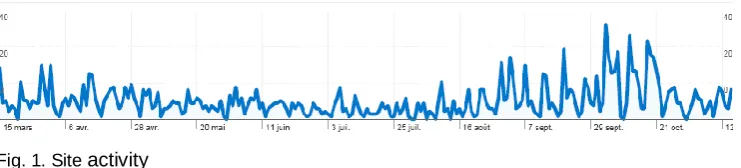
In terms of access to the webpage, statistics (below) confirm the trend. Data (from March 15th to November 15th) indicate that the website was
practice with a diversity of actors explored 1708 times and by 1086 unique visitors There have been approximately 55.68% new visits. The average time spent each time on the website is 2 minutes and 23 seconds. Some 4,627 pages were explored or 2.71 pages per visit.
Fig. 1. Site activity
Over the whole period, the number of visits declined during the summer months (June, July and August): it went from 239 visits in April to 111 visits in July (see Fig. 1). Then, the curve shows an increase in August and continues into September and October. This increase seems to correspond to a period when a particular activity was planned (in this case a major symposium for the network in the beginning of October). It is important to note that June, July and August are usually the months when people take holidays (academics usually take one month vacation in July or August, the partners of other groups 3 to 4 weeks in the same period).
The newsletter is another way that we targeted to send information to members and to help maintain contact with them and it is also received rather passively. Again, despite repeated calls for input, the network did not receive information to communicate to other members, except after very direct contact with one person, or when things came up during meetings. The webmaster surveys the web (including electronic academic journals) to find relevant information about members to share with the others; information on events and publications in which they participated is thus brought to the knowledge of the others.
6.2. Analysis of the Community of Practice and evaluation of the practice
6.2.1 Need for more time to participate in a CoP:
The interviews gave us a better picture on various themes of participation, communication, dissemination and sharing of knowledge, achievement of goals within the CoP, members’ satisfaction and interest to continue.
On the theme of participation, most participants interviewed said they felt engaged or highly engaged in the search network, but described their participation as infrequent. Indeed, some say that their participation is "sporadic, according to the issues raised, according to our needs or the needs of the research network " or "it depends on the projects that are ongoing or planned activities", or: " my organization has never released more time for me to do more than that”. Moreover, half of the participants think that the participation rate in the network is sufficient. Thus, some say: "I don’t think I can get more involved ... There is no way I could”.
The other half admits not having enough time; for example, one says: "It will not change if there are greater incentives because I'm the only person responsible for social issues in my organization; we used to be three, but now I’m alone ... I could not do more, given my job". They give very specific examples of time constraints; "... We want to participate, but don’t have time" or ”I am so busy that I do not run after information. I have a business, it is a small social economy business; sometimes there are big organizations, where there are people who are specifically responsible for research. But I have a business, so I am making an effort to support research. But I'm too busy to add or seek more information. This level of information suits me perfectly."
Another element is that people don’t spontaneously participate in a CoP to share knowledge. Some want more leadership from the others, or specific projects proposed to enhance participation. «There’s probably a lack of leadership, or projects put forward in a more structured way... because I think it does not come naturally to partners to propose information, or research or knowledge they have". Most partners clearly wait to be directly solicited for participation.
Some don’t feel confident to go forward and propose activities or knowledge; they don’t feel there is enough trust to test ideas or projects: "There are some interesting pairings to be made between our organization but the initiative will not come from us, partners; this needs to come from the network's management, to propose topics for our exchanges" .Another says: “In my view, I have a 75% participation level. I missed a meeting; when I am contacted, I participate, but when I am not solicited, I'm not proactive.”
practice with a diversity of actors On the issue of communication tools, the majority of participants surveyed show a certain ignorance of the main tools of web communication, mainly the blogs, and some confusion about their use. Thus, some argue: “The blog is not a tool that I spontaneously feel attracted to. The website, I do not go every day, I went there a few times”, or “I don’t have the reflex to go there once a week, the consultation takes time. If it is updated every day, I know there's new material, I’ll maybe go”. Another person says: “There are many means of communication, they cover a broad spectrum of needs but they are not sufficiently clear to me. ... I do not think it is clear how to proceed, who we need to contact to put such information in the newsletter, I think there is a lack of information” (even if they have received regular monthly emails from the coordinator asking them for information to be shared. As a result, until recently when one person decided to write some short messages for the blog, there has been little participation. Some post-docs say they will write things, “When they have finished their research” but there is no spontaneous thrust to put information out there to share with the others. The network coordinator will put things on the web and in the newsletter, to give others the idea that they can also share similar things, and she has even put a video found on the web, from one of the network members giving a conference on a theme of interest to the network, but the majority of participants still remain rather passive. They don’t feel comfortable with the tools (blog mainly) and they tend not to use these tools to search for information.
On the issue of knowledge sharing, the majority of participants surveyed said they expect to find extensive information (activities on the members, on students, research reports, technological, text search or practice, recent news, etc.) related to the themes of the network, which is pretty much what they do find, but they don’t feel compelled to contribute in any way. Moreover, the majority of participants surveyed would be willing to share relevant information on their topics of interest with other members, but indicate they need to be solicited. While they were solicited in the months following the end of this part of the research, their habits did not change much. They still apparently don’t feel confident enough to go onto the blog and write things in there, and they still wait to receive information from others, not contributing much themselves, except when specifically solicited to participate in a meeting, conference or research project.
6.2.2 Trust, time and leadership towards a common goal
6.2.2.1 University vs. organizational representatives: need to develop trust and a common goal
Depending on the member's profile (academic vs. community), expectations and modes of operation in the CoP are somewhat different. For example, rates of participation and work are different, the level of expectation in relation to the solicitation is different, and the degree of commitment is also variable, especially in light of the fact that a person can be actively involved in ongoing research or merely participates in conferences and activities. In any case, participation in online tools is low, except for email exchanges; indeed, there seem to be a good number of emails between a certain number of individuals in the network, but we could not keep track of emails, many of which are bilateral ones (peer to peer). Moreover, non-academics seem to find the pace of research projects to be slow, much slower than what they are used to, especially when they are working with students, who also may have courses and other activities. While academics may complain on the time it takes to get access to research places, non-academics want quick results. So the time issue is crucial, both worlds not functioning at the same speed.
One social partner says: "Take the example of M., a PhD student, I met her last summer, I invited her to meet with management, we created a project but I did not see her for one year. Mrs. M. came back last week for the same project. So, things have not moved over almost a year. I had invited her to our Hi Tech event, I introduced her to business leaders in our industry, the stage was set so that she could go to meet them, advance the project, then it came back just this year. So as I say, one participates at the rate at which it is sought." This may be a particular case, where a student was overwhelmed with her courses, but in the same vein, another said: "We had a meeting with Mr E. (University professor), who wanted to initiate a project on subject X. I met him, I sent various tools that we have produced on this subject, but it took time before I heard back from him”. Partners from the community environment start to develop distrust when they have such experiences. It thus appears that the issue of trust and time are quite central to engaging in active participation in a CoP, or other research project designed as such.
6.2.2.2 Rotation of organization representatives: need for stable partners to develop trust
practice with a diversity of actors backgrounds: unions, community groups, business people, government, etc. As some interviewees mentioned, this rotation of participants does not facilitate proper cooperation, because you have to learn to know people, develop trust, etc. The community must be somewhat reorganized each time someone changes. Meanwhile, university researchers do not usually move from their positions, so there is a difference here between the two types of partners. The academics become better known and identified, while the community reconstructs itself, to a certain extent, regularly.
6.2.2.3 Active Involvement vs Commitment
Among the members who admit they do not participate very actively in the network, most say they are committed, even very committed in some cases. Again, these are probably those who are more actively engaged in research or specific projects that are more involved in exchanges. Nevertheless, for most participants, the perception is that the sense of belonging is separate and not necessarily proportional to the rate of active participation in the community. This is something which appears new since in most of the literature on CoPs, it seems “natural” or automatic that participants will be committed and actively involved in the community.
6.2.2.4 Lack of a core of leaders
in our community, the active level and the peripheral level, a problem that was also observed in other cases of CoP [7].
We found that the director of project, administrative coordinator, web coordinator as well as the community and university representatives at the executive board for the core participant group. They search for information and distribute it through the web, add elements on the blog, etc. On the other hand, the peripheral group, which is also composed of university and community people, is satisfied with receiving the newsletter and going on the website to get information when they are informed of its publication.
7.
Discussion
This is an emerging community, and exchanges could develop over the years, as people get to know each other, as trust builds up and also possibly as they become more familiar with the ICT tools. The first questionnaire on the social networking tools showed some ignorance of the main tools, including blogs. Few members knew more than three social networking tools (if we include Facebook!). Accordingly, we obtained mixed results in terms of participation in the CoP, at least with regard to communication tools. Indeed, members feel involved in the network, participation in seminars and conferences is good, and there are ongoing discussions on the projects under the three main research themes. Some community partners even admitted: "Through the network, I am in contact with other groups, for example organization X, so the network has made it possible for me to create new links, to interact with Organization X and Y ". There are many email exchanges, although we do not monitor all emails sent from one member to another; however, it seems difficult to develop trust throughout the network and activate online exchanges, through the web site / blog and other tools.
However, ignorance of web communication tools and their use is not the only explanation for the low participation using these tools. Indeed, the participation rate to questionnaires and telephone interviews is low. If only to get answers to questionnaires or confirmation of appointment for an interview via email, it took many emails (often unanswered). Yet the majority of participants surveyed said they want to be contacted by email.
Despite poor results in terms of questionnaire or participation with the communication tools on the website (blog, etc.), the community seem to be becoming more and more active over time. Thus, time and trust appear to be the essential elements for a CoP to actually emerge.
practice with a diversity of actors
8.
Conclusion
What makes communities of practice successful over time is their ability to generate enough excitement, relevance and value to attract and engage members [29]. Although many factors such as management support or an urgent problem to solve can inspire a community, nothing can replace the sense of vitality, according to these authors. There is a real challenge to create this vitality (or drive) in a community of practice. We note that although in theory, to set up a community of practice and keep momentum may seem a simple thing, in practice it is somewhat more challenging.
Given our results, where people say they feel part of the community, feel engaged as well, we tend to think that a few more elements may be needed beyond the sense of vitality. We observed that some do not participate because of time, others do not take leadership, but they expect things to be organized for them. They look at the website, read the newsletter, but don’t find the time to contribute actively, thus staying in the status of “peripheral participation”. So if Wenger’s three levels of participation still hold true, it may be necessary to revise the conditions of successful CoPs and add the elements of trust, time and something like “togetherness” or a real feeling of “community”, the latter being necessary when people come from different organizations, with different priorities and different time spans.
The evidence gathered indicates that we must take into account the practical distinction between the various types of participants in the CoP, the fact that they need to build trust relationships, to get to know each other, to also try to function in the same timeframe, the university and research time frame obviously being different from that of business, or union people, but even of community groups as we found here.
The analysis of this research partnership in terms of knowledge sharing within a community of practice has made it possible to identify some difficulties associated with the active participation in knowledge sharing, which are supposed to be the norm in CoPs. The fact that this is a rather large research project in partnership, covering three main topics and including several studies, means that all partners do not feel concerned at all times and it is true that partners tend to be more active in specific research projects than in the general knowledge sharing which is one of the objectives of the CoP/research project. However, as the objective is to involve all in knowledge sharing, it is important to identify sources of difficulty in this regard and the time and trust issue come out as the main elements. Of course, these cannot be confirmed with a single case study, and future research will be needed to confirm the importance of these two dimensions, but we argue that these elements have been neglected in the literature and should be put forward.
much research concentrated on what happens “within the CoP”, research should probably look more towards the environment and what happens “around” the group, including time commitments of the participants and the time needed to develop trust within the group. The community we studied is composed of many members coming from different organizations and who therefore have different priorities. Obviously, if we want to get such communities actively engaged in knowledge sharing, a few prerequisites need to be taken into account.
In conclusion, we set out to determine the factors that facilitate or hinder cooperation within a community of practice composed by two groups of actors, community and university actors. We found that the different affiliations might impact on the CoP and lead to less active participation. This is the case, not because of opposition from the employer or power issues, but mainly for lack of time. We showed that it is not as easy as the literature seems to indicate to create a CoP and ensure knowledge sharing within it.
Indeed, the fact that members come from different organizations, are not bound by the same objectives, and need time to build trust between them explain the difficulties in creating a CoP,. While some may consider that the deliberate creation may affect the success in achieving participation, it must be remembered that no individual was forced to enter the research CoP. The organizational context is probably more important, and the presence of a university actor, alongside actors from community and union groups could be analyzed in more detail in future research, although it did not come out as a problem or issue in the interviews. Also, while many said they were committed to the CoP, they did not engage as actively as could be expected, given this commitment to the project. This time element and the distinction between commitment and active engagement in the CoP do not appear to have been highlighted in previous literature and this is surely something to put forward and be attentive to if organizations want to build active learning CoPs.
This is something which appears new to us since in most of the literature on CoPs, it seems “natural” or automatic that participants will be committed and actively involved in the community. Our research shows that this is not necessarily the case that they can have time constraints and clearly need time for trust to develop within the group in order to foster active participation. This is interesting since it confirms what [39] found, that is the importance of trust, limited to blogging activities in their case. Our results go a little further in indicating that it is not only in blogging that trust is essential, but in any type of knowledge-sharing activity which is designed in the form of a CoP.
9.
References
1. Cabrera A. and Cabrera E. F., Knowledge-sharing Dilemma. Organization Studies, 2002. 23(5): p. 687-710.
practice with a diversity of actors 3. Wenger E., McDermott R., and Snyder W. M., Cultivating Communities of
Practice: A guide to Managing Knowledge. 2002, Boston, MA: Harvard Business School Press.
4. Hildreth P., Wright P., and Kimble C. Knowledge management: are we missing something? in 4th UKAIS Conference. 1999. London: York, UK: McGraw Hill. 5. Wenger E. Communities of Practice: Learning as a social system. 1998 [cited. 6. McDermott R., Knowing in community : 10 critical success factors in building
communities of practice. IHRIM Journal, 2000. March 2000.
7. Bourhis A. and Tremblay D.-G., Les facteurs organisationnels de succès des communautés de pratique virtuelles. 2004, Cefrio: Québec. p. 140.
8. Guillaume O., Recherches partenariales : coordination et coopération entre chercheurs d’entreprise et chercheurs universitaires. Interventions économiques 2011. 43.
9. Hatchuel A., The two pillars of new management research. British Journal of Management, 2001. 12: p. 33-39
10. Starkey K. and Madan P., Bridging the relevance gap: aligning the stakeholders int the future of management research. British Journal of Management, 2001. 12(Supplement 1): p. 3-26.
11. Wenger E., Cultivating Communities of Practice: A quick start-up guide. 2002. 12. Lave J. and Wenger E., Situated Learning. Legitimate peripheral participation.
1991, Cambridge: University of Cambridge Press.
13. APQC, Building and Sustaining Communities of Practice. 2001, American Productivity and Quality Center: Houston, TX. p. 205.
14. Mitchell J., The potential for communities of practice to underpin the national training framework. 2002, Australian National Training Authority: Melbourne. p. 104.
15. McDermott R., Learning across teams: How to build communities of practice in teams organizations. Knowledge Management Review, 1999. 8(may/june): p. 32 -36.
16. Gherardi S. and Nicolini D., The organizational learning of safety in communities of practice. Journal of Management Inquiry, 2000. 9(1): p. 7-18.
17. Gherardi S. and Nicolini D., To transfer is to transform : The circulation of safety knowledge. Organization, 2000. 7(2): p. 329-348.
18. Tremblay D.-G., Concertation éducation travail - Politiques et expériences, in Éducation - Recherche, Hardy M., Editor. 2003, PUQ.
19. Lave J., Cognition in Practice: Mind, mathematics, and culture in everyday life. 1988, Cambridge, UK: Cambridge University Press.
20. Kearsley G. Explorations in Learning & Instruction: The Theory Into Practice Database. Situated Learning (J. Lave) 1994-2010 [cited 27 août 2010]; Available
from: http://tip.psychology.org/.
21. Cohendet P., Créplet F., and Dupouët O., Innovation organisationnelle, communautés de pratique et communautés épistémiques : le cas de Linux. Revue française de gestion, 2003. 147(Nov.- déc. 2003): p. 99-121.
22. Cothrel J. and Williams R. L., On line communities: Helping them form and grow.
Journal of Knowldege Management, 1999. 3(1): p. 54.
23. Ardichvilli A., Page V., and Wentling T., Motivation and barriers to participation in virtual knowledge sharing in communities of practice. Journal of knowledge management, 2003. 7: p. 64-77.
25. McDermott R. and O'Dell C., Overcoming cultural barriers to sharing knowledge.
Journal of Knowldege Management, 2001. 5(1): p. 76-85.
26. Sveiby K.-E. and Simon R., Collaborative climate and effectiveness of knowledge work - an empirical study. Journal of Knowledge Management, 2002. 6(5): p. 420– 433.
27. Tu C.-H., The management of social presence in an online learning environment.
International Journal on E-learning, 2002. April-June: p. 34–45.
28. Wasko M. and Faraj S., "It is what one does": why people participate and help others in electronic communities of practice. Journal of Strategic Information Systems, 2000. 9: p. 155-173.
29. Wenger E., McDermott R., and Snyder W. M. Seven Principles for Cultivating Communities of Practice. Harvard Business School Working Knowledge e-mail newsletter (March 25, 2002) 2002 [cited from http://hbswk.hbs.edu/ archive/2855.html].
30. Kimble, C., C. Grenier, and Goglio-Primard K., Innovation and knowledge sharing across professional boundaries: Political interplay between boundary objects and brokers. International Journal of Information Management, 2010. 30(5): p. 437- 444.
31. Esnault L., Zeiliger R., and Vermeulin F. On the Use of Actor-Network Theory for Developing Web Services Dedicated to Communities of Practice. in EC-TEL 2006 Workshop: Innovative Approaches for Learning and Knowledge Sharing. 2006. 32. Spinuzzi C., The methodology of participatory design. Technical Communication,
2005. 52(2): p. 163-174.
33. Clement A., Computing at work: empowering action by low-level users. Commun. ACM, 1994. 37(1): p. 52-ff.
34. Bowker G.C. and Star S.L., Sorting Things Out, Classification and its consequences. 1999, Cambridge, MA: MIT press.
35. Gasson S., A genealogical study of boundary-spanning IS design. European Journal of Information Systems, 2006. 15(1): p. 26-41.
36. Hildreth P and Kimble C., The Duality of Knowledge. Information Research, 2002. 8(1).
37. Psyché V., Rôle des ontologies en ingénierie des Environnement Informatique pour l'Apprentissage Humain (EIAH) : Cas d'un système d'assistance au design pédagogique, in Informatique. 2007, Université du Québec à Montréal: Montréal. p. 527.
38. Psyché V., Mendes O., and Bourdeau J., Apport de l'ingénierie ontologique aux environnements de formation à distance, in STICEF - Technologies et Formation à distance, Hotte R. and Leroux P., Editors. 2003, INRP. p. 89-126.
39. Sangmi Chai and Kim Minkyun, What makes bloggers share knowledge? An investigation on the role of trust. International journal of information management, 2010. 30(5): p. 408-415.
Diane-Gabrielle Tremblay is professor of labour economics at the
practice with a diversity of actors (Vietnam) and the European School of Management. She has published many articles in various journals such as the Applied Research on Quality of
Life, Social Indicators Research, the Journal of E-working, the Canadian
Journal of Urban Research, International Journal of Entrepreneurship and
Innovation Management, Canadian Journal of Communication, Canadian
Journal of Regional Science, Leisure and Society, Women in Management, Géographie, économie et société, Carriérologie, Revue de gestion des resources humaines, and others.
Valéry Psyché holds a Ph.D. in Cognitive Informatics from the University of Quebec at Montreal, (UQAM). She began her research career at the Research Centre LICEF TÉLUQ where she is associate researcher. She has been involved for 10 years in numerous projects, mainly in the field of educational technology and cognitive informatics. As a researcher, she developed a postdoctoral research project aimed at creating a community of practice for CURA (Community University Research Alliances). She keeps research collaboration with a world-class center in ontological engineering at Osaka University (Japan). She also teached at the University of Montpellier (France). She has published articles in the proceedings of many international conferences such as Artificiel Intelligence in Education (AIED), Intelligent Tutoring Systems (ITS), and LORNET Research Network on Intelligent, Interactive, Learning Object Repository Networks (I2LOR), and in various journals such as Sciences et Technologies de l'Information et de la Communication pour l'Education et la Formation (STICEF), Sociologies ; and others.