Geschke Center
Doctoral Dissertations Theses, Dissertations, Capstones and Projects
2018
Use of Multimedia Games for Biology Vocabulary
Instruction
Marlene Ingrid Mahony
University of San Francisco, [email protected]
Follow this and additional works at:https://repository.usfca.edu/diss
Part of theAnthropological Linguistics and Sociolinguistics Commons, and theHigher Education Commons
This Dissertation is brought to you for free and open access by the Theses, Dissertations, Capstones and Projects at USF Scholarship: a digital repository @ Gleeson Library | Geschke Center. It has been accepted for inclusion in Doctoral Dissertations by an authorized administrator of USF Scholarship: a digital repository @ Gleeson Library | Geschke Center. For more information, please [email protected].
Recommended Citation
Mahony, Marlene Ingrid, "Use of Multimedia Games for Biology Vocabulary Instruction" (2018).Doctoral Dissertations. 443.
The University of San Francisco
INVESTIGATING THE CAUSES AND CURES FOR UNCLEAR SCHOLARLY WRITING
A Dissertation Prospectus Presented to
The Faculty of the School of Education
International and Multicultural Education Department
In Partial Fulfillment
of the Requirements for the Degree Doctor of Education
by
Marlene Mahony San Francisco
ii
THE UNIVERSITY OF SAN FRANCISCO
Dissertation Abstract
Investigating the Causes and Cures for Unclear Scholarly Writing
This qualitative dissertation investigated possible causes and cures for unclear scholarly
writing. For this study, a stipulative definition of unclear scholarly writing, or “academese,” is
that the language tends to be vague and verbose. The problem, according to the included
literature, is that people who use or accept vague language have less academic, social,
professional, and civic power. Academese, some say, can detach readers and that can accordingly
diminish collective exchange. Because higher education is meant to share knowledge, promote
agency, and prepare students to communicate powerfully within and beyond the university, this
study researched the causes and cures of vague or verbose scholarly writing.
Orwell (2012) detailed the dangerous consequences of vague or verbose political
language, yet he connected that style to inherited traditions in academia. To evaluate inherited
traditions of scholarly language, this study relied on the theoretical framework of Discursive
Psychology, which integrates the theory of poststructuralism. Poststructuralists like Foucault
posit that when we unconsciously inherit and accept fixed premises, we fail to evaluate if those
premises are serving or constraining us. To create movement within those constraints (and work
toward agency), poststructuralists say we should widen our lens and take a macro look at
institutional structures (such as schools) and premises (such as assumed social roles). In addition
to poststructuralism, Discursive Psychology draws from sociolinguistics, which examines the
connection between language and social roles, such as the notion, or premise, that high language
iii
of whom were purposely selected for diversity and different levels of academic experience. The
selected students were enrolled in a second-level required rhetoric and writing class, and so they
were in the process learning how to transfer those writing skills to other disciplines. While the
students were asked their perceptions of the kind of academic writing they needed to master, the
professors were asked their perceptions of academic writing as well as possible causes and cures
for academese.
The data—which was categorized, verified, and analyzed—revealed key findings. One
finding was the disjunction between what the professors were teaching and what the students
were learning. Another finding was that academics tend to use academese when they want
present themselves as advanced scholars, when they want to belong to a discipline, and when they
want to advance in a particular discipline. This insulation seemed to hinder audience awareness
and the accessibility of the language.
To write more accessibly, the professors encouraged their students to use simple
language and weave in elements of story, for a storytelling approach seemed to connect with
readers and clear up the language. However, another inference was that many professors of
diverse disciplines (busy teaching their own subjects) relied on writing instructors to teach clear
prose. While the data suggested that writing instructors should integrate and reinforce more
exercises in precision, story, and audience awareness, it also suggested that two required
academic writing classes may not be enough for students to transfer and sustain a clear writing
style.
Suggestions for curriculum change are to require all university students to take an
advanced composition, rhetoric, or creative writing class. Because other disciplines (particularly
iv
This dissertation, written under the direction of the candidate’s dissertation committee and
approved by the members of the committee, has been presented to and accepted by the Faculty of
the School of Education in partial fulfillment of the requirements for the degree of Doctor of
Education. The content and research methodologies presented in this work represent the work of
the candidate alone.
Marlene Mahony May 11, 2018 Candidate
Dissertation Committee
Sedique Popal, Ed.D. May, 11, 2018 Chairperson
Patricia Mitchell, Ph.D. May 11, 2018
v
I would like to thank Dr. Popal, my professor and chair, whose teaching inspired this project. Taking even one class from him sparked my love of linguistics and showed me the difference a teacher can make. He held me to a high standard but he did so with humor, calm, communication, and commitment. He invested endless hours into my endless words, and he made me want to present my best work.
I am so grateful for Dr. Mitchell, who also guided me with warmth, care, and commitment. Any student who took her class was lucky to see how a teacher could create an environment of rigor and joy at the same time. Hers was one of my last classes in this program, and it has left a lasting and beautiful impression.
I was so happy that my dearest Dr. Taylor was my first professor. I worked hard but happily in her class. She believes in developing the whole person, and she
demonstrated that combination of IQ and EQ by motivating us with empathy,
engagement, authenticity, and insight. I felt lucky to be invited into the IME program that way, and I hope my own students benefit from the insight I gained from Dr. Taylor.
And I could not be more grateful to Dr. Koirala-Azad for the generosity of her time, commitment, and knowledge to help me through this project. Her expertise and energy reflect all that is excellent about this program.
To Jeana, Jenan, Brooke, and Shufina, who celebrated when I got into this
Table of Contents
ABSTRACT ... ii
SIGNATURE PAGE ... iv
ACKNOWLEDGMENTS ... v
TABLE OF CONTENTS ... Error! Bookmark not defined. CHAPTER 1: THE RESEARCH PROBLEM ... 4
Introduction ... 4
Statement of the Problem ... 6
Background ... 11
Need ... 13
Brief History... 14
Purpose of the Study ... 16
Theoretical Framework ... 17
Research Questions ... 20
Limitations and Delimitations ... 21
Significance of the Study ... 22
Definition of Terms ... 22
Summary of Chapter One ... 25
CHAPTER II: REVIEW OF THE LITERATURE ... 28
Restatement of the Problem ... 28
Academese ... 30
Summary of Academese ... 53
CHAPTER III: METHODOLOGY ... 87
Statement of the Problem ... 87
Design ... 87
Setting ... 89
Selected Course ... 89
Population ... 90
Instruments ... Error! Bookmark not defined. Research Questions ... 94
Research Question 1: ... 95
Research Question 3: ... 96
Reliability and Validity ... 96
Procedures ... 97
Background of the Researcher ... 102
Protection of Human Subjects ... 104
CHAPTER IV: RESULTS ... 105
Overview ... 105
Research Questions ... 105
Data Description ... 106
According to Students: ... 106
Support ... 107
Clear language: ... 109
According to Professors: ... 109
Section Two: Generative Themes ... 130
Research Question 1 ... 131
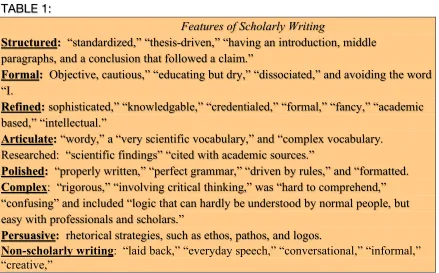
Features of Scholarly Writing ... 131
According to Professors: ... 131
Benefits of Scholarly Writing ... 135
According to Professors: ... 135
Challenges of Scholarly Writing ... 137
According to Professors ... 137
Political or Social Impact of Scholarly Writing ... 140
According to Professors ... 140
CHAPTER V: SUMMARY, KEY FINDINGS AND IMPLICATIONS, CONCLUSIONS, DISCUSSION, AND RECOMMENDATIONS ... 163
Summary of the Study ... 163
Summary of Findings ... 168
For Scholars... 179
For Students... 182
Conclusions ... 189
Future Research ... 194
For Future Practice ... 195
REFERENCES ... 201
APPENDIX A: Consent Forms ... 210
APPENDIX B: Sample Solicitation Letter ... 215
APPENDIX C: Coding Sample: Questions for Students in RHET 120 ... 216
CHAPTER 1
THE RESEARCH PROBLEM
Introduction
In his essay Politics and the English language, George Orwell (2012) described the danger of the vague and verbose speaker: “When one watches some tired hack on the platform mechanically repeating the familiar phrases, one has the feeling that one is not watching a live human being but some kind of dummy.” Orwell (2012) elaborated that the feeling “suddenly becomes stronger at moments when the light catches the speaker’s spectacles and turns them into blank discs which seem to have no eyes behind them” (p. 534). The danger, he explained, is not that vague language is hard to endure but that it is hard to understand.
Orwell claimed vague statements can obscure one’s intentions. When politicians use vague or verbose language, Orwell argued, it is because the truth is “too brutal to face” (p. 534) or there is a “gap between one’s real and one’s professed aims” (p. 535). While Plato (2015) felt trained rhetoricians could be especially manipulative in
disguising one’s aims, Aristotle (2009) believed sound rhetoric could lead one to a higher probability of truth. Aristotle explained that if one lined up a true premise with a true example, then one could reach a true conclusion. However, Orwell (2012) looked at these syllogisms, or deductive structures, at a language level, and he showed that if the language of the major or minor premise is unclear, then it is hard to reach a clear and true conclusion. In political language, said Orwell (2012), if the sentence is “cloudy”
claims line up for their best interests (p. 535). In his view, conclusions are connected to the clarity of individual statements.
Man Booker International Prize winner, Chinua Achebe also connected sociolinguistics to social justice when he said that language can be used “not only for expressing thought but also for concealing thought or even preventing thought” (p. 511). Reiterating Orwell’s (2012) claim that unclear language is “favorable to political
conformity” (p. 534), Achebe (2015) argued that “government prose” tends to keep one “in the dark about affairs” even when one’s life “or children’s lives” depend on those affairs (p. 511). Yet both Orwell and Achebe claimed this vague and verbose language has been inherited like a tradition, and they connected that tradition to academia, where vague and verbose sentences are the norm.
Yet as Orwell disentangled samples of typical academic prose, he demonstrated that vague and verbose language is not a sign of education but of a sign of inexperience.
Statement of the Problem
The tradition of vague and verbose language is a problem commonly described in college composition handbooks. “No student these days feels comfortable writing ‘Jim kicks Bill,” wrote academic writing handbook author Richard Lanham (1987): “The system seems to require something like, ‘Kicking Bill is an activity hugely enjoyed by Jim’” (p. 1). When published scholars use passive prose, or indirect phrasing, Lanham (1992) claimed, students who want to distinguish their writing as scholarly will model that diction. Although many rhetoric and composition instructors use Lanham’s exercises to help students tighten their sentences, Lanham argued that indirect language has
become institutionalized. This makes it difficult for students to transfer their training in concision to their writing in other disciplines.
In many other disciplines, a common warrant, or assumption, is that detached language reflects an impartial researcher. Lanham (1992) said the “learned professions” defer to this style because they “want above all to sound learned and scientific—
disinterested, impersonal, factual” (p. 60). More specifically, Lanham claimed that scholars defer to detached diction because they want to sound official. However, Lanham (1992) described “The Official Style” as a “scribal style, ritualized, formulaic” style that “reflects the general bureaucratization of American life” (p. 60). Similarly, in
composition classes, author John Trimble (2011) argued that this vague and verbose style continues because it is embedded in bureaucracy (p. 48).
The problem with this bureaucracy, the authors explain, is that in a quest to sound official, students and scholars alike sacrifice clarity and connection. While many writing instructors emphasize the importance of connecting to the audience with concrete and concise prose, both authors suggested vague and verbose writing is unconsciously inherited in a systematic way. The danger with systematic practices, claimed French philosopher Michael Foucault (2008), is that they turn into premises that people tend to inherit instead of question, and that makes people susceptible to political and social conformity. Foucault (2008) believed set premises are especially inculcated in
institutions such as schools. In the case of the university, because a common premise is that scholarly writing must retain a certain remove, many fail to question if this style is effective. In her article “The problem is: You write too well,” written for The Chronicle of Higher Education, Rachel Toor (2017) claimed students tend to write in a way that will initiate them “into the guild,” and this means “conforming to models, even if they're not good models.”
Most universities aim to develop effective communicators and critical thinkers. However, when university students receive, repeat, and reinforce laconic language, tradition can trump content (Lanham, 1992; Trimble, 2010). Orwell (2012) detailed how academics can parrot the phrases of others instead of expressing original thought.
potential problem with this conformity is that students might learn to repeat the claims of others yet not learn how to craft their own. It could also mean perpetuating a pattern of vague and verbose writing. If students confuse eloquent language with vague and verbose language, they might cement an ineffective style that they will use for the rest of their lives. Moreover, instead of working from the notion that good writing is clear, concise, and concrete (Trimble, 2011; Lanham, 1992; Tan, 2012; Lakoff, 2004; Orwell, 2012; Achebe, 2015; Pinker, 2014), they might expect others to use a removed style, and in turn reinforce the premise that vague and verbose writing reflects erudition. In fact, only 27% of advanced academic writing manuals name concrete detail as an essential writing element (Sword, 2012, p. 173). Orwell (2102) claimed that whatever is a cause is also an effect (p. 528), and if these students become published scholars, readers may repeat this vague and verbose style in their own writing.
Alternatively, readers may not connect to the writing at all, and this can diminish collective exchange. While the goal of education should be to develop the whole person (Nussbaum, 2015; Tagore, 2015), meaning students are knowledgeable in many different areas, some say disconnected writing creates chasms between disciplines. The mission of most universities is to have people learn and grow from one another’s insights. When departments develop a jargon that stays within the confines of that subject, said Mario Vargas Llosa (2002), that jargon may not be accessible to people outside the discipline, and that can diminish collective exchange.
field, my subfield, even my sub-sub-subfield,” and Harvard professor in biology and and Nobel Laureate, E. O. Wilson (2002), said that even scientists dread reading science writing because it often fails to connect to the audience. Orwell (2012) suggested disconnected writing can be out of indifference. But this indifference could lead to such bland prose that readers drift away from the words on the page. Plus, when writers use more words than they need, readers will take more time to learn less, and that can also diminish collective exchange.
Moreover, when writers fail to edit, they can also diminish their credibility. This works against the common university goal to help students succeed as professionals. According to Daniel Oppenheimer’s (2005) Princeton study, “Consequences of Erudite vernacular utilized irrespective of necessity: Problems with Using long words
political consequences Orwell described—can have social and professional consequences beyond the university.
When students enter the professional world and seem unable to manage their sentences, studies show, they are not instilling confidence that they can manage their work or other workers (Mindell, 1995). According to a study published in The Journal of Social Psychology, concrete speech will increase perceptions of action orientation,” so “instead of helping individuals interested in managing their images, speaking in an abstract manner may actually hurt them” (Palmiera, 2015). In fact, imprecision has traditionally suggested insecurity, especially for women (DeBeauvoir, 1989; Lakoff, 2004). So students can diminish themselves both socially and professionally if they do not learn to communicate in a concise and concrete way.
Academic writing handbooks in most composition or rhetoric classes emphasize direct, concrete, and concise phrasing, and in most universities, these are required classes. The problem is that, because some college departments adopt different premises about what constitutes good writing, students who are trying to master powerful writing can be confused. According to a study by Bermann and Zippernick (2007), many students felt that what they learned in composition classes did not apply to their others classes; in fact, they even saw their composition instructor’s feedback as “meddlesome” (p. 132).
they might also unconsciously support inherited social premises that work against their best interests. As Orwell (2102) explained when he linked civilian compliance to political sophistry, when citizens accept language that disguises, dodges, deludes, or dismisses, they are positioning themselves to support social inequity.
Most colleges aim to promote both social and individual agency, and this involves fostering questioning citizens who learn and share knowledge. This involves questioning premises that hinder that process. That is why this study looked at the premises of certain writing protocols, for ineffective writing can inhibit the reader’s ability to understand, absorb, or question the content, and that can diminish collective exchange. This study set out to understand what causes scholarly language to be vague or verbose and what could be done to make it more concrete and concise.
Orwell (2012) believed the orthodoxy of vague and verbose language can be fixed with the right steps. Those steps include revising to make sentences more direct.
However, in the university, students are often taught conflicting premises about whether or not to use direct language. That is why it is important to understand possible causes and cures for unclear writing across the academy. Perhaps, if students could adopt a more consistent premise of what constitutes effective writing, they could write more clearly as future academic scholars and even beyond the university.
Background
regardless of the discipline, should be clear and concise. If clear, concrete, and concise language is powerful (Orwell, 2012; Trimble, 2011; Lanham, 1983; Tan, 2012; Lakoff, 2004, Mindell, 1995, Mindell, 1995, DeBeauvoir, 1989), then it follows that unclear, vague, and verbose language is not. Linguists have also connected language styles to social power. According to Jim Wardhaugh (2015), “certain ways of speaking are combined with certain cultural models to produce and reproduce social meanings and structures” (p. 298). These meanings are reinforced by the way one is conditioned or expected to speak, such as wordiness in women.
In patriarchal times, wordiness suggested weakness. In her groundbreaking book
The second sex, Simone De Beauvoir (1989), wrote that women were “a lost sex” (p. 263) because of their inability “to choose, to erase,” (p. 706), to appeal “to others,” and to edit for their understanding” (p. 263). Women’s wordiness, found Lakoff (2004),
continues to suggest insecurity. Her study on Critical Discourse Analysis found that when people fill their sentences with needless words, they seem to be buying time to collect their thoughts. Moreover, women “reinforce their subordinate status” when they use hypercorrect grammar (Holmes, 2011, p. 301). In modern society, with more blurred identities, these patterns can move to any marginalized group (Holmes, 2011).
Even though imprecision suggests ineffective communication, the tradition of vague and verbose writing persists in the academe (Orwell, 2012, Lanham, 1993;
your niche in the system—public sector or private—without losing your soul to do it” (p. 60). While several writing experts have tried to understand how to teach that niche across the disciplines, more research needs to be done on why verbose writing is so common in the university and how it can be cured. Studies such as critical pedagogy have addressed reductive and formulaic teaching methods, and studies in linguistics have investigated how language registers can limit us socially, but more research needs to examine the impact of language traditions at the university level.
Need
Many universities aim to teach skills that facilitate social, civic, and professional power, and this research was designed to help facilitate that power with effective
language. This dissertation starts with the premise that effective language is clear, concrete, and concise. Academically, future scholars need to help their readers benefit from the research and ideas on the page. Articulate but authentic communication can help facilitate the university’s goal for collective exchange. Good writing generally translates to good speaking, which is skill that elevates social power. Socially, a command of language will help individuals engage confidently in different settings. Professionally, college graduates will need strong intercommunication and writing skills in their jobs. That is why students need to practice clarity.
opaque. Orwell (2012) believed clarifying cloudy language was the first step toward “political regeneration” (p. 528). If, as Orwell said, whatever is a cause is also an effect, then this regeneration could start in the university.
Academic, social, professional, and civic power can come from expecting clear language to be the norm, not the exception. This means investigating the causes and cures for vague and verbose academic language. In this lens, if university students can learn effective writing, then they can transfer those skills beyond the university.
Syllogistically, because this dissertation worked from the major premise that university training is meant to foster both individual agency and collective exchange and the minor premise that clear writing promotes agency and collective exchange, then universities need to emphasize the power of clear writing.
Brief History
Deductive reasoning is meant to rely on sound premises. Aristotle (2009) said that “all men attempt to discuss statements and to maintain them, to defend themselves and attack others,” and whether we do this this from practice or habit, “the subject can plainly be handled systematically,” and so it is important to inquire why some succeed (p. 5). A successful argument his argument runs, relies on the ability to communicate a position, and that position must rely on clear and true premises. To assess someone else’s argument (and decide whose interests it serves), it is also important to discern premises. That can help distinguish sound rhetoric from sophistry.
Sophistry, explained one of the first female rhetoricians Gertrude Buck (2010), is used to impose one’s view upon another. Achebe (2015) drew from Orwell’s (2012) claim that opaque language can disguise oppressive intentions. When Achebe(2015) said vague and verbose language can be used “not only for expressing thought but also for concealing thought or even preventing thought” (p. 511), he connected the verbosity of the university to the sophistry of politics. Similarly, linguist and philosopher Noam Chomsky (2008) said sophistic politicians try to “obscure the fact that the essential and defining property of man is his freedom” (p. 79). From this lens, there is a reflexive relationship between language and power.
evidence (logos) as they connect to the needs and values of the audience (pathos). This connection depends on the audience trusting the writer or speaker. To build this trust (ethos), the writer must show authenticity and authority (Rottenberg, 2015). Rhetoricians believe credibility can come from clarity. This enables a connection with the audience, which is a skill many rhetoric instructors remind learning writers to develop.
In essence, scholars have detailed how the language one learns in the university can impact one beyond the university. Sociolinguists (Brown, 2000; Holmes, 2011) and rhetoricians (Aristotle, 2010; Rottenberg, 2015) believe credibility can come from precise language; conversely, other luminaries (Plato, 2010) showed how manipulation can come from imprecision. Achebe (2015) and Orwell (2012) paralleled the vague and verbose language of academics to the language of politicians. From this premise, it is important for all university courses—which are designed to empower students academically, socially, professionally, and civically—to emphasize the power of precise prose. This emphasis could remind students to revise their writing for transparency and also help them discern political sophistry. In this way, clear language has power.
Purpose of the Study
problematic, and what can be done to correct it, this study aimed to add to the literature of how students can learn, master, and discern the power of language. Because different disciplines work from different premises about what constitutes effective writing, this study could potentially help college students write more powerfully across the disciplines and beyond the university.
Theoretical Framework
As this study investigated certain language practices in higher education, it relied on the theoretical framework of Discursive Psychology. Discursive Psychology is a blend of psychology, politics, and linguistics, yet it is “a branch of social psychology” that “shares more with linguistics than psychology” (Paltridge and Patkiti, 2012, p. 508); in particular, discursive psychologists tend to look at “things that are said, how, to what purpose, and to what effect in interaction” (p. 509). The interaction that this dissertation focused on was the exchange between the academic writer and reader.
Psychology provided a framework for how formal, or stilted language, affects the audience, and it add insight into what contributes to vague and verbose writing. This insight could potentially help college students reconsider features that make language effective.
When Orwell (2012) wrote “if language controls thought, then thought controls language” (p. 535), he was arguing that ineffective language diminishes both individual and collective power. When unclear language becomes commonplace, his argument ran, then people will think, write, and converse with less clarity. When vagueness seems normal, it follows that people will more likely accept vague explanations as normal instead of demanding transparent details.
Language patterns can reinforce social divisions, say linguists (Tannen, 1990; Lakoff, 2004). Foucault (2008) claimed division prevents citizens from uniting for collective power. Lacan (1968), Foucault (2008), and Butler (1988) argued that hierarchies are unconsciously learned, repeated, and reinforced by institutions such as schools. Foucault (2008) claimed teachers often reinforce divisive premises. This study investigated the premise that different disciplines should adopt different discourse styles. This draws from the warrant, or common assumption, that students should code-switch, or use different writing styles for different subjects. This study asked if these divided protocols limit a student’s writing potential. In other words, if students learn discordant writing premises (one for composition papers and one for social science papers, for example), how might they learn to write with consistent power beyond the university?
That is why this investigation of reflexive relationship between language and power—in higher education—relied on the theoretical framework Discursive
Psychology. This framework helped explain how institutional premises can be adopted unconsciously, and how individuals can unconsciously reinforce those premises, even when those premises reinforce institutional divisions that constrict them.
Poststructuralists believed that one should get out and take a macro look at inherited structures—and the premises that support those structures—for understanding constricting institutional practices was the best way to disrupt them (Ruti, 2006).
One example of an inherited premise is that university students should learn different language styles for different disciplines. Another tradition students learn is that high scholars should adopt a highbrow style or confine their audience to readers within the discipline. This study investigated ways to disrupt these premises. While
poststructuralists investigated how institutional divisions can impact individual agency, fewer scholars have examined how divisive, constricting premises can impact academic writing.
Research Questions
The following questions are designed to investigate what contributes to vague and verbose writing and what can be done to fix it.
1) What are the priorities for effective academic writing? What features mark that writing as effective?
3) What can be done to help students write more concisely and concretely across the disciplines?
Limitations and Delimitations
When determining causes for vague academic writing, one the limitations—or uncontrollable factors (Roberts, 2004, p. 148)— of this study was that it was difficult to distinguish consistent factors because different departments prioritized different writing styles. Also, because this investigation was conducted by someone who teaches writing in the rhetoric department of the university studied, and that department emphasizes the practice of active prose, there may have been inherent bias in the reporting and crafting of this study. Also, this study may have unconsciously favor the writing techniques taught in rhetoric and writing classes over the writing techniques prioritized in other disciplines.
From a social justice perspective, while the evaluation of academic language in the university can offer insight into whether college students are learning the kind of language that enables scholastic, social, professional, and civic power, the scope of this study may have been too limited to describe a definitive causal relationship. Other factors, such as race, income, friends, family, and personality may impact a person’s ability to speak or write effectively. Also, as far developing citizens who seek transparent language and premises, external circumstances can also impact a person’s motivation to question polemics, policies, and premises. Moreover, these findings may be too discrete and limited to generalize into patterns.
the premises and practices of colleges in other regions, and they do not reflect a longitudinal analysis. Also, some of the participants were from this researcher’s own rhetoric and writing classes, which constitutes a convenient sampling.
Significance of the Study
While many studies have evaluated the connection between language and power, there has been little research on the impact of scholarly writing premises and protocols. In other other words, working from the premise that vague and verbose writing can diminish collective exchange, deter individual investment in social change, and undermine one’s credibility, this study researched what contributes to vague writing (such as protocols or practices within a discipline) and what contributes to clear writing (such as professors’ expectations or techniques). This information could potentially inform planners of college curriculums as they evaluate if more classes should be required in a student’s individual discipline or if additional rhetoric or creative writing classes should be required for all university students.
Moreover, by asking what contributes to discordant academics writing premises, this research may contribute to a more consistent expectation of effective writing that could span college departments. This consistency could be conducive to collective exchange and individual agency both within and beyond the university.
Definition of Terms
Academese: This is language that creates “both distance from and superiority over the addressee” (Lakoff, 2004, p. 88).
3) and they create certain images in the mind. These kinds of nouns and verbs evoke concrete mental images.
Enthymeme: This is a variation of a syllogism, with a foundation in deductive reasoning” (Rottenberg, 2015, p. 8). It is similar to a thesis statement.
Ethos: Aristotle believed that credibility, or ethos, was the “most important element in the arguer’s ability to accept a claim” (p. 7), and he believed this credibility came from qualities such as “intelligence, character, and goodwill” (Rottenberg, 2015, p. 7). Other qualities that can improve a speaker’s or writer’s credibility are objectivity, character, charisma, and authority, and polish. Polish involves clean grammar and clear writing.
Function words: Free morphemes, which are words that can stand alone, include function words, which are grammatical words such as “but, in, are, these, she,” and these words “create relationships among content words” (Master, 1996, p. 3). Words such as prepositions or articles connect content words.
Logos: Logical, statistical, syllogistic, historical, defining, comparative, and concrete evidence generally appeals to one’s rational sense. This is the “evidence or proof that supports a writer’s claim” (Rottenberg, 2015, p. 7).
Rhetorical Strategies: These ares methods used in persuasion such as ethos, pathos, and logos. Aristotle believed that although logical arguments should be sufficient, people realistically responded to a combination of persuasive elements, such as ethos (credibility) and pathos (emotional appeals). This means appealing to the head and heart of the audience member while delivering the message with integrity and clarity
(Rottenberg, 2015, p. 6).
Sophistic Diction: Strategic language that attempts to impose a position, view, or argument on the audience (Buck, 2010). Often, this involves evasions or obfuscations to prevent the audience from understanding the underlying intention.
Stipulative Definition: This is when one stipulates a particular definition for a certain context, such as saying “academese,” for this paper, means vague and verbose scholarly writing. Or, “ethos” in rhetoric classes refers to the writer’s clarity, objectivity, goodwill, authority, and presentation, but in general terms it means a good social
presence (Rottenberg, 2015).
Syllogism: This is a deductive structure that includes a major premise, a minor premise, and a conclusion. If a major premise is “All mass murderers are narcissists” and the minor premise is “Seung-Hui Cho was a mass murderer,” then the conclusion would be Seung-Hui Cho was is a narcissist” (Rottenberg, 2015, p. 8). Aristotle (2010)
explained that all conclusions are probable, not certain; however, the premise must be true for the conclusion to be true, so it is important to check premises.
claimed: “Symbols in fact envelop the life of man in a network so total they join together, before he comes into the world, those who are going to engender him” (p. 68). This is similar to Freud’s Reality realm.
Warrant: The foundation for an argument that works like a general assumption is known as a warrant. Toulmin explained that a warrant works like a premise but is an assumption the author “hopes the audience will share” (Wood, 2009, p. 96). An example of a warrant is that we are entitled to “life, liberty, and happiness” (Jefferson, 2012, p. 696).
Summary of Chapter One
Because universities are meant to empower students, and good writing is a sign of power, this study looked at potential causes and cures for ineffective writing. In the university, distinct protocols can shape academic writing in various disciplines, but many writing experts complain that certain premises—across the disciplines—lead to overly complex writing that undermines the author and confuses the reader. Therefore, working from the premise that vague or verbose language diminishes collective exchange, critical thinking, and individual credibility, the research questions of this study were crafted to gather information about what contributes to vague writing and what can be done to make it more accessible.
When academic writing becomes inaccessible, many scholars argue, the ability to learn, question, and share insight is hindered. Sociolinguists have linked precise
language and personal power, yet many writing experts say that in the academe,
2002). To evaluate the writing premises in higher education, this study relied on the theoretical framework of Discursive Psychology, which blends linguistics, psychology, and poststructuralism. Poststructuralists draw from Foucault’s theory that premises are unconsciously inherited and reinforced by certain institutional communities. One of those institutions, he claimed, is school.
Research in Critical Pedagogy has examined how fixed premises in school can limit critical thinking and collective exchange, and theories in poststructuralism have explored how fixed institutional premises can extend into fixed social hierarchies. Rhetoricians have explored
how language can reinforce these hierarchies, using sophistic language to manipulate the underclass, and sociolinguists have studied how language patterns reflect and reinforce certain social roles, such as wordiness reflecting insecurity (Lakoff, 2004). However, more research needed to be done on the social, professional, academic, and civic impact of vague and verbose academic writing. This meant investigating how certain premises of scholarly writing can impact the both the writer and the reader. Understanding this impact can help college curriculum planners consider whether additional rhetoric, composition, or creative writing classes should be required for all college students or whether students should take more writing classes in their individual disciplines.
In sum, because higher education is meant to facilitate collective exchange, intellectual curiosity, and individual agency, this study investigated what common
CHAPTER II
REVIEW OF LITERATURE
Restatement of the Problem
Working from the premise that concise and concrete language is a sign of social power, this study asked how academics could write more powerfully within and beyond the university. The connection between sociolinguistics and social justice goes back to Aristotle and Plato, both of whom claimed that unclear arguments were a tool of social or political manipulation. Plato believed people were especially vulnerable to sophists, or trained rhetoricians, who could cleverly disguise their meanings with opaque arguments, and this opacity, claimed Orwell (2012), was supported by vague or verbose language. Achebe (2015) felt governments use longwinded language to prevent a populace from questioning political policies, and yet he claimed longwinded phrasing is often the mark of the academic.
In academia, others claim that imprecise language hinders the readers’ comprehension, reinforces bureaucracy (Lanham, 1992), excludes the audience (Lakoff 2004), disguises missing content (Cutting, 2012), dulls the delivery (Tan, 2010), limits interest (Wilson, 2002), wastes the reader’s time (Pinker, 2004), reflects insecurity (Toor, 2017), diminishes credibility (Oppenheimer, 2004), and diminishes collective exchange (Vargas Llosa, 2002). Although these scholars argue that vague or verbose language can limit critical thinking and slow
Poststructuralist Jacque Lacan (1977) believed that the language we use shapes our roles in society. Both Lacan (1977) and poststructuralist Micheal Foucault (1977) theorized that our social codes are inherited, unconsciously, from previous generations. These codes are meant to promote societal order and
productivity, explained Foucault (1977), and so they become premises. However, Foucault (1977) said these premises can also set social hierarchies in place, giving the elite more power than the masses. To create movement and individual power, poststructuralists believed we have to recognize what those constricting premises are and how they are held in place (Ruti, 2006). Foucault (1977) felt these premises are reinforced by institutions such as schools.
Academese
“Together with wearing earth tones, driving Priuses, and having a foreign policy, the most conspicuous trait of the American professoriate may be the prose style called academese,” wrote Princeton professor Steven Pinker (2014). To illustrate what
academese is, Pinker (2014) referenced a Calvin and Hobbes cartoon of Calvin titling his homework: “‘The Dynamics of Inter being and Monological Imperatives in Dick and Jane: A Study in Psychic Transrelational Gender Modes,” after which Calvin said, “Academia, here I come!””
To show how this kind of writing surfaces in academia, Pinker (2014) cited scholars who won awards for The Bad Writing Contest (1996 to 1998 Press Releases). One year, the top award went to poststructuralist Judith Butler for this sentence:
The move from a structuralist account in which capital is understood to structure social relations in relatively homologous ways to a view of hegemony in which power relations are subject to repetition, convergence, and rearticulation brought the question of temporality into the thinking of structure, and marked a shift from a form of Althusserian theory that takes structural totalities as theoretical objects to one in which the insights into the contingent possibility of structure inaugurate a renewed conception of hegemony as bound up with the contingent sites and strategies of the rearticulation of power. (p. 13)
Butler’s (1977) article was published in the scholarly magazine Diacritics and cited often by other scholars, but Pinker (2014) referred to this kind of prose as gobbledygook.
(1998), which defined gobbledygook as "official, professional, or pretentious verbiage or jargon.” Meyer (2017) explained that this term was coined by a Texas congressman, Maury Maverick (1944), who compared “‘that terrible, involved, polysyllabic language’” government officials use to the gobbling of a turkey, for a turkey was “‘always gobbledy gobbling and strutting with ludicrous pomposity.’” Meyer’s (2017) own definition of gobbledygook was “the way most writers over-complicate writing to make elementary thoughts hard to understand,” and he said they do this by using “two, or three, or ten words in the place of one” or by using a “a five-syllable word where a single syllable would suffice.” As an example, Meyer (2017) told of the doctor who testified in court that a person was “suffering from circumorbital haemotoma,” which Meyer explained was a black eye.
To use a parallel term for gobbledygook, Myers (2017) cited Sir Ernest Gowers, who used the word “officialese” to describe the “turgid or pedantic official prose” used in many official documents and settings. In academia, Richard Lanham (1979) referred to this “Official Style” as a “scribal style, ritualized, formulaic, using a special vocabulary to describe a very special kind of world, the world of bureaucratic officialdom” (p. 61). Lanham (1979) argued that we have lost a natural style of writing, for the “low style has dissolved, the high style has hardened and dehydrated, and the middle style has simply evaporated,”and the “Official Style threatens to replace all three” (p. 60). The official style, said John Trimble (2011), commonly translates to “roundabout” writing (p. 48), and this kind of “serpentine syntax,” wrote Helen Sword (2012), would often “thwart” her “desire to learn” (p. 5).
many rhetoricians, and Seneca (2015) uncovered the contradictory content of the
sophists. Orwell (2012) detailed how “cloudy” language had become a tradition in both politics and academia (p. 534). In 1947, editor Samuel Williamson claimed that “social scientists—economists, sociologists, and authorities on government” could not “write as well as their students” (p. 17), and he particularly ascribed poor writing to verbosity. But, according to Alain de Button (2017), there has also “been “an upsurge of complaints about the way academics write” in “English, history, philosophy, modern languages and the classics.” Because these complaints have spanned the disciplines, many writing experts have explored what is wrong with academese, what causes it, and what can be done to fix it.
Many argue that the problem with academese is that it can dismiss, confuse, annoy, bore, and exploit the reader. Some claim it disguises missing content, diminishes the writer’s credibility, and wastes the reader’s time. Others say it assumes a superior tone that excludes readers both within and outside the discipline, and that this exclusivity hinders collective exchange.
offenders” of inaccessible writing, with “dozens of mystifying technical terms” such as “stage-level and individual-level predicates,” which Pinker explained “are just unintuitive ways of saying "temporary" and “permanent.” In another example, Pinker (2014)
showed how terms like “Principles A, B, and C” could “just as easily” have been “called the Reflexive Effect, the Pronoun Effect, and the Noun Effect,” and this would have made it easier for readers to follow.
According to a study on vague writing in conference abstracts, early linguistics scholars “devoted little space to the ‘results’ and ‘discussion’” sections and more “space to the ‘method’” section, which helped researchers “‘disguise’ the lack of results”
(Cutting, 2012, p. 292). Pinker (2004) described reading one scholar’s methods section in which the author had written, ‘Participants read assertions whose veracity was either affirmed or denied by the subsequent presentation of an assessment word,” but Pinker explained that the author could have instead written a straightforward declarative sentence like, “Participants read sentences, each followed by the word true or false,” which would have made the content more accessible and saved the reader time.
Many complain that academese wastes the reader’s time. Williamson (1947) found social scientists to be the most guilty, saying that instead of using the word
“much,” social scientists would write phrases like “to a substantially high degree” (p. 17). In another example, Williamson (1947) described the “chore” of removing “the burdocks of excess verbiage which clung” to the manuscript of a well-respected scholar, a
time it takes to follow abbreviations often negates the purpose of the shorthand. For example, Pinker (2014) described staring “at a table of numbers” that were “labeled DA DN SA SN” before he had to “riffle back and scan for the explanation,” and he wanted to know why the author did not just spell out the abbreviations because “the white space” around them “would have taken the same room as writing out “Dissimilar Affirmative, Dissimilar Negative, Similar Affirmative, Similar Negative.” Pinker (2014) claimed these kinds of writers “forget that the few seconds they add to their own lives come at the cost of many minutes stolen from their readers.”
honestly say that you look forward, with certainty, to reading articles published in august journals?” In fact, studies show that dull writing can lead to negative feelings about the author.
Instead of portraying erudition, some studies show that scholars who use academese can diminish their credibility. Oppenheimer’s (2005) study found that “increasing the complexity of a text does not cause an essay’s author to seem more
intelligent” (p. 142); in fact, he concluded that “overly complex words” led “to decreased ratings of intelligence” (p. 147). Trimble (2011) wrote that indirect phrasing reflects a weak command of the content, for “if we think in terms of phrases, we’re only half-conscious of words” (p. 48). To reiterate Oppeheimer (2005), those who used “needless complexity” in “personal statements, sociology dissertation abstracts and philosophical essays,” for example, were perceived to have lower fluency; that lower fluency resulted in “negative evaluations” of the writer (Oppenheimer, 2005, p. 151). Sword (2012) described this kind of needless complexity as “very badly written,” (p. 4), and Pinker (2004) said this style “stinks.” People outside of academia also perceived overly complex writers in a negative way. Alain de Botton (2017) said this kind of scholarship “appears baffling (and at times laughable) to otherwise sober and judicious people beyond university walls.” Still, there is an assumption that scholars in the university understand each other.
However, others claim specialized language creates divisions even within
make information “more and more specific and compartmentalized” but also lead to a “lack of social understanding.” This kind of sectioning, he explained, cuts off our ability for critical thinking. Instead of seeing how humanity interrelates, he argued, we prevent people from connecting across time and space.
Others say specialized writing can shut down intellectual discovery and critical thinking. Williams and Colomb (2010) said we “bewilder readers when we can't organize complex ideas coherently,” and this can hinder the reader’s ability to gain insight. Others say the constraints of this style can limit the complexity of a writer’s analysis. Tan (20) paralleled the removed writing she learned in school to the binary thinking of standardized tests, both of which reduced her thinking to categorized choices instead of encouraging her to consider the complexities in between. Derounian (2011) said that higher education is “about learning” and “broadening horizons,” yet “we do ourselves no service at all by writing arcane tripe that obscures rather than illuminates.” In their view, academese can diminish collective exchange. “Currency?” asked
Derounian (2011). “Relevance? Agency for change?”
obscure, unpleasant to read, and impossible to understand?”
Because complaints about vague and verbose writing have spanned generations and disciplines, many have tried to understand what causes it. Pinker (2014) suggested that to understand academese, we should try to “engage in what academics do best: analysis and explanation.” Part of that analysis involves examining the writing expectations, protocols, and culture of different disciplines in higher education.
In The essentials of academic writing, a text that teaches students to write in various disciplines, author Derek Soles (2005) said that all good academic writing
“projects a forceful and confident voice,” has a “fluid and vigorous style, has “clarity and energy,” is organized, edited, and it develops ideas with enough detail for “readers grasp the knowledge” (p. 6). However, he also said that writing styles should change according to the department. Essays “must conform to the rules and conventions of the academic discipline—the subject—for which it written” (Soles, 2005, p. 7). In other words, students need to learn different writing styles for different departments.
Soles (2005) said the “social sciences, the natural sciences, the humanities, and the businesses all have their own subset of discourse conventions” (Soles, 2005, p. 8). These subsets include the paper’s format. Humanities and languages use MLA style; psychology and education use APA; and history, economics, and creative writing use Chicago style (Soles, 2005). Soles (2005) found that expository essays tend to be shorter, with more charts and graphs that emphasize fact over opinion. Quantitative researchers follow the order of hypothesis, literature review, methods, results, discussion, and
certain linguistic features, such as the passive voice and avoidance of first person pronouns, or the word “I.” While Soles (2005) claimed that writers in the sciences and social sciences “value a clear and concise writing” style (p. 10), he also conceded that this means adopting the “somewhat less efficient passive voice” (Soles, 2005, p. 8). However, many have questioned the orthodoxy of these protocols and even the purpose of passive syntax.
with “nominalized forms, past perfect tenses, conditional phrases,” all of which were “forms of standard English she had “learned in school and through books” (p. 233). As a result of these standards, wrote Lanham (1992), natural language is scarce: “The low style has dissolved, the high style has hardened and dehydrated, and the middle style has simply evaporated” (p. 60); in fact, Lanham said, “The official style threatens to replace all three” (p. 60).
Some argue that this style is used because it is part of an inside language within a particular academic community. However, Pinker (2014) said even those scholars who “do groundbreaking work on important subjects, reason well about clear ideas, and are honest, down-to-earth people” still “stink” at writing. One reason for this, Pinker (2014) claimed, is that academics know the material so well that they fail to imagine “what it is like for someone else not to know” what they know. Williams and Colomb (2010) said that because "we respond less to the words on the page than the thoughts in our minds” (p.7), it is difficult to predict when readers will find our writing unclear; therefore, we tend to "read into it what we want them to get out of it,” and we often stop revising when it meets our needs of clarity (p. 7). For example, there is an expectation that social scientists should use a standardized and serious discourse that focuses on the content, not the writer. The warrant is that other scientists will easily understand scientific phrasing. But Pinker had trouble with the insider theory, saying, “I suffer the daily experience of being baffled by articles in my field, my subfield, even my sub-sub-subfield” (Pinker, 2014). This suggests that the author is not taking the time to revise for clarity and concision.
“scientific results are by necessity couched in specialized language” (p. 11); however, he added that few scientists enjoy these articles because they do not connect to the writing. Wilson explained that all humans are hard-wired to learn material through narrative. If scientist would provide more narrative in their prose, he suggested, their writing would be more compelling; however, because scientists tend to be “semiliterate journeymen with respect to the humanities,” he said, they are “correspondingly” removed “from the heart and spirit of our species” (p. 11). But even scholars attempting to connect to their audience, or to “convert science into literature,” as Wilson (2002) termed it, are
constrained by the “standard format of research reportage in the technical journals.” Some say academese has been perpetuated by bureaucracy: “The Official Style,” Lanham (1992) said, “reflects the general bureaucratization of American life” (p. 60) because “learned professions want above all to sound learned and scientific—
disinterested, impersonal, factual” (p. 60). Similarly, Deronian (2011) felt stilted language is perpetuated by inertia, saying, “this is how it's always been done,” and “therefore this is how it stays.’” This inertia, Derounian (2011) claimed, is reinforced by administrators who want to “stick to the plan, the format, tried and trusted” and by blind reviewers “who know the convention, expect certain styles and approaches and enforce these.” What sets these conventions in more deeply, argued Derounian (2011), is the time delay. Many articles take a year to get published, he explained, and so the style sets in. Trimble (2011) also claimed this style is perpetuated by bureaucracy. In his chapter, “Faith, creed, and rules” Trimble (2011) said people “come by this literary prudishness” by “various means”:
morbid scrupulosity; some through ignorance reinforced by others’ ignorance”; some for a hunger for the security of dogma and absolutes; and some, it would seem, merely through the snob appeal of elitism. (p. 77)
Trimble (2011), like Lanham (1992) and Orwell (2012), suggested this kind of orthodoxy leads to a lifeless, unconscious delivery, and Lanham (1992) claimed that when language is used “unthinkingly, it becomes the quickest tipoff that you’ve become system-sick and look at the life only through the system’s eyes’” (p. 60). In other words, bureaucratic language shuts down connection and critical thinking.
Another reason for overly complex writing, some claim, it that is suggests seriousness. Pinker (2004) said that “the gatekeepers of journals and university presses insist on ponderous language as proof of one’s seriousness.” Derounian (2011) claimed complex phrasing is perpetuated by academics who “insist on fancying up their
credentials.” Yet De Button (2012) called this complexity a “sham designed to make readers feel more stupid and writers cleverer than they are” (De Button, 2017). Sword (2012) said these kinds of writers take on a “godlike persona” (p. 36), and Lakoff (2004) wrote that if “you want to seem cool and above it all, you use the passive” (p. 88), avoid colloquialisms, use hypercorrect grammar, the “academic authorial we,” and the word “one” as opposed to “you or I,” all of which are common premises of scholarly writing (p. 66). This coolness, Lakoff suggested, was perpetuated by the need to be a part of an exclusive academic group. When China Achebe (2015) complained about the
are disconnected from the content, and that hinders critical thinking and collective exchange.
Another reason for academese, some say, its that different departments emphasize different protocols of syntax and voice. Wilson (2002) explained that there are deep-rooted expectations of what is done in scientific circles. However, DeButton (2017) found that even professors in the humanities have “been seduced by the technical prose- style pioneered by French poststructuralists. Poststructuralist Mari Ruti (2006) explained that theorists are wordy because they want to “defy the notion of transparent and
commonsensical meanings,” and she said she personally enjoyed working through the complexity of that prose. At the same time, Ruti (2006) said that when she tried to cross over to a wider audience, she faced the “high stakes of lucidity” ( preface xvii). She found it more “disconcerting” to write in an accessible way because that “leaves the text naked and exposed in many ways that a more obscure style eludes” (preface xvii).
Another reason for academese, some say, is that it can hide undeveloped research or ideas. Pinker (2204) claimed that academics “in the softer fields spout obscure
verbiage to hide the fact that they have nothing to say”; he even said they “dress up the trivial and obvious with the trappings of scientific sophistication” because they are “hoping to bamboozle their audiences with highfalutin gobbledygook.” In fact, studies found that general nouns or passive language can be a tool to hide undeveloped content. According to Cutting’s (2012) study on vague language in conference abstracts,
incompleteness” such as weak data or results (Cutting, 2012, p. 283) or lack of “details about the research” (p. 284). She found that when early researchers lacked a “precise referent,” the would say something like, “‘I wanted to know about their culture,
experience etc.’” (p. 284). She noticed that one researcher tried to hide a lack of data by saying: “‘the methodology used and the data collection procedures and analyses, as well as preliminary results and implications’” (Cutting, 2012, p. 292). Replacing concrete content with vague language is imputed to happen in the humanities as well. Jay Parini (2005) said that “Marxist oddballs tend to cluster in language and literature departments, where the jargon is so thick that nobody can understand what they are saying anyway, rendering them harmless” (p. 145), and Williams and Colomb (2010) said that we “throw in a tangle of abstract words, in long, complex sentences” when we want to cover up the fact that “we don’t know what we're talking about” (p. 6).
Others say early researchers use general, passive, and impersonal writing because they are self-conscious. Toor (2017) said academics often “fall into self-conscious style” because they feel insecure, and Pinker (2004) concurred that the “hallmarks of academese are symptoms of this agonizing self- consciousness.” Writers tend to "freeze up”
self-consciously clever. Show-offy. Ornate. Baroque.” But for the most part, Toor (2017) claimed that budding scholars learn this “crabbed style” because of a “general sense” in academic circles that “if you write too clearly or too well, you will be punished.” Amy Tan (2012) described her own effort to assume the diction of the advanced scholar, but looking back, she called one of her own sentences (“That was my mental quandary in its nascent state”) a “terrible line,” which she “could barely pronounce” (p. 237). Tan (2012) felt that conforming to this style prevented her from writing well. It was her mother, she explained, who taught her to remember her reader.
In his book, The art of teaching, Jay Parini (2005) said teachers have a responsibility to teach students to think critically and question content. However, according to these scholars, overwritten language prevents such elucidation. Put
differently, the complexity of writing interferes with the complexity of thinking. Pinker (2014) said, “Enough already. Our indifference to how we share the fruits of our intellectual labors is a betrayal of our calling to enhance the spread of knowledge. In writing badly, we are wasting each other’s time, sowing confusion and error, and turning our profession into a laughingstock.” That is why he and other writing experts gave concrete suggestions about what could be done to fix academese.
objectives and results more clearly in their publications (p. 284). When Williamson (1947) reduced a manuscript from 30,000 to 20,000 words, it was so it would take “less time to read and it could be understood quicker” (p. 17). Even dissertation handbooks warn scholars to be precise. Qualitative Researchers Bodgan and and Biklen (2007) wrote that a long paper is easier to write than a short one; in fact, they said a long paper is just a draft: “Get back to work,” they said, and “say it once!” (p. 199). This concision puts the focus on the content.
Pinker said that a good writer takes command of the content. To do this, said Pinker (2014), one should stop apologizing, hedging, using shudder quotes, qualifiers, metadiscourse, and unnecessary technical terms or disclosures. Pinker (2014) said that “self-conscious writers” tend to “kvetch” that “what they’re about to do is so terribly difficult and complicated and controversial,” but the reader understands this and would rather get to the content. Even when one does need to hedge or use qualifiers in a effort to maintain objectivity, Pinker explained, it can be done mindfully. Instead of “leaving himself an escape hatch or being coy as to whether he really means” what he’s saying, Pinker (2014) said a scholar can “spell out the circumstances in which” a statement “does not hold” so that hedging becomes a “a choice, not a tic.” This means that the writer should make deliberate decisions in revision.
explained, the reader can get right to the controlling idea. Also, Pinker (2014) said, by using more active verbs, a writer can reduce words like “approach, assumption, concept, condition, context, framework, issue, level, model, perspective, process, prospect, role, strategy, subject, tendency, and variable,” which are the metaconcepts or nominalizations he said slows and stiffens the reading. Concrete language, he explained, will help the reader absorb the material more directly. Sill, even when the words are concrete, he warned, they should be accessible. For example, Pinker (2014) said, replacing “murine model with rats and mice will use up no more space on the page and be no less
scientific.” In this way, the writer can teach the reader. By “adding a few words of explanation to common technical terms, as in "Arabidopsis, a flowering mustard plant," rather than the bare "Arabidopsis" a writer could reach more readers.
disinterested truth.” But to share this truth effectively, he explained, the writer must have a complete command of the content. That means knowing “the truth before putting it into words” instead of “using the occasion of writing to sort out what he thinks” (Pinker, 2014). So even though the writer must be in control of the content before presenting it to the reader, he or she must also treat the reader as an equal.
This equality can even be established with pronoun choice, some say. After evaluating data from 1223 questionnaires, Sword (2012) said that no discipline forbids the use of the first person pronouns or recommends passive syntax (Toor, 2017). In fact, Sword (2012) found that the APA Publication manual has "advocated the use of personal pronouns since 1974”; in fact, she found that other publications such as ACS Style Guide, the AMA Manual, and the CSE Manual all encourage scholars to use “we or “I” (p. 39). Trimble (2011) said scholars could connect to readers by using the first person pronoun: “If you mean “I,” say ‘I.’ Don’t wrap yourself in pomposities like ‘the writer; or ‘one’ or ‘we,’ for the “printed page already puts enough distance between the two of you” (p. 66). Pinker (2014) said that because the writer and reader “are taking in the spectacle together, a classic writer can refer to them with the good old pronoun we.” To give an an example,
Pinker (2014) wrote that instead of writing something like, “The previous section
analyzed the source of word sounds. This section raises the question of word meanings," a writer could instead phrase this in a more relatable way: "Now that we have explored the source of word sounds, we arrive at the puzzle of word meanings.” When the writer maintains too much distance from the reader, these writing experts warn, then the reader may not invest the extra time to puzzle together the meanings.
narrative. As mentioned before, he argued that if scientists included more tension and narrative in their writing, more people could benefit from great discoveries of science Using evidence from cave drawings, Wilson (2002) explained that humans are hard-wired to understand narrative. This is how they filter, process, prioritize, and remember information. However, he explained, because science writing is so removed, even scientists dread reading science writing. He concluded that if scientists wrote with more tension and heart—as Wilson (2002) did himself in the opening of “Power of story,” (saying “Let me tell you a story.”), they could connect to more readers.
Sword concurred. She said stylish writers, across the disciplines, “know the importance of sustaining a compelling story rather than merely sprinkling isolated anecdotes throughout an otherwise sagging narrative" (Sword, 2012, p. 87). In fact, she claimed a piece that holds “no suspense, no narrative arc” will not capture the reader or teach lessons, and she found that researchers competing for prestigious grants understood that those grants depended on their ability to tell a good story and connect with the reader (p. 87).