Available online on 15.02.2019 at http://jddtonline.info
Journal of Drug Delivery and Therapeutics
Open Access to Pharmaceutical and Medical Research© 2011-18, publisher and licensee JDDT, This is an Open Access article which permits unrestricted non-commercial use, provided the original work is properly cited
Open Access
Research Article
Formulation and evaluation of albendazole nanoparticle
Yerikala Ramesh, Koorapati Balasaradhi*, Kaki Rohan Abhilash
Department of Pharmaceutics, Ratnam Institute of Pharmacy, Pidathapolur (V & P), Muthukur (M), SPSR Nellore (Dt) - 524346, Andhra Pradesh, India.
ABSTRACT
Therefore, there is a need to develop alternative novel drug delivery formulations of albendazole to improve its intestinal absorption and also to reduce its side effects during regular therapy. The Albendazole nanoparticles were prepared by hot homogenization method under high magnetic stirring using stearic acid as lipid and poloxamer 188 was used as surfactant. Initial pre-formulation studies using FTIR spectroscopy reveals that there are no interactions between Albendazole and other excipients and hence they can be used for the preparation of nanoparticles. The entrapment efficiencies varied from a minimum of 43.56 ± 0.95 % to a maximum of 85.1 ±0.58% and it can be concluded that higher amount of lipid is necessary for obtaining a good entrapment efficiency. The drug content of albendazole nanoparticles for all formulation ranges from 65.8% to 98.1%. A spherical shape was observed for the particles and the particles had a smooth morphology when examined under SEM. In vitro release studies of the formulations carried out in pH 7.4 PBS showed that the total amount of drug is released for 9hrs with sustained effect. That the formulations showed a drastic increase in size when stored at room temperature where the size of particles increased from an initial to 343.7 ±7.9 nm at the end of 1 month to 898.1 ± 5.8 nm at the end of 2 months. Entrapment efficiency of the formulation was determined at each interval to ensure that the drug molecules didn’t undergo any degradation during storage.
Keywords: Albendazole, Nanoparticles, Particle size, Entrapment efficiency.
Article Info:Received 05 Dec 2018; Review Completed 18 Jan 2019; Accepted 23 Jan 2019; Available online 15 Feb 2019
Cite this article as:
Ramesh Y, Balasaradhi K, Abhilash KR, Formulation and evaluation of albendazole nanoparticle, Journal of Drug Delivery and Therapeutics. 2019; 9(1-s):16-22 http://dx.doi.org/10.22270/jddt.v9i1-s.2239
*Address for Correspondence:
Koorapati Balasaradhi, Department of Pharmaceutics, Ratnam Institute of Pharmacy, Pidathapolur (V & P), Muthukur (M), SPSR Nellore (Dt) - 524346, Andhra Pradesh, India.
INTRODUCTION
Nanoparticles consist of a solid lipid matrix (at room and body temperatures) which are stabilized by surfactants and have a mean size of 50- 1000 nm and stabilized by
surfactants 1. The main advantages of Nanoparticles are a
controlled release of the drug can be achieved, The stability of the drug can be improved, high amounts of drug loading can be achieved, hydrophilic and lipophilic drugs can be incorporated there is no toxicity of the various lipids used of organic solvents can be prevented, Preparation of large scale of Nanoparticles can be easily scaled up for industrial
purpose 2. Nanoparticle are solid colloidal particles ranging
from 10 to 1000 nm (1.0 μm), in which the active principles (drug or biologically active material) are dissolved, entrapped, and/or to which the active principle is adsorbed
or attached 3. In recent years, significant effort has been
devoted to develop nanotechnology for drug delivery, since it offers a suitable means of delivering small molecular weight drugs, as well as macromolecules such as proteins, peptides or genes to cells and tissues and prevents them
against enzymatic degradation 4. Therefore, there is a need
to develop alternative novel drug delivery formulations of albendazole to improve its intestinal absorption and also to
reduce its side effects during regular therapy. Already, approaches like albendazole suspensions, liposome’s and polymeric nanoparticles were developed to improve the efficacy 5.
MATERIALS & METHODS
The Albendazole was purchased from Chimak Health Care, Himachal Pradesh, Excipients like Steric acid, Polaxamer 118 was procured from Sigma Aldrich chemicals Pvt. Ltd., USA, Bees wax, Dimethyl formamide, Sodium hydroxide, was procured from S.D. Fine Chem. Ltd. Mumbai. All other reagents used were of analytical grade.
Methodology:
FT-IR Studies: The purity of the drug was determined by subjecting Albendazole for IR analysis using Fourier Transform Infrared Spectroscopy (FT/IR 8400S (CE) Shimadzu spectrophotometer). The samples were prepared as KBr pellet method. Drug and potassium bromide are mixed in the ratio of 1:100 and a pellet is formed by
compressing at 8 ton/mm2 pressure 6. The wavelength range
was selected from 400 - 2000 cm-1 in Shimadzu FT-IR
Stearic acid (mg) 150 150 100 100 150 150 110 110
Bees Wax (mg) 100 100 120 120 150 150 130 130
Polaxamer (mg) 200 200 200 200 200 200 200 200
Span 80 (ml) 0.5 0.75 1.0 1.25 0.5 0.75 1.0 1.25
Ethanol (ml) 10 10 101 10 10 10 10 10
Scanning Electron Microscopy: The prepared Nanoparticle formulation was examined for surface morphology and
shape using scanning electron microscope 8. The scanning
electron microscopy was performed on Hitachi high technologies corporation-S4800 type II, Japan. The samples were dried thoroughly in vacuum desiccators before mounting on brass specimen studies.
Particle Size: The average mean diameters and size distribution of albendazole loaded nanoparticles was found out by photon correlation spectroscopy using a Zeta sizer (nano ZS90, Malvern Instruments) at 25°C. The samples were kept in polystyrene cuvette and the readings were
noted at a 90° fixed angle 9.
Zeta Potential: The electrophoretic mobility (zeta potential) measurements of drug loaded nanoparticles were made using Zeta sizer (Nano ZS90, Malvern Instruments). The samples were placed in a polystyrene cuvette (at 25°C) and a
Zeta dip cell was used to find out the potential 10.
Entrapment Efficiency: 2ml of the formulation was taken and ultra-centrifuged at 13, 000 rpm at 4°C for 90 minutes
using Eppendrof centrifuge 11. The supernatant was
recovered using micro pipette and analyzed by UV method
for free drug content.
Drug content: 50mg of Albendazole nanoparticles was crushed and suspended in water to extract the drug from the
nanoparticles. After 24 h, the filtrate was assayed spectrophotometrically at 295 nm for drug content against
water as blank 12.
In Vitro Release Studies: The in vitro release studies was carried out using in pH 7.4 phosphate buffer by dialysis bag method with a molecular weight cut off of 12,000- 14,000 Da. Precisely 2 ml of the formulation was placed in the dialysis bag by sealing both the ends with the help of clips. The dialysis bag is dipped in a 50 ml dissolution medium maintained at 37± °C and stirred at 100 rpm using a magnetic stirrer. 2 ml of the buffer solution is removed at an interval of 1, 2, 3, 4, 6, 7, 8 and 10 hrs and is replaced by an
equal amount of fresh buffer to maintain sink conditions 13.
The content of drug in the samples was determined by
ultra-visible spectroscopy at λmax of 295 nm.
Stability Studies as per ICH guidelines: Stability of formulations during storage includes the preservation of initial particle size and prevention of degradation reactions. Stability studies were carried out for freeze dried method. The samples were stored in room temperature (25 to 30 °C) and in refrigerator (3 to 5 °C) over a period of 2 months. Samples were evaluated at 0, 1 and 2 months for their particle size, entrapment efficiency and changes in their
physical appearance 14.
RESULTS AND DISCUSSION
Drug excipients compatibility studies
Figure 2: FTIR spectra of Stearic acid
Figure 3: FTIR spectra of Bees wax
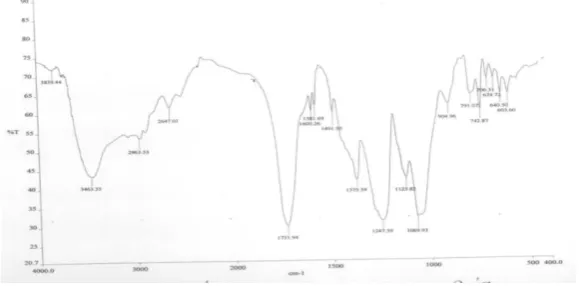
Figure 5: FTIR spectra of drug and polymer mixture
Table 2: FTIR Interpretation drug and polymer mixture Albendazole
S. No. Interpretation IR absorption bands (cm-1)
Characteristic peak Observed peak
1. C–Cl stretch 850–550 742.87
2. C–N stretch 1250–1020 1069.93
3. C–N stretch 1250–1020 1247.59
4. C=O stretch 1740–1720 1731.94
5. O–H stretch 3500–3200 3463.35
Stearic acid
1. C-H Bend 1650-1580 1644
2. C-C Stretch 1600-1585 1546
3. C-H Stretch 3000-2850 2955, 2895
Bees Wax
1. C-Br Stretch 690-515(m) 641.88
2. O-H Bend 950-910(m) 633.87
3. C-O Stretch 1320-1000(m) 1297.71
4. C-H Bend 1470-1450(m) 1456.61
Eudragit RS 100
1. (s)= C-H bend 1000-650 745
2. (s, b) N-H wag 900-675 754
3. (s) C-O stretch 1320-1000 1056
Poloxamer 188
1. C–O stretch 1320–1000 1175
2. C–H wag 1300–1150 1133
3. C–C stretch 1500–1400 1423
4. N–H bend 1650–1580 1602
Drug + Polymer Mixture
1. O-H stretch 3300-2500 3055,2955
2 C-O Stretch 1320-1000 1128
3 N-H Bend 1650-1580 1628
4 N-O Stretch 1550-1475 1509
Formulation of albendazole nanoparticles: They were prepared by hot homogenization method under high speed magnetic stirring using stearic acid as lipid, Bees wax act as a wax and poloxamer 188 as surfactant. On a whole 8 formulations were prepared by changing the different ratios of lipids &Wax. The percentage of surfactant used ranging from 0.5, 0.75, 1.0 & 1.25%).
Figure 6: Scanning Electron Microscope image of the Nanoparticles
Determination of particle size by photon correlation spectroscopy: The Zeta average diameters of the formulations are mentioned in table 3. The values show that the size of the nanoparticles for all formulations ranges from 110.6 ±1.5 nm to 400.9 ± 2.4nm. The effect of various concentrations of lipids and surfactants on the size of the particles was studied.
Determination of zeta potential: The Zeta potential of all the formulations varied between -0.04 ±1.6mV and -9.15 ±1.1 mV and is mentioned in table 3. Poloxamer being a non-ionic surfactant was not able to induce potential on the surface of the nanoparticles and the partial negative observed was due to the charge induced by lipid and and drug.
Determination of entrapment efficiency: The encapsulation efficiencies mentioned in table 3 reveals that the in all the formulations the drug is moderately encapsulated and the values varied between a minimum of 43.56 ± 0.95 to 85.1 ± 0.58%. Albendazole being a hydrophobic drug has shown moderate entrapment in the stearic acid
Drug content: The Drug content mentioned in table 3 reveals that the in all the formulations the drug is moderately encapsulated and the values varied between a minimum of 65.8 % to 98.1% for formulation.
Table 3: Evaluations of Albendazole Nanoparticles Formulation
code Zeta Size (nm) Polydispersity index Zeta potential (mV) Entrapment Efficiency (%) Drug content %)
ANF1 110 ± 1.5 0.215 ±0.23 -4.71 ±1.3 43.56 ±0.95 65.8
ANF2 211 ±1.23 0.304±0.4 -1.16 ±1.7 54.61 ±1.2 69.2
ANF3 227 ± 2.3 0.355 ±0.12 -4.29 ±1.9 47.91 ±1.1 90.3
ANF4 249 ± 0.59 0.215±1.4 -0.261 ±1.2 85.12 ±0.58 98.1
ANF5 332 ± 1.41 0.407 ±1.9 -9.15 ±1.1 45.72 ±0.69 75.2
ANF6 367±0.99 0.521 ±1.3 -0.04 ±1.6 56.34 ±0.55 85.2
ANF7 400 ±2.4 0.02 ±1.1 -4.32 ±2.3 48.01 ±1.2 88.5
ANF8 108 ±0.94 0.656 ±1.8 -7.83 ±0.98 64.9 ± 1.4 78.2
In Vitro drug release studies: In this section, the in vitro
drug release studies have been carried out in pH 7.4 buffer (simulated intestinal pH) using a Dialysis bag which allows only the drug released from the nanoparticles to pass across the membrane. The drug solution was taken in the Dialysis bag which is placed in the buffer and samples are withdrawn
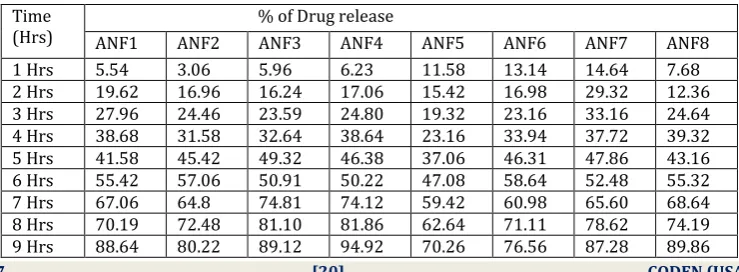
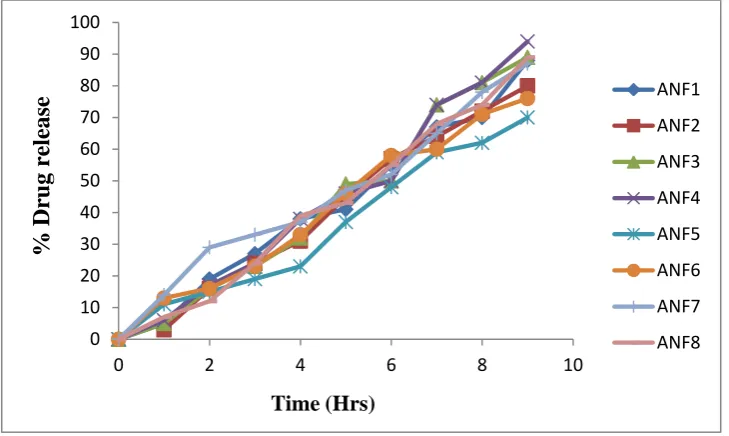
at regular intervals of time for measuring drug concentration. All the formulations release till 10hrs which extend the therapeutic activity in the disease site. The release has followed biphasic pattern where 30-40% of the drug was released in first 1 hr and the remaining got released till 9 hrs.
Table 4: In vitro release release studies of albendazole nanoparticles Time
(Hrs) % of Drug release ANF1 ANF2 ANF3 ANF4 ANF5 ANF6 ANF7 ANF8
1 Hrs 5.54 3.06 5.96 6.23 11.58 13.14 14.64 7.68
2 Hrs 19.62 16.96 16.24 17.06 15.42 16.98 29.32 12.36
3 Hrs 27.96 24.46 23.59 24.80 19.32 23.16 33.16 24.64
4 Hrs 38.68 31.58 32.64 38.64 23.16 33.94 37.72 39.32
5 Hrs 41.58 45.42 49.32 46.38 37.06 46.31 47.86 43.16
6 Hrs 55.42 57.06 50.91 50.22 47.08 58.64 52.48 55.32
7 Hrs 67.06 64.8 74.81 74.12 59.42 60.98 65.60 68.64
8 Hrs 70.19 72.48 81.10 81.86 62.64 71.11 78.62 74.19
Figure 7: In Vitro Release Release Studies of Albendazole Nanoparticles Table 5: Release kinetics of Albendazole Nanoparticles ANF1 TO ANF5
Table 6: Release kinetics of Albendazole Nanoparticles ANF6 TO ANF8
Model ANF 6 ANF 7 ANF 8
R2 M R2 m R2 M
Zero order 0.917 15.49 0.949 154.4 0.937 1593
First order 0.481 0.052 0.465 0.051 0.399 0.061
Higuchi’s Matrix 0.798 1057 0.848 1067 0.899 11409
Korsmeyer-Peppas 0.835 2.032 0.827 2.033 0.785 2.560
Stability Studies: Smaller particles tend to aggregate faster during transport, storage and dispersion. Stability studies were carried out on freeze dried at room temperature (20 - 25°C) and refrigerator (3 to 5 °C) over a period of 2 months. Particle size, appearance of the formulation, drug release and FT-IR were evaluated to confirm the stability of the
formulation. When stored at room temperature, the
formulations showed instability by formation of larger floccules and when dispersed in water the solution turned into heavier particles. Whereas, the formulation when stored
in refrigerated condition was stable with no visible floccules formation. Hence, it is concluded that the formulations should be stored in refrigerated conditions. When stored at room temperature where the size of particles increased from an initial to 343.7 ±7.9 nm at the end of 1 month to 898.1 ± 5.8 nm at the end of 2 months. The Entrapment Efficiency of formulation didn’t show any change during the 60 days of storage in both refrigerated condition and room temperature. The entrapment efficiency is mentioned in table 8 & 9.
Table 8: Particle sizes of the formulations during stability studies
Stability Condition 0 days Average Particle size of DS15 (nm) 1 month 2 months
Room temperature (25°C) 249 ± 0.59 343.7 ±7.9 899.8 ± 5.8
Refrigerated temperature (3 to 5 °C) 249 ± 0.59 255 ± 0.19 280 ± 0.39
Table 9: Entrapment efficiency of formulation on storage condition
Storage condition Day 30 Day 60
Room temperature 73.1 ±0.58% 72.29 ±3.2%
Refrigerated temperature 75.1 ±0.58% 76.53±3.6%
0 10
0 2 4 6 8 10
ANF7
ANF8
Time (Hrs)
Model ANF 1 ANF 2 ANF 3 ANF 4 ANF 5
R2 m R2 m R2 m R2 m R2 m
Zero order 0.655 69.4 0.939 1123 0.007 15.93 0.202 72.88 0.928 1414
First order 0.494 0.061 0.540 0.067 0.257 0.038 0.352 0.044 0.438 0.062
Higuchi’s
Matrix 0.516 4508 0.767 7420 0.023 212.0 0.189 515.5 0.803 9618
SUMMARY & CONCLUSION
The present work was proposed to prepare and optimize
Albendazole loaded Nanoparticle to improve its
bioavailability and reduce its side effects which are caused when given conventionally. Initial pre-formulation studies using FTIR spectroscopy reveals that there are no interactions between Albendazole and other excipients and hence they can be used for the preparation of nanoparticles. Albendazole nanoparticles were prepared by hot homogenization method under high magnetic stirring using stearic acid as lipid and poloxamer 188 was used as surfactant. On whole 8 batches of formulations were prepared by varying the amount of lipid and surfactant and were evaluated for various parameters like particle size, shape, morphology, physical state, entrapment efficiency,
Drug content and in vitro drug release. Particle size was
measured using Malvern Zeta sizer and the size range of the particles was found to be in the range of 110.6 ±1.5 nm to 400.9 ± 2.4nm. Increase in size of nanoparticles was observed when we gradually increase the lipid content. The different concentrations of surfactant were evaluated for optimum one required for the preparation of stabilized solid lipid nanoparticles. The entrapment efficiencies varied from a minimum of 43.56 ± 0.95 % to a maximum of 85.1 ±0.58% and it can be concluded that higher amount of lipid is necessary for obtaining a good entrapment efficiency. The drug content of albendazole nanoparticles for all formulation ranges from 65.8% to 98.1%. Albendazole, being a
hydrophobic drug has moderate entrapment efficiency. A
spherical shape was observed for the particles and the particles had a smooth morphology when examined under SEM. In vitro release studies of the formulations carried out in pH 7.4 PBS showed that the total amount of drug is released for 9hrs with sustained effect. Taking the particle size, entrapment efficiency and in vitro release into account F4 was found out to be the best formulation which has a particle size of 249 ± 0.59 nm and entrapment efficiency of 85.1 ±0.58%. The drug content was release from 98.1%. Further, F4 is one among the few formulations which showed a drug release up to 9hrs, perform with release order kinetics like zero order, first order, Higuchi matrix, korsmeyer peppas it must best fit the model was zero order
kinetics. The stability studies are performed with
appearance of the formulation will stored at room temperature, the formulations showed instability by formation of larger floccules and when dispersed in water the solution turned into heavier particles. Whereas, the formulation when stored in refrigerated condition was stable with no visible floccules formation. The particle size of the formulation is evaluated by photon correlation spectroscopy and the particle size. That the formulations showed a drastic increase in size when stored at room temperature where the
size of particles increased from an initial to 343.7 ±7.9 nm at the end of 1 month to 898.1 ± 5.8 nm at the end of 2 months. Entrapment efficiency of the formulation was determined at each interval to ensure that the drug molecules didn’t undergo any degradation during storage.
REFERENCES
1. Muller R H, Wissing S A and Kayser. Solid lipid nanoparticles for parenteral drug delivery. Adv Drug Del Rev 2004; 56:1257-1272.
2. Wolfgang M, Karsten M. Solid lipid nanoparticles: Production, characterization and applications. Adv Drug Del Rev 2001; 47:165-196.
3. Muller RH, Radtke M, Wissing SA, Solid lipid nanoparticles and nanostructured lipid carriers (NLC) in cosmetic and dermatological preparations, Adv. Drug Deliv. Rev. 2002; 54:131-155.
4. R.H. Muller, K. Mader, S. Gohla, Solid lipid nanoparticles for controlled drug delivery a review of the state of the art, Eur. J. Pharm. Bio harm. 2000; 50: 161– 177.
5. Cavalli R, Caputo O, Carlotti ME, Trotta M, Scarnecchia C, M.R. Gas co, Sterilization and freeze-drying of free and drug-loaded solid lipid nanoparticles, Int. J. Pharm. 1997; 148:47-54. 6. Vijaya Suman Reddy D, Ramesh Y, Parameshwar K, Jhansi
reddy K, Formulation and Evaluation of Mouth Dissolving Tablets of Metoprolol Tartrate by New Coprocessed Technique, Research journal of Pharmaceutical, Biological & Chemical Science, 2011; 2(3):385-390.
7. Puglia C, Samad A, Ali A, Aqil M, Sharma M, Mishra AK. Gelrite-based in-vitro gelation ophthalmic drug delivery system of gatifloxacin. J Disp Sci Tech, 2010; 29:89-96.
8. Ramesh Y, Abhirami B, Gnana Sri K, Kaveri S, Neha Sulthana SK, Sravya A.S.L.S.M., Sujatha K, Formulation And Evaluation Of Oxymetazoline Hydrochloride Nasal Gels, Journal of Drug Delivery & Therapeutics, 2018; 8(6):49-57.
9. Radomska, Bonferoni MC, Rossi S, Ferrari F, Güneri T, Caramella C. Cyclosporine A loaded SLNs: evaluation of cellular uptake and corneal cytotoxicity. Int J Pharm, 2007; 364:76-86 10. Pignatello R, Du YZ, Yuan H, Ye YQ, Zeng S. Preparation and
characterization of stearic acid nanostructured lipid carriers by solvent diffusion method in an aqueous system. Colloids Surf B Biointerfaces, 2006; 45:167-173
11. Puglia C, Samad A, Ali A, Aqil M, Sharma M, Mishra AK. Gelrite-based in-vitro gelation ophthalmic drug delivery system of gatifloxacin. J Disp Sci Tech, 2010; 29:89-96
12. Viswanatha Reddy M, Saravana Kumar K, Ramesh Y, Chanukya Kumar G, Venkateswarlu I, Venkatesh R, Preparation And Evaluation Of Quetiapine Fumarate Microspheres, Journal Of Pharmacy Research, 2011; 4(11):41-43.
13. Casadei M.A, Solid lipid nanoparticles loaded with insulin by sodium cholate-phosphatidylcholine- based mixed micelles: preparation and characterization. Int J Pharm, 2010; 340:153-162.
14. Ramesh Y, Sireesha V, Transdermal Patch of Ramipril Loaded