Available online on 25.08.2019 at http://jddtonline.info
Journal of Drug Delivery and Therapeutics
Open Access to Pharmaceutical and Medical Research© 2011-18, publisher and licensee JDDT, This is an Open Access article which permits unrestricted non-commercial use, provided the original work is properly cited
Open Access
Research Article
Formulation development and evaluation of gastroretentive floating tablets
of ambroxol hydrochloride
Yogendra Malviya*, Avinash Kondalkar
NRI Institute of Pharmacy, Raisen Rd, Gopal Nagar, Bhopal, MP 462022
ABSTRACT
The present study is focused on the development of gastroretentive floating drug delivery system of ambroxol hydrochloride, which acts as a mucolytic agent that is reported to be useful in gastric neoplasms which are designed to increase the gastric residence time, thus prolonging the drug release in the stomach. Gastro retentive floating tablets of ambroxol hydrochloride were prepared by direct compression method using altered concentrations of HPMC K4, HPMC K15 and PVP K30 as polymers. Sodium bicarbonate and citric acid was used as gas releasing agent. The prepared tablets of ambroxol hydrochloride were evaluated for hardness, thickness, friability, weight variation, drug content uniformity, buoyancy lag time, total floating time, in-vitro dissolution study, etc. All the compositions were resulted in adequate Pharmacopoeial limits. Compatibility studies was execution during FTIR shown that there was absence of probable chemical interaction between pure drug and excipients. The varying concentration of gas generating agent and polymers was found to affect on in-vitro drug release and floating lag time. In vitro drug release of floating gastro retentive tablet of ambroxol hydrochloride shown that the formulation F6 was found to be the best formulation as it releases 99.87% in a controlled manner for an extended period of time (up to 12 hrs).The release data was fitted to various mathematical models such as Higuchi, Korsmeyer-Peppas, First order and Zero order to evaluate the kinetics and mechanism of the drug release.The optimized formulation (F6) showed no significant change in physical parameters such as, hardness, friability, weight variation and %drug content for accelerated stability condition at 40±2oC temperature and 75±5% relative humidity for a period 3 months. Prepared
floating tablets of ambroxol hydrochloride may prove to be a potential candidate for safe and effective controlled drug delivery over an extended period of time for gastro retentive drug delivery system.
Keywords: Ambroxol hydrochloride, Gastro retentive floating tablets, Mucolytic agent, Total floating time.
Article Info:Received 21 June 2019; Review Completed 10 Aug 2019; Accepted 16 Aug 2019; Available online 25 August 2019
Cite this article as:
Malviya Y, Kondalkar A, Formulation development and evaluation of gastroretentive floating tablets of ambroxol hydrochloride, Journal of Drug Delivery and Therapeutics. 2019; 9(4-s):1016-1021 http://dx.doi.org/10.22270/jddt.v9i4-s.3732
*Address for Correspondence:
Yogendra Malviya, NRI Institute of Pharmacy, Raisen Rd, Gopal Nagar, Bhopal, MP 462022
INTRODUCTION
The oral bioavailability of many drugs is limited by their unfavourable physicochemical characteristics or absorption in well-defined part of the gastrointestinal tract (GIT) referred as absorption window1. Prolonged gastric retention improves bioavailability, reduces drug waste and improves the solubility for drugs that are less soluble in a high pH environment2. Various approaches have been investigated to increase the retention of oral dosage form in the stomach, including floating systems, swelling, expanding systems, bioadhesive systems, modified shape systems, high density systems and other delayed gastric emptying devices1. Ambroxol hydrochloride is a metabolite of bromhexine and is official in the Martindale Extra pharmacopoeia3. It is chemically described as Trans-4-[(2-Amino-3, 5-dibromo benzyl) amino]-cyclohexanol. It is widely used as an expectorant and a mucolytic agent used in the treatment of
MATERIALS AND METHODS
Materials
Ambroxol hydrochloride was received as gift sample from Trojan Pharma, Baddi, India. Hydroxypropyl methylcellulose (HPMC K4M, HPMC K15M) was procured from Meditab Specialities Pvt. Ltd., Satara. PVP K30 was purchased from S.D fine chemicals, Mumbai. Sodium bicarbonate, citric acid, magnesium stearate, talc were purchased from Mapromax, Life sciences Pvt. Ltd., Dehradun. Other solvents and chemicals used in the research were of LR grade. All the studies were carried in distilled water.
Methods
Preformulation studies
Determination of λ max of Ambroxol hydrochloride
Accurately weighed 10 mg of drug was dissolved in 10 ml of 0.1N HCl solutions in 10 ml of volumetric flask. The resulted solution 1000µg/ml and from this solution 1 ml pipette out and transfer into 10 ml volumetric flask and volume make up with 0.1N HCl solution. Prepare suitable dilution to make it to a concentration range of 5-25μg/ml. The spectrum of this solution was run in 200-400 nm range in U.V. spectrophotometer (Labindia-3000+).
Fourier Transform Infrared (FTIR) spectroscopy
The physical properties of the physical assortment were comparing with those of ambroxol hydrochloride pure drug. Samples was assorted comprehensively through 100mg potassium bromide IR powder as well as compacted under vacuum at a pressure of concerning 12 psi for 3 minutes. The ensuing disc was mounted in an appropriate holder in Brukers Alpha IR spectrophotometer and the IR spectrum was recorded from 3500 cm to 500 cm. The resultant spectrum was compared for any spectrum changes.
Formulation development of Tablets
Direct compression method
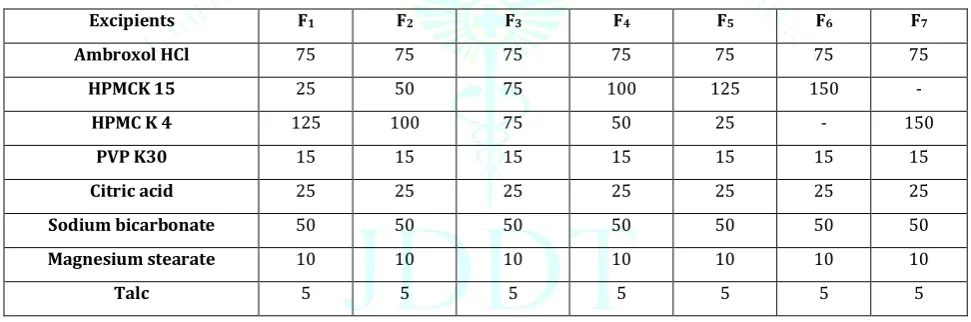
Different tablets formulations (F1-F7) were prepared by direct compression technique. All powders were passed through 40 meshes. Required quantities of drug and polymers were mixed thoroughly, Magnesium stearate was added as lubricant. Talc was used as glidant and sodium bicarbonate and citric acid were used as gas generating agent. Finally the powder mix was subjected to compression after mixing uniformly in a polybag. Prior to compression, the blends were evaluated for several tests8. The composition of ambroxol hydrochloride floating tablets was shown in Table 1.
Table 1 Formulation composition of sustained release gastro-retentive floating tablets of ambroxol hydrochloride
Excipients F1 F2 F3 F4 F5 F6 F7
Ambroxol HCl 75 75 75 75 75 75 75
HPMCK 15 25 50 75 100 125 150 -
HPMC K 4 125 100 75 50 25 - 150
PVP K30 15 15 15 15 15 15 15
Citric acid 25 25 25 25 25 25 25
Sodium bicarbonate 50 50 50 50 50 50 50
Magnesium stearate 10 10 10 10 10 10 10
Talc 5 5 5 5 5 5 5
Evaluation of tablets
All the tablets were evaluated for following different parameters which includes;
General Appearance
Five tablets from various batches were randomly selected and organoleptic properties such as color, odor, taste, shape were evaluated. Appearance was judged visually. Very good (+++), good (++), fair (+) poor (-), very poor (- -).
Thickness and diameter
Thickness and diameter of tablets were determined using Vernier caliper. Five tablets from each batch were used and an average value was calculated.
Hardness
For each formulation, the hardness of five tablets was determined using the Monsanto hardness tester (Cadmach). Friability
The friability of a sample of 10 tablets was measured using a Friability tester (Electro Lab).Ten tablets were weighed,
rotated at 25 rpm for 4 minutes. Tablets were reweighed after removal of fines (dedusted) and the percentage of weight loss was calculated.
Uniformity of weight
Twenty tablets were randomly selected from each batch individually weighed, the average weight and standard deviation of 20 tablets was calculated.
Drug content
In vitro buoyancy studies
In vitro buoyancy was determined by floating lag time as per the method described by Rosa et al9. The tablets were separately in a 100 ml glass beaker containing simulated gastric fluid (SGF), pH 1.2 as per USP. The time necessary for the tablet to increase to the outside and float was determined as floating lag time. The experiments were conducted in triplicate. Total floating times were measured during in vitro dissolution studies.
Dissolution rate studies
In vitro drug release of the sample was done using USP-type II dissolution apparatus (Paddle type). The dissolution medium, 900 ml 0.1N HCl was set into the dissolution flask maintaining the temperature of 37±0.50c and rpm of 75. One ambroxol hydrochloride tablet was set in every container of dissolution apparatus. The mechanical assembly was permitted to keep running for 10 hours. Sample measuring 5 ml were pulled back after each 1 hour up to 10 hours using 10ml pipette. The new disintegration medium (370C) was supplanted each time with a similar amount of the sample and takes the absorbance at 244nm using spectroscopy10-12.
Mathematical treatment of in-vitro release data
The quantitative analysis of the qualities got in dissolution/release tests is simpler when mathematical formulas that express the dissolution comes about as an element of a portion of the measurement frames attributes are utilized.
Zero-order kinetics
The pharmaceutical dosage frames following this profile release a similar measure of medication by unit of time and it is the ideal method of medication release keeping in mind the end goal to accomplish a pharmacological prolonged action. The following relation can, in a simple way, express this model:
Qt = Qo + Ko t
Where Qt is the amount of drug dissolved in time t, Qo is the initial amount of drug in the solution (most times, Qo=0) and Ko is the zero order release constant.
First-order kinetics
The following relation expresses this model:
Where Qt is the amount of drug dissolved in time t, Qo is the initial amount of drug in the solution and K1 is the zero order release constant.
Along these lines a graphic of the decimal logarithm of the released measure of drug versus time will be linear. The pharmaceutical dosage shapes following this dissolution profile, for example, those containing water-solvent drugs in permeable frameworks, discharge drug in a way that is corresponding to the measure of drug staying in its inside, in such way, that the measure of drug released by unit of time reduce.
Higuchi model
Higuchi built up a few theoretical models to ponder the arrival of water-solvent and low dissolvable medications in semi-strong or potentially strong grids. Mathematical expressions were acquired for sedate particles scattered in a
uniform grid acting as the diffusion media. The simplified Higuchi model is expressed as:
Where Q is the amount of drug released in time t and KH is the Higuchi dissolution constant. Higuchi model describes drug release as a diffusion process based in the Fick’s law, square root time dependent. This relation can be utilized to portray the drug dissolution from a few kinds of modified release pharmaceutical dosage structures, for example, transdermal systems and matrix tablets with water-dissolvable drugs.
Korsmeyer-Peppas model
Korsmeyer et al. used a simple empirical equation to describe general solute release behaviour from controlled release polymer matrices:
Where Mt/Mis fraction of drug released, is kinetic constant, t is release time and n is the diffusional exponent for drug release. ’n’ is the slope value of log Mt/M versus log time curve. Peppas stated that the above equation could adequately describe the release of solutes from slabs, spheres, cylinders and discs, regardless of the release mechanism. Peppas used this n value in order to characterize different release mechanisms, concluding for values for a slab, of n =0.5 for fickian diffusion and higher values of n, between 0.5 and 1.0, or n =1.0, for mass transfer following a non-fickian model. In case of a cylinder n =0.45 instead of 0.5, and 0.89 instead of 1.0. This equation can only be used in systems with a drug diffusion coefficient fairly concentration independent. To the determination of the exponent n the portion of the release curve where Mt/M < 0.6 should only be used. To use this equation it is also necessary that release occurs in a one-dimensional way and that the system width-thickness or length-width-thickness relation be at least 10. A modified form of this equation was developed to accommodate the lag time (l) in the beginning of the drug release from the pharmaceutical dosage form:
When there is the possibility of a burst effect, b, this equation becomes:
In the absence of lag time or burst effect, l and bvalue would be zero and only atn is used. This mathematical model, also
known as Power Law, has been used very frequently to describe release from several different pharmaceutical modified release dosage forms13-15.
Stability studies
interval and evaluated for physical parameters such as, hardness, friability, weight variation and %drug content.
RESULTS AND DISCUSSION
The λmax of ambroxol hydrochloride was found to be 244 nm by using UV spectrophotometer (Labindia-3000+) in linearity range 5-25µg/ml Fig.1. Identification of ambroxol hydrochloride was done by FTIR spectroscopy with respect to marker compound. It was identified from the result of IR spectrum as per specification. Ambroxol hydrochloride tablet quality control tests such as weight variation, hardness and friability, thickness, drug content and drug release studies in 0.1 N HCl were performed on the compression tablet. All the parameters such as weight variation, hardness, friability, thickness and drug content were found to be within limits Table 2.
Fig. 1 Determination of λmax of ambroxol hydrochloride
Table 2 Results of post compression properties of ambroxol hydrochloride GRF tablets
F. code Thickness
(mm) Hardness (kg/cm2)
Weight variation
(mg) Friability (%) Drug content (%) Total floating duration (h) F1 3.53±0.05 4.8 328.19± 2.94 0.58 ± 0.10 98.33± 0.92 8 F2 3.94± 0.10 4.4 332.18 ± 3.77 0.51 ± 0.08 97.20 ± 0.34 10 F3 3.96± 0.05 4.5 335.33 ± 1.50 0.38 ± 0.12 99.60 ± 1.39 >12 F4 3.95± 0.05 4.7 336.30 ± 3.30 0.16 ± 0.04 98.14 ± 1.69 >12 F5 3.93± 0.10 5.2 327.13 ± 2.83 0.31 ± 0.07 97.21 ± 1.07 >12 F6 4.03± 0.06 5.3 332.16 ± 2.33 0.27 ± 0.05 97.50± 1.81 >12 F7 4.05± 0.05 4.8 338.18 ± 3.11 0.29 ± 0.08 98.34 ± 0.37 >12
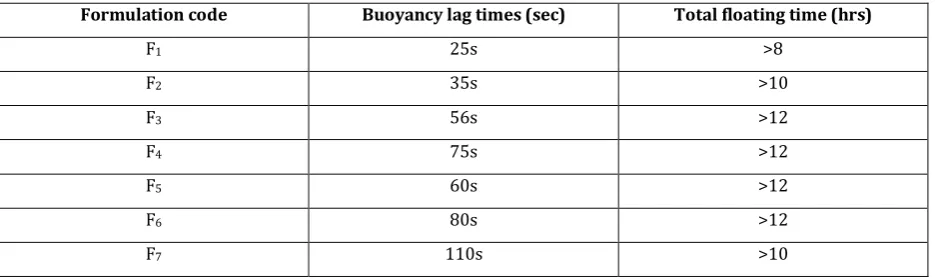
In the present study 7 formulations with variable concentration of polymers (HPMC K4, K 15) were prepared by direct compression method and evaluated for physicochemical properties. The results of buoyancy lag time, total floating time and in vitro drug release was given in Table 3, 4. The results indicated that optimizes formulation F6 on immersion in 0.1N HCl at 37±0.50C tablets immediately and remain buoyant up to 12hr without disintegration. These 2 factors are essential for tablets to acquire density< 1, so that it remains buoyant on the gastric fluids. The in vitro
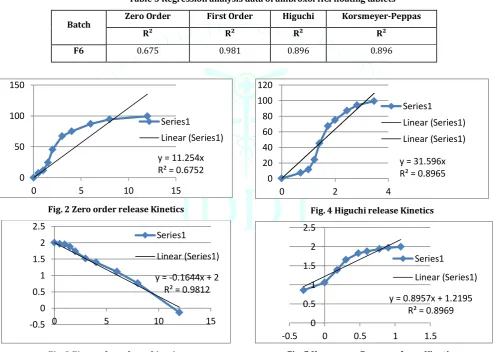
drug release data of the optimized formulation was subjected to goodness of fit test by linear regression analysis according
to zero order, first order kinetic equation, higuchi’s and korsmeyer’s models in order to determine the mechanism of drug release. When the regression coefficient values of were compared, it was observed that ‘r’ values of first order was maximum i.e. 0.981hence indicating drug release from formulations was found to follow first order release kinetics. Table 5 & Fig. 2-5. After storage of sustained release gastro-retentive floating tablets of ambroxol hydrochloride (F6) were analyzed for various physical parameters, results are showed in table. 6. Therefore formulation remains stable for sufficient time.
Table 3 Results of in-vitro buoyancy study of ambroxol HCl
Formulation code Buoyancy lag times (sec) Total floating time (hrs)
F1 25s >8
F2 35s >10
F3 56s >12
F4 75s >12
F5 60s >12
F6 80s >12
Table 4 In-vitro drug release study of GRF tablets
Time % of Drug Release
(hr) F1 F2 F3 F4 F5 F6 F7
0.5 08.23 07.14 07.24 08.23 07.23 07.45 08.32 1 12.32 10.23 11.45 10.45 10.45 11.23 12.23 1.5 26.23 22.42 24.23 23.76 31.23 38.23 32.13 2 42.45 40.32 45.23 44.23 48.23 46.32 47.14 3 76.34 66.11 67.21 65.71 50.56 67.02 71.13 4 82.23 77.33 75.11 82.34 55.00 88.13 91.23 6 82.55 97.13 87.13 83.00 56.00 99.13 92.00 8 83.00 97.10 94.23 83.21 57.25 99.99 93.00 12 84.21 97.23 99.26 83.50 57.85 99.87 94.56
Table 5 Regression analysis data of ambroxol HCl floating tablets
Batch Zero Order First Order Higuchi Korsmeyer-Peppas
R² R² R² R²
F6 0.675 0.981 0.896 0.896
Fig. 2 Zero order release Kinetics
Fig. 3 First order release kinetics
Fig. 4 Higuchi release Kinetics
Fig. 5 Korsmeyer-Peppas release Kinetics
Table 6 Evaluation parameters of stability batch of ambroxol HCl Evaluation
parameters Before stability After 1 month storage After 2 months Storage After 3 months storage
Hardness (kg/cm2) 5.2±0 5.2±0 5.2±0 5.2±0
Friability (%) 0.31 0.33 0.34 0.34
Drug content (%) 98.3±0.49 97.84±0.3 97.45±0.37 97±0.03
Weight variation
(mg) 327.13±2.8 327.37±0.39 328.09±0.75 328.03±0.45
y = 11.254x
R² = 0.6752
0
50
100
150
0
5
10
15
Series1
Linear (Series1)
y = -0.1644x + 2
R² = 0.9812
-0.5
0
0.5
1
1.5
2
2.5
0
5
10
15
Series1
Linear (Series1)
y = 31.596x
R² = 0.8965
0
20
40
60
80
100
120
0
2
4
Series1
Linear (Series1)
Linear (Series1)
y = 0.8957x + 1.2195
R² = 0.8969
0
0.5
1
1.5
2
2.5
-0.5
0
0.5
1
1.5
Series1
CONCLUSION
Ambroxol HClfloating tablets were successfully formulated by floating technique. The optimized formulation (F6) was selected on the basis of in vitro buoyancy and in vitro drug release. The addition of gel forming agent and gas generating agent was essential to achieve in vitro buoyancy. The results of the in vitro drug release and in vitro buoyancy study showed that the optimized formulation (F6) sustained the drug release (99.87) up to 12 hrs and remained buoyant for >12 hrs. Optimized formulation (F6) does not show any significant change in physical parameters such as hardness, friability, weight variation and %drug content after storage at 40°C/75% RH and stable for 3 months.
REFERENCES
1. Shahi S, Sonawane A, Vanamore S, et al. Formulation and in-vitro characterization of acyclovir floating matrix tablets: a factorial design study. J Appl Pharm Sci 2013; 3:65-68. 2. Yadav A, Jain D. Formulation development and
characterization of gastroretentive floating beads. Asian J Pharm Med Sci 2012;2: 1-10.
3. Sweetman C: Martindale, the Extra Pharmacopoeia. The Pharmaceutical Press, 34th Edition 2005.
4. Barzeh H, Sogali BS, Shedvar S. A Review on extended release matrix tablets. J Pharm Res 2016; 15(4): 147-152.
5. Tripathi KD: Essentials of medical pharmacology. Jaypee brother’s medical publisher’s Pvt. Ltd., 7th Edition 2013.
6. Jaya S, Srilaxmi G. Formulation and in-vitro characterization of ambroxol hydrochloride sustained-release matrix tablets. Int J Pharm Sci Res.2019; 10(3): 1208-1213.
7. Pawar HA, Gharat PR, Dhavale RV, et al. Development and evaluation of gastroretentive floating tablets of an antihypertensive drug using hydrogenated cottonseed oil. ISRN Pharmaceutics 2013; Article ID 137238.
8. Ambati BR, Samyuktha Rani B, Sivanaga Raja D, et al. Aceclofenac floating tablets- a promising suatained release dosage form. Int J Drug Develop Res 2011; 3: 290-300. 9. Rosa M, Zia H, Rhodes T. Dosing and testing in-vitro of a
bioadhesive and floating drug delivery system for oral application. Int J Pharm 1994; 105:65-70.
10. Rajesh K, Usharani E, Nagaraju R. Design and evaluation of sustained release floating tablets for the treatment of gastric ulcer. J Pharm Sci Res 2009;1(4): 81-87.
11. Patil JM, Hirlekar RS, Gide PS. Trends in floating drug delivery systems. J Sci Ind Res 2006;65(01):11-21.
12. Ritger PL, Peppas NA. A Simple equation for description of solute release fickian and anomalous release from swellable devices. J Control Release 1987;5(1):37-42.
13. Brahamankar DM, Jaiswal SB. Biopharmaceutics and pharmacokinetics e a treatise, pharmacokinetics: basic consideration. 2nd ed. Vallabh Prakashan; 2009. pp. 240-3.
14. Higuchi T. Mechanism of sustained action medication, theoretical analysis of rate of release of solid drugs dispersed in solid matrices. J Pharm Sci 1963; 52:1145-9.