World Maritime University
The Maritime Commons: Digital Repository of the World
Maritime University
World Maritime University Dissertations
Dissertations
2006
Non-conventional ferry safety and the potentiality
of inland waterways for multimodal transportation :
a comparative analysis for the betterment of
Bangladesh's situation
Quazi Mohammed Habibus Sakalayen
World Maritime UniversityFollow this and additional works at:
http://commons.wmu.se/all_dissertations
This Dissertation is brought to you courtesy of Maritime Commons. Open Access items may be downloaded for non-commercial, fair use academic purposes. No items may be hosted on another server or web site without express written permission from the World Maritime University. For more
Recommended Citation
Sakalayen, Quazi Mohammed Habibus, "Non-conventional ferry safety and the potentiality of inland waterways for multimodal transportation : a comparative analysis for the betterment of Bangladesh's situation" (2006).World Maritime University Dissertations. 343.
WORLD MARITIME UNIVERSITY
Malmö, Sweden
NON-CONVENTION FERRY SAFETY AND THE
POTENTIALITY OF INLAND WATERWAYS
FOR MULTIMODAL TRANSPORTATION: A
COMPARATIVE ANALYSIS FOR THE
BETTERMENT OF BANGLADESH’S SITUATION
By
QUAZI MOHAMMED HABIBUS SAKALAYEN
Bangladesh
A dissertation submitted to the World Maritime University in partial fulfilment of the
requirements for the award of the degree of
MASTER OF SCIENCE
In
MARITIME AFFAIRS
(SHIPPING MANAGEMENT)
2006
Declaration
I certify that all the material in this dissertation that is not my own work has been identified, and that no material is included for which a degree has previously been conferred on me.
The contents of this dissertation reflect my own personal views, and are not necessarily endorsed by the University.
(Quazi Mohammed Habibus Sakalayen)
Date: ……….
Supervised by:
Mr. Jan-Åke-Jönsson
Professor, Maritime Safety and Environment Protection World Maritime University
Internal Assessor:
Mr. Patrick Donner
Associate Professor, Port and Shipping Management World Maritime University
External Assessor:
Mr. Åke Sjöblom Chief Surveyor
Acknowledgements
First and foremost I would like to thank Mr. Yohei Sasakawa for providing me with the opportunity and sponsorship to study at the World Maritime University (WMU). I am also grateful to the Secretary, Ministry of Shipping, Bangladesh for selecting me to study at WMU. I am highly indebted to my supervisor Professor Jan-Åke-Jönsson for his valuable time, directives and guidance. My sincere thanks are also due to my Course Professor Mr. Patrick Donner for his tremendous support and inspiration and to Mr. Clive Cole, Lecturer of the WMU for his valuable suggestions and linguistic help.
I am grateful to Capt Moin Ahmed, Head, Asia and Pacific Geographical Focal Points, Technical Co-operation Division, IMO and Ms. Marianne Harvey, Head, IMO library Services for their valuable assistance. I am also thankful to the academic staffs Mr. Bruce Browne, the Academic Registrar of the University, Ms. Sue Jackson, Ms. Lyndell Lundhal, and Ms. Denise Wilson for their ever-willing and untiring help and assistance whenever required. My heartfelt gratitude goes to Ms. Susan Wangeci-Eklow, Ms. Cecilia Denne, Mr. Robert Bauchspies and Ms. Susanne Forsberg for their tremendous support from the WMU library.
My appreciation goes to Mr. Zahid Hossain, Chief Inspector, Department of Shipping, Bangladesh for his inestimable assistance in providing me with information needed for this study. I am also thankful to my Bangladeshi colleagues here in the WMU for their continuous support.
I am most grateful to my mother and my wife for their prayers, endurance, understanding and uncomplaining support throughout my absence from home in pursuit of this program of study at the World Maritime University.
Abstract
Title of dissertation: Non-convention ferry safety and the potentiality of inland waterways for multimodal transportation: a comparative analysis for the betterment of Bangladesh’s situation.
Degree: MSc
This dissertation is a study of the non-convention ferry safety issue and the inland waterways of Bangladesh to identify the needs of technical support for improving the ferry safety through translating the potentiality of the inland waterways as a multimodal element. Ensuring non-convention ferry safety is an important issue for Bangladesh as it is for developing countries like Somalia, Indonesia, Congo and Senegal. Each year hundreds of people die in these nations because of non-convention ferry accidents. In Bangladesh non-non-convention ferry accident is a regular phenomenon where poor rural people suffer most as it is the only effective transportation system for them. No effectual and sustainable measures have been detected so far in Bangladesh to prevent the non-convention ferry accidents which indicate the lack of expertise, resources and support. This research studies the causes of the ferry accidents in Bangladesh concentrating on the examination of the geographical, regulatory and operating environments of the non-convention vessels in the backdrop of the entire transportation system. It also examines the level of technology and business environment within the non-convention ferry sector and the inland waterways to apprehend the potentiality of the sector.
The research reviews the inland waterways of Europe and their efforts preparing IWT sector as a multimodal element, hence weighing up the potentiality of the inland waterways of Bangladesh. For Bangladesh the inland waterways transport is the sustainable development element as it requires less energy, less space and in near future continuous flow of costly energy is going to be a crucial factor for the country. Finally, the concluding chapters identify the loopholes, propose for the technical assistances and present recommendations to enhance the non-convention ferry safety and materialize the potentiality of the inland waterways of Bangladesh.
Keywords: Non-convention, Ferry safety, Multimodal, Transportation,
Table of Contents
Declaration... ii
Acknowledgements ...iii
Abstract...iv
Table of Contents... v
List of Tables...viii
List of Figures ...ix
List of Abbreviations... x
Chapter 1 ... 1
Non-Convention Ferry Safety and the Concept of Multimodal Transportation... 1
1.1 Introduction ... 1
1.2 Non-convention ferry safety ... 1
1.3 Concept of multimodal transport ... 2
1.4 Problems ... 3
1.5 Objectives ... 5
1.6 Methodology... 6
1.7 Structure of the dissertation ... 7
Chapter 2 ... 9
Bangladesh and Its Transport System ... 9
2.1 Bangladesh and Its Geography... 9
2.2 River System of Bangladesh... 10
2.3 Economy of Bangladesh ... 11
2.4 Transportation System ... 12
2.4.1 Seaports... 12
2.4.2 Air Transport ... 13
2.4.3 Inland Transport ... 13
2.5 Accidents in different modes of transportation ... 16
2.6 Resource allocation for IWT... 17
Chapter 3 ... 18
Non-convention Ferry Accidents in Bangladesh ... 18
3.1 Nature of ferry accidents ... 18
3.3 Causes of accidents: a theoretical perspective... 20
3.3.1 Poor maritime administration and monitoring system ... 21
3.3.2 Faulty design and construction of vessels ... 23
3.3.3 Inadequate regulations and enforcement... 24
3.3.4 Poor manpower and training system... 26
3.3.5 Absence of proper funding and insurance policy ... 26
3.3.6 Poor waterways and infrastructure... 27
3.4 Responsibilities of different quarters ... 27
Chapter 4 ... 29
Safety Regulations and Codes for Non-Convention Vessels... 29
4.1 Ferry accidents in other countries ... 29
4.2 Causes of the accidents and lessons learnt... 31
4.3 Safety codes for non-convention vessels developed by IMO ... 32
4.3.1 Safety regulations for non-convention ships in the Asian region ... 33
4.3.2 Code of safety for Caribbean cargo ships (CCSS Code)... 33
4.3.3 Safety regulations for non-convention vessels in the Pacific region ... 34
4.3.4 Model safety regulations for inland waterways vessels and non-convention craft in Africa ... 35
4.3.5 Safety regulations for cargo ships not covered by the provisions of IMO Conventions in the Mediterranean region ... 35
4.4 The National Shipping Policy and the Inland Shipping Ordinance of Bangladesh ... 36
4.5 Analysis of the regional efforts and the situation of Bangladesh... 39
Chapter 5 ... 43
Inland Waterways in Europe and the Comparative Scenario of Bangladesh... 43
5.1 Introduction ... 43
5.2 Inland waterways of Europe... 43
5.3 Benefits of inland waterways for EU countries... 47
5.4 Bangladesh: A comparative picture ... 48
Chapter 6 ... 50
Potentiality of Inland Waterways as a Multimodal Element... 50
6.1 Inland waterways as a tool of multimodal transport ... 50
6.2 Indirect use of inland waterways ... 51
6.3 Economy of scale... 51
6.4 Inland river ports as freight hub... 52
6.5 Interoperability... 53
6.6 IT, regulation and policy ... 54
6.7 Trade Facilitation... 55
6.8 Sea-port Connectivity... 56
6.9 Supply Chain Integration... 57
Chapter 7 ... 60
Conclusions and Recommendations... 60
7.1 Introduction ... 60
7.2 Conclusions... 60
7.3 Recommendations ... 64
References... 69
Appendix A... 76
Tables Appendix B... 90
SWOT analysis Tentative policy matrix Appendix C ... 92
The map of the rivers of Bangladesh Appendix D ... 93
List of Tables
Table 1: Ferry Fatalities in the recent past ... 76
Table 2: Fundamental statistics on Bangladesh... 77
Table 3: Freight handling statistics in Chittagong Port Authority (CPA) ... 78
Table 4: Performance related statistics of CPA... 78
Table 5: Classified navigable inland waterways of Bangladesh... 79
Table 6: Passenger/Freight flows and modal shares ... 79
Table 7: Reported road accident trend in Bangladesh (1993-2000) ... 80
Table 8: The trend of resource allocation for IWT sector in ADP ... 80
Table 9: Factors behind water transport accidents ... 81
Table 10: Types, frequency, weather condition, and time of ferry accidents (DOS report based) ... 82
Table 11: Months and region of ferry accident during 1995 – 2005 (DOS report based) ... 83
Table 12: Types frequency, weather condition, and time of ferry accidents (ARC statistics) ... 84
Table 13: Months of ferry accident during 1995 – 2005 (ARC statistics) ... 85
Table 14: Modal shares (in percentage for the year 2002) of 8 EU riparian countries for all surface freight ... 86
Table 15: Cost comparison of the three modes of transport in Bangladesh... 87
Table 16: Passenger and freight transportation statistics of important river ports.. 87
Table 17: Trade gains (in $ million) from capacity building by some South Asian countries... 88
Table 18: Comparison between Bangladesh IWT and the Netherlands IWT ... 89
Table 19: SWOT analysis of the IWT of Bangladesh ... 90
List of Figures
Figure 1: Macro-economic trend of Bangladesh... 11
Figure 2: IWT accident trend in Bangladesh ... 16
Figure 3: The trend of IWT allocation in Annual Development Program ... 17
Figure 4: Causes of accident (DOS report) ... 19
Figure 5: Causes of accident (ARC Statistics) …………...….………...……….19
Figure 6: Regions of accident (DOS report) ... 20
List of Abbreviations
ADP Annual Development Program ARC Accident Research Centre
BIWTA Bangladesh Inland Water Transport Authority BIWTC Bangladesh Inland Water Transport Corporation BUET Bangladesh University of Engineering and Technology DOS Department of Shipping
NGO Non-governmental Organization IMO International Maritime Organization
SOLAS International Convention for Safety of Life at Sea, 1974 and its Protocol of 1978
MARPOL International Convention for the Prevention of Pollution from Ships, 1973, as modified by the protocol of 1978
GOB The Government of the People’s Republic of Bangladesh ILLC International Convention on Load Lines, 1966
COLREG International Regulations for Preventing Collisions at Sea 1972 EPIRB Electronic Position-Indicating radio Beacon
GMDSS Global Maritime Distress and Safety System
STCW International Conventions on Standards of Training, Certification and Watchkeeping for Seafarers 1978, as amended in 1995 and 1997 CAAB Civil Aviation Authority of Bangladesh
CCSS Code of Safety for Caribbean Cargo Ships USL Uniform Shipping Laws Code of Australia DNV Det Norske Veritas
MoU Memorandum of Understanding HSLC High Speed Light Craft
PACSCAT Partial Air Cushion Supported Catamaran DMP Decision Making Procedure
Chapter 1
Non-Convention Ferry Safety and the Concept of Multimodal
Transportation
1.1 Introduction
Safety is always a live issue in the sense that it needs continuous monitoring and improvement. In other words, safety on the whole means the process to care for human lives from accidents or incidents of misfortune and is certainly related with the steps to prevent or reduce mistakes. However, to increase safety is always to be realistic and far-sighted. In Bangladesh non-convention ferries plying the inland waterways have serious safety problems. Each year hundreds of people die because of non-convention ferry accidents. The main objectives of this research are to identify the causes of the non-convention ferry accidents in Bangladesh for finding the loopholes and obstacles and pointing out the areas where technical assistances are required and to evaluate the potentiality of inland waterways as a complementary tool for multimodal transportation in an intention to enhance the overall ferry safety in the inland waterways of Bangladesh.
1.2 Non-convention ferry safety
Ghana costing 120 lives and the ‘Alexandros T’ incident near South Africa in May 2006 cost 26 crew members. Out of these six accidents five disasters took place very near to the coast or in internal waters and four of them concerned non-convention vessels (Mitropoulos, 2006 May 6). In recent years, hundreds of people have died in developing nations like Bangladesh, Somalia, Indonesia, Congo and Senegal; it being regular phenomenon in these countries. This is depicted in Table 1 and the statistics are based only on the recovered bodies let alone the missing bodies. A lack of specific documentation is a hindrance in knowing the exact number of fatalities(Lawson et al, 2005, pp.18-19).
With this picture in mind, the safety of non-convention vessels is not an ignorable issue in this modern world even for IMO, which is not directly involved with this type of vessels. Non-convention vessels usually ply in the inland waterways of different countries where the inland waterway is an important mode of transportation. As the world is becoming more and more globalized, the demand for a safer and better infrastructure of every mode of transportation is inevitable, which the inland waterways can offer very easily. In other words, the necessity of the multimodal transportation system is unavoidable for a country to exist in the global economy where inland waterways can play a vital role.
1.3 Concept of multimodal transport
Multimodal transportation has eventually made the door-to-door service easy and smooth. The invention of the container has revolutionized the idea of multimodal transportation. Nowadays, a great number of multimodal activities are the common picture at a port i.e. at the land-water boundary. Multimodal activities such as truck-to-rail, truck-to-air are also popular in the transportation sector. In some geographical areas such as in Germany, Netherlands, USA, Canada and China, coastal and inland waterways are widely used for transportation. Inland waterways can contribute firmly towards the further development of multimodal transportation.
The lack of flexibility and relatively low speed are the only limitations of inland waterways which have to be overcome. Investments in inland waterways not only flourish multimodality, but will develop an environment-friendly transportation system, reduce congestion on the land-based transport system and eventually help establish safety in the inland waterways, which is usually a neglected sector. An emphasis on inland waterways would be a positive step for a populous and space scarce country like Bangladesh, for the development of multimodal transportation and ensuring the safety of the vessels.
1.4 Problems
In Bangladesh, non-convention ferry accidents cause hundreds of fatalities each year. But ferry transport is significant because rural people use it effectively and the ferry system is more environmentally friendly and sustainable, needs less capital investment for expansion and improvement and has numerous values for economic growth (Lawson et al, 2005, pp.19-20). So, when accidents take place rural poor
people become the first victims. Beside this, the same types of accidents take place again and again causing the deaths of hundreds of valuable lives, but no preventive measure has been detected so far. Rather, it seems that the non-convention ferry sector has fallen into a vicious circle.
which operates very limited safe passenger and cargo transport services. The improvement of the entire business environment of the non-convention ferry sector of Bangladesh, including the technical level of design scrutiny, construction supervision, methodology of survey, judgements of the technical fitness of the vessel are the big challenges to overcome.
Road construction in Bangladesh is such a popular agenda item for politicians that this has reached nearly to a saturated level. Sometimes roads are constructed by filling up waterways when they become dry during winter. Rural roads are constructed without proper planning resulting in water logging during the monsoon. Considering Bangladesh as a growing economy, her transport system, particularly the multimodal transportation probability, has not been focused upon where inland waterways and railways can play a vital role. The potentiality of the inland waterways of Bangladesh as a multimodal element has not been researched extensively. Since Bangladesh is a country where rivers are spread like a fishing net, the multimodal opportunity cannot be materialised without involving inland waterways. How the supply chain, including the transportation system, can be made consistent is still an unanswered low priority question.
In general, the problems of ferry safety can be better understood when the questions to be asked regard bodies that organize, make the policies, formulate and enforce regulations. Questions to be answered are on the level of use of technology, how are the standards and procedures of inspection, training, certification, search and rescue system, reporting and analysis system and the involvement of public and private sectors for a continuous improvement of the efforts (Lawson et al, 2005,
1.5 Objectives
Transportation is at the core of economic development for a country. For Bangladesh the ferry system is the major constituent of the transportation systems. For this reason, a lack of safety in the ferry system of Bangladesh will be economically devastating. A safe and reliable ferry system is also crucial and evident to the nation’s sustainable future. Despite the fact that ferries also produce emissions, they have a lower environmental impact than other forms of transportation (Lawson et al, 2005, p.20). So, understanding the ferry safety issues
of Bangladesh is obviously significant for the country. The majority of the rural people of Bangladesh will benefit from the growth and improvement of a safe ferry sector, which in turn will have a direct and positive impact on the economy. One of the objectives of this study is to put the existing scenario of the non-convention ferry safety and the potentiality of inland waterways of Bangladesh on the table, so that the preliminary task of finding a model for the development of the entire sector can be established.
The nature and causes of ferry accidents in Bangladesh are multifarious and complex. Statistics regarding accidents are not authenticated and well preserved. It is essential to find the loopholes and obstacles against the documentation process. Good statistics will eventually help find the root causes and will create a basic platform for further meaningful study of the sector. This study undertakes to examine the loopholes in the documentation system and to identify the causes of ferry accidents in Bangladesh.
Each system has its own rules, regulations and policy direction that may be either good or bad but these usually generate over a long period of time. It is always worthwhile to know the prevailing regulatory and strategic standpoint of a system before devising a new or way out dimension. One of the objectives of this study is to examine the existing rules and regulations and government policy for the ferry sector in Bangladesh.
suitable process. This study takes the opportunity to compare ferry safety and the multimodal potentiality of the inland waterways of Bangladesh with those of other countries in the world and analyze the needs of technical assistance for the sector. The creation of investment opportunities for inland waterways could be a positive step to increase safety. The potentiality of inland waterways for multimodal transportation can be utilized for this purpose.
Finally, this study intends to make proposals and recommendations to improve the ferry safety of Bangladesh and to utilize the inland waterways optimally for the development of multimodal transportation.
1.6 Methodology
In order to achieve the above-mentioned objectives, a literature review, the collection and examination of data, interviews with the relevant persons, and analyses of the issues have been conducted.
Non-convention ferries in Bangladesh are used mainly for passenger transportation and for some cargo transportation. Locally this type of ferry is known as a ‘launch’. For this reason, sometimes the term ‘launch’ has been used to mean ‘non-convention ferry’ in this study.
When the safety of a system or process is in question, at that time statistics always help reveal the truth and find the loopholes so that corrective measures can be taken for a sustainable system or process. In the same way, the deteriorated scenario of the non-convention ferry safety in Bangladesh is well understood through statistics. Statistics of non-convention ferry accidents in the inland waterways of Bangladesh have been collected from two different sources. Statistics from the Department of Shipping (DOS), Bangladesh and Accident Research Centre of the Bangladesh University of Engineering and Technology (BUET) have been used in this study.
regulations for non-convention vessels for various parts of the world developed by IMO, shipping policy and inland shipping ordinance of Bangladesh, the media, especially newspapers, research reports of professionals, web-based documents and library-based books, magazines, journals, articles and previous dissertations have all served as vital sources of information. Various transport documents of the European Union and casualty investigation reports and procedures have provided an opportunity to depict a comparative picture.
It is worthwhile mentioning here that recently IMO, in co-operation with Interferry, finalized a program to reduce the ferry casualties in the developing world with a special focus on Bangladesh. Important information from IMO and Interferry helped to enrich this study. It is remarkable to note here that a consultation with the head of the technical division, Asia and Pacific section of IMO’s Technical Co-operation Division, a key person to the IMO-Interferry program, was very stimulating and informative.
Documents of some European countries and their ongoing efforts are helpful to understand the strengths, weaknesses, opportunities and threats of the inland waterways of Bangladesh as a multimodal tool, and to present a comparative picture.
1.7 Structure of the dissertation
Depending on the strategies and tools mentioned above, the entire dissertation has been pursued in the following chapters:
As already illustrated, Chapter I presents the issue of non-convention ferry safety in Bangladesh. The basic concept of multimodal transportation, the problems, objectives and methodology of the study are also described in this chapter.
Chapter III, one of the core chapters, deals with the nature and causes of ferry accidents in Bangladesh. It analyses the issue statistically and theoretically and describes the role of different quarters in this issue.
Chapter IV looks into the ferry accidents in other countries and evaluates the safety codes for non-convention vessels for various parts of the world developed by IMO. It also highlights the legislative framework, existing facilities, policies and strategies of the Bangladesh government on the relevant issues and identifies the need for reform and the necessity of technical support.
Chapter V pictures the inland waterways of Europe and their ongoing efforts on the inland waterways. It evaluates the significance of the inland waterways of Bangladesh in the backdrop of the European scenario.
Chapter VI appraises the inland waterways of Bangladesh as a complementary tool for the development of Multimodal transportation in Bangladesh and relates the non-convention ferry safety with the potentiality of inland waterways as a multimodal element.
Chapter 2
Bangladesh and Its Transport System
2.1 Bangladesh and Its Geography
Bangladesh is a low-lying, riverine, South-Asian country where rivers criss-cross each other like cobwebs. It is a broad deltaic plain subject to frequent flooding and there is a small hilly region crossed by swiftly flowing rivers. The geographic coordinates of Bangladesh are 24° North and 90° east. It has a land boundary of 193 km with Myanmar in the south-east, 4053 km with India all around except in the south (U.S-C.I.A., 2006 June). The Bay of Bengal is in the south. Bangladesh has a coastline of 710 kilometers (440 miles) along the northern littoral of the Bay of Bengal. A large portion of the coastline is marshy jungle. The area of the country is 144,000 square kilometers formed by a deltaic plain at the confluence of the Ganges (Padma), Brahmaputra (Jamuna), and Meghna Rivers and their tributaries. Out of this 144,000 square kilometers of area about 10,000 square kilometers is covered with water. Bangladesh extends about 820 km from north to south and about 600 km from east to west (US Library of Congress, 2003-2005).
The interweaving existence of land and rivers is the remarkable feature of the landscape in Bangladesh. The same river has different names in different places during its course of flow (Geocities, 1997 January). Mostly Bangladesh has plain land and the deposit of rich silt during flooding recharges the fertility of the land. Excess monsoon rainfall is carried to the Bay of Bengal by the rivers. So, rivers are the source of communication and resources but also cause hazards.
2.2 River System of Bangladesh
The rivers of Bangladesh can be divided into five major networks. The first network is Jamuna-Brahmaputra, which is 292 kilometers long and extends from northern Bangladesh to its confluence with the Padma. The Brahmaputra originates in China (Tibet), flows through Arunachal state of India and enters into Bangladesh from the north. In Bangladesh it meets with the river Tista and takes a new name Jamuna and flows up to the Manikgang district where it meets with the river Padma. The second network is the Padma-Ganges which is about 354 km long and extends from the western border with India to its confluence with the Jamuna at Manikgang, having the same name Padma further flowing up to Chandpur where it joins with the river Meghna and takes the name Meghna (US Library of Congress, 2003-2005).
2.3 Economy of Bangladesh
The economy of Bangladesh is mostly agricultural oriented. Nearly two-thirds of the workforces are employed in the agriculture sector where rice is the single-most-important product, with a weak but potential industrial base. Cheap unskilled labour is plentiful in this overpopulated country. Recently the garments industry of Bangladesh has achieved tremendous growth. The infrastructure of transportation, communication and power supply are improving very slowly. Bangladesh has moderate reserves of natural gas and limited reserves of coal. A big trade imbalance is the weak point of the economy of Bangladesh (Table 2). As export is not possible without import (Kleist, 1986, p.185)in this globalized world, Bangladesh is heavily dependent on import of machinery, technology and in some cases raw materials. Macro-economic trend 0 500000 1000000 1500000 2000000 2500000 3000000 3500000 4000000 4500000
1975 1980 1985 1990 1995 2000 2005 2010
Year G D PPP C o m p a ris o n ( in U S D )
Figure 1: Macro-economic trend of Bangladesh
(Data Source: Adapted from Wikipedia, 2006 July)
calamities such as cyclones and floods and hesitancy in taking important decisions such as approval of foreign investment projects.
2.4 Transportation System
The main transportation system of the country consists of networks of about 8300 km of waterways, 239226 km of roads, and 2706 km of railways (Appendix D). The rivers of Bangladesh create the skeleton of the country and influence other modes of transport. Most of the rivers, about 700 in number, of the country flow from north to south. Each year during monsoon, the rivers flow at an average speed of about 140,000 cubic meters per second, but during the dry period the rate diminishes to about 7,000 cubic meters per second (US Library of Congress, 2003-2005). Each mode of transportation is discussed below:
2.4.1 Seaports
Bangladesh has two seaports– ‘Chittagong port’, the main port or gateway to the country, is situated on the bank of the river Karnaphuli, nine nautical miles upstream from the shore lines of the Bay of Bengal and the ‘Mongla port’, which is situated at the confluence of the river Pussur and Mongla Nala in the south-western part of Bangladesh. Inland river ports and ghats (wharfs) also serve as the feeder ports to the two seaports of the country (Dewan, M.Z.I., 1995, pp.31-32).
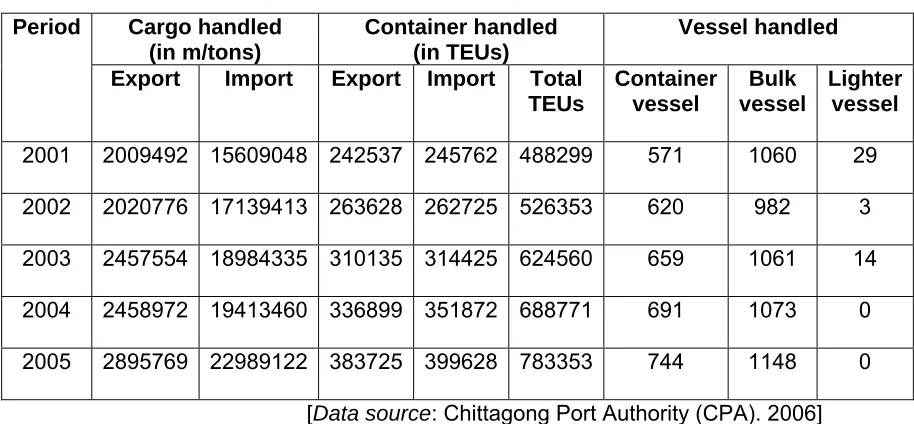
Chittagong, the major sea port and essential node of the transport and logistic chain of Bangladesh, handles 80% of trade and connects Bangladesh with most of the business world. Although container handling business in Chittagong port is growing at an average rate of 15% annually (Domus, 2005, pp.28-29); it also handles a large volume bulk cargo (Table 3).
2.4.2 Air Transport
Out of 16 operational airports in Bangladesh 3 of them are international airports situated in Dhaka, Chittagong, and Sylhet districts. All airports of the country are looked after by the government entity the Civil Aviation Authority of Bangladesh (CAAB), except some minor ground facility is in the private sector. Biman, the state owned Bangladesh Airlines, has the monopoly to operate the freighter service, but its service is not standard and customer focused. For example, Biman charges $ 5600 for ground handling of a cargo aircraft but the charge for the same job in Dubai, Bangkok, and Kolkata are $1000, $1200 and $ 4000 respectively. The CAAB also charges higher for the landing, parking and navigational support compared to other regional airports. For example, the landing charge set by CAAB for a 55-tonne capacity cargo plane is $ 2332, but in Dubai, Bangkok, Karachi, and Kolkata the charges are $ 295, $ 312, $ 1450 and $ 1220 respectively. Public and private sector airlines both operate in domestic routes (Domus, 2005, p.31).
2.4.3 Inland Transport 2.4.3.1 Roads and Highways
Road transport is the dominant mode of inland transport carrying 65% of freight and 70% of passengers. About 15% of the total 239226 km road is a national highway and 8% is regional highways and the remaining is the feeder roads. Besides these, about 16000 km of rural road is maintained by local government out of which 8546 km is paved road (Domas, 2005, p.33). The overall strength of roads in Bangladesh is not up to the standard. This is a big obstacle to join in Asian highway project. On the other hand, only 49% of sub district roads are all weather standard. Rural roads are still insufficient to provide support to the rural economy and demands more investment.
2.4.3.2 Railways
of railway is decreasing day by day because of its poor service, inadequate infrastructure and inefficient management.
The rail system is principally divided into broad gauge in western part and meter gauge in the eastern part; this division is another major drawback of the state owned Bangladesh railway. Out of 2706 km of railways about 900 km is broad gauge and rest is the meter gauge; in some places dual gauge is in use. Parbatipur, the place through which both gauges system pass, is the major railway station situated in the northern district of Dinajpur. The ferry operated by railway is the connector between eastern and western parts of the railway. The railway service covers only 32% area of Bangladesh (Fida, 2003 July) and can easily be expandable.
The congestion of two major catchments areas- Dhaka and Chittagong could also be solved for long term by constructing elevated mass rail transit system (EMRTS) (Khan, 2003 August). At present, a day-to-day service with India and occasionally service with Nepal via India are being provided by Bangladesh railway.
2.4.3.3 Inland Waterways and river ports
Bangladesh, the world’s largest delta, is situated at the peak of the Bay of Bengal. Nearly 7% of its surface is covered by a total of about 24000 km long inland waterways. The navigable waterways vary from 8300 km during the monsoon to 5200 km (Alam, 2005, pp.1-3) during the dry season. Inland waterway transport is a popular and common mode of transport providing low-cost service and access to areas where land transport would be costly and in some cases time consuming. The Government has classified about 5968 km of waterways as navigable inland waterway routes (Table 5).
The country boats can easily ply through the rest of the unclassified inland waterways. According to Alam (2005), about 0.2 million passengers and 0.55 million tons cargo are carried through the inland waterways network. The number of registered passenger vessels and cargo vessels are 1868 and 2160 respectively (p.4). Unregistered country boat is regarded as the informal sector. A significant number of country boats are mechanized, mostly with the low-cost shallow pump engines1. The number of country boats is about 745000 and 65% of them cater for
the passenger service. Country boats carry nearly one million tons of cargo, which is approximately double the present carrying capacity of the formal sector (Alam, 2005, p.4).
From the commercial point of view, navigable rivers are one of the most important elements of the economy as it directly provides dynamism to the rural economy. Rivers have also influenced the location of the cities, as is the case for many cities of the world. Most of the major cities / towns and commercial centers in Bangladesh are located on the banks of rivers. The other transportation systems have been developed maintaining a relatively consistent connection with the inland waterways.
Country’s 19 main inland river ports play a vital role particularly connecting some remote areas of Bangladesh. A significant percentage of passengers, domestic and foreign cargo traffic are transported by waterways (European Commission, 2001 August). Table 6 shows the modal shares of the passenger and freight transport in Bangladesh. Modal share of both passenger and freight transportation is dominated by road transport.
Water transport is the only means available to the poor people living in the coastal area of Bangladesh. Road infrastructure is not sustainable in the coastal areas as erosion and accretion are common phenomena there. As a result people depend on the water transport no matter whether it is safe or not. Beside this, water transport becomes the only solution during the annual floods, cyclones and natural calamities to distribute relief materials and to continue rescue programs (Alam, 2005, p.6). The
1 Shallow pump engines are usually used for irrigation , but sometimes they are installed with the country boats to
services in the coastal areas are mainly Government provided socially justifiable passenger services for the poor people. A small number of old vessels are used for providing this service. Very little cargo is carried by the mechanized vessels because of the lack of shore facilities in the islands; smaller country boats are used to provide cargo services instead of mechanized vessels (The World Bank, 1991, pp.50-51).
2.5 Accidents in different modes of transportation
Transport accidents are always shocking and sudden and take away lots of lives. In Bangladesh among all modes of transportation road accidents are more frequent than inland water transport (IWT) accidents. As the number of road accident each year remains highest, it causes more death also. Table 7 shows the number of road accidents and fatalities in the year 1993 to 2000.
Although the number of accidents in the inland waterways remains less, each year hundreds of lives are lost in these accidents. In other words, usually one accident in inland waterways causes more death than a road accident and mostly poor people suffer in the inland waterways accidents. Figure 2 shows increasing IWT accident trends in Bangladesh.
0 2 4 6 8 10 12 14
19 9 4 19 9 6 19 9 8 2 0 0 0 2 0 0 2 2 0 0 4 2 0 0 6 Year
N
o
. o
f acci
d
e
n
ts
In case of rail transportation, although the number of accidents is great, the number of casualties is less. For example, in 2011 train accidents about 59 people were killed in between 2002 and 2005 (“1670 acres rail land…”, 2005 August). Accident in air transportation in Bangladesh is very rare.
2.6 Resource allocation for IWT
The IWT sub-sector is a small receptor of the total Annual Development Program (ADP). Figure 3 / Table 8 shows the trend of resource allocation for IWT sub-sector.
700 750 800 850 900 950
1991 1992 1993 1994 1995 Year
A
llo
c
a
tio
n
in
millio
n
U
S
D
IWT allocation Total ADP allocation
Figure 3: The trend of IWT allocation in Annual Development Program (Data source: The World Bank, 1991)
The allocation in the ADP for IWT remains fairly steady between 0.7 to 1.4% of the total ADP (The World Bank, 1991, pp.8-9). The IWT sub-sector does not have the capability of properly utilizing more allocation of the ADP.
Chapter 3
Non-convention Ferry Accidents in Bangladesh
3.1 Nature of ferry accidents
The primary reasons or the first hand causes of the non-convention ferry accidents in Bangladesh are: bad weather, faulty construction of the vessels, faulty loading and inefficient crews. The loss of lives in every accident can be enormous. When an accident happens usually a single reason is focused upon, however, in most cases the situation is more complex. Several reasons together contribute to the accidents. According to the Accident Research Centre of the Bangladesh University of Engineering & Technology, Dhaka, five main factors, as shown in Table 9, are behind these accidents.
The rescue procedures and equipment are also obsolete. When ferries capsize the government tries to remove the wrecks with the help of BIWTA and Bangladesh Navy rescue vessels. In some cases they succeed, but most of the time the efforts fall in vain either because of the lack of technology and undercapacity of the rescue vessels or, because of the high siltation rate and current, the rescue team can not trace the wreck. The number of missing persons also remains high in most cases. Statistics of the missing and dead always remain unclear. A large gap in the number is always noticed among the statistics of government agencies and media for the same accident.
3.2 Statistical analysis of the accidents occurring
after most of the technical and administrative sides of the IWT sub-sector such as surveys, training, registration, certification and investigation. A recent investigation report into 84 ferry accidents of the Department of Shipping (DOS), Bangladesh provides the primary source of statistics. The Accident Research Centre (ARC) of the Bangladesh University of Engineering and Technology (BUET) is an authentic institute devoted to the relevant field. Their research papers provide a secondary source of valuable information. Tables 10-11 depict the analysis of DOS statistics and Tables 12-13 illustrate the consolidation of ferry accident statistics of the Accident Research Centre.
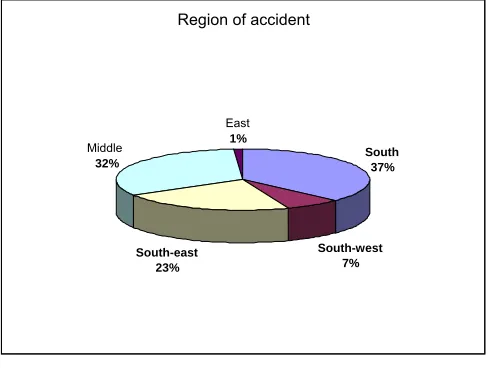
An analysis of DOS statistics (collected from investigation reports) reveals that collisions and the human element are the main causes of accidents. Most of the accidents occur in between 06:00-17:59 hours. It is worthwhile to mention here that the daylight in Bangladesh starts to shrink at about 19:00 hrs in summer and at about 17:00 hrs in winter time. Rough weather and overloading as a cause of an accident comes next. Most of the accidents occur between January and May which partially includes winter (Jan-March, foggy weather conditions) and summer (April-May, stormy weather conditions). This reveals that lack of navigational equipment, stability problems with the vessel and unskilled shipboard manpower were general problems. The south, southeast, and middle areas of Bangladesh are the most accident-prone.
Causes of accidents (DOS report)
Overloading/ Overcrowdin g 11% Others 18% Extremely bad weather 17% Physical failure 7% Excessive Current 4% Collision/Hu man element 43% Others 13% Physical failure 6% Excessive Current 12% Collision 32% Overloading & Cyclone 37%
Causes of accidents (ARC Statistics)
However, the statistics of ARC present overloading and cyclone as the main cause of accidents. Most of the accidents occur in stormy weather between 12:00- 23:59 hours, which is consistent with the main cause of accidents coming out of these statistics but different from the DOS statistics. This difference tells us that there are several reasons which together create a complex situation resulting in the accidents. Most of the accidents, according to ARC, occur between March-July, which mainly includes stormy weather conditions.
Region of accident
South-west 7% South-east
23% Middle
32%
East 1%
South 37%
Figure 6: Regions of accident (DOS report) (Data source: Adapted from Ali, 2006)
In both analyses the frequency of accidents because of physical failure is comparatively low. This indicates that the designs of non-convention vessels seem apparently correct for calm weather but they become explicitly dangerous for slightly rough weather, i.e. an unacceptable design. It is also true that there is no opportunity in the country to examine the stability of the design. Besides this, because of malpractice (change of super structure after survey) these vessels lose stability.
3.3 Causes of accidents: a theoretical perspective
causes of these accidents. They are so deep that this sector needs urgent technical support to address the issues. These root causes are discussed below.
3.3.1 Poor maritime administration and monitoring system
Safety and order in a sector is obviously dependent on good administration and a monitoring system. In Bangladesh the Ministry of Shipping governs maritime administration. Under the control of the Ministry of Shipping there are mainly eight agencies among which the DOS (Department of Shipping) and BIWTA (Bangladesh Inland Water Transport Authority) look after the issues regarding inland waterways and the safety aspects. Another agency BIWTC (Bangladesh Inland Water Transport Corporation) is engaged in catering for passengers and cargo transportation services with a very small number of fleets.
However, BIWTA approves the design of construction of a vessel in the beginning. But it does not have adequate equipment and technology to cater for this service; only a small unit of naval architects looking after this job. BIWTA is also responsible for maintaining the navigability of the inland waterways through maintenance and development dredging and providing the landing facilities throughout the inland waterways and maintaining some river ports (The World Bank, 1991, pp.18-19).
BIWTA looks after about 19 river ports, 5 ferry ghats (wharf) where convention and convention ferries can access services and about 292 launch ghats where non-convention ferries or launches provide landing facilities. Non-non-convention launches or ferry ghats are constructed by using pontoons; these pontoons are connected to the shore by the wooden jetties and gangways. They are used for berthing the vessels, loading and unloading of cargo and the embarkation and disembarkation of passengers. BIWTA operates some of the launch ghats while others are operated by private operators (Alam, 2005, p.3).
process compels the authorities to shift pontoons and ghats frequently. This entire situation makes the inland waterways vulnerable for ferries or launches to ply through these channels.
The Department of Shipping (DOS), on the other hand, does the survey and registration. The shortage of manpower, surveyors and technical hands, and inadequate infrastructure are the principal problems of this agency. The number of surveyors is so small that the survey of more than 5000 registered vessels is quite impossible for them. A lack of logistical support is one of the hindrances in performing the work of the surveyor. For example, a thickness gauge to measure hull plate thickness is a rare instrument (Rahim et al, 2002, pp.9-10).
In between the approval of the design and plan of construction by BIWTA and the survey and registration by DOS, there is an important stage of supervision of new construction. There is no authority to perform this duty. Sometimes surveyors are employed to do the job, but it is clear that they are heavily assigned with their original task of annual surveying. At the same time this employment brings up the question of conflict of interest because the same surveyor may survey the vessel after construction for its registration. The Ministry of Shipping has taken a step to create the ground for forming a local classification society, but this step still faces many hurdles from some particular evil quarters of professionals, ferry owners, and politicians. The department does not have sufficient skill and efficiency to investigate an accident scientifically. Nothing is learnt or changed after an accident or after submitting an investigation report, whatever the quality of the report.
3.3.2 Faulty design and construction of vessels
Design and construction are at the root of ensuring safety. In almost every ferry accident faulty construction is the main or secondary cause. The form of the hull, structure, propulsion systems and different kinds of stability are the vital points when one considers design.
Some professionals put forward the idea that little modifications in the criteria developed by IMO for SOLAS ship would be suitable for ferries in the inland waterways of Bangladesh (Rahim et al, 2002, pp.6-8). The idea of professionals
modifying certain criteria of IMO seems to be intended to reduce the construction cost which, in fact, leads to sub-standard vessels. Another impression is that the construction of SOLAS ship will increase the fares a lot, which the poor passengers will not be able to bear if owners build vessels considering sea-going criteria. However, this is also not true when we compare the situation with other modes of transportation. The fact is that the economic conditions of the people of the southern part of Bangladesh are better than in other regions of Bangladesh. Another fact is that the lack of industry in the villages and opportunity for work, people from the villages come to the cities to work and they use buses, trucks or trains to travel to and from. For these modes of transportation they pay more than in the inland waterways.
Also the standard of vessel construction industry or dockyards has never been checked. The standardization of construction facilities is an essential factor which can be done by introducing the certification provision for shipbuilders and shipbuilding manpower.
Most of the ferries carry passengers and cargo in the holds. It has been observed that when an accident occurs the vessel sinks within a minute or two. Lots of passengers on the upper deck or overcrowding reduce the meta-centric height which puts the vessel in a risky situation (Rahim et al, 2002, p.7). It has been
observed that cargo is not stowed in a professional manner, thus creating an instable situation. Even dropping cargo in the hold sometimes may cause serious leakage or rupture of the hull. When the vessel falls in bad weather this situation increases the risk.
The gearbox design is another vital issue. Almost all ferries use the obsolete manually-powered steering gear box and single plate rudder. These are inefficient and ineffective in bad weather. The hatch covers of the holds are sometimes found not to be watertight. There is no instrument for the surveyor to test the hull quality or even the hull plate thickness. A degraded hull plate during construction shortens the life-span of the vessel and makes the whole structure weak.
The attitude of ship owners to get a better design and construct a standard ship has to be injected through stringent policy implementation and by establishing a corruption-free administration. Establishing an accountable classification society should institutionalize supervisory tasks during construction.
3.3.3 Inadequate regulations and enforcement
The launch owners go on strikes frequently when the authorities try to enforce regulations stringently. Since there is a very small public sector operated ferry service (operated by BIWTC) on very limited routes, the launch owners use this situation and take hostage the whole ferry sector and the passengers to press their illegal demands. This type of syndicated action of launch owners should be restricted through adequate regulation and strict enforcement.
Sometimes vessels are forced to leave the port when they are filled with a sufficient number of passengers and sufficient cargo, but the ship-operators, or in other words the ship-owners, take passengers and cargo in the middle of the channel. Some country boats assists in this case. These country boats carry passengers and cargo and place the boats beside the vessels in the middle of the channel. After shifting the passengers and cargo to the vessel for a long journey, the country boats leave the place. This points out that there is no river police to monitor these issues.
Throughout the year the demand of ferry services remains the same except during some festivals. Weekends also have some increased passenger intensity. Considering all these situations, and analysing the demand route, permits can be issued accordingly.
Most of the vessel owners do not maintain their vessels regularly. Only when the need becomes essential do they dock their vessels, otherwise they do not pay any heed to any complaints by the crew. Small damages are fixed in a very simple way such as applying cement to a small hull leakage. This type of activity for fixing damages in a ridiculous manner weakens the vessel’s structure. On the other hand, measures to prevent damages beforehand are completely absent in the sector. Annual docking for a survey to be done should be made mandatory through the regulations. Corrective and preventive measures prescribed during annual docking should be implemented rigorously (Rahim et al, 2002, pp.8-9).
3.3.4 Poor manpower and training system
The man behind a machine is always significant and this is also true for a vessel. However, most of the crews working in the operation of vessels in the inland waterways of Bangladesh are not up to the mark. Most of them are illiterate or have very little formal education. A great number of crew members are aged and they do not have the physical fitness to perform the job. What the aged crew members have learnt many years back have now evaporated from their memory. Formal training facilities for the crews are too little, let alone the review facilities of training. Some crew members with fraudulent certificates are also found (Rahim et al, 2002, p.10).
The profession as a crew member of a vessel is not a respectable one and it is also not an appropriately paid job. To attract young educated people into this profession, the government and vessel owners should establish training institutes. Training for ferry operations can be popularized among the vocational training centres’ and Madrasa (religious school) students in the coastal regions of Bangladesh. The government can declare the minimum wage level and force vessel-owners to pay that amount. Payment through the banking mechanism will be helpful to monitor the minimum wage level.
3.3.5 Absence of proper funding and insurance policy
help for shipbuilding can be provided institutionally then some discipline could be established automatically in this business through those institutions, as they will provide loan depending on their own appraisal. This will also help the growth of this industry. The same is true for insurance policies. The lack of a proper insurance policy for this sector is a big problem.
3.3.6 Poor waterways and infrastructure
Political commitment is the main driver to translate a plan into reality. The inland shipping sector is a neglected sector in Bangladesh where It always has received a low development budget. Every year the same types of ferry accidents take place but no preventive measures are taken to improve the scenario. The lack of navigational aids makes the ferry routes risky in some places. Although some of the politicians or their relatives are vessel-owners, they use their influence for doing business but not to improve the sector. They influence the administration with illegal demands or dictate to the administration in their convenient way. This is a major hurdle to overcome because when the administration wants to take necessary action against a faulty vessel, and if the vessel belongs to an influential person, the administration overlooks it.
The use of information technology in the sector is very scarce. The establishment of a central database could bring transparency, accountability and swiftness to the registration, surveying and certification procedures.
3.4 Responsibilities of different quarters
Programs can be undertaken through the educational institutes to make people aware. The print and electronic media can also be used for the same purpose. Unlike many other areas, Non-governmental Organizations (NGO) are not seen in these types of awareness building activities. They can also step in to make people aware.
When ferry accidents take place, the news media mainly covers the matter very rapidly giving lots of emphasis, but they do not follow up the accidents and there is very limited discussion of the issues. The media, for example, never focus on the issue of identifying the responsible quarters properly and the ferry owners do not face any substantial civil liabilities or criminal sanctions for such mishaps or accidents (Henry, 2004 January 31). The ferry operators cannot count only on the revenues at the cost of poor people’s lives. It is also sad that still in this 21st century,
Chapter 4
Safety Regulations and Codes for Non-Convention Vessels
4.1 Ferry accidents in other countries
Besides the ferry accidents of Bangladesh, they also frequently occur in the Philippines, Indonesia, China, Tanzania, Somalia, Zambia, Senegal, Congo and Burundi (Henry, 2004 January 31).
In the industrial world such services as the Staten Island ferry service in the USA are very popular. It carries nearly 70000 people everyday in a shuttle service to and from Manhattan. But one day a ferry of 3335 tons struck the dock on Staten Island at a speed of 17 knots and killed 11 people. The investigation revealed the fact that there were systematic contributing factors such as the failure to distribute and enforce safety rules, absence of proper navigational equipment and warning systems that caused the accident. Nepotism and corruption in the management of the Staten Island ferry system were also imminent. Further, the statistics also revealed the fact that similar type of accidents, but less destructive, had occurred in 1998, 1992, and 1978. These depict that accidents are recurrent in a nearly similar way and regulatory failures are at the core. The recurring nature of ferry accidents, both in the first and third world, reveal that it is a predictable consequence and proper systematic measures and the enforcement of regulations could reduce the fatalities (Henry, 2004 January 31).
maintenance. The investigation report stated that the ship was procured on supplier’s credit without following the normal procurement procedures and with the builder taking advantage since there was a lack of expertise on the Tanzanian side. Even the technical specifications were not discussed for the building contract (Tanzania Government, 1996, pp.1-3,12-14,59-62).
An Indonesian ferry sank near Rote Island in February 2006 where nearly 40 people died. In this case, the causes of the disaster were bad weather, engine failure, and the poor safety standard of the vessel (“Indonesia hunts for…”, 2006, February 02). In the last 50 years, out of 122 transport accidents in Indonesia 43% were at sea related with ferry accidents followed by road 23%, air plane 20%, and rail 14% (“A call for Risk Management…”, 2006, May 10).
A Senegalese ferry ‘Joola’ capsized because of overloading (carrying four times more passengers) and negligence off the coast of Gambia. In this tragic accident more than 1800 people died (“Senegal remembers ferry...”, 2003, September 26).
A ferry, the Dashun, capsized in the Bohai Sea in China killing 280 people. The reasons identified for the accident were human error, fire, bad weather, and the improper loading of cargo. Human error was the main reason among these since the crew members used excessive water to fight the fire which made the vessel unstable (“Human error caused…”, 2000, March 27). In south-western China, an overloaded ferry turned over killing 21 people in 2004 (“Overloading likely…”, 2004, September 28).
In the Philippines a cargo vessel, the 71-ton ML Annahada, sank in which more than 74 people died in 2000; the vessel had the provision to carry only 11 passengers. The worst ferry accident in the world was also in the Philippines in 1987 when the MV Dona Paz was hit by an oil tanker killing more than 4000 people. This ferry was also overloaded (“Death toll in Philippine…”, 2000, April 17).
caught fire. In 2002, in the Gulf of Aden near Somalia, a ship capsized and caused the loss of 90 lives. The ship was not fit to sail as there was a leak in the hull and the ship capsized in heavy seas. Again in the Gulf of Aden in 2003 near the Yemei coast, a boat caught fire killing 80 people and in 2005 a boat sank off the Somali coast claiming about 100 lives; both vessels were carrying refugees. In February 2006, the Al Salaam Boccaccio ferry accident in the Red sea claimed more than 1000 lives and in March 2006 a tourist boat capsized off the coast of Bahrain killing at least 57 people (“Worst ferry accidents…”, 2006, April 01). This list can be easily lengthened.
4.2 Causes of the accidents and lessons learnt
It is a small list mentioned above which reveals the nature of ferry accidents in other countries. Although not all of the vessels are non-convention vessels, the truth which comes out is that some non-convention vessels are really big in size, involving losses which are sometimes more than those of convention vessels. The main causes are overloading, bad weather, improper cargo stowage, fire, poor design of the vessel, poor maintenance, lack of training and expertise, poor economic condition of some countries which create social problems and obviously the lack of resources. If we look back at the ferry accidents in Bangladesh (chapter3), we can easily realize the similarities of the causes.
Again overloading is the number one cause of ferry accidents. This is related with the excessive profit making mentality of businessmen or vessel operator. They are playing with the lives of people. It also reveals that the provision of punitive measures for these vessel operators or businessmen is not stiffer and the implementation mechanism is simply inadequate or has great loopholes.
places of refuge, throughout the route of a vessel to accommodate sudden changes in the weather condition.
The poor maintenance process of the vessel also points a finger at the regulatory mechanism and at the vessel operators. Although a vessel can have a good design and condition, lapses in the maintenance process can make it a dangerous and unfit vessel to sail in. The lack of due diligence in maintaining and operating vessels should be focused on in future regulations.
Above all, the human element cannot be ignored. The proper training of the crews and their certification process should be scrutinized as we have seen in the Dashun ferry accident case in China mentioned above. The Bukoba ferry accident in Tanzania reminds us that the expertise in the ferry sector on country basis should be improved.
4.3 Safety codes for non-convention vessels developed by IMO
All these factors are related with the improvement of regulations and investment of resources. Although the ultimate impact is the same, that is the loss of lives and properties, there are also some inherent differences. The climate, route of trade, economic conditions, nature of people and existing regulations are different from region to region. With this background, IMO has sponsored the effort to make safety regulations for non-convention vessels.
Since IMO does not have a direct mandate for formulating regulations for non-convention vessels, it extends its hand from a technical support position where it has a strong mandate (Williams, 2000a, p.14-15). IMO has taken on some projects through which it has provided technical support. The outputs of some of these projects are:
a) Safety regulations for non-convention sized ships in the Asian region b) Safety regulations for non-convention vessels operating in the Pacific
region
IMO has also helped developing the Caribbean Cargo Ship Safety (CCSS) Code for ships of 24 m in length and over up to 500 GT (Williams et al, 2000b, pp.3-4).
4.3.1 Safety regulations for non-convention ships in the Asian region
Provisions, relevant to smaller ships, mentioned in international conventions such as SOLAS 1974, ILLC 1966, STCW 1978 and COLREG 1972 were taken into consideration when designing these regulations and some resolutions were referenced to guide the application of these technical regulations. Three regional seminars were held and lots of enthusiasm was expressed but only the Philippines took the initiative to adopt national regulations in accordance with the Asian harmonized regulations; Bangladesh and India expressed their will to set up new standards according to the harmonized regulations. Countries like Korea, Singapore, China, and Japan stated that their existing regulations were sufficient enough (Williams, 2000a, p.15-16). The main features of the Asian regulations are:
a) Applicable for new cargo ships of less than 500 gross tonnages but above 15 m of length (IMO, 2006, p.6).
b) Including one major survey every five years and an annual inspection; all survey and certification based on SOLAS principles
c) Requirements of machinery, electrical equipment, fire protection and safety arrangements, life-saving appliances and arrangements and navigation safety requirements are based on SOLAS
d) Manning provisions are related to relevant IMO standards
e) Simple bilge pumping provisions, MARPOL 73/78 for environment protection and Load Line Convention (LL) for provisions related to load line matters.
f) Equation for freeboard calculation provided as- 50+ (150x L) / 24 (mm), with necessary corrections according to LL (Williams et al, 2000b, pp.3-4).
4.3.2 Code of safety for Caribbean cargo ships (CCSS Code)
The initial regulations developed for Asia are the basis of the CCSS Code (Williams
et al, 2000b, p.7). This Code is more comprehensive and has adopted a
a) Applicable for cargo ships of length 15m and above. b) Distinctive organization for construction related chapters.
c) Freeboat requirements are more precise and conservative and should not be less than as follows:
Length of Ship 20m> L ≥ 15m 24m> L ≥ 20m L= 24m
Freeboard 340 mm 375mm 400mm (Source: Caribbean Port State Control Committee, 1997, p.34)
These values are nearly two times or more than the values stipulated in the Asian harmonized regulations through equation.
d) A noteworthy role has been given to the administration regarding the fitting of GMDSS equipment and provision has been made for EPIRB with a radar transponder.
e) Most important is a provision to keep a comprehensive record of equipment and ship information (Williams et al, 200b, p.7).
4.3.3 Safety regulations for non-convention vessels in the Pacific region Regulations for the Pacific region non-convention vessels are based on the Asian harmonized regulations, CCSS Code, related IMO resolutions and Australian Uniform Shipping Laws (USL) Code. The main features of these regulations are as follows:
a) The scopes of the regulations are also extended to non-convention passenger vessels unlike the Asian regulations and CCSS Code. That is, the definition of non-convention vessels has been elaborated considering the specific purpose of the region (IMO, 2000a, p.8).
b) A new category of cargo-passenger ship requirements has been formulated with higher intact stability standard, life–saving appliances arrangement and communication equipment.
c) Subdivision and damage stability requirements have been developed in accordance with the International Code of Safety for High-speed craft. d) Provision has been created to make it a stand alone document with
e) Emphasize has been given to the communication equipment depending on the size and the period of build (Williams, 2000a, p.16-18).
4.3.4 Model safety regulations for inland waterways vessels and non-convention craft in Africa
The necessity for new regulations for inland waterway vessels in Africa was felt after the Mv Bukoba ferry accident in 1996. The basic principles for ferry safety regulations were laid down when Kenya, Uganda, and Tanzania entered into a Tripartite Agreement on Inland Waterways Transport (IWT) in 1998. Later, IMO drafted model safety regulations for IWT in 2001 which is a subject of consultation among the countries of the region.
The basis of this model regulation is EC regulations for inland waterways vessels, considering African conditions and existing regulations (Williams et al, 2000b, p.7).
The main features of these regulations are as follows:
a) The basic standards are derived from the existing regulations. Vessels operating in inland waterways have been given emphasis.
b) Emphasis has also been given to effective casualty reporting.
c) A company and the master are made responsible for the safety management and environment protection, but the details have not been formulated.
d) Scope has been made to apply sanctions for non-compliance.
e) Provision for a basic level of safety has been made for vessels less than 12.5 m in length. Life-saving and fire fighting equipment for fishing vessels of 12.5 m and above are required (IMO, 2002a January).
4.3.5 Safety regulations for cargo ships not covered by the provisions of IMO Conventions in the Mediterranean region
IMO has developed these safety regulations at the request of the Member states of the Mediterranean region. It is an effort to form a basis for a harmonized regulatory regime for the Mediterranean region. The main features of these regulations are as follows: