17
A MODIFIED ROUTE DISCOVERY APPROACH FOR DYNAMIC SOURCE ROUTING (DSR) PROTOCOL IN MOBILE AD-HOC NETWORKS
Alaa Azmi Allahham1 and Muamer N. Mohammed1,2
1Faculty of Computer Systems and Software Engineering University Malaysia Pahang,
26300 Kuantan, Pahang, Malaysia
2IBM Center of Excellence, University Malaysia Pahang, 26300 Kuantan, Pahang,
Malaysia
e-mail: [email protected], [email protected]
ABSTRACT
Mobile Ad-hoc networks (MANETs) involved in many applications, whether commercial or military because of their characteristics that do not depend on the infrastructure as well as the freedom movement of their elements, but in return has caused this random mobility of the nodes many of the challenges, where the routing is considered one of these challenges. There are many types of routing protocols that operate within MANET networks, which responsible for finding paths between the source and destination nodes with the modernization of these paths which are constantly changing due to the dynamic topology of the network stemming from the constant random movement of the nodes. The DSR (Dynamic Source Routing) routing protocol algorithm is one of these routing protocols which consist of two main stages; route discovery and maintenance, where the route discovery algorithm operates based on blind flooding of request messages. blind flooding is considered as the most well known broadcasting mechanism, it is inefficient in terms of communication and resource utilization, which causing increasing the probability of collisions, repeating send several copies of the same message, as well as increasing the delay. Hence, a new mechanism in route discovery stage and in caching the routes in DSR algorithm according to the node's location in the network and the direction of the broadcast is proposed for better performance especially in terms of delay as well as redundant packets rate. The implementation of proposed algorithms showed positive results in terms of delay, overhead, and improve the performance of MANETs in general.
Keywords: MANET; DSR Protocol; Threshold, Broadcasting
INTRODUCTION
A wireless Ad-hoc network (WANET) is a decentralized type of wireless network (Lin, 1999), where WANET networks such as home and sensor networks have become an important part of our daily life and are expected to provide multimedia services, which increases the demand for higher data rates, higher link reliability, and longer battery life. The main feature of these types of networks is self-organization (distributed), and these features reduce the cost and effort of their configuration and maintenance.
18
by natural catastrophes. Furthermore, are used to provide wireless communications infrastructure in different areas as a fast, deployable, temporary replacement for destroying fixed network or in areas where wired LANs are impossible or only cost-intensive to deploy such as protected historical. People are also using these networks in cafes, restaurants, malls, universities, and public gatherings such as conferences (Gibson, 2012; Rappaport, 1996; Tse & Viswanath, 2005).
Mobile Ad-hoc network (MANET) is considered one of WANET types, where the nodes in MANET has the capability to move freely and randomly, which result in changing the paths between the nodes and the topology of the network constantly (Gibson, 2012). The effect of high mobility of the nodes brings fundamental challenges to the routing protocols in MANET Network. The main function of routing protocols is to find the routes from the source to the destination, but will be more complicated in an environment where topology constantly changing as a result of the ongoing movement of the node causing the lasting change to all the routes that have already identified by the routing protocols. Therefore, routing protocols of MANET networks must have an effective mechanism to find constantly changing routes and notified them quickly about the constantly changing routes (Guevara, Jiménez, Prieto, & Seco, 2012; Yadav & Chavan, 2013). However, because of the constant movement of the nodes, the possibility of broken links increases and also with a possibility of the nodes destination goes out of the transmission range (Wu & Dai, 2005; Ali. S. et al, 2015).
In this paper, we propose a modified route discovery mechanism in order to reduce the effect of the mobility in the link transmission using efficient DSR protocol. The DSR protocol is very suitable to small and medium networks and can offer a quick and easy network solution comparing to any other routing protocols (Abolhasan, Wysocki, & Dutkiewicz, 2004; Royer & Toh, 1999). The proposed mechanism that will be clarified in detail in the methodology section depend on an update the DSR protocol algorithm on the part of route discovery to a destination node and adding a new technique for classifying and arranging routes stored in the node`s cache memory.
MANETS
Mobile ad hoc networks (MANETs) are infrastructure-less wireless networks, where it characterized in a number of properties, such as configuring, forming, self-healing network, random mobility for the nodes, transmission through multiple hops, in addition, to the decentralized nature which improves the scalability.
The devices in MANETs have the freedom to move randomly in all directions, which play the roles of both the client and router together during sending or receiving the data in the network, where it must depend on in its own information to take the decisions to choose the paths which lead to the destination, which that create the challenges on finding and updating that information constantly (Ayoob, Sulaiman, Mohammed, & Abdulsahib, 2014).
19 Routing Protocols
As there are different types of networks, there are different types of routing protocols also which have similar aspects in the main task which is the routing, but they differ in a way to work, where each one has a special algorithm is different from the other. Routing protocols are originally designed for wired networks which are not adequate and sufficient to ad hoc networks, although there is a big difference in term of wired network topology that is more of stability compared with the topology of the ad hoc networks which changes constantly (Mauve, Widmer, & Hartenstein, 2001).
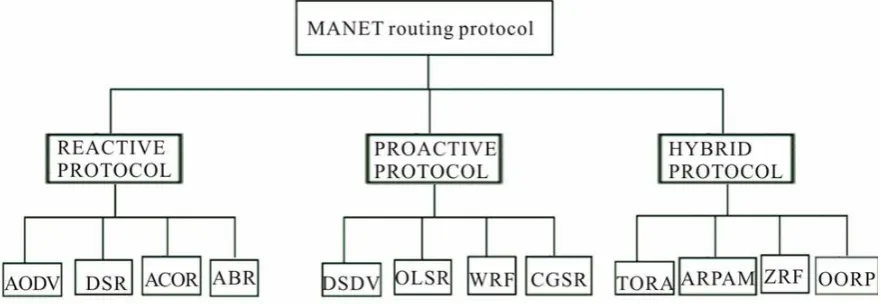
When designing a routing protocol that will work within the ad hoc network environment, it should be noted that the ad hoc network has to work within a limited bandwidth, in addition to limited resources in terms of node storage capacity, CPU capabilities, and energy resource since it depends mainly on batteries. We can infer from the above, the fundamental differences between routing protocols for wired networks that consume large amounts of bandwidth and resources of the nodes, like memory capacity, processor capabilities, also deal with the fixed and stable devices, topologies and routing protocols for ad hoc networks (Menchaca-Mendez & Garcia-Luna-Aceves, 2008; Moustafa, Kenn, Sayrafian, Scanlon, & Zhang, 2015). MANET routing protocols were classified into three major categories, Figure 1 presents the classification of routing protocols (Royer & Toh, 1999).
Figure 1. Classification of MANETs routing protocols
Reactive routing protocols
20 Dynamic source routing protocol (DSR)
The DSR protocol is classified as one of the reactive routing protocol used in multi hop wireless Ad-hoc networks. It consist two main stages one is route discovery, second is route maintenance. The route discovery stage begins when the source node want to send the data to a node not exists in its routing table. The route maintenance stage begins when one of the identified routes is broken or failed.
DSR uses source routing, which allows routing of packets to be loop free and also allows caching of routes in nodes for future use (Kant & Kumar, 2012; Mohammed & Sulaiman, 2014; Unnikrishnan, 2004). When the source node decides to send data to the destination node, it will first searches in the in its cache memory to find any valid routes to destination node, if didn’t find any it will initiates route discovery process (Gavrilovska & Prasad, 2006).
RELATED WORK
The (Ayoob et al., 2014) presented new proposal in order to mitigate the negative effects resulting from the continuous mobility of the nodes and lasting change in the network topology. The proposal includes providing a new algorithm consist of two mechanisms (route status checker, route order) and make a change to the mechanism of keeping the routes in the cache memory by setting up two tables (Master route cache and Index Route Cache). While (Yu & Kedem, 2004) proposed a distributed adaptive cache update algorithm for DSR, and defined a new cache structure, cache table without limiting the capacity. The result showed significant improvement in TCP throughput and achieved a large reduction of normalized routing overhead. Moreover, the (Manjhi & Patel, 2012) proposes to find a mechanism to determine the best routes and their updates as well as the acceptance or rejection of the new routes based on measuring the signal strength of the nodes, which will reflect positively on the performance of the entire network and measure the positive results related to end-to-end delay, packet delivery ratio, throughput, routing overhead.
METHODOLOGY
In this paper, the processes are divided into two main parts, the first part will be focusing on dissecting the DSR route discovery algorithm. While the second part will cover the proposed adjustments to improve DSR protocol performance in the both processes of discovering the routes and sending the data. In other words, it would be reflected in practice to improve the performance of overall MANET networks, where the importance of routing protocols in controlling the performance of all kinds of networks as well as representing the backbone and network analyzer, which measure the performance of any network.
Dissection DSR Route Discovery
21
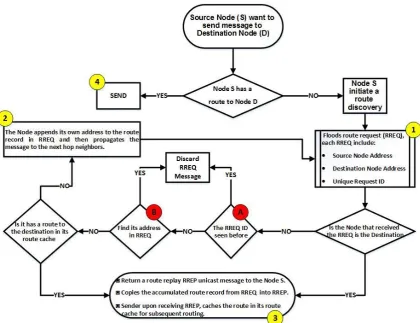
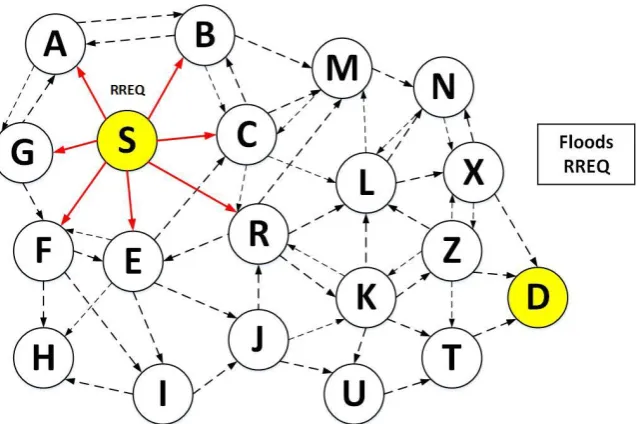
indicated with the number 2 in figure 2 is the mechanism used by intermediate nodes to re-propagate the RREQ message to all its neighboring nodes in all directions. Figure 3 shows the node S initiating a route discovery by flooding RREQ message to all its neighbor nodes. When the intermediate nodes receive the RREQ message and after each of them applied all the checks described in figure 2, which indicated by A and B. After that, each node reaches to the stage number 2 as described in figure 2, then each one re-broadcast the RREQ to all neighboring nodes in all directions without the organization of the process. The process continued whereby other intermediate nodes perform the same process until the RREQ message reaches to the destination node.
Through the analysis represented in figure 3, the following disadvantages can be observed:
a) There is a great possibility for the majority of the intermediate nodes to receive the RREQ message from more than one node at the same time, which increases the probability of occurrence the collisions and that leads to discarding the messages, which causes an additional consumption of bandwidth, in addition, to increase the overhead, delay, and latency because of the need to re-send the messages.
22
Figure 2. Basic DSR Route Discovery Algorithm
23
Figure 3. Re propagate RREQ between Intermediate nodes
Proposed Algorithm
The first proposed solution provides is to perform adjustments in the mechanism of re-send the RREQ broadcast messages by intermediate nodes to their neighboring nodes, which has been explained previously with clarified the negative results from them. The proposed adjustments are:
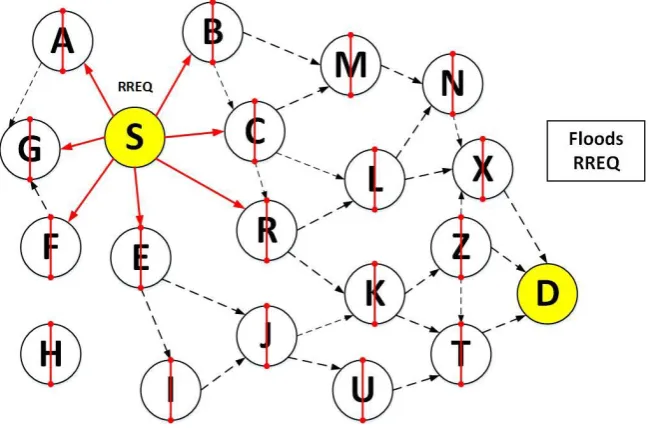
a) In normal case, the intermediate node sends an RREQ message to all neighboring nodes in all directions. In the proposed algorithm, each node forms two route search zones (RSZ): right and left. Each node keeps in a special table in its cache memory the data of all its neighboring nodes with identified the RSZ where this node belongs to, with continuous updating of this table when receipt of any message from any of these nodes later. Each node uses the GPS system to determine its location in addition to its neighboring nodes location to determine in any RSZ resides as well as updating their locations continuously. The intermediate node resends the broadcasting message to all nodes located in RSZ which opposite to the RSZ where the neighboring node that sent the message located, for example: when the node receives the message from the right RSZ, then it will resend this messages to all nodes located in left RSZ and vice versa. The basic idea relies on determining the RSZ on the concepts of geographic routing where each node knows of its own location using GPS in outdoor and infrared in indoor, like LAR, DREAM, and GRID protocols.
24
path with highest signal strength and ignore the hop count default factor as shown in Figure 4 and 5.
25
Figure 5. The proposed algorithm
IMPLEMENTATION
26
applying on three different scenarios in terms of network size (5 nodes, 10 nodes, and 20 nodes), while the nodes are moving in all scenarios on speed 5 m/s.
Simulation Parameters
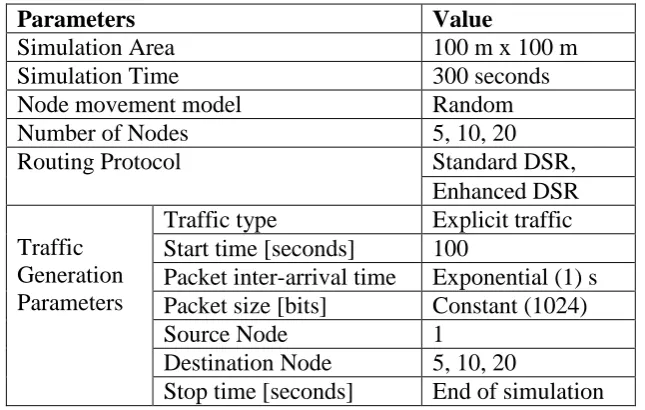
Table 1 presents the simulation parameters which was used in this experiment.
Table 1. Simulation parameters
Parameters Value
Simulation Area 100 m x 100 m
Simulation Time 300 seconds
Node movement model Random
Number of Nodes 5, 10, 20
Routing Protocol Standard DSR,
Enhanced DSR
Traffic Generation Parameters
Traffic type Explicit traffic Start time [seconds] 100
Packet inter-arrival time Exponential (1) s Packet size [bits] Constant (1024)
Source Node 1
Destination Node 5, 10, 20
Stop time [seconds] End of simulation
Performance Metrics
Performance metrics are used to measure and analysis the performance of the networks in order to make a comparison between different network models and systems. There are three performance metrics within this designed simulation that are related to the modified and proposed algorithms in this paper, which they are:
1. Route Discovery Delay: It is the delay time elapsed in route discovery process from the first moment which the source node initiates the route discovery process until it receives the responses from the destination node.
2. Routing Traffic: It is the total routing traffic sent and received by all nodes in the MANET, which is equal in the route discovery process the sum of both RREQ messages and RREP messages.
Number of RREQ Messages: It is the total number of RREQ messages which distributed from all nodes in the network during route discovery process until reaching the destination node.
Number of RREP Messages: It is the total number of RREP messages which sent from the destination node to the source node as a response to the RREQ messages during the route discovery process.
SIMULATION RESULT AND OBSERVATIONS
27
metrics separately, and then will be thrown an analytical look at these results as a whole for both standard and enhanced algorithms.
Route Discovery Delay
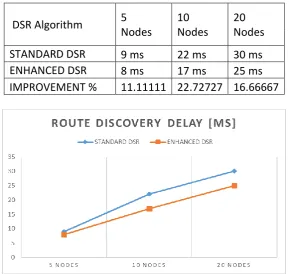
This metric determines the amount of time spent in the process of route discovery. Table 2 shows with Figure 6 the results of the route discovery delay for all scenarios.
Table 2. Route discovery delay
DSR Algorithm 5 Nodes
10 Nodes
20 Nodes
STANDARD DSR 9 ms 22 ms 30 ms ENHANCED DSR 8 ms 17 ms 25 ms IMPROVEMENT % 11.11111 22.72727 16.66667
Figure 6. Route discovery delay
Number of RREQ Messages
Table 3 and Figure 7 show the simulation results of the number of RREQ messages in all scenarios.
Table 3. Number of RREQ messages
DSR Algorithm 5 Nodes
10 Nodes
20 Nodes
STANDARD DSR 14 86 362
ENHANCED DSR 6 28 74
28
Figure 7. Number of RREQ messages
Number of RREP Messages
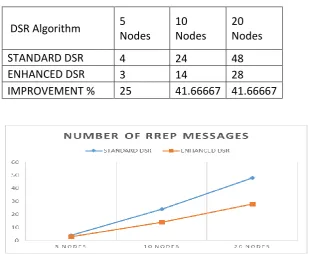
Table 4 and Figure 8 show the simulation results of the number of RREP messages in all scenarios.
Table 4. Number of RREP messages
DSR Algorithm 5 Nodes
10 Nodes
20 Nodes
STANDARD DSR 4 24 48
ENHANCED DSR 3 14 28
IMPROVEMENT % 25 41.66667 41.66667
Figure 8. Number of RREP messages
It can be observed positive results from applied the modified algorithm, which can be summarized thus:
Significantly reduce the number of broadcast messages (RREQ), where each node became sends on one direction instead of the four directions. Where the number of RREQ which exchanged between the nodes decreased by 50-80% when using the modified algorithm.
29
Due to the significant decline in routing traffic (RREQ and RREP), so a decline in the value of the delay occurred using the modified algorithm by 11-22%.
Dramatically reduces the problem of the node which receives more than one copy of the same message.
Generally, the modified algorithm provides better performance as the number of nodes in the network has increased.
From the results of the previous points, there is a significant reduction in the probability of collision which resulting from the receipt of the node more than one message from different nodes at the same time.
CONCLUSION
The constant motion of the nodes is one of the key challenges faced by MANET networks. The negative effects of not dealing with this challenge, such as High consumption of bandwidth, overhead, delay and latency. The proposed modified algorithm for DSR protocol providing for performing two adjustments, and are: firstly, perform adjustments in the mechanism of re-send the intermediate nodes to RREQ broadcast messages to neighboring nodes according to the direction and signal strength. Secondly, perform adjustments in the mechanism of arrangement the routes in the cache memory, according to best signal strength (SS) of routes.
After applied of the proposed adjustments of a DSR protocol algorithm, we got the following results:
General decline in the network overhead includes the RREQ and RREP messages
Alleviate the problem of collision and repeating received the same message.
Improve the speed of convergence
Increase the probability of discovering the route to the destination in less time.
REFERENCES
Abolhasan, M., Wysocki, T., & Dutkiewicz, E. (2004). A review of routing protocols for mobile ad hoc networks. Ad Hoc Networks, 2(1), 1-22.
Ali Safa Sadiq, Kamalrulnizam Abu Bakar , Kayhan Zrar Ghafoor, Jaime Lloret,and Mohammed Adam Ibrahim Fakhreldin. (2015). A Developed Network Layer Handover Based Wireless Networks. International Journal of Software Engineering & Computer Sciences. Vol1. pp.113-122. DOI: http://dx.doi.org/10.15282/ijsecs.1.2015.9.0009
Ayoob, A. A., Sulaiman, N., Mohammed, M. N., & Abdulsahib, G. M. (2014). Reduction the Effect of Mobility in Link Transmitting Using Efficient DSR Route Cache for MANETs. Journal of Advances in Computer Networks, 2(4).
Gavrilovska, L., & Prasad, R. (2006). Ad hoc networking towards seamless communications: Springer.
30
Guevara, J., Jiménez, A. R., Prieto, J. C., & Seco, F. (2012). Auto-localization algorithm for local positioning systems. Ad Hoc Networks, 10(6), 1090-1100. Kant, S., & Kumar, K. (2012). Performance analysis of dynamic source routing
protocol in wireless mobile ad hoc network. Paper presented at the International Journal of Engineering Research and Technology.
Lin, T. (1999). Mobile ad-hoc network routing protocols: methodologies and applications.
Manjhi, N., & Patel, N. (2012). Signal Strength Based Route Selection in MANETs. International Journal of Computer Science and Telecommunications, 3(7), 27-30. Mauve, M., Widmer, J., & Hartenstein, H. (2001). A survey on position-based routing
in mobile ad hoc networks. Network, IEEE, 15(6), 30-39.
Menchaca-Mendez, R., & Garcia-Luna-Aceves, J. (2008). An interest-driven approach to integrated unicast and multicast routing in MANETs. Paper presented at the Network Protocols, 2008. ICNP 2008. IEEE International Conference on.
Mohammed, M. N., & Sulaiman, N. (2014). Performance Analysis of DSR, AODV On-Demand Routing Protocols in Mobile Ad Hoc Networks. Advanced Science Letters, 20(2), 359-363.
Moustafa, H., Kenn, H., Sayrafian, K., Scanlon, W., & Zhang, Y. (2015). Mobile wearable communications [Guest Editorial]. Wireless Communications, IEEE, 22(1), 10-11.
Rappaport, T. S. (1996). Wireless communications: principles and practice (Vol. 2): prentice hall PTR New Jersey.
Royer, E. M., & Toh, C.-K. (1999). A review of current routing protocols for ad hoc mobile wireless networks. Personal Communications, IEEE, 6(2), 46-55.
Tse, D., & Viswanath, P. (2005). Fundamentals of wireless communication: Cambridge university press.
Unnikrishnan, P. (2004). Introduction and Analysis of DSR protocol.
Wu, J., & Dai, F. (2005). Efficient broadcasting with guaranteed coverage in mobile ad hoc networks. Mobile Computing, IEEE Transactions on, 4(3), 259-270.
Yadav, M. M., & Chavan, G. (2013). Predictive Location-Based QoS Routing with Admission Control in Mobile Ad-hoc Networks to improve QoS. Extraction, 2(7). Yu, X., & Kedem, Z. M. (2004). Reducing the effect of mobility on TCP by making