SECURING XML DOCUMENTS
Charles A. Shoniregun
School of Computing and Technology, University of East London,
Longbridge Road, Barking, Dagenham Essex, RM8 2AS, UK E-mail: [email protected],
Oleksandr Logvynovskiy
Business, Computing & Information Management, London South Bank University, Borough Road, London SE1 OLU UK
E-mail: [email protected], [email protected]
ABSTRACT
XML (extensible markup language) is becoming the current standard for establishing interoperability on the Web. XML data are self-descriptive and syntax-extensible; this makes it very suitable for representation and exchange of semi-structured data, and allows users to define new elements for their specific applications. As a result, the number of documents incorporating this standard is continuously increasing over the Web. The processing of XML documents may require a traversal of all document structure and therefore, the cost could be very high. A strong demand for a means of efficient and effective XML processing has posed a new challenge for the database world. This paper discusses a fast and efficient indexing technique for XML documents, and introduces the XML graph numbering scheme. It can be used for indexing and securing graph structure of XML documents. This technique provides an efficient method to speed up XML data processing. Furthermore, the paper explores the classification of existing methods impact of query processing, and indexing.
Keyword: XML data, XML document, numbering scheme, securing graph structure INTRODUCTION
The web and database communities have developed several approaches to resolve this problem. One is to convert semi-structured data into structured. This requires a pre-defined schema and a non-trivial translation of the data. Another option uses a partial schema to convert the XML data into structured data, where a partial schema is extracted from the data by using data mining techniques. Data that does not fit into this schema, will be stored and queried separately.
An XML query combines searching by value and structure. The structure search incorporates navigating through relationships among the elements. The major difficulties of the structure search are full XML document traversals and presence of cross-references that may require a closure computation. As the costs of these operations are significantly high, it is especially important to employ suitable indexes to speed up the searching operations. The processing of XML documents may require a traversal of all document structure and, therefore, the cost could be very high (Logvynovskiy and Lü, 2003). A strong demand for a means of efficient and effective XML processing has posed a new challenge for the database world.
RELATED WORK
partial schema and then converts semistructured data into relations. For the parts of the semistructured data that do not fit the schema are stored separately in native form. Cooper et al (2001) have considered an approach of indexing XML paths as strings. They use a structure, called Index Fabric, analogous to a B-tree, to store paths encoded as stings. This technique has been implemented over relational database management systems (DBMSs) and has shown better results than traditional indexing schemes.
Li and Moon (2001) proposed the XISS system to index and store XML data. There are two indexes used for value related data and three indexes used for structure related data. These three indexes (value / structure related data) are element, attribute, and structure indexes. Along with the identifier of each node these indexes contain a pair of numbers assigned to the node – extended traversal number and size of the node, which are later used by a selection algorithm for computing of ascendant-descendant relationship without tree traversal. Within the XISS system indexes are used for speed up processing regular expression queries. A complex path expression is decomposed into several subsequent simple ones, which are then processed by one of the three join algorithms. The indexing scheme makes path query processing much faster than conventional algorithms. One unique feature of this approach is able to determine the ancestor-descendant relationship quickly and without traversal of the data tree. However, this scheme only deals with data that have tree-like structure. This means the data model of XML documents has to be a tree, i.e. the branches of the tree are independent, and there are no links between nodes of different branches.
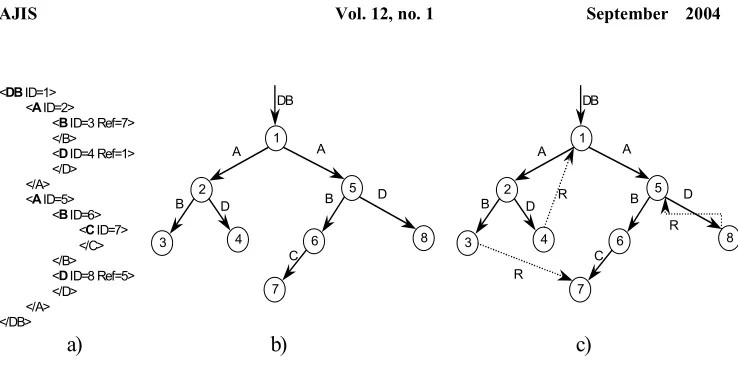
The structure of the XML document can be considered as either syntactical or logical. In the first case a document is treated as a tree, and in the latter case the document can be viewed as a graph. However, only in some simple cases does an XML document have a logical tree structure where each of its elements has exactly one parent element. In general, the logical relationship between different elements within an XML document is a graph. Various models have been proposed with little difference (McHugh, 1999). If directly applied the numbering scheme proposed by Li and Moon (2001) on XML documents with graphs as their data models, requires significant additional query costs. For example, 0b shows a query that involves selecting node 2 and all of its reference nodes. If the numbering scheme proposed was used then 4 nodes need to be accessed. However, if the reference links can be modelled by the numbering scheme, then only two nodes need to be searched. Indeed, we have extended the numbering scheme to handle XML documents with various types of data models, including graphs and trees.
Extended XML Numbering Scheme
Securing graph structure describes the motivation for introducing an extended numbering scheme for XML documents and the details of the algorithms designed to maintain the indexes based on the extended numbering graph scheme.
a)
b)
<DB ID=1><A ID=2> <B ID=3 Ref=7> </B> <D ID=4 Ref=1> </D> </A> <A ID=5>
<B ID=6> <C ID=7> </C> </B> <D ID=8 Ref=5> </D> </A> </DB>
DB
A A
B
C
B D D
R R
R 1
2
4 6 8
7 3
5
с)
DBA A
B
C
B D D
1
2
4 6 8
7 3
5
Figure 1 XML source data and its tree and graph representations Tree Numbering Scheme
First, let us consider the trees that are involved in the representation of our approach. The idea of using numbering scheme to determine the ancestor-descendant relationship between any two nodes of a tree was firstly introduced by Dietz (1982)0. Each node of a tree is associated with a pair of numbers. These numbers are calculated during pre-order and post-order traversals of a tree. It is stated that given nodes x and y and their pre- and post-order traversal numbers (nxpre, nxpost) and
(nypre, nypost) respectively, x is an ancestor of y (y is a descendant of x), iff nxpre < nypre and nxpost > nypost. 0, shows an example of numbering of a tree. Such an approach to find the relationship
between nodes is very useful for indexing of XML trees, since it avoids tree traversals during query execution. The pre- and post-order numbers of each node can be calculated and stored in a database. There is one disadvantage of this scheme: when a node is inserted, removed, or updated, the recalculation of all numbers will be required. To overcome this drawback, Dietz’s numbering scheme was modified Li and Moon, to calculate and compare pairs of extended pre-order numbers and ranges of descendants (size of sub-tree) of any two nodes within a tree. “Extended” means that extra space are reserved for future possible insertions. Deletions do not require recalculation either, increasing only the available space within the parent node range. The proposition was: given nodes x and y and their extended pre-order and size numbers (nxorder, nxsize) and (nyorder, nysize) respectively, x is an ancestor of y (y is a descendant of x), iff nxorder < nyorder and nxorder + nxsize ≥ nyorder + nysize.
The extended numbering scheme is applied to the same example shown on 0, b. For simplicity, each node on the example is assigned to the pair (norder, norder + nsize) instead of (norder, nsize) – one can be
1
2
4 6 8
7 3
5
a)
b)
1
2
4 6
8 7 3 5 (1, 100) (10, 40) (15, 19) (30, 35) (50, 90) (60, 75) (65, 71) (80, 87) (1, 8) (2, 3)
(3, 1) (4, 2)
(5, 7)
(6, 5)
(7, 4)
(8, 6)
Figure 2 Numbering and extended numbering of the XML tree.
This numbering scheme was used to implement indexes in XISS project and had shown improved performance for processing queries.
Graph Numbering Scheme
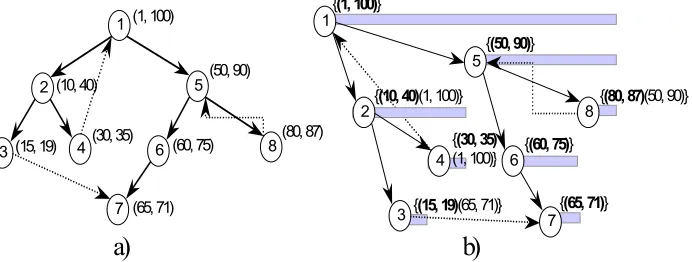
We consider the same XML document as a logical graph (it is illustrated in 0, a). The graph is constructed based the numbered tree by interpreting links among its nodes. Such a numbering system could not be able to explicitly specify the ancestor-descendant relationship. For example, the link o4 → o1 would create a cycle in the graph that makes the node o1 an ancestor and a descendant
of the node o4 simultaneously.
1
2
4 6 8
7 3
5
a)
{(1, 100)}
{(10, 40)(1, 100)}
{(15, 19)(65, 71)} {(50, 90)}
{(60, 75)}
{(65, 71)}
{(80, 87)(50, 90)}
b)
1
2
4 6
8 7 3 5 (1, 100) (10, 40)
(15, 19) (30, 35)
(50, 90)
(60, 75)
(65, 71)
(80, 87) {(30, 35)
(1, 100)}
numbering set of each node will never be empty and consists at least of one numbering pair, the primary numbering pair. The ancestor-descendant relationship between two nodes is determined as follows. Given nodes x and y and their numbering sets {(nxorder, n
x
size)} and {(n y
order, n y
size)}
respectively, x is an ancestor of y (y is a descendant of x), iff ∃i, (nxiorder, nxisize) ∈ {(nxorder, nxsize)},
that nxiorder < nyyorder and nxiorder + nxisize ≥ nyyorder + nyysize. In other words, there exist such a node i,
which is referenced by x and the ancestor of the node y. An example of the graph numbering is given on 0, b. The primary pairs are shown in bold. Node o8 has the linked pair (50, 90), corresponding to
node o5 and representing the link: o8 → o5. Nodes o2, o4 have the linked pair (1, 100), corresponding
to node o1 and representing the reference o4 → o1 (node o2 as parent of o4). Lastly, node o3 has the
linked pair (65, 71), corresponding to node o7 and representing the reference o3 → o7. Nodes o2, o4
are ancestors of the node o3 but do not have the linked pair (65, 71) as they can reach node o7 via
their linked pair (1, 100). The root node o1 has not any linked pairs: every node of the graph is
reachable through its primary pair.
ALGORITHMS
This section describes algorithms designed to maintain index records for cross-references (links) of XML graph. Each record of the index has such a form [ox, oy, (ny, sy), add_info], where oy, ny, sy are
the identifier, the extended pre-order, and the size of the node y corresponding to the linked pair (nxyorder, n
x
ysize) of the node x. And add_info is the additional information stored in index, like IDs of
the parent, first children, sibling etc. For simplicity, we omit add_info in the following discussion. The process of creating an index includes into two steps:
1. create the index of the XML graph nodes from the source data. This step will produce index records for primary pairs of each node of the graph;
2. create index records for linked pairs of each node of the graph. The pseudo-code of the algorithm is described in 2 below:
Algorithm 1 CREATE INDEX Input: source XML data file
Output: index of the numbered XML tree
//building tree index (records for primary pairs of each node) 1: for each input element of the XML file do
generate id, extended pre-order and size numbers oi, ni, si
add index record [oi, oi, (ni, si)]
end for;
//resolving links (records for linked pairs of each node) 2: for each node oi of the tree do
for each link oi → oj do
INSERT LINK oi, oj
end for end for.
node o7: D = {[o7, o7, (65, 71)]}. For each ancestor a∈A, a record [a, o7, (65, 71)] is to be added in
the index, if the node o7 is not already a descendant of a. Thus the records [o2, o7, (65, 71)] and
[o3, o7, (65, 71)] are added, and no record for the node o1 will be added, since o7 is already its
descendant. Next, let we add link o4 → o1. The ancestors records of the node o4 (including itself) are
selected, including A = {[o1, o1, (1, 100)],[o2, o2, (10, 40)], [o2, o7, (65, 71)]}. Then select the set of
link pairs of the node o1: D = {[o1, o1, (1, 100)]}. For each ancestor a∈A, a record [a, o1, (1, 100)]
is to be added in the index, if the node o1 is not already a descendant of a. The records
[o2, o1, (1, 100)] and [o4, o1, (1, 100)] are added, and no duplicate record for the node o1 need to be
added. The record [o2, o7, (65, 71)] will be removed since it is overlapped by the record
[o2, o1, (1, 100)]. When we add the link o8 → o5, the ancestors records of the node o8 (including
itself) are selected, including A = {[o1, o1, (1, 100)],[o5, o5, (50, 90)], [o8, o8, (80, 87)]}. Then select
the set of link pairs of the node o5: D = {[o5, o5, (50, 90)]}. For each ancestor a∈A, a record
[a, o5, (50, 90)] is to be added in the index, if the node o5 is not already a descendant of a. Thus, only
the record [o8, o5, (50, 90)] is added, and no records for nodes o1 and o5 need to bee added. The final
result is shown on 0, b and the Algorithm 2 below shows the insert link. Algorithm 2 INSERT LINK
Input: index, referencing node oi and referenced node oj
Output: index updated with records referencing node oj //select ancestor records of the node oi //note, that this selection includes oi
1: select index records for ancestors of the node oi: A = {[op, or, (nr, sr)]}, such that op is the
parent of oi;
//select records of the node oj
2: select index records for of the node oj: D = {[oj, ok, (nk, sk)]}; //
3: for each record [oj, ok, (nk, sk)] ∈D do //
for each record [op, or, (nr, sr)] ∈A do //
Ancestor ← op;
AddNode ← TRUE; //
while Ancestor = op do //
The algorithm for deletion the link oi → oj is straightforward: to delete all records of the form
[op, oj, (nj, sj)], where op is the ancestor of oi. This is to remove the records for links from parents of
the node oi to oj and from oi node itself to oj. The pseudo-code of the algorithm is described in
Algorithm 3 DELETE LINK
Input: index, referencing node oi and referenced node oj
Output: index updated with records referencing node oj
1: select index records for ancestors of the node oi: A = {[op, oj, (nj, sj)]}, such that op is the
parent of oi
//select records of the node oj
2: for each record [op, oj, (nj, sj)] ∈A do //
DELETE RECORD [op, oj, (nj, sj)];
end for;
ANALYSIS
To assess the usability of this indexing method, we focused on the growth of index depending on the number of cross-reference links in XML documents. Because if the indexes growth dramatically and require enormous storage space, this method would not be applicable. We have chosen two real-world data sets (Digital Bibliography and Library Project (DBLP), and Internet Movie Database (IMDB)) to estimate the number of records in their indexes:
• DBLP contains computer science bibliography information. Each DBLP file represents a single publication. All the documents are grouped into classes of publication (book, conference paper, journal article, etc.).
• IMDB is a highly cyclic semistructured database with information about movies, actors, directors, producers, writers, etc. IMDB includes 49 files (>500Mb). We chose a subset of two files (movies, actors). The characteristics of the DBLP and IMDB data sets are summarised in Error! Reference source not found. below.
Data Set Size (Mb) Files Elements Links
DBLP 96.6 251,520 2,095,552 25,745
IMDB 88.1 2 2,221,423 1,624,311
Table 1 XML data sets
To estimate the index size S for a database, it is necessary to find numbers of records corresponding to primary nprimary and linked nlinked numbering pairs of each node:
S = nprimary + nlinked.
The number of primary pairs nprimary is equal to the number of elements in the database N. The
number of linked pairs nlinked depends on the number of referencing nodes nref and how many
ancestors precede these referencing nodes (according to the 0). The number of preceding ancestors of any node is equal to the path length of this node li. Consequently, the number of linked pairs nlinked
equals: nlinked = Σli, i = [1, nref]. If the path lengths of nodes are approximately equal to each other,
the previous statement turns into the following:
where L is the average path length of referencing nodes; nref is the number of referencing nodes. The
number of referencing nodes nref depends on the topology of the graph, since every link increases the
number of ancestors for the referenced node. For example, the number of ancestors of the node o7 in
0: Numbering and extended numbering of the XML tree, a is equal to 3 (nodes o1, o5, o6), while the
number of ancestors of the same node o7 in the 0: Numbering and extended numbering of the XML
graph, a is equal to 7 (nodes o1 to o6).
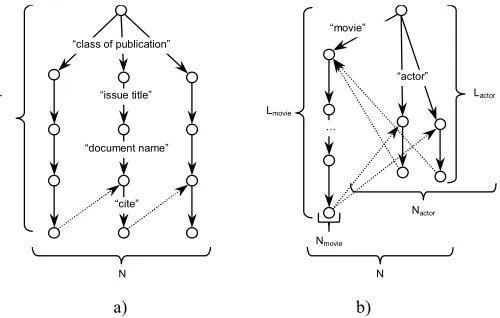
First, we consider the topology of DBLP data. A DBLP document contains information about the type of publication, the title, the authors, and so on. It may also include a reference to other publication in the database. Each reference is given as an absolute path from the entry directory. The length of any path does not exceed 3 and has form «class of publication/issue title/document name». So the average path length of referencing nodes is LDBLP = 3. The approximate topology of the
DBLP dataset is shown on 0, a and b. It is assumed that there are no cross-references between any two documents, i.e. if book A has reference to book B, then book B can not have references to the book B.
“class of publication”
“issue title”
“document name”
“cite” L
N
a) b)
“actor” “movie”
… Lmovie
Lactor
N Nactor
Nmovie
Figure 4 Approximate topology of DBLP data The index size S for the DBLP database is:
S = NDBLP + LDBLP · nBDLPref,
where NDBLP, LDBLP, nBDLPref are the number of elements, the average path length of referencing nodes
Now consider the topology of IMDB data. There are several different types of IMDB documents: movies, actors, directors, etc. Each of the types has different structure and references to the documents of other types. The database contains many cross-references between documents. For example, “The Matrix” movie has links to the actors “Keanu Reeves” and “Laurence Fishburne”. These actor documents have cross-reference to the “The Matrix” movie. We have selected the subset of the IMDB of two types (movie titles and actors). The approximate topology of the IMDB subset is shown on 0, b. Each type of documents has its average path length of referencing nodes Lmovie and Lactor, and number of referencing nodes nmovie and nactor respectively. If an average number of actors
in each movie is denoted Nactor, then each of the Nactor actor nodes will have (Nactor – 1) linked pairs
to other actors and linked pairs to the movie. The movie node will have Nactor pairs for the actors.
Thus, the number of linked pairs for one movie node and its ascendants is Lmovie·Nactor and the
number of linked pairs for one actor node and its ascendants is Lactor · ((Nactor – 1) + 1) = Lactor · Nactor.
The total of linked pairs is:
nlinked = nmovie (Lmovie·Nactor + Lactor · N 2
actor),
where nmovie, Lmovie are the number of elements, the average path length of movie referencing nodes; Nactor, Lactor are the average number of actors and the average path length of actor referencing nodes.
Even in the case of two types of documents, the index size grows non-linear. The statistical results regarding the DBLP data set are summarised Table 3 below:
Data Set
Number of primary pairs records, NIMDB
Number of references, nmovie
Number of linked pairs, nlinked (Nactor= 20, Lmovie= 5, Lactor = 3)
Growth of index, %
IMDB 2,221,423 1,000 1,215,000 54.7
movies: 229,180 10,000 12,150,000 546.9
actors: 367, 932 100,000 121,500,000 5469.4
1,624,311 (present in
DB) 1,973,537,865 88841.1
TABLE 3 ESTIMATION OF INDEX GROWTH FOR IMDB DATA SET CONCLUSION
Our results showed that the indexing method introduced in this paper is efficient in cases where the number of cross-reference is relatively low as a result of securing the graph structure. However, in the case of circular references or where a large number of cross-referencing is involved, the number of index records will be increased at a non-linear rate. Indeed, the problems of Internet security cannot be ignored by companies as this would result in the loss of competitive advantage in the market place and what the future holds for Internet security technology cannot be predicted to the rate technology is advancing (Shoniregun, 2002).
REFERENCES
B. F. Cooper, N Sample, M. J. Franklin, G. R. Hjaltason, and M. Shadmon (2001) A fast index for semistructured data. InProceedings of the 27th VLDB Conference, Roma, Italy
P. F. Dietz (1982) Maintaining order in a linked list. InProceedings of the 14th Annual ACM Symposium on Theory of Computing, San Francisco, California.
R. Goldman, J. Widom (1997) DataGuide: enabling query formulation and optimization in semistructured databases. In VLDB.
Q. Li, B. Moon (2001) Indexing and querying XML data for regular path expressions. In Proceedings of the 27th VLDB Conference, Roma, Italy.
J. McHugh, J. Widom (1999) Query optimization for XML. In Proceedings of the 27th VLDB Conference.
Y. Papakonstantinou, H. Garcia-Molina, J. Widom (1995) Object exchange across heterogeneous information sources. In Proceedings of the 11th International Conference on Data Engineering.
Shoniregun C.A. (2002), The Future of Internet Security, ACM Ubiquity: Information Technology (IT) magazine and forum, Volume 3, Issue 37, Oct 29.