Journal of Cognitive Neuroscience, 16(2):219–37, 2004.
A Feedback Model of Visual Attention
M. W. Spratling and M. H. Johnson
Centre for Brain and Cognitive Development, Birkbeck College, London. UK.
Abstract
Feedback connections are a prominent feature of cortical anatomy and are likely to have a significant func-tional role in neural information processing. We present a neural network model of cortical feedback that success-fully simulates neurophysiological data associated with attention. In this domain our model can be considered a more detailed, and biologically plausible, implementation of the biased competition model of attention. How-ever, our model is more general as it can also explain a variety of other top-down processes in vision, such as figure/ground segmentation and contextual cueing. This model thus suggests that a common mechanism, in-volving cortical feedback pathways, is responsible for a range of phenomena and provides a unified account of currently disparate areas of research.
1
Introduction
Top-down effects play an important role in sensory information processing (Siegel et al.,2000). For example, during visual perception, information propagates through the visual processing hierarchy from primary sensory areas to higher cortical regions. In addition to this feedforward transmission of information, feedback connections convey information in the reverse direction and lateral connections integrate information across the visual field (Lamme et al.,1998;Lamme and Roelfsema,2000).
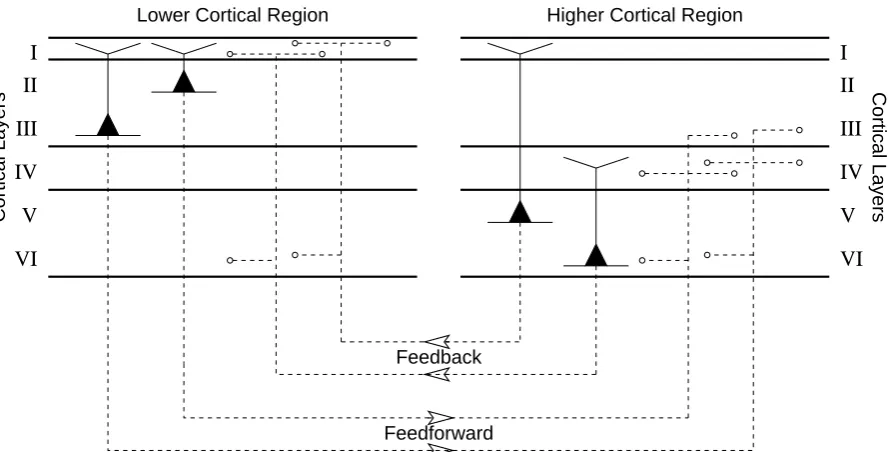
Feedforward and feedback connections can be distinguished by the cortical layers from which they originate and in which they terminate, as illustrated in figure1(Felleman and Van Essen,1991;Crick and Koch,1998; Mountcastle,1998; Budd,1998; Ebdon,1996;Mumford,1992;Lamme et al.,1998; Johnson and Burkhalter, 1997; Barbas and Rempel-Clower, 1997). Feedforward connections are provided by the axon projections of pyramidal cells in layers II and III. These projections terminate predominantly in layer IV of the higher region (as do inputs from the thalamus). The main target for feedforward projections are spiny-stellate cells which, in turn, target the basal dendrites of pyramidal cells in layers II and III. Feedback connections are provided by the axon projections from pyramidal cells in layers V and VI and terminate mainly in layers I and VI of the lower region (or are sent to sub-cortical structures). The main targets of the feedback projections terminating in layer I are the apical dendrites of pyramidal cells with somata in layers II, III and V (Cauller,1995;Cauller et al., 1998;Rockland,1998;Budd,1998;Rolls and Treves,1998). In general, cortical regions tend to be reciprocally connected (Felleman and Van Essen,1991;Crick and Asanuma,1986;Mountcastle,1998;Lamme et al.,1998).
Attention is one top-down process that operates via the cortical feedback projections (Treue,2001;Schroeder et al.,2001;Mehta et al.,2000;Desimone and Duncan,1995;Pollen,1999) targeting the apical dendrites in layer I (Cauller,1995;Olson et al.,2001). By manipulating attention or expectation, it is possible to explore the affects of feedback on the response properties of cortical pyramidal cells. Attention modulates the sensory-driven activation of cells (Kanwisher and Wojciulik,2000;Luck et al.,1997;Kastner et al.,1999;McAdams and Maunsell,2000), such that activity in response to an attended stimulus is increased in amplitude and duration (Schroeder et al., 2001;Kastner and Ungerleider,2000). Such top-down modulation also affects the on-going competition between cells (Luck et al.,1997;Itti and Koch,2001;Reynolds et al.,1999). Competition can be biased both by stimulus saliency and by attention (Kastner and Ungerleider,2000;De Weerd et al.,1999;Olson,2001). Hence, increased attention has effects similar to increasing the contrast or saliency of the stimulus (Kastner and Ungerleider,2000; Olson,2001;Itti and Koch,2001;Reynolds et al.,2000). Feedback thus serves “to amplify and focus activity” (Hup´e et al.,1998).
VI
V
IV
III
II
I
I
II
IV
V
VI
Lower Cortical Region Higher Cortical Region
Cortical Layers
Cortical Layers
III
Feedback
Feedforward
Figure 1: Cortical layers and regions. A schematic showing pyramidal cells within the six layers of the cortical sheet. Pyramidal cell bodies are shown as filled triangles, dendrites as solid lines and axons as dashed lines. All other cell types have been omitted, as has the intra-regional connectivity. The cortical sheet is shown divided into two regions at different levels in an information processing hierarchy. Axon projections connecting these two regions are illustrated.
figure/ground segmentation, feature binding, and contextual cueing. Hence, our model suggests that a common mechanism, involving cortical feedback pathways, is responsible for a range of phenomena in visual perception and could potentially provide a unified account of currently disparate areas of research.
1.1
The Biased Competition Model
The biased competition model (Duncan,1998;Desimone and Duncan,1995;Reynolds et al.,1999) is a leading account of the neurophysiological data associated with attention (Frith,2001;Kastner and Ungerleider,2000). This theory proposes that visual stimuli compete to be represented by cortical activity. Competition may occur at each stage along the visual information processing pathway. The outcome of the competition is influenced not only by bottom-up, sensory driven, processes but also by top-down, attention-dependent, biases towards the information that is most relevant to current behavioural goals.
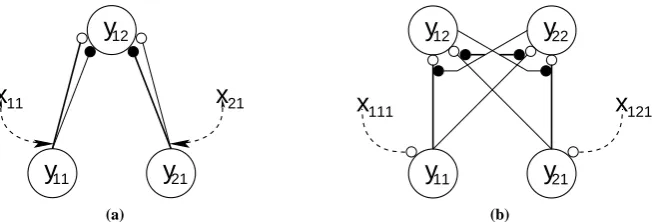
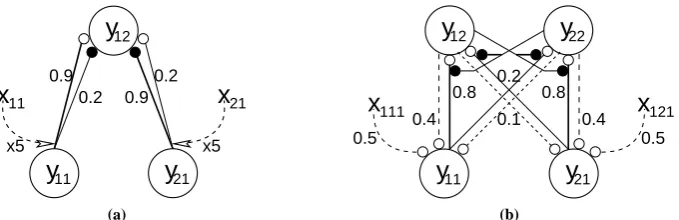
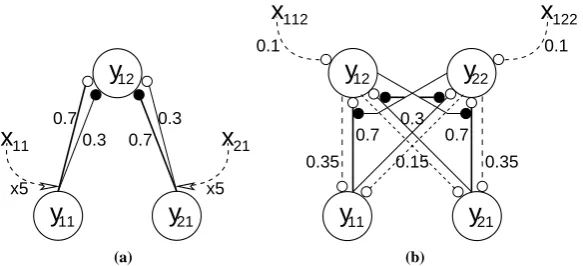
A neural network architecture, to implement this model, has been proposed (Reynolds and Desimone,1999; Reynolds et al.,1999), and is shown in figure2(a). In this network, two “input” neurons, with distinct stimulus selectivities, project both excitatory and inhibitory connections to a single “output” neuron in a subsequent stage of the cortical hierarchy. The response of the output node is dependent upon the activation of each of the input nodes and the strengths of the excitatory and inhibitory afferents. Attention acts by increasing the synaptic efficiencies of the connections originating from the input neuron selective to the attended stimulus.
This neural network architecture was “not intended to be an account of the actual neural circuitry underly-ing visual attention” (Reynolds et al.,1999, p.1752). It is therefore unsurprising that while this implementation succeeds as a descriptive model of the observed behaviour it has shortcomings as a detailed, functional, account. Firstly, the time-varying response of this model is a poor match to that of real cells (see section2). Secondly, at-tention acts by multiplicatively modulating the strengths of afferent synapses, for which no biologically plausible mechanism is specified. Finally, while this network is proposed as an implementation of the biased competition model there are actually no competitive processes occurring between nodes within this neural architecture.
x
11x
2111 21
12
y
y
y
(a)
x
111x
121y
y
y
y
11
22
21 12
(b)
Figure 2: Models of attention. Nodes are shown as large circles, excitatory synapses as small open circles and inhibitory synapses as small filled circles. Thexvalues represent top-down biases that vary in strength depending on the attentional state. These top-down signals are assumed to arise from neural generators outside the modelled circuits. (a) The Reynolds and Desimone implementation of the biased competition model. In this model, the top-down signals modulate the strength of the feedforward con-nections. (b) The proposed feedback model. In this model, the top-down signals modulate the strength of activation of the nodes. Feedback connections reciprocating the feedforward connections also exist, but have been omitted from this figure for clarity.
and Desimone model, the top-down signals vary in strength depending on the attentional state. These attention-dependent, top-down, signals are assumed to originate in higher cortical regions which are not explicitly modelled. However, this should not be taken to imply that these signals arise from a dedicated “attentional system”, a point we return to in the Discussion.
The nodes employed by the proposed model have more complex behaviour than those used in the Reynolds and Desimone model. Hence, the feedback model is capable of simulating experimental data in greater detail. More importantly, the model proposes a biologically plausible mechanism by which biased competition can operate, and can explain other top-down, perceptual, processes that have not previously been thought to share common mechanisms.
1.2
The Feedback Model
The Reynolds and Desimone model, in common with others (e.g.,Olshausen et al.,1993), uses top-down signals to multiplicatively modulate the synaptic strengths of inter-regional connections so that attended information can be selectively routed to higher cortical regions. Equivalent results can be achieved by using top-down signals to modulate the activity of neurons rather than weights of synapses (Salinas and Thier,2000;Salinas and Abbott, 1997). This mechanism has previously been modelled by allowing the activity generated by stimulation of the receptive field to be multiplicatively modulated by the response to a separate set of inputs applied to a “gain field” (Salinas and Abbott,1996;Salinas and Thier,2000;Salinas and Sejnowski,2001) or a “contextual field” (Phillips and Singer,1997;Phillips et al.,1995). These algorithms thus require inputs from different sources to be integrated separately and to have dissimilar effects on activity.
Feedforward and feedback connections preferentially target distinct regions of pyramidal cell dendrites (Spratling, 2002). For example, pyramidal cells in layers II and III predominantly receive feedforward information at the basal dendrites and feedback information at the apical dendrites. The apical dendrite appears to act as a functionally distinct dendritic compartment since activation applied to the apical dendrites is integrated prior to transmission to the soma (Larkum et al.,1999;K¨ording and K¨onig,2000,2001). The distal (i.e., apical) and proximal (mainly basal) dendrites of pyramidal cells thus appear to act as separate dendritic compartments (Yuste et al.,1994) ca-pable of independently integrating the feedforward and feedback information that they receive (Spratling,2002). The axon initial segment acts as the final site of integration as it is here that action potential initialization occurs (Stuart et al.,1997). However, inputs to the different dendritic regions contribute to this output in different ways (Larkum et al.,2001). Stimulation of the apical dendrite causes smaller, but more protracted, excitatory post-synaptic potentials (EPSPs) at the soma than does equivalent stimulation of the basal dendrites (Rockland,1998; Budd,1998). Hence, apical inputs have weaker effects on output activity than basal inputs. Such findings are consistent with the suggestion that feedback acts to modulate responses that are primarily driven by feedforward inputs (Koch and Segev,2000;Crick and Koch,1998;Hup´e et al.,1998;Friston and B¨uchel,2000).
X
y
x
x
X
basal
y
Lower
Region
Cortical
apicaly
apical
y
Higher
Cortical
Region
basaly
y
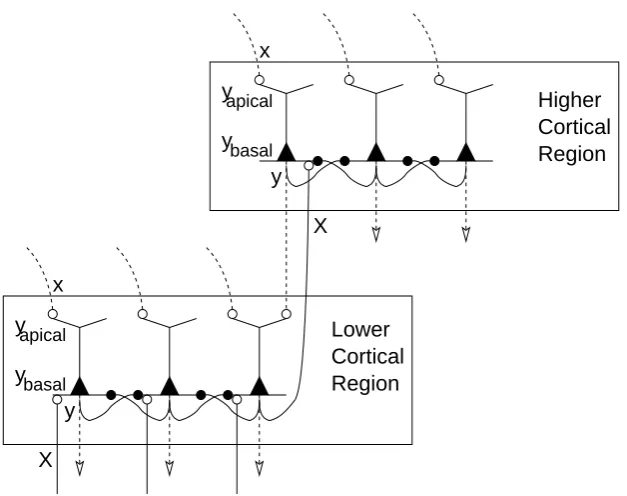
Figure 3: The feedback model in greater detail. A schematic of the proposed model showing two interacting cortical regions. Each region contains one layer of pyramidal cells (somata shown as filled triangles). These model neurons each have two, independent, dendritic regions: the basal dendrites, which receive feedforward connections (shown as solid lines), and the apical dendrites, which receive feedback connections (shown as dashed lines). Nodes in different regions are reciprocally connected by feedforward and feedback projections (only the connections between one pair of nodes are shown) and may also be targeted by connections originating from other regions or by sensory inputs. Nodes within the same region compete via lateral inhibitory connections which target the basal dendrites (only selected connections between neighbouring nodes are shown). Excitatory and inhibitory synapses are shown as open and filled circles respectively.
node. This formulation enables bottom-up, sensory-driven, stimulation to drive the response of the node even in the absence of top-down activity. In contrast, feedback activation can not drive the node’s activity in the absence of feedforward activation, but it can amplify any response to feedforward stimulation. The activations of nodes in the model are also affected by lateral inhibitory connections targeting the basal dendrites, via which neurons in the same region compete to represent stimuli (Spratling and Johnson,2001,2002). A schematic of the model is shown in figure3. For comparison with the Reynolds and Desimone model, a simplified illustration of the feedback model with two input nodes and two output nodes, is also shown in figure2(b).
For simplicity the model only contains one layer of cells in each region. Hence, in contrast with the cortex, feedback connections originate from the same neurons that receive feedforward connections. This simplification is justified since pyramidal cells within the same cortical column are believed to have similar response properties. Furthermore, there is insufficient data about the differences between the layers to meaningfully model distinct superficial and deep layer neurons.
2
Results
Response
Time
pref attend away poor attend away pair attend away pair attend pref
(a)
Time
Response
pref attend away poor attend away pair attend away pair attend pref
(b)
Time
Response
pref attend away poor attend away pair attend away pair attend pref
(c)
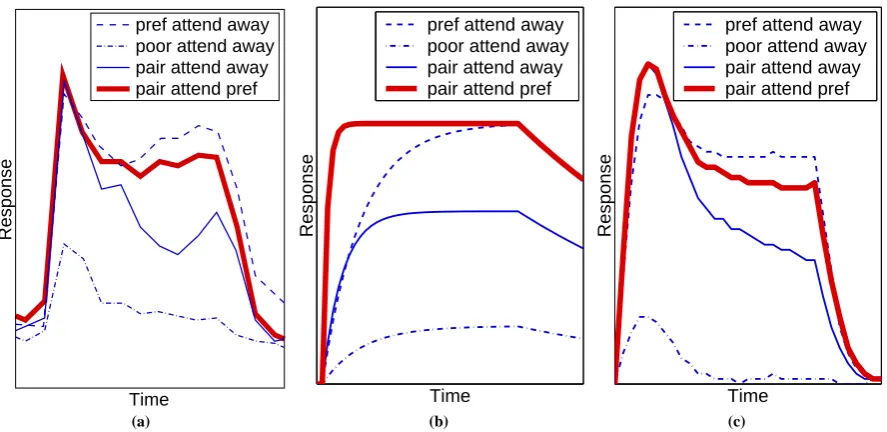
Figure 4: The effect of spatial attention on the response of a neuron. Responses are shown for different combinations of stimuli appearing within the receptive field of a single neuron. (a) The response of a cell in V2 (adapted fromReynolds et al.,1999). (b) Simulation results from the Reynolds and Desimone model. (c) Simulation results from the feedback model. For (a) the response was measured in spikes per second and time in milliseconds, for (b) and (c) both response and time are in arbitrary units and have been scaled to resemble (a).
For clarity, in each simulation we have employed the simplest network which can successfully model the physiological data. Hence, appropriate numbers of nodes and synaptic weight values have been chosen for each experiment. However, it should be noted that the architecture of the model remains constant and that every node in every reported simulation operates in the same way (as described in the Methods section). Furthermore, the same parameters have been used throughout all the simulations reported here. Hence, each simulation can be considered to be a specific example of the behaviour generated by of a single computational model.
2.1
Spatial Attention
2.1.1 Attentional Selection
For neurons in the ventral pathway the response to a stimulus, that generates strong neural activation when pre-sented in isolation, is reduced by the introduction of a second, non-preferred, stimulus within the receptive field (Reynolds et al.,1999). Hence, rather than being processed independently, multiple stimuli, within the same re-ceptive field, appear to compete in a mutually suppressive manner (Kastner and Ungerleider,2000). If attention is directed toward one stimulus then the response becomes more similar to the response that would be generated by that stimulus in isolation (Moran and Desimone,1985;Luck et al.,1997;Reynolds et al.,1999). Hence, attention appears to bias the competition in favour of the attended stimulus. These effects are illustrated in figure4(a), which shows the response of a single cell recorded in area V2 of a rhesus monkey. Similar results have been demonstrated for cells in area V4, inferior temporal cortex, in area MT of the dorsal pathway, and in prefrontal cortex (Treue and Martinez-Trujillo,1999;Reynolds et al.,1999;Reynolds and Desimone,1999;Everling et al., 2002).
0.2 0.9
x5 x5
0.9
0.2
x
x
11 21y
12y
11y
21(a)
0.8
0.5 0.5
0.2
0.1 0.8
0.4 0.4
x
x
y
y
y
11y
22
21 12
111 121
(b)
Figure 5: Details of the neural network architectures used to simulate the data shown in figure4. Nodes are shown as large circles, excitatory synapses as small open circles and inhibitory synapses as small filled circles. Thexvalues represent top-down biases that have an activation value of either zero or one depending on the attentional state. These top-down signals are assumed to arise from neural genera-tors outside the modelled circuits. Feedforward (and lateral) connections are shown as solid lines and feedback connections are shown as dashed lines. Values for the synaptic strengths are indicated, these weights were chosen to provide the best fit between the behaviour of each model and the experimental data (see the Methods section). (a) The Reynolds and Desimone model. (b) The feedback model.
intermediate between the responses generated by each stimulus in isolation. When attention is directed to the preferred stimulus this has the effect of multiplying the synaptic efficiencies from the attended input by a factor of five, and causes the response of the output node to become dominated by the attended stimulus.
This experiment was also simulated with the feedback model, using the network shown in figure 5(b). For this simulation, each output node had a preference to a different one of the two inputs. The input nodes received feedback connections from the output nodes which had weights proportional to the corresponding feedforward connections. In addition, the input nodes each received a feedback connection, of weight 0.5, from different attention-dependent sources of feedback. The results of the simulation, showing the response of one output node, are shown in figure4(c). When only one stimulus is presented to the network, the output node with the preference to this input quickly wins the competition. Hence, the recorded node is strongly active in response to its preferred stimulus, but has a weak and brief response to its non-preferred stimulus. When both stimuli are present, both output nodes are strongly activated and there is on-going competition between them. Hence, the response of the recorded node to the pair of stimuli is less than its response to its preferred stimulus in isolation. When attention is directed to the preferred stimulus, one of the top-down signals is active, modulating the activity of one input node so that the feedforward activation received by the output nodes is stronger for one input than the other. The output of the node with the preference for this amplified-input is therefore enhanced.
Note that for both models a similar effect would result if the activities in the two input nodes were made un-equal, not by differences in the strength of the attention-dependent biases, but by a difference in the strength of the feedforward activation each node received, for instance, due to the stimuli having unequal contrasts. Hence, a strong bottom-up signal can bias competition in just the same way that top-down modulation can. Such effects have been observed experimentally (Reynolds and Desimone,1999;De Weerd et al.,1999;Kastner and Ungerlei-der,2000;Vecera,2000). Furthermore, training has been observed to increase the apparent salience of a stimulus (Jagadeesh et al.,2001). This effect is explained since training is likely to enhance the neuronal representation of the training stimulus and hence provide that stimulus with a competitive advantage (Jagadeesh et al.,2001).
2.1.2 Attentional Facilitation
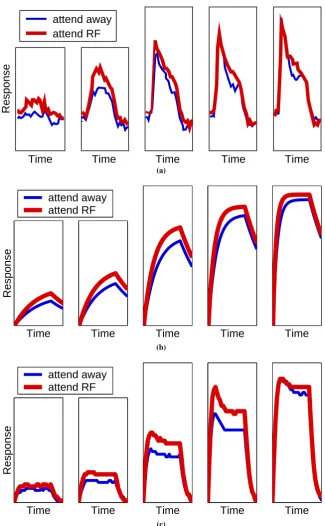
When attention is directed to a particular location, the processing of a stimulus appearing at that location is enhanced (Reynolds et al.,2000; Kastner et al.,1999;Kirschfeld and Kammer,2000). Increased attention has effects similar to increasing the contrast or saliency of the stimulus (Kastner and Ungerleider,2000;Olson,2001; Itti and Koch, 2001; Reynolds et al.,2000). Results form one experiment illustrating this effect are shown in figure6(a). In this experiment only one stimulus appeared within the receptive field of the recorded cell. The response of the cell was measured when the location of this stimulus was attended and when it was not attended for varying stimulus contrasts. The data shown was measured from area V4 of the rhesus monkey.
Response
Time
Time
Time
Time
Time
attend away
attend RF
(a)
Response
Time
attend away
attend RF
Time
Time
Time
Time
(b)
Time
Response
attend away
attend RF
Time
Time
Time
Time
(c)
0.2 0.6 x1.4
x
11y
11y
12(a)
0.5 0.3 0.6
x
y
y
11 12111
(b)
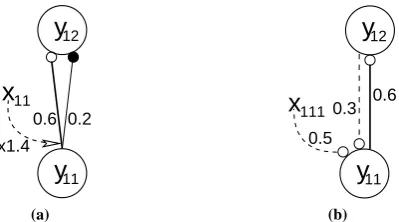
Figure 7: Details of the neural network architectures used to simulate the data shown in figure6. Nodes are shown as large circles, excitatory synapses as small open circles and inhibitory synapses as small filled circles. Thexvalues represent top-down biases that have an activation value of either zero or one depending on the attentional state. These top-down signals are assumed to arise from neural generators outside the modelled circuits. Feedforward connections are shown as solid lines and feedback connec-tions are shown as dashed lines. Values for the synaptic strengths are indicated, these weights were chosen to provide the best fit between the behaviour of each model and the experimental data (see the Methods section). (a) The Reynolds and Desimone model. (b) The feedback model.
using the neural network architecture shown in figure7(b), are plotted in figure6(c).
Both neural network architectures successfully simulate the change in magnitude of attentional facilitation with stimulus contrast. Attention produces the largest change in response at intermediate stimulus contrasts and has only a weak effect at high contrast. Since sub-optimal stimuli were used to generate the physiological data it appears that weak attentional modulation at high contrast is not due to the firing rate of the recorded cell reaching saturation. The two models explain this effect in different ways. For the Reynolds and Desimone model, as the activation of the input node increases, the response of the output node tends towards the maximum response that is possible given the balance between the excitatory and inhibitory afferents. Further increasing the effective strength of the input via attention has a diminishing effect as this upper limit is reached. In contrast, in the feedback model it is saturation of the response of the node in the lower region that result in attention having less effect at high contrast.
While both models account equally well for the the general effects of attentional facilitation, the models can be distinguished when compared to the finer detail of the physiological data. It can be seen that for the biological data, response latencies reduce with increased stimulus contrast, but are not affected by attention (in this respect increasing attention is unlike increasing the stimulus contrast). For the Reynolds and Desimone model, response latencies correctly reduce with increased stimulus contrast, but also with attention. For the feedback model, response latencies are marginally reduced by stimulus contrast but not by attention. The feedback model thus provides a better fit to the detailed experimental data.
It can also be seen from the physiological data that attentional modulation occurs at longer latencies with increasing contrast. Reynolds et al.(2000) state that this effect can be explained by the the biased competition model, however, the implementation they propose fails to do so. Instead, with their neural network architecture the effect of attention at high contrast is at least as strong at short latencies as it is at longer latencies. In contrast, the feedback model does successfully simulate this aspect of the experimental data. It does so due to the input node reaching saturation during the early part of its response at high contrast. The top-down activation is therefore unable to amplify the early activity of the input node. However, at longer latencies the response of the input node is attenuated (see equation5in the Methods section) enabling attention to modulate activity at longer latencies.
pair attend poor pref attend pref poor attend poor pair attend pref
Response
Time
(a)
Time
Response
pref attend pref poor attend poor pair attend pref pair attend poor
(b)
Time
Response
pref attend pref poor attend poor pair attend pref pair attend poor
(c)
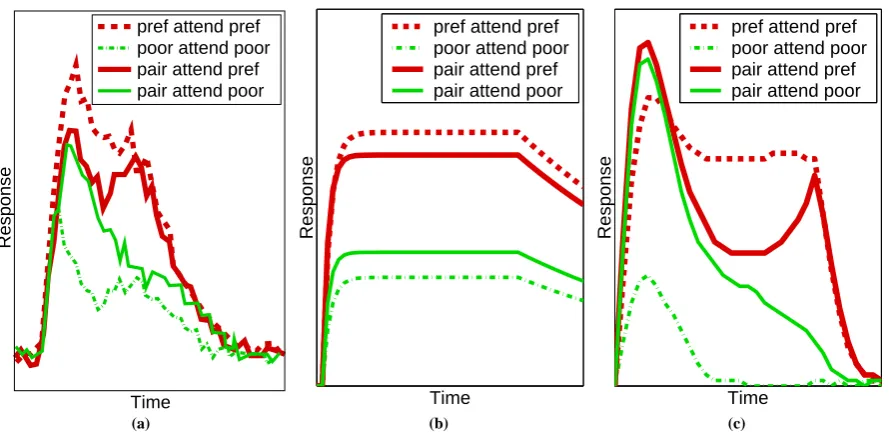
Figure 8: The effect of featural attention on the response of a neuron. Responses are shown for different combinations of stimuli appearing within the receptive field of a single neuron. (a) The averaged response for a population of cells in V4 (adapted from Chelazzi et al.,2001). (b) Simulation results from the Reynolds and Desimone model. (c) Simulation results from the feedback model. For (a) the response was measured in spikes per second and time in milliseconds, for (b) and (c) both response and time are in arbitrary units and have been scaled to resemble (a).
feedback model, the activation of the input nodes corresponding to weak and strong stimuli would be modulated equally by attention, but these activation values would drive the output neuron via differently weighted afferents and hence cause attention to have a proportionate effect on the response of the output node. Alternatively, with the feedback model, the activation of the recorded cell might be directly modulated by an attention-dependent, top-down, bias.
2.2
Featural Attention
Rather than specifying the spatial location that is to be attended, it is also possible to experiment with the effects of cueing the target object that is to be attended. In one such experiment (Chelazzi et al.,2001), rhesus monkeys were presented with an array containing one or two objects, one of which might have previously been cued as the target for a saccade. Responses were measured from cells in area V4, with receptive fields sufficiently large to encompass the stimulus array. Different responses were generated when the target object was the preferred stimulus of the recorded cell compared to when the target was a non-optimal stimulus (see figure8(a)). Results are similar to those for attentional selection using spatial cues (presented above) in that when the stimulus array contains a pair of objects the response of the cell becomes more similar to the response that would be generated by the attended stimulus in isolation.
x5 x5
0.7 0.3
0.3 0.7
x
11x
21y
12y
11y
21(a)
0.7 0.7 0.3
0.15 0.35 0.35
0.1 0.1
x
x
y
y
y
11y
22
21 12
112 122
(b)
Figure 9: Details of the neural network architectures used to simulate the data shown in figure8. Nodes are shown as large circles, excitatory synapses as small open circles and inhibitory synapses as small filled circles. Thexvalues represent top-down biases that have an activation value of either zero or one depending on the attentional state. These top-down signals are assumed to arise from neural generators outside the modelled circuits. Feedforward (and lateral) connections are shown as solid lines and feed-back connections are shown as dashed lines. Values for the synaptic strengths are indicated, these weights were chosen to provide the best fit between the behaviour of the model and the experimental data (see the Methods section). (a) The Reynolds and Desimone model. (b) The feedback model.
higher cortical region1. When a single stimulus is presented to the network the node with the preference to that
stimulus wins the competition and inhibits the output of the other node. When both stimuli are presented, both nodes in the higher region receive equal feedforward activation. In this condition even a small top-down signal to one node, or the other, can bias the competition in favour of that node.
2.3
Familiarity and Context
In all the tasks described above, the attended object or location was cued prior to stimulus onset. Top-down activity thus corresponded to an expectation about the content of the test stimulus. In other tasks the required focus of attention may not be defined a priori, but may be influenced entirely by the content of the stimulus itself. Similarly, in non-attentional tasks, the content of the visual scene may influence the processing of specific stimuli. Perception will be influenced both by bottom-up biases, such as stimulus saliency, and by top-down influence such as familiarity (Olson et al.,2001;Chun,2002).
In this section we present various experiments on the effect of familiarity on neural activity in the feedback model. In these simulations two regions of neurons are reciprocally connected by feedforward and feedback connections, as illustrated in figure10(a). The lower region receives sensory input in the form of an eight-by-eight pixel image. Nodes in this region have small receptive fields and are selective to simple patterns within the input image (short horizontal and vertical bars, examples of which are shown in figure10(c)). Nodes in the higher region receive feedforward connections from all the nodes in the lower region. These nodes thus have larger receptive fields and can learn to become selective to larger, more complex, patterns within the input (stimuli composed of several individual bars, as shown in figure10(b)). The selectivity of the nodes in the upper region is determined by prior experience. Nodes learn to become selective to frequently reoccuring patterns within the input data. Hence, unlike previous simulations, where appropriate synaptic weights were set by hand, in these simulations synaptic weights are learnt2. Furthermore, in contrast to the simulations presented above, where the
top-down signals were generated by sources outside the modelled circuits, in this section the simulations do not make use of external sources of feedback. Instead, the effects of feedback processes are generated by the recurrent connectivity between the two model cortical regions.
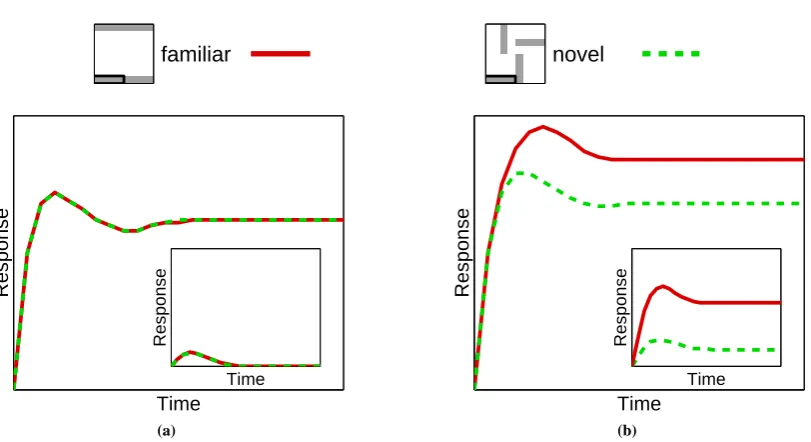
Figure11shows the response of a single node in the lower region under different conditions. The recorded node is selective to the bar outlined in the images shown at the top of the figure. The response of this node when different patterns are presented to the network is shown. Note that in each case the recorded neuron receives an identical sensory input, however, the context within which this image feature appears changes. Before training,
1Rather than considering this a change in the network architecture, we can consider the that the same architecture was used in previous experiments, but that the top-down signals targeting nodes in the upper region were silent, and hence could be ignored. Similarly, in the current experiment, top-down signals targeting the lower region are irrelevant and have been ignored.
Image Input Region Lower Region Upper
(a)
(b)
(c)
Figure 10: (a) The neural network architecture used for experiments on familiarity and context. Nodes in the lower region receive feedforward connections from an eight-by-eight pixel input image. Nodes in the upper region receive feedforward connections from all the nodes in the lower region. Reciprocal feedback connections also exist between nodes in the upper region and nodes in the lower region. (c) Examples of image features to which nodes in the lower region are selective. (b) The patterns to which nodes in the upper region become selective after training.
familiar
novel
Time
Response
Time
Response
(a)
Time
Response
Time
Response
(b)
familiar
novel
Time
Response
Time
Response
(a)
Time
Response
Time
Response
(b)
Figure 12: The effect of familiarity on the responses of two simulated neurons in the feedback model. The pattern shown at the top of the figure was presented to the network and the responses of two nodes in the lower region, were recorded. The recorded nodes were selective to the two outlined bars indicated, each of which formed part of a different familiar pattern (shown in figure10(b)). The presented pattern provided equal sensory-driven activity to both nodes but contained only one of the familiar patterns. (a) Before training, each node generates equal responses to the stimulus. (b) After training, one node generates an enhanced response to the bar that is part of the presented familiar stimulus, compared to the other node. The insets in both figures show the responses of the two nodes in the upper region which become selective to the familiar patterns after training. Before training, both upper region nodes generate a weak response to the stimulus. After training, the upper region node that is selective to the presented familiar pattern produces a much stronger response to the stimulus compared to the other node. This difference in activity in the upper region results in the modulation observed in the responses of the lower region nodes. Both response and time are measured in arbitrary units, but the same scale has been used in each plot.
nodes in the upper region are equally unselective to all patterns, and hence, the recorded node receives similar top-down activation in each case and the response of the recorded node is the same for each stimulus. However, after training, one node in the higher region becomes selective to the familiar pattern. The feedback from this node modulates the activation of the recorded node, such that after training the recorded node shows an enhanced response to a familiar pattern compared to a novel pattern. A similar enhancement to the response of the node would be expected in a task exploring feature-based attentional facilitation.
Note that in this experiment, response enhancement is driven by the stimulus and so it could be described as resulting from a bottom-up process. However, the modulation results from feedback to the recorded node, and is determined by the response properties of neurons in a higher-level region, so that, in this sense, it is a top-down process. For the recorded neuron, the sensory-driven stimulation is identical in each case, and changes in the response are due to stimulus features that occur outside its receptive field. The response of a cortical cell to a particular stimulus is known to be highly dependent on the context in which that stimulus appears (Gilbert et al., 2000). While stimuli outside the receptive field are incapable of generating a response when presented in isolation, they can modulate the activation generated by stimuli appearing within the receptive field. Many of these effects are due to long-range, horizontal, connections intrinsic to a cortical region (Li,2000,1999;Somers et al.,1998; Stemmler et al.,1995;Gilbert et al.,1996;Lamme et al.,1998). However, similar modulatory, contextual, effects also result from feedback (Zipser et al.,1996;Hup´e et al.,1998;Gilbert et al.,2000;Olson et al.,2001).
figure
noise
Time
Response
(a)
Time
Response
(b)
Figure 13: The effect of familiarity on noise suppression in the feedback model. The pattern shown at the top of the figure was presented to the network and the responses of two nodes in the lower region, were recorded. The recorded nodes were selective to the two outlined bars indicated, each of which formed part of a different familiar pattern. The presented pattern was a corrupted version of one of the familiar patterns, such that each node received equal sensory-driven activity. (a) Before training each node generates equal responses to the stimulus. (b) After training one node generates an enhanced response to the bar that is part of the presented familiar stimulus, compared to the other node. Both response and time are measured in arbitrary units, but the same scale has been used in each plot.
1995;Zipser et al.,1996;Lamme et al.,1998,2000;Lamme and Spekreijse,2000). The enhancement to activity occurs during the sustained response of the neuron at longer latencies. This late onset of modulation could be due either to response saturation during the initial burst of activity (as postulated to explain the results shown in figure6) or it could result from a delay in receiving feedback from higher regions (Treue,2001).
Behavioural results show that figure/ground segmentation is influenced by experience such that a familiar shape is more likely to be perceived as the figure (Peterson et al.,1991). We thus modified the previous task to simulate figure/ground segmentation. In this case the responses of two different nodes in the lower region are plotted when a single stimulus is presented. The stimulus is the superposition of a familiar and a novel pattern (see figure12). Both recorded nodes are selective to a bar which is contained within different familiar patterns. However, the presented pattern contains only one of those familiar patterns (together with the novel pattern). Before training, nodes in the higher region are unselective and hence both nodes receive equally weak feedback and respond similarly to the stimulus. After training the stimulus evokes a strong response from the node in the higher region which is selective to the embedded familiar pattern. This node provides feedback to one of the recorded nodes which enhances the response of this node in comparison to the other recorded node. The result in this case is similar to the effect that would be expected in an attentional selection task.
Similar results of training on a search task have been described by Lee et al. (2002). In this experiment the responses of cells in primary visual cortex were found to be dependent on experience and the behavioural relevance of stimuli. These cells only became sensitive to certain odd-ball stimuli defined by shape-from-shading after training. Perceptual pop-out saliency depended on experience and appeared to result from feedback from area V2. Higher-order stimulus attributes were thus shown to influence lower-level processing.
stimuli to be represented more strongly than unfamiliar stimuli or background noise.
Attention has been suggested as one possible mechanisms for solving the ‘binding’ problem (Treisman,1998; Reynolds and Desimone,1999;Roelfsema et al.,2000;Luck and Ford,1998). One proposal is that spatial at-tention acts to enhance the processing of stimulus features, across multiple dimensions, and hence provide a cue for grouping together all the features originating from a single object at one location (Treisman,1998). More generally, top-down information could act to disambiguate sensory data for which there would otherwise be mul-tiple interpretations. Such a proposal is compatible with the feedback model since the competition between nodes representing incompatible interpretations of the sensory data could be biased by top-down signals. This would enhance the responses of nodes compatible with the biased interpretation and enable these nodes to suppress the activity of nodes representing other possible interpretations. Similarly, sources of feedback, other than those gen-erated by attentional demands, could also act to bias the interpretation of feedforward information. For example, figure14illustrates how contextual information from outside a neuron’s receptive field could bias the interpreta-tion of images presented to the network described throughout this secinterpreta-tion. We introduce an ambiguous situainterpreta-tion into the the previous task by making all the pixels in one quadrant of the image active. Given the selectivities of the nodes in the lower region, this input might be interpreted either as four horizontal bars or four vertical bars. Hence, due to the presence of multiple objects in the image, there is a need to group together features that belong to a single object, i.e., to determine whether a particular pixel should be grouped with other pixels in the same row, or with other pixels in the same column.
Without any feedback, the competition between the nodes representing horizontal bars and those representing vertical bars is resolved entirely by the relative strengths of the feedforward connections, or in the event of all weights being equal, the competition is resolved randomly (due to the noise in the node activations). However, if contextual information is provided, by presenting the ambiguous features in combination with a familiar pattern, then the competition is biased in favour of one interpretation or the other (see figure14). Feedback from the node in the higher region, activated by the familiar pattern, modulates the activity of all nodes which are consistent with this familiar pattern. One node with a receptive field within the lower-left quadrant thus receives feedback activation. This additional, top-down information is sufficient to bias the competition in favour of either the horizontal or vertical bars, as appropriate to the context. Similar results would be expected if feedback was provided by an attention-dependent top-down signal rather than being generated by a familiar stimulus context.
3
Discussion
hoizontal
vertical
Time
Response
(a)
Time
Response
(b)
vertical
hoizontal
Time
Response
(c)
Time
Response
(d)
separate, interacting, systems (e.g., Koch and Ullman,1985; Itti and Koch,2001; Heinke et al.,2002; Heinke and Humphreys,2003;Mozer,1988). These models typically employ a “saliency map” or “selection network” in which competition occurs between different spatial locations. This module is responsible for selecting the focus of attention and is used to gate the perceptual input to a separate neural system which performs object recognition. Rather than postulating a separate cortical system for the selection and control of the focus of attention, the biased competition model suggests that “attention is an emergent property of many neural mechanisms working together to resolve competition for visual processing” (Desimone and Duncan,1995, p.194). Since competition can occur at each stage in the visual processing hierarchy, this model resolves the dichotomy between early (Broadbent, 1958;Treisman,1969) and late (Deutsch and Deutsch,1963;Shiffrin and Schneider,1977) selection theories of attention by challenging the traditional view that there are distinct preattentive and attentive stages in perceptual processing. Rather than proposing that attention always operates to select objects at an early stage of visual processing, or that attentional selection operates at a late stage in visual processing, the biased competition model suggests that selection occurs at different stages depending on the stimuli and the task.
In many of the experiments we have reported, top-down information is provided by sources that are external to the simulated neural network. The biased competition model proposes that these top-down signals originate in cortical regions that respond distinctively in each of the attentional task conditions. Physiological data suggest that such signals might originate in a number of frontal and parietal regions of the cortex (Kanwisher and Wojciulik, 2000;Kastner and Ungerleider,2000). These regions thus seem to be responsible for the selection and control of attention in these tasks. A very similar set of cortical regions are implicated in the provision working memory (Kastner and Ungerleider,2000;Luck et al.,1997). The sustained activity of cells in these regions provides work-ing memory and generates top-down signals that can affect the responses of cells throughout the ventral hierarchy (Sup`er et al.,2001;Duncan,1998). These effects on neural activity, recorded during working memory tasks, are very similar to those recorded during attention tasks in the absence of visual stimulation (Kastner and Ungerleider, 2000). Hence, the top-down signals from working memory are likely to bias processing of subsequently presented stimuli (Desimone,1998;Reynolds and Desimone,1999;de Fockert et al.,2001). It therefore seems likely that the feedback signals in the attentional tasks we have simulated originate in working memory since all these tasks required a memory to be maintained of the cued spatial location or the cued target object.
While top-down bias results from working memory in certain experiments, it results from long-term memory in the experiments on familiarity and context. In these tasks, top-down bias was generated by the selectivity of the modelled neurons rather than being provided by an external source. The reciprocal connectivity of the modelled neural network then results in the modulation of neural response properties. Training causes a node to become selective to a certain stimulus. This node subsequently generates a stronger response to this stimulus which can bias processing of perceptual data via feedback. Such bias can modulate the responses of nodes in the previous region. It could also be transmitted via feedforward connections, to increase the the strength (or saliency) of the bottom-up signal corresponding to the familiar item in subsequent processing stages. In this way, the processing of the perceptual data is biased by the selectivity of each node. Since the selectivities of cortical cells, at all stages of the visual processing hierarchy, can be modified by past experience (Kobatake et al.,1998;Karni,1996; Logothetis,1998;Sigala and Logothetis,2001;Desimone,1996) sensory-driven activity is biased to be interpreted in terms of stored knowledge about previously encountered situations (Lee et al.,2002;Siegel et al.,2000).
4
Methods
4.1
The Reynolds and Desimone Model
The total excitatory and inhibitory activation received by the output node is calculated as:
y12,excit=
2
X
i=1
w+i12yi1xi1
y12,inhib=
2
X
i=1
wi−12yi1xi1
Whereyi1is the activation of nodeiin the input region,w+i12is the strength of the excitatory weight from inputi, w−i12is the strength of the inhibitory weight from inputi, andxi1is the strength of the attention-dependent signal
directed at inputi.Reynolds et al.(1999) suggest thatxi1should take a value of 5 for attended stimuli, and 1 for
unattended stimuli.
The time-varying output of the node can be calculated as:
y12t =y
t−1
12 +γ
β−yt12−1y12,excit−(α+y12,inhib)y12t−1
Whereαis a parameter controlling the rate of decay of a node’s activity,βis the maximum response of a node, andγis a parameters that updates the activity slowly so as to dampen oscillatory behaviour.Reynolds et al.(1999) specify parameter values ofα= 0.2andβ = 1and we use a value ofγ = 0.1in our simulations. If the input activity remains constant for a sufficient time, the output reaches a steady-state value given by:
y12t
t→∞
= βy12,excit
y12,excit+y12,inhib+α
4.2
The Feedback Model
For each node the activations of the apical and basal dendrites were calculated as:
ytjk,apical=
ma
X
i=1
vijkxtijk−1 (1)
yjk,basalt =
mb
X
i=1
wijkXijkt−1 (2)
Whereyt
jk,apical is the activation of the apical dendrite of nodejin regionkat timet,ytjk,basalis the activation
of the basal dendrite of the same node,mais the total number of synapses on the apical dendrite,mbis the total number of synapses on the basal dendrite,vijkis the synaptic weight from inputito the apical dendrite of node
j in regionk,wijk is the synaptic weight from inputi to the basal dendrite of nodej in regionk,xtijk is the activation of inputito the apical dendrite of nodej in regionk, andXt
ijk is the activation received by the basal dendrite of nodejin regionkfrom inputiafter pre-integration lateral inhibition3:
Xijkt =xtijk
1−α
tmaxn
p=1
(p6=j)
wipk maxm
q=1{wqpk}
ypkt−1
maxn
q=1
n
yqkt−1o
+ . (3)
Whereαtis a scale factor controlling the strength of lateral inhibition,yt−1
pk is the activation of nodepin region
kat timet−1 (defined below in equation4), and(z)+is the positive half-rectified value ofz. In the reported
simulations, the value ofαtwas gradually increased at each time-step, from an initial value of zero to a maximum value of six in steps of 0.1.
The values of the apical inputs (xtijk) are the activations of nodes in a higher cortical region at the previous time step (i.e.,ytj−0k1+1), or are top-down signals that arise from neural generators outside the modelled circuits.
The values of the basal inputs (Xt
ijk) are the inhibited activations from nodes in a lower cortical region at the
previous time step (i.e.,ytj−0k1−1). Note that the activations of every node are determined in an identical way and
that attention-dependent top-down signals are treated in the same way as any other source of feedback: they provide another activation value,x, that contributes to the apical activation via a synaptic weight,v.
The activation of the apical dendrite multiplicatively modulates the activation of the basal dendrite in order to determine the output activation of each node:
ytjk=ytjk,basal 1 +yjk,apicalt
(4)
Whereyt
jkis the activation of nodej in regionkat timet. This formulation enables bottom-up, sensory-driven, stimulation to drive the response of the node even in the absence of top-down activity. In contrast, feedback activation can not drive the node’s activity in the absence of feedforward activation, but it can amplify any response to feedforward stimulation.
The presence of reciprocal excitatory connections can lead to positive feedback effects resulting in run-away activation values. To prevent this, the activity of each node is attenuated in proportion to the cumulative strength its previous activity (Cjkt−1), and this attenuated activation is clipped to be in the range [0,1]:
ytjk= "
yt jk 1 +Cjkt−1
#1
0
(5)
This attenuated activity has a time-varying profile which resembles that of biological neurons; having an initial burst of activity followed by a sustained response at a lower firing rate. To make this profile more realistic the change in activity of the node is smoothed by taking into account the previous activity of the node:
yjkt =τ1yjkt + (1−τ1)yjkt−1 (6)
The cumulative activity,Ct
jk, of the node is calculated as:
Cjkt =τ2yjkt + (1−τ2)Cjkt−1 (7)
Whereτ1andτ2are time constants, which take the valuesτ1= 0.5andτ2= 0.25.
Finally, the activity of each node was modified by a small amount of noise, such that:
ytjk=ytjk(1 +ρ) (8)
The noise values,ρ, were logarithmically distributed positive real numbers in the range [0,0.01]. Since the mag-nitude of the noise is small it has very little effect on neural activity except when multiple nodes have virtually identical synaptic weights. When this occurs, the noise causes one of these nodes to win the competition to be active in response to the current stimulus.
4.3
Synaptic Weight Values
In the simulations of the attentional data reported in sections 2.1and2.2, appropriate values for the synaptic weights were set by hand. Since the model was being used to simulate neurophysiological data collected from different cells with distinct selectivities, different sets of weight values were used in different simulations. Weights were chosen to provide the best fit between the behaviour of each model and the experimental data, with the following restrictions. Weight values were limited to the range [0,1], and were adjusted in steps of 0.1. The total sum of the synaptic weights received at each basal dendrite was made equal to one (i.e.,Pmi=1(wijk)
+
= 1). Where a network was symmetrical, corresponding weights were given the same value (e.g., the weight from input one to node one was made equal to the weight from input two to node two). Feedback weights were given a value of half the corresponding feedforward weight. Given these constraints, there were 11 possible sets weights for the interconnections between the input and output regions, and 11 possible sets of weights for the external sources of feedback. Rather than exhaustively searching through these possibilities, weights were adjusted incrementally to improve the fit with the experimental data until satisfactory results were obtained.
Acknowledgements
This work was funded by MRC Research Fellowship number G81/512.
References
Barbas, H. and Rempel-Clower, N. (1997). Cortical structure predicts the pattern of corticocortical connections. Cerebral Cortex, 7:635–46.
Broadbent, D. E. (1958). Perception and communication. Pergamon, London, UK.
Budd, J. M. L. (1998). Extrastriate feedback to primary visual cortex in primates: a quantitative analysis of connectivity. Proceedings of the Royal Society of London. Series B, 265(1400):1037–44.
Cauller, L. J. (1995). Layer I of primary sensory neocortex: where top-down converges upon bottom-up. Be-havioural Brain Research, 71(1-2):163–70.
Cauller, L. J., Clancy, B., and Connors, B. W. (1998). Backward cortical projections to primary somatosensory cortex in rats extend long horizontal axons in layer I. Journal of Comparative Neurology, 390(2):297–310. Chelazzi, L., Miller, E. K., Duncan, J., and Desimone, R. (2001). Responses of neurons in macaque area V4
during memory-guided visual search. Cerebral Cortex, 11(8):761–72.
Chun, M. M. (2002). Contextual cueing of visual attention. Trends in Cognitive Sciences, 4(5):170–8.
Corchs, S. and Deco, G. (2002). Large-scale neural model for visual attention: integration of experimental single cell and fMRI data. Cerebral Cortex, 12(4):339–48.
Crick, F. and Asanuma, C. (1986). Certain aspects of the anatomy and physiology of the cerebral cortex. In Rumelhart, D. E., McClelland, J. L., and The PDP Research Group, editors, Parallel Distributed Processing: Explorations in the Microstructures of Cognition. Volume 2: Psychological and Biological Models, pages 333– 71. MIT Press, Cambridge, MA.
Crick, F. and Koch, C. (1998). Constraints on cortical and thalamic projections: the no-strong-loops hypothesis. Nature, 391:245–50.
de Fockert, J. W., Rees, G., Frith, C. D., and Lavie, N. (2001). The role of working memory in visual selective attention. Science, 291(5509):1803–6.
De Weerd, P., Peralta, M. R., Desimone, R., and Ungerleider, L. G. (1999). Loss of attentional stimulus selection after extrastriate cortical lesions in macaques. Nature Neuroscience, 2(8):753–8.
Deco, G., Pollatos, O., and Zihl, J. (2002). The time course of selective visual attention: theory and experiments. Vision Research, 42(27):2925–45.
Desimone, R. (1996). Neural mechanisms for visual memory and their role in attention. Proceedings of the National Academy of Science USA, 93:13494–9.
Desimone, R. (1998). Visual attention mediated by biased competition in extrastriate visual cortex. Philosophical Transactions of the Royal Society of London. Series B, 353(1373):1245–55.
Desimone, R. and Duncan, J. (1995). Neural mechanisms of selective visual attention. Annual Review of Neuro-science, 18:193–222.
Deutsch, J. A. and Deutsch, D. (1963). Attention: some theoretical considerations. Psychological Review, 70:80– 90.
Duncan, J. (1998). Converging levels of analysis in the cognitive neuroscience of visual attention. Philosophical Transactions of the Royal Society of London. Series B, 353(1373):1307–17.
Ebdon, M. (1996). Towards a General Theory of Cerebral Neocortex. PhD thesis, University of Sussex.
Everling, S., Tinsley, C. J., Gaffan, D., and Duncan, J. (2002). Filtering of neural signals by focused attention in the monkey prefrontal cortex. Nature Neuroscience, 5(7):671–6.
Felleman, D. J. and Van Essen, D. C. (1991). Distributed hierarchical processing in primate cerebral cortex. Cerebral Cortex, 1:1–47.
Friston, K. J. and B¨uchel, C. (2000). Attentional modulations of effective connectivity from V2 to V5/MT in humans. Proceedings of the National Academy of Science USA, 97(13):7591–6.
Frith, C. (2001). A framework for studying the neural basis of attention. Neuropsychologia, 39(12):1367–71. Gilbert, C., Ito, M., Kapadia, M., and Westheimer, G. (2000). Interactions between attention, context and learning
in primary visual cortex. Vision Research, 40(10-12):1217–26.
Gilbert, C. D., Das, A., Ito, M., Kapadia, M., and Westheimer, G. (1996). Spatial integration and cortical dynamics. Proceedings of the National Academy of Science USA, 93(2):615–22.
Grossberg, S. and Raizada, R. (2000). Contrast-sensitive perceptual grouping and object-based attention in the laminar circuits of primary visual cortex. Vision Research, 40(10-12):1413–32.
Hamker, F. H. (1999). The role of feedback connections in task-driven visual search. In Heinke, D., Humphreys, G. W., and Olson, A., editors, Connectionist Models in Cognitive Neuroscience: Proceedings of the 5th Neural Computation and Psychology Workshop (NCPW98), pages 252–61, London, UK. Springer.
Heinke, D. and Humphreys, G. W. (2003). Attention, spatial representation and visual neglect: simulating emer-gent attention and spatial memory in the selective attention for identification model (SAIM). Psychological Review, 110(1):29–87.
Heinke, D., Humphreys, G. W., and di Virgilo, G. (2002). Modeling visual search experiments: selective attention for identification model (SAIM). Neurocomputing, 44-46:817–22.
Hup´e, J. M., James, A. C., Payne, B. R., Lomber, S. G., Girard, P., and Bullier, J. (1998). Cortical feedback improves discrimination between figure and background by V1, V2 and V3 neurons. Nature, 394(6695):784–7. Itti, L. and Koch, C. (2001). Computational modelling of visual attention. Nature Reviews Neuroscience, 2(3):194–
202.
Jagadeesh, B., Chelazzi, L., Mishkin, M., and Desimone, R. (2001). Learning increases stimulus salience in anterior inferior temporal cortex of the macaque. Journal of Neurophysiology, 86(1):290–303.
Johnson, R. R. and Burkhalter, A. (1997). A polysynaptic feedback circuit in rat visual cortex. Journal of Neuroscience, 17(18):7129–40.
Kanwisher, N. and Wojciulik, E. (2000). Visual attention: insights from brain imaging. Nature Reviews Neuro-science, 1(2):91–100.
Karni, A. (1996). The acquisition of perceptual and motor skills: a memory system in the adult human cortex. Cognitive Brain Research, 5:39–48.
Kastner, S., Pinsk, M. A., De Weerd, P., Desimone, R., and Ungerleider, L. G. (1999). Increased activity in human visual cortex during directed attention in the absence of visual stimulation. Neuron, 22(4):751–61.
Kastner, S. and Ungerleider, L. G. (2000). Mechanisms of visual attention in the human cortex. Annual Review of Neuroscience, 23:315–41.
Keysers, C. and Perrett, D. I. (2002). Visual masking and RSVP reveal neural competition. Trends in Cognitive Sciences, 6(3):120–5.
Kirschfeld, K. and Kammer, T. (2000). Visual attention and metacontrast modify latency to perception in opposite directions. Vision Research, 40:1027–33.
Kobatake, E., Wang, G., and Tanaka, K. (1998). Effects of shape-discrimination training on the selectivity of inferotemporal cells in adult monkeys. Journal of Neurophysiology, 80(1):324–30.
Koch, C. and Segev, I. (2000). The role of single neurons in information processing. Nature Neuroscience, 3(supplement):1171–7.
Koch, C. and Ullman, S. (1985). Shifts in selective visual attention: towards the underlying neural circuitry. Human Neurobiology, 4(4):219–27.
K¨ording, K. P. and K¨onig, P. (2000). Learning with two sites of synaptic integration. Network: Computation in Neural Systems, 11(1):25–39.
K¨ording, K. P. and K¨onig, P. (2001). Supervised and unsupervised learning with two sites of synaptic integration. Journal of Computational Neuroscience, 11(3):207–15.
Lamme, V. A. F. (1995). The neurophysiology of figure-ground segregation in primary visual cortex. Journal of Neuroscience, 15(2):1605–15.
Lamme, V. A. F. (2000). Neural mechanisms of visual awareness: a linking proposition. Brain and Mind, 1:385– 406.
Lamme, V. A. F. and Roelfsema, P. R. (2000). The distinct modes of vision offered by feedforward and recurrent processing. Trends in Neurosciences, 23(11):571–9.
Lamme, V. A. F. and Spekreijse, H. (2000). Modulations of primary visual cortex activity representing attentive and conscious scene perception. Frontiers in Bioscience, 5:232–43.
Lamme, V. A. F., Sup`er, H., Landman, R., Roelfsema, P. R., and Spekreijse, H. (2000). The role of primary visual cortex (V1) in visual awareness. Vision Research, 40(10-12):1507–21.
Lamme, V. A. F., Sup`er, H., and Spekreijse, H. (1998). Feedforward, horizontal, and feedback processing in the visual cortex. Current Opinion in Neurobiology, 8(4):529–35.
Larkum, M. E., Zhu, J. J., and Sakmann, B. (1999). A new cellular mechanism for coupling inputs arriving at different cortical layers. Nature, 398(6725):338–41.
Larkum, M. E., Zhu, J. J., and Sakmann, B. (2001). Dendritic mechanisms underlying the coupling of the dendritic with the axonal action potential initiation zone of adult rat layer 5 pyramidal neurons. Journal of Physiology, 533(2):447–66.
Lee, T. S., Mumford, D., Romero, R., and Lamme, V. A. F. (1998). The role of primary visual cortex in higher level vision. Vision Research, 38(15-16):2429–54.
Lee, T. S., Yang, C. F., Romero, R. D., and Mumford, D. (2002). Neural activity in early visual cortex reflects behavioral experience and higher-order perceptual saliency. Nature Neuroscience, 5(6):589–97.
Li, Z. (2000). Pre-attentive segmentation in the primary visual cortex. Spatial Vision, 13(1):25–50.
Logothetis, N. (1998). Object vision and visual awareness. Current Opinion in Neurobiology, 8(4):536–44. Luck, S. J., Chelazzi, L., Hillyard, S. A., and Desimone, R. (1997). Neural mechanisms of spatial selective
attention in areas V1, V2, and V4 of macaque visual cortex. Journal of Neurophysiology, 77:24–42.
Luck, S. J. and Ford, M. A. (1998). On the role of selective attention in visual perception. Proceedings of the National Academy of Science USA, 95:825–30.
McAdams, C. J. and Maunsell, J. H. R. (1999). Effects of attention on orientation-tuning functions of single neurons in macaque cortical area V4. Journal of Neuroscience, 19(1):431–41.
McAdams, C. J. and Maunsell, J. H. R. (2000). Attention to both space and feature modulates neuronal responses in macaque area V4. Journal of Neurophysiology, 83(3):1751–5.
Mehta, A. D., Ulbert, I., and Schroeder, C. E. (2000). Intermodal selective attention in monkeys. II: Physiological mechanisms of modulation. Cerebral Cortex, 10:359–70.
Moran, J. and Desimone, R. (1985). Selective attention gates visual processing in the extrastriate cortex. Science, 229(4715):782–4.
Mountcastle, V. B. (1998). Perceptual Neuroscience: The Cerebral Cortex. Harvard University Press, Cambridge, MA.
Mozer, M. C. (1988). A connectionist model of selective attention in visual perception. In Proceedings of the 10th Annual Conference of the Cognitive Science Society, pages 195–201, Hillsdale, NJ. Erlbaum.
Mumford, D. (1992). On the computational architecture of the neocortex II: the role of cortico-cortical loops. Biological Cybernetics, 66:241–51.
Olshausen, B. A., Anderson, C. H., and Van Essen, D. C. (1993). A neurobiological model of visual attention and invariant pattern recognition based on dynamic routing of information. The Journal of Neuroscience, 13(11):4700–19.
Olson, C. R. (2001). Object-based vision and attention in primates. Current Opinion in Neurobiology, 11(2):171– 9.
Olson, I. R., Chun, M. M., and Allison, T. (2001). The contextual guidance of attention: human intracranial event-related potential evidence for feedback modulation in anatomically early temporally late stages of visual processing. Brain, 124(7):1417–25.
O’Reilly, R. C. (1998). Six principles for biologically based computational models of cortical cognition. Trends in Cognitive Sciences, 2(11):455–62.
Peterson, M. A., Harvey, E. M., and Weidenbacher, H. J. (1991). Shape recognition contributions to figure-ground reversal: which route counts? Journal of Experimental Psychology, Human Perception and Performance, 17(4):1075–89.
Phaf, R. H., Van der Heijden, A. H. C., and Hudson, P. T. W. (1990). SLAM: a connectionist model for attention in visual selection tasks. Cognitive Psychology, 22(3):273–341.
Phillips, W. A., Kay, J., and Smyth, D. (1995). The discovery of structure by multi-stream networks of local processors with contextual guidance. Network: Computation in Neural Systems, 6(2):225–46.
Phillips, W. A. and Singer, W. (1997). In search of common foundations for cortical computation. Behavioural and Brain Sciences, 20(4):657–722.
Pollen, D. A. (1999). On the neural correlates of visual perception. Cerebral Cortex, 9(1):4–19.
Reynolds, J. H., Chelazzi, L., and Desimone, R. (1999). Competitive mechanisms subserve attention in macaque areas V2 and V4. Journal of Neuroscience, 19:1736–53.
Reynolds, J. H. and Desimone, R. (1999). The role of neural mechanisms of attention in solving the binding problem. Neuron, 24(1):19–29.
Reynolds, J. H., Pasternak, T., and Desimone, R. (2000). Attention increases sensitivity of V4 neurons. Neuron, 26:703–14.
Rockland, K. S. (1998). Complex microstructures of sensory cortical connections. Current Opinion in Neurobi-ology, 8:545–51.
Roelfsema, P. R., Lamme, V. A. F., and Spekreijse, H. (1998). Object-based attention in the primary visual cortex of the macaque monkey. Nature, 395:376–81.
Roelfsema, P. R., Lamme, V. A. F., and Spekreijse, H. (2000). The implementation of visual routines. Vision Research, 40:1385–411.
Rolls, E. T. and Deco, G. (2002). Computational Neuroscience of Vision. Oxford University Press, Oxford, UK. Rolls, R. T. and Treves, A. (1998). Neural Networks and Brain Function. Oxford University Press, Oxford, UK. Salinas, E. and Abbott, L. F. (1996). A model of multiplicative neural responses in parietal cortex. Proceedings
of the National Academy of Science USA, 93:11956–61.
Salinas, E. and Sejnowski, T. J. (2001). Gain modulation in the central nervous system: where behavior, neuro-physiology and computation meet. The Neuroscientist, 7(5):430–40.
Salinas, E. and Thier, P. (2000). Gain modulation: a major computational principle of the central nervous system. Neuron, 27:15–21.
Schroeder, C. E., Mehta, A. D., and Foxe, J. J. (2001). Determinants of attentional control in cortical processing: evidence from human and monkey electrophysiologic investigations. Frontiers in Bioscience, 6:d672–84. Shiffrin, R. M. and Schneider, W. (1977). Controlled and automatic human information procesing: II perceptual
learning, automatic attending, and a general theory. Psychological Review, 84(2):127–90.
Siegel, M., K¨ording, K. P., and K¨onig, P. (2000). Integrating top-down and bottom-up sensory processing by somato-dendritic interactions. Journal of Computational Neuroscience, 8:161–73.
Sigala, N. and Logothetis, N. K. (2001). Visual categorization shapes feature selectivity in the primate temporal cortex. Nature, 415:318–20.
Somers, D. C., Todorov, E. V., Siapas, A. G., Toth, L. J., Kim, D. S., and Sur, M. (1998). A local circuit approach to understanding integration of long-range inputs in primary visual cortex. Cerebral Cortex, 8(3).
Spratling, M. W. (2002). Cortical region interactions and the functional role of apical dendrites. Behavioral and Cognitive Neuroscience Reviews, 1(3):219–28.
Spratling, M. W. and Johnson, M. H. (2001). Dendritic inhibition enhances neural coding properties. Cerebral Cortex, 11(12):1144–9.
Spratling, M. W. and Johnson, M. H. (2002). Pre-integration lateral inhibition enhances unsupervised learning. Neural Computation, 14(9):2157–79.
Stemmler, M., Usher, M., and Niebur, E. (1995). Lateral interactions in primary visual cortex: a model bridging physiology and psychophysics. Science, 269:1877–80.
Stuart, G., Spruston, N., Sakmann, B., and H¨ausser, M. (1997). Action potential initiation and backpropagation in neurons of the mammalian CNS. Trends in Neurosciences, 20(3):125–31.
Sup`er, H., Spekreijse, H., and Lamme, V. A. F. (2001). A neural correlate of working memory in the monkey primary visual cortex. Science, 293(5527):120–4.
Treisman, A. (1998). Feature binding, attention and object perception. Philosophical Transactions of the Royal Society of London. Series B, 353(1373):1295–1306.
Treisman, A. M. (1969). Strategies and models of selective attention. Psychological Review, 76:282–99.
Treue, S. (2001). Neural correlates of attention in primate visual cortex. Trends in Neurosciences, 24(5):295–300. Treue, S. and Martinez-Trujillo, J. C. (1999). Feature-based attention influences motion processing gain in
macaque visual cortex. Nature, 399(6736):575–9.
Usher, M. and Niebur, E. (1996). Modeling the temporal dynamics of IT neurons in visual search: a mechanism for top-down selective attention. Journal of Cognitive Neuroscience, 8(4):311–27.
Vecera, S. P. (2000). Toward a biased competition account of object-based segregation and attention. Brain and Mind, 1:353–84.
Yuste, R., Gutnick, M. J., Saar, D., Delaney, K. R., and Tank, D. W. (1994). Ca2+ accumulations in dendrites
of neocortical pyramidal neurons: an apical band and evidence for two functional compartments. Neuron, 13(1):23–43.