ORGANISATIONAL CLIMATE: PERSPECTIVES ON A PROBLEMATIC CONCEPT
Joyce Marion Hamblett
Thesis presented to the University of London, Institute of Education, for the degree of Doctor of Philosophy.
September, 1991.
1
.
,IMAGING SERVICES NORTH
Boston Spa, Wetherby
West Yorkshire, LS23 7BQ
www.bl,uk
CONTAINS
ABSTRACT
It is generally accepted that organisations have their own tone or atmosphere whose subtle qualities may be intuitively recognised or felt. In an organisational model the technical term, organisational climate, defines these qualities more precisely so their effects upon organisational participants can be investigated. In school organisations, "school climate", "ethos" and "culture" have been used as synonyms to identify differences assumed to be important for teachers, pupils and parents.
Unfortunately, conceptual ambiguity has pervaded climate research for positivist operational definitions appear to have taken precedence over considerations of construct validity. Organisations have been assumed to have one climate which is differentially perceived, and perceptual measurement techniques have been used to identify underlying dimensions. Within this framework, competing assumptions of different researchers have obscured agreement about the nature of climate variables. There has been scant concern for the construct's factorial stability. Conflicting findings which have been difficult to generalise or relate to school effects, have resulted in conceptual confusion. The possibility that organisations may possess multiple climates has hardly been considered. Nor have studies investigated climate as a symbolic construct related to meanings and feelings held by individuals.
The present study argues traditional assumptions are too global for the construct to be useful as a focus of research. A qualitative analysis is applied to investigate the extent to which climate as an individual, personal construct can be translated into a global construct of shared meanings at organisational level.
Semi-structured interviews are conducted with the head teachers and teachers from two secondary schools. Meanings and feelings about organisational interaction are categorised into hierarchical networks representing emergent organisational-level characteristics. Data interpretation is further supported by quantified data of card-sort and questionnaires from 18 INSET teachers and 37 headteachers in different secondary schools.
Results suggest teachers but not head teachers, distinguish between meanings of "organisational climate", "ethos" and "school climate". Their different viewpoints have implications for school management practices.
CONTENTS
INIRODUcnON 9
TI-IE MAIN ISSUES 19
1. ISSUES: Systems Theory Frameworks
33
2.
ISSUES: Phenomenological Perspectives47
3.
ISSUES: Traditional Studies of Organisational Climate 594.
ISSUES: Which Way Forward? A New Paradigm forPsychology or Symbolic Interactionism?
91
5.
ISSUES: Organisational Climate or Organisational Culture?101
6.
Towards a Model of Organisational Climate106
7.
An Intersubjective Role-Rule Model128
8. Intersubjcctive Climate Analysis
134
9. The Purpose of the Study
138
10.
The Present Study:Introduction - The Design of the Present Study
143
Procedure(i). The School Contexts
146
(ii). Data Gathering Techniques
155
(iii). Qualitative Analysis of Data163
(iv). Interpretation of Data166
(v). Conclusions
216
11.
Extension of the Study by Quantitative Techniques(i). Introduction
224
(ii). Procedure
226
(iii). Results 234
(iv). Conclusions
261
12.
School "E" report263
13. Discussion
268
Appendices
282
Bi bliography
306
APPENDICES
Appendix 1. Framework of interview questions 282
Appendix 2. Halpin & Croft: The 8 dimensions of organisational climate 283 Appendix 3. Scoring sheet for card-sort statements 284 Appendix 4. Teachers' questionnaire:
Statements of school climate, ethos and
organisational climate meanings 285
Appendix 5. Scoring sheet for questionnaire statements 289 Appendix 6. Headteachers' questionnaire:
Statements of school climate, ethos and
organisational climate meanings 290
Appendix 7. School "B": SR and NA category frequencies 291 Appendix 8. INSET teachers and head teachers:
SR and NA category frequencies 292
Appendix 9. 39 item x 37 school "B" teacher matrix of paired E/OC scores 289 Appendix 10. 39 item x 18 INSET teacher matrix of paired ElSC/OC scores 294 Appendix 11. 39 item x 37 headteacher matrix of paired ElSC/OC scores 295 Appendix 12. Individual rank order of ethos and organisational climate [ElOC]
"same" score frequencies with corresponding SR-change scores for: 12a. school "B" teachers
12b. INSET teachers
12c. head teachers 296
Appendix 13. Individual rank order of "same" score frequencies with
corresponding SR-change scores for school climate and ethos [SC/E] and organisational climate and school climate [OC/SC] for:
13a INSET teachers
13b. head teachers 297
Appendix 14. Significance tests of same/change scores for school "B" teachers 298 Appendix 15. Significance tests of same/change scores for INSET teachers
and head teachers 299
Appendix 16. Pearson' product-moment correlations for ElSC and OC/SC
paired scores for INSET teachers and head teachers 300 Appendix 17. Results: School "B" report 301
TABLES
10.1. Organisational Climate: Positive and Negative Frequencie of Teachers' Meanings
10.2. Ethos: Positive and Negative Frequencies of Teachers' Meanings
10.3. Teachers' Meanings of Organisational Climate: School "A" 10.4. Teachers' Meanings of Organisational Climate: School "B"
10.5. Summary: School Comparison by Meanings of Organisational Climate
10.6. Teachers' Meanings of School Ethos: School "A" 10.7. Teachers' Meanings of School Ethos: School "B" 10.8. Summary: School Comparison by Meanings of Ethos
10.9. Curriculum and Pastoral Issues of Concern: School "A" 10.10. Curriculum Issues of Concern: School "B"
10.11. Pastoral Issues of Concern: School "B"
10.12. Summary: School comparison by Issues of Concern: Academic and Pastoral Curriculum
10.13. Management Content Issues of Concern: School "A" 10.14. Management Content Issues of Concern: School "B" 10.15. Summary: School comparison by Issues of Concern:
Management Content
10.16. Management Processes Issues of Concern: School "A" 10.17. Management Processes Issues of Concern: School "B" 10.18. Summary: School Comparison by Issues of Concern:
Management Processes
10.19. Summary: School Comparison of Teachers' Meanings of Ethos and Issues with Management Content, Schools "A" & "B"
10.20. Summary: School Comparison of Teachers' Meanings of Organisational Climate and Issues with Management Processes, Schools "A" & "B"
168 168 174 175 176 180 181 182 189 190 191 192 198 199 200 207 208 209 213 215
11. 1. Teachers' Ethos and Organisational Climate Statements facing pages 234 & 237
FIGURES
Intersubjective Role/Rule-Meaning Model of Organisational Climate
FIGURE 7.1 128
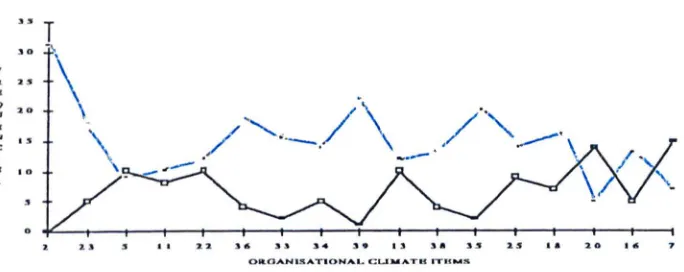
Organisational Climate items ranked by frequencies of "Strongly Represent" [SR] and "Not Appropriate" [NA] meanings of Organisational Climate [OC]
FIGURE 11.1 a. n=37 SCHOOL "S" TEACHERS FIGURE 11.1b. n=37 SCHOOL "S" TEACHERS
FIGURE 11.5a. n=18 INSET TEACHERS FIGURE 11.5b. n=18 INSET TEACHERS
FIGURE 11.10a. n=37 HEADTEACHERS FIGURE 11.10b. n=37 HEADTEACHERS
FIGURE 11.1Sa. n=37 SCHOOL "B" TEACHERS,
n=18 INSET TEACHERS
n=37 HEADTEACHERS
Ethos items ranked by frequencies of "Strongly Represents" [SRI and "Not Appropriate:" [NA) Meanings of Ethos [E]
FIGURE 11.2a. n=37 SCHOOL "S" TEACHERS FIGURE 11.2b. n=37 SCHOOL "S" TEACHERS
FIGURE 11.6a. n=18 INSET TEACHERS FIGURE 11.6b. n=18 INSET TEACHERS
FIGURE 11.11a. n=37 HEADTEACHERS FIGURE 11.11b. n=37 HEADTEACHERS
FIGURE 11.16a n=37 SCHOOL "S" TEACHERS,
n=18 INSET TEACHERS
n=37 HEADTEACHERS
234 236 245 246 254 254 260 237 238 247 248 255 255 260
Organisational Climate Items ranked by School "B" teachers' frequencies of "Strongly Represents" [SR] and "Not Appropriate" [NA] meanings of
Organisational Climate [~C), and categorised as School Climate [SCI
FIGURE 11.5c. n=18 INSET TEACHERS FIGURE 11.10c. n=37 HEADTEACHERS
Ethos items ranked by School "B" teachers' frequencies of "Strongly Represents" [SR] and "Not Appropriate" [NA] meanings of Ethos [E] and categorised as School Climate, [SC]
FIGURE 11.6c. n=18 INSET teachers FIGURE 11.11c. n=37 HEADTEACHERS
6
249 256
Teachers ranked as High/Low separators of term meanings by frequencies of "Same" and corresponding "SR-change" paired scores for meanings of Ethos and Organisational Climate, [ElOC]
FIGURE 11.3. n=37 SCHOOL "B" TEACHERS
FIGURE 11.7. n=18 INSET TEACHERS FIGURE 11.12. n=37 HEADTEACHERS
239 251 facing page 258
INSET teachers and Headteachers ranked as High/Low separators of term
meanings by frequencies of "Same" and corresponding "SR-change" paired
scores for meanings of Ethos and School Climate, [ElSC]
FIGURE 11.8. n=18 INSET TEACHERS FIGURE 11.13 n=37 HEADTEACHERS
facing page 252 facing page 258
INSET teachers and headteachers ranked as High/Low separators of term
meanings by frequencies of "Same" and corresponding "SR-change" paired
scores for meanings of Organisational Climate and School Climate, [OC/SCI
FIGURE 11.9. n=18 INSET TEACHERS FIGURE 11.14. n=37 HEADTEACHERS
Percentages of Same/Change Scores
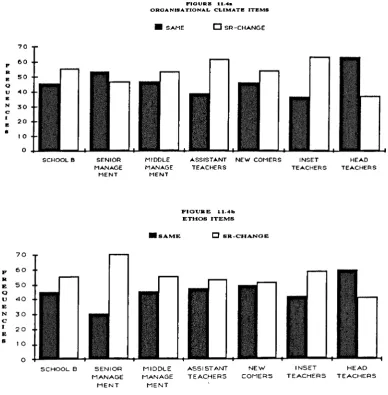
FIGURE 11.4a: Histogram of samples for Organisational Climate items FIGURE 11.4b: Histogram of samples for Ethos items
7
facing page 252 facing page 258
ACKNOWLEDGEMENTS
I should like to thank Derek May and Norman Worrall in the department of Child Development and Educational Psychology, University of London Institute of Education for their guidance and comments upon earlier drafts of this thesis and to Trevor Brighton, West Sussex Institute of Higher Education, for encouraging and supporting its completion. My thanks are also due to Norman, Nigel and Fiona for their patience and support and to the head teachers and teachers of the two secondary schools without whose cooperation and time the study reported here would not have been possible. Finally, my thanks are due to the Social Science Research Council for the financial support provided by their Studentship Award.
INTRODUCTION
Schools differ from each other in many ways. Apart from such physical aspects as their structure, and provision of facilities and resources, they differ in less obvious, but still real ways, by the impact they make on both external observers and participants.
Such differences are subtle. relatively intangible. and elusive to describe. In many respects they appear to defy identification. Nevertheless there is a quality - a "feeling", "tone", or "atmosphere", that is unique to each organisation and that is held by some to characterise the complex internal or psychological environment. This quality is generally considered, more or less synonymously as the ethos, climate, or organisational climate of the school.
Many visitors to schools can often identify - feel, or even "smell", this individual quality, quickly and unerringly. It is shaped by what is observed and experienced. For example, halls and corridors are empty or bubbling with noise; the work displayed is varied, eyecatching and original, or it is commonplace; activities are or are not -displayed on noticeboards; there is general tidiness and a cared-for appearance of the physical surroundings, or there is disorder, damage, and perhaps graffiti.
It is possible also, for visitors to become aware of a school's orientation towards traditional knowledge and scholarship, or its attitude towards the freedom of expression and creativity, as well as its concern for personal relationships and respect for others.
Similarly, the interpersonal behaviours of those working in the school seem to affect visitors'impressions. For example, the headteacher's leadership style can be perceived - whether slhe appears too busy. aloof, formal and correct, firm, condescending, or friendly and welcoming.
The nature of the interaction among pupils may also be noted: their chatter - albeit shrill, threatening, defensive, questioning - or their silence; their liveliness, energy and enthusiasm - or their dullness, boredom and apathy.
The quality of the teacherpupil relationships in the classroom may be observed -whether pupils sit quietly at their desks while their teacher talks, or -whether they move about, actively investigating and problem-solving; whether they work together as a whole class, or in small groups, or as individuals - or whether they are working at all; whether the learning environment is structured or resourced by the teacher - or whether it is a disruptive environment. It can also be observed whether, and how, teachers and children communicate with each other outside the classroom - in the corridors, or elsewhere around the school.
Some, but not all, school visitors have access as professional colleagues, to the more separated world of the school staffroom. Here, they may become aware of teachers' working relationships with each other and with their senior management personnel, as well as of their attitudes to the children they teach.
Teachers' reactions to their experience of the quality of the communication among themselves - and between senior management and themselves - may be noted. These experiences, though perhaps difficult to define, are phenomenologically real to teachers: they seem to affect in a profound way, though differentially, and at different times, the personal happiness of all concerned, and this is reflected in their professional lives.
It is possible for instance, to observe whether teachers appear calm, competent, assured, involved, and concerned - or whether they are uncertain, tense, stressed, frenzied, cynical, detached, or even alienated. It is also possible to note their attitudes to change and professional development and career promotion, as well as the degree of commitment and involvement with the school as a whole.
Thus, for teachers the professional world amongst themselves as managers and administrators, and the school world they share with their pupils as embodied by the school's image to the outside world, are intrinsically linked: they may be attuned, but for some teachers the two worlds may also be in conflict.
These different aspects of school organisations - the physical environment, the various
school activities, the interpersonal relationships of pupil-pupil, pupil, teacher-teacher, and teacher-management - that seem to subscribe to this notion of organisational climate, are not only recognisable as features of present day school practice. Thomas and Slater (1972), in their validation studies of the concept of organisational climate ... or "tone", "atmosphere", "feel", or "school climate" ... set the term in an historical context by noting an official mention of the phenomenon as early as 1858, in Chief Inspector Wilkin's Report of Clarence Town School in N.S. W:
" ... except in a few cases, children were tolerably clean and tidy. Still, I do not feel satisfied that all has been done to promote the neatness and cleanliness that could be desired .... the maps on the walls were covered with dust.. ... although the children were orderly and obedient and the government seemed mild and considerate. My impression of the school as a whole is not satisfactory considering the means at the teachers' disposal. The progress made is not adequate to the power employed. In respect to that subtle and indescribable feeling which pervades every school and is to it, what personal character is to an individual, which, defying analysis and definition, is distinctly perceived by a visitor and which is named the "moral tone" of the school: I feel more disappointment. Instead of finding an earnest desire for knowledge, which always characterises children attending a school in a healthy condition, I was impressed with the idea that the pupils were languid and apathetic; that the instruction was mechanical rather than intellectual; and that their energies were repressed rather than developed ... "
This conglomeration of impressions of past and present school practice, raises some questions about the veridical nature of the concept of organisational climate. For example, what are the relevant criteria of this phenomenon, and to whom do they apply? Are they the products of organisational behaviours, the behaviours themselves, or the meanings attributed to these behaviours? Are they observed or felt - or both? Do different people because of their different experiences of the school organisation, perceive different climates, or do they differentiate between certain aspects of a single climate? Chief Inspector Wilkins' perspective for instance, as a visitor to the school, is an "outside" observer's view of school organisation, despite his obvious knowledge of schools. It may be asked, therefore, whether other school visitors with access to
different aspects of school organisation, perceive different organisational climates in a school or different perspectives of the same climate. It may also be asked whether it is possible for any of these visitors, as "outside" observers, to share the same understanding of the term as those who work inside the school - the teachers and pupils who experience the school processes. Indeed, it may be asked whether management personnel, teachers, and pupils as "insiders", perceive the same criteria for their notions of school organisational climate. Pupils, for example, may perceive different criteria from those of thcir teachers; teachcrs may share a different perspective from that of their senior management personnel. It is also possible that different viewpoints might exist within each of these groups. For example, the different age, gender, and ability groups of pupils, the different status and faculty groups of teachers, or the relative role status of senior management personnel, may differ in their selected perspectives of school climate.
Even those aspects of organisational behaviour that are commonly identified as relevant perspectives of climate, can be interpreted differently, according to individuals' experience of these. The interpretations may also be bound up with associated feelings that give personally significant meanings to these experiences. Ultimately, therefore, it may be asked whether each individual, "outsider" or "insider", has a unique understanding of an organisational climate in a school. If this were so, there could be as many organisational climates as the number of individuals - visitors, members, or even researchers - who experience the school organisation. The phenomenon could exist only as a set of multiple realities - the constructions of unique, individual minds. It would be the subjective property of these individuals.
Conversely, aspects of the phenomenon that are commonly identified within a school can support the existence of a single school climate as a general molar property of the organisation, even though this may be differentially perceived. The criteria, however, may be school specific and, therefore, inapplicable to other school organisations: the qualitative and holistic nature of each school although identified, defies quantification. Alternatively, these characteristics may be universal features of school organisations, so that once idcntified they can be quantified to differentiate schools systematically. It may
even be assumed that climate characteristics of school organisations are universal features of all organisations.
Thus, the difficulties of conceptualising organisational climate as behavioural outcomes, behaviours, or as meaningful "felt experiences", are closely tied to methodological concerns of whether the phenomenon can be justifiably quantified in terms of dimensions that have a common basis across individuals. Such methods, however, may discount the qualitative nature of individuals' underlying meanings and feelings that may contribute importantly to a notion of climate.
The difficulties are reflected in organisational studies which have recognised the phenomenon as a useful research heuristic to account for organisational behaviour. There have been intensive and diverse efforts to conceptualise, measure and utilise the term, especially in the field of organisational management and administration.
Generally, it has been represented as a global, categorising concept in an organisational model, to distinguish those global qualities of an organisation that are experienced by its members, from other objective-based variables such as physical structures that might be assumed to influence organisational behaviour. In the case of schools, for example, the term has been assumed to have measurable effects upon the learning, and social and personal development of pupils.
The majority of climate studies, in assuming climate as a single, albeit multi-faceted concept, have also assumed that it conforms to linear dimension profiles. They have adopted an "outsider" perspective, and have concentrated upon the rigour of their methods to identify objectively, the basic dimensions of organisational behaviour that have been assumed to be characteristic of the concept. The universality of the construct has also been assumed, so that schools might be compared by these dimensional profiles. Few studies appear to have defined climates as nominal types, with a pluralistic configuration of dimensions.
Unfortunately, the studies appear to have misused or even abused, the status of climate
as a construct. The diverse operational definitions of the term, to coincide with the measurement techniques that have been adopted, have lead to conflicting findings and confusion. There is concern, for example, that the construct is "synonymous with organisational situation" .(James & Jones, 1974; plO99). Conversely, there is evidence to support its overlap with constructs that are individual behaviours of organisational research, such as role, leadership, and job-satisfaction (House and Rizzo, 1972). This state of affairs prompted Guion (1973), to conclude that climate represented a "fuzzy" concept and that its measurement was more a function of methodological convenience than deliberate intention to move to a new construct.
Similarly, James and Jones (1974), were concerned that measurement techniques and operational definition had preceded conceptualisation and that the concept was "even more diverse" than when Forehand and Gilmer (1964) had reviewed the organisational climate literature a decade earlier. They attempted to impose some order and direction by reconceptualising climate, and proposed guidelines for continuing its research by the "scientific method" paradigm. Further progress in this direction, however, appears to have been inhibited by the surgence of the alternative and competing paradigm for sociological research, which has drawn upon the work of G.H.Mead (Berger and Luckmann, 1967).
This paradigm recognises the importance of individual meanings that are acquired by personal experience of events in the social construction of reality. Thus, the paradigm provides the opportunity to tap the individual meanings and reactions underlying perceived organisational behaviour, by those who experience school processes. It also assumes the possibility of the qualitative nature of a specific school context.
Although this paradigm has also been a phenomenological perspective for conceptualising organisations (Barr-Greenfield, 1974), it has been more strongly emphasised in the research studies of organisational sociology as the "interpretative" approach. In this field, however, climate is more often assumed to be synonymous with the concept of culture - a term also subject to varying interpretations in the research
Ii terature.
The integration of social science disciplines may well be helpful for organisational themes, but the distinctions between climate and culture have by no means been clearly established and the existing conceptual confusion associated with organisational climate, can only be exacerbated by this assumed synonymity of terms. The conceptual boundaries of each term first need to be considered, to guide the measurement of data and its levels of explanation. It seems important, therefore, to address the veridical nature of the construct organisational climate if it is to be useful as a heuristic concept in organisational research.
The present study takes a step in this direction. Its basic question, "What is organisational climate"? attempts to grapple with the complexity of the construct. The
study, therefore, does not ask whether the construct is an organisation level attribute that is perceived differentially by all or whether it is an individual attribute with many different climates existing in people's minds. Instead it examines the extent to which both attributes exist as the construct and the nature of their linkage.
The study compares the conceptual boundaries of the construct as perceived by two groups of school members - teachers and their management personnel - to explore the extent to which different people with different knowledge of a school perceive different
perspectives of the same climate, or perceive different climates.
The study also attempts to uncover the symbolic nature of the construct by tapping teachers' underlying meanings and feelings associated with organisational processes. It categorises their individual data, to determine the extent to which individual meanings remain qualitative or emerge as categories of shared symbolic understandings of a construct with organisational level force. Individual meanings that contradict, could indicate an organisational climate as a set of multiple realities.
Finally by comparing the teacher/management perspectives of two schools, the study attempts to determine the extent to which the construct categories may be systematically compared, or whether climate is school specific.
The study adopts an intersubjective, socio-psychological perspective to take account of the complexity of a climate construct by recognising individuals' symbolic processes as well as the more general dimensions of organisational behaviour in a climate structure. By capturing the dynamic relationships within both levels as well as their relation to each other, this perspective can explain how individual meanings are welded into an organisational force by showing what organisational behaviours have what sort of meanings for its participants. The critical defining characteristic of the construct for an organisation, is the manner in which this linkage is defined.
The study also adopts a "grounded theory" approach, (Glaser and Strauss, 1967), to determine the conceptual boundaries of the construct as perceived by teachers in schools. It takes the view that schools may be specific organisational contexts, with specific climate characteristics best known to those who work in them. Also, teachers can provide a more comprehensive picture of school organisational practice than the managerial (e.g. leadership) perspective assumed by many climate studies. As "insiders" of school organisations, they also experience the organisational processes. Thus the underlying meanings ascribed to these may be tapped, to enable the symbolic aspects of the climate construct to be explored.
It is assumed that the gathering of qualitative data through participants' open-ended, free-response interviews can tap the underlying meanings and feelings. The complexity of the climate construct, however, may be just as limited by such qualitative description as it has been by quantitative techniques because its organisational level of analysis can be neglected. The data analysis, therefore, attempts to link individual and organisational levels by developing a network hierarchy of categories from individual data, each hierarchy accounting for more shared meanings than the one before. The analysis assumes the more general categories represent increasingly global organisational characteristics of organisational climate as an intersubjective construct, and the manner of linkage defines the construct in a specific context. Although this "textural" approach does not have immediate generalisabilty, it does enable the specificity of school climates to be examined. Successive studies can accumulate as well as distinguish critical
features.
The study sets up two theoretical models - a conceptual model and a methodological model - both of which acknowledge the construct's complexity. The first model proposes, in an outline structure of roles and "rule-meanings", how the two levels of analysis might be related through the interactions of teachers in schools. Thus, despite the" grounded theory" approach, existing theoretical ideals and research paradigms are tacitly recognised by this role-rule model to account for both the objective and subjective social reality of a school climate. Notions of symbolic interactionism, for instance, are germane to the model, for its "rule-meaning" aspects aecount for teachers defining their situation based upon meanings arising from the behaviours of school interaction. At the same time, the role aspects of the model can incorporate the existence of the "out-there" organisational reality of the job-situation, to monitor and maintain the rule-following social behaviour.
Secondly, a methodological model is outlined to bridge the epistemological gap between theoretical model and "grounded theory" approach. This provides a rationale for identifying the gaps or weak points in the data, through successive investigations in different schools. These investigations, however, are not intended to capture the social realities of climates as full, separate case studies describing school life, nor are they
intended to treat one school as a simple pilot study of other school investigations. They are intended to progress towards an understanding of school organisational climate by
successive case examples - capturing first one school in action, then another, and comparing and contrasting the salient features meaningful to their teachers, in order to predicate the construct. It is appreciated that the two-school investigation of the present study will be too limited to fully validate the theoretical model but, nevertheless, it can
claim to refine the "fuzziness" of the construct.
Systemic network analysis of the data is adopted as a heuristic device, to elicit the hierarchical levels of relationships in revealing the basic characteristics of organisational climate as emergent organisational-force properties of the categorised individual data. In the event of the present study, however, this strategy becomes inappropriate for
detailed extension as unanticipated findings emerge at an early stage of the analysis, that require the investigation to alter direction in its methodological emphasis.
The initial analysis of qualitative data suggests that teachers differentiate between the terms ethos, organisational climate, and school climate. These have been assumed as synonyms by previous organisational studies.
These data, therefore, draw attention to the hermeneutic, subjective and meaning-laden significance of the concept of organisational climate and challenge the objective, logical stance taken in its conceptualisation. It prompts a systematic investigation, to describe the subtle differentiations in a terminology grounded in the perceptions and experiences of its participants.
In quantifying these data, the investigation is extended to wider samples of practising secondary school teachers and head teachers and these analyses specify some parameters of the concept of school organisational climate, that have implications for school management practice. The parameters may also apply to climates of other organisations. At the same time, despite the different approach, the findings partially support the integrity of the early conceptualisation by the researchers Halpin & Croft (1966), who first coined the term "organisational climate" in their studies of leadership behaviours in elementary school organisations.
The following review argues a case for the present study's conceptualisation of organisational climate, and for the need to develop an appropriate methodology if it is to retain its status as a useful research heuristic in organisational studies. Rather than being an exhaustive, or an historical account of the literature, the review first addresses in more detail, the major theoretical issues currently associated with ways of conceptual ising and measuring organisational climate, and then focuses upon those writings that are representative as perspectives of these main issues. Although necessary reference is made to some industrial organisation studies, emphasis is placed upon studies that are primarily concerned with the organisational climate of educational insti tutions.
THE MAIN ISSUES
[1] CONCEPTUAL ISSUES
The main theoretical issues related to the construct of organisational climate are clearly associated with its conceptual definition and its methods of measurement. Both of these are closely linked. The issues stem from conflicting assumptions that are held about the nature, or social reality, of climates as organisational environments for individuals. These assumptions not only influence what, and to whom, the construct applies but also its ability to determine organisational behaviour. The assumptions also suggest whether climatcs can be justifiably quantified or whethcr their qualitative differences defy quantification.
Of fundamental importance is the issue of conceptualising the relationship of the individual in an organisational context and determining the level of analysis for explaining this. This creates a dilemma for researchers because they confront a paradox. For example, people are seen to create, maintain, and control their organisations. At the same time, organisations seem to have a life of their own in determining the behaviour of their individual members. Which exists first to influcnce the other?
The general behavioural truth - that both people and organisations may be mutually or reciprocally dependent, seems to have been overlooked by more over-riding, functional concerns about the purpose of organisations and by underlying assumptions about the nature of man in these contexts. The paradox of "who controls whom" has usually been resolved by acknowledging the relationship exists, then gravitating towards either one focus or the other as the level of analysis, according to the interests and assumptions of the researcher.
These assumptions are supported by organisational theory which has also focused, in varying degrees, upon either the individual or the organisation as concepts for its levels of theoretical analysis. Theoretical perspectives concerned with environmental influence upon individual behaviour have generally focussed upon the more global, molar concept
of organisation~ theoretical concerns for individual rights and freedoms have found expression in the qualitative differences of individual concepts.
For instance, social and economic pressures may have forced a demand for increased efficiency and output to become a major organisational concern - and generated research concerned with the organisational control required to achieve these ends. An organisational level of analysis has been genera)]y assumed with concerns of this nature, but an individual level of analysis could also be adopted, according to researchers' assumptions and concerns for "who controls whom". For example, Steiner's, (1972), statement that "individual predispositions are likely to be less critical than the demands of the social system", suggests an organisational level of analysis. Conversely, Barr-Greenfield's, (1976), phenomenologic~1 assertion that "organisations are the constructs of its participants" - organisations are people, not things - emphasises the importance of individual control.
Between these two extremes, interactionist theories in their various ways, attempt to account for the two-way influence between individual and organisation. For example, from the diagnostic viewpoint of a psychoanalytic perspective, concerns for working days per year lost through absenteeism, and the steady rise of stress-related problems of people at work, suggest individual needs may be so subjugated by organisational control that output and efficiency are decreased. The equilibrium is upset between organisational demands for productivity and the individual, psychological needs of how people want to work. The interactive influence of the individual and organisation is emphasised. Not only do the statistics suggest the adverse effects of organisational control upon productivity, but also in a more negative way, they indicate the influence of the individual as a determinant of organisational behaviour. For example, the "socio-technical systems" approach of Trist & Bamforth's, (1951), coal-mining studies, and Rice's, (1958), Ahmedabad experiment in Indian textile mills, reflect the importance of individual influence in determining an organisational effectiveness below that of its optimum capacity. Similarly, Goffman, (1961), has written detailed and convincing accounts of how individuals adapt to the humiliating and depersonalised systems of
organisational control in "total" institutional life such as prisons or asylums.
The issue of the appropriate level of analysis can even be seen in the choice of such interface concepts as socio-technical system, role, group, attitude and perception, adopted by interactionist theorists to reflect the organisational/individual field as their unit of analysis. These also are subject to researchers' assumptions and concerns.
From a role theory perspective, for example, Goffman, (1969), views individual roles and the "fixed props" of job-situations from the perspective of the individual's dramatic performance. Conversely, Katz & Kahn's, (1978), concept of role in a social systems model, as "the building block of social systems and the summation of the requirements with which the system confronts the individual member", is an organisational orientation, as is the concept of role in the Getzel-Guba model, (1957).
Similarly, the importance of individual needs in group dynamic approaches of Lewinian field theory, is discounted by some structural sociologists as the irrational, informal counterpart of a rational, formal, organisational system of control. Thus, in organisational studies there is clearly an issue about the appropriate level of analysis for conceptualising the nature of the organisation, according to assumptions and the purpose of the research. The issue is not only between levels, but also lies within the interpretation of interface concepts. Neither the individual nor the organisational focus appears to have given the other its full due. The issue reflects, perhaps, the dominant concerns of psychological and sociological disciplines. Individual and organisation have been assumed as psychologically and socially separate - like Newtonian atoms colliding in organisational space, (Llewelyn & Kelly, 1980). It is suggested for example, that psychologists "have been slow to document the effects of organisations upon individuals", and that the individual is rated too highly in psychological studies of organisational behaviour, (Stephenson, 1978).
More recently, however, social psychology has re-addressed the individual-environmental field as its smallest unit of analysis in order to reflect not only the
interaction, but the mutuality and inter-relationship of each concept. Studies adopting this conceptual framework need to elicit the underlying meanings attributed by individuals to organisational behaviour, as appropriate concepts for this level of analysis.
The conceptual issues of organisational studies have also confronted researchers with a specific interest in organisational climate, a construct introduced as a research heuristic into an organisational model to reflect the qualities an organisational context has for its participants. As such, it has represented a useful means of distinguishing organisational characteristics for individuals, from other organisational variables such as physical structures that might be assumed to influence behaviour. However, are these characteristics observer-based organisational products or behaviours or do they exist in an intrapersonal or psychological sense - as constructs inside people's heads? The issue of its level of analysis is fundamentally important in determining the nature of the construct.
The issue has been perpetuated in climate studies for the same reasons as in organisational studies - the purpose of the research and researchers' assumptions. The issue is reflected, for example, in studies directed towards organisational effectiveness and those of diagnostic intervention for organisational development. The issue has also been resolved in the same way - climate has been assumed as either an organisational attribute, or an individual attribute. Climate concepts such as communication networks, for example, have been considered as organisational attributes; concepts such as perceptions and attitudes have been individual attributes.
Climate studies that have attempted to relate individual reactions to organisational attributes have also confronted the same within-level of analysis issue of concepts such as groups, roles, attitudes and perceptions. Lewin's, (1939), set of authoritarian, democratic and laissez-faire climate experiments is a classic example of climate as an individual attribute in a group level analysis. His concern is for the highly subjective "life space" of the world as the individual sees it, but his methodology is a
style study at a group level of analysis. It is assumed organisational behaviour is "individual behaviour writ large in organisational terms", (Sofer, 1973).
Other researchers have attempted to relate individual reactions to organisational characteristics by individual perceptual measures to explain climate as an organisational attribute. Even climate concepts such as perceived leadership style, for example, with two within-levels of analysis - roles and perceptions - have been assumed to have stable organisation-wide "role" characteristics that can be perceived by everyone. As perceptions are individual attributes, these assumptions reflect more conceptual ambiguity and uncertainty than interactionist conceptualisations.
Thus, climate researchers in varying degrees have also considered the individual and organisation as basically separate concepts. Their assumptions have determined the use of the construct as an antecedent, mediating, or consequent variable, with implications for the extent to which it can be manipulated as a truly explanatory construct. Psychologists have yet to investigate the construct's possible symbolic aspects at a level of analysis that elicits individual meanings, to reflect the mutuality and interdependency of the individual/organisational field. In organisational sociology, this avenue has already been explored by ethnographic studies of the concept of culture.
However, the individual I organisational issue of whether climates as social environments preexist individuals to control their behaviour, or vice versa, is not the only concern at issue. This broad issue also raises a number of interrelated conceptual issues that have contributed to the conceptual confusion and ambiguity with the construct.
First, if climates are assumed to preexist individuals, it must also be asked whether they exist in a real sense as objective, observer-based characteristics or behaviours to be selectively perceived, or in a more abstract, psychological sense as "states of minds" created by individuals. For those who subscribe to the former, climates exist as a "set of summary or global perceptions held by individuals about their organisational
environment", (James & Jones, 1974, p.ll0S). This approach is representative of many traditional climate studies. If climates exist in a real sense, however, there is the difficul ty of deciding which organisational characteristics, and to whom, these apply. There may be different perspectives of the construct for say, outsiderlinsider, management-worker, or teacher-pupil. Although it is clear members would have to be consulted, it is uncertain whether visitors, with less knowledge of the organisation, can perceive the same organisational characteristics.
Secondly, if climates are psychological constructs, it must also be asked to what extent such climates exist as global organisational concepts of shared minds - the accumulated constructs of the organisational group's experiences. This conceptual definition can assume affective components are concomitants of experience to influence individual members. The shared meanings of the group are manifested by an intangible, social atmosphere that develops as a consequence of these organisational experiences. Therefore, the climate construct can apply only to group members. As a global, shared construct located in individual minds climate could be assumed to have an organisation-wide determining force as both an antecedent and a moderating variable of behaviour.
Alternatively, personal constructs might be unique so that climates can only exist as sets of multiple realities, reflecting the transient and subjective qualities of its individuals. Johanneson, (1973), suggests "there are as many climates as there are people in the organisation". Thus he highlights the issue of whether different perspectives of a climate are differential perceptions of the same climate or whether these are evidence of different organisational climates. This means climate researchers must also address the issue of whether organisations can have basic climate characteristics in common with each other to enable comparison, or whether each is a unique configuration of its members.
Climates, therefore, may exist as real or created, and as global or mUltiple realities of the individuallorganisational field. There is also a further within-level of analysis issue that affects the nature of the construct. If symbolic aspects are important in a climate
construct, the adequacy of such concepts as perceptions or attitudes, to reflect the depth of this level of analysis, must also be questioned. Individual meanings need to be elicited. The level of meaning involved must also be determined: manifest meanings -meanings that affect behaviour but of which the individual is unaware - may suffice, but deeper, hidden or "unconscious" aspects of meaning could also be involved.
Conversely, it must also be asked whether individual meanings as mutual, interdependent concepts can adequately create a construct with an organisation-wide force. Francis, (1980), recognises this difficulty in analysing school organisations, as the different conceptual status of "the life of the school" and the life of the child". She suggests two systems models to account for both, but interestingly adds "it is just
possible that a suitable analysis of the school life of the child might rest within an analysis of the school". Might not it be possible to demonstrate the climate construct as a relationship of individuals' underlying meanings of the construct, nested within an organisational level analysis of its structure? Thus, a more global level of shared meanings demonstrating its relation to the level of individual meanings might be necessary to account for how individual status attributes can weld into an organisational force.
In order to address these issues that relate to the nature of organisational climate the present study takes the view that people can create, maintain, and control the climates
that also exist to influence their actions. Thus, a climate can acquire a life of its own and an existing climate can change its identity by the influence of any of its members. In order to demonstrate their mutuality and interrelationship an intersubjcctive construct of climate is adopted, that not only uses intersubjective concepts, but also an intersubjective level of analysis to bridge both levels of individual and shared meanings. This conceptualisation addresses the construct's complexity. It also imposes some methodological restraints for explaining it. The methodological issues related to the climate construct are discussed in the following chapter.
(2) METHODOLOGICAL ISSUES
Issues of the conceptual definition of the climate construct are closely linked to issues of the methodology adopted to explain its complexity. The methodological issues are concerned with the appropriateness of quantitative v. qualitative methods, especially the issues of the empirical approaches traditionally used to measure the construct. These have raised the issue of whether climates can be systematically compared or whether they are qualitatively discrete constructs. They have also raised the issue of whether climates should be defined in terms of linear dimensions or as nominal types.
Climate researchers have been constrained in their conceptualisation of the construct by the assumptions underlying qualitative and quantitative methodology, for these also reflect the individual/organisational issues confronting its conceptual definition as an individual or as an organisational attribute. Organisational attributes are assumed to be
quantifiable by an "outside" researcher's objective procedures so that organisations can be systematically compared; individual attributes are assumed to be assessed by subjective measures that can acknowledge qualitative differences in individuals.
Quantitative approaches, however, can less easily take adequate account of the subjective underlying meanings and feelings, or hermeneutic significance, of individual perceptions. They cannot account for how an existing climate is created. They ignore the "thick", (Geertz,1973:6), "deep", (Sieber,1973), and "holistic", (Rist,1977:47), material of qualitative data. These critcria may be important in accounting for symbolic aspects of the climate construct but are more readily tapped by qualitative methods.
Few climate studies, however, have adopted a qualitative approach as they tend not to be methodical: each analysis begins anew focussing on whatever happens to be pertinent to the question in a specific context. As a result, although qualitative approaches can afford detailed insights by tapping underlying meanings they are not by nature, systematic: a particular context may be described in detail, but the possible relation of its insights to other contexts can be neglected. Thus, the hermeneutic significance of individuals in contributing to a conceptualisation of organisational
climate may have been underrated, or even discounted.
Conversely, it seems the assumptions underlying the rigorous empirical approach of the "scientific method" paradigm have enabled climate researchers to sidestep some difficult conceptual issues of the nature of the relationship between the individual and the organisational context. Within the context of this paradigm, they have been able to assume climate as a preexisting, global, multi-faceted, organisational attribute whose characteristics have a common basis among individuals, so that organisations can be compared objectively for wider policy-making purposes. This has been convenient for those researchers whose interests are in organisational control and administration. They have been able to assume a management perspective for explaining the construct.
The vast majority of climate studies have attempted to relate the organisational characteristics of management such as leadership style to individual responses, by means of perceptual measures such as the questionnaire and have made use of robust, multi-dimensional statistical models such as factor analysis, to confirm the construct's underlying dimensions. They have assumed the models' methodological rigour to supply the objectivity lacked by the subjective, individual response.
Alternatively, some climate studies have adopted laboratory style experiments whose methodological rigour has been in the experimental design, for the control of variables. The observed behaviours of specific individuals under controlled experimental conditions have been recorded and analysed to explain researchers' hypotheses. For example, Lewin's, (1939), classic experiments defining climates as authoritarian, democratic, or laissez-faire types have demonstrated the effect of different leadership styles upon the observed socio-emotional behaviours of groups of boys in hobby clubs, to determine the group atmosphere or social climate as a nominal type. The paradigm has enabled a conceptualisation of climate not as an intangible concept, but as an existing psychological reality that can be scientifically observed. The observable behaviours, under the objectivity of experimental conditions, have been assumed to account for the underlying individual meanings of the affective reactions.
However, the extent to which methcxlology can verify the construct, is debatable. The procedures of the paradigm raise issues that question not only their claim to objectivity, but also challenge the appropriateness of the paradigm for determining the veridical nature of the construct. Of particular concern are the role of the "outside" researcher, operational definitions, methods of data collection, and statistical techniques for data interpretation. All of these raise issues that relate to conceptual confusion and ambiguity about the appropriate level of analysis to be adopted.
Climate studies indicate that researchers vary in what they consider to be the construct's relevant, measurable features. There has been a plethora of operational definitions with various item pools of questions, according to different researchers' hypotheses of the nature of the construct. Clearly, there is conceptual confusion about what organisational characteristics to formulate as relevant questions and to whom they apply. In addition, the questions asked by "outside" researchers may not be valid for organisational members, nor reflect their deeper knowledge of the organisation. Their focus upon a management perspective such as leadership style, also ignores the possibility of different perspectives of climate among other organisational members such as teachers and pupils in schools.
Confusion about the appropriate unit of analysis may also have led researchers to utilise inappropriate methcxls of measurement. Questionnaires as measures of perceptual data may have only tapped the surface features of the construct, rather than the deeper structures of the construct itself. Even these may be invalid, for items may be variously interpreted, their language may be inappropriate and responses may be veiled or lacking in thought.
Researchers' use of statistical techniques for interpreting data, also reflects their conceptual ambiguity about the appropriate level of analysis to be adopted for explaining the construct. The techniques are based upon consensus measures - that is, they dismiss individuality as error variance and provide information about how members feel on average. Researchers, however, make no mention of the degree of consensus required for individual reactions to achieve the status of an organisational attribute.
They are uncertain whether to define climate at the individual, or the organisational level, or somewhere in between. They rely upon the mathematics of the statistical model. Neither do they interpret the contradictory perceptions: these could indicate the absence of a climate, or the presence of different climates. There is a marked difference between no climate and a climate with a low rate of agreement: the latter could imply dissent.
The use of statistical models to group and interpret individual data also raises further issues about the paradigm's ability to establish the true nature of the construct. For example, the statistical techniques adopted to identify the basic dimensions of the construct are usually formulated by the precise mathematical formulas of confirmatory factor analysis, that tend only to reflect the "a priori" hypotheses of the researcher. Thus, the extent to which the organisational dimensions of the construct are empirically determined is in doubt. Researchers also assume the stability of the factor structures as organisational attributes. There has been difficulty, however, in generalising the dimensions that have emerged from factor analyses beyond the organisations where they were first developed. Even in replication studies, problems have surfaced with the internal validity and reliability of the factor structures. These contest not only the mathematical model, but also the stability of the construct as a quantifiable concept. The nature of the construct may be qualitative, with aspects untapped by this paradigm.
School climates, for example, could have different characteristics from those of
business or industrial organisations. Even differences in school climates that emerge as a result of quantitative measures could be interpreted either as the existence of different climates or argued as due to context and/or time specific elements. When can researchers be certain they have identified the veridical factors of climate? At what stage do pilot studies, that identify context and time specific elements, become redundant for establishing the universal existence of the construct as a global, multi-faceted organisational attribute? If climates are context and time specific, their qualitative differences might not enable systematic comparison.
The issue of whether climates are quantitative or qualitative in nature also influences
whether they should be defined as dimensions or types. For comparing schools systematically, it has been a simpler strategy to define climates as sets of dimensions or continuous variables. The statistical procedures assume each dimension is discrete and meaningful to organisational members and exists on a continuum with values that vary in degree from organisation to organisation. There could be as many possible climates as there are combinations of values in a climate profile.
Conversely, climates classified as nominal types are more generally conceptualised as discrete and qualitative by nature. They are assumed to be fewer in number. They cannot be reduced to a set of dimensions because they are integrated sets of properties to which members react as wholes. They are constellations or patterns that are inseparable, although they can be rated on dimensions like autonomy or supportiveness. Statistical techniques, such as cluster analysis and higher order factor analysis, in their different ways reduce the individual data still further by grouping the dimensions to illuminate underlying structures more clearly. There is a problem, however, of defining what constitutes a group for describing a climate type. The usefulness of the greater parsimony of these global distinctions is also questioned, for their generality has led to inconclusive research findings.
Thus, the main issues confronting climate researchers are not only conceptual issues of whether the construct as an organisational attribute, exists or is created by individuals; of whether it is a global concept or a multiple reality; and of whether its symbolic meanings or its observer-based perceptions, are significant. The issues are also methodological: of whether climates can be quantified or whether qualitative approaches are more appropriate for reflecting their conceptual complexity, and whether they should be defined as linear dimensions or as nominal types. The issues have arisen from problems in empirical approaches traditionally used to explain the construct - the role and assumptions of the "outside" researcher, and the adequacy of rigorous procedures of data collection and the statistical interpretation of this, for explaining the construct. Concern for quantifying climates could have underrated its qualitative characteristics, especially its hermeneutic significance to "inside" members. Also, measuring climates as dimensional profiles in preference to a typology of climates might not have done
justice to this complexity.
What is needed is a methodology that can address these issues by reflecting both the construct's underlying symbolic aspects and its more globally shared meanings of behaviours, as a fully intersubjective construct. Not only must the concepts be intersubjective, but the methodology also, must reflect this intersubjectivity.
The conceptualisation of climate as an intersubjective construct, however, imposes its own methodological constraints. For instance, as participants' experiences are crucial to the conceptualisation and, as experiences of organisational processes involve communication with other members, the intersubjectivity must be based upon their interaction. The method must also be able to uncover the symbolic meanings of their experiences in a specific organisational context. It must be based, therefore, on members' accounts of these and reflect the language concepts they use to give meaning to these practices.
It is appreciated that this indirect approach may only identify the possible nature of the climate construct, but the direct practices to be observed by either a participative or non-participative researcher are excluded - as are the perceptions of other visitors - because they are not truly "insiders" of such processes. This could be an empirical question for later investigations.
Finally, the data analysis must reflect the nature of the linkage between the complexity of individual meanings and the more commonly shared categories of global organisational interaction, in terms of intersubjective concepts. Systemic network analysis is adopted as a heuristic device, to indicate the degree to which climates are either multiple or shared global realities. By systematically comparing and contrasting the salient features of members' interaction in two different schools, the network structures may also indicate the degree to which school climates are context specific and qualitative in nature.
The following review of the literature argues that an intersubjective analysis of climate is
more complex, but more true to the nature of climate than either individual-level or organisational-level definitions. It argues for a broader conceptualisation than that provided by a management perspective alone, and the importance of an "insider" view of the construct. It also argues for the need to develop an appropriate methodology to capture not only the construct's complexity, but also to establish the extent to which one climate or different climates exist in a school and the extent to which school climates may be systematically compared.
In order to justify the need to move to a new construct and to develop an appropriate methodology, the review first considers the issues of systems theory and phenomenological perspectives that have been central to conceptualising the construct to
date. Methodological issues that have contributed to the existing conceptual confusion of the construct are also examined, by reference to the empirical findings of climate studies. The specific issues to be highlighted by these studies are the role of climate researchers and their operational definitions of the construct, issues of data collection, and issues of the statistical techniques for analysing and interpreting the climate construct.
CHAPTER 1
ISSUES: SYSTEMS THEORY FRAMEWORKS
Many of the operational definitions of the climate construct are rooted in the ideas and concepts of systems theory. This explains organisations as "complex unities of orderly arrangements" and organisational behaviour as a function of people's interaction in these environments. The climate construct defined in behavioural terms, is a useful research heuristic for understanding organisational behaviour so that strategies can be developed to control this more effectively. However, what is the nature of organisational behaviour - and is defining the construct in these terms an appropriate way of conceptualising it? To address these questions, this chapter examines the relationship between behavioural conceptualisations of climate and systems theory frameworks of organisational behaviour.
\bn Bertalanffy's, (1968), concepts of "closed" and "open" systems have been useful for distinguishing organisations in terms of their behaviour. Closed systems based on the laws of physics, are those organisations that are independent of their environment. They achieve internally, their own stable, steady state of operation converting their energy into a finite end-product.
Open systems based upon an organismic, biological model of life processes are those organisations that import and work to convert in order to support, their environment. Such systems are continually interacting with their environment. There is a continuing process of adaptation or change between their boundaries. Boundary exchanges are assumed to be the essential responsibility of management personnel. For organisations such as schools, boundaries may be either different groups within an organisation such as senior management, teachers and pupils, or those of the local community such as governors, L.E.A., parents or visitors. There are however, "strong" and "weak" versions of open systems.
For example, adaptation between boundaries is an important concept for open systems. It enables the organisation to maintain and create itself in a state of dynamic
equilibration by a two-way process of control. Equilibration, i.e. causing things to balance - rather than equilibrium as a state of balance - is also an important concept. It assumes change is more than adaptation: it is positive and "feeds forward" to provide development. "Forward change" is the stable condition of such an open system - not a sudden or rare occurrence, but a continuing process that maintains and increases effectiveness.
The concept of dynamic equilibrium on the other hand, assumes a stable, finite state as a slow, but continuing outcome of change - not the continuous stream of change as a process underlying this. This version of an open system can account for change only as adaptation - an adaptation as two-way reactive behaviour. It cannot pinpoint the source of change between or within boundaries. It has already achieved an internal stability - perhaps, for example, by the interpersonal consensus of its members in adapting to the administrative styles of management.
The equilibrium mOOel is thus ill-equipped to explore incompatibility among members: it cannot take into account contradiction as well as consensus among different groups, nor their unequal strength by their relative independence or dependence upon organisational control. It is a convenient concept for those managers - and researchers - who assume organisational consensus across internal boundaries is critical for achieving predetermined goals. Maintenance of equilibrium can be assumed as a means of social control - by socialisation, or by the role-taking behaviours of members in a planned system of overlapping work groups.
Individuals in this version of the model are viewed as members of organisational groups. The model cannot account for "man as a pro-active, self-aware subject, intentionally intervening within a socially circumscribed world", (Llewelyn & Kelly,1980; Shotter,1975; Harre,1979;). The individual social and emotional needs that are known to pervade interpersonal relationships and group dynamics are acknowledged in this version of the mOOel, but only as the latent behaviours of an informal system: a non-rational, but necessary counterpart of the logical and orderly, observer-based formal system.