United Kingdom Vol. V, Issue 12, December 2017
Licensed under Creative Common Page 236
http://ijecm.co.uk/
ISSN 2348 0386
SMEs IN GEORGIA: DOES THE DEFINITION MATTER?
Tatiana Papiashvili
International Black Sea University, Georgia [email protected]
Ilyas Ciloglu
International Black Sea University, Georgia [email protected]
Abstract
Small and medium sized enterprise (SME) criterions are still varied among the countries.
Developing countries like Georgia, which are oriented on deep cooperation with the EU,
harmonize their legislation and institutional framework to meet EU requirements and norms.
Nowadays, Georgia has two definitions of SMEs (for producing business statistics and for tax
purposes only) which are close to but still inconsistent with the EU one. Further consistency with
the European standards offers both benefits and challenges for Georgian SMEs. Georgian
SMEs will benefit if access to European support programs and funds will be opened for them.
Current statistical “bread butter on both sides” creates an illusion that causes misleading
conclusion on the further SME policy. It might provide considerable room for politicians to
manipulate with the statistical data, disorients Georgian academic and business communities by
sending a wrong signal to the Government, neglects main economic and social function of small
business, changes government policy priorities. Thus, while the benefits of consistency are
potential, the challenges are real.
Keywords: Small and medium-sized enterprise, definition, Georgia, EU standards, potential
Licensed under Creative Common Page 237 INTRODUCTION
Problem statement
The value of small and medium enterprises (SMEs) for a national economy is widely recognized internationally. Georgia is not an exception. Georgian government declared the importance of the creation of a strong private sector, with special emphasis on SME sector, in several documents - “Socio-Economic Development Strategy of Georgia – Georgia 2020” (2014), Governmental Programme “For a Strong, Democratic and United Georgia” (2015), etc.
A challenging task is still SME definition. National governments’ policy in terms of
developing institutional frameworks, including the improvement of SME definition, has a vital importance for this sector development.
The member-states of EU have come to consensus – the common SME definition was
developed that created the common base for small and medium enterprises when they are applying to “all policies, programmes and measures that the European Commission develops and operates for SMEs” (User guide, 2015, p.4). In other words, the European Commission has
to be ensure that support measures are granted only to those enterprises that genuinely need them. However, even “for Member States, use of the Definition is voluntary” (Ibid, p.5).
The aim of the research
The current research aimed to analyze Georgian government policy towards SMEs after signing in 2014 the Association Agreement with the European Union. Herewith, with new trade and investment perspectives, the Agreement offered both new opportunities and important challenges for Georgian SMEs. Not surprisingly, the first question that arose was updating the definition of SME in compliance with the European standards (Private Sector, 2016a; Private Sector, 2016b).
The research questions
How can small developing country like Georgia adopt and implement EU standards and requirements, and in this particular case, criterion and the definition of SME?
If so, to what extent?
What are, if any, benefits and challenges of such standardization?
Research Methodology
Licensed under Creative Common Page 238 Problem statement: International practice
A first EU-wide SME definition was introduced in 1996 and the first time it was revised in 2003. The latest updated version came into force from 2015 (User guide, 2015, p.38-43). Scrutinized work has been done because the essential of a common definition was widely recognized across the EU. Specifically, “lack of a common definition could lead to the uneven application of policies and thus distort competition across Member States. An enterprise in one Member State, for example, might be eligible for aid, while an enterprise in another Member State of exactly the same size and structure might not be eligible” (Ibid, p.5).
Two main criteria to distinguish SME and non-SME are used:
enterprise size that is measured by the number of employees, turnover, and balance
sheet total,
resources available that include ownership, partnership, and linkages.
Based on this, three classes of SME were distinguished: micro enterprises, small- and medium scale enterprises (Table 1). This approach alongside with a case-by-case analysis helps to classify status for the enterprise with a more complex structure.
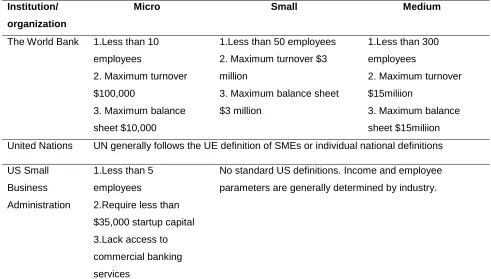
World Bank (WB) and the United Nations use different criteria of SMEs, also less precise definition is used in the US (Table 2). All apply the number of employees as the key benchmarking criteria. However, the second criteria - financial - is different. The EU as well as WB consider turnover and balance sheet, in the US they evaluate startup capital and access to commercial banking services.
Table 1. Thresholds of SME definition in EU Enterprise
category
Staff Headcount
(number of persons expressed
in annual work units)
Annual
Turnover
Or Annual balance sheet total
Medium-sized < 250 ≤ € 50 million ≤ € 43 million
Small < 50 ≤ € 10 million ≤ € 10 million
Micro < 10 ≤ € 2 million ≤ € 2 million
Licensed under Creative Common Page 239 Table 2. World Bank and United Nations SME definitions
Institution/
organization
Micro Small Medium
The World Bank 1.Less than 10 employees
2. Maximum turnover $100,000
3. Maximum balance sheet $10,000
1.Less than 50 employees 2. Maximum turnover $3 million
3. Maximum balance sheet $3 million
1.Less than 300 employees
2. Maximum turnover $15miliion
3. Maximum balance sheet $15miliion United Nations UN generally follows the UE definition of SMEs or individual national definitions
US Small Business Administration
1.Less than 5 employees
2.Require less than $35,000 startup capital 3.Lack access to commercial banking services
No standard US definitions. Income and employee parameters are generally determined by industry.
Source: The role of small and medium enterprises in developing countries. (2006) Final report, p.6
Problem statement: Georgia
The first SME definition was given in the Law of Georgia on “Small and Medium Enterprise Support” in July 1999, but was abolished by the Georgian government in 2006, and was partly
replaced in 2010. From January 2011 important changes and additions in Tax Code were adopted. The main novelty was the introduction of a new institution - micro-enterprise.
Licensed under Creative Common Page 240 Table 3. Current SME definitions in Georgia
Employment Turnover
Tax Code GNIA Tax Code GNIA
Micro Self-employed ≤ 30 000 GEL
Small Self-employed ≤ 20 employees ≤ 100 000 GEL ≤ 500 000 GEL
Medium ≤ 100 employees ≤ 1 500 000 GEL
Source: Law of Georgia No 519 of 19 June 2012 on the Georgian National Investment Agency, Tax Code of Georgia, Geostat.ge
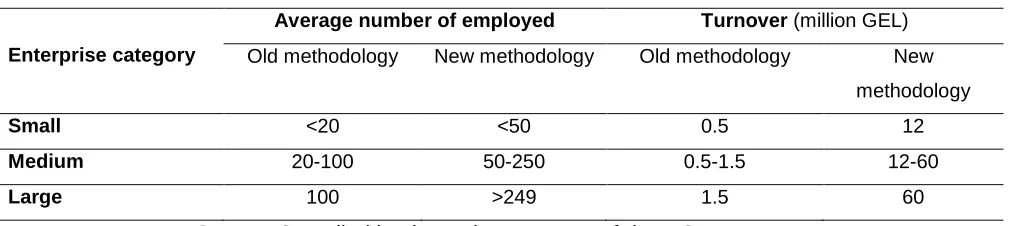
Table 4. Definition of SMEs used by Geostat
Enterprise category
Average number of employed Turnover (million GEL)
Old methodology New methodology Old methodology New methodology
Small <20 <50 0.5 12
Medium 20-100 50-250 0.5-1.5 12-60
Large 100 >249 1.5 60
Source: Compiled by the authors; source of data: Geostat
Table 4 presents comparison of “old” and “new” methodology that are currently applied by
Geostat. One can see that the main difference between two approaches relates to size-class breakdown. Application of the new methodology required regrouping the enterprises by their size, and part of previously “large enterprises” has been included into the category “medium size enterprises” automatically.
This statistical revision caused changes of business landscape of Georgia’s economy and should be analyzed from economic point of view in more detail.
Business demography indicators in Georgia: Overview
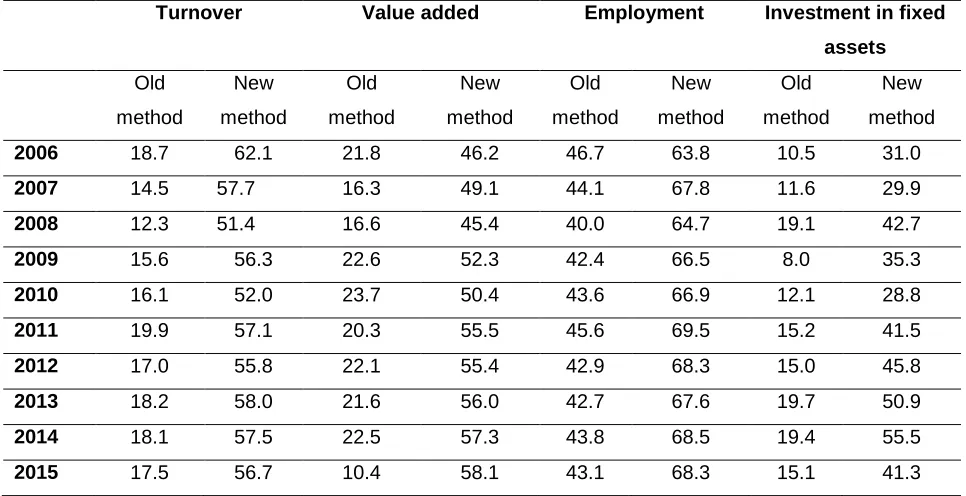
Licensed under Creative Common Page 241 Table 5. The share of SMEs, percent
Turnover Value added Employment Investment in fixed
assets
Old method
New method
Old method
New method
Old method
New method
Old method
New method
2006 18.7 62.1 21.8 46.2 46.7 63.8 10.5 31.0
2007 14.5 57.7 16.3 49.1 44.1 67.8 11.6 29.9
2008 12.3 51.4 16.6 45.4 40.0 64.7 19.1 42.7
2009 15.6 56.3 22.6 52.3 42.4 66.5 8.0 35.3
2010 16.1 52.0 23.7 50.4 43.6 66.9 12.1 28.8
2011 19.9 57.1 20.3 55.5 45.6 69.5 15.2 41.5
2012 17.0 55.8 22.1 55.4 42.9 68.3 15.0 45.8
2013 18.2 58.0 21.6 56.0 42.7 67.6 19.7 50.9
2014 18.1 57.5 22.5 57.3 43.8 68.5 19.4 55.5
2015 17.5 56.7 10.4 58.1 43.1 68.3 15.1 41.3
Source: Compiled and calculated by the authors, source of data: Geostat.
Keeping in mind 2014 Association Agreement with the European Union that offered both new opportunities and challenges for Georgian SMEs, the prospect of further improvement of legislative framework, updating the definition of SME in compliance with the European standards, seems like an urgent issue (Recommendations, 2016).
Evaluating consistency: Benefits and challenges
Consistency is usually considered as the base for comparability. Indeed, for the member-states of EU consistency has a crucial meaning because the common SME definition creates the common base for small and medium enterprises when they are applying to “all policies, programmes and measures that the European Commission develops and operates for SMEs”
(User guide, 2015, p.4). In other words, the European Commission has to be ensured that support measures are granted only to those enterprises that genuinely need them.
It is worth noting, that even “for Member States, use of the Definition is voluntary”. (User guide, 2015, p.5). The Commission together with the European Investment Bank (EIB) and the European Investment Fund (EIF) just invite Member States to apply it as widely as possible.
Licensed under Creative Common Page 242 micro, small and medium-sized enterprises, came into force on 1 May 2017 (Small and Medium-Sized Business).
For countries that are not member of any formal economically integrated unit, for example, for OECD countries common approaches in policies and legislation are not required. Particular, according to OECD experience, the fact that some states use national-specific criterion of SME definition, does not prevent international comparisons (http://dx.doi.org/10.1787/sdbs-data-en).For instance, in Korea and Mexico instead of “enterprise”, “establishment” is used as the statistical unit. Similar problem arises in case of
different size-class breakdown, for example for Mexico, Australia, Turkey, Canada, Switzerland, the United States, the Russian Federation, etc.
Despite the differences in national SME definitions, since 2006 the UNECE has introduced a new economic indicator called “Index of SME Development”, which provides a dynamic tool for analyzing the trend of the development of the SME sector in emerging market economies as well as in countries in transition (SME Policy Index, 2016). The Index of SME is applied to four regions in 32 economies (Western Balkans and Turkey, Eastern Europe and South Caucasus, North-Africa and the Middle East, Southeast Asia).
WB and IMF programs as well as EU programs successfully work in different countries including Georgia based on existing national legislation (http://www.ebrd.com/work-with-us/project-finance.html, http://www.eu4business-ebrdcreditline.ge/).
The last but not the least argument, practice of Georgian banks (leastwise, two of the leading, Bank of Georgia and TBC) shows that making the loan decisions, they apply their own criteria, including size-class breakdown of enterprises (Investing in opportunity, 201;Capturing growth, 2016)
Taking into account the above mentioned facts, one can conclude that the only case when full harmonization of Georgian and EU legislations will benefit domestic small and medium sized enterprises is if access to European support programs and funds will be opened for Georgian SMEs. Unfortunately, this is a big “if” that translates opportunities into long-term perspectives.
Licensed under Creative Common Page 243 to build a competitive SME sector (Enterprise Georgia. 2016), this conclusion is misleading. “Results of economic growth did not reach a significant part of the Georgian population and failed to have an impact on reducing unemployment and poverty levels” (Social-economic, 2014, p. 11).
Thus, playing tricks with the SME statistics creates real challenges. Statistical “bread butter on both sides” creates an illusion that causes misleading conclusion concerning the
further SME policy. New statistical method provides considerable room for politicians to manipulate with the data, selecting suitable statistics to demonstrate to voters how successful current policy is. New methodology disorients Georgian academic and business communities and sends a wrong signal to the Government that main goals have been achieved. Main economic and social function of small business – being one of the important drivers of economic
growth and engine of employment and income – might be neglected due to the achieved “successes”. “Dizzy from success” might cause change in government policy priorities by
disappearance from the government agenda special policy towards SMEs that shall provide targeted support to this sector. Therefore, while the benefits of consistency are potential, the challenges are real.
The way forward
The guiding principle of Georgia’s strategy for economic development has been defined since
1996, when Partnership and Cooperation Agreement between the EU-Georgia was signed. The Association Agreement of 2014, which integral part is Deep and Comprehensive Free Trade Area, deepens this cooperation. Consequently, SMEs internationalization, which includes developing institutional frameworks, becomes one of the top priorities of Georgian government policy.
Harmonization of legislation and institutional framework in order to meet EU requirements and norms opens up new avenues of inquiry for scholars. Among them are monitoring SME sector performance based on reliable statistics; conducting regular SME-specific regulatory impact assessment by developing a simple “SME test” to assess the likely
costs and benefits of new primary legislation for SMEs (Recommendations, p.13, 16); monitoring of the progress in the implementation and measuring convergence towards EU practices and standards; etc.
CONCLUSION
Licensed under Creative Common Page 244 The common definition is important for economically integrated countries such as the EU which introduce common policies and programs towards SME inside the group. Despite OECD countries including the USA do not follow EU common approaches in SME policies and legislation, they actively cooperate with each other.
Developing countries such as Georgia, which are oriented on deep cooperation with the EU, harmonize their legislation and institutional framework to meet EU requirements and norms. Nowadays, Georgia has two definitions of SMEs which are close to but still inconsistent with the EU one.
The further updating of the definition of SME in compliance with the European standardsis not a simple task. Consistency offers both benefits and challenges for Georgian small businesses. Georgian SMEs will benefit if access to European support programs and funds will be opened for them. Unfortunately, this is a big “if” that translate opportunities into long-term perspectives.
Current statistical “bread butter on both sides” creates an illusion that causes misleading
conclusion on the further SME policy. It might provide considerable room for politicians to manipulate with the statistical data, disorients Georgian academic and business communities by sending a wrong signal to the Government, neglects main economic and social function of small business, changes government policy priorities.
Therefore, while benefits of consistency are potential, challenges are real. In Georgia more urgent problem is to develop and adopt one definition acceptable for all purposes and all economic participants - business, statistic department, and commercial banks.
REFERENCES
Annual Progress Report (2016) on SME Development Strategy Action Plan 2016-2017. Retrieved
March15, 2017, from
http://www.economy.ge/uploads/files/2017/ek__politika/eng_sme_annual_report_2016.pdf
Capturing growth opportunities. Annual report (2016). BGEO. Retrieved October 5, 2017, from http://bgeo.com/uploads/annualreports/2016-804.pdf
Enterprise Georgia. Annual Report. 2016. Retrieved October 12, 2017, from http://enterprisegeorgia.gov.ge/files/document/1938313d7f039122cb076f052ed0aef7.pdf
Governmental Programme “For a Strong, Democratic and United Georgia” (2015). Retrieved September 4, 2017, from http://gov.ge/files/41_50258_481988_Strong,Democratic,UnitedGeorgia1.pdf
Investing in opportunity. TBC Annual Report (2015). Retrieved October 22, 2017, from http://www.tbcbank.ge/web/documents/10184/166980/TBC+Bank_Annual+Report+2015.pdf/af373e87-0f36-403b-b256-a1ac3eda6f16
Law of Georgia on the Georgian National Investment Agency. Retrieved February 16, 2016, fromhttps://matsne.gov.ge/en/document/download/13810/6/en/pdf
Licensed under Creative Common Page 245 Papiashvili &Ciloglu, 2015). SMEs and country’s growth strategy: Evidence from Georgia (with I.Ciloglu). Journal of Business (IBSUJB), Tbilisi, Georgia, 2015, Vol.4, Issue 1, p.25-30
Private Sector Development Advisory Council Information about the Meeting N1. (2016a). Ministry of Economy and Sustainable Development of Georgia.Retrieved September 25, 2017, from
http://www.economy.ge/uploads/departamentebi/ekonomika/Eng_-_RF-Minutes_of_PSDCC_N1_29_07_2016.pdf
Private Sector Development Advisory Council Information about the Meeting N2. (2016b). Ministry of Economy and Sustainable Development of Georgia. Retrieved September 25,
2017http://www.economy.ge/uploads/departamentebi/ekonomika/Eng_-_RF-Minutes_of_PSDCC_N2_03.10._2016.pdf
Small and Medium-Sized Business. Ministry of Economy of the Republic of Lithuania.Retrieved October5, 2017 fromhttps://ukmin.lrv.lt/en/sector-activities/business-environment/small-and-medium-sized-business Small and medium-sized enterprises in countries in transition (2003).UN. Retrieved September 22, 2010
fromhttp://www.insme.org/documents/Small%20and%20Medium-Sized%20Enterprises%20in%20Countries%20in%20Transition.pdf)
SME Development Strategy of Georgia 2016-2020. (2015). Ministry of Economy and Sustainable Development of Georgia. Retrieved October 2, 2017, from http://www.economy.ge/uploads/files/2017/ek__politika/eng_sme_development_strategy.pdf
SME definition: User guide and model declaration (n/d). Retrieved October 2, 2017, fromhttps://web.archive.org/web/20060720043724/http://ec.europa.eu:80/enterprise/enterprise_policy/sm e_definition/sme_user_guide.pdf
SME Policy Index: Eastern Partner Countries 2016: Assessing the Implementation of the Small Business Act for Europe. OECD Publishing, Paris
Socio-Economic Development Strategy of Georgia – Georgia 2020. (2014). Retrieved September 24, 2010, from https://www.adb.org/sites/default/files/linked-documents/cps-geo-2014-2018-sd-01.pdf
Tax Code of Georgia. Retrieved 22 November, 2016, from https://matsne.gov.ge/en/document/dowload/1043717/94/en/pdf
The role of small and medium enterprises in developing countries. (2006) Final report. Retrieved
September 24, 2010, from
http://www.google.ge/search?client=opera&rls=en&q=The+role+of+small+and+medium+enterprises+in+d eveloping+countries.+(2006)+Final+report&sourceid=opera&ie=utf-8&oe=utf-8
Recommendations for Georgia’s SME Development Strategy 2016-2020 (2016). Supporting SME competitiveness in the Eastern partner countries. OECD. Retrieved September 11, 2017, from
http://www.oecd.org/eurasia/competitiveness-programme/eastern-partners/Recommendations_for_Georgia_SME_strategy.pdf