A Modified Apriori Algorithm for Fast and
Accurate Generation of Frequent Item Sets
K.A.Baffour, C.Osei-Bonsu, A.F. Adekoya
Abstract—The Classical Apriori Algorithm (CAA), which is used for finding frequent item sets in Association Rule Mining, consists of two main steps; the join step for generating candidate item sets and the prune step for eliminating candidate item sets that are not frequent.
The CAA despite its simplicity has some limitations; the generation of a large number of candidate item sets, the generation of many combinations that never occur in the database as well as the need to perform several full database scans when generating frequent item sets. In this research, a Modified Apriori Algorithm (MAA) is proposed to address the problem of generating many combinations that never occur in the database by using a row-wise combination generation technique. A comparison of the results of the proposed algorithm against the Classical Apriori Algorithm shows that the proposed algorithm is faster and more efficient. The MAA was implemented on transaction databases and the results were compared against results from four (4) other Improved Apriori Algorithms for efficiency. The results of the comparative analysis showed that the MAA was more efficient in terms of execution time than the other Improved Apriori Algorithm.
Index Terms: Association Rule Mining, Candidate item sets, Combinations, Database, Frequent item sets, Join, Prune.
————————————————————
1 I
NTRODUCTION The world has gradually evolved into a knowledge economy which according to Powell and Snellman (2004) is an economy in which production of goods and services is based on knowledge-intensive activities that contribute to an accelerated pace of technical and scientific advancement. Over the years so much data mostly in the form of files and databases have been generated by many organizations.Data Mining
Data mining is the process of collecting and aggregating data from different perspectives and sources and analyzing the data to generate meaningful information.
Association Rule Mining
Association rule mining, introduced in 1993, is one of the most useful applications of data mining. Association rule mining makes it possible to discover patterns and interesting relationships between items in databases (Wakchaware, 2014).
Classical Apriori Algorithm
The Classical Apriori Algorithm (CAA), which is used for finding frequent item sets, was developed by Aggrawal and Srikant in 1994. The CAA is very simple to implement and consists of two main steps; the join step for generating candidate item sets and the prune step for eliminating candidate item sets that are not frequent (Kaur, 2014).
The CAA is the traditional algorithm used to generate Association Rules. The CAA despite its simplicity and ease of implementation has several drawbacks. Some weaknesses of the algorithm include:
Generation of many candidate item sets consisting of many infrequent and unnecessary item sets
the generation of a large number of combinations that never occur in the database as well as
the need to perform several full database scans when generating frequent item sets .
1.1 Aims
In this paper, a Modified Apriori Algorithm (MAA) is proposed
combinations that do not exist in the database are generated. The MAA addresses this issue by using the principle of generating combinations from the frequent items found in each row of the transaction database.
2
RESEARCH
METHODOLOGY
The MAA and its architecture are explained in this section.
2.1 Data Collection
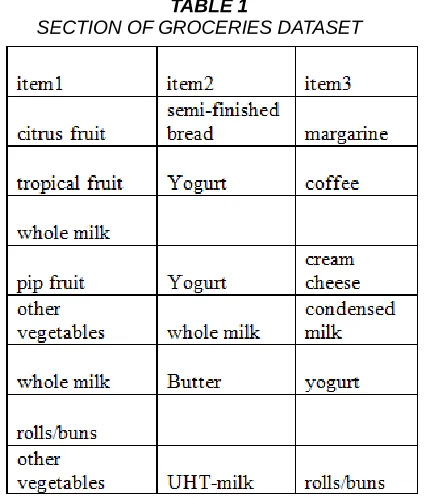
Secondary data, ―Groceries Dataset‖ obtained from ‗http: //www.inside-r.org/packages/cran/arules/docs/Groceries‘ was used. A transactions database, transactions_db was created on a database server (MySQL).Inside this database, table, Groceries was created and populated with the content of the Groceries Dataset.
TABLE 1
SECTION OF GROCERIES DATASET
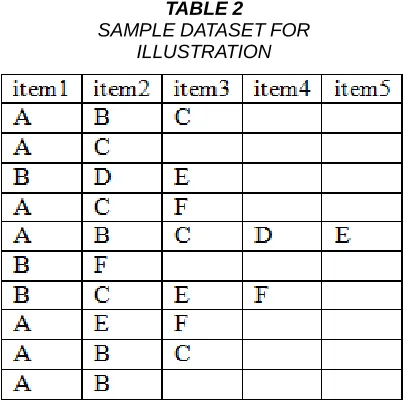
TABLE 2
SAMPLE DATASET FOR ILLUSTRATION
2.2 Data Preprocessing
Data preprocessing involves transforming rawdatainto an understandable format. The data processing involves transformation of raw data into appropriate format. Using Microsoft Excel (Spreadsheet Application), the following three (3) activities of Data Processing were carried out on the Groceries dataset:
replacement of all forward slash ‗/‘ with the word ‗or‘, replacement of all open bracket ‗ ( ‘ with the word
‗and‘, replacement of closing bracket ‗)‘ with a blank space and
replacement of all hyphen ‗-‘ with a blank space. 2.3 Architecture of the MAA
The MAA consists of six (6) modules namely;
Database connection and table selection module Minimum Support Threshold Definition module Frequent Items module
Array of frequent items module Combination generation module Frequent item sets module
Fig. 1. Architecture of MAA
2.4 Database Connection and Table Selection
All databases reside on a database server. The database server used for this research was the MySQL database server. To access the transactions_db database, a connection had to be established with the database server. After connecting to the database server, the Groceries table was selected.
2.5 Minimum Support Threshold (MST) Definition The MST is used in discovering frequent items and item-sets. The MST value is usually accepted as an input from the user since it is user defined.
For this research however, the MST value was determined using Measures of Central Tendency. Measures of Central Tendency are statistical measures that make it possible to choose a value that best describes or represents a whole set of data. The MST for this research was determined using the measure known as the Mid-Range. The Mid-Range of a set of data is the mean of the maximum and minimum values in the dataset. The Mid-Range of the occurrence counts of the items in the transactions database was calculated and used as the MST. It is defined by:
(1)
TABLE 3
OCCURRENCE COUNT OF ITEMS
From Table 3 Max occurrence is 7 and the Minimum occurrence is 2.
M= (7+2) / 2 = 4.5 ≈ 5 Therefore the MST is 5.
2.6 Frequent Items
Frequent items refer to those items with occurrence counts greater than or equal to the MST.
TABLE 4 FREQUENT ITEMS
2.7 Array of Frequent Items
same structure as the Groceries table was created. The contents of the Groceries table were read into the array to populate it. The infrequent items were then deleted from the array.
TABLE 5
STRUCTURE OF ARRAY OF FREQUENT ITEMS
2.8 Combination Generation
Starting with the first row to the last row in the array of frequent items, all possible combinations were generated using the items from that row.
Row1: AB, AC, BC Row2: AC
Row3: - Row4: AC
Row5: AB, AC, BC Row6: -
Row7: BC Row8: -
Row9: AB, AC, BC Row10: AB
2.9 Frequent Item sets
Frequent item sets were obtained by counting the occurrence of each unique combination and checking if it was greater than or equal to the MST. All those combinations that met this criterion were selected as frequent item sets.
TABLE 6
ITEMSET OCCURRENCE
From the Table above, the only combination that meets the MST is AC.
3
RESULTSThe results of implementing the MAA on the extracts of the Groceries dataset are presented in this section. The
comparative analyses of the MAA against the other Improved Apriori Algorithms are also presented.
TABLE 7
RESULTS (MAA ON FIRST 100 RECORDS)
TABLE 8
RESULTS (MAA ON FIRST 500 RECORDS)
TABLE 9
RESULTS (MAA ON FIRST 1000 RECORDS)
3.1 Comparative Analysis of MAA against Other Improved Apriori Algorithms (IAA)
The MAA was comparatively analyzed against three (3) other Improved Apriori Algorithms for efficiency.
3.2 MAA against Matrix Apriori
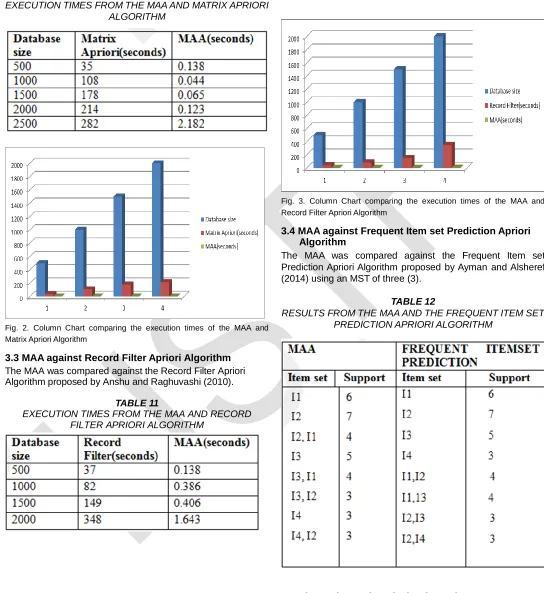
TABLE 10
EXECUTION TIMES FROM THE MAA AND MATRIX APRIORI ALGORITHM
Fig. 2. Column Chart comparing the execution times of the MAA and Matrix Apriori Algorithm
3.3 MAA against Record Filter Apriori Algorithm The MAA was compared against the Record Filter Apriori Algorithm proposed by Anshu and Raghuvashi (2010).
TABLE 11
EXECUTION TIMES FROM THE MAA AND RECORD FILTER APRIORI ALGORITHM
Fig. 3. Column Chart comparing the execution times of the MAA and Record Filter Apriori Algorithm
3.4 MAA against Frequent Item set Prediction Apriori Algorithm
The MAA was compared against the Frequent Item set Prediction Apriori Algorithm proposed by Ayman and Alsheref (2014) using an MST of three (3).
TABLE 12
RESULTS FROM THE MAA AND THE FREQUENT ITEM SET PREDICTION APRIORI ALGORITHM
3.5 Discussion and Analysis of Results
generates exactly the same number and size of item sets as the other IAA i.e., the MAA generates the same results as the other IAA. With regards to execution time however, the MAA requires very little time for generating its results and can therefore be said to be more efficient and computationally less expensive than the other IAA.
4
CONCLUSION
In this research, an enhanced Modified Apriori Algorithm (MAA) was developed to address a major problem of the CAA From the results, it was observed that the MAA was better and more efficient than the CAA since it succeeded in eliminating the problem of non-existent combination generation.
5
R
EFERENCES[1] Aggarwal, S., & Sindhu, R. (2015). An approach to improve the efficiency of apriori algorithm (No. e1410). PeerJ PrePrints.
[2] Agrawal, R., & Srikant, R. (1994, September). Fast algorithms for mining association rules. In Proc. 20th int. conf. very large data bases, VLDB (Vol. 1215, pp. 487-499).
[3] Anshu, C., & Raghuvanshi, C. S. (2010). An algorithm for frequent pattern mining based on Apriori. International Journal on Computer Science and Engineering, 2(04), 942-947.
[4] Ayman, K.E., Alsheref, F.K. (2014). Improved Apriori Algorithm VIA Frequent Item sets Prediction. International Journal of Advanced Research in Computer Science and Engineering, 4(4), 748-758.
[5] Dutt, S., Choudhary, N., & Singh, D. (2014). An Improved Apriori Algorithm based on Matrix Data Structure. Global Journal of Computer Science and Technology, 14(5), 1-5. [6] Garg, S., & Sharma, A. K. (2013). Comparative Analysis of
Various Data Mining Techniques on Educational Datasets. International Journal of Computer Applications, 74(5), 1-5 [7] Kaur, G. (2014). Improving the Efficiency of Apriori Algorithm In
Data Mining. International Journal of Science, Engineering and Technology, 2(5), 315-326.
[8] Luo, X., & Wang, W. (2010, June). Improved algorithms research for association rule based on matrix. In Intelligent Computing and Cognitive Informatics (ICICCI), 2010 International Conference on (pp. 415-419). IEEE (Conference proceedings)
[9] Powell, W. W., & Snellman, K. (2004). The knowledge economy. Annu. Rev. Sociol., 30, 199-220