Selection of model liquid with refractive index matching for
visualization of internal flow in a scaled atomizer model
Marcel Sapík1,*, Milan Malý1, Jan Jedelský1, Graham Wigley2 and Ondřej Cejpek1 1Brno University of Technology, Faculty of Mechanical Engineering, Czech Republic 2Loughborough University, United Kingdom
Abstract. A scaled transparent modular model of pressure-swirl (PS) atomizer was prepared from cast PMMA (Poly(methyl methacrylate), Perspex™, Plexiglas™) with the aim to achieve a better understanding of internal flow and subsequent spray formation. Because of use of high-speed imaging and Laser Doppler Anemometry (LDA) the working liquid had to be selected with respect of a refractive index matching (RIM) with the atomizer material. The liquid should be colourless and chemically non-aggressive to the model material with suitable viscosity to achieve the Reynolds number of the internal flow of the original atomizer. Froude number should be high enough to neglect the influence of gravity on the flow. An extensive search for transparent liquids and materials of enlarged models was made with a focus on RIM in performed experiments. Several liquids were chosen, and their chemical effect on PMMA was tested. Despite the successful tests that proved the liquid suit the case, the model material was damaged and the tests proved to be insufficient. For this reason, the tests were modified to better involve the stress of the bolted model. It turned out that a force effect (bolt in the thread, pre-stressed bolt connection) on the material has a significant influence on the acceleration of the chemical effect. The internal flow was examined using a high-speed camera with several liquids.
1
Introduction
The PS atomizers are used industrially for example in combustion, painting, water cooling, etc. The pumped liquid is injected via tangential ports into a swirl chamber. High tangential velocity causes a swirl motion of liquid under which it leaves the exit orifice. The centrifugal motion of the liquid creates low-pressure zone with an air core along the centreline of the swirl chamber. The air core prevents the liquid from exiting and liquid flows out as a liquid sheet. The internal flow determines the formation and shape of the air core, which indicates the form of the liquid sheet and subsequently the resulting spray.
Because the nozzles are a few millimetres small devices, it is necessary to create an enlarged, transparent model for visualizing and measuring the internal flow. Internal flow is strongly associated with the resulting spray, but not all aspects of the internal flow are well understood. The scaled model must meet some dimensionless criteria to make the flow behaviour identical to the original nozzle. An enlarged model is used, for example, for Laser Doppler Anemometry (LDA) measurement or visualization using a high-speed camera. Due to the geometry of the chamber with its curved surface, it is advisable that the refractive index (RI) of the liquid and the transparent material be the same for accurate optical measurement.
A number of authors have studied and visualized the internal flow using transparent models. Horvay and Leuckel [1, 2] examined the effect of the nozzle geometry on the internal flow. The authors used scaled transparent modular atomizer made of PMMA in combination with a mixture of castor (ricinus) oil, tetraline (1,2,3,4-Tetrahydronaphthalene), and turpentine oil as working liquid to match the refraction index. The same mixture was used by Liu [3], although it chemically damages the PMMA material. Keukelaere [4] used scaled PMMA model with water as working liquid to measure the flow rate, air core dimensions, pressure distribution and the velocity profiles in the swirl chamber. The results were compared with theoretical assumptions. His work was followed by Cooper, Chinn and Yule [5] who compared computer models of internal flow with measurement in three different swirl chamber geometries (conical, curved and square) using PMMA and water. Purwar in [6] used 1-Bromonaphthalene with calibration oil (Castrolcalibra-tionoil ISO 4113) and PMMA asymmetric diesel nozzle to study the effect of cavitation on the final spray.
a glass tube with a mixture of water and sugar and also with a mixture of water and glycerine.
Many other authors studied RIM techniques, and their work is also part of this paper, where the main objective is to pass experience with a selection of liquid and material to achieve the matched RI. This objective is related to the issue of atomization but can serve as a practical tool for any sector dealing with the RIM techniques. This paper also includes a summary of transparent materials, including materials for 3D printing, usable transparent liquids with experience from their chemical corrosion tests against PMMA.
2
Methodology
Liquid selection refers to a 10× scaled modular PMMA model of a PS nozzle, originally used in an aviation engine. The model is part of a test bench in the Spray laboratory at the Brno University of Technology. The material of the model (PMMA) was selected before the selection of the liquid because it was the most commonly used material for scaled nozzle models [1–6], and the problem of a suitable liquid turned out later. Due to the negative chemical behaviour of liquids, the production of the model from another material was considered.
2.1 The atomizer
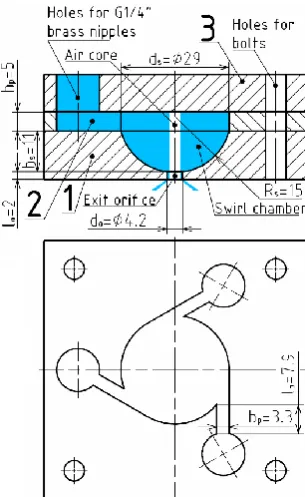
The model is made of cast PMMA and consisted of three pieces, one with the swirl chamber, the second part with the tangential inlet ports, and the last one is a cap. This modular construction allows changing each piece for another with a different geometry. Due to prevent leakage of the liquid between the interfaces, a thin transparent gasket material was used. Surfaces of every piece were grounded and polished. The construction is shown in figure 1 and the 3D model is shown in figure 2.
Fig. 1. Ten times enlarged model of the transparent atomizer. Dimensions are in millimetres.
Fig. 2. Model of the scaled transparent atomizer
2.2 The liquids
The greatest emphasis in the selection of the liquid was placed on a match with a refractive index of PMMA with RI approximately 1.49 (at a wavelength of 500–700 nm). To achieve this value, it is necessary to create a mixture of two or more components (mainly liquids), of which at least one will have an RI higher than PMMA. However, this requirement greatly reduces the number of liquids which can be used. By using at least three components, it is possible to change the viscosity or density of the mixture in addition to the refractive index.
The close RI of PMMA have oils – organic compounds, but only a few (e.g. aniseed oil) have a significantly higher RI. Against this advantageous feature is the fact that PMMA is corrosive in combination with many organic, especially aromatic, liquids. Oils are often miscible among themselves but are not with water and aqueous solutions. Due to different physical and chemical properties, a search was made, where other liquids were considered in addition to oils.
Also, when selecting liquids, it is necessary to observe several dimensionless numbers to maintain the flow, such as swirl number, Reynolds number and Froude number.
The swirl number S0 is the ratio of the radius of the
swirl chamber, the exit orifice and sum of a cross-section of the inlet ports [4]. This number has to remain the same for the model as compared to the original nozzle. The swirl number of scaled model remains the same if the dimensions of the original nozzle are equally scaled.
𝑆0=𝜋𝑟𝑠𝑟0
𝐴𝑝 , (1)
where 𝑟𝑠 is swirl chamber radius, 𝑟0 is radius of the exit orifice and 𝐴𝑝 is total cross-section of inlet ports.
The Reynolds number is important parameter that must be maintained to simulate the behaviour of liquid in the original atomizer and is defined as the ratio of inertial and viscous force [9]:
𝑅𝑒 =𝑤𝑝𝐷𝑝
𝜈 , (2)
The effect of the gravity on the internal flow is described by the Froude number [9], which must be high enough to consider the influence of gravity to be negligible. The atomizer model cannot reach the original values.
𝐹𝑟 = √ 𝑢0
2
4𝑟0g
, (3)
where 𝑢0 is axial velocity, 𝑟0 is the diameter of the exit orifice and g is gravitational acceleration.
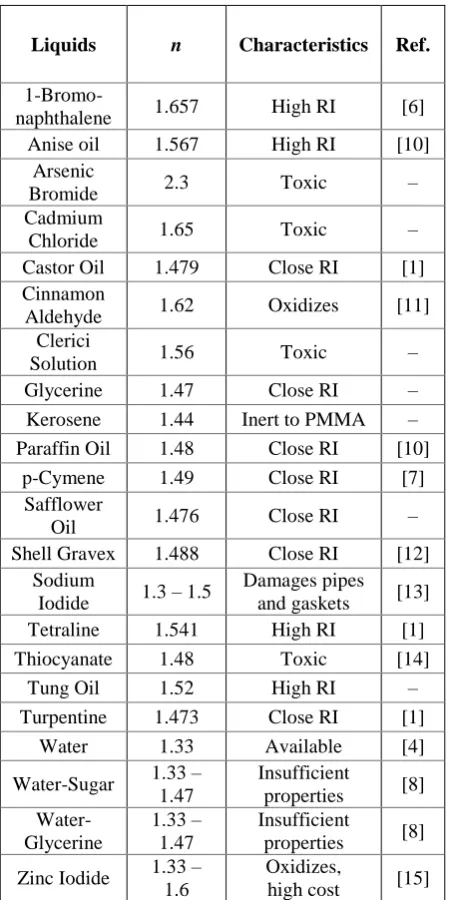
Table 1 contains a large number of liquids that have been considered or used by other authors to match the RI. The table also contains some of liquids characteristics.
Table 1. Liquids obtained by extensive research, mean RI based on wavelength 500-700 nm
Liquids n Characteristics Ref.
1-Bromo-naphthalene 1.657 High RI [6]
Anise oil 1.567 High RI [10]
Arsenic
Bromide 2.3 Toxic –
Cadmium
Chloride 1.65 Toxic –
Castor Oil 1.479 Close RI [1]
Cinnamon
Aldehyde 1.62 Oxidizes [11]
Clerici
Solution 1.56 Toxic –
Glycerine 1.47 Close RI –
Kerosene 1.44 Inert to PMMA –
Paraffin Oil 1.48 Close RI [10]
p-Cymene 1.49 Close RI [7]
Safflower
Oil 1.476 Close RI –
Shell Gravex 1.488 Close RI [12]
Sodium
Iodide 1.3 – 1.5
Damages pipes and gaskets [13]
Tetraline 1.541 High RI [1]
Thiocyanate 1.48 Toxic [14]
Tung Oil 1.52 High RI –
Turpentine 1.473 Close RI [1]
Water 1.33 Available [4]
Water-Sugar 1.33 – 1.47
Insufficient
properties [8]
Water-Glycerine
1.33 – 1.47
Insufficient
properties [8]
Zinc Iodide 1.33 – 1.6
Oxidizes,
high cost [15]
Toxic liquids in table 1 are miscible with water, but have been excluded due to health risk. Iodide solutions are highly hygroscopic, making them difficult to prepare. They are also difficult to store because they oxidize quickly. Moreover, sodium iodide corrodes the steel and
even stainless steel sections of the experimental track and causes hardening of elastics plastics (gaskets, hoses) [35]. It is inert against Al, Cu, PMMA and hard plastics. Shell Gravex oils have almost similar properties as paraffin oil, which is more readily available. The cinnamon aldehyde is a powder that requires precise weighing, quickly oxidizes and damages PMMA. Water solutions with sugar or glycerine do not offer a sufficiently high RI and glycerine is highly viscous and is immiscible with oils. Water is used for comparison in other tests as it does not damage PMMA.
Based on the extensive research on usable liquids in Table 1, their chemical corrosivity on small clean pieces of PMMA (20×20×5 mm) without any perforation was tested, and a possible damage was inspected after 10, 60 and 130 days. The pieces were immersed in undiluted liquids (table 3) or mixtures (table 4) in small glass jars at room temperature (20°C). For mixtures, the ratio of liquids was chosen to match the RI of PMMA.
The anise and tetraline mixtures are colourless and transparent except for castor oil mixtures. Highly viscous mixtures (paraffin oil, castor oil) lose transparency for a long time due to bubbles after shaking the jars. Mixtures with low viscosity (turpentine, p-Cymene) returned to normal state very quickly. Tetraline mixtures bubbled more markedly than with anise oil and are less suitable for optical measurements.
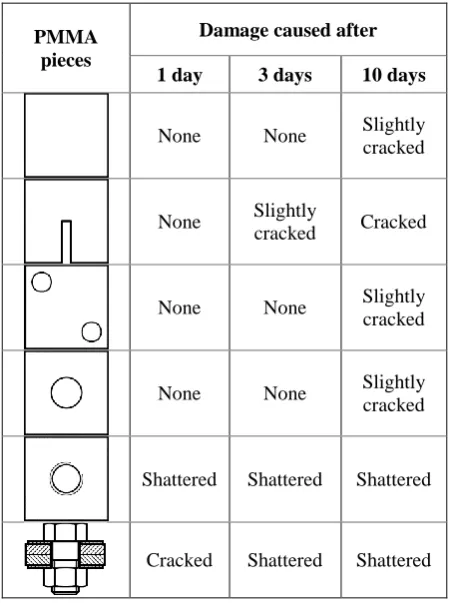
Based on the results of chemical tests, a close RI, and a sufficiently low viscosity, p-Cymene was chosen as the working liquid. After one day of testing with p-Cymene, the model was severely damaged, with deep cracks around the threads and inlet ports. The extent of the damage did not match the tests. Therefore, new tests were prepared where the PMMA pieces (20×20×5 mm) were perforated so as to be similar to that of the atomizer model, as shown in table 5. The same tests were carried out with water, where all the pieces remained undamaged. The tests have thus shown that the chemical effect of liquids is greatly accelerated by stress in the material.
These new tests were also carried out with a mixture of three liquids – aniseed oil, paraffin and p-Cymene. For these mixtures, the RI was matched to PMMA, and the paraffin oil fraction was in the range from 10% to 80%. Even at 70%, the threaded part was damaged very quickly and with 80% only slow slightly down. Therefore, a compromise had to be made in the RI, and a new working fluid inert to PMMA had to be chosen. The selected liquid became kerosene, which has sufficient RI and viscosity. Kerosene is also used in the original nozzle, so some recalculations for dimensionless numbers are easier.
Selected liquids were injected into the atomizer and internal flow with air core was observed, see figure 3.
A Photron SA-Z high-speed camera was used with a background light using an LED panel. The shutter speed was 20 μs, and the frame rate was 20,000 fps with resolution 1024 × 1024 px.
RIM is important because of the light beam refracting on the interface, which is increased by the spherical shape of the chamber, as shown in figure 4.
Fig. 4. Schematic drawing of light beam refraction
Zhang in [16] determined a location recalculation, which is appropriate for using the LDA system.
𝑠2=
𝑅𝑠𝑛
1 +𝑛1𝑛
2(
𝑅𝑠𝑛
𝑠1 − 1)
(4)
Where 𝑛1 is the RI of the material from which the light beam emerges (PMMA), 𝑛2 is the RI of the liquid into which the beam enters (p-Cymene, kerosene), 𝑅𝑠𝑛 is the radius of the swirl chamber in the selected position, 𝑠1 and 𝑠2 is the distance that reaches the beam without and with refraction, respectively.
2.3 Transparent materials for models
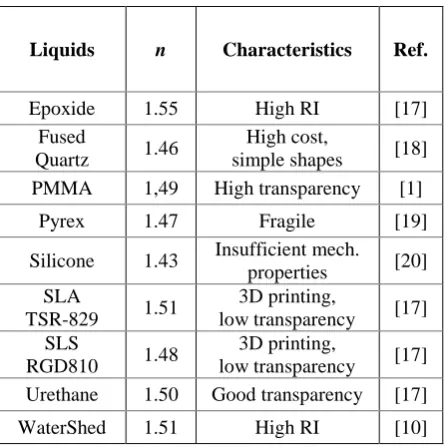
After the model was damaged by p-Cymene, the use of other model material was considered, as shows table 2.
Table 2. Transparent materials obtained by extensive research
Liquids n Characteristics Ref.
Epoxide 1.55 High RI [17]
Fused
Quartz 1.46
High cost,
simple shapes [18]
PMMA 1,49 High transparency [1]
Pyrex 1.47 Fragile [19]
Silicone 1.43 Insufficient mech.
properties [20] SLA
TSR-829 1.51
3D printing,
low transparency [17] SLS
RGD810 1.48
3D printing,
low transparency [17]
Urethane 1.50 Good transparency [17]
WaterShed 1.51 High RI [10]
It turned out, however, that there are not many other materials that could be successfully used. Most of these are glass-based materials. Improving 3D printing technology offers the ability to create transparent models, but their optical properties are insufficient.
Fused quartz was used in combination with mineral (paraffin) oil, this combination offers good optical properties, and mineral oil does not damage the material. However, the price of fused quartz is very high and only simple shapes such as a plate, cylinder or sphere can be produced [18]. PMMA offers good mechanical properties, especially in cast form, when it is very strong and resistant to scratches and mechanical damage. It is resistant to most aqueous solutions, but organic substances or solvents can adversely affect it. However, it is the most commonly used material for this type of measurement. Pyrex™ is not very much used because of its fragility. Mechanical properties of the silicone for the atomizer model are insufficient. Transparency of the material made by a 3D print by SLA and SLS methods is inadequate. Better optical results are achieved by vacuum casting, but air bubbles can occur in the material.
3
Results and discussion
Perspex has proved to be a mechanically durable material with good optical properties. In order to achieve the same refractive index between PMMA and liquid, organic substances must be used which, however, damage the material, as shown in tables 3, 4 and 5.
Table 3. Damage caused to pieces in undiluted liquids in 10, 60 and 130 days
Liquids Damage caused after
10 days 60 days 130 days
1-Bromo-naphthalene Cracked Shattered Shattered Anise oil Shattered Dissolved Dissolved
Castor Oil None None None
Kerosene None None None
Paraffin Oil None None None
p-Cymene Slightly cracked
Slightly cracked
Slightly cracked Safflower
Oil None None None
Tetraline Cracked Cracked Dissolved
Tung Oil None None None
Turpentine None Slightly
cracked
Slightly cracked
Water None None None
A suitable replacement could be glass (e.g. Pyrex) or fused quartz, however, it is necessary to know whether it is possible to produce the desired shape and dimensions. This replacement is rather inappropriate for a modular design of a pressure swirl atomizer, as the parts are bolted together, and the material around the bolts could break. PMMA allows partial deformation without damage.
Table 4. Damage caused to pieces in mixtures with matched RI to PMMA in 10 and 60 days
Mixtures
Damage caused after
10 days 60 days
Anise oil +
Castor oil None Cracked
Paraffin oil None Cracked
p-Cymene None Slightly
cracked Turpentine Cracked Shattered
Tetraline +
Castor oil None Cracked
Paraffin oil None Cracked
p-Cymene None Slightly
cracked Turpentine Cracked Shattered
Table 5. Damage caused to perforated PMMA pieces immersed in p-Cymene during 1, 3 and 10 days
PMMA pieces
Damage caused after
1 day 3 days 10 days
None None Slightly
cracked
None Slightly
cracked Cracked
None None Slightly
cracked
None None Slightly
cracked
Shattered Shattered Shattered
Cracked Shattered Shattered
The fastest damage was caused to the piece with thread and bolt, when the material shattered after several hours. Another significant effect on the chemical resistance of the material had a pre-stressed bolt connection. The various shapes of the holes did not have a noticeable effect on the damage.
Liquid tests have shown that it is important to partially simulate its stress in testing the chemical effect of liquids on the material. However, no information was found in the literature to describe the relationship between chemical corrosion and material stress. The authors of this paper recommend that pieces of material be stressed during the resistance tests, as the chemical effect is greatly enhanced and accelerated. If there is no damage to the stressed material within 5 days, it can be assumed that the
liquid is actually inert to it. Based on this, kerosene was chosen as a new working liquid instead of p-Cymene.
Kerosene does not have a significantly different RI than PMMA, yet the difference is noticeable, see figure 3. Bromonaphthalene can be used to increase kerosene RI where the resulting viscosity of the mixture is suitable for measurement on a scaled atomizer model.
If the viscosity value is unimportant or higher than required in this paper, the excellent liquid in combination with PMMA is paraffin oil, which can also be mixed with castor, tung or safflower oil. Turpentine may be used to reduce viscosity, but the chemical effect of this mixture should be tested because turpentine is corrosive to the acrylic material.
4
Conclusion
Refractive index matching (RIM) for application with atomizers has proved to be a very complex problem where several compromises must be made to achieve the desired results. RIM is important for accurate LDA measurements, but the results from the high-speed camera were independent of the liquid used.
The most suitable material of the modular model of the pressure swirl nozzle for optical measurements proved to be PMMA. The liquid suitable for use with this material can be considered, for example, kerosene or paraffin oil. There is not much work, that deals with RIM between liquid and solid material and a frequent problem with this type of work is the lack of evaluation by authors of whether a working fluid was suitable for the selected type of test or whether there were any problems with the deterioration of a certain type of material: PMMA, gaskets, metal parts of the track, pump materials, etc.
For this reason, tests of chemical resistance of PMMA for different liquids were prepared and performed. From these, p-Cymene was first selected and then kerosene, because it turned out that the stressed material is corroded significantly faster as the chemical effect is increased.
This work has been supported by the project No. GA18-15839S funded by the Czech Science Foundation, the project “Computer Simulations for Effective Low-Emission Energy” funded as project No. CZ.02.1.01/0.0/0.0/16_026/0008392 by Operational Programme Research, Development and Education, Priority axis 1: Strengthening capacity for high-quality research and the project No. FSI-S-17-4444 funded by the Brno University of Technology.
References
1. M. Horvay, W. Leuckel, ALAFM, 2, 18, (1985) 2. M. Horvay, W. Leuckel, Experimental and
Theoreti-cal Investigation of Swirl Nozzles for Pressure-Jet Atomization, (1986)
3. C.H. Liu, C. Vafidis, J.H. Whitelaw,EF, 10, 6, (1990) 4. H.J.K de Keukelaere, MSc Dissertation, Dept. Mech.
Eng., UMIST, (1995)
7. Y.A. Hassan, E.E. Dominguez-Onziveros, NED, 238, 6, (2008)
8. I. Muguercia, B. Cazanas, W. Li, M.A. Ebadian, SPIE,
2052, 8 (1993)
9. J.J. Chinn, The Numerics of the Swirl Atomizer. Dept. Mech. Eng., UMIST, (2008)
10.A. Nemes, S. Jalal, T. van de Moortele, F. Coletti, ISALITFM, 18, 9, (2016)
11.P.M. Bardet, C.D. Fu, C.E. Sickel, N.A. Weichselbaum, ISALITFM, 17, 6, (2014) 12.M. Stahl, M. Gnirs, N. Damaschke, C. Tropea,
ILASS, 20, 6, (2002)
13.P. Scholz, I. Reuter, D. Heitmann, ISALITFM, 16, 12, (2012)
14.R. Budwig, EF, 17, 6, (1994)
15.F. Hendriks, A. Aviram, RSI, 53, 4, (1982)
16.Z. Zhang, LDA Application Methods: Laser Doppler Anemometry for Fluid Dynamics, Springer, (2010) 17.M.S. Song, H.Y. Choi, J.H. Seong, E.S. Kim, NED, 7,
(2015)
18.C. Stoots, S. Becker, K. Condie, F. Durst, D. McEligot, EF, 30, 8, (2001)
19.A.P. Yarlagadda, A.P. Yoganathan, EF, 8, 13, (1989) 20.L.M. Hopkins, J.T. Kelly, A.S. Wexler, A.K. Prasad,