A Mega Super Classifier with Fuzzy
Categorization in Face and Facial Expression
Identification
Dhananjay Bhakta PhD Student, Dept. of CSE
NIT Durgapur, India Dr. Goutam Sarker
Senior Member IEEE, Associate Professor, Dept. of CSE
NIT Durgapur, India
A new method for face and facial expression identification from a facial image has been developed through a Mega Super classifier system with fuzzy classification. This system built using two set of super classifier where first super classifier was intended to identify facial expression and second super classifier was designed for person identification. These two decisions are integrated to form the Mega Super classifier output as the person with their expression. This fuzzy classification technique improved the overall system accuracy.
Keywords:
Facial Expression Identification, Face Identification, Fuzzy Confusion Matrix, Learning Based Boosting, Mega Super Classifier.I. INTRODUCTION
Person with their facial expression identification is an interesting and effective application from several other image processing, pattern recognition and computer vision applications area which categorizes a person as well as their facial expression from a set of train person and a set of train facial expression. According to Mehrabian (Psychology today, 1968), speech is meaningless without any facial expression
because spoken word and voice information are less important than facial expression. Facial expressions are practical meaning of social communications. One can judge about the mood of a person by seeing their facial expression. Happy emotional states can be determined through looking smile on the face. The human face is capable of doing more than 10,000 different expressions using all the various muscles that precisely control mouth, lips, eyes, eyebrows, nose, forehead, and jaw. Among these, seven expressions such as happy, sad, fear, disgust, anger, surprise and contempt are universally accepted. Most of the researcher deals with first six basic emotions [1].This system introduced a five class fuzzy categorization techniques [2]. Each person and facial expression is further categorized into five categories on the basis of fuzzy membership values instead of considering as single class. After determining the presence of a face in
the image, this system is able to identify a person with their facial expression from an image with partial occlusion (up to 50%), 2D in-plane rotation, different pose and multi-frame containing multiple faces [28,29,31,39-42]. A Mega Super classifier is introduced to solve these three problems from a single framework and the second super classifier is used to identify a person from color facial image. The Mega Super Classifier performs three maintasks at three different levels. In the first level, the system first detects faces in the input images. In this scheme, the face portion is first detected and extracted for face and facial expression identification. If no face is detected, then exit from the system without wasting of much time. After successful detection of faces, at the second level we used two set of super classifier to form the Mega Super Classifier, one for color facial expression identification through different expressive face portions [43] and other for face identification instead of relying on a single classifier. At the third level, decisions of these different classifiers present in the super classifier are combined using incremental weight learning based boosting techniques [25,26,28,32,43] and the final decision of these two set of super classifier are integrated or fused together to form the decision of face with facial expression. For facial expression identification, the pre-processed face portion are trained using Optimal Clustering Algorithm (OCA) [4,42] based Modified Radial Basis Function Network (MRBFN) classifier, forehead images are trained using Modified Optimal Clustering Algorithm (MOCA) [2,43]
based classifier separately. Now in final level, responses of all classifiers contained in the first set of super classifier are fused together with incremental weight learning based boosting process to gain final evidence classified as facial expression which is the first super classifiers’ output and responses of the classifiers contained in the second set of super classifier are combined using the same incremental learning based boosting method to achieve solid evidence. Finally, conclusion is drawn by integrating these two outputs. The system performance is evaluated in terms of accuracy, precision, recall, f-score through five class fuzzy categorization [2] and Holdout method[2,25,26,28,31,43].
The main contributions of this present paper are
The concept of Mega Super Classifier is introduced with the help of eight efficient classifiers to detect and identify faces with its facial expression.
1) A weight learning based boosting technique is used to integrate multiple decisions for a particular problem.
2) The overall performance of the system is evaluated through the fuzzy confusion matrix with five fuzzy membership values for aclass.
3) The system performs face detection, face identification, and facial expression identification from facial images with different pose, partial occlusion, 2D in-plane rotation, multiple imageframes.
The remaining part of the paper is prepared as follows. In section II, previous works are discussed briefly. Section III, described the working flow of Mega Super classifier. In section IV, a five class fuzzy confusion matrix is explained. Section V, illustrates the proposed system. Section VI reports experimental results with KDEF [7] facial
expression database
(http://www.emotionlab.se/resources/kdef). Finally, section VII concludes this paper.
II.PREVIOUSWORKS
Recognizing faces and facial expressions from highly varying facial expression uncontrolled situation, partially occlusion, 2D in-plane and out-plane rotation, multiple image frame is very difficult task for a machine. Many research efforts have already been discovered solution to these problems. Still, an optimal answer to those problems is yet to be reached. Among several approaches neural network based face or facial expression identification achieves better performance due to their capability of handling huge number of patterns [8-12,43]. In [8], an automatic face identification system was developed with multiple classifiers which operate on different aspects (eyes with eyebrows, nose and mouth).In this work an incremental weight
learning based boosting technique is developed to improve the recognition accuracy. In [9], the author proposed a fractal-based face recognition system which mainly deals with expressions and occlusions. The system shows that the recognition rate in highly screamed expression is 60–84%, but in normal case, it is 96–99% while in case of occlusion, it is about 85–97%. In [10], a pose adaptive component-based face recognition system has been designed to deal with illumination, expression, pose variations and occlusion.
At the same time in this experiment descriptors of each component extracted from face are fused together to assign the class label of the probe image. The system use five different pose, three different expression and occlusions caused by sunglasses and scarf is mainly consider. Results shows that 92% recognition rate achieve in frontal faces while recognition rate in different pose vary from 80-89% and in faces with different expression it is 91%. When the facial components are individually used for recognition, the recognition rate is varied from 60-72%. In partial occluded faces the recognition rate is vary from 55- 60%. In [11], a multi-algorithmic approach for face recognition is proposed. This system combines the four individual face recognition algorithms such as PCA, DCT, Template matching using Correlation (Corr), and Partitioned Iterative Function System (PIFS). All of these four techniques perform individually and finally scores of these recognition techniques are fused together for final decision. This multi-algorithmic approach achieves highest recognition rate as 97%, which is better than the combination of 3 algorithms (96%) or 2 algorithm(94%).A multiple classifiers system is proposed in [13] to recognize faces. In this system, one new component
expressions.
A 2-D discrete cosine transform (DCT) is apply over the entire face image as a feature detector and aconstructive one-hidden-layer feed-forward neural network is used as a facial expression classifier [12]. An automatic facial expression recognition system has been designed in [15], which recognizes facial gestures in static, frontal-view and/or profile-view color facial images. This works localize the facial features such as contour of the frontal face, profile face, eyes, and mouth using a multi-detector approach. From these extracted contours, 10 profile-contour fiducial points and 19 fiducial points of the contours from the different facial components are extracted. A certainty factor is used to assign each of these fiducial points. With the certainty factor of each extracted points, emotion is recognized. These feature vectors used to determine the state and motion of certain features. A rule based algorithm using these features set is recognizes 32 individual facial action units as a single or in combination. Facial expression recognition rate of 86% is achieved from this system while 93% in upper facial action units and 91% in lower facial action units. In [16], automatic facial expression identification under partial occlusion circumstances is proposed. A Gabor wavelets texture information extraction method is used to classify one of the six basic facial expressions from partially occluded images. Geometrical movement of certain facial features (or facial muscles movement) can be obtained using a supervised image decomposition method based on Discriminant Non-negative Matrix Factorization and a shape-based method. Effects of different types of partial occlusion in facial expression identification and the part of the face (left, right, lower or upper region) that contains more discriminant information for each of the facial expression are discussed in this works. Generally, the movement on the mouth region is more visible, thus mouth occlusion affects more in facial expression identification. Similarly, the movement between the eyes, in the bridge of the nose, is unique for the particular facial expression. Thus, the eyes facial region occlusion affects most of the facial expressions. Facial expression recognition on facial images with eyes occlusion, using three different classifier Gabor filters, the DNMF algorithm and SVMs, achieves recognition rates of 86.8% (4.8% decrease), 84.2% (2.5%decrease) and 88.4% (3% decrease), respectively. But, facial expression recognition on facial images from the Cohn– Kanade database with mouth occlusion, using these classifiers, achieves recognition rates of 84.4% (7.2% decrease), 82.9% (3.8% decrease) and 86.7% (4.7%decrease), respectively. In mouth region occlusion, the overall performance is decreased by 50% compared to the
equivalent eyes occlusion. An eigenvector-basedfacial expression recognition system is present in [17]. This system used segments of the image instead of the whole image to recognize an expression. The expressional features are extracted from the images using Eigenvectors. After the image is acquired the five expressional portions such as left eye, right eye, nose, lip, and joint nose-lip are cropped and stored. Using six basic expressions 95% accuracy is achieved. In [18], KNN classifier with LBP features is used to recognize facial expression. In pre-processing steps auto color, auto brightness, and auto contrast are adjusted. After detecting the facial images, edges are segmented and features are extracted using LBP operator. This system considers eyes and mouth to encode an expression. An expression is identified according to majority voting of its nearest neighbors. They achieve average recognition rate of 96% on KDEF face dataset. In
to compute its weights. These weights are compared to obtain best matched weights for the identity. Face recognition rates are achieved for JAFFE and CK databases as 96.50% and 99.24% respectively for the both condition with or without facial expression steps.
From these existing methodologies, it is clear that still now it is desirable to build an efficient system that can perform face detection and face with facial expression identification from clear as well as occluded facial images with different pose, 2D in-plane rotation, and multiple image frames which is our main scope of the present paper.
III.MEGA SUPERCLASSIFIER
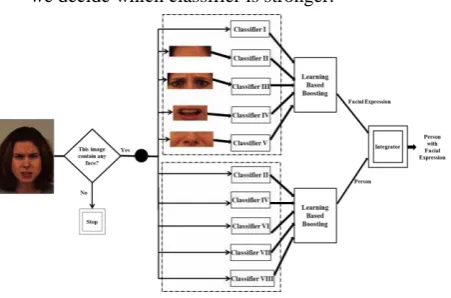
We proposed a Mega Super Classifier where classification is done with the help of multiple classifiers where each classifier works on different characteristics of the input feature. To make an efficient system we used two set of super classifier. The first super classifier contains a set of five different classifiers each of which classifies facial expression irrespective of person and second super classifier comprise another set of five different classifiers including two classifier from the first super classifier where each classifier classifies person irrespective of facial expression. These classifiers are constructed asfollows:
Classifier-I: This classifier use OCA [3,43] clustering to determine mean (central image of each cluster) and standard deviation which are used to train the middle layer unit of MRBFN. With the help of Back propagation network, outputs of RBF network are used to achieve the desireoutput.
Classifier-II: This classifier use the modified OCA (MOCA) [2,3] to learn a set of mean and standard deviation of the clusters formed. In this learning stage intra cluster distance and inter cluster distance are suitably adjusted by the system to reach the separation between cluster and separation within cluster ratio maximum. By following this criterion we can minimize the chances of overlapping of clusters. With these mean and standard deviation MRBFN classifier classifies the corresponding class label.
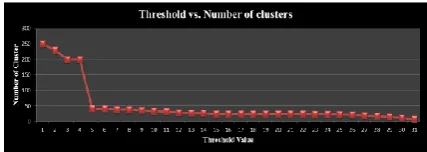
Classifier-III: At first stage of this classifier, Unsupervised OCA (UOCA) [2,3] clustering is used for grouping of ―person-expression‖ pattern. In UOCA, the system spontaneously examines for the suitable intra-cluster distance. This clustering system plot a graph for Threshold vs. Number of clusters formed (shown in Fig. 1) and from this graph the system searches for first saturation region, which will have the maximum number of clusters and last saturation region which contain optimum number of cluster. Like other clustering technique, this clustering also returns a set of mean and standard deviation which are used to train the
MRBFN classifier.
Figure 1. Graph of Threshold value vs. Number of clusters formed
Classifier-IV: In this classifier HBC [6,7] clustering is used as the first stage of learning to learn a set of mean and standard deviation among pattern points. Here, the system automatically finds the intra cluster similarity which varies from cluster to cluster. Now training MRBFN classifier is performs with this information.
Classifier-V: Here, UMOCA [2,4] clusteringis used to learn mean and standard deviation of each cluster formed. In UOCA clustering by maximizing the ratio of separation between cluster and separation within cluster, we build the idea of UMOCA clustering technique. Using these mean and standard deviation MRBFN Classifier are train to predict class label.
Classifier-VI: This classifier builds some ruleusing knowledge [21, 22] of a human being. According to a human being every face contains two similar eyebrows, two similar eyes within certain distance, a nose and a mouth. Relative position and size of these features are almost same for a particular person. This classifier is widely used in upright face identification. To make it general, we incorporate knowledge of side view faces by extracting nostril points, middle point of completely visible eye, furthest point of ear, middle point of mouth and their relative position. Classifier -VII: This is a feature invariant classifier
where faces are recognized through skin color at image pre-processing level. Due to color complexion are largely varies from person to person, we store the blue difference component, Cb and red difference component, Cr information from a transformed YCbCr color image. During testing Cb and Cr component are extracted from a test input and compared with stored information to find a match based on the Euclideandistance. Classifier -VIII: This is another featureinvariant
Classifier-II, Classifier-IV, Classifier-VI, Classifier-VII and Classifier-VIII to identify a person from facial image. These two set of super classifier are integrated to form Mega Super classifier. After training of these two set of super classifier when we test with a test input we get 10 possible output from these two set of super classifier. We have to consider any one output from each of this two super classifier. To combine these decisions when these two set of super classifier are completely learned the learning based boosting technique [9] is used. In learning based boosting technique, the input features are again passed to these trained super classifiers to learn weight of each classifier in super classifier. In this learning technique weights are incremented and updated for that classifier only which agrees with the decision of most of the classifier and weight of rest of the classifier remain unchanged. After updating, each time normalize the weights of each classifier in a super classifier to restrict the total weights of each super classifier to a constant value.
IV. OVERVIEW OF THE PROPOSED WORK
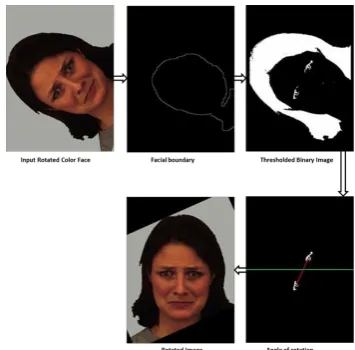
We proposed a Mega Super classifier to identify a person and their facial expression where one set of super classifier is used to identify facial expression and another set of super classifier is used to identify a person from a single color facial image. In both cases at image pre-processing stage at first only face portions are extracted using skin color feature. Then to classify facial expression most expressive facial parts are extracted [24]. Extraction of facial feature of a sad facial expression is shown in Fig. 2. Fig. 3 shows the steps to perform rotation of a rotated facial image. The proposed scheme is demonstrated in Fig. 4. The overview of the proposed system is described asfollows:
IMAGE PRE-PROCESSINGSTEPS
As we know, the most expressive area is located at forehead, eyes, eyebrows, nose and lip section in the facial image. We use some simple image pre-processing step, to extract just face portion and gather facial expression information from these areas.
• After bringing the acquire RGB colorimage into YCbCr color space find skin region from blue difference (Cb) and red difference (Cr) chroma components.
• Boundary of the skin area can be obtained by using Robert filter and label connected.
• Now, after detecting eye area extract those image parts within facial boundary
• Compressed the extracted feature images using block based technique with median value to reduce its dimensionality
• Normalize all the compressed images to bring
them into a fixed size to adequate into our classifier
Finally, convert these pre-processed images into 1D column matrix which will be directly apply as input to the different classifiers.
PROCEDURE FOR ROTATING OF A ROTATED IMAGE:
Step 1: at first facial skin boundary is extracted by using labeling connecting component image processing MATLAB function bwlabel().
Figure 2. Image Pre-processor for feature extraction
Step 2: by suitably thresholding, find darkest region in the input color image.
Step 3: now find eye location within facial skin boundary, as we know size of an eye is lesser than mouth size but greater than size of nostril points. Step 4: find angle between two eye and horizontal axis. Step 5: finally re-rotate the input image with obtain angle.
CLASSIFICATIONS
Classification of person and their facial expression are performed using a Mega Super classifier comprised of two set of super classifier.
we decide which classifier is stronger.
Figure 3. Perform rotation of a rotated facial image
We find weighted sum for each class by summing all product(weight, degree_of_belongingness) of classifiers that agree with that class. Finally, we accept the decision by considering the class for which the weighted sum is maximum. During training for all of these classifier, 1D column matrix of pre-processed ―Person1-Pose1-Expression1‖ to ―Person I-Pose J-Expression K‖ images are supply as input where I is number of person, J is number of pose and K is number of expression used. In our experiment we consider I=5, J=3 (front, left side and right side) and K=5 (neutral, happy, angry, sad and surprise). In clustering layer these input images are group into ―Pose J-Expression K‖ groups irrespective of persons and in classification layer these are further reduced to ―Expression K‖ groups irrespective of poses.
Similarly, in second set of super classifier, 1D column matrix of the pre-processed face portion are pass to the five different classifiers which are Classifier II, Classifier IV, Classifier VI, Classifier VII and Classifier VIII. During training of Classifier II and Classifier IV, in clustering layer ―Person I-Pose J-Expression K‖ images are group into ―Person I-Pose J‖ irrespective of expressions and in classification layer ―Person I-Pose J‖ groups are reduced to ―Person I‖ group irrespective of poses.But, Classifier VI, Classifier VII and Classifier VIII classifies on the basis of best match
strategy with stored information using Euclidean distance.By combining decisions of these five classifiers we obtain person as class label. Finally, facial expression and person class are integrated to form Mega Super classifier’s output.
Once learning of Mega Super classifier is completed, we pass different test image set to construct different fuzzy confusion matrix with the incremental value mentioned in Table 1. Different types of classifier used in Mega Super Classifier are shown in Table2.
Table 1. INCREMENTAL CONSTRUCTION OF FUZZY CONFUSION MATRIX
Actual Class
Extremely Highly Probable
Extremely Highly
Probable +5
Highly Probable +4
Moderately probable +3
Fairly Probable +2
Least probable +1
Table 2. TYPE OF CLASSIFIER USED IN THE PROPOSED SYSTEM
Classifier Type
Classifier Name Classifier Techniques
First Super Classifier
Classifier I OCA based RBFN Classifier II MOCA based RBFN Classifier III UOCA based RBFN Classifier IV HBC based RBFN Classifier V UMOCA based RBFN
Second Super Classifier
Classifier II MOCA based RBFN Classifier Classifier IV HBC based RBFN Classifier VI Knowledge-based
Classifier VII Skin color based classifier Classifier VIII Histogram based Classifier
Figure 4. Block Diagram of proposed method
V. EXPERIMENTAL RESULTS
The performance evaluation of our proposed system is done through a system with Intel® Core™ 2 Duo CPU [email protected] GHz, 4GB RAM, 32-bit Operating system and KDEF [10] facial expression database. In this system to train our Mega Super classifier we used five different faces each of which have fivedifferent expressions and three different pose each with three variations as a total of 225
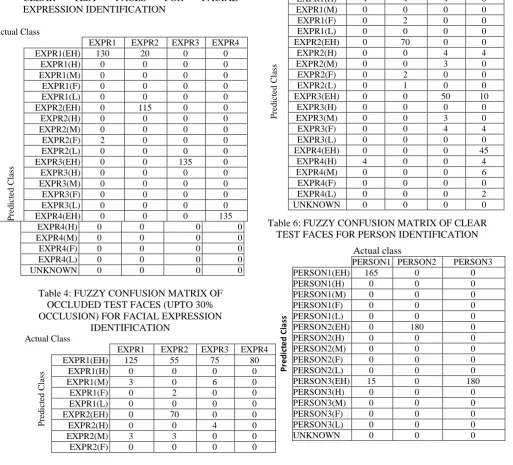
training instance. Due to unavailability of different types of faces (as required by our experiment) in standard dataset we made slight variation of the dataset to form the training and test dataset. We also made a rotated image set (Clockwise or anti clockwise 2D in-plane rotation), partially occluded image set (by varying invisibility portion from 1%- 60%),and multi-frame image set (containing multiple different types of faces at different location in a single image frame) as test dataset. These test dataset are used to measure the performance of our system which is not introduced during training time. Experimental results for 3 persons with 4 expressions are displayed in Table 3 to
Pr
ed
ic
te
d
C
la
Table 11 in terms of accuracy, precision, recall and F-Score. In Table 3, 4, 5, and 10, EXPR1, EXPR2, EXPR3, EXPR4 indicates expression 1, expression 2, expression 3, expression 4 respectively and UNKNOWN indicates undefined expression. Table 3 to Table 5 shows the complete fuzzy confusion matrix for facial expression and Table 6 to Table 8 shows the complete fuzzy confusion matrix for face identification. In Table 3 to Table 8, the parenthetical EH, H, M, F, L interprets Extremely Highly probable, Highly probable, Moderately probable, Fairly probable, and Least probable respectively. Fig. 5 shows sample multiple image frames. In Fig. 6 and Fig. 8 graph of facial expression and face recognition accuracy versus percentage of occlusion is shown. In Fig. 7 and Fig. 9 graph of facial expression and face recognition accuracy versus different occluded portions isshown.
Table 3: FUZZY CONFUSION MATRIX OF
CLEAR TEST FACES FOR FACIAL
EXPRESSION IDENTIFICATION
Actual Class
Pr
ed
ic
te
d
C
la
ss
EXPR1 EXPR2 EXPR3 EXPR4
EXPR1(EH) 130 20 0 0
EXPR1(H) 0 0 0 0
EXPR1(M) 0 0 0 0
EXPR1(F) 0 0 0 0
EXPR1(L) 0 0 0 0
EXPR2(EH) 0 115 0 0
EXPR2(H) 0 0 0 0
EXPR2(M) 0 0 0 0
EXPR2(F) 2 0 0 0
EXPR2(L) 0 0 0 0
EXPR3(EH) 0 0 135 0
EXPR3(H) 0 0 0 0
EXPR3(M) 0 0 0 0
EXPR3(F) 0 0 0 0
EXPR3(L) 0 0 0 0
EXPR4(EH) 0 0 0 135
EXPR4(H) 0 0 0 0
EXPR4(M) 0 0 0 0
EXPR4(F) 0 0 0 0
EXPR4(L) 0 0 0 0
UNKNOWN 0 0 0 0
Table 4: FUZZY CONFUSION MATRIX OF OCCLUDED TEST FACES (UPTO 30% OCCLUSION) FOR FACIAL EXPRESSION
IDENTIFICATION Actual Class
Pr
ed
ic
te
d
C
la
ss
EXPR1 EXPR2 EXPR3 EXPR4
EXPR1(EH) 125 55 75 80
EXPR1(H) 0 0 0 0
EXPR1(M) 3 0 6 0
EXPR1(F) 0 2 0 0
EXPR1(L) 0 0 0 0
EXPR2(EH) 0 70 0 0
EXPR2(H) 0 0 4 0
EXPR2(M) 3 3 0 0
EXPR2(F) 0 0 0 0
EXPR2(L) 0 0 0 0
EXPR3(EH) 0 0 30 0
EXPR3(H) 0 0 0 0
EXPR3(M) 0 0 3 0
EXPR3(F) 0 0 4 0
EXPR3(L) 0 0 0 0
EXPR4(EH) 0 0 0 50
EXPR4(H) 0 0 0 4
EXPR4(M) 0 0 0 0
EXPR4(F) 0 0 0 0
EXPR4(L) 0 0 0 0
UNKNOWN 0 0 0 0
Table 5: FUZZY CONFUSION MATRIX OF ROTATED TEST FACES(ROTATION FROM -25 DEGREES TO +25 DEGREES) FOR FACIAL EXPRESSION IDENTIFICATION
Actual Class
Pr
ed
ic
te
d
C
la
ss
EXPR1 EXPR2 EXPR3 EXPR4
EXPR1(EH) 125 50 65 40
EXPR1(H) 4 4 4 0
EXPR1(M) 0 0 0 0
EXPR1(F) 0 2 0 0
EXPR1(L) 0 0 0 0
EXPR2(EH) 0 70 0 0
EXPR2(H) 0 0 4 4
EXPR2(M) 0 0 3 0
EXPR2(F) 0 2 0 0
EXPR2(L) 0 1 0 0
EXPR3(EH) 0 0 50 10
EXPR3(H) 0 0 0 0
EXPR3(M) 0 0 3 0
EXPR3(F) 0 0 4 4
EXPR3(L) 0 0 0 0
EXPR4(EH) 0 0 0 45
EXPR4(H) 4 0 0 4
EXPR4(M) 0 0 0 6
EXPR4(F) 0 0 0 0
EXPR4(L) 0 0 0 2
UNKNOWN 0 0 0 0
Table 6: FUZZY CONFUSION MATRIX OF CLEAR TEST FACES FOR PERSON IDENTIFICATION
Actual class
PERSON1 PERSON2 PERSON3
PERSON1(EH) 165 0 0
PERSON1(H) 0 0 0
PERSON1(M) 0 0 0
PERSON1(F) 0 0 0
PERSON1(L) 0 0 0
PERSON2(EH) 0 180 0
PERSON2(H) 0 0 0
PERSON2(M) 0 0 0
PERSON2(F) 0 0 0
PERSON2(L) 0 0 0
PERSON3(EH) 15 0 180
PERSON3(H) 0 0 0
PERSON3(M) 0 0 0
PERSON3(F) 0 0 0
PERSON3(L) 0 0 0
UNKNOWN 0 0 0
Pr
e
di
ct
e
d
C
la
Table 7: FUZZY CONFUSION MATRIX OF OCCLUDED TEST FACES (UPTO 30% OCCLUSION) FOR PERSON IDENTIFICATION
Actual Class
PERSON1 PERSON2 PERSON3
PERSON1(EH) 35 0 0
PERSON1(H) 4 0 0
PERSON1(M) 0 0 0
PERSON1(F) 0 0 0
PERSON1(L) 0 0 0
PERSON2(EH) 0 95 0
PERSON2(H) 0 0 0
PERSON2(M) 0 0 0
PERSON2(F) 0 0 0
PERSON2(L) 0 0 0
PERSON3(EH) 100 80 175
PERSON3(H) 4 4 4
PERSON3(M) 9 0 0
PERSON3(F) 8 0 0
PERSON3(L) 0 0 0
UNKNOWN 0 0 0
Table 8: FUZZY CONFUSION MATRIX OF ROTATED TEST FACES (ROTATION FROM -25
TO +25 DEGREE) FOR PERSON IDENTIFICATION
Actual Class
PERSON1 PERSON2 PERSON3
PERSON1(EH) 125 0 0
PERSON1(H) 4 0 0
PERSON1(M) 6 0 0
PERSON1(F) 0 0 0
PERSON1(L) 0 0 0
PERSON2(EH) 0 80 0
PERSON2(H) 0 0 0
PERSON2(M) 0 3 0
PERSON2(F) 2 0 2
PERSON2(L) 0 0 0
PERSON3(EH) 25 75 170
PERSON3(H) 4 8 0
PERSON3(M) 3 6 3
PERSON3(F) 0 0 0
PERSON3(L) 0 0 0
UNKNOWN 0 0 0
Table 9: ACCURACY OF DIFFERENT TYPES OF FACES FOR PERSON AND FACIAL EXPRESSION
IDENTIFICATION
Accuracy (in %)
Type of Images
Facial Expression
Person Identification
Clear Faces 95.9032 97.2222
Occluded Faces (upto 30%
occlusion) 56.4797 60.4247
Rotated Faces 61.9607 75.7751
Table 10: PRECISION, RECALL AND F-SCORE OF DIFFERENT TYPES OF FACES FOR FACIAL
EXPRESSION IDENTIFICATION
Type of Images
Performanc e metric
Facial Expression Identification EXPR1 EXPR2 EXPR3 EXPR4
Clear Faces
Precision 0.8709 1 1 1
Recall 1 0.8846 0.9605 1
F-score 0.9309 0.9387 0.9798 1
Occluded Faces
Precision 0.3699 0.9125 1 1 Recall 0.9771 0.5615 0.3033 0.403
F-score 0.5367 0.6952 0.4654 0.5745
Rotated Faces
Precision 0.4387 0.8690 0.8028 0.9344 Recall 0.9699 0.5658 0.4285 0.4956 F-score 0.6042 0.6854 0.5588 0.6477
Table 11: PRECISION, RECALL AND F-SCORE OF DIFFERENT TYPES OF FACES FOR PERSON
IDENTIFICATION
Type of Images
Performance metric
Person Identification PERSON
1
PERSON2 PERSON 3
Clear Faces
Precision 1 1 0.9231
Recall 0.9167 1 1
F-score 0.9565 1 0.96
Occluded Faces
Precision 1 1 0.4661
Recall 0.2437 0.5307 1 F-score 0.392 0.6934 0.6359
Rotated Faces
Precision 1 0.9540 0.5884
Recall 0.7988 0.4825 0.9885 F-score 0.8881 0.6409 0.7377
Sample multiple image frames and sample output are shown below.
Input the folder for evaluation:test_multiple2
Pr
ed
ic
te
d
C
la
ss
Pr
ed
ic
te
d
C
la
Figure 5 Sample multiple image frame set
In Location (51.00,859.00) person=3 with Extremely Highly Probable: with Extremely Highly Probable Angryexpression
In Location (88.00,425.00) person=3 with Extremely Highly Probable: with Extremely Highly Probable Happyexpression
In Location (142.00,1208.00) person=3 with Extremely Highly Probable: with Extremely Highly Probable Surpriseexpression
In Location (168.00,76.00) person=2 with Extremely Highly Probable: with Extremely Highly Probable Surpriseexpression
In Location (481.00,749.00) person=1 with Extremely Highly Probable: with Extremely Highly Probable Angryexpression
In Location (588.00,190.00) person=2 with Extremely Highly Probable: with Extremely Highly Probable Sadexpression
In Location (697.00,1292.00) person=1 with Extremely Highly Probable: with Extremely Highly Probable Angryexpression
In Location (844.00,565.00) person=3 with Extremely Highly Probable: with Fairly Probable Angry expression
Figure 6 Facial expression identification accuracy vs. percentage of occlusion
Figure 7 Facial expression identification accuracy vs. occluded portions
Figure 8 Person identification accuracy vs. percentage of occlusion
Figure 9 Person identification accuracy vs. occluded portions
From these results and graphs it is clear that the decision combination and use of fuzzy confusion matrix increase theperformance of our system.With this method, the system gains up to 95.9% facial expression recognition accuracy and 97.22% face identification accuracy. In case of partially occluded faces the system can identify 56.47% facial expression and 60.42% faces accurately up to 30% occlusion in facial images. Performance are degrades drastically if occlusion parts are mostly covers in forehead, nose, chin and mouth area. The system works well for rotated images with -25 to +25 degree in- plane 2D rotation. But for arbitrary rotation the system can identify only 28.21% facial expression and 44.76% faces accurately. The system takes about 483.97 seconds to learn 225 facial images on an average for identifying both faces and itsexpression.
VI. CONCLUSION
and its facial expression identification with help of fuzzy confusion matrix is effective and morereliable.
REFERENCES
[1] P. Ekman and W. V. Friesen, ―Facial Acton Coding System‖, Investigators Guide, Consulting Psychologists Press, 1978 [2] G. Sarker, S. Dhua, M. Besra, ―An Optimal Clustering for
Fuzzy Categorization of Cursive Handwritten Text with Weight Learning in Textual Attributes‖, IEEE 2nd International Conference on Recent Trends in Information Systems (RETIS-2015), pp. 6-11.
[3] D. Bhakta and G. Sarker, ―A Method of Learning Based Boosting in Multiple Classifier for Color Facial Expression Identification‖, 2015 IEEE 2nd International Conference on Recent Trends in Information Systems (ReTIS), 2015, pp. 319-324
[4] G. Sarker, ―An Unsupervised Natural Clustering with Optimal Conceptual Affinity‖, Journal of Intelligence System, 2010, 19(3), pp. 289-300
[5] D. Bhakta and G. Sarker, ―An Unsupervised OCA based RBFN for Clear and Occluded Face Identification‖, First International Conference on Intelligent Computing & Applications 2014 (ICICA 2014), Springer, Advances in Intelligent Systems and Computing, 2014, pp. 19-25 [6] G. Sarker, ―A Heuristic Based Hybrid Clustering for Natural
Classification‖, IJCITAE International Journal of Computers Information Technology and Engineering, 2007, 1(2), pp. 79–86
[7] G. Sarker and S. Sharma, ―A Heuristic Based RBF Network for Location and Rotation Invariant Clear and Occluded Face Identification‖, International Conference on Advances in Computer Engineering and Application, ICACEA-2014, with IJCA, pp. 30-36
[8] D. Lundqvist, A. Flykt and A. Öhman, ―The Karolinska Directed Emotional Faces – KDEF‖, CD ROM from Department of Clinical Neuroscience,Psychology section, Karolinska Institutet, ISBN 91-630-7164-9, 1998.
[9] D. Bhakta and G. Sarker, ―A Multiple Classifier System with Learning based Boosting for Clear and Occluded Color Face Identification‖, American Journal of Advanced Computing, 2014, 1(2), pp. 54-59
[10] Marsico, M., D., Nappi, M., and Riccio, D.; FARO: FAce Recognition Against Occlusion-sand Expression Variations, IEEE Transactions On Systems, Man, And Cybernetics— Part A: Systems And Humans, 40(1), (2010) pp. 121-132. [11] S. Chintalapati, M. V. Raghunadh, ―Illumination, Expression
and Occlusion Invariant Pose-Adaptive Face Recognition System for Real-Time Applications‖, International Journal of Engineering Trends and Technology (IJETT) – Volume 8 Number 6- Feb 2014, pp. 292-298.
[12] Lone, Manzoor Ahmad, S. M. Zakariya, and Rashid Ali. "Automatic face recognition system by combining four individual algorithms." In Computational Intelligence and Communication Networks (CICN), 2011 International Conference on, pp. 222-226. IEEE, 2011.
[13] L. Ma and K. Khorasani, ―Facial Expression Recognition Using Constructive Feed forward Neural Networks‖, IEEE Transactions On Systems, Man, And Cybernetics—Part B: Cybernetics, 2004, 34(3), pp. 1588-1595
[14] M. Najafi and M. Jamzad, ―A Solution of Combining Several Classifiers for Face Recognition‖, Proceedings of the World Congress on Engineering and Computer Science 2007, WCECS 2007, October 24-26, 2007
[15] H. S. Devi, D. M. Thounaojam and R. Laishram, ―An Approach to Illumination and Expression Invariant Multiple Classifier Face Recognition‖, International Journal of Computer Applications (0975 – 8887), Volume 91 (15), April 2014, pp. 34-37
[16] M. Pantic and M. J. L. Rothkrantz, ―Facial Action Recognition for Facial Expression Analysis From Static Face Images‖, IEEE Transactions on Systems, Man, and Cybernetics—Part B: Cybernetics, 2004, 34(3), pp. 1449-1461
[17] Kotsia, I., Buciu, I. and Pitas, I., 2008. An analysis of facial expression recognition under partial facial image occlusion. Image and Vision Computing, 26(7), pp.1052-1067.
[18] J. Kalita and K. Das, ―Recognition of Facial Expression Using Eigenvector Based Distributed Features and Euclidean Distance Based Decision Making Technique‖, (IJACSA) International Journal of Advanced Computer Science and Applications, 2013, 4(2), pp. 196-202
[19] S. Mahto, Y. Yadav, ―Effectual Approach for Facial Expression Recognition System‖, International Journal of Advanced Research in Computer and Communication Engineering, Vol 4(3), pp. 229-232, 2015.
[20] Taheri, S., Patel, V.M. and Chellappa, R., 2013. Component-based recognition of facesand facial expressions. IEEE Transactions on Affective Computing, 4(4), pp.360-371.
[21] Hazar Mliki · Emna Fendri · Mohamed Hammami, ―Face Recognition Through Different Facial Expressions‖, J Sign Process Syst (2015) 81:433–446, DOI 10.1007/s11265-014-0967-z. [22] M. A. Martinez, C. A. Kak, ―PCA versus LDA‖, IEEE Transactions
on Pattern Analysis and Machine Intelligence, 2001, 23(2), pp. 228-233
[23] H.M. Yang, J. D. Kriegman and N. Ahuja, ―Detecting Faces in Images: A Survey‖, IEEE Transactions On Pattern Analysis and Machine Intelligence, 2002, 24(1)
[24] M. Hamouz, J. Kittler, K. J. Kamarainen, P. Paalanen, H. l. Ka and J. Matas, ―Feature-Based Affine-Invariant locaization of Faces‖, IEEE Transactions on Pattern Analysis and Machine Intelligence, 2005, 27(9), pp. 1490-1495.
[25] Sarker, G.(2000),A Learning Expert System for Image Recognition, Journal of The Institution of Engineers (I), Computer Engineering Division.,Vol. 81, 6-15.
[26] G. Sarker(2002), SELECTWIN – A New K-WTA Optimal Learning Technique for Pattern Classification and Recognition, Journal of The Institution of Engineers(I), Computer Engineering Division.,Vol. 83, 16 – 21.
[27] G. Sarker(2010),A Probabilistic Framework of Face Detection , International Journal of Computer, Information Technology and Engineering (IJCITAE),4(1), 19-25.
[28] G. Sarker(2011),A Multilayer Network for Face Detection and Localization, International Journal of Computer, Information Technology and Engineering (IJCITAE), 5(2), 35-39.
[29] G. Sarker(2012),A Back Propagation Network for Face Identification and Localization, International Journal of Computer, Information Technology and Engineering (IJCITAE),6(1), 1-7.
[30] G. Sarker(2012), An Unsupervised Learning Network for Face Identification and Localization, International Journal of Computer, Information Technology and Engineering
(IJCITAE),6(2), 83-89.
[31] G. Sarker and K. Roy (2013), A Modified RBF Network With Optimal Clustering For Face Identification and Localization, International Journal of Advanced Computational Engineering and Networking, ISSN: 2320- 2106.,1(3), 30 -35.
[32] G. Sarker and K. Roy(2013), An RBF Network with Optimal Clustering for Face Identification, Engineering Science International Research Journal (ISSN) – 2300 – 4338 ,1(1),ISBB: 978-93-81583-90-6, 70-74.
[33] G. Sarker(2013), An Optimal Back Propagation Network for Face Identification and Localization, International Journal of Computers and Applications (IJCA),ACTA Press,
Canada.,35(2).,DOI 10.2316 / Journal .202.2013.2.202 – 3388. [34] G. Sarker(2014), A Competitive Learning Network for Face
Detection and Localization, International Journal of Computer Information Technology and Engineering (IJCITAE), Serials Publications, 8(2),119-123.
[35] G. Sarker(2002), A Semantic Concept Model Approach for Pattern Classification and recognition, 28th Annual Convention and Exhibition IEEE – ACE 2002.,December 20-21 2002 , Science City ,Kolkata, 271 – 274.
Congress, organized by The Institution of Engineers (India), December 15-18, 2005, Kolkata, INDIA, paper no. 4.
[37] G. Sarker(2011), A Back propagation Network for Face Identification and Localization, 2011 International Conference on Recent Trends in Information Systems (ReTIS–2011) held in Dec. 21-23, Kolkata, DOI: 10.1109/ReTIS.2011.6146834, pp 24-29.
[38] G. Sarker(2012), An Unsupervised Learning Network for Face Identification and Localization, 2012
International Conference on Communications, Devices and Intelligent Systems (CODIS) Dec. 28 and 29, 2012, Kolkata, DOI: 10.1109/CODIS.2012.6422282, pp 652-655.
[39] G. Sarker, and K. Roy(2013), An RBF Network with Optimal Clustering for Face Identification, International Conference on Information & Engineering Science – 2013(ICIES -2013), Feb. 21-23 2013,
organized by IMRF, Vijayawada, Andhra Pradesh, pp – 70-74.
[40] G. Sarker and K. Roy(2013), A Modified RBF Network with Optimal Clustering for Face Identification and Localization, International Conference on Information & Engineering Science – 2013(ICIES -2013), Feb. 21-23 2013, organized by IMRF, Vijayawada, Andhra Pradesh pp 32-37. [41] K. Roy and G. Sarker (2013), A Location Invariant Face
Identification and Localization with Modified RBF Network, International Conference on Computer and Systems ICCS-2013, 21-22 September, 2013, pp – 23-28, Bardhaman.