Android Based Fall Detection Alert System
using Multi-Sensor
Neha R. Singh¹, P.R. Rothe², A. P. Rathkanthiwar³
¹
Mtech Student in Electronics department VLSI design²Professor in Electronics department ³Professor in Electronics department Priyadarshini college of engineering, Nagpur
Maharashtra, INDIA
Abstract— An enhanced fall detection system is
proposed for elderly person monitoring that is based on-body sensor operating through consumer home networks. The on-body sensor which consists of accelerometer and cardiotachometer is used in this model. In this proposed system accelerometer measures overall vibration by means of using Signal Magnitude Vector and trunk angle. Here Signal Magnitude Vector is used to calculate the acceleration caused due to movement of the body with respect to xyz axis and trunk angle is used to calculate the posture of the elderly person during fall event. Cardio tachometer is used to measure the pulse rate. A typical fall event ends with the person lying on the ground or leaning on walls, or furniture that will cause a significant change in trunk angle. In this case, it is desirable to consider changes on the trunk angle to detect whether the detected acceleration was due to a fall event. The set values of acceleration and pulse provides accuracy to the system avoiding false detection. By utilizing information gathered from an accelerometer, cardiotachometer and smart sensors, the impacts of falls can be logged and distinguished from normal daily activities. This system is connected to GPS and GSM for communication purpose which is unique. When the fall is detected the GPS locates the exact fall location and GSM modem is used to transmit the message to the mobile phone of caretakers/relatives of the fallen subjects at that time also send their latitude and longitude value by using GPS.. This alert message helps to provide immediate assistance and treatment.
Keywords — Wireless Sensor Networks, Fall Detection System, Global Positioning System Accelerometer, Cardiotachometer
I. INTRODUCTION
In recent years, many types of consumer electronic devices have been developed for home network applications. A consumer home
network
usually contains various types of electronic devices like sensors and actuators, so that home users can control them in an intelligent and automatic way to improve their quality of life. Some representative technologies to implement a home network are Ultra Wide Band, Bluetooth and accelerometer.Accelerometer is suitable for consumer home networks because various sensors can be deployed to collect home data information in a distributed, self-organizing manner with relatively low power. The structure of projected fall detection system core structure relies on a Micro programmed Controller Unit (MCU). The cardio tachometer and accelerometer are integrated on one single board, recording real time acceleration and heart beat. Each acceleration and heart beat information is first captured by analog-to-digital converter (ADC). Then, the digital signal is transmitted to the MCU for any process. The system is complemented with a customer interface designed to watch information in period. This system is designed such that it can help the elder persons who are residing in the house. Global Positioning System consists of a constellation of 21 satellites orbiting the earth every 12 hours at a height of approximately 10,900 nautical miles. Six orbital planes contain four satellites each and have an angle of inclination of 55 degrees with respect to the plane of the earth's equator. Control of the system is aided by five globally located monitoring stations. These stations continuously evaluate the system's performance and upload timing and health data which is then rebroadcast to the user.
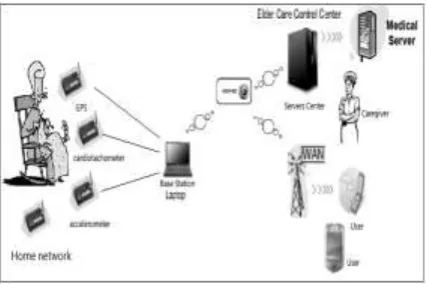
Fig 1. System architecture using the consumer wireless sensor network.
We will develop a network which contains accelerometer and Cardiotachometer and a bluetooth interface. This hardware will be connected to the smart phone via bluetooth in case of any disruptions in the reading of accelerometer or heart rate the hardware will communicate the readings via bluetooth to the android phone that will communicate these values directly to the doctor and the family members via GSM and GPRS also sending the location of the person. Fig.1 example of safety alert architecture. This paper proposes the new model by using advanced modern technology to detect the fall and also continuously monitoring the elderly person in various levels. And also when the fall is detected GPS is used to track the exact location of elderly person.
II. RELATED WORK
Modern technologies are equipped with different sensing devices such as accelerometers, gyroscopes, and magnetometers. The accelerometer (also called inertial sensor or G-sensor) can measure the proper acceleration felt by the sensors, and can have many applications on gesture based interactions with smart phone such as automatic screen rotation. This study focus on the advanced technologies to help elderly person and detect the fall by various ways.
With the purpose to successfully detect falls, there are different types of fall detection methods for elderly people, namely wearable device based methods, vision based methods, and ambient based methods. The literature reviewed provides evidence of the lack of a common approach. Noury et al. [3] classify the different studies on fall detection according to whether they only focus on the detection of the impact shock, or they also include the detection of the post fall phase. Zhang, Ren and Shi [1] proposed HONEY (Home healthcare sentinel system), a three-step detection scheme which consisted of an accelerometer, audio, image and video clips. Its innovation was to detect falls by leveraging a triaxial accelerometer, speech
recognition, and on-demand video. Bagalà et al. [2] gave an evaluation of accelerometer-based fall detection algorithms on real-world falls. They found that the sensitivity and specificity on real falls are much lower than that in an experiment environment. This inspires researchers to take more real world scenarios into consideration. Abbate et al. [4], [5] proposed a smartphone based fall detection system with consideration of the acceleration signal produced by fall-like activities of daily lives.
Yu et al. [6] proposed a vision based fall detection method by applying background subtraction to extract the foreground human body and post processing to improve the result. Sazonov et al [7] developed an in-shoe pressure and acceleration sensor system that was used to classify activities including sitting, standing, and walking with the ability of detecting whether subjects were simultaneously performing arm reaching movements.
Recent advances in smart phone technology have led to their use in fall detection systems. Often, these systems combine fall detection with localization of the person who fell via a GPS-based method [8,9]. Yavuz et al [10] developed a fall detection system that relied upon the accelerometers available in smart phones and incorporated different algorithms for robust detection of falls. WEALTHY [11], led to the development of garment-based wearable sensors aiming at general health monitoring of people in the home and community settings.
III. PROPOSED RESEARCH METHODOLOGY
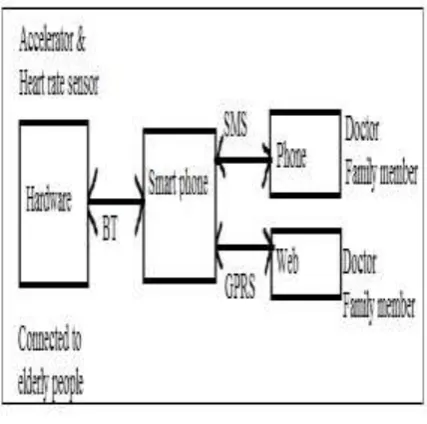
person. Fig. 2 shows block diagram of safety alert system.
Fig. 2 Block Diagram of Safety Alert System
Here, we will be interfacing a hardware with Bluetooth and sensors like accelerometer and heart rate sensor. The Bluetooth connection will be done on the Android based phone, which will inform the Doctor and the family members in case of any emergency. The hardware will be connected to the smart phone via bluetooth. The hardware will communicate the readings via bluetooth to the android phone & the android phone will communicate these values directly to the doctor & the family members via GSM or GPRS. This will happen so quickly that in just one hop everyone is informed about the health condition of the elderly person.
An instrument for measuring the acceleration of a moving or vibrating body is called n accelerometer. By using android development tool we can make the application which will show the measure of accelerometer.
The proposed system works as mentioned below. The wearer will wear the smart locator band. Then, a safe zone is defined or set by the caregiver for safety of wearer. The device will continuously monitor the latest location of the wearer, generate an SMS alert, and give birth to the possibility of two conditions: (a) whether the wearer enters or leaves the secure zone;
(b) whether there is an emergency situation or not. When the wearer crosses the safe zone, then SMS notification will be sent as shown in fig. 3; otherwise it will not be sent. When an emergency situation is noticed then wearer presses emergency button S1 for calling and S4 for sending location via SMS as shown in Fig. 3 and Fig. 4.
Fig. 3 SMS notification
Fig. 4 Location of elderly people
IV. HARDWARE DESCRIPTIONS
A. GSM Technology:
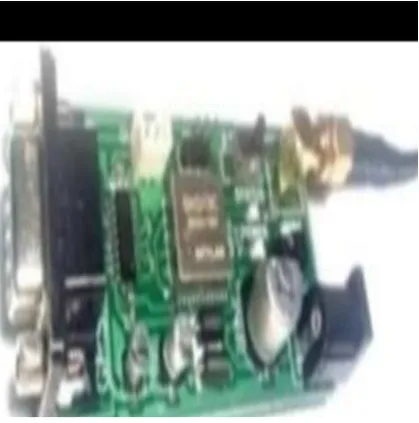
Fig. 5 GSM Module
B. GPS Technology:
The GPS is based on a global navigation satellite system to determine speed, position, direction, and time. It utilizes a constellation of 24/32 active satellites in Earth orbit that transmit an accurate microwave signal and enable GPS receiver. A GPS receiver needs at least three or four satellites to calculate the distance and figure out its two dimensions, that is, latitude and longitude, or three dimensions, that is, latitude, longitude, and altitude positions. [13] GPS module which works on 3.3V supply. It continuously senses the current position of the wearer and sends it automatically to the microcontroller.
Fig. 6 GPS Module
The control segment constantly monitors the GPS constellation and uploads information to satellites to provide maximum user accuracy. Your GPS receiver collects information from the GPS satellites that are in view. Your GPS receiver accounts for errors. For more information, refer to the Sources of Errors. Your GPS receiver can calculate other information, such as bearing, track, trip distance, and distance to destination, sunrise and sunset time so forth. Your GPS receiver displays the applicable information on the screen.
Fig.7 GPS Working
C. AVR (ATmega8515):
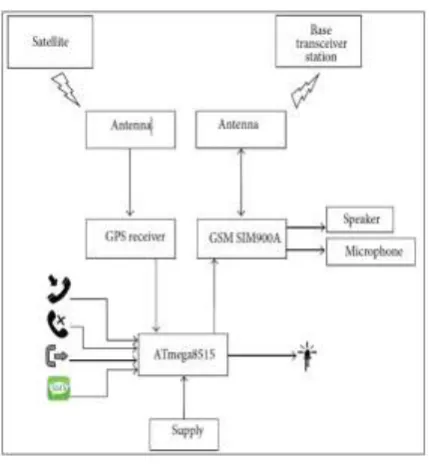
The ATmega8515 belongs to AVR (enhanced RISC architecture) family which is a low power (7.5mW), high performance device as it works at crystal frequency of 4MHz and executes powerful instructions in a single clock cycle (it achieves throughputs approaching 1MIPS per MHz) and In-System Self-Programmable Flash 8-bit microcontroller. It has byte SRAM and 512-byte EEPROM internal memories. It is as well recognized as the centre of this system. It mostly works as an interface between a GPS receiver and GSM module. It has a feature of three power saving modes: idle, power-down, and standby. This microcontroller initiates and sends the wearer’s information, message, and voice calling details to mobile phone through the GSM chip.
D. Monitoring Unit:
towards the coordinates which is the exact current location of the wearer.
Fig. 8 Architecture of Transmitting Unit.
E. Steps to Implement the Proposed System: 1. Give the power supply to the hardware board. 2. Set up the Network and make sure that bluetooth modules are in the network range.
3. Turn on all the sensors.
4. Collect the data from the MEMS accelerometer. 5. Find whether it exceeded the threshold value of the MEMS accelerometer
.
6. If it not Exceeded then check for the temperature threshold value.
7. If the temperature threshold value is exceeded then send message to the relatives. If not go to the step-4.
8. Once MEMS threshold is crossed then check for the Blood pressure threshold.
9. If Blood pressure Threshold is exceeded then send the message to the Ambulance along with the GPS location of the elder person.
10. If Blood pressure is not exceeded then check for the Temperature of the person, if it exceeded then send message to the Relative.
11. If temperature is not exceeded the threshold then go to step-4.
Flow chart:
Fig. 9 Flow chart of the Project
V. WEARABLE DEVICES
They can be defined as miniature electronic sensor-based devices that are worn by the bearer under, with or on top of clothing. The vast majority of wearable fall detectors are in the form of accelerometer devices. Some of them also incorporate other sensors such as gyroscopes to obtain information about the patient’s position. The use of applications based on accelerometers and gyroscopes in gait and balance evaluation, fall risk assessment and mobility monitoring has been actively.
A. Accelerometer attached to the body:
Acceleration data are collected during falls using independent tri-axial accelerometers attached to different parts of the body.
B. Smartphone built-in accelerometer:
Today’s smart phones come with a rich set of embedded sensors, such as an accelerometer, digital compass, gyroscope, GPS, microphone, and camera. [14] Several researchers are currently taking advantage of this fact to develop smart phone based fall detectors.
Fig. 10 Hardware for Alert System
Fig. 10 shows hardware for alert system from which it will read data from sensor and send it over Bluetooth to android phone. The phone will process and give results on screen. Accelerometer is used to detect fall detection and after detecting it will send the data to smart phone n then it will send the message to the family member with location. If we connect the acceleration of the movements with the position of the node worn by the patient, it would be possible to detect the posture of a person. The placement of one or more nodes on the body is the key to differentiate the influences of various fall detection algorithms. It is not possible to neglect the usability aspect, since it strongly affects the effectiveness of the system. [15] A node placed on the head gives an excellent impact detection capability, but more hardware efforts are required to ensure its usability for wearing the node continuously. The wrist is not recommended to be a good position, since it is subject to many high acceleration movements that would increase the number of false positives. The placement at the waist is more acceptable from the user point of the view, since this option fits well in a belt and it is closer to the center of gravity of the body
.
VI. CONCLUSIONS AND FUTURE WORK
In this paper, an enhanced fall detection system based on Wearable device was proposed and implemented that successfully detected accidental
falls in a consumer home application. By using information from an accelerometer, smart sensor and cardiotachometer, the impacts of falls can successfully be distinguished.
Wearable device is completely safe because it is worn on the outside of the body not inside the body. This work is of low cost, very effective, and productive. But there is always room for improvement. This merchandise has been designed as a prototype and requires further developments for using it in assorted applications. This system can be further expended in developing a Windows application which can support windows phone and the wearer device must be small and unobtrusive in the form of compact watch and it should not label people.
ACKNOWLEDGMENT
I take this opportunity to express my profound gratitude and deep regards to my professors ,staff members of department of electronics engineering of Priyadarshini college of engineering Nagpur for their exemplary guidance throughout .
REFERENCES
[1]Q. Zhang, L. Ren, and W. Shi, “HONEY a multimodality fall detection and telecare system,” Telemedicine and
e- Health, vol. 19, no. 5, pp. 415-429, Apr. 2013.
[2] F. Bagalà, C. Becker, A. Cappello, L. Chiari, and K. Aminian, “Evaluation of accelerometer-based fall detection algorithm in real world falls,” PLoS ONE, vol. 7, no. 5, pp. 1-8, May 2012 [3] Noury N, Rumeau P, Bourke AK, OLaighin G, Lundy JE: A proposal for the classification and evaluation of fall detectors. Irbm 2008, 29:340–349.
[4] S. Abbate, M. Avvenuti, F. Bonatesta, G. Cola, P. Corsini, and A.Vecchio, “A smartphone-based fall detection system,” Pervasive and Mobile Computing, vol. 8, no. 6, pp. 883-899, Dec. 2012.
[5] S. Abbate, M. Avvenuti, G. Cola, P. Corsini, J.V. Light, and A.Vecchio, “Recognition of false alarms in fall detection systems,” in Proc. 2011 IEEE Consumer Communications and Networking Conference, Las Vegas, USA, pp. 23-28, Jan. 2011. [6] M. Yu, A. Rhuma, S. Naqvi, L. Wang, and J. Chambers, “A posture recognition-based fall detection system for monitoring an elderly person in a smart home environment,” IEEE Trans. Infor. Tech. Biom., vol. 16, no. 6, pp. 1274-1286, Aug. 2012.
[7] Sazonov ES, Fulk G, Sazonova N, Schuckers S: Automatic recognition of postures and activities in stroke patients. Conf Proc IEEE Eng Med Biol Soc 2009, 2009:2200-2203.
[8]. Sposaro F, Tyson G: iFall: an Android application for fall monitoring and response. Conf Proc IEEE Eng Med Biol Soc 2009, 2009:6119-6122.
[9] Dai J, Bai X, Yang Z, Shen Z, Xuan D: PerFallD: A pervasive fall detection system using mobile phones. IEEE International Conference on Pervasive Computing and Communications Workshops; Mannheim 2010, 292-297.
[10] Yavuz G, Kocak M, Ergun G, Alemdar HO, Yalcin H, Incel OD, Ersoy C: A smart phone based fall detector with online location support. International Workshop on Sensing for App Phones; Zurich, Switzerland 2010, 31-35.
[11] Paradiso R, Alonso A, Cianflone D, Milsis A, Vavouras T, Malliopoulos C: Remote health monitoring with wearable non-invasive mobile system: the health wear project. Conf Proc IEEE Eng Med Biol Soc 2008, 1699-1702.
the False Alarm Rate”, in Proc. 30th Int. IEEE Eng. in Medicine and Bio. Soc. Conference, pp. 4628-4631, Aug.2008.
[13] J. Winkley, P. Jiang, and W. Jiang, “Verity: An Ambient Assisted Living Platform,” IEEE Trans. Consumer Electron., vol. 58, no. 2, pp. 364-373, May 2012.
[14] H.R. Yan, H.W. Huo, Y.Z. Xu, and M. Gidlund, “Wireless sensor network based E-health system: implementation and experimental results,” IEEE Trans. Consumer Electron., vol. 56, no. 4, pp. 2288-2295, Nov. 2010.