Investigation E-waste generation in Chennai City
Udhayakumar. T Dr. K. Prbhakar
SRM university SRM university
Subhashree Ananthraman SRM university
Abstract
The electronic industry is the world’s largest and fastest growing manufacturing industry in the world. Discarded electronic and electrical equipment with all of their peripherals at the end of life is termed as e-waste. The quantity of c-waste generated in developed countries equals 2% of total solid waste on an average with 2011 and is expected to grow to 4% by 2017 and is one of the fastest growing waste streams. E-waste consists of ferrous and nonferrous metals, plastic, glass, ceramics, rubber etc. E-waste is valuable source for secondary raw material but harmful if treated and discarded improperly as it contains many toxic components such as lead, cadmium, mercury, polychlorinated biphenyl etc. The presence of lead, mercury, arsenic, cadmium, selenium and hexavalent chromium and flame retardants beyond threshold quantities in e-waste classifies them as hazardous wastes. The mammoth generation of e-waste has created a new e-waste stream in the country containing obsolete, End of life Electrical and Electronics Equipments discarded after their intended use.
Keywords: E-waste, CFC, CRT
________________________________________________________________________________________________________
I. IDENTIFICATION OF ELECTRONIC WASTE MATERIALS
Organization has identified following electronic items which could be categorised under potential electronic waste, once become useless or nonproductive and/or outdated.
Computers – Desktop/ Laptops Servers
CPU and peripheral devices like monitors, mouse, keyboard, webcam, printers, scanners etc Photo Copiers
Projectors, Plasma screens, LCD Screens Pocket and desk calculators
SIM Cards
Mobile, wireless and wire-line devices/handsets, chargers and batteries wireless and wire-line electronic equipments
BTS, BSC and MSC electronic equipments
Antennae
Air Conditioner Units/ Refrigerators Lighting Equipments
Mobile Charger Stations
Smoke detectors/ fire alarms / Access control devices
Other products and equipments used for the collection, storage, processing, presentation or communication of information by electronic means [4].
E- Waste generation in top 10 states:
S. No States WEEE (Tonnes)
1 Maharashtra 20,270.6
2 Tamil Nadu 13,486.2
3 Andhra Pradesh 12,780.3
4 Uttar Pradesh 10,381.1
5 West Bengal 10,381.1
6 Delhi 9,729.1
7 Karnataka 9,118.7
8 Gujarat 8,994.3
9 Madhya Pradesh 7,800.6
10 Punjap 6,958.5
S. No City WEEE (Tonnes)
1 Mumbai 11,017.1
2 Delhi 9,730.3
3 Bangalore 4,648.4
4 Chennai 4,132.2
5 Kolkata 4,025.3
6 Ahmedabad 3,287.5
7 Hyderabad 2,833.5
8 Pune 2,584.2
9 Surat 1,836.5
10 Nagpur 1,768.9
Source: E-waste Management in India- Consumer Voice, April 2009 [8]
How does e-waste affect human and environment?
E-waste has many hazardous components made up of chemicals and metal like, lead, cadmium, chromium, mercury, polyvinyl chloride (PVC), brominated flame retardants, beryllium, antimony and phthalates.
Long-term exposure to these substances damages the nervous systems, kidney, bones, reproductive and endocrine systems. Some of them are carcinogenic or neurotoxic.
There are number of channels through which e-waste goes to the environment. E-waste that is land filled produces contaminated leachates, which eventually pollute the groundwater.
Acids and sludge obtained from melting computer chips, if disposed on the ground ,cause acidification of soil, leading to contamination of water resources.
Incineration of e-wastes can emit toxic fumes and gases, thereby polluting the surrounding air. Crude forms of dismantling can often lead to toxic emissions, which pollute the air.
The most dangerous form of recycling and recovery from e-waste is the open air burning of printed circuit boards (made of plastic) in order to recover copper and other metals.
Extraction of metals through acid bath method or through mercury amalgamation also contributes to environmental degradation.
Mercury from circuit breakers [13], [15].
II. METHODOLOGY
Strategic objective:
To provide a framework for the development of regulations and policies with the participation of key stakeholders in the sustainable management of e-waste in India
Specific objectives:
To provide guidelines that will enhance environmental protection from e-waste To establish a basis for a policy and regulatory frameworks on e-waste management To raise public awareness on sustainable management of e-waste in India.
Scope:
These guidelines apply to the handling and management of the various categories and elements of e-waste in India. The guidelines provide a clear mechanism for the management of e-waste at various stages in the supply chain, the objective being to ensure the integrity of the environment is assured against the potential adverse impacts of e-waste and its elements.
Purpose:
The purpose of these guidelines is to assist the government, private sector, learning institutions among others to manage e-waste in a manner that enhances environmental conservation.
Overview:
Processing:
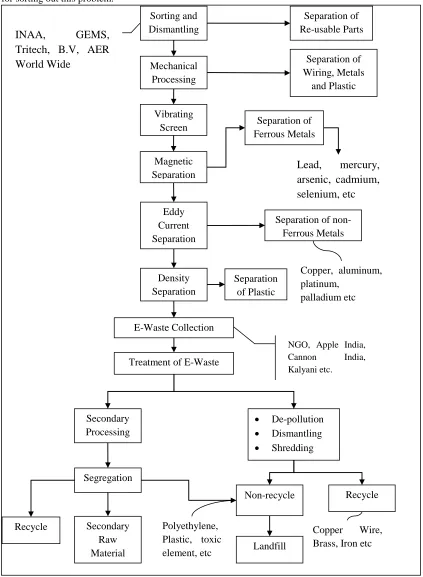
The proposed approach is presenting the 3 level training methodologies for solving the e-waste management issue and it would be nice step for sorting out this problem.
Fig. 1: Overall Process of E-waste Management 1st Level Treatment:
Input: e-waste items like TV, refrigerator and Personal Computers (PC) Unit Operations: There are three units operations at first level of e-waste treatment
1) Decontamination: Removal of all liquids and Gases
Sorting and Dismantling
Separation of Re-usable Parts
Mechanical Processing
Separation of Plastic
E-Waste Collection
Separation of Wiring, Metals
and Plastic
Eddy Current Separation
Vibrating Screen
Recycle
Landfill Secondary
Processing
De-pollution
Dismantling
Shredding Treatment of E-Waste
Separation of Ferrous Metals
Magnetic Separation
Non-recycle Segregation
Secondary Raw Material
Separation of non-Ferrous Metals
Density Separation
Recycle
NGO, Apple India, Cannon India, Kalyani etc.
INAA,
GEMS,
Tritech, B.V, AER
World Wide
Copper Wire, Brass, Iron etc Polyethylene,
Plastic, toxic element, etc
Lead,
mercury,
arsenic, cadmium,
selenium, etc
Copper, aluminum, platinum,
2) Dismantling -manual/mechanized breaking 3) Segregation
All the three unit operations are dry processes, which do not require usage of water.
Decontamination
The first treatment step is to decontaminate e-waste and render it nonhazardous. This involves removal of all types of liquids and gases (if any) under negative pressure, their recovery and storage.
Dismantling
The decontaminated e-waste or the e-waste requiring no decontamination are dismantled to remove the components from the used equipments. The dismantling process could be manual or mechanized requiring adequate safety measures to be followed in the operations.
Segregation
After dismantling the components are segregated into hazardous and nonhazardous components of e-waste fractions to be sent for 3rd level treatment.
Output:
1) Segregated hazardous wastes like CFC, Hg Switches, batteries and capacitors
2) Decontaminated e-waste consisting of segregated non-hazardous E-waste like plastic, CRT, circuit board and cables
DETAILS OF E-WASTE RECYCLING UNITS IN CHENNAI
No. NAME OF THE FIRM ADDRESS
1. M/s. SEZ Recyclers TP-7th, IVth Avenue, Mahindra world City Developers Ltd., Industrial Estate, SEZ Area, Thenmelapakkam Village, Kancheepuram Dt.
2. M/s. Tes-Amm India Pvt. Ltd., Plot No.A-18,SIPCOT Industrial Growth centre, Panruti A1 Village,Sriperampudur Taluk, Kancheepuram Dt.
3. M/s. Ultrust Solution India Pvt. Ltd. Pappanakuppam Village,Gummidipoondi Taluk,Thiruvallur Dt.
4. M/s. Victory Recovery & Recycle
Technologies India Pvt. Ltd., Kottiyur Village, Tiruvallur Taluk & Dt
DETAILS OF E-WASTE DISMANTLING UNITS IN CHENNAI
S.
No. NAME OF THE FIRM ADDRESS
1 M/s. Abishek Enterprises., Ambattur Village & Taluk, Thiruvallur Dt,
2 M/s. AER World Wide(India) Pvt.
Ltd., 774, Elandhncheri, Sadayan Kuppam Village, Manali New Town,Thiruvallur Dt,
3 M/s. B.V. Enterprises. S.F.No 42/1, Perambakkam Road, Thandalam Village, Sriperambatur Taluk, Kancheepuram District.
4 M/s. GEMS RECYCLING PVT
LTD., S.F No.222-3, Plot No.147/A, Neervalur Village, Kancheepuram Taluk&Dt.
5 M/s. Green R2 ReProcessors Pvt
Ltd, Plot No.19,TASS Industrial Estate, Bhansali Chemical Avenue, Ambattur,Chennai-98.
6 M/s. INAA Enterprises. Plot No.AC-31/24,SIDCO Industrial Estate, Thirumudivakkam Village, Sriperumpudur Taluk, Kancheepuram Dt.
7 M/s. Leela Traders., S.F.No41/1, Part Gudalore Village, Chengalpattu Taluk, Kancheepuram Dt.
8 M/s. Shri Raaam Recycling., No.DP-29, Phase IV&V,SIDCO Industrial Estate, Pappakuppam village, Gummidipoondi, Tiruvallur Taluk &District.
9 M/s. Trishyiraya Recycling India
Pvt. Ltd., Plot No. A-7, Phase – I MEPZ - SEZ, Kadaperi Tambaram Taluk, Kanchipuram District.
10 M/s. Tritech Systems, 55 AP 941,66th Street, 11th Sector, KK Nagar, Chennai-78
DETAILS OF E-WASTE COLLECTION CENTERS
S. No NAME & ADDRESS OF INDUSTRY
1
M/s. Apple India Private Ltd., C/o. M/s. Kuehne Nagel India Private Ltd., 41&42, Koduvalli karanai Village, Redhills to Thiruvallur High Road,
Chennai - 55.
2 M/s. Canon India Private Ltd.,
2nd Floor, Wood Head Center, No 23, Sivaganga Road, Nungampakkam, Chennai-34.
3 M/s. Daikin Airconditioning India Pvt Ltd.,
Flat No 1, D Block, Ground Floor, Gemini Parsn Apartments, Door No 599 (Old No 121), Anna Salai, Chennai-600 006.
4 M/s. E Parisaraa Pvt Ltd.,
Plot No 150(Part), Perunkudi Industrial Estate, Perunkudi, Chennai-600 091.
5 M/s. Kalyani Enterprises.,
73, Konnur High Road, Annai Indra Nagar, Ayanavaram, Chennai-600 023.
6 M/s. Param Enterprises.,
Plot No 3, Periyar Salai, Kovilampakkam, Chennai-600 117.
7 M/s. Schenker India Private Ltd., C/o. M/s. Lenova India Pvt Ltd.,
2nd Level Treatment:
Input:
Decontaminated E-waste consisting segregated non-hazardous e-waste like plastic, CRT, circuit board and cables.
Unit Operations:
There are three unit operations at second level of E-waste treatment 1) Hammering
2) Shredding
3) Special treatment Processes comprising of
1) CRT treatment consisting of separation of funnels and screen glass. 2) Electromagnetic separation
3) Eddy current separation 4) Density separation using water
Process:
The two major unit operations are hammering and shredding. The major objective of these two unit operations is size reduction. The third unit operation consists of special treatment processes. Electromagnetic and eddy current separation utilizes properties of different elements like electrical conductivity, magnetic properties and density to separate ferrous, non ferrous metal and precious metal fractions. Plastic fractions consisting of sorted plastic after 1st level treatment, plastic mixture and plastic with flame retardants after second level treatment, glass and lead are separated during this treatment. The efficiency of this treatment determines the recovery rate of metal and segregated E-waste fractions for third level treatment.
3rd Level E-waste Treatment:-
The 3rd level E-waste treatment is carried out mainly to recover ferrous, nonferrous metals, plastics and other items of economic value. The major recovery operations are focused on ferrous and non ferrous metal recovery, which is either geographically carried out at different places or at one place in an integrated facility. The following sections describe the unit operations, processes, available technology and environmental implications.
III. MUNICIPAL E-WASTE MANAGEMENT CHAIN
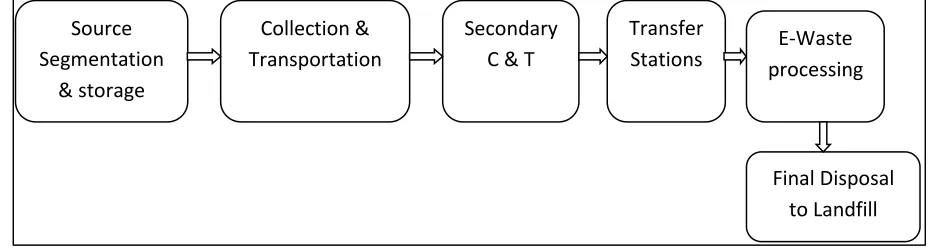
Municipal E-Waste Management (MEWM) refers to a systematic process that comprises of waste segregation and storage at source, primary collection, secondary storage, transportation, resource recovery, processing, and final disposal of solid waste.
Fig. 2: Municipal E-Waste Management
The processing of waste results in following by-products: (i) Compost is derived from processing of the organic component of waste and is used as manure (ii) Refuse Derived Fuel or RDF is prepared from the combustible portion of MSW and can be used in cement industry and waste to energy plants
1) Waste processing yields an important source of fuel for power generation through biogas and also directly by setting up waste to energy plants
2) Bricks, tiles and other construction aggregates can be made from the Construction and Demolition waste and 3) Methane recovered through landfill is also a source of energy.
Landfill gas extraction systems add to climate change initiatives as it helps in reducing greenhouse gas emissions through avoidance of landfill gas (mainly comprising of methane) into the atmosphere.
Source
Segmentation
& storage
Final Disposal
to Landfill
E-Waste
processing
Collection &
Transportation
Secondary
C & T
Indian Government Approach:
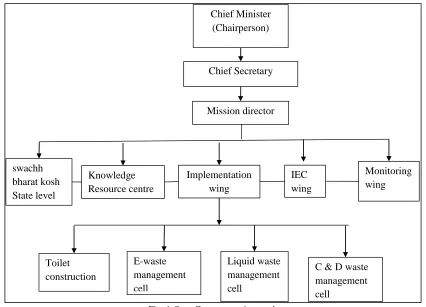
Fig. 3: Indian Government Approach State Government Approach:
Fig. 4: State Government Approach Service Scope toward E-Waste Management:
SI. No Scope of Service PPP format
1 Door to Door collection Service/management contracts
2 Street Sweeping Service contracts
3 Construction & Maintenance of Community Bins BOT and its variance and/or separate EPC and
Prime minister (Chairperson)
Mission director
swachh bharat kosh
Knowledge Resource centre
Implementation wing
National technical board
IEC wing
Monitoring wing
Toilet construction
cell
E-waste management
cell
Liquid waste management
cell
C & D waste management
cell
Chief Minister (Chairperson)
Mission director
swachh bharat kosh State level
Knowledge Resource centre
Implementation wing
IEC wing
Monitoring wing
Toilet construction
E-waste management cell
Liquid waste management cell
C & D waste management cell
O&M contract
4 Transportation of waste to integrated processing & disposal facility Concession and/or O&M contract
5
Design, development, operations & maintenance of processing and treatment facility for MSW including special waste like vegetable market and/or abattoir
waste
BOT and its variance and/or separate EPC and O&M contract
6 Design, development, operations & maintenance of sanitary landfill site BOT and its variance and/or DFBOT and/or separate EPC and O&M contract
E-Waste Generation in Chennai
The situation is alarming as India generates about 1.5 lakh tones of e-waste annually and almost all of it finds its way into the informal sector as there is no organized alternative available at present. Toxics link, a Delhi-based non-government organization (NGO), says that India annually generates 1.5 billion worth of e-waste. As per a study done by Chennai-based NGO, the city generates around 4,000 tons of e-waste every year. It is true that the e-waste spectrum is broad, but IT companies are the single largest contributors to the growing mountains of it. This is because 30% of their equipments are rendered obsolete every year. Reason being is that the life cycle of some electronic goods as short as about 15-20 months. This average age of computer is only 3 years and is progressively decreased because of the demand for ever accelerating speeds in the processing capability of the telecommunication infrastructure.
Recycle
Only 3% of total E-waste generated is recycled properly in India. The rest of it is handled by workers who work with bare hands, without masks under unhygienic conditions, informally recycling tons of e-waste for about 12-14 hours a day. The workers which are involved in collection and recycling come from socially and economically poor families. Most of them are landless or small farmers. None of the labour laws or environmental laws is implemented while using this rudimentary tech.
E-waste
The major impediment in management of e-waste is about collection of such waste and unauthorized recyclers in informal sector. Current e-waste management practices in India are beset with numerous weaknesses, such as the difficulty in inventorisation of generated e-waste, unhealthy conditions of informal recycling, inadequate capacities, lack of information among generators of e-waste as well as ULBs.
Municipality e-waste management
Fig. 5: Cost and Revenue Streams of Municipal E-Waste Management
Cost
Revenue
Collection
Secondary storage
Transportation
E-Waste processing
Administrative
Sale of products
(compost/gas/power
/RDF)
Carbon credits
User charges
Tipping fees
Municipal
The issues which need to be addressed are:
1) Segregation of waste at source and responsibility for ensuring the same;
2) User charges to be levied for collection of waste and if so the rate, collection agency (whether ULB or private partner) and frequency of collection;
3) Tipping fees to a private operator and if so, determine the viable range of Tipping fees; 4) Alternatives to Tipping Fee and incentivizing reduced transportation costs;
5) Pricing of the by-products like Compost/ RDF and Power; 6) Creating Market for the products from waste management; 7) Financial viability of ULBs
Opportunities
Willingness by stakeholders to contribute to e-waste management
MoEF has allocated land to TTSL to build a national e-waste recycling centre Employment opportunities
Informal business in recycling found around dumpsites can be formalized Capacity in formal business can be developed
Some manufacturers e.g. (Sony Ericsson, LG) and suppliers and service providers (e.g. Safaricom) are implementing take back schemes
Funds available that can be used by small entrepreneurs (e.g. CDF, Youth and Women Fund)
IV. CONCLUSION
Solid waste management, which is already a mammoth task in India, is becoming more complicated by the invasion of e-waste, particularly computer waste. There exists an urgent need for a detailed assessment of the current and future scenario including quantification, characteristics, existing disposal practices, environmental impacts etc. Institutional infrastructures, including e-waste collection, transportation, treatment, storage, recovery and disposal, need to be established, at national and/or regional levels for the environmentally sound management of e-wastes. Establishment of e-waste collection, exchange and recycling centers should be encouraged in partnership with private entrepreneurs and manufacturers. Model facilities employing environmentally sound technologies and methods for recycling and recovery are to be established. Criteria are to be developed for recovery and disposal of E-Wastes. Policy level interventions should include development of e-waste regulation, control of import and export of e-wastes and facilitation in development of infrastructure. An effective take-back program providing incentives for producers to design products that are less wasteful, contain fewer toxic components, and are easier to disassemble, reuse, and recycle may help in reducing the wastes.
REFERENCES
[1] Ministry of Environment and Forests ―Guidelines for environmentally sound management of e-waste” March 12, 2008
[2] Ministry of Environment and Forests, CPCB Registered Recyclers, 2008
[3] EMPA. The e-waste guide; Accessed on Aug 2006: http://www.ewaste.ch/
[4] Compendium on National WEEE Legislation, United Nations University, United Nations Environment Program, 2006
[5] Implementation of the Waste Electrical and Electronic Equipment Directive in the EU, European Commission, Directorate General, Joint Research Centre,
IPTS, 2006
[6] www.cpcb.nic.in/Hazardous%20Waste/default_Hazardous_Waste.html
[7] www.environment.gov.au
[8] E-Waste Management in India, GTZ, Indo-German Environment Programme 7th July 2009
[9] Electronic Waste: A Case Study, Research Journal of Chemical Sciences, ISSN 2231-606X, Vol. 1(9), 49-56, Dec. (2011)
[10] Electronic Waste Management System In Bangalore – A Review, ISSN 0975–0924 Volume 1, Number 1 (2009), pp. 11–24
[11] Environmentally sound options for e-wastes management, Envis Journal of Human Settlements, March 2004.
[12] Guidelines For Environmentally Sound Management Of E-Waste, March 12, 2008
[13] Mainstreaming the Informal Sector in E-Waste Management, Urban, Industrial and Hospital Waste Management Ahmedabad, Saket Projects and Gujarat
Pollution Control Board 7-8 May 2010
[14] Understanding E-Waste Generation, Collection & Recycling in Bangalore, Saahas, 2005
[15] WEEE Recycle, Establishing E-Waste Channels to Enhance Environment Friendly Recycling, GTZASEM, 15 September 2010
[16] Waste electrical and electronic equipment the EU and India: sharing best practices, Toxics Link, toxicslink. org
[17] Westcott, M. E-Waste; Queensland Parliamentary: Queensland, Australia, 2012.
[18] Pink, R. Australia’s Environment: Issues and Trends; Australian Bureau of Statistics: Canberra, Australia, 2010.
[19] Kahhat, Ramzy, J. Kim, M. Xu, B. Allenby, E. Williams, and P. Zhang (Kahhat et al.) “Exploring e-waste management systems in the United States”,
Resources, Conservation and Recycling 52 (2008) 955-964, Elsevier, Web, 5 January 2013
[20] Jiang, Ping, M. Harney, B.Chen, Y. Song, Q. Chen, T. Chen, G. Lazarus, L. Dubois, M.Korzenski (Jiang et al). Improving the End-of-Life for Electronic
Materials via Sustainable Recycling Methods. Advanced Technology Materials Incorporated, Inc. Print.
[21] Electronics TakeBack Coaliation. “State Legislation”, Web. 10 December 2012
[22] Electronics TakeBack Coalition. “Ten Lessons Learned from State E-waste Laws.” Web. 2 February 2013.