e-ISSN: 2278-067X, p-ISSN: 2278-800X, www.ijerd.com
Volume 13, Issue 12 (December 2017), PP.47-53
Optimal Sequence for MIMO Radar
1
Pandu .J,
2Dr.C.D.Naidu
Department of ECE Sreyas IET Hyderabad ,India Department of ECE, VNRVJIET Hyderabad, India
Corresponding Author: 1Pandu .J
ABSTRACT:
A modified particle swarm optimizer algorithm has been proposed for polyphase signal coded sequence for multiple input and multiple output radar applications. A set of sequence is checked for the identification of peaky values obtained by using auto correlation and cross correlation process. This modified algorithm is guided for the experimental study in different set of sequences. This work is compared along with pervious Non-dominated Sorting Genetic Algorithm (NSGA) and particle swarm optimizer has been chosen. This paper intends to improvise the pulse coded sequence using selected frequency range to improve the efficiency.Keywords:
Modified particle swarm optimizer, Polyphase signal, Multiple input and multiple output, Non-Dominated Sorting Genetic Algorithm, Correlation process.--- --- Date of Submission: 13 -10-2017 Date of acceptance: 26-12-2017 --- ---
---I.
INTRODUCTION
A numerous number of waveforms have been used for radars till date. Several properties of radar waveforms are discussed in [1], [2]. Radar waveforms are application specific. The presentation of radar is proportionally belongs to the waveform chosen. An un-modulated or modulated continuous signal is used in Continuous Wave (CW) radar. Such a system can detects using Doppler offset, but range measurements become difficult. Since the radar transmits continuous waves, the requirement for secondary antenna for reception arises which is considered as another short coming of such a system. [3] Pulsed radar transmits signals at regular time intervals. Unlike the CW radar, pulsed radars could give range measurements. But the selection of pulse width is combined among the required resolution of the system and the detectable maximum Range. Numerous characteristics of the radar system such as the accuracy, resolution, range, range Doppler ambiguity etc. are decided by the radar waveforms. Thus, [4], [17] the optimal radar waveform decides the efficiency of the system. For example, the shorter the pulse width of pulsed radar, the more accurate resolution the system has. But at the similar instance of time, short pulse will not support a good detection range.
[5]These issues were solved by the method of the Pulse Compression. Pulse compression shares the hint of transmitting a long-range pulse with some modulation embedded which spreads the energy over the bandwidth necessary for the required resolution. [6] When comparing uncompressed pulse waveform along with compressed pulse waveforms, compressed waveform has larger time bandwidth (BT). This compressed waveform can be used either as customized frequency or phase coding. [22] This gives rise to frequency modulated waveforms such as Linear Frequency Modulation (LFM) and Non-Linear Frequency modulation (NLFM). A modulated signal carries frequency which varies with time in a specified periodic. It commonly finds applications in waveforms like continuous waveform and pulsed radars. Since this LFM works as a constant waveform, it spread the energy over frequency domain. The variation can be asymmetrical or symmetrical changes over time. More or less of nonlinear frequency modulations can be summed up as quadratic. A variation of the discrete FM uses N contiguous pulses with discrete frequency. This form of waveforms is identified as Costas FM. This is similar to a frequency hopping system where the FM frequencies are chosen so that resulting waveform has a minimum side lobe over the delay Doppler plane. Costas FM signals are generated using Welch construction or using some frequency hopping codes.
[9] In poly phase coding or M phase coding, the phase of the sub pulse takes any of the M arbitrary values. Frank codes, polyphase Barker sequence, P codes, quadriphase-coded waveform are some of the commonly used sequences in Polyphase coding. The range side lobes for polyphase coded waveforms are lower than that of binary-coded waveform of same length, but the Doppler performance gets deteriorated. [10, 11].
II.
LITERATURE SURVEY
Recent research in this field gives reference to the idea of transmission and reception of multiple signals which is studied in [3]. [12] MIMO radars differ from the phased array systems in the fact that each antenna transmits different waveforms while phased array uses weighted copies of a single waveform. Thus, MIMO radar comes with additional units of liberty as discussed in [6] and gives the experimental results promising enhanced performance [7]. MIMO radar comes in two configurations, with collocated antenna and widely distributed antenna. Both antennas placed closed to each other so that they can see the target alike. To enhance the performance of radar genetic algorithm of RADAR, genetic algorithm is framed for optimization. [13], [14], [15], [19] Multi objective optimization uses a popular NSGA as an efficient method but it is not chosen widely because of its complexity. So this algorithm is modified further into NSGA-II which performs better than conventional NS genetic algorithm by giving importance to its priority. [16] To improvise further, particle swarm optimizer has been modified and used for optimization.
III. MIMO RADAR SIGNAL MODEL
[11, 17] Poly phase coded sequence consists of large number of sub pulse sequence. [9] Sequence that consists of auto correlation and cross correlation has been used for the application of identifying the signals. Sub-pulses of poly phase code are complex numbers with N number of bits which is given by
sl n = ej∅(n) (1)
Where n=1, 2, …., Nc and l=1, 2, …., L
ϕl n ∈ 0,2π
Mc, 2.
2π
Mc, … , Mc− 1 . 2π
Mc (2)
ϕl n = Ψ1,Ψ1, … ,ΨMc
where, 𝜙𝑙 𝑛 , (0 ≤ 𝜙𝑙(𝑛) ≤ 2𝜋) is represented as sub pulse of poly phase code denoted as L . Assuming a set a
poly phase codes that contains the set as N whose set size is L, one can briefly signify the phase values of S with following L×N phase matrix
S L, Nc, Mc =
ϕ1(1) ϕ2(2) … ϕ1(Nc)
ϕ2(1) ϕ2(2) … ϕ2(Nc) ∶
ϕL(1) ∶
ϕL(2) … ∶
ϕL(Nc)
(3)
Here the poly phase signal is shown as a phase sequence at the first row of the matrix, which has been selected from the phase pattern as shown in equation (3). Distinguishable poly phase coded sequencing is obtained from correlation techniques. It is shown as,
A ϕl, k = 1
Nc exp j ϕl n −ϕl n + k = 0 0 < 𝑘 < Nc
Nc−1
n=1
1
Nc exp j ϕl n −ϕl n + k = 0 − Nc< 𝑘 < 0
Nc
n=−k+1
(4)
C(ϕl, k) ≈ 1
Nc exp j ϕq n −ϕp n + k = 0 0 < 𝑘 < Nc
Nc−k
n=1
1
Nc exp j ϕq n −ϕp n + k = 0 − Nc < 𝑘 < 0
Nc
n=−k+1
(5)
For p≠q and p, q=1, 2… L
E = A(ϕl, k) 2+λ Nc−1 C(ϕp,ϕq, k) 2
k=−(Nc−1)
L q=p+1 L−1 p=1 Nc k=1 L
l=1 (6)
where 𝐴(𝜙𝑙, 𝑘) and 𝐶(𝜙𝑝, 𝜙𝑞, 𝐾) represents autocorrelation and cross correlation function. 𝑆𝑙, 𝑆𝑝 and
one, it means more weight is given to cross correlation and if it is less than one, it means more weight is given to autocorrelation. So, the crafting of polyphase sequence made through using a matrix which is shown in equation ( 3) along with 𝐴(𝜙𝑙, 𝑘) and 𝐶(𝜙𝑝, 𝜙𝑞, 𝐾) equation (4) and (5). [7], [9] In MIMO, polyphase sequence coding performs the process of optimization. It will minimize the occurrence of peak value and also it will scrutinize the whole energy by equation (4) and (6).
IV. EVOLUTIONARY MODIFIED ALGORITHM
[16], [18], [20] For the process of optimization, particle swarm optimizer algorithm has been chosen here, and that was first proposed by kennedy and Ederhart [14]. Performance is high and mechanism is simple [15], [21]. This technique verifies each and every sequence of the function. Also it performs simultaneously for different sequences. [12] At the starting stage, this particle swarm optimizer evolutionary algorithm creates a random sequence within the limited space. Its velocity and position can be identified by using equation (8).
vi (t + 1) = w vi (t) + c1φ1 (pibest − Xi) + c2φ2(pgbest − Xi) (7)
Xi(t + 1) = Xi(t) + vi(t + 1) (8)
Where, is the inertia weight.Process of inertia weight provides better balance to explore and exploit the number of sequences. Achievement of the value better inertia weight will improve the performance by checking all the available sequence. [15] Meantime, others perform a common search to find the sequence. Eberthart and Shi [14] performed a process of tracking and optimizing to increase the occurrence of early iteration process in particle swarm optimization algorithm. [20] improved performance and efficiency using optimized particle swarm optimization algorithm by experimentally obtained inertia weight through simulation result.
V. SIMULATION RESULTS
Performance of the modified method is proposed and the following study has been made. Optimization of polyphase coded sequence has been designed through using evolutionary modified particle swarm algorithm. [6], [8], [12] This modified algorithm is used to optimize the 16 phase coded sequence set vary from 3 to 5 and the length of the sequence N=128.
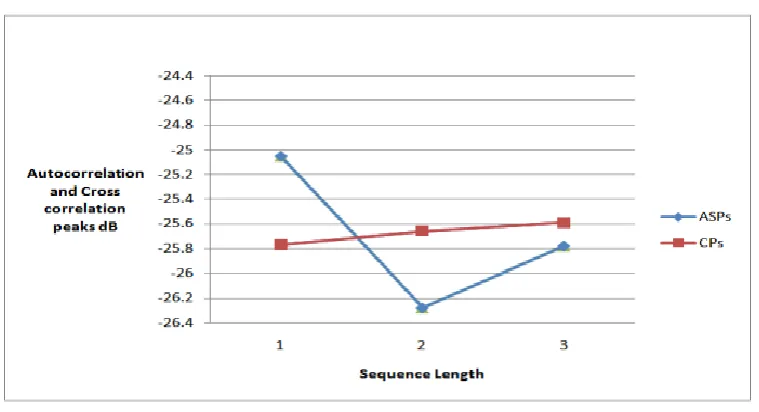
Case 1: Experimental study has been made through by setting L=3 and length of the sequence N=128. Table 1, Figure 1 and Figure 2 shows the peak value obtained through the sequences of ASPs and CPs. Obtained average value of ASP is -25.7 dB and the average value of CPs is -25.6 dB.
Table.1 ASPs and CPs of Sixteen phase synthesized sequence sets with L=3, and Sequence length N= 128.
Seq1
Seq2
Seq3
Seq1
-25.05
-25.77
-25.66
Seq2
-25.77
-26.28
-25.59
Fig.1 Max (ASP) values of Sixteen phase sequence set L=3 and N=128.
Fig.2 Average (ASPs) and (CPs) values of Sixteen phase sequence set L=3 and N=128.
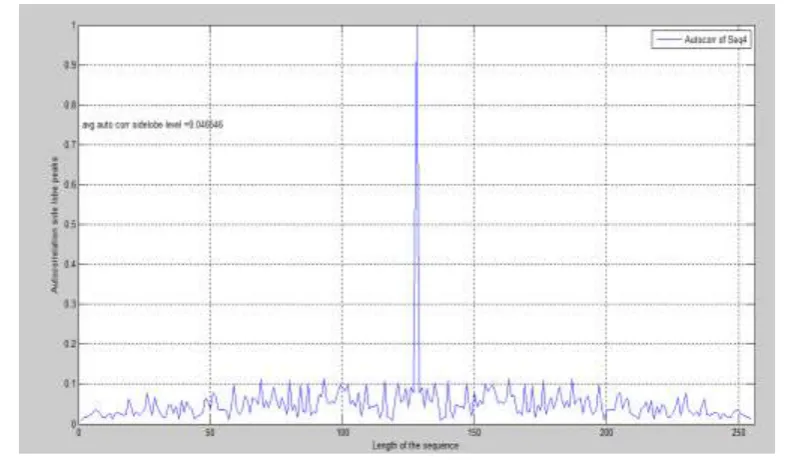
Case 2: Experimental study has been made through by setting L=4 and length of the sequence N=128. Table 2, Figure 3 and Figure 4 shows the peak value obtained through the sequences of ASPs and CPs. Obtained average value of ASP is -25.4 dB and the average value of CPs is -25.2 dB.
Table.2 ASPs and CPs of Sixteen phase synthesized sequence sets with L=4, and Sequence length N= 128.
Seq1
Seq2
Seq3
Seq4
Seq1
-26.63
-25.27
-25.81
-25.34
Seq2
-25.27
-23.72
-25.34
-24.48
Seq3
-25.81
-25.34
-25.83
-25.27
Seq4
Fig.3 Max (ASP) values of Sixteen phase sequence set L=4 and N=128.
Fig.4 Average (ASPs) and (CPs) values of Sixteen phase sequence set L=4 and N=128.
Case 3: Experimental study has been made through by setting L=5 and length of the sequence N=128. Table 3, Figure 5 and Figure 6 shows the peak value obtained through sequences of ASPs and CPs. Obtained average value of ASP is -25.8 dB and the average value of CPs is -25.6 dB.
Table.3 ASPs and CPs of Sixteen phase synthesized sequence sets with L=5, and Sequence length N= 128.
Seq1
Seq2
Seq3
Seq4
Seq5
Seq1
-24.58
-25.32
-26.63
-25.95
-25.44
Seq2
-25.32
-26.91
-25.49
-25.54
-25.66
Seq3
-26.63
-25.49
-25.86
25.54
-25.41
Seq4
-25.95
-25.54
-25.54
-25.95
-25.81
Fig.5 Max (ASP) values of Sixteen phase sequence set L=5 and N=128.
Fig.6 Average (ASPs) and (CPs) values of Sixteen phase sequence set L=5 and N=128.
VI. CONCLUSION
An effectively modified particle swarm optimization is used in the multiple input and multiple output radar application which is designed for sixteen bit phase coded sequence. It has been experimentally subjected in three different cases. Result obtained by using the particle swarm optimization shows a major improvement in obtaining a peak value of autocorrelation and cross correlation. Here 16 phase coded sequence has been set in the order L=3, 4 and 5 with the length of sequence N=128. Obtained results are compared with the previous works. From this modified particle swarm optimization algorithm, we have concluded that the result obtained from this algorithm gives a great improvement in ASPs and CPs in most length of sequences.
REFERENCES
[1]. H. Deng, “Polyphase code design for orthogonal netted radar systems”, IEEE Transactions on Signal Processing, Vol. 52, PP. 3126-3135 2004.
[3]. F. C. Robey, S. Coutts, D. Weikle, J. C. McHarg, and K. Cuomo, “Mimo radar theory and experimental results,” in Proc. of 37th ASILOMAR 2004 Conf. on Signals, Systems and Computers, pp. 300–304, 2004.
[4]. Hammad A. Khan, Yangyang Zhang, Chunlin Ji, Christopher J. Stevens, David J. Edwards, And Dominic O’brien Optimizing Polyphase Sequences For Orthogonal Netted Radar. Ieee Signal Processing Letters, Vol. 13, No. 10, October ,2006.
[5]. S.P.Singh and K.Subha Rao , “Discrete frequency-Coded radar signal design ,” IET Signal Process , Vol.3,No.1,pp.7-16, july,2008.
[6]. G. H. Wang And Y. L. Lu Sparse Frequency Waveform Design For MIMO Radar Progress In Electro magnetics Research B, Vol. 20, pp.19-32, 2010.
[7]. Xiangneng Zeng , Yongshun Zhang, and Yiduo Guo “Polyphase coded signal design for MIMO radar using MO-Mic PSO “ Journal of Systems Engineering and Electronics Vol. 22, No. 3, pp.381–386,June, 2011.
[8]. S.P.Singh and K.Subha Rao , “Sixty-Phase Sequences Design with Good Autocorrelation Properties ,” IETE Journal of research , Vol.57,No.3,pp.256-262, June ,2011.
[9]. N.Balaji and Kakarla Subba rao , “VLSI –based Real –time Signal Processing Solution Emplyoing Four –Phase Codes for Spread –spectrum Application,” IETE Journal of Research ,Vol.58,No.1,pp.57-64,Jan-Feb.2012.
[10]. Hai Deng “Othogonal Waveform Design for Multiple-Input Multiple-Output (MIMO) Radar ,“2012 world Congress on Engineering and Technology
[11]. B. Roja Reddy , M.Uttara Kumari Target Detection Using Orthogonal Polyphase MIMO Radar Waveform against Compound Gaussian Clutter Science Direct Procedia Engineering 64 ,pp.331 – 340,2013.
[12]. J.Pandu , Dr. N.Balaji, and Dr.C.D.Naidu “FPGA based Solution for the Identification of RADAR Pulse Sequences for Defense Applications ”, Global Journal of Researches in Engineering, Vol .14 ,No.2, pp 17-24 , February, 2014.
[13]. Using Genetic Algorithm for Improved Safe Image Transmission Method by Colour Transitions *A.K Parvathi, Journal of Excellence in Computer Science and Engineering, Vol. 1(1) 2015, pp. 25-33, http://dx.doi.org/10.18831/djcse.in/2015011004 [14]. R. C. Eberhart and Y. Shi., “Tracking and optimizing dynamic systems with particle swarms,” In Evolutionary Computation,
2001. Proceedings of the 2001 Congress on, Vol. 1, pages 94–100. IEEE, 2002.
[15]. Performance Comparison of NSGA-II and NSGA-III on Various Many-Objective Test Problems Hisao Ishibuchi, Ryo Imada, Yu Setoguchi and Yusuke Nojima
[16]. J.Pandu , Dr. N.Balaji, and Dr.C.D.Naidu “Optimal Coded Sequence Design for Radar using Fractional Oppositional Particle Swarm Optimization”,IEEE International Conference on Recent Advances and Innovations in Engineering (ICRAIE-2014) , May 09-11, 2014, Jaipur ,India .
[17]. Yongzhe Li; Vorobyov, S.A.; Koivunen, V., (2015) “Ambiguity Function of the Transmit Beamspace-Based MIMO Radar,” in IEEE Transactions on Signal Processing, Vol.63, No.17, pp.4445-4457, Sept. 2015.
[18]. T. Aittomki and V. Koivunen, (2016) “Radar Waveform Sidelobe Level Optimality and Sampling,” in IEEE Signal Processing Letters, Vol. 23, No. 3, pp. 371-375, March, 2016.
[19]. Journal of Advances in Mechanical Engineering and Science, Vol. 2(4) 2016, pp. 11-18, http://dx.doi.org/10.18831/james.in/2016041002 Optimization of Machining Parameters using Scatter Search Algorithm *R Sri Siva1 , B Balachithra2
[20]. J. Xin, G. Chen, and Y. Hai., “A Particle Swarm Optimizer with Multistage Linearly-Decreasing Inertia Weight”, In Computational Sciences and Optimization, 2009. CSO 2009. International Joint Conference on, Vol. 1, pages 505–508. IEEE, 2009.
[21]. Journal of Advances in Mechanical Engineering and Science, Vol. 2(4) 2016, pp. 25-34 http://dx.doi.org/10.18831/james.in/2016041004 Virtual Obstacle Parameter Optimization for Mobile Robot Path PlanningA Case Study *Hussein Hamdy Shehata1 , Josef Schlattmann
[22]. Reducing the Grating Lobes and Main Lobe Width for Increasing Range Resolution Using Phase and Frequency Modulated Codes. International Conference on Electrical, Electronics, and Optimization Techniques (ICEEOT) - 2016
BIOGRAPHY
Mr. J. Panduobtained is B.Tech degree from VNR Vignana Jyothi Institute of Technology, Bachupally, Hyderabad. He recived Master’s degree from Osmania University Hyderabad and Pursuing his (Ph.D) from JNTUH Hyderabad. Presently he is working as a Assoc professor in the Department of ECE, Sreyas Institute of Engineering &Technology, Nagole, Hyderabad. He is a life Member of ISTE . His areas of research interest are Signal Processing, Radar, and Embedded Systems.