Prediction Algorithm for State Prediction Model
Zili ZhangComputer Science Department, Shijiazhuang University, Shijiazhuang, China [email protected]
Hongwei Song
Computer Science Department, Shijiazhuang College, Shijiazhuang, China [email protected]
Yan Li
Computer Engineering Department, Ordnance EngineeringCollege,Shijiazhuang, China Hao Yang
Computer Science Department, Nanjing Normal University, Nanjing, China
Abstract—Dynamic Bayesian network is the extension of Bayesian network in solving time series problems .It can be well dealt with the time-varying multivariable problem. A state model is given based on Dynamic Bayesian network. The model can more accurately describe the relationship between the system state and the influencing factors. Single-step and multi-step prediction algorithms are given to predict the system state. The multi-step state prediction algorithm is achieved by extending time-slice. In this paper, the width of the reasoning is used to simplify the amount of data in the reasoning process.
Index Terms – dynamic Bayesian networks, state prediction model, single-step prediction algorithm, multi-step prediction algorithm
Ⅰ. INTRODUCTION
Bayesian networks, also known as belief networks, are already well-established as representations of domains involving uncertain relations among several random variables. Dynamic Bayesian network, the extension of Bayesian network in solving time series problems and the reducible model for complex random progress, which variables evolve with time, can effectively represent and solve the multi-variables’ problem [1,2]. Dynamic Bayesian Networks (DBNs) have been receiving increased attention as a tool for modeling complex stochastic processes, especially that they generalize the popular Hidden Markov Models (HMMs) and Kalman lters. In time series modeling, we observe the values of certain variables at different points in time. The assumption that an event can cause another event in the future.
It is very important for makers to predict the state of system. But the state prediction is very difficult because the state of the system is generally affected by many random factors. The random variable can evolve with time in dynamic Bayesian network. The DBNs have also been widely used to reason and predict[3]. A dynamic
system can be represented by a state-space model. The state prediction model based on DBNs is mainly used to solve the state prediction for the system affected by many random factors. A single-step prediction algorithm is proposed to adjust time forecast. However, the prediction
is difficult to the case that the forecast time is far away from the current time. This paper proposes a multi-step prediction algorithm which can be used to solve this problem.
We begin with formal description of the state prediction model. In the section, we proposed two algorithms to respectively determine factors and dependences. Section 3 discusses the support degree among all nodes and variable transition probabilities of nodes. We propose forward and backward algorithms in the end of this section. In section 4, this paper proposes a definition of interface span to greatly reduce data storage space. In Section 5, this paper gives the single-step prediction algorithm and the multi-step prediction algorithm. Section 6 finally ends with an experiment.
Ⅱ. STATE PREDICTION MODEL
Our task is to predict thestate of a system for making a reasonable decision. Recently, there has been a surge of interests along this direction[4,5,6,7]. Firstly, we give a model for state prediction based on Dynamic Bayesian networks. Dynamic Bayesian networks are a class of Bayesian networks specifically tailored to model temporal consistency present in some data sets. In addition to describing dependencies among different static variables, DBNs[8] describe probabilistic
dependencies among variables at different time instance. A set of random variables at each time instance t is represented as a static BN. A major benefit of the DBNs is that their well-constrained network structure allows for simplified inference. Therefore we give a state prediction model based on Dynamic Bayesian networks.
A. A summary of Model Structure
the state node within a slice. We assume that these dependencies between nodes at neighboring time slice satisfy the Markov assumption [9]. .The kind of state
prediction is illustrated as follows:
With the topology shown in Figure 3.1, we firstly give necessary instructions of some symbols in the prediction model to the description and use in lower sections.
State space is expressed as Q={ ,q q1 2…qn}.So we
can use Qt to express the state at time t, and qt∈Q
denotes the arbitrary value of the state. Assigning a time index t to each variable, the symbol {Q Q1, 2…QT} is a
sequence of state. This paper assumes that Ti is the average of the sampling interval of all state nodes in Q.
Assigning a number index i to each variable, the vector
V
=
{ ,
V V
1 2…
V
m}
expresses m influence factors. The ith influence factor will be denoted by Vi and itsspace of values expressed by
V
i=
{
v v
i1,
i2…
v
ik}
.Lett
V describe the vector of an influence factor at time
t
.So the ith variable could be denoted by t iV
and its exact value is tij
v
.With the help of symbols described above, the state predication model can be represented with the sate sequence
0:T
Q and a vector sequence of factors
V
0:T.There are two conditional independence relations among all nodes and these relations could be respectively described by I( ,Vt {Q0: 1t− ,V0: 2t− } |Vt−1) and
} | { 0: 1 0: 1
{ , 1
( ,Qt Q t V t Q , })V
t t
I − − − .
So, from basic probability theory we know that we can factor the join probability as a product of conditional probabilities in the model:
0 : 0 : )
(
T T
p Q V =
0) ( 0 0)
( p
|
p V Q V .
1 1
( |t t ) ( t| t t) t
p V V − p Q Q − V
∏
B. The selection of influence factors
Firstly, we should construct the state prediction model. The knowledge of basically framework of the model known from the expert makes it important to determine all influence factors and the dependent relationships
between them at the adjacent time slices. The result of selection factors will directly affect the state prediction. According to the actual situation, factors should meet two basic requirements: effectiveness and non-redundancy. The so-called effectiveness is that factors can play a role to the state. The validity of factors could be tested by the average mutual information I Q V( ; )i between the
influence node and the statute node. If I Q V( ; )i >τ (
τ
is a given threshold value), then we believe that the factor meets effectiveness. The so-called non-redundancy is that there is less mutual information between the factors at the same time. The non-redundant can be detected by the average mutual information between the factorsI( ; )V Vi j .If I( ; )V Vi j <ξ (
ξ
is a given threshold), then it isconsidered that
i
V and Vj meet the non-redundancy. Let U be a set of the candidate factors, Vbe the selection set of the influence factors. Then the selection algorithm of influential factors is such as algorithm 3.1.
Algorithm 3.1. Set V = ∅,V'= ∅
For
i
=1 to| |
UIf ( ; )
i
Q U
I >
τ
then add UjtoV
' Sort 'i
V into an order decreasing by I Q V( ; )i'
For
j
=1 to | '| VFor each V ∈V If ( ; )V' V
j
I <ξ then add '
j
V to
V
C. Determination of dependency
In this model, the dependence between the state node and factors is obvious, thus it dose not need to learn. According to the selection algorithm of influencing factors, we could obtain that different factors at the same time are mutually independent. Therefore it is only needed to determine dependencies between factors at the adjacent time in this model. The specific algorithm is shown as algorithm 3.2.
Algorithm 3.2 Input t−1=
V V ,Vt =V For each t 1
j
V
−∈
V
t−1 For each ti
V
∈
V
t If( ;
t t 1)
i j
I V V
−>
ω
thenV
jt−1→
V
itThrough the choice of factors and dependencies of the selection, the state prediction model of the structure can be determined. We can get the conditional probability table by the statistics of historical data.
D. Two factors
Because we use maximum likelihood estimation to study the state transition probability, we do not consider its variability. The node transition probability calculated by maximum likelihood estimation is an average value and it is time-invariant. The context is different, and although the state node's parent has the same value as these nodes at other times, the state node’s value may be
t-1 t t+1
V
1
1 −
−
=
tt
q
Q
Q
t=
q
tQ
t+1=
q
t+1different. The context mentioned here refers to the values of influence nodes at the time slice which has two times slice distance with the observation time, thus transition probability of the state node is not always invariant, but has certain variability. This paper introduces two factors: the maintenance factor and transfer factor. Therefore the model can not only handle these time-invariant systems but also deal with these variable systems.
From context, we give judging method to determine whether to consider the changes in the state transition probability at time t. If p q q( | , )i iVt ≥p q q( | ,i iVt−1), then
changes need to be considered. However, if
1
( | , )
i iVt( | , )
i i Vtp q q
<
p q q
− , then changes need to be considered.The possibility of changes in the state transition probability will due to the state duration time and the longer the duration the greater the possibility to change. To solve this problem, this paper constructs two factors: the maintenance factor and transfer factor. These two factors should meet some requirements.
(1) Maintenance factor is in inverse proportion to the duration of the same state. Transfer factor is in inverse proportion to the duration of the same state.
(2)If t is less than or equal to
2 i
T , the maintenance should be more than the transfer factor. If t is larger than
2 i
T , the maintenance should be less than the transfer factor.
Let qibe the state value at the current time and Tithe
average of duration. Assuming that the value of state has a duration t. If the maintenance factor is
γ
and thetransfer factor is λ, we have
t
i
T
γ α= , i
T t
T i
λ α
−
= .
Where
α
is undetermined coefficientsatisfying0<α≤1. If
α
is equal to one, it shows that the state transition probability meets invariance.E. Calculation of variable transition probability
Assuming that q
iis the value of the state node at time t. The values of all influence factors are known at time t+1, and they meet p q q( | , )i iVt+1 <p q q( | , )i iVt .The
state transition probability obtained by maximum likelihood estimates is denoted by '
k
p(k=1, 2,…,n). The maintenance factor
γ
and transfer factorλ
has been known at current time. The state transition probability at time t+1 could be calculated as follows: statei
q transition probability ispi =ωγ pi' and other
state transition probability is '
j j
p =
ωλ
p . Whereω
isthe normalization constant and the value is
' '
1
(1 )
i i
p p
ω
γ λ
=
+ −
The value of the variable α should make the formula
'
1
| |
T
t t
t
q q
=
−
∑
to obtain the minimum, where qtis thepredict of the state, '
t
q is the actual value for the state and T is the sampling duration.
Ⅲ THE FORWARD-BACKWARD ALGORITHM
The mentioned evidences refer to all the random variables known values. When you get values of some nodes at predict time slice, you can update the predicted results of nodes unknown value by the support degree among nods. The forward algorithm is that the predicted likelihood of the state node will be updated by the support degree of the influence factors to it. The backward algorithm is that the predicted likelihood of the factor node will be updated by the support degree of the state node to it.
A. Support Degree
There are different influences between events, thus a method is proposed to measure the degree of influence between nodes in paper [10,11]. The results of this method cannot reflect the negative impact between random events. However, the fact is not the case. This article gives a new method to compute the support according to the mutual information between random events. Mutual information between random events
i
x
andy
jis as follow:( |
)
( ;
)
( )
( |
)
log
( )
i j
i j i i j
i
p x
y
I x y
I x
I x
y
p x
=
−
=
If P(xi|yi) is greater than P(xi) ,then I(xi;yi) is larger
than zero. If P(xi|yi) is less than P(xi) ,then I(xi;yi) is less
than zero. If the event xi and the event yi are mutually
independent , then I(xi;yi) equals zero. We can conclude
that some events would have different effects on the same event. Some promote the event, some hinder it, and others have nothing with the random event.
Based on what are discussed above, this definition is given to compute the support degree of influence factors to the state node
Definition 1 Let
v
ilbe the lth value of the ith influencefactor. Now assuming that the state value is
q
jat time slice t, and then the support degree of influence factor to state node isw
il=
I v q
( ; )
il j,
and the range is( ,
−∞ +∞
)
.According to the above two methods, we can get support degrees among the different nodes. Then we would update the predicted results by the amended algorithms which will be introduced.
B. The relationship between conditional probabilities and mutual information
Let xi be the value of the random variable, then the
probability of X can be described as P(X= xi).
Considering the endless independent random variables, E1, E2… and En, the values of these random variables
are respectively e1, e2, … and en. Thus we can compute
1 2
( | , ..., )
i np x e e
e
=
1 21 2
( , , ..., )
( , ..., )
i n
n
p x e e
e
p e e
e
=
1 21 2
( ) ( , ..., | )
( , ..., )
i n i
n
p x p e e
e
x
p e e
e
=
1
( | )
( )
( )
nj i i
j j
p e
x
p x
p e
=
∏
According to mutual information I(xi;yi) and conditional probability
p(x
i|e
1,e
2,…,e
n),
we can have1 ( ; ) 1 2
( | , ..., )
( )
n i j j
I x e
i n i
p x e e
e
p x e
=∑
=
This expression reflects the relationship among the prior probability, posterior probability and the mutual information.
Thus we can have the methods to update the prediction results by posterior probability and the mutual information.
C. Amendment to the state node
Let qj be the value of the state Q at t+1 time slice,and
the probability of Q would be described as P(Q= qj).
Assuming thatλjis the support of evidences to the state qj.
The selection algorithm shows that the influence nodes are independent of each other at the same time slice. Then according to the relationship between mutual information and the posterior probability, the prediction likelihood could be updated by the following formula.
'
1 1
(
)
j(
)
t j t j
p Q
+=
q
=
α
e p Q
λ +=
q
(
j
=
1,2…,
n
)
In the above formula,
α
is the Normalization Factor, and it’s value is' 1
1 1
( ) ]
j
n
t j
j
eλ p Q + q −
= =
∑
D Amendment to the influence factors
Let
v
ilbe the value of the ith influence factorV
i at t+1 time slice, then we would use '( t1 )i il
p V+ =v to
describe the probability of t 1 i
V
+ . Assuming thatw
ilis the support degree of the stateQ
t+1tov
il . So the prediction likelihood could be updated by the following formula.1 ' 1
(
t)
wil(
t)
i il i il
p V
+=
v
=
β
e p V
+=
v
(
i
=
1,2 ,
"
m
;
1,2 ,
l
=
"
k
).
In the above formula,
β
is the Normalization Factor,and its value is ' 1 1
1
[
il(
)]
k
w t
i il l
e
p V
v
β
+ −=
=
∑
=
Ⅳ. INFERENCE SPAN
When modeling a large and complex decision problem involving a sequence of decisions, the past observations and decisions of a decision may involve a large set of
variables. If without any restrictions the nodes in all time slices will be needed to store for reasoning the values of nodes at a time slice. Therefore, when the time span is very large, it requires a lot of storage space. However, in fact, the node values at all time slices are not needed to calculate the probability distribution of nodes at the time slice t, and the reasoning span needs to be determined in
order to reduce the time complexity of reasoning. Let T be the reasoning span. When T is determined, we only keep the values of nodes within the time span T. Thus this greatly reduces storage space.
Definition 2[12] The forward interface of a DBN
with span T is the set variables at time
t
<
T
with children at timet
+
1
.It is represented as follows:1
{
t| ( , )
(
1),
t}
tmp t
F
= ∈
u
V
u v
∈
E
t
+
v V
∈
+Definition 3[13] The backward interface of a DBN
with span T is the set variables at time
t
<
T
with parents at timet
−
1
or having children which have parents at timet
−
1
. It is represented as follows:{
|
t t
B
= ∈
v V
( , )
u v
∈
tmp( )
E
t
or
1
( ) : ( , )
tmp( ),
}
t
w
ch v
u w
E
t u V
−∃ ∈
∈
∈
.Based on the above two definitions and combining with the characteristics of the prediction model, this paper gives the following theorem:
Theorem 1 The forward interface at time
t
−
1
andthe backward interface at time
t
+
1
make D-Separation the time t from the past and future. It is represented as follows:I V
{{
1: 2t−,
V
t+2:T}, |{
V
tF
t−1,
B
t+1}}
Proof: Suppose there are variables as follows:
t
V
∈
V
,I
t−1∈
F
t−1 ,I
t+1∈
B
t+1 ,P V
∈
1: 2t− , 2:t T
F
∈
V
+ .According to the definition 1 and thecharacteristics of the model, we can conclude
P
→
I
t−1→
V
;By the definition 2 and thecharacteristics of the model, if the node
I
t+1 has parentnode
V
at time slice t and childrenF
, hence there is1 +
→
t→
V
I
F
; if the nodeI
t+1 has childF
and anode
w
(w
∈
F
,w V
∈
t+1) has a parentV
,we have→ →
V
w
F
.Because the paths ofP
andF
toV
are all blocked, there areI
{{ , }, |{
P F V
F
t−1,
B
t+1}}
.This theorem shows that the probabilities of nodes at time slice t are related with the forward interface
F
t−1, thebackward interface
B
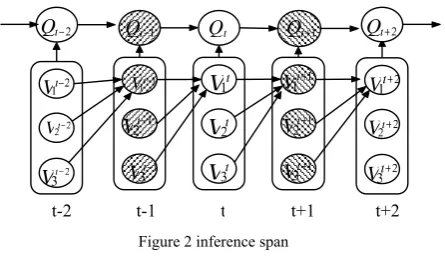
t+1 and the time slice t. Therefore,the reasoning span of the time slice t is three, containing
time slice t -1, t and t +1.
Definition 4 The inference span is the time pieces
which are needed in an inference process.
By construction method of state prediction model, there are Ft−1 ⊆{Qt−1,Vt−1}and Bt+1={Qt+1,Vt+1}. The
V. STATE PREDICTION ALGORITHM As the distance between the perdition time and the current is uncertainty, the pager proposed two prediction algorithms to solve this problem.
A. Single-step state prediction algorithm
Suppose T is the interval of the time to be predicted with the current time. If T is less than or equal to △t, we only need to extend a time slice. Such a prediction is called single-step prediction and the prediction associates only with nodes at the current time slice. Therefore, the state prediction model contains only two time slices. This paper proposed a single-step state prediction algorithm based on inference methods in Bayesian network and evidence propagation. However, exact inference in Bayesian networks is NP hard[14].The more appropriate reasoning algorithm is approximate reasoning, although it is NP hard too. This article gives prediction method combined with Gibbs sampling and variable transition probability.
Gibbs sampling starts with a random setting of the hidden states {St}. At each step of the sampling process,
each state variable is updated stochastically according to this probability distribution conditioned on the setting of all the other state variables. The graphical model is again useful here, as each node is conditionally independent of all other nodes given its Markov blanket, defined as the set of children, parents, and parents of the children of a node. For example, to sample from a typical state variable m
t
Q in a factorial HMM we only need to
examine the states of a few neighboring nodes. Sampling once from each of the TM hidden variables in the model results in a new sample of the hidden state of the model and requires O(TMK) operations. The sequence of states resulting from each part of Gibbs sampling defines a Markov chain over the state space of the model[10].
Let UkSet represent the node set unknown value.
Random sample prediction algorithm is as follows: Algorithm 4.1:
Read:
q
t,Vt,A , B, C, P,Vt+1,UkSet
,Q
t+1;For i←1 to m do
0 0
i
T ←
For j←1 to k do
1
( t | ( ))
ij ij a i
p ←p v+ p V
1
ij ij ij
T ←p +T −
END FOR
END FOR
FOR I←1 to N1 do FOR i←1 to
1
t
V+ do
IF Vi ∈U kSet andTij−1<Random( )≤ Tij
THEN Vi←vij END FOR
FOR l←1 to n do
0 0
R ←
If Qt =qlthen
1 1
(
| ,
)
l t l t t
p
=
ωγ
p Q
+=
q q V
+ Elsep
l=
ωλ
p Q
(
t+1=
q q V
l| ,
t t+1)
1
l l l
R ← p + R−
END FOR
FOR i←1 to N2 do IFRj−1<Random( )
≤
R
jTHEN COUNT_qj= COUNT_qj+1 END FOR
END FOR
FOR j←1 to n do
1 1 2
( t j) _ j/
p Q+ =q =COUNT q N N
END FOR
When getting the values of some influence factors, we should execute the forward algorithm to revise the forecast results of the state node. If we get the value of the state node, the backward algorithm should be executed to revise the forecast results of other influence nodes. Therefore, this paper proposed a complete single-step prediction algorithm.
single-step prediction algorithm4.2:
Step1: Performing random sampling prediction algorithms to get the predicted probability of all nodes. Step2: If you get the values of some factors, then go to
Step3.
If you get the values of the state node, then go to Step5.
Step3: Compute the support degree of influence nods to the sate node.
Step4: Execute forward algorithm, and amend the predict value of the state node.
Go to Step7.
Step5: Calculate the degree of support of the state node to factors.
Step6: Execute backward algorithm, and amend the predict value of the influence nodes.
Step7:End
B. Multi-step state prediction algorithm
As the dynamic Bayesian networks need to expand over time, so the model needs to be expanded until to include the predict time slice. The expansion of time slices is realized by inference in Bayesian networks.
1 1t
V− 1t
V
V1t+11
2t
V−
V
2t V2t+11
3t
V−
V
3t V3t+1t-2 t-1 t t+1 t+2
2 1t
V−
2 2t
V−
2
3t
V−
2
1t V+
2 2t
V+
2
3t V+
2
t
Q− Qt−1 Qt Qt+1 Qt+2
However, exact inference in Bayesian networks is NP hard[15].More appropriate inference algorithm is similarly
reasoning, although the approximate reasoning is NP hard too. Therefore, this paper gives a random sampling method to expand the time slices according to Gibbs sampling[14].
Let Δt be the sampling frequency. If the predict
span t is larger than Δt, the time slices need to be
expanded at least two time slots. This case is called multi-step prediction. Let the current time
t
be the time slice 0, the expansion time slice could be recorded as 1,2, ..., Tt
⎡ ⎤ ⎢ ⎥
⎢ Δ⎥ . According to the front content, the
multi-step prediction algorithm is as follows:
Input:Let ∑ contain CPTs and the values of all nodes at time slice
t
.Return:
(
T| )
0t
p X
⎡ ⎤E
Δ
⎢ ⎥
Step1:Initialize all nodes of slice 1,2,…,T t
⎡ ⎤ ⎢ ⎥
⎢ Δ⎥ to form
vector
I
.Step2:Let
N X
[ ]
be 0 and give a value for T tX
⎡⎢ Δ⎤⎥.Step3:For i=1 to SAMPLE_NUMBER For j=0 to T
t
⎡ ⎤ ⎢ ⎥ ⎢ Δ⎥
a. For each
Z
i inZ
The posterior CPT of
Z
i at time slice i+1 is calculated byI
in a local model contained by slice j,j+1,j+2. SampleZ
i According to the CPT. the sampling value assigned toZ
iat time slice j+1.b. When T t
X
⎡⎢ Δ⎤⎥=x
, N x[ ]←N x[ ] 1+Step4:Calculate the value of
(
T| )
0t
p X
E
Δ ⎡ ⎤
⎢ ⎥ byN X[ ].
Ⅵ. EXPERIMENTAL RESULTS
A. Structure learning algorithm verification
Firstly we produce some random numbers which are between 0 and 1.These data need not be standardized, because all data are less than or equal to 1 and greater than or equal to 0. However, according to actual needs, we respectively discredit into two states for all sample data of each node, and they are denoted by 0 and 1.
In this simulation experiment, we randomly generated a state node Q and four influence factorsV V V V1, , ,2 3 4. We finally got three factors satisfied the selection condition by Selection algorithm mentioned in section 2. These factors were respectively named
V V V
1, ,
2 3 .The other factorsV
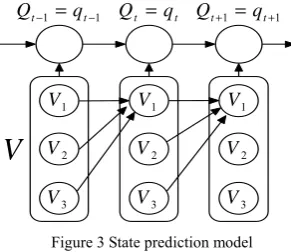
4 was abandoned, because it does not meet the selection criteria. The final selection results match with the condition for generating random numbers. Therefore it shows that factors selection algorithm has better identification. We obtained three dependencies between adjacent factors by time dependence of the learning algorithm. These dependencies are respectively1 1 1
t t
V− →V , 1
2 1
t t
V− →V and V3t−1→V1t, and the results show
that the learning algorithm is effective.
When we got the influence factors, dependencies among nods, and various parameters, the final complete model can be constructed. Because the parameters are too more, the CPTs in the model are not listed.
The state prediction model is shown in Figure 3.
Meanwhile, after the study of a random sample of the data, we ultimately got the parameter
α
which is used in the maintain factor and transfer factor. The average duration for all values of the state node is Ti.α
is equalto one, and then we can see that the maintenance factor
and the transfer factor always equal one according to the characteristics of the exponential function. This shows that the state transition probability met invariance in the forecasting model.
B. State Prediction algorithms verification
After learning the state prediction model shown in figure 5.1, we give two examples to respectively validate single-step algorithm and multi-step algorithm. In these examples, assume that the current time is t = 0, and value of each node at the current time isQ0=1,V10=V20=V30=0.
Assuming that the distance between the prediction time and the current time is less than or equal to
Δ
t
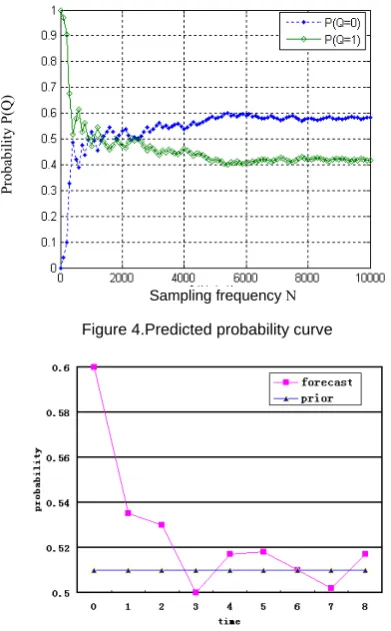
, thus it would take the single step prediction. Prediction time is credited to t=1. When making single-step prediction, let’s assume that the values of all factors at time t are unknown. According to the results, we draw the prediction probability curve of the state shown in Figure 4. The sampling interval was 100 in the example.It can be seen from the figure that the state prediction probability gradually stabilizes with increase in the sampling frequency. Therefore, the sampling results show that the single-step prediction algorithm has good convergence.Assuming that the distance between the prediction time and the current time is larger than
Δ
t
, it would take the multi-step prediction. Prediction time is credited to t=T. In the experiment, let T=9 and these time slices be denoted 0,1,2…,8. During the experiment, we recorded each prediction probability of the 9-chip state node. The chart shows that the predict probability gradually decreases and finally fluctuates in the prior probability over time. There is the conclusion that the prediction ist t
Q =q
1 1
t t
Q− =q− Qt+1 =qt+1
V
1
V V1 V1
2
V V2 V2
3
V V3 V3
meaningless when the predicted moment is far away from current. Therefore the algorithm is suitable for short-term forecast.
ACKNOWLEDGMENT
We would like to thank LIU Xuning and HE Dongbin who were collaborators on much of the work reviewed in this chapter. The author was supported by Shijiazhuang University research foundation.
REFERENCES
[1] Murphy Kevin Patrick.Dynamic Bayesian
Networks:Representation, Inference and Learning.University of California,Berkeley, Ph.D thesis. 2002.
[2] Dean T.L,Kanazawa K.Probabilistic temporal
reasioning[A].Mitchell T M,Smith RG.Proc of 7th National
conference on AI[C].Madsion,Wisconsin: AAAI Press.524-528,1988.
[3] Cristina Elena Manfredotti, Modeling and inference with
relational dynamic Bayesian networks, Ph.D thesis October 2009.
[4] Le Song,Mladen Kolar,Eric P.Xing,Time-Varying
Dynamic Bayesian Networks.NIPS,2009.
[5] Xiang Xuan and Kevin Murphy.Modeling changing
dependency structure in multivariate time series.In ICML
24,2007.
[6] Amr Ahmed and Eric P.Xing.Tesla:Recovering
time-varying networks of dependencies in social and
biological studies.Proceeding of the National Academy of
Sciences,in press,2009.
[7] Joshua W.Robinson, Alexander J.Hartemink, Learning
Non-Stationary Dynamic Bayesian Networks.Jorunal of
Machine Learning Research 11:3647-3680,2010.
[8] T.Dean and K.Kanazawa, ”A model for reasoning about
persistence and causation,” Computational
Intelligence,Vol.5,pp.142-150,1989.
[9] Pearl J.Probabilistic Reasoning in Intelligent
System:Networks of Plausible Inference.Morgan
Kaufmann,San Mateo,CA,1988.
[10]Weisheng_Li,Baoshu_Wang.Situation Assessment Based
on Bayesian Networks. SYSTEMS ENGINEERING AND
ELECTRONICS. Vol.25,No.4,2003.
[11]Umnt A.Acar,Guy E.Blelloch,Robert Harper,Jorge
L.Vittes,and Maverick Woo.Dynamizing static algorithms with applications to dynamic trees and history
independence.In ACM-SIAM Symposium on Discrete
Algorithms(SODA),2004.
[12]Darwiche.A. Constant Space Reasoning in Dynamic
Bayesian Networks.Intl. J. of Approximate Reasoning,
26:161–178, 2001.
[13]U. Kjaerulff. dHugin: A computational system for dynamic
time-sliced Bayesian networks.Intl. J. of Forecasting,
11:89–111, 1995.
[14]Pearl J.Bayesian Networks.UCLA Congnitive Systems
Laboratory, Technical Report(R-277), November.2000.
[15]S.Geman and D.Geman. Stochastic relaxation, Gibbs
distributions,and the Bayesian restoration of images,IEEE
Transactions on Pattern Analysis and Machine Intelligence,6:721-741,1984.
[16]Bockhorst J,Craven M,Page D,et al.A Bayesian network
approach to operon prediction. Bioinformatics ,19(10):1227-1235,2003.
Zili Zhang, born in Shijiazhuang, 1981, professor, received the master degree at Yunan University,Kunming, China. The major field of study focus on artificial intelligence .
His current job is teacher. His research interests include data mining and network security.
Hongwei Song was born in 1966, professor, Her research interests include artificial intelligence and network security.
Yan Li, was born in 1981,Master, Her research interests focus on neural compution and wireless sensor networks..
Hao Yang, born in 1990, His research interests focus on data management.
Sampling frequencyN
Pro
ba
bil
ity P(Q)
Figure 4.Predicted probability curve