Page 159 www.ijiras.com | Email: [email protected]
Cost Optimization Using Alternative Construction Techniques For
Low Height Buildings
Hans Raj Chaudhary
Technical Officer A (Civil Engineering), Snow & Avalanche Study Establishment (SASE), Defence Research and Development Organization
I. INTRODUCTION
Approximately, 18 million people are added annually in India only. Providing house shelter to all those deprived is a challenge due to a substantial growth in World’s population. The increasing demand, and subsequently the cost escalation are areas of concern. There will be an acute shortage of natural resources for the manufacturing of construction materials like cement, steel, brick, etc. in near future to fulfill the construction requirement. The building materials must be used to its optimized utilization without compromising the structural stability of the structure. To meet this, alternative techniques of construction than conventional, may be explored and propagated so that the cost of construction is reduced. The three major building making components which are addressed in this paper are; wall, slab and frames for doors & window openings.
Walling material constitutes approximately 22% of construction. Walls are commonly constructed of stones and bricks (load bearing for low height buildings). The extent of damage of stonework (due to improper vertical bonds, otherwise heavy cost is required for the dressing of stones to the regular shape and size) in recent earthquakes reveals the needs for alternative walling material. Brick is one of the widely used wall making materials for its suitability and adaptability. It is also supposed to have better earthquake resistance for low rise buildings. Brick masonry is commonly constructed in conventional English bond or Flemish bond, which is a solid wall. The alternate bond for wall construction in brick masonry is Rat-trap bond, which gives a discontinued cavity wall of equal strength using lesser number of bricks, though this bond is not very common pattern of laying bricks for wall construction. The overall cost saving on wall constructed by rat-trap bond compared to the conventional 9” Abstract: House shelter is the one of the primary needs of human next to food and clothing. Cost of building construction is increasing at very rapid rate. Buildings making materials like cement, steel, brick, etc. and the natural resources required for their manufacturing have substantial impact on environment and its degradation. These construction materials exploit limited resources as such their appropriate and optimize utilization for the construction purpose is very important. To meet these, alternative construction technologies namely; rat-trap bond wall, filler slab, frameless door & window shutter are highly appreciated to be incorporated in the design/execution. Three different cases with similar specifications of building are analyzed for cost estimation. The impact of these building making components i.e. walling, RCC slab, and frame for shutter for door & window on costing of building is evaluated. It is observed that the savings in cost with the incorporation of these simple construction practices is really significant.
Keywords: Rat-trap bond wall, Filler slab, Frameless door & window shutter
Objectives: This study is conducted with the main objectives
Cost effectiveness of building construction with the use of alternative construction techniques.
Page 160 www.ijiras.com | Email: [email protected] wall is about 26% (Marunmale A K and Attar A C, 2014). The
technology has not only proved to be useful and economical but also has resulted in aesthetical housing options (Jain A K & Paliwal M C, 2012) as the appearance is pleasing as compare to the other patterns.
Rattrap bond provides thicker walls with comparatively less weight resulting in an increased seismic resistance (Gokhale V A, 2005). Rat trap bond behave much better in terms of indoor thermal comfort thus it has advantages as a walling material when the thermal comfort and cost of construction are concerned (Jayasinghe C et al, 2008). This is due to formation of air gap when the two bricks are laid on edge (stretcher) for making the bond. Though the compressive strength is slight lesser than Flemish and English bonds but it can be provided to the constructions upto two storeys and without any doubt as infill walling material in R C or Steel frames. Weight plays an important role in design of masonry system subjected to seismic loads (Sivaraja S et al 2012) thus the reduced weight of rat-trap masonry may be less vulnerable and destructive to earthquake.
Secondly, the common slabs are solid reinforced cement concrete slab. Filler slab is a normal RCC slab where the bottom half (tension) concrete portions are replaced by filler materials such as bricks, tiles, cellular concrete blocks, etc. These filler materials are so placed as not to compromise the structural strength, result in replacing unwanted and non-functional tension concrete, thus resulting in economy (Sengupta N, 2008).
Thirdly, the frames of door and window opening are made of wood or steel which facilitate the connection of shutters with the help of hinge. If the shutter is directly attached to the wall with some detailing, the cost of frames is saved. The fixtures to be used for installation of frameless doors and windows may either be pivot type or fork type.
All the mentioned techniques if are incorporated in the construction practice, it leads to a significant impact on reduction of construction cost alongwith a comparatively more seismic resistant feature. Financially weaker sections of society are directly benefitted due to reduced housing cost. The saving in the construction materials has a positive impact on ecology conservation otherwise the additional natural resources would have been exploited for their manufacturing.
ALTERNATIVE TECHNOLOGIES IN CONSTRUCTION; TECHNICAL BRIEF
RAT-TRAP BOND WALL
This housing construction practice is the result of a technology that is developed by the Architect Laurie Baker and has been tested and proven in India. Rat-trap bond in wall construction: while laying bricks, the manner in which they overlap is called the bond. There are several types of bonds developed in different countries from time to time. They are called as stretcher bond (required to construct 125 mm thick partition walls), English bond (most widely used to construct walls of thickness 230 mm or more), Flemish bond (decorative bond, used to construct walls of thickness 230 mm or more) and rat-trap bond. The rat-trap bond is laid by placing the bricks on their sides having a cavity of (100 mm), with
alternate course of stretchers and headers. The headers and stretchers are staggered in subsequent layers to give more strength to the walls. The main advantage of this bond is the economy in use of bricks, giving a wall of one brick thickness with fewer bricks than a solid bond. Strength is slight less as that of standard 9” (230 mm) brick wall, but consumes 20% less bricks. Buildings up to two stories can easily be constructed with this technique. The air medium created between the brick layers helps in maintaining a good thermal comfort inside the building. Construction is done by aligning the bricks from both sides with the plain surface facing outwards, thus plastering is not necessary except in a few places. The finished surface is appealing to the eye. Bricks are laid on edge in rat-trap bond with a cavity between two leaves of bricks, having a header after every stretcher. All the frogs of the bricks are kept towards the cavity. It is required that a brick on edge course is used as a first course and that at roof level. The overall saving on cost of materials used for construction compared to the traditional 9” wall is about 26%. Three different patterns (bonds) of brick laying are shown below in Figure: 1
Figure: 1 Different Bond in Brickwork
FILLER SLAB IN ROOF
This is a normal RCC slab where the bottom half (tension) concrete portions are replaced by filler materials such as bricks, tiles, cellular concrete blocks, etc. These filler materials are so placed as not to compromise the structural strength, result in replacing unwanted and non-functional tension concrete, thus resulting in economy. These are safe, sound and provide aesthetically pleasing pattern ceilings and also need no plaster.
Page 161 www.ijiras.com | Email: [email protected] Figure 2: Filler Slab with Filler Materials
FRAMELESS SHUTTER FOR DOOR AND WINDOW OPENINGS
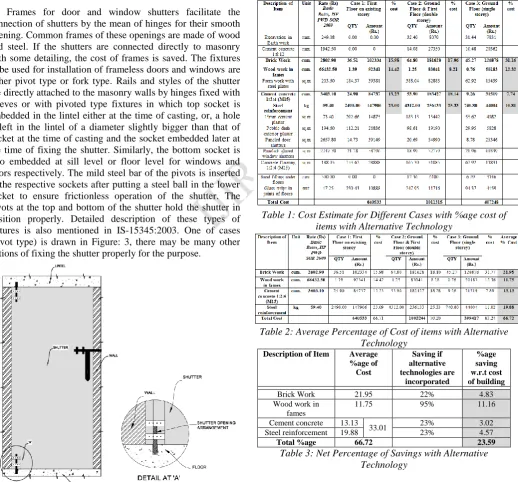
Frames for door and window shutters facilitate the connection of shutters by the mean of hinges for their smooth opening. Common frames of these openings are made of wood and steel. If the shutters are connected directly to masonry with some detailing, the cost of frames is saved. The fixtures to be used for installation of frameless doors and windows are either pivot type or fork type. Rails and styles of the shutter are directly attached to the masonry walls by hinges fixed with sleeves or with pivoted type fixtures in which top socket is embedded in the lintel either at the time of casting, or, a hole is left in the lintel of a diameter slightly bigger than that of socket at the time of casting and the socket embedded later at the time of fixing the shutter. Similarly, the bottom socket is also embedded at sill level or floor level for windows and doors respectively. The mild steel bar of the pivots is inserted in the respective sockets after putting a steel ball in the lower socket to ensure frictionless operation of the shutter. The pivots at the top and bottom of the shutter hold the shutter in position properly. Detailed description of these types of fixtures is also mentioned in IS-15345:2003. One of cases (pivot type) is drawn in Figure: 3, there may be many other options of fixing the shutter properly for the purpose.
Figure 3: Frameless Shutter for Door/Window
II. COST ESTIMATION
Three different cases of building plan namely Case 1; First Floor on Existing Storey, Case 2; Ground Floor & First Floor (two storeyed), and Case 3; Ground Floor (single storeyed) have been analyzed for cost estimation. The Standard Schedule of Rates 2009 Building (civil works) of HP PWD, Government of Himachal Pradesh, INDIA is used for costing of the structures. The specifications for all the cases are kept similar with different sizes, opening schedule, leads & lifts. Cost evaluation is done for all the major items constituting about 95%-97% of the building cost. The percentage cost of the items with alternative technologies are evaluated and tabulated below at Table: 1 with regard to total cost of structure for all the mentioned cases.
Table 1: Cost Estimate for Different Cases with %age cost of items with Alternative Technology
Table 2: Average Percentage of Cost of items with Alternative Technology
Description of Item Average %age of Cost
Saving if alternative technologies are
incorporated
%age saving w.r.t cost of building
Brick Work 21.95 22% 4.83 Wood work in
fames
11.75 95% 11.16
Cement concrete 13.13
33.01 23% 3.02 Steel reinforcement 19.88 23% 4.57
Total %age 66.72 23.59
Page 162 www.ijiras.com | Email: [email protected] III. RESULTS AND DISCUSSIONS
Rat-Trap bond is not a very common pattern of laying bricks for wall construction and it requires initial training of artisans for proper execution. This bond is not only economical alternative (it uses approximately 80 bricks against 100 bricks require in English bond for one square metre of wall, Figure: 4) but is also faster to construct as with only eight courses are required for 950 mm high wall as against eleven courses in conventional English bond. Due to less weight it is lesser vulnerable to earthquake. It is pleasing to view and thermally insulated solution. Due to a margin in air-gap inside two bricks laid on edge, irregular sized bricks can be used effectively.
Figure 4: Wall in English and Rat-Trap Bonds Filler slabs provide better thermal comfort inside space and its lesser weight is favorable for earthquake prevention. Less consumption of cement and aggregates for concrete making results in preservation of natural resources as well. Frames for doors’/windows’ openings are generally made of wood. Savings are done if the frameless option is explored, although some detailing as mentioned above is required for the fixing of shutters.
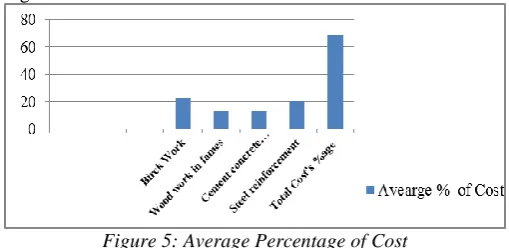
The approximate (averaged for three mentioned cases) percentages of these items are observed as 22 %, 12%, and 33% for brick work (walling), wooden frames for doors’ & windows’ openings and RCC work to the total estimated cost of structure respectively, Table 2. The cumulative percentage of these items constitutes 67% of the building cost as shown in Figure: 5.
Figure 5: Average Percentage of Cost
Further, as evaluated at Table: 3 and shown at Figure: 6, the net total percentage of the savings with the incorporation of these alternative technologies is about 24% of the cost of the building.
Figure: 6 Percentage Saving in Cost with Alternative Construction Techniques
IV. CONCLUSION
The work presented is considered as a small endeavor on reducing of construction cost by incorporation of alternative construction techniques. There are many arrays of technology options available for various elements of building making, leading to cost effectiveness and at the same time not affecting its structural performance. Author is of the opinion to have an increased understanding of the materials available for the construction at local resources. Inclusion of these practices collectively would lead to the cost reduction due less material consumption in the construction without compromising the quality standards. The economically weak sections of society are directly affected/ benefitted by the constructions incorporating these kinds of technologies due to reduced construction cost. The lesser consumption of building making materials like cement, steel, bricks would results to environment conservation. It is worth pointing that these kinds of techniques would definitely benefit the society by reduced cost of construction and saving of natural resources.
Need of housing for all is of primary nature, and at the same time it is a fact that natural resources for manufacturing of building making materials are limited. As such the necessity of switching to alternative/ innovative construction practice is an appreciable effort and the outcome on ground is observed virtually. Further studies be explored and propagated & encouraged like incorporation of wall construction with cement stabilized mud blocks, use of recycled aggregates for making of concrete, solar passive features in the construction to achieve the thermal comfort to the inmates, so that cost effective solution is developed without more damage to the ecology.
REFERENCES
[1] Jain, A. K., & Paliwal, M. C. (2012). Adoption of Appropriate and Cost Effective Technologies in Housing: Indian Experience. World Academy of Science, Engineering and Technology Vol:6 2012-03-26.
[2] Marunmale, A. K. & Attar, A.C. (2014). Designing, Developing and Testing of Cellular Lightweight Concrete Brick (CLC) Wall built in Rat-Trap bond. Current Trends in Technology and Science ISSN: 2279- 0535. Volume: 3, Issue: 4 (June-July 2014).
Page 163 www.ijiras.com | Email: [email protected] Annual Transactions of IESL, pp 38-46, 2008, The
Institution of Engineers Sri Lanka.
[4] Indian Standards Code, IS 15345:2003, “Installation of Frameless Door and Window Shutters — Code of Practice”, Bureau of Indian Standards, New Delhi 110002.
[5] Sengupta, Nilanjan 2008. Use of cost-effective construction technologies in India to mitigate climate change. Current Science, Vol. 94, No. 1, 10 January 2008.
[6] Saileysh, S., Sivaraja, Vijayakumar, S., Thandavamoorthy, T. S., Moses S., Aranganathan, & Chinnaraju, K. (2012). Base Shock Excitation of Rat-Trap Bond Masonry with and Without Roof Slab. ISSN 0974-5904, Volume 05, No. 01.