DOI:10.21276/ijprhs.2017.05.21
Neelima and Likitha Rao CODEN (USA)-IJPRUR, e-ISSN: 2348-6465
Original Article
Development and Validation of New Analytical
Methods for the Estimation of Ritonavir in Bulk and
Pharmaceutical Dosage Forms
KSSN Neelima
1,*, S P Likitha Rao
2Vikas institute of pharmaceutical sciences, Rajahmundry, Andhra Pradesh, India. Azad College of pharmacy, Hyderabad, Telangana State, India.
A R T I C L E I N F O A B S T R A C T
______
1. INTRODUCTION
Drugs and pharmaceuticals are chemicals or like substance, which are of organic, inorganic or other origin. Whatever may be origin we use some property of the medicinal agent to measure them quantitatively or qualitatively. Qualitative analysis is the identification of elements, species or compounds present in a sample1. Quantitative analysis is the determination of the absolute or relative amounts of
International Journal of Pharma Research and Health Sciences
Available online at
www.pharmahealthsciences.net
Received: 23 Jul 2017 Accepted: 04 Sep 2017
Pharmaceutical analysis occupies a pivotal role in statuary certification of drugs and their formulations either by the industry or by the regulatory authorities. The current good manufacturing practices (CGMP) and the Food Drug Administration (FDA) guidelines insist for adoption of sound methods of analysis with greater sensitivity and reproducibility. Therefore, the complexity of problems encountered in pharmaceutical analysis with the importance of achieving the selectivity, speed, low cost, simplicity, sensitivity, specificity, precision and accuracy in estimation of drugs. In the present investigation potent drug namely Ritonavir only few analytical methods were reported and hence there is wide scope for the development of new analytical methods for its quantitative analysis. All the developed methods are complimentary to each other and the proposed methods can be used as alternative methods to reported ones thereby providing a wide choice for routine determination of the Ritonavir in bulk and pharmaceutical preparation. In the present investigation, a simple, sensitive, precise and accurate RP-HPLC method was developed for the quantitative estimation of Ritonavir in bulk and pharmaceutical dosage forms. The results expressed for HPLC is promising. In addition to positive requirements for analytical methods, the striking advantage of all the presently developed methods is that they are economical. And method is validated in terms of accuracy, precision, linearity, and limit of detection, limit of quantitation, and robustness. This method can be used for the routine determination of Ritonavir in bulk and pharmaceutical dosage forms.
Keywords:Ritonavir, pharmaceutical preparation, RP-HPLC, limit of quantitation.
Corresponding author * Mrs KSSN Neelima
Vikas institute of pharmaceutical sciences, Rajahmundry, Andhra Pradesh, India
elements, species or compounds present in a sample. The aim of the study is develop and validate new analytical methods for the estimation of ritonavir in bulk and pharmaceutical dosage forms2,3.
2. MATERIALS AND METHOD
Drug profile4,5
Category: Antiretroviral agent
Chemical name:1,3-thiazol-5-ylmethyl
N-[(2S,3S,5S)-3- hydroxy-5-[(2S)-3-methyl-2-{[methyl({[2-(propan-2-yl)- 1,3-thiazol-4-yl]methyl})carbamoyl]amino}butanamido]-1,6-diphenylhexan-2-yl]carbamate.
Molecular formula:C37H48N6O5S2 Molecular weight:720.944
Description: A white to off-white powder
Solubility: Practically insoluble in water, freely soluble in
Methanol, Ethanol, Acetonitrile
Fig 1: Ritonavir
Methods
Method development, Validation and Forced degradation studies of Ritonavir by RP-HPLC6
Trail-1
Column: INERTSIL C18 250 x 4.6mm Injection Volume: 20 µl
Diluent: Methanol: Water (70:30) Absorbance: 239 nm
Observation: Here the Retention time is too long i.e. 13 and further mobile phase. Polarity should be increased.
Flow rate Methanol Water 1.00 ml/min 50 50
Trail-2
Column: INERTSIL C18 250 x 4.6 mm Injection Volume: 20 µl
Diluent: Methanol: water (70:30) Absorbance: 239 nm
Observation: Theoretical plates < 2000, Tailing factor was found to be > 2.
Flow rate Methanol Water 1.00 ml/min 70 30
Preparation of Ritonavir Tablets7
Ritonavir : 100 mg Cospovidone : 5mg Talc : 5mg Magnesium stearate:5mg
Micro crystalline cellulose:120 mg Method: Direct compression method
Preparation of Sample solution
Ten tablets were accurately weighed and crushed. Powder equivalent to 2 tablets was taken and transferred into 200 ml volumetric flask, followed by the addition of 170 ml of diluent, sonicated and diluted upto the mark. From this 4 ml was taken and diluted to 25 ml with the diluent, filtered through 0.45 µ nylon syringe filter. 20 µ L of the standard, sample solution (160μg/ml) was injected into the
chromatographic system, area for the Ritonavir peak was measured and the % Assay was calculated by using the formulae8, 9.
3. RESULTS & DISCUSSIONS
Method development, Validation and Forced degradation studies of Ritonavir by RP-HPLC:
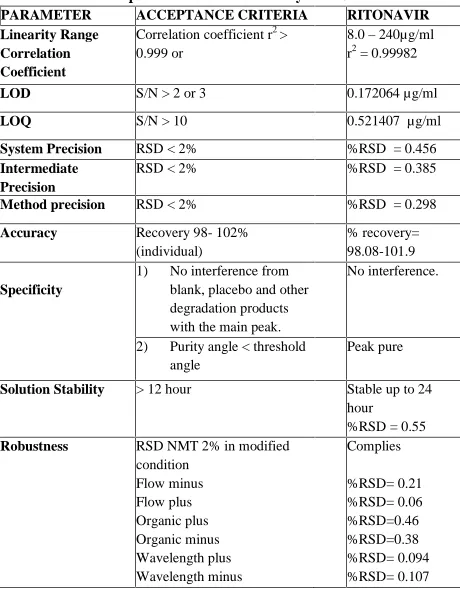
The development of an analytical method for the determination of drugs by HPLC has received considerable attention in recent years because of their importance in quality control of drugs and drug products. The objective of this study was to develop a simple, rapid, precise, accurate and sensitive HPLC method for the analysis of Ritonavir in bulk and its pharmaceutical dosage form by using solvent system of ACN: OPA in the ratio 55:45 and Zodiac C18, 150mm x 4.6mm, 5µ m stationary phase. The chromatographic condition is set at flow rate of 1ml/min with PDA detector at 239 nm. As per ICH requirements validation studies are carried out by using freshly prepared solutions10. Optical characteristics were given in table no.1
Table 1: Validation parameters of Ritonavir by HPLC
PARAMETER ACCEPTANCE CRITERIA RITONAVIR Linearity Range
Correlation Coefficient
Correlation coefficient r2> 0.999 or
8.0–240µg/ml r2= 0.99982
LOD S/N > 2 or 3 0.172064 µg/ml
LOQ S/N > 10 0.521407 µg/ml
System Precision RSD < 2% %RSD = 0.456
Intermediate Precision
RSD < 2% %RSD = 0.385
Method precision RSD < 2% %RSD = 0.298
Accuracy Recovery 98- 102% (individual)
% recovery= 98.08-101.9
Specificity
1) No interference from blank, placebo and other degradation products with the main peak.
No interference.
2) Purity angle < threshold angle
Peak pure
Solution Stability > 12 hour Stable up to 24 hour %RSD = 0.55
Robustness RSD NMT 2% in modified condition
Flow minus Flow plus Organic plus Organic minus Wavelength plus Wavelength minus
Complies
Effect of solvents on λmaxof Ritonavir:
The solubility of Ritonavir was determined as per Indian pharmacopeia. As the drug Ritonavir is insoluble in all the solvents initially drug was dissolved in methanol and further dilutions were made with corresponding solvents11. And the concentration prepared was 10 µ g/ml. λmaxof Ritonavir in
various solvents were tabulated.
Table 2: λmax ofRitonavir in various solvents
S.No. Solvent λmax(nm)
1. Methanol 239
2. Water 240
3. 0.1N HCl 241.5
4. 0.1N NaOH 240.5
Method development and Validation of Ritonavir by Titrimetry:
A simple precise, rapid accurate and sensitive non-aqueous titration method was developed for quantitative determination of Ritonavirin pharmaceutical dosage form.The titration was carried out using standardized 0.1 N perchloric acid. The proposed method was found to be precise with % RSD =1.86 which is less than 2 (n = 6). The method showed strict linearity (r2 = 0.999) of 100 mg of drug substance weight. The percentage recovery of Ritonavir in the optimized method was between 100.03 % to 101.85 %. The method is also found to be rugged when checked by different analysts and using different lots of reagents and different makes of titrators12.
Method development, Validation and Forced degradation studies Of Ritonavir by UV Spectroscopy:
An effort has been made to identify a simple, precise, rapid, specific and accurate method for the estimation of Ritonavir in bulk and in formulation.The solubility of Ritonavir was determined as per Indian pharmacopoeia. Number of solvents tried include Distilled water, Methanol, Ethanol, Acetonitrile, Isopropanol. It is insoluble in Distilled water. It is freely soluble in Methanol and ethanol. It is very slightly soluble in 0.1N HCl. By considering thecost of Methanol, solubility of the drug was tried with 0.1NHCl and to increase the solubility intially drug was dissolved in methanol, further dilutions were made with 0.1N HCl. The solution was scanned in UV region in the wavelength range from 200-400 nm against solvent as the blank. From the spectrum of Ritonavir the wavelength maxima was found to be 243.5 nm. Different aliquots of Ritonavir were prepared in the concentration range of 10-30µ g/ml with the solvent. The absorbances of solution were measured at 243.5 nm. The calibration curve was plotted using concentration Vs absorbance. The correlation coefficient value for the calibration graph was found to be 0.999. The slope and intercept value was found to be 0.009 and 0.083 respectively. It indicates that the concentration of Ritonavir has a good linearity in the range 10-50 µ g/ml.
LOD and LOQ values are calculated from the linearity studies. Linearity study was performed three times and the value of slope and intercept were calculated from the
calibration curve. The LOD was found to be 2.5 µ g/ml and LOQ was found to be 7 µ g/ml.
The percentage purity was calculated and it was found to be 99. The accuracy of the method was performed by recovery studies. To the pre analysed formulation a known quantity of Ritonavir raw material solution was added at different levels viz., 50%, 100%, 150%. The absorbances of the solutions were measured and the percentage recovery was calculated. The percentage recovery was found to be 99.40-101.50%.. It was indicated that there was no interference with excipients used in the formulation during the analysis of Ritonavir. Hence the method was found to be accurate13.
Precision studies were done with the Ritonavir standard (20 µ g/ml). The absorbance of the Ritonavir standard at 243.5 nm was measured for six times and recorded. The % RSD value for six replicate absorbance was found to be 0.855% i.e., within the specified limit. Based on forced degradation studies according to the ICH requirements, this methodcan be used for the routine and quality control analysis of Ritonavir in bulk and pharmaceutical dosage forms.
Method development and Validation of Ritonavir by Visible Spectroscopy:
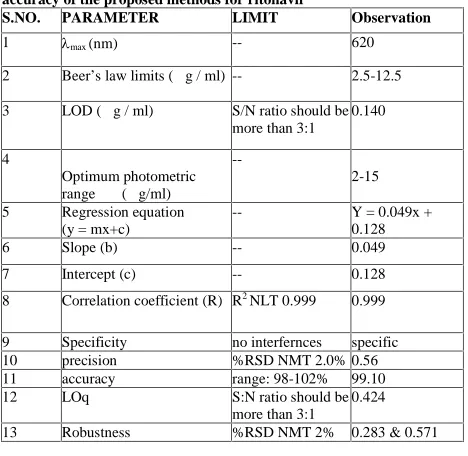
The recommended procedure is accurate, sensitive, and precise and is adapted to micro determinations of Ritonavir in bulk and pharmaceutical preparations. It may be used in routine determination of Ritonavir. The chemistry involved in the above proposed methods to give various colored chromogens can be explained by the following scheme. Ritonavir undergoes oxidation in the presence of ferric chloride and forms complex with MBTH reagent.
Table 3: Optical characteristics, regression data, precision and accuracy of the proposed methods for ritonavir
S.NO. PARAMETER LIMIT Observation
1 max(nm) -- 620
2 Beer’s law limits ( μg / ml)-- 2.5-12.5
3 LOD ( μg / ml) S/N ratio should be more than 3:1
0.140
4
Optimum photometric range ( μg/ml)
--2-15
5 Regression equation (y = mx+c)
-- Y = 0.049x +
0.128
6 Slope (b) -- 0.049
7 Intercept (c) -- 0.128
8 Correlation coefficient (R) R2
NLT 0.999 0.999
9 Specificity no interfernces specific
10 precision %RSD NMT 2.0% 0.56
11 accuracy range: 98-102% 99.10
12 LOq S:N ratio should be
more than 3:1
0.424
13 Robustness %RSD NMT 2% 0.283 & 0.571
4. CONCLUSION
complimentary to each other and the proposed methods can be used as alternative methods to reported ones thereby providing a wide choice for routine determination of the Ritonavir in bulk and pharmaceutical preparation.
1.) Stability indicating RP-HPLC method:
In the present investigation, a simple, sensitive, precise and accurate RP-HPLC method was developed for the quantitative estimation of Ritonavir in bulk and pharmaceutical dosage forms.The results expressed in
Tables: 7-19 for HPLC is promising. In addition to positive
requirements for analytical methods, the striking advantage of all the presently developed methods is that they are economical. And method is validated in terms of accuracy, precision, linearity, and limit of detection, limit of quantitation, and robustness. This method can be used for the routine determination of Ritonavir in bulk and pharmaceutical dosage forms.
2.) Effect of solvents on λ max:
Chromophores (e.g., Ritonavir) give rise to “characteristic”
absorbance bands. Changes in theirenvironment (solvent) cause changes in their energy levels which then affect the wavelength and theintensity of absorbance. The experiment shows that external factors, in this case the solvent used, canalso influence the chromophore. Because the substance used shows both strong and weakabsorbance bands at different wavelengths, four different solvent concentrations will beexamined. This concludes that λmax changes based
upon solvent for the same drug molecule and the Ritonavir
showed different λmax in different solvents.
3.) Titration :
The proposed method of non-aqueous potentiometric titration was found to be precise, accurate and rugged. It requires simple apparatus as compared to methods reported in literature. The values of percentage recovery and standard deviation showed sensitivity. The method was completely validated. It showed satisfactory data for all the parameters of validation. Hence it can be applied for routine quality control application. Hence method is strongly recommended for quality control of method of Ritonavir.
4.) UV spectroscopy:
Quantitative estimation of poorly water-soluble drugs involves use of organic solvents. Major drawbacks of organic solvents include high cost, volatility and toxicity. Majority of the methods reported for Ritonavir estimation by UV Spectroscopy were by methanol which is costlier than 0.1N HCl. The present work demonstrates simple, rapid,accurate, reproducible and economical method for the estimation of Ritonavir by UV using 0.1N HCl. It is highly suitable for routine analysis of the drug to monitor quality control of drug products.
5.) Visible spectroscopy:
Among the several techniques [HPLC, GC, NMR, MS, IR] available for the assay of drugs, the visible spectrophotometric technique is simple and less expensive. The selectivity and sensitivity of the visible
spectrophotometric method depends only on the nature of the chemical reactions involved in color development. A simple, sensitive and reproducible visible spectrophotometric method have been developed for the quantitative determination of Ritonavir in bulk drug and pharmaceutical dosage forms using MBTH and Ferric chloride by oxidation coupling.
5. REFERENCES
1. K.Seetaramaiah, A.Anton Smith, K.Ramya Teja et al., Spectrophotometric determination of Ritonavir in bulk and pharmaceutical formulation Sci. Revs. Chem. Commun.: 2012; 2(1): 1-6.
2. K.Chiranjeevi, K.P.Channabasavaraj, P.Srinivas Reddyet al., Development and validation of spectrophotometric method for quantitative estimation of Ritonavir in bulk and pharmaceutical dosage forms. International Journal of ChemTech Research, 2011; 3(1): 58-62.
3. Anindita Behera, Swapan Kumar Moitra, Sudam Chandra Siet al., Method development, validation and stability study of Ritonavir in bulk and pharmaceutical dosage form by spectrophotometric method. Chronicles of young scientist, 2011; 2(3): 161-167.
4. K. Chiranjeevi, G. Vijaya Kumar, K.P. Channabasavaraj,et al.,Third order derivative spectrophotometric estimation of Ritonavir in bulk and pharmaceutical dosage forms. International Journal of Pharmaceutical Sciences, 2011;3(1): 1017-1020. 5. Veera Venkata Satyanarayana Peruriand Murali
Musuluri RP-HPLC Method for the Estimation of Ritonavir in Pharmaceutical dosage forms. Journal of Pharmacy Research, 2011; 4(9): 3049-3051.
6. K. Chiranjeevi and K. P. Channabasavaraj Development and validation of RP-HPLC method for quantitative estimation of Ritonavir in bulk and pharmaceutical dosage forms. International journal of pharmaceutical science and research 2011; 2(3): 596-600.
7. T.Sudha, R.Vanitha and V.Ganesan Development and validation of Rp-Hplc and Hptlc methods for estimation of Ritonavir in bulk and in pharmaceutical formulation.Der Pharma Chemica, 2011; 3(2): 127-134. 8. Anindita Behera, Swapan Kumar MoitraSimple
validated isocratic RP – LC method for estimation of Ritonavir in bulk and tablet dosage form.Der Pharmacia Lettre, 2011; 3(1): 145-151.
9. C.L. Dias, R.C. Rossi, E.M. Donato, Liquid chromatography determination of Ritonavir, a HIV protease inhibitor, in soft gelatin capsules. 2005; 62(11-12): 589-593.
11. P. D. Sethi, Quantitative Analysis for Pharmaceutical Formulation, CBS Publishers and Distributors, New Delhi, 2001; 1st edition: 7-50.
12. Asean Guidelines for Validation of Analytical
Procedures”, Adopted from ICH Guidelines, ICH Q2A-27th Oct.1994; ICH Q2B-6th Nov.1996.
13. Chung Chow Chan, Lee Y.C, Herman Lam, Xue-Ming Zhang. Analytical Method Validation and Instrument Performance Verification. A John Wiley and Sons, 2004; 15: 16-21.
Conflict of Interest: None