Available online at
www.ijpras.comVolume 1, issue 4 (2012), 40-45
International Journal of Pharmaceutical Research &
Allied Sciences
40
Stability Indicating RP-HPLC Assay Method Development and Validation
for Determination of Deferasirox in Tablet Dosage Form
Jayesh R. Kothawade*, Kapil M. Agrawal, Vishal S. Lad.
Department of Quality Assurance.R. C. Patel Institute of Pharmaceutical Education and Research,Karwand Naka, Shirpur, Dist. Dhule (MS) India - 425 405.
Email id: [email protected]
Subject: Pharmaceutical Analysis
Abstract:
A simple stability indicating RP-HPLC assay method has been developed and validated for the determination of Deferasirox from tablet dosage form. Drugs were determined on a Hypresil BDS 150 × 4.6mm column packed with 5µ m particles. The optimized mobile phase was a 50: 50 (v/v) Buffer (1ml OPA in 2lit Milli Q Water) and Acetonitrile, pumped at a flow rate of 1 ml/min. UV detection was performed at 245 nm. The method was validated in the concentration ranges of 50 to 150 ppm where it demonstrated good linearity with r2= 0.998. The method was found to be robust, resisting to small deliberate changes in flow rate, column temperature and composition of the mobile phase. Degradation was observed for Deferasirox in the conditions of acid, base and peroxide. The drugs were found to be stable during photo-degradation. The degradation products were well resolved from main peak. The applicability of the method was demonstrated by determining the drug content of commercial pharmaceutical formulations, where it exhibited good performance.
Keywords:
RP-HPLC, Stability indicating assay, Deferasirox. Introduction:Deferasirox is an oral iron chelator. Its main use to reduce chronic iron overload in patients who are receiving long term blood transfusion for conditions such as beta-thalassemia and other chronic anemias. It is first oral medication approved in the USA for this purpose. Chemically 4-[(3Z,5E)-3,5-bis(6-oxo-1-cyclohexa-2,4-dienylidene)-1,2,triazolidin-1-yl] benzoic acid.
Deferasirox is a white white crystalline powder with a Molecular weight 373.4. Deferasirox is freely in Dimethyl formamide, Dimethyl. Its melting point is 116o to 117°C. Official in any pharmacopoeia and till now, few liquid chromatographic procedures have been developed for the determination of Deferasirox. However there are no publications concerning the analysis of Deferasirox. However, there are no publications concerning the analysis of Deferasirox in pharmaceutical dosage forms, so it is necessary to develop a liquid. Chromatographic (LC) procedure which would serve as a rapid and reliable method for the determination of Deferasirox in pharmaceutical dosage forms. Finally the method was thoroughly validated for the assay determination of Deferasirox tablets.
Materials and Method:
Chemicals and Reagents:Deferasirox tablets (Brand Name- Exjade) were manufactured by Glenmark Generics Ltd. Navimumbai (Purity 99.5%). Analytical reagent grade reagents (orthophosphoric acid 85% solution) and HPLC grade Methanol, Acetonitrile. High quality HPLC water was prepared by Milipore purification system.
Figure no: 1 Chemical structure of deferasirox
41
mobile phase consists of mixture of buffer (1ml OPAin 2lit Milli Q Water) and Acetonitrile in the ratio of 50:50 (v/v) was used in the analysis. Other parameters such as flow rate 1 ml/min, column temperature 25°C, injection volume 10µl and UV detection at 245nm were used for study.
Standard solutions:
Weighed accurately and 50mg of Deferasirox working standard and transfered it into 100ml volumetric flask. Add about 50-60 ml diluent and sonicate to dissolve. Make up to the mark with diluent & mix. Dilute 5ml of this solution to 50ml with diluent. To obtained 50 ppm solutions.
Sample solution:
Weighed accurately about 50mg of deferasirox sample and transfer it into a 100ml volumetric flask. Add about 50-60ml of diluents and sonicate to dissolve. Make up to the mark with diluents and mix. Dilute 5ml of this solution to 50ml with diluent and mix. Sample solution filtered through 0.45µ nylon filter.
Validation of proposed Method:
Proposed method was validated according to ICH guidelines Q2B [25].
Linearity:
Linearity of the proposed method was evaluated according to the ICH guidelines by the analysis of working solutions of Deferasirox at different concentrations. Taking into account the purpose of the assay, the linearity ranges were 50-150 % of deferasirox in the tablet samples.
Precision:
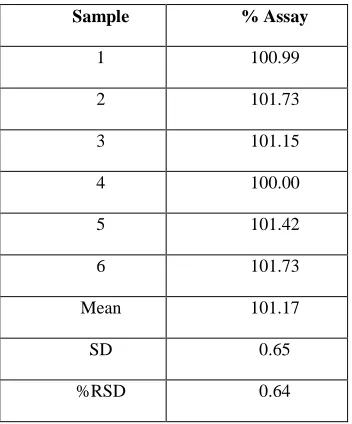
System precision was determined by performing injection repeatability test and % RSD was calculated. Method precision (intra-day precision) was evaluated by carrying out six independent assays of test samples against a reference standard. The % RSD of six assay values obtained was calculated. The intermediate precision (inter-day precision) of the method was also evaluated using two different analysts and different days in the same laboratory. Accuracy:
The accuracy of the method was determined by measuring the drug recoveries by the standard addition method, in order to determine eventual positive or negative interferences produced by the excipients in the formulation. Known amounts of each drug, corresponding to 50%, 100% and 150% of the label claim were added to placebo and their percentage recoveries were calculated. Each set of additions was repeated three times.
Selectivity:
Selectivity of the method was demonstrated after observing that the excipients did not produce absorption peaks in the chromatogram and did not
interfere with the exact determination of the analytes in the accuracy assay.
Force Degradation Study:
Interference from the degradation in the analyte
determination was studied by observing sample under various stressed conditions. The purpose of stability indicating assay method is to provide evidence that the analytical method is efficient in determination of drug substances in commercial drug product in the presence of its degradation products. Stress study was carried out under the degradative conditions of acid, base, Peroxide and Photo-degradation.Acidic degradation:
Transfer 12 tablets into 500mL volumetric flask. Add 300 mL of diluent and sonicate with intermittent vigorous shaking. Cool at room temperature and add 10 mL of 5N Hcl & shake vigorously for some moment. Add 5N NaOH to neutralize the solution, comparing the pH with control sample by pH meter cooled to room temperature. Dilute the solution upto the mark with diluent. Filtered through 0.45µ syringe filter and inject the solution.
Base Degradation:
Transfer 12 tablets into 500mL volumetric flask. Add 300 mL of diluent and sonicate with intermittent vigorous shaking. Cool at room temperature and add 10 mL of 0.1N NaOH & keep the solution for 10 min with intermittent shaking. Add 0.1N Hcl to neutralize the solution. Cool at room temperature. Dilute the solution up to the mark with diluent. Filtered through 0.45µ syringe filter and inject the solution.
Peroxide Degradation:
Transfer 12 tablets into 500mL volumetric flask. Add 300 mL of diluent and sonicate with intermittent vigorous shaking. Cool at room temperature and add 10 mL of 50% H2O2 & keep the solution for 3Hour at room temperature with intermittent shaking. Cool at room temperature. Dilute the solution up to the mark with diluent. Filtered through 0.45µ syringe filter and inject the solution.
Stability of Analytical Solution:
The sample and standard preparations were stored at room temperature and tested against freshly prepared standard preparation for 24 hours.
Robustness:
Robustness was performed by deliberately changing the chromatographic conditions. The flow rate of the mobile phase was changed from 1 ml/min to 0.9 ml/min and 1.1 ml/min. The bile phase composition (48:52 and 52:48) was varied by ±2ml , column temperature varies by ±5oC. Standard solution was injected six times in replicate for each change. % RSD’s were calculated.
Result and Discussion:
Method Development:42
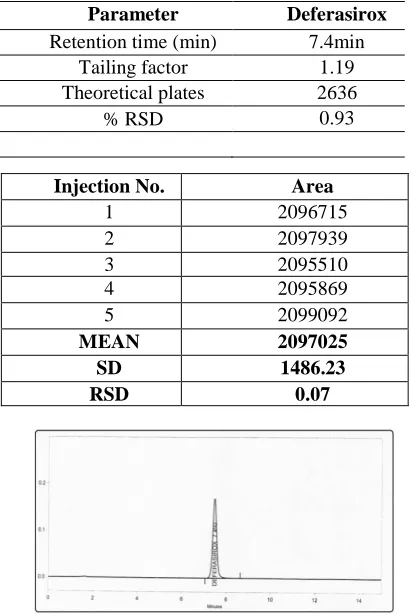
well resolved and sharp peaks for Deferasirox witha retention time of 7.4 min. A wavelength of 245 nm selected for quantification of the drugs, good resolution of peaks with good selectivity. System suitability parameters of proposed RP-HPLC method shown in table 1. And optimized chromatogram is shown in figure. 2
Table 1. System Suitability Parameter of Proposed RP-HPLC Method
Figure 2: Chromatogram showing well resolved peaks of Deferasirox
Table no: 2 Statistical Analysis or Calibration Curve of Deferasirox
Optimal conditions used during validation:
• Column- HYPRESIL BDS (150 × 4.6mm, 5µ).
• Mobile phase- Buffer (1ml OPA in 2lit Milli Q Water): Acetonitrile (50:50).
• Flow rate- 1.0 ml/min.
• Total Analysis Time- 12min.
• Detection wavelengths- 245 nm.
Linearity
The calibration curve for Deferasirox was found to be linear in the range of 50%-150% with a correlation coefficient of 0.998. The equation obtained for the calibration curve of Deferasirox was y = 427.4x The statistical data of linearity is shown in Table 2.
Table 3: The statistical data of linearity
Figure 3: Linearity Graph for Deferasirox. Precision:
The relative standard deviations in repeatability analysis (% RSD) were 0.07 for Deferasirox, which are well within the acceptable limit of less than 2.0%. Precision data for system precision and method precision shown in table 4.1 and 4.2. Parameter Deferasirox
Retention time (min) 7.4min Tailing factor 1.19 Theoretical plates 2636
% RSD 0.93
Injection No. Area
1 2096715
2 2097939
3 2095510
4 2095869
5 2099092
MEAN 2097025
SD 1486.23
RSD 0.07
%Conc. of sample
Conc. PPM
Mean Response
(Area)
Statistical analysis
50 25.1 10774 Correla tion
0.998 80 40.2 17323
100 50.2 20995 Interce pt
1157.3 7931 120 60.2 26022
150 75.3 32171 Slope 42720
%Conc. of sample
Conc. (PPM)
Mean Response
(Area)
Statistical analysis
50 25.1 10774 Correlation 0.998
80 40.2 17323
100 50.2 20995 Intercept 1157.37 120 60.2 26022
43
Table4.1 Method PrecisionTable 4.2 System Precision
Table 5. Recovery Analysis of Deferasirox
Accuracy:
Accuracy of the method was determined by calculating recoveries of Deferasirox by method of standard addition. The mean recoveries found to be 101.86%. for Deferasirox (Table 4). The high recovery values indicate that the method is accurate.
Selectivity:
Selectivity of the method was demonstrated after observing that the excipients did not produce absorption peaks in the chromatogram and did not interfere with the exact determination of the analytes in the accuracy assay in addition, chromatograms were completely super imposable with those recorded by simultaneous detection at 245 nm, all of which served as indication that the determination was not interfered by any of the ingredients.
Forced Degradation
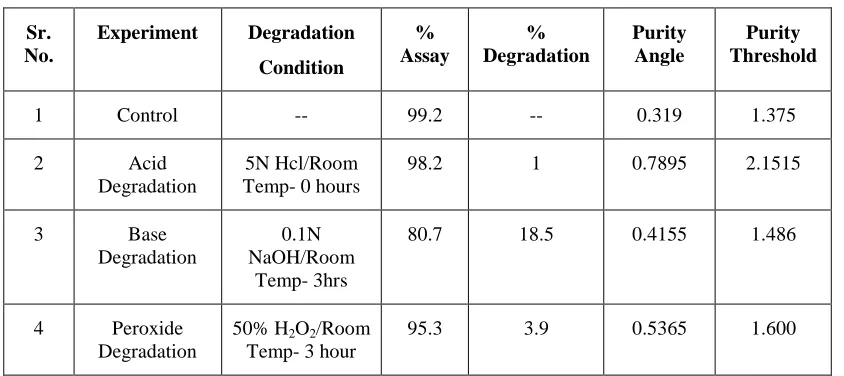
No degradation was observed during UV exposure. Degradation was observed in acidic, basic and peroxide conditions. The table 6 indicates the degradation condition and peak purity data.
Robustness:
The robustness of the proposed method was examined against small, deliberate variations of critical parameters such as the composition of the mobile phase, flow rate and column temperature. Robustness indicates that small and deliberate changes were not significantly affecting the determination so method was found to be robust. The detail data of robustness study is shown in table 7.
Table 7. Data for Robustness
Stability of Analytical Solution:
The sample and standard preparations were stored at room temperature and tested against freshly prepared standard preparation for 24 hours. The assay results are within the limit. Results are shown in table 8.
Sample % Assay
1 100.99
2 101.73
3 101.15
4 100.00
5 101.42
6 101.73
Mean 101.17
SD 0.65
%RSD 0.64
Injection No. Area
1 2096715
2 2097939
3 2095510
4 2095869
5 2099092
MEAN 2097025
SD 1486.23
RSD 0.07
Accuracy Level
Amount Added
Amt. Recovered
%Reco very
50% 25.30 25.85 102.2
50% 25.40 25.98 102.3
100% 50.30 50.55 100.5
100% 50.60 50.49 99.8
150% 75.40 77.52 102.8
150% 75.20 77.73 103.4
MEAN : 101.86 % SD : 0.32
RSD : 0.32
Parameter % ASSAY
Mobile phase composition
48:52 101.17 52:48 101.17 Flow rate (in
ml/min.)
0.9 101.27
1.1 101.31
STATISTICAL PARAMETERS
MEAN 101.25
SD 1.1
44
Conclusion:
A simple, specific, precise and accurate RP-HPLC method has been developed for quantitative determination of Deferasirox in tablet formulation. The developed method was validated based on ICH guidelines. Statistical analysis proves that the method is reproducible and selective for the analysis of Deferasirox as bulk drug and in pharmaceutical formulations. The developed method is stability-indicating as all degradants were resolved well and method can be used for assessing stability of tablet formulation. The advantages of the proposed methods involve a simple procedure for sample preparation and relatively short time of analysis. The proposed RP-HPLC method is suitable for the analysis of Deferasirox in presence of its degradation products in commercial tablets.
Acknowledgements
I would like to thanks my beloved parents and my research guide Mr.K M Agrawal & Dr. H.S. Mahajan for their important guidance and support to every stage.
“Cite this article”
J. R. Kothawade, K.M.. Agrawal, V.S. Lad.
“Stability Indicating RP-HPLC Assay Method Development and Validation for Determination of Deferasirox in Tablet Dosage Form” Int. J. of Pharm. Res. & All. Sci.2012; Volume 1, Issue 4,40-45
Table 8. Stability of Analytical Solution
Table 6. Results of Forced Degradation Study Sr.
No .
Name of solutions % Content % Correlation
1 Standard Solution - 0 hours 100.0 --
2 Standard Solution - 24 hours 99.3 99.3
4 Sample Solution - 0 hours 98.0 --
5 Sample Solution - 24 hours 98.8 100.8
Sr. No.
Experiment Degradation
Condition
% Assay
% Degradation
Purity Angle
Purity Threshold
1 Control -- 99.2 -- 0.319 1.375
2 Acid
Degradation
5N Hcl/Room Temp- 0 hours
98.2 1 0.7895 2.1515
3 Base
Degradation
0.1N NaOH/Room
Temp- 3hrs
80.7 18.5 0.4155 1.486
4 Peroxide Degradation
50% H2O2/Room Temp- 3 hour
45
References:
1. Drug Bank database, Deferasirox (DBO1609). 2. PDR: Physician’s Desk reference, edn 61 (2007). 3. Kaja RK, Radhakrishna KV, Satish P, Satyanarayana
J, P.V.V, A Stability Indicating LC Method for Deferasirox in Bulk Drugs and Pharmaceutical Dosage Forms.
4. Snyder R, Kirkland J, Joseph Glajch I, Practical HPLC Method Development Second Edition Lloyd. 5. Remington’s The science and Practice of Pharmacy,
edn 20, 2000.
6. Sockalingam A, Indumathy NR, Shanmugapandiyan P, and Sridhar SK, Journal of Pharmaceutical Analysis, 2005 39(3), 801-804.
7. Ponnilavarasana I, Rajasekarana A, Dharumana JG, Kalaiyarasia D, Senthilkumara M, Journal of Nanomaterials and Biostructures 2010, 5(3), 771-778.
8. Steinhauser S, Heinz U, Bartholomä M, Weyhermüller T, Nick H, Hegetschweiler K, Complex Formation of ICL670 and Related Ligands with FeIII and FeII , 13 SEP 2004.
9. Wood JC, Otto-Duessel M, Aguilar M, Nick H, Nelson MD, Coates TD, Pollack H, Moats R, Cardiac iron determines cardiac T2*, T2, and T1 in the gerbil model of iron cardiomyopathy, Circulation, 2005, 112(4) 535-543.
10. Asian Guideline for Validation of Analytical Procedure Adopted from ICH guideline, Q2A27 Oct. 1994 and ICH Q2B, 6th Nov. 1994.