ISSN (e): 2250-3021, ISSN (p): 2278-8719
Vol. 08, Issue 3 (March. 2018), ||V1|| PP 67-75
An Experimental Analysis on the Effects of Additives with Blends
of Alternative Fuels on CI Engine Performance Using Modified
Piston Geometry
M. Suresh
1, R. Hari Prakash
2, B. Durga Prasad
31Asso. Prof.& HOD, Dept. of ME, Gokula Krishna College of Engineering, Sullurpet. 2Pincipal, Brahmaiah College of Engineering, Nellore
3
Professor & Head, Dept. of ME, JNTUA College of Engineering, Ananthapuramu.
Corresponding Author:
M. Suresh
Abstract
:Around the world, there is a growing increase in biofuels consumption, mainly ethanol and biodiesel as well as their blends with diesel that reduce the cost impact of biofuels while retaining some of the advantages of the biofuels. The usage of additive is also predominant in the current era of auto motives. The inclusion of small amounts of chemical lead to improvement of many engine, combustion and emission characteristics. In this paper, the improvement in performance of engine is experimentally analyzed by considering four additives. These are 2-Ethylhexyl Nitrate, Octyl Nitrate, Isopropyl Nitrate and Di-Tert-Butyl Peroxide. These additives are added to two alternate fuel blends, one from Thurayi seed oil and other from Cuban royal palm seed oil. In addition to the investigation of these fuels in standard piston, two modified of piston configurations are considered the effect of additives is also inspected.Keywords:
Additives, CI engine, Emission analysis, Nitrate additives, Piston geometry.--- Date of Submission: 15-03-2018 Date of acceptance: 03-03-2018 ---
I.
INTRODUCTION
Fuel additives are natural substances dissolvable in fuels. Around 20 properties of fuels can be enhanced, retained or bestowed new advantageous attributes by the inclusion of small amounts of specific chemicals denoted as fuel additives. Fuel additives are included at a level from a few ppm to a few thousand ppm. It is imperative that additives which improve some properties do not impair different other properties and fuel quality. Some of these additives may help to maintain fuel quality (e.g., antioxidants, stabilizers, corrosion inhibitors, and biocides). Others may help the development of fuel through the dispersion into the vehicle tank (e.g., flow improvers, pipeline drag reducers, demulsifiers and antifoams); may be included for legal reasons (e.g., colors and markers) or can address particular concerns from engine manufactures (e.g., deposit control additives and lubricity improvers).103 Fuel additives in diesel, biodiesel and their blends improves the fuel characteristics of hence show the following benefits [1].
Suppression of corrosion of fuel tanks, channel lines etc.
Suppression of catastrophic wear of fuel system equipment in the diesel engine. Diminished pumping expenses and energy use in long distance fuel pipelines. Improvement in diesel cetane, octane parameters.
Improvement of cold flow in middle distillates, boosting utilization of biofuel. Changes of stability to enhance long time storage of fuels.
Improved vehicle performance and economy. Decrease in noxious emissions.
Enhanced fluid stability over a more extensive range of conditions.
Improvement of viscosity number and reduction of the rate of change of viscosity with temperature. Enhanced ignition by decreasing delay time, flash point, etc.
Reduction of wear with agents that adsorb onto metal surfaces and provide chemical to-chemical contact as opposed to metal-to-metal contact under high-load condition.
fuel in cold weather. Higher concentration of antioxidants showed a remarkable increase of acid values at antioxidant levels of 1000 mg kg-1. In this work, four additives are considered. These are 2-Ethylhexyl Nitrate, Octyl Nitrate, Isopropyl Nitrate and Di-Tert-Butyl Peroxide [3][4].
II.
ADDITIVES
The additives considered in this work are:1. 2-Ethylhexyl Nitrate 2. Octyl Nitrate 3. Isopropyl Nitrate 4. Di-Tert-Butyl Peroxide
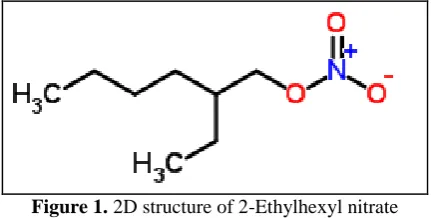
2-Ethylhexyl nitrate (2-EHN) is a major fuel additive, has been used to increase the cetane number of diesel. The 2D structure of 2-Ethylhexyl nitrate is given in Figure 1. The molecular formula of 2-Ethylhexyl nitrate is C8H17NO3. The average mass of 2-Ethylhexyl nitrate is 175.225Da and Monoisotopic mass is 175.120850Da [5].
Figure 1. 2D structure of 2-Ethylhexyl nitrate
Octyl Nitrate is another additive with same molecular formula, same average mass and monoisotopic mass as that of 2-Ethylhexyl nitrate. But the 2D structure of Octyl Nitrate is different from that of 2-Ethylhexyl nitrate [6]. The 2D structure of Octyl nitrate is given in Figure 2.
Figure 2. 2D structure of Octyl Nitrate
Isopropyl Nitrate is a clear colorless liquid with a pleasant odor. May spontaneously decompose and explode under prolonged exposure to fire or heat. Denser than water and insoluble in water. Vapors are heavier than air. Produces toxic oxides of nitrogen during combustion. The 2D structure of Isopropyl Nitrate is given in Figure 3. The molecular formula of Isopropyl Nitrate is C3H7NO3. The average mass of Isopropyl Nitrate is 105.093Da and Monoisotopic mass is 105.042595Da [7].
Di-Tert-Butyl Peroxide is a clear colorless liquid used as additive. The 2D structure of Di-Tert-Butyl Peroxide is given in Figure 4. The molecular formula of Di-Tert-Butyl Peroxide is C8H18O2. The average mass of Di-Tert-Butyl Peroxide is 146.227Da and Monoisotopic mass is 146.130676Da [8].
Figure 4. 2D structure of Di-Tert-Butyl Peroxide
III.
ENGINE MODIFICATION
The Performance, emissions and combustion characteristics of diesel engines depend on various factors like the engine design, operating parameters and fuel properties. The engine design, particularly the combustion chamber design in a direct injection diesel engine has to achieve a high degree of air movement inside the cylinder in terms of swirl, squish and turbulence, in order to prepare better air-fuel mixture, to promote the evaporation in a very short time and to achieve higher combustion efficiency [9]. If a good mixture can be achieved, the resulting combustion is both clean and efficient, with all the fuel burned and minimal exhaust remaining. The conventional combustion chamber has been optimized for combustion of diesel fuel, including improvement of mixing between injected diesel and in-cylinder air, but not for derived alternate fuel. With this background, in order to achieve enhanced engine characteristics with the derived alternate fuel from biodiesel, combustion chamber modification is mandatory [10]. The dimensions of the pistons are chosen so as to maintain the same piston bowl volume. The fuel injection quantity was maintained the same for all the piston geometries. In respect of the design modification with the combustion chamber geometry, the conventional hemispherical combustion chamber is modified to have SCC and TCC. The piston bowl geometry is modified without changing the compression ratio of the engine. This is realized by modelling the combustion bowl geometry using CAD initially and when the volume is found to attain the constant value, the geometric dimension are finalized. Followed by this, the combustion bowl in piston geometry is fabricated based on the obtained design and used for the experimental investigation in a diesel engine fuelled with biodiesel [11].Two piston configurations, toroidal combustion chamber (TCC) and swirl blade combustion chamber (SCC) were designed in such a way that the piston bowl volumes of these modified bowls are exactly the same with that of the original engine. This will ensure a similar compression ratio between models. In the design of SCC, a small baffle plate is welded in the piston [12]. The swirl inducing blade has six holes of 2.5mm diameter were drilled. This setup was chosen to investigate, how the distribution of vortices inside the bowl enhances combustion. The piston configurations are shown below in Figures 5, 6 and 7.
Figure 6. Dimensions for toroidal combustion chamber (P1)
Figure 7. Dimensions for swirl blade combustion chamber (P2)
IV.
PERFORMANCE WITH ADDITIVES
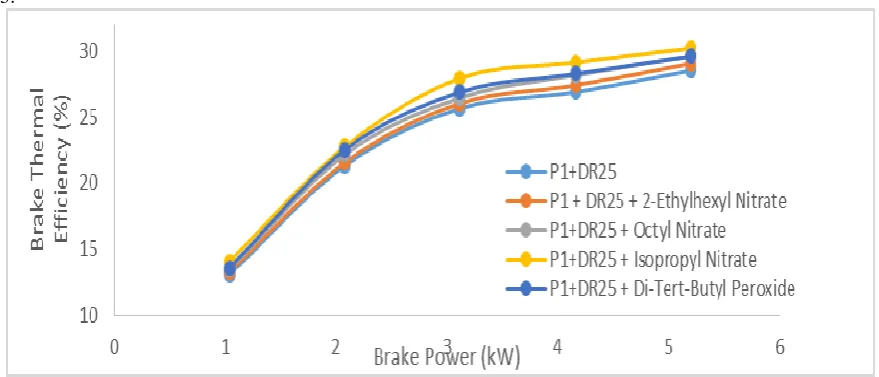
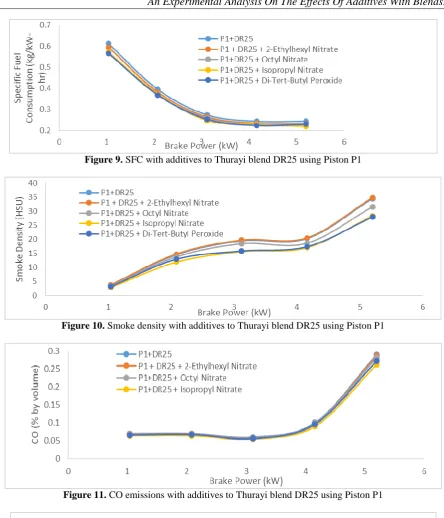
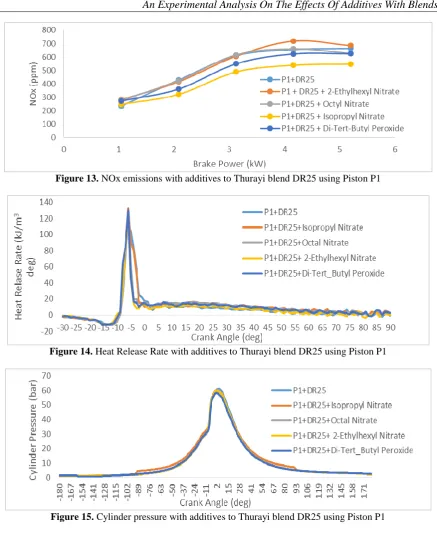
Four additives are added to biodiesel blends and studied the performance. The additives considered are: 2-Ethylhexyl Nitrate, Octyl Nitrate, Isopropyl Nitrate and Di-Tert-Butyl Peroxide. Both the blends and modified pistons are verified with these additives. It is found that the performance is optimum in Thurayi seed oil blend DR25 with P1 piston model. The parameters of the engine combustion and emission are plotted in Figures 8 to 15.
Figure 9. SFC with additives to Thurayi blend DR25 using Piston P1
Figure 10. Smoke density with additives to Thurayi blend DR25 using Piston P1
Figure 11. CO emissions with additives to Thurayi blend DR25 using Piston P1
Figure 13. NOx emissions with additives to Thurayi blend DR25 using Piston P1
Figure 14. Heat Release Rate with additives to Thurayi blend DR25 using Piston P1
Figure 15. Cylinder pressure with additives to Thurayi blend DR25 using Piston P1
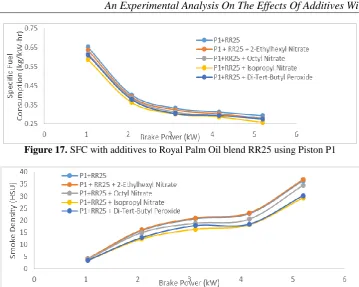
The performance of IC engine with Cuban royal palm oil blend RR25 is given in the Figures 16 to 23.
Figure 17. SFC with additives to Royal Palm Oil blend RR25 using Piston P1
Figure 18. Smoke Density with additives to Royal Palm Oil blend RR25 using Piston P1
Figure 19. NOx with additives to Royal Palm Oil blend RR25 using Piston P1
Figure 20. CO Emissions with additives to Royal Palm Oil blend RR25 using Piston P1
Figure 22. Cylinder pressure with additives to Royal Palm Oil blend RR25 using Piston P1
Figure 23. Heat release rate with additives to Royal Palm Oil blend RR25 using Piston P1
V.
CONCLUSIONS
A In this paper an attempt has been made to verify the performance of the DI diesel engine with additives along with different blends of both Thurayi seed oil and Royal Palm seed oil and also with modified piston geometries. The additives considered are 2-Ethylhexyl Nitrate, Octyl Nitrate, Isopropyl Nitrate and Di-Tert-Butyl Peroxide. The additive Isopropyl Nitrate had given best performance both in terms of combustion and emissions. Out of all the possible cases Thurayi seed oil blend DR25 with P1 piston geometry and with Isopropyl Nitrate additive produces the best combustion and emission results.
REFERENCES
[1] Lilia C. Fernfindez, “Effects of D-004, a Lipid Extract of the Fruit of the Cuban Royal Palm (Roystonea regia) or the Lipidosterolic Extract: A Controlled, Experimental Study”. Current Therapeutic Research, Vol 69(1), 2008
[2] Edward Ntui Okey and Peggy Ari Okey, “Optimization of biodiesel production from nonedible seeds of Delonix regia (Gul Mohr)”. International Journal of Bioresource Technology 2013, Vol. 1(1), PP: 01 – 08.
[3] Carmen L. Morales et al, “Physico-chemical characterization of the residual cake of D-004 production: lipids extract of the Roystonea regia fruits.Technical note”. Cuban Journal of Agricultural Science2013, Vol. 47(4), pp.409-411. [4] Nu´bia M. Ribeiro, Angelo C. Pinto, Cristina M. Quintella, et al., “The Role of Additives for Diesel and Diesel
Blended (Ethanol or Biodiesel) Fuels: A Review”, Energy & Fuels, American Chemical Society, 21, 2433-2445, 2007.
[5] H. K. Imdadul, H. H. Masjuki, M. A. Kalam, N. W. M. Zulkifli, M. M. Rashed, H. K. Rashedul, I. M. Monirul and M. H. Mosarof, “A comprehensive review on the assessment of fuel additive effects on combustion behavior in CI engine fuelled with diesel biodiesel blends”, RSC Adv., 2015, 5, 67541.
[6] Gangadhara Rao, Kumar G N, Mervin Herbert, “Effects of Additives on Biodiesel/Diesel Performance, Emission Characteristics, Combustion Characteristics and Properties”, National Conference on Advances in Mechanical Engineering Science (NCAMES-2016).
[7] K. Prasada Rao and Vara Lakshmi Reddi, “Performance Evaluation of Diesel Engine with Biodiesel along with Additive for Replacing Diesel Fuel”, Int. J. Chem. Sci.: 14(4), 2016.
[8] M. Vijayakumar and P. C. Mukesh kumar, “Performance Enhancement and Emissions Analysis of Diesel Engine with Biodiesel, N-Propanol and 1-Butanol Blend”, Journal of Applied Fluid Mechanics, Vol. 10, Special Issue, pp. 79-84, 2017.
[9] Abdülvahap Çakmak and Atilla Bilgin, “Performance and Emissions of a Single Cylinder CI Engine Running on Corn Oil Methyl Ester-Diesel Blends”, Journal of Clean Energy Technologies, Vol. 5, No. 4, July 2017.
[11] A.Ravichandran, K. Rajan, M.Rajaram Narayanan, K.R.Senthil Kumar, “Effect of piston bowl geometry on the performance of a diesel engine using Corn biodiesel and its diesel blends”, International Journal of ChemTech Research, Vol.9, No.01 pp 105-112, 2016.
[12] Dr. Abdul Siddique.Sk, Shaik Abdul Azeez, Raffi Mohammed, “A Review on C.I Engine Combustion Chamber Geometry and Optimization”, International Journal of Core Engineering & Management (IJCEM), Volume 3, Issue 5, August 2016.