International Journal of Research in Engineering and Science (IJRES)
ISSN (Online): 2320-9364, ISSN (Print): 2320-9356
www.ijres.orgVolume 6 Issue 10Series I ǁ 2018 ǁ PP. 13-22
Synthesis and catalytic evaluation of magnetically recyclable
CaO/CoFe
2O
4nanoparticles for biodiesel production via ethylic
transesterification
Diogo Gontijo Borges
1*, Audrey Moores
2and José Mansur Assaf
11Laboratory of Catalysis, Department of Chemical Engineering, São Carlos Federal University, C. Postal 676, CEP: 13565-905, São Carlos-SP, Brazil.
2Center for Green Chemistry and Catalysis, Department of Chemistry, McGill University, H3A-0B8, Montreal-QC, Canada.
Corresponding Author: Diogo Gontijo Borges
ABSTRACT: CaO/CoFe2O4nanoparticles were easily synthesized by calcination at 650°C for 1h of Ca(NO3)2.4H2O impregnated CoFe2O4 nanoparticles. The resulting systems were studiedas catalysts for the transesterification reaction of esters with ethanol under mild reaction conditions (70°C, ethanol/ester molar ratio = 6/1 and 4 wt.% of catalyst, at 30, 60, 120, 180 and 240 min). For this reaction, methyl acetate and soyben oil were tested as substrates, and the effect of reaction time and ester/ethanol ratio on performance wasstudied. The materials were characterized by XRD, SQUID, N2physisorption, TEM equipped with energy-dispersive X-ray spectroscopy (EDX),XRF, and CO2 -TPD. Optimizedcatalystandreactionconditionsafforded in 4 h 68% conversion for methylacetateand 29% for soybean. The proposed catalysts were magnetically separated and reused for the same reaction in up to 6 cycles. Ca2+was shown to leach, but did not afford any homogeneous catalytic activity. As such, the CaO/CoFe2O4catalysts showed promise for replacing alkaline homogeneous catalysts for biodiesel production.
KEYWORDS: Biodiesel, Transesterification reaction, Calcium oxide, Cobalt ferrite, Heterogeneousbase catalyst.
--- --- Date ofSubmission: 16-01-2019 Date ofacceptance: 28-01-2019
---
1.
INTRODUCTION
The search for renewable energy sources has attracted global interest and in recent years, there has been increasing research into replacing fossil fuels. Fossil fuels generate pollutants and are linked to global warming, climate change and even to the increasing frequency of the appearance of some serious diseases. The looming challenges of substitution and the environmental implications of the use of fossil fuels have been extensively discussed in the literature (Aransiolaet al., 2014). Biodiesel is important option for conventional fuels abatement. It is primarily produced viatransesterification reactions, also known as alcoholysis of vegetable and/or animal fats, or by esterification of free fatty acids by use of an acid, basic or enzymatic catalyst (Mardhiahet al., 2017). Biodiesel is compatible with current diesel-cycle engine technology, making it as an alternative technique able to immediately attended to all existing fleets already powered by petroleum diesel. Biodiesel also provides a number of environmental advantages compared to petroleum-based diesel such as low carbon monoxide and particulate matter emissions during combustion, no sulfur compound emissions into the atmosphere, better fuel properties, such as cetane number and lower emissions of the main greenhouse gases because the carbon dioxide produced in the combustion is almost totally consumed during cultivation of the oilseeds(Mardhiahet al., 2017; Goet al., 2016; Cordeiroet al., 2011).
Important research efforts have been focused on the development of magnetic nanoparticles in catalysis, as they offer a unique avenue for easy separation technologies (Rossi et al., 2014; Polshettiwaret al., 2011; Lu, Salabas, Chem, 2007). In this scheme, strategies include the grafting of homogeneous catalysts at the surface of the magnetic nanoparticles, the deposition of catalytic materials on its surface, or the direct use of the magnetic nanosized materials as catalysts (Hudson et al., 2014). In all cases, magnetic nanoparticles combine the high surface-over-volume ratio, allowing a high density of catalytic sites, which the magnetic properties making them tractable using an external magnet (Huixiaet al., 2014), thereby facilitating removal of the catalyst from the reaction system and eliminating filtration step. In this context, ferrite nanoparticles (MFe2O4) are appealing materials combining magnetic properties, easy synthesis, versatile crystalline form groups: cubic or spinel and hexagonal ferrites or hexaferrites (Arana et al., 2013; Mozaffariet al., 2014), and the ability to modulate properties by careful choice of complementary metal M. Among these nanoparticles, the cobalt ferrite (CoFe2O4), which has a cubic spinel structure, is emphasized due to its high coercivity, moderate saturation magnetization, high stability and elevated mechanical strength (Huixiaet al., 2014), becoming a promising material in the development of magnetic catalysts.
In this paper, we present thesimple synthesis of novel magnetic nanoparticles active for the ester transesterification. We deposited ontocobalt ferrite nanoparticles, used here as magnetic cores, calcium oxide as a heterogeneous alkaline transesterification catalysts. The catalysts were evaluated for the transesterification reaction of either methyl acetate or soybean oil with ethanol.
2.
EXPERIMENTAL
2.1. Catalysts preparation
The cobalt ferrite nanoparticles was synthesized according to the methodology described by Borges(2015).4mmol of Fe(NO3)3.9H2O, 2mmol of Co(NO3)2.6H2O and 9 mmol of citric acid were dissolved in 50 mL of distilled water.The solution was heated at 90°C in a silicone bath under continuous stirring till removal of water excess, forming a high viscosity precursor citrate. The temperature was increased to 300°C for the citric acid decomposition, causing the expansion of the precursor due to the entrapment of the carbon monoxide, carbon dioxide and water vapor gases, resulting in a semi-carbonised, black and brittle foam, called "puff".
The material obtained above was used as solid support for calcium oxide addition by the wet impregnation method. Ca(NO3)2.4H2O was dissolved in 20 mL of ethanol and then cobalt ferrite added. The suspension was stirred at 80°C until complete solvent evaporation. Catalysts were prepared with different loadings of CaO:10, 20, 30, 40 and 50 wt.% (wt. of Ca2+ cobalt ferrite support). Subsequently, calcination at 650°C/1h was performed on the recovered powders and were named CoFe2O4 and X-CaO/CoFe2O4, in which “X” is the calcium loading in wt.%.
2.2. Characterization
2.2.1. X-ray diffraction (XRD)
The catalysts were characterized by X-ray diffraction at room temperature in a RigakuMultiflex equipment using Cu-Kα radiation (λ= 1.5406 Å) with a scan range 2θ angles from 3 to 80° 0.02° step and goniometer rate of 2°.min-1. The obtained data were compared with JCPDS files database.
2.2.2. Transmission electron microscopy (TEM) and Energy Dispersive X-ray Spectroscopy (EDX) The oxide morphologies and elemental chemical analysis were studied by transmission electron microscopy (TEM) equipped with Energy Dispersive X-ray Spectroscopy (EDX). The images were obtained in a FEI Tecnai G20F20 electron microscope.
2.2.3. Nitrogen adsorption/desorption analysis
Nitrogen physisorption at 77 K was used for surface area determination on a NOVA-1200 Quantachrome equipment by using the Brunauer–Emmett–Teller (BET) method.
2.2.4. X-ray fluorescence spectrometer (XRF)
The Ca concentrations supported on CoFe2O4 were determined by X-ray fluorescence spectrometry (XRF) on a Shimadzu EDX-720, RayNy.
2.2.5. Temperature programmed desorption technique (CO2-TPD)
2 4
the samples at a rate of 50°C min-1under helium atmosphere (flow of 30 mL.min-1) until 1000 °C.
2.2.6. Magnetic measurements
The magnetic measurements of the catalysts were performed in a Superconducting quantum interference device (SQUID). The magnetometry measurements were carried out using a Quantum Design MPMS XL magnetic property measurement system. Each powder sample was loaded in a gelatin capsule, which was sealed with a thin strip of Kapton tape. The capsule was inserted in a clear plastic straw fixed to the MPMS sample rod. Centering of the samples was done under zero field. For both zero-cooled (ZFC) and field-cooled (FC; applied field was 10 mT) measurements, the samples were first field-cooled to -254°Cbefore allowed to warm up to 127°C under 10 mT while magnetization was measured. ZFC measurement preceeds FC. Finally, magnetic hysteresis loops were measured at temperatures of 27 and -254°C, with applied field up to 7 T or the minimum needed for saturation.
2.2.7. Atomic Absorption Spectroscopy
The determination of possible calcium leaching from the catalysts was carried out by chemical analysis of the reaction solution. For this purpose, the supernatant solution was collected after reaction and the catalyst was removed by filtration using syringe filters (0.45 μm pore size). Thus, the volatiles were evaporated and re-suspended with 1% (v/v) HNO3 solution for chemical analysis of residual calcium. The calcium content in the solution was analyzed by atomic absorption spectroscopy (Varian Spectr AA).
2.2.8. Temperature-programmed Desorption of CO2 (CO2-TPD)
The catalysts basicity was evaluated by the Temperature-programmed CO2 desorption technique (CO 2-TPD). First,100 mg of sample was subjected to a pretreatment using a heating rate of 20°C min-1 until 650°C for 1 hour under a helium atmosphere with a flow of 50 mL min -1 to remove adsorbed impurities. The sample was cooled to 100°C and CO2 adsorption performed for 1 hour using a CO2 flow rate of 50 mL min-1. Subsequently, the system was purge with He for 1 hour to remove the adsorbed CO2. The sample was cooled to 50°C and the CO2 desorption was then performed under He flow at 30mL.min-1, by heating samples at a rate of 50°C min-1 up to 1000°C. The desorbed CO2 was detected using a thermal conductivity detector (TCD).The results were obtained by integration and the areas under the CO2-TPD curvesusing Gaussian functions.
2.3. Catalysts evaluation
Experiments were carried out in 2mL micro-reactors as described by Martins (2007). Methyl acetate was chosen as a simple model reagent for screening the active catalysts for transesterification. A solution containing a 6/1 ethanol/methyl acetate (molar ratio) was placed in contact with 4% of catalyst (wt. catalyst/wt. of the reaction mixture) at 70°C controlled by immersion of the reactor in hot water in a reaction time of 30, 60, 120, 180 and 240 min. In the end of the run, the reactions were stopped by immersing the reactor in an ice bath. The catalyst was separated and the supernatant recovered for product analysis by GC (GC Varian Star Model 3400) equipped with a FID detector and an RTx®-1capillary column.
Upon completion of the transesterification using model molecules, a catalytic test was performed using soybean oil (Molar mass = 874.8g/mol) and ethanol. The reaction was carried under the same test conditions on model molecules while maintaining the 4% (w/w) ratio of the catalyst and varying the ethanol/soybean oil ratio 6/1, 12/1 and 24/1.The conversion was analyzed at four different reaction times: 4; 8; 12 and 24h. After eachreaction time, an aliquot was withdrawn from the reactor and decanting was conducted.Three phases were obtained: a solid containing the catalyst, a heavy liquid phase mainly comprised of glycerine and ethanol and a light liquid phase consisting of esters and ethanol. The solid phase was removed and the other two phases formed were washed with warm water.An aliquot of the light/organic liquid phase was analyzed by GC, in order to determine the content of esters produced and separated at this stage of interest. The standard used to determine the ester content was the European standard - EN 14103. This is the Standard: Fatty Acid Methyl Esters (FAME) - Determination of ester and linolenic acid methyl ester contents.
2.4. Stability evaluation
The catalyst stability investigation was carried out using different methods. Primarily, the catalyst stability was investigated using the methodology proposed by Sheldon et al. (1998) and Braga et al. (2011), which consists of removing the catalyst from the reaction system after 1h of reaction and subsequently monitoring the composition of the remaining solution under same reaction conditions without the catalyst, for 3 hours.
hydrated in contact with atmospheric CO2 and H2O, the recovered catalysts were not dried and kept in contact with a minimum quantity of reactants and products,before a new reaction mixture was added for carrying out an additional cycle.
3.
RESULTS AND DISCUSSION
3.1. Support and catalysts characterization
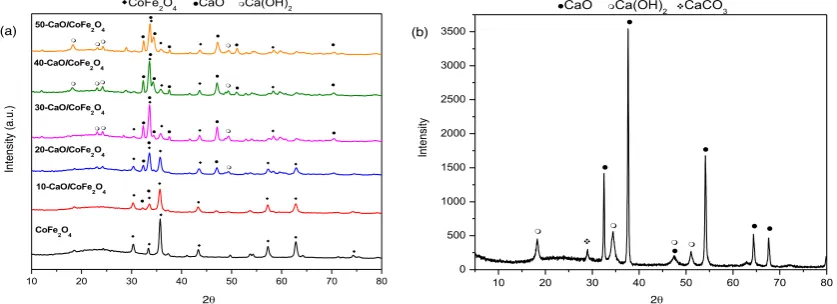
CoFe2O4 and CaO/CoFe2O4 nanoparticles were characterized by X-ray diffraction (XRD, Figure1-a). The diffraction peaks of the CoFe2O4 (JCPDS 077-0426) with cubic structure were observed in all samples. CaO/CoFe2O4 samples featured diffraction peaks characteristic of CaO, of raising intensity as the CaO/CoFe2O4 ratio increased. The 10-CaO/CoFe2O4 sample presented characteristic features ofCoFe2O4, with the CaO formed suggesting that this sample has a small crystallite size (Figure 1-a). In the 20-CaO/CoFe2O4 sample, the intensity of the peaks related to CaO can be observed, consequently the peaks increase intensity are easily observed in the 30-CaO/CoFe2O4, 40-CaO/CoFe2O4 and 50-CaO/CoFe2O4 samples (Figure1-a).
Due to the fast CaO hydration and carbonation in atmospheric air, diffraction peaks characteristic ofCa(OH)2 (JCPDS 72-0156) and CaCO3 (JCPDS 85-1108) were detected. Similar patterns were seen in the diffractogram obtained from commercial CaO (Figure 1-b).
Figure 1. X-raydiffractogram for CoFe2O4and X-CaO/CoFe2O4 (a) andcommercial CaO (b).
2 4
Figure 2. TEM of CoFe2O4 (a); 10-CaO/ CoFe2O4 (b), 20 CaO/ CoFe2O4 (c), 30-CaO/ CoFe2O4 (d)and 50-CaO/ CoFe2O4 (e) Spectraandenergydispersive X-ray (EDX) ofthemicrographsshownleft (f-j).
Table 1 presents the specific area values of all synthesized catalysts, determined by BET method. CoFe2O4 featured a specific surface area value of 34 m-2.g-1. This BET value is consistent with the specific surface of nanoparticles of the size range observed by TEM. 10-CaO/CoFe2O4 featured a very similar specific area, which is consistent with the deposition of small CaO nanoparticles. With increasing CaO content, a significant decrease in the area values occurred. It dropped by 3.6 times for 20-CaO/CoFe2O4 and then dropped below 1 m-2.g-1 for samples X-CaO/CoFe2O4 (X=30, 40 and 50).
Table 1-Specificarea for thecatalystsdeterminatedby BET. Catalysts BET area (m2g-1)
CoFe2O4 34
10- CaO/CoFe2O4 35
20- CaO/CoFe2O4 9.4
30- CaO/CoFe2O4 <1
40- CaO/CoFe2O4 <1
50- CaO/CoFe2O4 <1
CaO 3
(a)
(b)
(c)
(d)
(e)
(f)
(g)
(h)
(i)
Table 2 displays the chemical analysis determined by X-ray fluorescence (XRF) for CaO/CoFe2O4. These results showed that the levels determined experimentally were close to nominal levels. The differences observed are possibly due to the intrinsic error in hydrate content in starting materials and losses during the impregnation and subsequent drying stages.
Table 2 - Ca contentdeterminedby X-rayFluorescencecatalysts CaO / CoFe2O4.
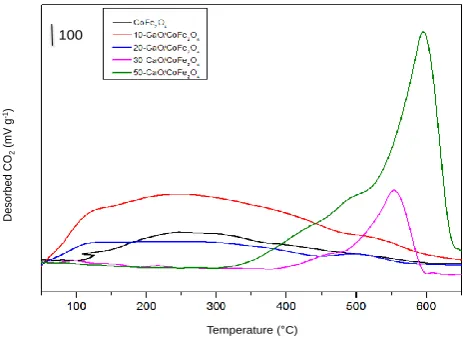
Figure 3and Table 3 show the CO2-TPD patterns obtained from catalysts investigated in this paper. It can be observed that CoFe2O4 and 10-CaO/CoFe2O4 samples showed the same characteristic for both materials, which can be attributed to the interaction of CO2 with medium-strength basic sites (Braga et al., 2011).
Table 3-Densityofbasic sites for catalysts X-CaO/CoFe2O4..
Catalysts Densityofbasic sites- db (μmol/m2)
Weakdb Strong db Total db
CoFe2O4 1.9 - 1.9
10-CaO/CoFe2O4 - - 0
20-CaO/CoFe2O4 0.6 - 0.6
30-CaO/CoFe2O4 - 2.3 2.3
50-CaO/CoFe2O4 - 9.5 9.5
Increasing of the calcium content on the samples leads to the disappearance of this band, suggesting that CaO particles are covering the CoFe2O4 surface, as shown in Figure 2. The appearance of CO2 desorption bands at higher temperatures indicates that increasing the calcium amount incorporated into the catalysts generated stronger basic sites. Taufiq-Yap et al. (2011) reported that the intense band between 400-650°C is related to Ca2+O2- pairs that have high basic strength. The results show that the addition of calcium contributed to the development of strong basic sites which were quantified by density analysis of basic sites in proportion to the amount of CO2 desorbed from the catalyst.
Figure 3.TDP-CO2patternsof CoFe2O4, 10-CaO/CoFe2O4, 20-CaO/CoFe2O4, 30-CaO/CoFe2O4and 50-CaO/CoFe2O4.
The magnetization curves, as shown in Figure 4, were obtained for samples CoFe2O4 and 50-CaO/CoFe2O4. The measurements were performed at 27 and -254°C. The magnetization curves at 27°C, show that both samples present excellent magnetic properties, reaching saturation magnetization values of about 30
100
D
e
so
rb
e
d
C
O2
(
m
V
g
-1)
Temperature (°C)
Catalysts Nominal content
(% wt/wt)
Experimental content (% wt/wt)
10- CaO/CoFe2O4 10 11.5
20- CaO/CoFe2O4 20 21.4
30- CaO/CoFe2O4 30 33.8
40- CaO/CoFe2O4 40 40.6
2 4
emu/g and superparamagnetic material properties (remanent magnetization and coercivity are zero).
Figure 4.Magnetization curve for samples CoFe2O4 (a) and 50-CaO / CoFe2O4 (b).
As expected, hysteresis curves determined at -254°Care distinctly different from measurements performed at 27°C. At -254°C, both materials exhibit coercivities and remanent magnetization, being directly related to the magnetic anisotropy of the material. This is because at low temperatures the magnetic anisotropy increases. Therefore, the lower the temperature, the higher the magnetocrystalline anisotropy constant of the material (Grigorova, 1998).
Importantly, all the materials used in this paper presented superparamagnetic behavior, meaning they were strongly attracted to a magnetic field, but also no residual magnetization, meaning that their magnetization dropped to zero, as soon as field vanished. Both features are important for efficient magnetically recoverable catalysts (Chien, 1991).
3.2. Catalytic evaluation
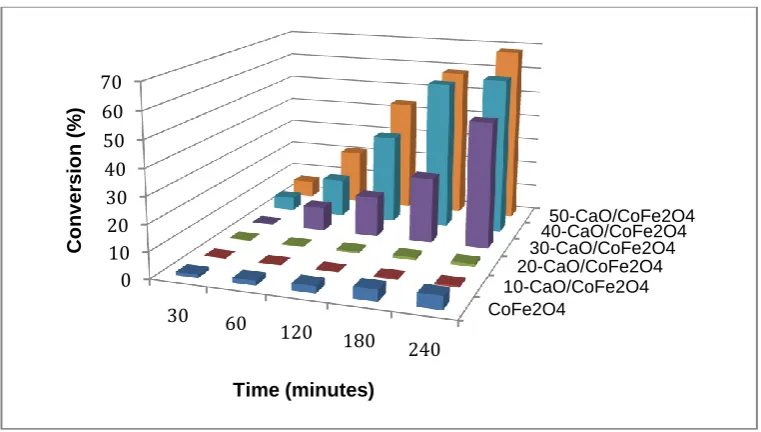
The catalytic activity of the designed materials was evaluated for the model transesterification reaction between methyl acetate and ethanol at 70°C with ethanol/ester molar ratio of 6/1 and 4 wt.% of catalyst with reaction times varying from 30 min to 4 hours (Figure 5).
Figure 5.Catalytictest for transesterification reactionbetweenmodelmolecules in the time betweenmethylacetateandethanol.
CoFe2O4 nanoparticlesshowed marginalyield rates of 5% at 4 hours of reaction. This residual activity was possibly linked to the synthetic method, where alkaline solution (NaOH) were used during the precipitation step. 10-CaO/CoFe2O4 and 20-CaO/CoFe2O4 showed no conversion, even after 4 h of reaction. Significant activity boost was observed when CaO content was increased. For instance, 30-CaO/CoFe2O4afforded 49% conversion, 40-CaO/CoFe2O4 61%, and 50-CaO/CoFe2O4 68%, respectively, after 4 hours. Based on this, we can infer that the increased concentration of CaO supported on CoFe2O4 is essential for the creation of active
CoFe2O4
10-CaO/CoFe2O4 20-CaO/CoFe2O4
30-CaO/CoFe2O440-CaO/CoFe2O4 50-CaO/CoFe2O4
0 10 20 30 40 50 60 70
30 60
120 180
240
Co
n
v
er
sion
(
%
)
sites for the reaction, and the ferrite plays an auxiliary role in the dispersion and stabilization of the active phase (CaO).
The catalysts performance may be explained by considering the textural properties of the catalysts as well as the basicity. The catalytic activity depends on the Ca2+ content, which affects the amount and strength of basic sites, plus the physical properties of the catalysts, mainly specific area and crystallite size of the active phase of CaO (Demirbas, 2008).
Because of its excellent catalytic performance, catalyst 50-CaO/CoFe2O4 was tested in the transesterification reaction of soybean oil with ethanol. Conversion to the corresponding methyl-ester is presented Figure 6, as a function of reaction time and soybean/ethanol oil ratio.The reaction progressed quasi linearly as a function of time reaching 13% after 24 hours with the ethanol/soybeanration of 6/1. Raising this ratio to 24/1, the conversion improved to 29% after 24 hours. Thistrend can be explained by the fact that the transesterification of vegetable oils is kinetically favored when an excess of alcohol is used relative to the triglyceride. We did not explore ethanol:soybean oil ratios above 24/1, as large excess of ethanolinterferes with glycerol separation due to the increase in itssolubility of glycerol in ethanol. Furthermore, the presence of glycerol in the reaction system favors the formation of triglycerides (Demirbas, 2008).
Figure 6.Catalyticevaluationof 50-CaO/ CoFe2O4 catalyst for the transesterification betweensoybeanoilandethanol.
The obtained maximum conversion was 29%. It is relatively low when compared to the 68% conversion in the reaction performed using model molecules. This result may be attributed to the greater complexity of the triglycerides present in soybean oil when compared with methyl acetate used in the model reaction. This influences the complexity of molecule connections between the triglycerides and the active sites of the catalyst, resulting in a lower reaction rate, since less triglyceride molecules can bind to sites (Castro et al., 2014).
3.3. Catalyst stability
Considering that the present study aims at the production of heterogeneous catalysts for use in liquid-phase reactions, the stability study becomes necessary. The loss of the active liquid-phase for the reaction system by leaching is a major obstacle in the production of heterogeneous catalysts, since these leached species can be solubilized in the liquid system, homogeneously catalyzing the reaction and contaminating of the final product, while revealing a degradation of the catalysts.
The reuse of the 50-CaO/CoFe2O4 catalyst was investigated in six consecutive runs at 70°C, ethanol/ester molar ratio=6/1 and 4 wt.% of catalyst for 2h (Figure 7). After the reaction, the catalyst was magnetically sequestered and the supernatant was removed. A new reaction mixture was placed in contact with the catalyst used. The yield is showing how relative conversion, being offered for thefirstcicle 100% yieldandlosing a yieldonreused.Over loss the 6 cycles, the relative conversion dropped 41%.
6:1 12:1
24:1
0 10 20 30
4 8
12
24
Co
n
v
er
sion
(
%
)
2 4
Figure 7. Reuse cycles for catalyst 50-CaO/ CoFe2O4
Based on this activity loss, we evaluatedafter each use cycle soluble Ca2+ content into the reaction mixture, using Atomic Absorption Spectrometry to determine the (Table 4).
Table 4-Determinationof Ca2+leachedintothereaction médium byAtomicAbsorptionSpectrometry.
Reuse cycles Ca2+concentration (mg mL-1)
1 0.10
2 0.08
3 0.09
4 0.09
5 0.11
6 0.10
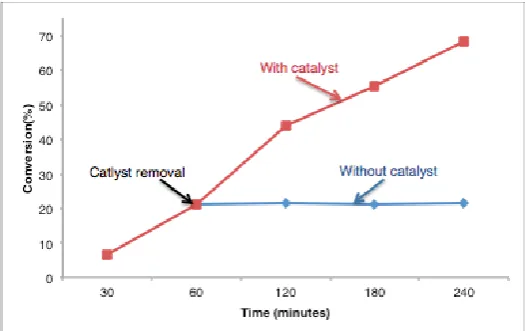
Ca2+ concentrations ranging from 0.08 to 0.11 mg.mL-1 were measured after each cycles. This value remains fairly stable over the different cycles, and this leaching did not impact catalytic activity. Since leached Ca2+ was detected in the reaction, it was important to investigate whether these cations in solution form active species capable of catalyzing the reaction in homogeneous phase. To test this hypothesis, was following a methodology proposed by Sheldonet al.(1998) was performed. After 1 hour of reaction, magnetic removal of CaO/CoFe2O4 completely stopped activity, because the productions concentration remained constant, keeping the conversion unchanged. Thus confirming a purely heterogeneous mechanism (Figure 8).
Figure 8. Transesterification reaction in thepresenceof 50-CaO/ CoFe2O4 as functionofthe time andaftercatalystseparationfromthereaction system.
4.
CONCLUSIONS
It was shownthat CoFe2O4nanoparticles used as support facilitates the separation and dispersion of CaO as the catalytically active phase in ester transesterification. Their excellent magnetic properties allowed its easy
0 10 20 30 40 50 60 70
1 2 3 4 5 6
C
on
ver
sio
n
(%)
separation from the reaction medium by the application of an external magnetic field. The content increase of CaO dispersed on the support was proved fundamental for catalytic activity. The more abundant the CaO, the higher the activity. The 50-CaO/CoFe2O4 catalyst showed high conversion (68%) with model molecules and was subsequentlyapplied in the reaction between ethanol and soybean oil showing conversion was 29%. The CaO/CoFe2O4 catalyst reuse tests showed that it is feasible to reuse up to 6 times. The CaO/CoFe2O4 catalyst can be considered a promising heterogeneous catalyst that may replace homogeneous catalysts for biodiesel production via ethylic transesterification.
5.
REFERENCES
Arana, M.; Galván, V.; Jacobo, S. E.; Bercoff, P. G.Cation distribution and magnetic properties of LiMnZn ferrites. Journal of Alloys and Compounds, 568, 5–10 (2013).
Aransiola, E. F.; Ojumu,T. V.; Oyekola,O. O.; Madzimbamuto, T. F.; Ikhu-Omoregbe, D. I. O. A review of current technology for biodiesel production: State of the art. Biomass and Bioenergy, 61, 276-297 (2014).
Bet-Moushoul, E.; Farhadi, K.; Mansourpanah, Y.; Nikbakht, A M..;Molaei, R.; Forough, M. Applicationof CaO-based/Aunanoparticles as heterogeneousnanocatalysts in biodiesel production. Fuel, 164, 119-127, (2016).
Borges, D.G. Síntese e caracterização de catalisadores de óxido de cálcio suportado em ferritas magnéticas avaliados na reação de transesterificação etílica. Ph.D. Thesis, Federal Universityof São Carlos (2015).
Braga, T.P.; Sales,B. M. C.; Pinheiro, A. N.; Herrera, W.T.; Baggio-Saitovitch, E.; Valentini, A. Catalytic properties of cobalt and nickel ferrites dispersed in mesoporous silicon oxide for ethylbenzene dehydrogenation with CO2. Catalysis Science and Technology, 1, 1383–1392 (2011).
Castro, C. S.; Júnior, L. C. F. G.; Assaf, J. M. The enhanced activity of Ca/MgAl mixed oxide for transesterification. Fuel Processing Technology, 125, 73–78 (2014).
Chien, C. L. Science and Technology of Nanostructured Magnetic Materials.editedHadjipanayis, G. C.; Prinz, G. A. NATO Advanced Study Institute, Series B: Physics, 259, 477 (1991).
Cordeiro, C. S.; da Silva, F.R.; Wypych, F; Ramos, L.P. Catalisadores Heterogêneos Para A Produção De Monoésteres Graxos (Biodiesel). Química Nova, 34, 477-486 (2011).
Demirbas A. Comparison of transesterification methods for production of biodiesel from vegetable oils and fats. Energy Conversion and Management, 49, 125-130 (2008).
Go, A. W.; Sutanto, S. S.; Ong, L. K.; Tran-Nguyen, P.; Ismadji, S.; Ju, Y. Developments in in-situ (trans) esterification for biodiesel production: A critical review. Renewable and Sustainable Energy Reviews, 60, 284-305 (2016).
Grigorova, M.; Blythe, H. J.; Blaskov, V.; Rusanov, V.; Petkov, V.; Masheva, V. Magnetic properties and Mössbauer spectra of nanosizedCoFe2O4 powders.Journal of Magnetism and Magnetic Materials, 183, 163– 172 (1998).
Gryglewcz, S.Rapeseed oil methyl esters preparation using heterogeneous catalysts.Bioresource Technology, 70, 249-253 (1999).
Hasan, M. M.; Rahman, M. M. Performance andemissioncharacteristicsof biodiesel–diesel blendandenvironmentalandeconomicimpactsof biodiesel production: A review. Renewable and Sustainable Energy Reviews,74, 938-948, (2017).
Huixia, F.; Baiyi, C.; Deyi, Z; Jianqiang, Z; Lin, T. Preparation and characterization of the cobalt ferrite nano-particles by reverse coprecipitation. Journal of Magnetism and Magnetic Materials, 356, 68–72 (2014).
2 4
Kouzu, M.; Yamanaka, S.; Hidaka, J.; Tsunomori, M. Heterogeneous catalysis of calcium oxide used for transesterification of soybean oil with refluxing methanol. Applied Catalysis A: General, 355, 94-99 (2009).
Lu, A. H.; Salabas, E. L.; Angew. S. Magnetic Nanoparticles: Synthesis, Protection, Funcionalization, and Application. AngewandteChemie International Edition, 46, 1222–1244, (2007).
Mardhiah, H. H.; Ong, H. C.; Masjuki, H. H.; Lim, S.; Lee, H. V. A review on latest developments and future prospects of heterogeneous catalyst in biodiesel production from non-edible oils. Renewable and Sustainable Energy Reviews 67, 1225-1236 (2017)
Martins, L.; Cardoso, D. Influence of surfactant chain length on basic catalytic properties of Si-MCM-41.Microporous and Mesoporous Material, 106, 8-16 (2007).
Mozaffari, M.;Amighian, J.; Darsheshdar, E. Magnetic and structural studies of nickel-substituted cobalt ferrite nanoparticles, synthesized by the sol–gel method. Journal of Magnetism and Magnetic Materials, 350, 19–22 (2014).
Nair, P.; Singh, B.; Upadhyay, S.N.; Sharma, Y.C. Synthesis of biodiesel from low FFA waste frying oil using calcium oxide derived from Mereterix as a heterogeneous catalyst. Journal of Cleaner Production 29, 82-90 (2012).
Polshettiwar, V. ;Luque, R. ; Fihri, A. ; Zhu, H. ; Bouhrara, M. ; Bassett, J.-M. Magnetically recoverable nanocatalysts. Chemical Reviews, 111, 3036–3075, (2011).
Rossi, L. M.; Costa, N. J. S. ; Silva, F. P. ; Wojcieszak, R. Magnetic nanomaterials in catalysis: advanced catalysts for magnetic separation and beyond. Green Chemistry 16, 2906-2933, (2014).
Sheldon, R. A.; Wallau, M.; Arends, I. W. C. E.; Schuchardt, U. Heterogeneous Catalystsfor Liquid-Phase Oxidations: Philosophers' Stones or Trojan Horses. Accounts of Chemical Research, 31, 485-493 (1998).
Shi, M.; Zhang, P.; Fan, M.; Jiang, Pingping, J.; Dong, Y. Influenceofcrystalof Fe2O3 in magnetismandactivityofnanoparticle CaO@Fe2O3 for biodiesel production. Fuel, 197, 343-347, (2017).
Tang, Z.; Xu, J.; Zhang, J; Lu, Y.Biodiesel production from vegetable oil by using modified CaO as solid basic catalysts. Journal of Cleaner Production, 42, 198-203 (2013).