Vol. 09, Issue 5 (May. 2019), ||S (XII) || PP 41-46
“Study on Working Capital of Mahindra & Mahindra Ltd”
Akash B. Selkari
1, Omdeo Ghyar
21(Master of Business Administration,Jhulelal Institute of Technology/ Rtmnu, India)
Abstract:
The present study of the research entitled “Study on Working Capital of Mahindra & Mahindra Ltd”. The study was based on secondary data from annual records, reports and profile of the organization. The validity of any research is based on the systematic method of data collection analysis. The Ratio analysis is the process of identifying the financial soundness and cost effectiveness of the firm by establishing relationship between the items of balance sheet and profit and loss a/c. An objective of the study includes if the working capital management has an impact on the profitability of the firm and its growth.Short term-long term position of the company. Based on the three years balance sheet and profit and loss a/c suitable suggestion were given by the researcher for a better soundness and cost effectiveness of the company.Thus working capital referred to concerns investment to short term assets like cash, short term securities, debtors and inventories of all types. Every firm should have adequate working capital to run its business operation. No business can run successfully with adequate amount of working capital. The current assets of company are higher than its current liabilities, then position of company from working capital point of view is sound and satisfactory.Keywords:Mahindra & Mahindra ltd, Ratio Analysis, Working Capital, Working Capital Management (WCM).
I.
Introduction
Mahindra utility Vehicle, Tractors, LCV’s and now luxury cars that have driven strait into the hearts of the millions of Indians, their home, frames and workplaces covering verify individual need, Mahindra and Mahindra builds people at many levels and through variety of high quality products and services. Mahindra and Mahindra limited is a public limited company having its registered office at Gateway Building, Apollo Blunder, and Mumbai-400 039.The objectives of working capital management in the company are liquidity and profitability; however emphasis is more on liquidity. To achieve its day to day funds requirements, the company follows the policies of efficient and timely production, by maintaining minimum level of cash balance in each component of working capital, continuous review of market situation, managing inflows and outflows without affecting production and sales, maximizing creditors and minimizing receivable review and follow up credits and effective management of inventory. This ensures smooth day-to-day operation. At Mahindra & Mahindra Ltd. the budget period is weekly, monthly, quarterly and annual. The budget figures are subsequently reviewed with actual and corrective action is taken if required. The working capital budget is prepared in co-ordination with the budgets of production sales and collection function.
1. Importance and Significance of the Study.
1.1.The importance of efficient working capital management (WCM) is indisputable Working capital is the difference between resources in cash or readily convertible into cash (Current Assets) and organizational commitments for which cash will soon be required (Current Liabilities).
1.2.The objective of working capital management is to maintain the optimum balance of each of the working capital components.
1.3.Business viability relies on the ability to effectively manage receivables, inventory, and payables. Firms are able to reduce financing costs and/or increase the funds available for expansion by minimizing the amount of funds tied up in current assets.
1.4.Much managerial effort is expended in bringing non-optimal levels of current assets and liabilities back toward optimal levels. An optimal level would be one in which a balance is achieved between risk and efficiency.
2. Objectives Of Study
2.1.To study the concept of working capital management.
2.2.To understand the working capital of Mahindra & Mahindra Ltd. 2.3.To know the financial position of Mahindra & Mahindra Ltd. 2.4.To study the sources and uses of the working capital.
Ltd.
3.2.Study is conducted to review the performance of the working capital management of the company for a period of three years.
3.3.The study would also attempt to identify the various sources available for financing of working capital. It also provides suitable suggestions and conclusions based on the findings.
II.
Indentations And Equations
1. Research MethodologyResearch methodology is a way to systematically solve the research problem In that various steps, those are generally adopted by a researcher in studying his problem along with the logic behind them.The research study falls under the category of Analytical Research. In analytical research, researcher has to use facts or information already available, and analyses these to make evaluation of material.
1.1.Data Collection
The secondary data are those which have already collected and stored. Secondary data easily get those secondary data from records, journals, annual reports of the company etc. It will save the time, money and efforts to collect the data. Secondary data also made available through trade magazines, balance sheets, books etc.
This project is based on secondary information collected through these 2015-16 to 2017-18 three years long term investment records of the company, supported by various books and internet sides. The data collection was aimed at study of working capital of the company.
1.2.Ratio Analysis
Ratio analysis is the powerful tool of financial statements analysis. A ratio is define as “the indicated quotient of two mathematical expressions” and as “the relationship between two or more things”. The absolute figures reported in the financial statement do not provide meaningful understanding of the performance and financial position of the firm. Ratio helps to summaries large quantities of financial data and to make qualitative judgment of the firm’s financial performance.
III.
Figures and Tables
1.1.Data Analysis and InterpretationAfter collecting and analysing the data, researcher has to accomplish the task of drawing inferences followed by research writing. This has to be done very carefully.
[1] Current Ratio
Formula
Current Ratio = Current Assets Current Liabilities
Current Ratio calculation For the F. Y. from 2015-16 to 2017-18
Table 1.1
GRAPH 1.1
Formula
Quick Ratio = Quick Assets Current Liabilities
Quick Ratio calculation For the F. Y. from 2015-16 to 2017-18 (Amount in Lacs)
Year Quick Assets Quick Liabilities Quick Ratio
2015-2016 1723 572 3.01
2016-2017 1929 650 2.96
2017-2018 2263 644 3.51
Table 1.2
GRAPH 1.2
Data Analysis and Interpretation
As Per Table No.1.2 In Mahindra & Mahindra Ltd. Liquid Ratio Having Satisfactory Position. Ratio Was Decreased By 4% It Means That Largest Amount Of Money Is Tied Up In Slow Moving and Unsalable Inventories And Slow Paying Debts. It Is Increased By 21%. Ideal Position Should Be 1:1. Average Ratio 3.14 Shows Satisfactory Condition Of Mahindra & Mahindra Ltd.
[3] Cash to Current Ratio
Formula
Cash to Current Assets = Cash Current Assets
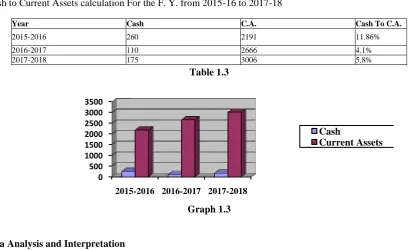
Cash to Current Assets calculation For the F. Y. from 2015-16 to 2017-18
Table 1.3
Graph 1.3
Data Analysis and Interpretation 0 500 1000 1500 2000 2500 3000 3500
2015-2016 2016-2017 2017-2018
Cash
Current Assets
Year Cash C.A. Cash To C.A.
2015-2016 260 2191 11.86%
2016-2017 110 2666 4.1%
year 2015-2016 the ratio was 11.86%, in year 2016-2017 it becomes 4.1% and it is decreased by 7.76% in comparison with the previous year. It is due to increase the in credit sales. In financial year 2017-2018 i.e. 5.8%, it was increased.
[4] Sales to Cash Ratio
Formula
Sales to Cash Ratio =Sales Cash
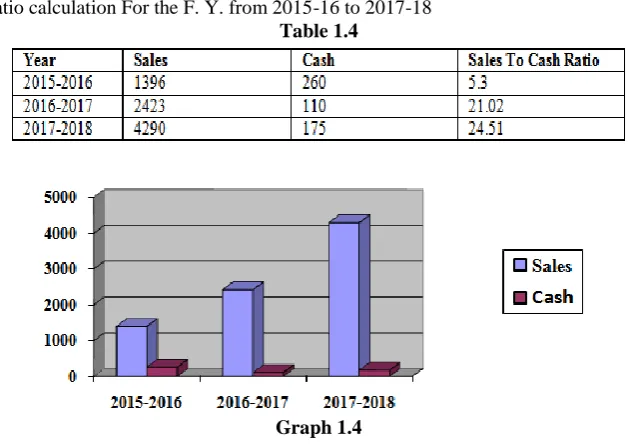
Sales to Cash Ratio calculation For the F. Y. from 2015-16 to 2017-18
Table 1.4
Graph 1.4
Data Analysis and Interpretation
As per table no.1.4 shows that sales for the year 2015-2016 was Rs. 1396 which was increased to Rs. 2423 in the year 2016-2017 and during the year 2017-2018 it was increased to Rs. 4290,it increased the sales value due to market condition and increase in price of product. The company is earning profit at increased level, it is due to increase in sales of the company.
[5] Inventory Turnover Ratio
Formula
Inventory Turnover Ratio = Sales Inventory
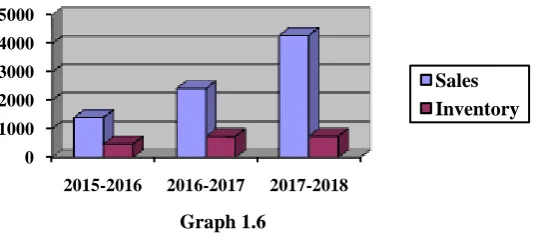
Cost of Sales = Total cost + Opening stock of finished goods - Closing stock of raw material Inventory Turnover Ratio calculation For the F. Y. from 2015-16 to 2017-18
Year Sales Inventory Ratio
2015-2016 1396 468 2.98
2016-2017 2423 737 3.28
2017-2018 4290 743 5.77
Table 1.5
Graph 1.6
Data Analysis and Interpretation
As per table no.1.5 shows that in the year 2015-2016 inventory turnover ratio was 2.98 and it increased up to 3.28 in 2016-2017 and in 2017-2018 it’s become 5.77 which is good condition for company. It is due to more frequently the stocks are sold, the lesser amount of money is required to finance the inventory i.e. there is a proper management of inventory.
[6] Net Working Capital (2015-16 to 2017-18)
Formula: Net Working Capital = Current Assets – Current Liability Net Working Capital calculation For the F. Y. from 2015-16 to 2017-18
YEAR C.A. C.L. NET W.C
2015-2016 2191 572 1619
2016-2017 2666 650 2016
2017-2018 3006 644 2362
Table 1.6
Graph 1.7
Graph 1.8
Data Analysis and Interpretation
As per table no.1.6 the net working capital for the year 2015-16 to 2017-18 increased. Hence from the graph we conclude that current assets of the company are higher than that of current liabilities of company. So it increased the value of net working capital because increased in the value of inventories, sundry debtors, and loans and advances.
0 1000 2000 3000 4000 5000
2015-2016 2016-2017 2017-2018
IV.
Conclusion
4.1.Average current ratio of Mahindra & Mahindra Ltd is 4.19 times as per the conventional rule ideal ratio 2.1, average quick ratio is 3.14 times as per the ideal ratio is 1.1. Working capital to net worth is continuously increased during the study period (2015-16 to 2017-18). So the financial position of the Mahindra & Mahindra Ltd. is better.
4.2.As per the statement of working capital shows the increased in working capital requirement from the financial year (2015-16 to 2017-18).The working capital for the financial year 2015-16 was Rs.1619 and it should be increased as Rs.2016 and Rs. 2362 in next year i.e. in 2016-17 and 2017-18.
4.3.The working capital of Mahindra & Mahindra Ltd was increased due to proper inventories, cash and bank balance, other current asset (amount) and decreased in the current liabilities and provision.
References
Books[1]. Bhagavati& Pillai: Management Accounting
[2]. S.P. Gupta: Management Accounting, SahityaBhavan
[3]. Financial Management by R.M. Srivastav, Kalyani Publishers.
[4]. Research Methodology by C. R. Kothari, New Age International Publication
Website
[5]. www.investopedia.com
[6]. www.moneycontrol.com
[7]. www.wikipedia.com