132906-8484-IJET-IJENS © December 2013 IJENS
Impact of Changeover time on productivity:
A case study
Rubayet Karim
E.mail:[email protected]Department of Industrial & Production Engineering, Jessore University of Science & Technology,Jessore,Bangladesh
Abstract-- For developing countries such as Bangladesh, reaching international markets is a great challenge. It is vital to understand what it takes for a small enterprise to survive in a global economy. To gain profit from scarce time and to increase productivity as well as to minimize waste it is necessary to adopt new manufacturing concepts like lean manufacturing philosophy. This paper addresses the application of lean manufacturing concepts to the mass production sector with a focus on sewing section of the studied garments industry. The objective of this research work is to investigate how lean manufacturing tools can be adopted to the discrete manufacturing system and to evaluate their benefit on a specific application instance. In this concern changeover time analysis has been done in this research work. The basic idea behind the lean manufacturing concept is to eliminate waste. Waste is defined as anything that does not add value to the end product from the customer’s perspective. The goal of lean manufacturing is to assist manufacturers to improve their company’s operational efficiency and become more competitive through the implementation of various lean tools and techniques in various sectors of the continuous production process. This research paper tries to extract the common scenario of readymade garments (RMG) sector of Bangladesh by depicting the existing condition of sewing section. However, this paper proposes some guidelines for the studied garments industry to improve the performance of the sewing section.
Index Term— Changeover time, Lean Manufacturing, RMG, Productivity, Waste.
I. INT R O D U C T I O N
The RMG sector in Bangladesh is playing a remarkably important role in the growth of the national economy. To gain competitive advantage, to sustain the market share and to cope with the newest competitors it is necessary to deliver quality products in time with reasonable price to the customer. In Bangladesh the labor cost is comparatively less which helps to keep the garments company alive in the competitive market. But cost stabilization also depends on proper utilization of every resource. When there is a lack of resource utilization, then it affects the every aspects of production as well as cost of production. In any manufacturing company the two basic types of wastes are material waste and time waste. In order to maximize profit margin it is necessary to minimize all types of waste. Today lead time is very important for any kind of industry as like to continuous mass production industry or service industry. In order to gain competitive advantage it is
necessary to achieve shorter lead time and it is possible through reduction of waste of time or eliminating non value added activities[1]
Lean manufacturing is one of those initiatives that focus on cost reduction by eliminating non value added activities.[1] The tools and techniques of lean manufacturing have been widely applied in the discrete industry. Now these tools and techniques of lean manufacturing are widely used in various industries all over the world. Any Garments industry can maximize their profit margin by reducing all types of waste. So there is a scope of applying lean manufacturing tools and techniques in this sector in order to reduce waste and increase productivity. In garments sector sewing section is defined as a nuclease among different sections, because major value added activities (for making finish garments) are done in this section. So in this research work sewing section is selected for detail analysis. The most commonly used lean manufacturing tools are Just In Time, Cellular Manufacturing, 5S, Value Stream Mapping, Quick Changeover(SMED), Kaizen, Total Productive Maintenance(TPM).[2 ,3]Some lean tools are difficult to adopt in the garments industry. So it is necessary to identify which tools are
appropriate for the specified garments industry. Lean
manufacturing tools can help the garments industry to eliminate waste, have better inventory control, better product quality, and better overall financial and operational procedure. This research is mainly performed to measure the existing situation of the selected garments industry using quick changeover philosophy. Hereimpact of changeover time on various aspects is determined.
II. LIT ERAT URE REVIEW
132906-8484-IJET-IJENS © December 2013 IJENS can, and often is, used in starting up a process and rapidly getting it
to running condition with minimum waste. It is a concept that says all changeovers (and startups) can and should take less than 10 minutes. Closely associated is an advanced concept of OTED (One-Touch Exchange of Die), which says changeovers can and should take less than 100 seconds. It can be applied to critical processes to reduce batch sizes, reduce work-in process inventories, achieve shorter lead times, and thereby reduce product costs and increase flexibility to meet changing customer demands. [6 , 7] SMED changes the assumption that setups have to take a long time. [4]When setups can be done quickly, they can be done as often as needed. This means companies can make products in smaller lots, which has many advantages: Flexibility: Companies can meet changing customer needs without the expense of excess inventory. Quicker delivery: Small- lot production means less lead time and fewer customers waiting time. Better quality: Less inventory storage means fewer storage- related defects. SMED also lowers defects by reducing setup errors and eliminating trial runs of the new product. Higher productivity: Shorter changeovers reduce downtime, which means a higher equipment productivity rate. [4] A research work carried out on “Analysis of Apparel Production Systems to Support Quick Response Replenishment” by-Russell E. King (Team leader), Thom J. Hodgson (NCSU Engineering); Trevor Little, Carol Carrere (NCSU Textiles); Michelle Benjamin, Tim Currin (Textile Clothing Technology Corporation). The goal of this project is to determine the structure and operational policies of apparel supply systems to best support rapid replenishment to retail in order to maximize performance and productivity. A paper named “An Integrated Methodology for More Effective Set-up Reduction” was presented at the IIE SOLUTIONS 2001 Conference organized by the Institute of Industrial Engineers, in Dallas, TX (21-23 May 2001). This paper describes how Setup time is being reduced when different types of IE Techniques and SMED are combined together.
III. METHODOLOGY
The methodology of this research work is a case study research. This case study is conducted in a selected garments industry. The study gives an idea about the existing scenario of the sewing section of the garments industry. This study deals about various types of wastes of the industry, more specifically the waste of time. Quick changeover is used to investigate the existing situation of the selected garments industry. The necessary steps required to perform the case study are discussed below.
Step-1:Primary investigation: Various sections such as knitting, dying, store, cutting, sewing, finishing section of the production floor of the selected garments industry have been investigated and finally sewing section has been selected for detail study.
Step-2: Finding literature review: As there were not enough books available on the selected topics, very few books on lean
manufacturing were found so an extensive search was carried out in the internet. Some papers related to lean manufacturing was collected but topics relevant to lean implementation in garments industry was not found, however. After visiting the selected industry, a preliminary questionnaire was prepared. As sewing section was selected for detail analysis so, the questionnaire was made on the basis of primary survey of the sewing floor as well as on the basis of theoretical aspects of the study.
Step-3: Investigation through the literature: After preparing the primary questionnaire the entire sewing section is finally investigated on the basis of lean theory and lean tools.
Step-4: Preparing the final questionnaire: After final investigation of the entire sewing section, the primary questionnaire is finalized and necessary modification was made considering specific study area through addition, deletion as well as reformation. Then this questionnaire is prepared and sorted in different groups.
Step-5: Data collection: Finally case study was conducted and data was collected through observation and questionnaire. Major quantitative data was collected through the observation of the production floor and some past record of the Industrial Engineering Department and Planning Department of the selected industry. Other qualitative data was collected through interview with the industrial engineering officer, planning officer and manager and finally by asking question to the worker, operator, supervisor and quality checker.
Step-6: Data processing and analysis: The information and data collected were sorted and arranged so that further study and analysis could be performed. Quantitative data were analyzed by using tables and graphs. After completion of the data processing, the analysis has been performed. As sewing section is selected for detail analysis so all data collected are relevant to sewing section.
Step-7 Results & Discussion: Finally results from the overall analysis are given and necessary guidelines are provided for necessary improvement (productivity, quality, resource utilization, waste minimization) of the sewing section.
IV. FINDINGS &ANALYSIS
This case study has been conducted in a selected garments industry. This case study deals with various types of waste exists in sewing section more specifically time waste. The information as well as data has been gathered through the questionnaire, observation and interview. The data and information was collected through the observation of the production floor and some past record from the industrial engineering and planning department of the selected industry. Finally all data has been analyzed by using various types of tables, graphs.
A. Changeover activities in sewing section
132906-8484-IJET-IJENS © December 2013 IJENS are: 1. Nose, needle, thread change.2. New lopper adjustment. 3.
New guide adjustment.4. Trial run and adjusting the machine.
External activities found in sewing section are: 1. Getting instruction about new styles of product from the line supervisor.2. Getting fabrics, threads and other accessories from the cutting and store section.3. Getting needle, guide and other tools for the new style product from maintenance department (If require). 4. Returning tools from the last operation to maintenance department.
B. Style wise comparative analysis of changeover time:
For changeover time analysis two styles are selected. Change overtime was calculated by observing these two styles. From these observations it has been found that actual change over time for these two styles is longer than the standard change over time. Here actual changeover time for each operation is recorded by using stopwatch & standard changeover time information for each operation is collected from the production department of the studied industry. The difference between these actual change over time and standard change over time are shown in table1 & table2 2. The following table1 represents the change over time for style 01.
Table 1. Changeover process with time for style 01.
(BuyerA Style-01 Line-21)
The following table2 represents the change over time for style 02.On the basis of the table a comparison between standard changeover time and actual changeover tine for style 02 has been made which is shown in figure 2. From this figure it has been found that actual changeover time for style02 is also longer than the standard changeover time
Table2.Changeover process with time for style 02(BuyerB Style-02 Line-1)
.
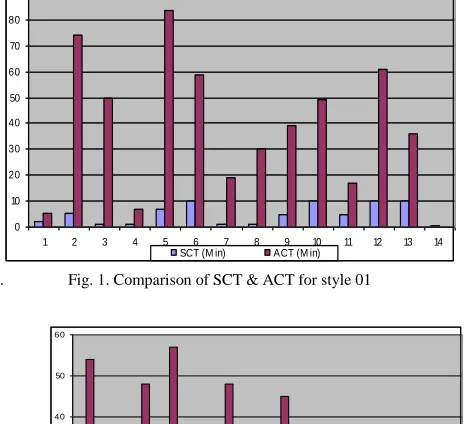
The comparison between standard change over time and actual change over time for style 01 is shown in fig.1. From this figure it has been found that actual changeover time is longer than the standard changeover time.
Operation No
Operation
Name
M/C Name
Standard Changeover Time
(min)
Actual Changeover Time = Setup Time + Start up Time
1 Care Label Plain M/C 2 5 min+10sec =5.10min
2 Shoulder
Joint O/L
5.5
4 min+1hr10min=1hr14min
3 Rib make Plain M/C 1 4 min+46min= 50min
4 V-Tack (2) Plain M/C 1 2 min+5min=7min
5 V-Neck
Join(2) O/L
7 1 hr 23 min + 43 sec=1hr23min43sec
6 Neck Top
Seam Flat Lock
10
55min + 4min =59min
7 Neck TST Plain M/C 1 4min+15 min=19min
8 Main Label
Joint Plain M/C
1
5min + 25 min=30min
9 Sleeve
Join(2) O/L
5
4.20min+35min=39.20min
10 AHTS Flat Lock 10 4min+45 min=49min
11 Side Seam(2) O/L 5 6min+11 min=17min
12 Body Hem Flat Lock 10 1hr 23 sec+15sec=1hr38sec
13 Sleeve Hem Flat Lock 10 35min + 45sec =35.45min
14 Thread
Cutting Manually
.5
0 + 15sec =15sec
Operation No
Operation
Name
M/C Name
Standard Changeover Time (min)
Actual Changeover Time = Setup Time + Start up Time
1 Back Front
Matching Manual
5
0+50 min =54min
2 Shoulder
Joint(1) O/L
5
5 min + 30 sec =5min30sec
3 Main Level
Joint Back Part P/M
1
3 min + 45 min =48min
4 Neck Piping F/L 20 24.10 min + 33 min =57.10min
5 Neck Tack (1) P/M 1 15 min + 9 min =24min
6 Shoulder Joint
(2) O/L
5
4 min + 44 min =48min
7 Neck Chap
Tack P/M
1
2 min + 15 min =17min
8 Arm Hole
Piping(2) F/L
20
20 min + 85 min =1hr 45min
9 Main label join P/M 1 10 min + 2 hr 12 min =2hr 22min
10 Opening Tack P/M 1 5 min + 10 min =15min
11 Side Joint/Seam O/L 5 6 min + 10 min =16min
12 Finish Tack P/M 1 5 min + 7 min =12min
13 Hem Tack P/M 1 5 min + 5 min =10min
14 Body Hem F/L 10 10 min + 20 min =30min
15 Thread Cut Manual .5 0 + 5 sec =5sec
132906-8484-IJET-IJENS © December 2013 IJENS Change over time is long because most of the time when new
styles enter in sewing line then there is a major setup problem in machine as well as supply problem of fabrics and accessories.
0 10 20 30 40 50 60 70 80 90
1 2 3 4 5 6 7 8 9 10 11 12 13 14
SCT (M in) ACT (M in)
. Fig. 1. Comparison of SCT & ACT for style 01
0 10 20 30 40 50 60
1 2 3 4 5 6 7 8 9 10 11 12 13 14
SCT (M in) ACT (M in)
Fig. 2. Comparison of SCT & ACT for style 02
C.Impact of changeover time
There is a significant impact of changeover time on production rate, lead time, WIP stock, defect. As Change Over time is the summation of machine setup and startup time. So when setup time and startup time is increased then Change Over time is also increased. Change Over time influence the overall production process. When change over time is long then it decreases the production rate, increase the lead time, WIP stock and defect. The following Table3 contains the information related to changeover time and production for style 01 & 02, table 4 contains the information related to excess lead time, defect, and WIP stock. These two tables (3&4) are mainly used to make a relationship between changeover time with respect to lead time, WIP stock, defect and production rate.
Styles & Buyers
Avg Defect
(as Alter) Per
Day Per line
Actual
Defect found
In COD
Excess
Time Require
For prodn
Total
WIP stock
Excess
WIP stock
A,01
86
158 460.85 345 268
B,02 112 505.85 724 620
Table3. Change over time for style 01 & 02.
Table 4: Information related to excess lead time, defect, and WIP stock for Style 01 & 02.
D.Impact of changeover time on production rate
There is a significant impact of changeover time on productivity. Production is very much hampered due to long changeover time. It has been found that the day after change over average production rate is 84 pieces/hr but in the change over day (when new style enters in the line) the production rate is 10 pieces/hr, i.e. 74pieces are less produced in the changeover day. So 1.23 pieces are less produced in every single minute of production which is shown in fig.3
Production rate
0 2 4 6 8 10 12
1 2 3 4 5 6 7
Time
N
o
.
o
f
p
ie
ce
s
No. of pieces
Fig. 3. Impact of changeover time on production rate
Styles
& Buyer
s Total
SCT
(min) Total
ACT
(min) Prodn
in the COD.
Day 1
Prodn
After
The COD.
Day 2, Day 3
Day 4
Avg
Available Time for
Prodn
SMV Require
to Produce
Each product
A,01 69 529.8
5 130 380, 820, 672
10hours
6.544
B,02 78 583.8
132906-8484-IJET-IJENS © December 2013 IJENS
E.Impact of changeover on WIP stock
Changeover time also influence the WIP stock. There is a significant increase in WIP stock due to long changeover time. As a result extra space or container is required for extra work in process (WIP) inventory. There is a linear relationship between change over time and WIP stock. For every 10 minute of excess changeover time, WIP stock increase is 9.18. This is shown below in fig.4
WIP stock vs Changeover time
0 20 40 60 80 100 120
10 20 30 40 50 60 70 80 90 10
Excess change over time
W IP s to c k WIP stock
Fig. 4. Impact of changeover time on WIP stock F.Impact of changeover time on production lead time
It has been found that time require to change machine setup for a particular style product is too long due to various internal activities and machine problem. Change over time is also long due to start up time, as worker makes delay to start their operation for various reasons, such as input problem. Due to long change over time, extra time is required to complete production. As a result lead time for production is also increased. The extra change over time for style 01 & 02 is 966.7 minutes, which is totally waste of time. So for making delivery, the additional time require for production is 966.7 minutes.
G.Impact of changeover time on defects
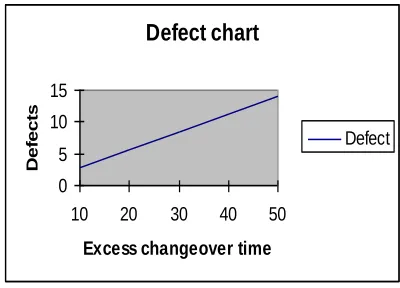
It has been found that, there is an impact of change over time on products defect. Due to long change over time the defect generates in each line is higher than the average defect generates per line per day. Two style of a particular product has been chosen for study purpose. For style 02, the defect (alter) item is 112, for style 01, defect item is 158 and all of this findings are higher than the average defect, which is 86 (per day per line). It has been analytically found that for each excess 10 minutes of changeover time the number of defect (excess) is1.01, which is shown in fig.5.
Defect chart
0 5 10 15
10 20 30 40 50
Excess changeover time
D e fe c ts Defect
Fig. 5. Impact of changeover time on defects.
H. Production characteristics based on changeover time
Two styles are considered for changeover time analysis. For both these two style, production quantity is very small on changeover day but after the day of changeover the production level is reasonable. The characteristics of production for these two styles (01 & 02) are shown in fig. 6 & 7.
68
694
1506 1574
1000 1000 1000 1000
600 600 600 600
1 1 1 0 200 400 600 800 1000 1200 1400 1600 1800
1 2 3 4
Date P rod uc ti on P e r D a y
68 (10 hr)
1000 (Target for 10 hr)
600 (Minimum Target Per Day) 694 (8 hr)
1506 (11 hr)
1574 (11 hr)
Fig. 6. Analysis: Actual Production Vs Target of Production for style 02
From fig. 7 & 6 it has been found that for both style 01 and 02, the production quantity is very low on the changeover day (130 pieces & 68 pieces) but after the day of changeover the production is increased in a significant amount but sometimes it does not
130
380
820
672
1000 1000 1000 1000
600 600 600 600
1 1 1 0 200 400 600 800 1000 1200
1 2 3 4
Date P rod uc ti on P e r D a y
130 (10 hr)
1000 (Target for 10 hr) 600 (Minimum Target Per Day) 380 (8 hr)
820 (11 hr)
672 (8 hr)
Fig. 7. Analysis: Actual Production Vs Target of Production for style 01
132906-8484-IJET-IJENS © December 2013 IJENS buyer requirement the company must reach the desired level of
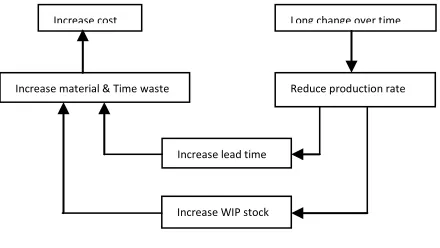
production at the due date so they involve extra resource (extra time, manpower) to full fill the shipment at the due date. The company has to bear extra cost for this extra resource, which is totally wastage for the company. The effect of this long changeover time is shown in fig.8.
Fig. 8. Impact of changeover time
From this figure it has been found that long change over time ultimately increases the cost of production.
I. The reason behind long changeover time
Changeover operation is performed when new styles are entered into the line. But sometimes it is possible to perform the setup operation before the starting day for the new style product (operation). Most of the time there is a problem in guide adjustment, lopper and trim adjustment and a significant amount of time is wasted for this adjustment problem. Amateur mechanics are assigned to solve the problem and when he is not able to solve the problem then expert and experienced mechanics are assigned. Start up time is more because sometimes operator makes delay to start their operation because of unavailability of various accessories at that time; sometimes operator makes delay without any reason.
Only the machine operator do the setup operation (if no problem in set up), no extra man is available to help operator. More time is spent for trial operation and for adjustment till the machines is good enough for production.
V. GUIDELINES FOR CHANGEOVER TIME REDUCTION
A. For streamlining internal activities
1. Start the setup operation before the day of new style operation (if possible).2. Assign the expert mechanics at the right time to solve the adjustment problem or any machine problem.3. Implement parallel operation for quicker setup. Parallel operations divide the setup operation between two people, here one is operator himself/herself and other one is helper who must be expert in setup operation for various sewing machines.4. Optimize the start-up time by eliminating trials and adjustment.
5. Eliminating trials and adjustments is done by making good settings before the operator startup the machine for new operation.
B. For streamlining external activities
1. To make sure that all accessories are available in sewing section, when it is needed.2. To make sure that all accessories and equipment are arranged properly (set in order) in store & maintenance department, so all these things can be bring at a right speed without much time spends.
In order to reduce the changeover time the company must follow the following steps: 1. Measure and record changeover times. 2. Continuously put pressure on reducing the setup times.3. Involve the team in analysis. Do not rely only on industrial engineers.4. Make a video, and get operators to record the critique. The video must remain their property. Put their ideas up on a board at the workplace, and prioritize the improvement activities.5. Consider a financial incentive for quick setup operation.
VI. CONCLUSION & FUTURE WORK
Today there is no quota system in RMG sector. Today competitiveness rather than quotas determine the market share. So in order to gain the largest market share as well as to sustain in the present competitive market it is necessary to improve this sector. As sewing section is the most important section among different section of garment industry, so this research proceeds with a focus on improvement of the sewing section among different section. In this connection lean manufacturing concept is applied as a new concept of manufacturing in the sewing section of the studied garments industry. The improvement of any manufacturing organization depends on various issues such as waste minimization, productivity improvement, quality management as well as labor efficiency, resource utilization etc. This research is concerned with the sewing section of the selected industry. So recommendations are provided for overall improvement of the sewing section. Proper and adequate training could be provided to the inexperienced sewing operators so that they have right knowledge and consciousness about the operation of various sewing machines.
A proper on-time maintenance system should be provided for various sewing machines so that it is possible to minimize machine breakdown.The line supervisor must monitor his/her line properly to ensure that no operators, helpers make delay in his/her operation without any reason. They should keep production in the right direction by motivating the workers. Before receiving fabrics from cutting section it should be checked properly to ensure that there is no shading & GSM problem in fabrics as well as there is no foreign particles exist in the fabrics.
From changeover time analysis it has been found that on changeover day a significant amount of time is wasted due to machine setup problem. Time is also spent for bringing needle, trim, guide and other accessories as all of those items are not available in the store moreover they are not properly arranged. So a Increase cost
Increase material & Time waste
Increase lead time
Increase WIP stock
132906-8484-IJET-IJENS © December 2013 IJENS significant amount of time is spent to find out the right needle,
trim, guide etc. That’s why on changeover day (when new style enters in the line) the production rate is very low than the production rate in the next day (The day after change over). Due to long changeover time the lead-time for production is increased, consequently average defect per line is also increased. Based on the current research work, further study can be done on the garments industry in different dimension. Some of them are: 1. this research work is concentrated only in the sewing section of the selected garments industry, so further study can be done in other section of the selected industry such as knitting, dying, cutting, finishing and packing section.2. This research work is done in a knit composite industry; so further study can be done in wovenand other types of apparel industry.3.Finally the changeover time analysis is done only to show the impact of changeover time on productivity, lead time, WIP stock, defect but further study can be performed in sewing section by using SMED method to reduce changeover time.
REFERENCES
[1] S Bicheno John, The Lean Toolbox, 2nd edn (Picsie Books,
Buckingham, England, 2000) PP-21-24.
[2] Kolarik William J., Creating Quality (McGraw-Hill, Inc. International Editions, 1995) PP-173-191.
[3] Besterfield Dale H., Carol Besterfield-Michna, Besterfield Glen H. & Mary Besterfield-Sacre, Total Quality Management, 3rd edn
(Pearson Education,Inc.Singapore,2003) PP-184-464. [4] Shingo Shigeo, Quick Changeover for operators: The SMED
system, (Productivity press, Portland, Oregon, 1996), PP-16. [5] Simon Caulkin, Lean Thinking and Methods: "Waste Not, Want
Not.", (The Observer, September 2002)
[6] Hawtin Peter, Mike Perrett (BAeS), Phil Harvey, Winton Peter [7] (Rolls Royce), Robert Small (AO Henton), Mike James-Moore
(Warwick University),Faz Zaman, Alan Harrison; “6 Common Components,(LAI Training Working Party, Cranfield University,UK.)