White Rose Research Online URL for this paper: http://eprints.whiterose.ac.uk/73334/
Monograph:
Thornton, P and Corden, A (2002) Evaluating the Impact of Access to Work: A Case Study Approach. Research Report. Research & Development Report, WAE138 . Claimant
Unemployment and Disadvantage Analysis Division, Department for Work and Pensions , Sheffield.
[email protected] https://eprints.whiterose.ac.uk/ Reuse
Items deposited in White Rose Research Online are protected by copyright, with all rights reserved unless indicated otherwise. They may be downloaded and/or printed for private study, or other acts as permitted by national copyright laws. The publisher or other rights holders may allow further reproduction and re-use of the full text version. This is indicated by the licence information on the White Rose Research Online record for the item.
Takedown
If you consider content in White Rose Research Online to be in breach of UK law, please notify us by
EVALUATING THE IMPACT OF ACCESS TO
WORK: A CASE STUDY APPROACH
List of Tables i
List of Figures ii
Acknowledgements v
Extended Executive Summary vii
1 Introduction 1
1.1 Background to the Study 1
1.2 The Access to Work Programme 1
1.3 Case Study Methodology 2
1.4 Access to Work Case Study Methods 2
1.4.1 Interview Techniques 3
1.4.2 Rating Scales 3
1.4.3 Approach to Retrospective Questioning 4 1.4.4 The Problem of Socially Acceptable Answers 4
1.5 Question Areas 5
1.5.1 Outcomes in the Absence of Access to Work at Time 5 of Application
1.5.2 Alternatives to Access to Work 6
1.5.3 Acceptability of Alternatives 6
1.5.4 The Difference Access to Work Makes 6 1.5.5 Outcomes without Access to Work Now 6 1.5.6 Overall Effects of Access to Work 7
1.6 The Sample 7
1.7 Structure of the Report 7
2 Support Workers 9
2.1 Introduction 9
2.2 Support Used 10
2.2.1 Support Worker Roles 10
2.2.2 Levels of Support 10
2.2.3 Duration of Access to Work Support 11
2.2.4 Support Packages 11
2.3 Employment Situation 11
2.4 Employer Respondents 12
2.5 Likely Employment Outcomes in the Absence of Support Worker 13 Provision
2.5.3 Likely Outcomes Now 17 2.5.4 Importance of Support Worker Provision in the Access to 19
Work Package
2.6 Alternatives to Support Worker Provision 19 2.7 Funding the Support Worker Provision Some Other Way 21 2.7.1 Users Paying for a Support Worker 21 2.7.2 Employers Paying for a Support Worker 22 2.7.3 Users’ Views on Funding Support Worker Provision 25
from other Sources
2.8 The Difference Support Worker Provision Makes to Users 26
2.9 Summary 27
3 Travel to Work 29
3.1 Introduction 29
3.2 Support Provided 30
3.2.1 Levels of Support 30
3.2.2 Past Use of Travel to Work 30
3.2.3 Support Packages 30
3.3 Employment Situation 30
3.4 Alternatives to Travel to Work 31
3.4.1 Possibility of Walking to Work 32
3.4.2 Possibility of Lifts from Family, Neighbours or Friends 32 3.4.3 Possibility of Lifts from Colleagues at Work 32 3.4.4 Possibility of Using Public Transport 33
3.4.5 Possibility of Using Own Car 33
3.4.6 Possibility of Using Transport Provided by the Employer 34 3.4.7 Possibility of Using Taxis Paid for by the Employer 34 3.4.8 Possibility of Paying the Taxi Fares 35
3.4.9 Alternatives Now 36
3.5 Likely Employment Outcomes in the Absence of Travel to Work at 37 Application
3.5.1 Likely Outcomes at the Time of Application for Travel to 38 Work Users Taking up a New Job
3.5.2 Likely Outcomes for Travel to Work Users in Paid Work 38 at Application
3.5.3 Likely Outcomes for Travel to Work Users Now 41 3.6 Differences Travel to Work Made to Users 42
3.7 Summary 44
4 Alterations to Premises 45
4.1 Introduction 45
to Premises
4.5.1 Likely Outcomes for Users of Alterations to Premises 47 When they Applied
4.5.2 Likely Outcomes Now 49
4.6 Funding the Alterations Some Other Way 49 4.6.1 Possibility of Employers Paying for the Alterations 49 4.6.2 Acceptability of the Employer Paying 50 4.6.3 Users Paying for the Alterations 51
4.7 Summary 51
5 Aids and Equipment 53
5.1 Introduction 53
5.2 Support Provided 53
5.2.1 Levels of Support 54
5.2.2 Access to Work Support Packages 54
5.3 Employment Situation 54
5.4 Likely Employment Outcomes in the Absence of Aids and 55 Equipment
5.4.1 Taking Up a Job 56
5.4.2 Staying in Work 57
5.5 Funding Aids and Equipment Some Other Way 63 5.5.1 Users Paying for Aids and Equipment 63 5.5.2 Employers Paying for Aids and Equipment 65 5.5.3 Users’ Views on Funding Equipment from other Sources 70
5.6 Summary 70
6 Conclusions: The Impact of Access to Work 73
6.1 The Impacts of Access to Work Elements 73
6.2 The Overall Impact of Access to Work 75
6.2.1 Users’ Responses 75
6.2.2 Deadweight 79
6.2.3 Employers’ Responses 80
References 83
Appendix A Research Methods 85
Appendix B Respondents 91
Table 2.1 Occupational sector of Support Worker respondents 12
Table 2.2 Support Worker user and employer interviews achieved by sector 12
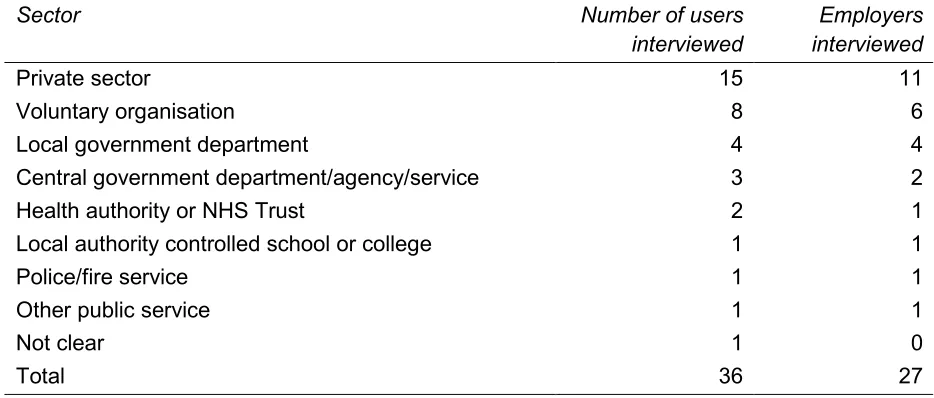
Table 3.1 Travel to Work user and employer interviews achieved by sector 31
Table 4.1 Types of alterations to premises 46
Table 4.2 Support packages of users of alterations to premises at interview 46
Table 4.3 Alterations to premises user and employer interviews by sector 47
Table 5.1 Types of Aids and Equipment provided to current users 54
Table 5.2 Aids and Equipment users’ occupations 55
Table 5.3 Aids and Equipment user and employer interviews achieved 55
by sector organisation would have paid for the equipment
Table A.1 Respondents by ES Region/Country 86
Table A.2 Employer interviews achieved 87
Table A.3 Number of employer representatives interviewed per employing 87
organisation
Table B.1 Users’ age and gender 91
Table B.2 Employment status at interview 91
Table B.3 Earnings at interview, or in last job if not working 91
Table B.4 Users claiming Disability Living Allowance 91
Table B.5 Users’ occupations 92
Table B.6 Access to Work elements ever received 92
Table B.7 Access to Work elements received at interview 92
Support Workers
Figure 2.1 Likelihood at application of taking up a new job without 14
a Support Worker
Figure 2.2 Likelihood at application of giving up working altogether 15
Figure 2.3 Likelihood at application of carrying on without a Support 16
Worker
Figure 2.4 Likelihood of losing the job now 18
Figure 2.5 Likelihood of carrying on without a Support Worker now 18
Figure 2.6 Likelihood of being in the job now without Access to Work 19
Figure 2.7 Possibility at application of getting the support needed 20
from other people at work
Figure 2.8 Possibility at application of paying for the support 21
Figure 2.9 Acceptability at application of paying for the support 22
Figure 2.10 Possibility at application of the employer (or business) 22
paying
Figure 2.11 Acceptability at application of the employer (or business) 23
paying
Figure 2.12 Possibility at application of the organisation paying 24
Travel to Work
Figure 3.1 Possibility at application of lifts from family, neighbour or 32
friend
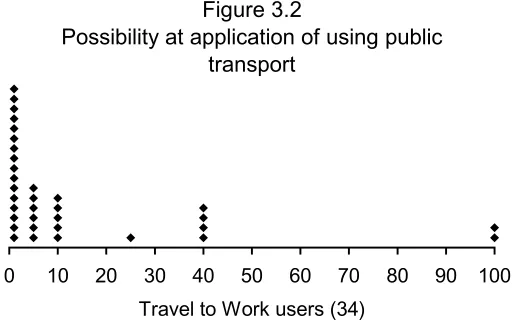
Figure 3.2 Possibility at application of using public transport 33
Figure 3.3 Possibility at application of the organisation paying for taxis 35
Figure 3.4 Possibility at application of users paying for taxis 35
Figure 3.5 Acceptability at application of paying for taxis 36
Figure 3.6 Possibility of finding another way of getting to work now 37
Figure 3.7 Possibility of paying for fares now 37
Figure 3.8 Likelihood at application of taking up the job without 38
Travel to Work
Figure 3.9 Likelihood at application of giving up working altogether 39
Figure 3.10 Likelihood at application of getting another job 39
Figure 3.11 Likelihood at application of carrying on without fares to work 40
Figure 3.14 Likelihood of taking more sick leave now 41
to Work
Alterations to Premises
Figure 4.1 Likelihood at application of carrying on without the alteration 49
Figure 4.2 Possibility at application of the employer paying 50
Figure 4.3 Possibility at application of the organisation paying for the 50
Alterations to Premises
Figure 4.4 Acceptability of the employer paying 51
Aids and Equipment
Figure 5.1 Likelihood at application of taking up the job without Aids 56 and Equipment
Figure 5.2 Likelihood at application of taking more sick leave 57 Figure 5.3 Likelihood of taking more sick leave now 58 Figure 5.4 Likelihood of taking more sick leave now 58 Figure 5.5 Likelihood at application of giving up working altogether 59
Figure 5.6 Likelihood of losing the job now 60
Figure 5.7 Likelihood of having to leave the job now 61 Figure 5.8 Likelihood at application of carrying on without the equipment 62 Figure 5.9 Likelihood of carrying on without the equipment now 62 Figure 5.10 Possibility at application of paying for all the support 63 Figure 5.11 Acceptability at application of paying for all the support 64 Figure 5.12 Likelihood of paying for the equipment now 65 Figure 5.13 Possibility at application of the employer (or business) 66
paying everything
Figure 5.14 Acceptability at application of the employer (or business) 66 paying everything
Figure 5.15 Likelihood at application of the organisation paying for the 67 equipment
Figure 5.16 Likelihood of the organisation paying the full costs of the 68 Equipment now
Conclusions
Figure 6.1 Ratings of the likelihood of being in the job without Access 76 to Work: all users in paid work
Figure 6.2 Ratings of the likelihood of being in the job without Access 77 to Work: users whose current Access to Work package
included Aids and Equipment
Figure 6.3 Ratings of the likelihood of being in the job without Access 77 to Work: users whose current Access to Work package
Figure 6.5 Ratings of the likelihood of being in the job without Access 78 To Work: users who have ever received a Support Worker
Figure 6.6 Ratings of the likelihood of being in the job without Access 79 To Work: users of Alterations to Premises
This report would not have been possible without the help and good will of a large number of people. We wish to thank:
The Access to Work users and employer representatives interviewed, and those who helped with the development of the research instruments.
Regional Disability Service Managers, Disability Service Team Managers and office staff who provided essential information.
Research managers in Working Age Evaluation Division of the Department for Work and Pensions, Jobcentre Plus Head Office staff and the Research Steering Group for their encouragement and support.
The ten research interviewers recruited to the study for commitment and quality of work in an exacting project.
The Access to Work programme aims to reduce inequalities between disabled people and non-disabled people in the workplace by removing practical barriers to work. There are four main elements of support: support workers in the workplace or to assist in getting to work; help with costs of travel to work; alterations to workplace premises; and aids and equipment in the workplace. Employers may be asked to make a financial contribution and users to contribute to costs of fares to work.
The Employment Service (now Jobcentre Plus) commissioned the Social Policy Research Unit to evaluate the impact of the Access to Work programme. The aims were to estimate the difference the programme makes in enabling its users to take up and stay in work and to estimate whether the same outcomes could have been
achieved without the programme. Users and their employers were asked to explain the difference the support made to them and to hypothesise about what would have happened in the absence of the programme.
Research Methods
A case study methodology was used as an alternative to estimating the difference attributable to the programme and deadweight through experimental and quasi-experimental research methods. Case study is a well-established methodology, and useful when the focus is on the relationship between a person and their setting. It is now accepted as an appropriate strategy for explanation, leading to findings which may be generalised at an analytical level on the basis of the cogency of the
theoretical reasoning. The approach developed, within a realist theoretical paradigm, used qualitative techniques to obtain and explain quantifiable results, providing detailed insights into the way in which the programme led to outcomes.
Using agreement scales calibrated 1 – 100, users and employers were asked to rate the likelihood of possible outcomes in the absence of Access to Work, and then to discuss the reasons for so placing their response. They were also asked to rate the possibility and acceptability of alternatives to Access to Work support elements. They were asked about the differences Access to Work made to them without using the scale. Because users often receive more than one support element, question modules were developed for each, and in conclusion users were asked to rate the overall effects of Access to Work. The semi-structured interview schedule was designed to address, and circumvent, potential problems related to recall in retrospective interviews and socially acceptable answers.
applied in 1999 or 2000, though some respondents were longer-term users. There was no attempt to achieve geographical representation, the prime consideration being to achieve adequate representation of the four main elements of Access to Work.
Eighty-seven full case studies were achieved, based on interviews with Access to Work users and their respective employers, and on extracts from client case records. There were interviews with a further 30 users who were self-employed or for whom no employer interview could be achieved.
Support Workers
Respondents and their Access to Work Support
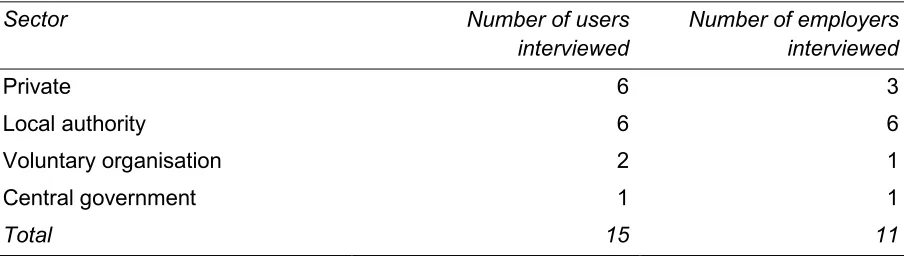
Fewer Support Worker users took part in the study than projected. Twenty-one users were interviewed but full responses were obtained from only 19. Twelve employer representatives were interviewed.
Support Workers were used as readers, communicators at work, job aides, personal assistants, drivers to work and in work, and, exceptionally, as a job coach. Support Workers often performed more than one function. Levels of support varied from the entire working week throughout the year to six two-hour sessions per annum. People with physical or visual impairments had much higher levels of support than people with hearing impairments.
Likely Employment Outcomes in the Absence of Access to Work
Although numbers are small, there is strong evidence from users that Support Worker provision was essential to take up a job. Without a Support Worker, getting any job would have been impossible for most, and some thought they might even have given up looking for work altogether. Some employers, keen to appoint the best person for the job, thought they might have found alternative solutions in the absence of Access to Work support, but it is not certain that such solutions would have
materialised or been sustainable in the longer-term, or that they would have been fully acceptable to users. In only one case did both user and employer believe that an alternative might have been found by rearranging the work.
Support Worker provision was also important to sustain employment. Around one in four users established in work when they applied felt that they would have given up working altogether if Support Worker provision had not been available. Employers generally agreed with this view. Almost half of Support Worker users were
performance was the main reason given for not carrying on. Those who said they would have carried on without the support stressed the importance to them of working, having an income, supporting a family or maintaining a business, although they believed they could not do the job effectively without the support. Employers’ judgements generally concurred with those of users, though they tended to be more pessimistic about the possibility of carrying on without the support.
All except one had a package of Access to Work support and Support Worker provision appears to be a key ingredient in most cases.
Alternatives to Support Worker Provision
Most users were pessimistic about the possibility of getting the support they needed from other people at work, and most would find accepting help from others
unacceptable were it available. Where alternative sources of help were available, they were not likely to be of the same quality or intensity as that offered by Support Workers. Only one user was confident that the employer could have found an acceptable alternative solution.
The Possibilities of Employers Paying for a Support Worker
Support Worker costs ranged from £300 to £24,000 per annum. Most users saw little or no possibility of the employing organisation paying for a Support Worker. Were it possible, it was generally unlikely to be acceptable to users. Some stressed the responsibility of government to promote equality of opportunity for disabled people, though it was also felt by some that employers have a duty to pay. Possible negative consequences of the employer paying were the effects on felt independence and good relations at work. Asking an employer to pay would emphasise impairment and difference, and prejudice employment chances. Some employees of small
organisations and owners of businesses were concerned about the financial impact on an organisation to which they were strongly committed.
Employers were overall less negative than users about the possibility of paying, though none agreed wholeheartedly that the organisation would pay. There is some evidence that employers might be prepared to pay for a proportion of the costs. Where several staff members made use of Access to Work Support Worker provision organisations were concerned about the ongoing costs. The point was made that shifting costs to employers would make disabled people disproportionately expensive to employ.
The Possibilities of Users Paying for the Support Worker
Differences Support Worker Provision Makes to Users
Users were keen to emphasise the difference that Support Worker provision made to them. For some the fundamental difference was being able to work at all. Almost all emphasised the increased ability to do their job more effectively. Also stressed were participation at work and social inclusion. Independence, control and associated well-being were highlighted. Career chances were enhanced. For self-employed people a Support Worker could be the key to running a company in the way open to a non-disabled person. Using a Support Worker brought significant health gains that made the difference between staying in work and giving up. Having a Support Worker also demonstrated to non-disabled colleagues and customers that disabled people can work on an equal footing and helped to reduce prejudice. Only one respondent referred solely to financial advantage, where the Support Worker was a family member who served as a driver to work.
Travel to Work
Respondents and their Travel to Work Support
Travel to Work users were well represented in the study: 36 respondents had received help with taxi fares or the costs of being driven to work, of whom 23 were still receiving such help when interviewed. Twenty-seven employers were
interviewed. As the employers’ role is only to provide proof of attendance, employers were not always sufficiently aware of their employee’s support to give full answers.
The approved annual costs of Travel to Work ranged up to £10,700. Support had sometimes been provided on a short-term basis.
Possible Alternatives to Travel to Work Support
Walking to work was almost never an option. Using public transport was impossible, according to users, because it was inaccessible, journey lengths would have been unacceptable, or using it would be damaging to health or risk personal safety. Getting lifts to work from family or friends was definitely possible for a small minority of
respondents, and where this was also acceptable, it might be concluded that Access to Work support was not essential. For most, however, there was no scope for such lifts, which would have seemed an unacceptable option, creating obligations and loss of independence.
Likely Employment Outcomes in the Absence of Access to Work
There was strong evidence from users that Travel to Work was essential to taking up a job. With no other options for travelling to work for most people, the expense of taxi fares meant that people could not otherwise afford to go to work.
were all too important. Those who felt they could have carried on without Travel to Work thought some other options were open to them, such as using their own resources or asking family members for lifts. However, such arrangements were not thought to be sustainable for long.
A striking finding is users’ views of the likelihood of taking more sick leave in the absence of Travel to Work, both at the time they first applied and, for those still receiving this help, in current circumstances. Those who saw no other way of getting to work felt they would be at home claiming sickness. Those who might have
managed to make alternative arrangements expected the extra time and effort
required would lead to exhaustion, and stress, and the likelihood of decline in health.
A strong possibility of losing their job without Travel to Work was felt among several current users, whose employers tended to agree.
People might have been expected to change their hours to reduce costs of travel, if Access to Work were not available. However, this was not an option for most, even where employers might have made arrangements. Reducing journeys by lengthening working days could have led to negative effects on health; major reductions in hours would have meant unacceptable loss of earnings. Home-working was sometimes seen as an option, but people generally wanted to come into a work-place.
The Possibilities of Employers Paying for Travel to Work
Few users were optimistic about the possibility of using taxis paid for by their employer, although this would have been acceptable to many. When employers’ views were sought, few thought this was more than a half-way possibility. The financial impact on the organisation was considered unacceptable, and they pointed to the precedent set in ‘opening the floodgates’. Even if willing in principle, which was unusual, taxi fares did not fit into existing budget allocations, or were beyond the control of local managers. It was unusual for this kind of accommodation for disabled people to be viewed as a legal responsibility. Where employers were rather more positive about the possibility of paying for taxi fares under current circumstances, they sometimes mentioned the value of retaining trained and competent staff. The possibility of employers actually providing transport themselves seemed remote, and unlikely to be a practical solution, to both employees and employers.
The Possibilities of Users Paying for their Travel Expenses
Travel to Work users normally make a contribution to their travel expenses. For most, the full cost was unaffordable at the time of their application, although a minority thought this would have been a possibility. Acceptability was generally rated lower, again for financial reasons, and because it seemed unfair to have to pay extra to go to work. Even those who felt they might have afforded to pay were likely to rate lower the acceptability of doing so. Some users felt this should be a government
Differences Travel to Work Provision Makes to Users
For many users, the fundamental difference made by Travel to Work was being able to get to their job. For some, taking-up or continuing in lower-paid work would not otherwise have been possible, and people with higher earnings and expensive journeys would not have been able to do their job. Being able to assure prospective employers that getting to work was not a problem gave job applicants confidence and credibility.
People could be relied upon to arrive at work on time, and ready for work, which was valued by employers in terms of work performance. Users felt that health was not jeopardised by the stress, risk, and fatigue attached to otherwise exhausting
journeys, and concentration and quality of work were enhanced by relief from worry and distraction. Not being financially out of pocket by going to work made substantial differences to the viability of employment.
Alterations to Premises
Respondents and their Access to Work Support
Fifteen users for whom alterations to the building had been made and 11 employers were interviewed. The most common alteration was to toilet facilities. Other
assistance included stair-lifts, automatic doors and ramps. Costs ranged up to £10,000 and six alterations cost over £5,000.
Employment Outcomes in the Absence of Access to Work
Alterations to Premises appeared to have the greatest impact on sustaining the employment of people who developed health problems which put their job at risk, although the support could also be indispensable to disabled people taking up work. For many of those, work would be totally impossible without the alterations. Disabled people who did not have health problems affecting their work mostly got help with Alterations to Premises when they had been carrying on without the support for some time. The benefits to them lay mainly in easier and more equal access in the
workplace and some associated improvements in efficiency. Working without the alterations could have been tiring and sometimes demeaning but not intolerable for people determined to work.
Almost all users believed that the alteration had made some difference to them, though in two instances it was thought to be entirely dispensable. Some users felt they could have carried on without it with no serious negative effect on their work, health or well-being.
The Possibilities of Employers Paying for Alterations to Premises
pessimistic. Not all users were happy with the idea of their employer paying. Feeling obligated to the employer and the effect on relationships was a factor. Some felt that responsibility to enable employment of disabled people should lie with government; others felt that employers had a duty to their employees.
Employer representatives’ ratings of the possibility of paying were only marginally higher than users’. Local authority respondents found it hard to answer if they themselves did not have control over budgets for adaptations. Most employers felt they would ‘find some way’ of meeting their employees’ needs, though how the funds would be found was not always clear. Only two respondents were certain or almost certain that the organisation would pay because it had a policy to make adaptations. Legal obligations were mentioned very rarely. Although the organisation might have been willing and able to pay, the expertise to make appropriate alterations could be lacking.
It was very exceptional for an employer to say that paying for the alteration was not at all acceptable, making it unlikely that the alteration would have been made. Employers generally seemed to accept the principle of employers paying for
alterations. Benefits to other staff, students or customers were acknowledged. Where users had previously appeared to manage without the alterations some employers were less inclined to find paying acceptable.
The Possibilities of Users Paying for the Alterations
Users rarely saw any real possibility of paying for the alterations. Many users rejected the idea on principle, believing it should not be their responsibility, that it was unfair to ask disabled people to pay or it denied equality of access. In some instances where users had previously managed without the alteration, saw it as a ‘luxury’, or found it unsuitable there would have been little point in paying themselves.
Aids and Equipment
Respondents and their Aids and Equipment Support
Special Aids and Equipment is the largest element of Access to Work provision. In all, 87 people were interviewed who had experience of using Aids and Equipment, of whom 11 were not current users at the time of their interview. The 76 current users are likely to be representative of the population of Aids and Equipment users in the survey of users’ views who said they first applied for Access to Work in 1999 or 2000, although not regionally representative. Interviews relating to Aids and Equipment were conducted with 66 employers.
Employment Outcomes in the Absence of Access to Work
A small minority of people were taking up a new job when they applied for Aids and Equipment, and it was rare for any of these to say they would not have taken their job without this support. In the one case where this would have been impossible, the employer agreed. Employers were generally positive about the likelihood of taking on these employees without Access to Work, wanting the best person for the job and sometimes believing that the organisation would have paid for the equipment.
However, although numbers were small, findings suggested that Access to Work might be an important factor where the job was in doubt and organisations were uncertain about paying themselves.
Most people who had used Aids and Equipment had applied when established in work. Several emphasised that having an impairment did not mean they were ill, and totally disagreed that they would take more sick leave without their Aids and
Equipment. However, other disabled people agreed that struggling to cope without their support (in particular, with pain and fatigue at their workstation) would have led to taking more sick leave. It seems that people were taking less sick leave since they got their support, and their morale had improved. Improved work performance was an important outcome, from the point of view of both users and employers.
Giving up work altogether at the time they applied, had Aids and Equipment not been available, was inconceivable to most, although one in ten would definitely or almost definitely have give up without the support. Employers were generally more
pessimistic about the possibility of their employees staying in their jobs at that time, and sometimes had completely opposite views to their employee. There was strong evidence of the importance of their equipment for people staying in their jobs ‘now’. A substantial number felt it was certain or more than likely that they would lose their job, under current circumstances, without their Aids or Equipment. Their employers, tended to be less pessimistic. Findings generally suggested that users were
depending on their equipment to stay in their job, and that once employers saw the benefits they were more inclined to consider finding other solutions to keep that person in their employment.
Possibilities of Users Paying for Aids and Equipment
Views on paying themselves for all their equipment when they first applied were wide ranging. It would have been completely impossible for nearly half, while one in three saw a distinct possibility. Among those receiving a package of equipment, one in three thought they could have paid for some items. Yet, paying was unacceptable to most, who saw provision of appropriate equipment as their employer’s responsibility. However, the possibility of paying ‘now’ seemed higher to current users. Having felt the benefits, they were reluctant to lose them, and some felt better off financially.
Possibilities of Employers Paying for Aids and Equipment
When users were asked about the possibility of employers paying for their aids and equipment at the time they applied, a number just did not know. Otherwise, views were polarised, but it was generally considered acceptable for employers to pay for such items. Indeed, some felt that this was the employer’s responsibility.
When employers were asked a corresponding question, it was rare for them to say that their organisation would not have paid at all and four in ten agreed completely that the organisation would have paid for all the support at the time of application. Some were uncertain what would have been decided, and some scores reflected employers’ willingness to try to fund items. There was no correspondence between the costs of the equipment and willingness to pay but few employers agreed
completely that the organisation would have paid for packages that included accessible IT equipment or software which might have involved up-grading costs. Employers were overall more cautious about agreeing that the organisation would pay for all the equipment if Access to Work were not available at the time of the interview.
One issue was that while, in principle, employers might have been willing and able to pay, they lacked expertise in finding the right solution for an employee, and they valued this element of Access to Work. Employers sometimes felt that they might be forced to procure lower quality provision, or a slimmed down package of support, should they have to bear the full costs, and some commented that delays would be inevitable if they had to negotiate internal funding.
Looking across sectors, local authority employer respondents were overall most confident that the organisation would have paid the full costs in the absence of
Conclusions
Towards the end of the interview, all Access to Work users in paid work at the time were asked to rate on the scale from 1 to 100 the likelihood of being in their job if Access to Work were not available. By this point in the interview they were in a position to give a considered score of the overall impact of Access to Work, taking account of the contribution of the different types of support they received.
Users’ scores for the overall impact of the programme are set out in the figure below. Fourteen of the 97 respondents opted for the middle score, indicating no strong opinion either way. The number saying it was less than half way likely that they would be in their job was rather higher than the number saying it was more than half way likely (45 compared with 38). Scores concentrate at the end points of the scale: 22 users estimated they would ‘absolutely not’ be in their job without Access to Work and 18 judged they ‘definitely’ would be in their job. If we include scores within ten points of each pole, we find that 35 per cent of respondents rated it highly unlikely (1-10) that they would be in their job without Access to Work while 28 per cent rated it as highly likely (90 -100).
Looking across the four main support elements, the level of deadweight is lowest in the case of Travel to Work and highest for Aids and Equipment.
Employers were considerably more positive about the likelihood of the users being in their jobs in the hypothetical absence of Access to Work, with almost half of the 65 employer respondents agreeing completely that their employee would be in the job without Access to Work and only five totally disagreeing. Employers’ judgements of
22
5 6
3 3 3
14
3 3 3
4 3 2 18 1 1 1 1 1 0 5 10 15 20 25
1 2 5 10 15 20 25 30 35 40 45 50 55 60 65 70 75 80 82 85 90 91 95 100
1.1
Background to the Study
In May 2001 the Employment Service (ES) – now Jobcentre Plus - commissioned the Social Policy Research Unit (SPRU), through the Disability Services Research
Partnership Agreement, to evaluate the impact of the Access to Work programme. The main purpose of the evaluation was to inform decisions about the most effective and efficient use of limited resources in an on-going public programme.
The ES had been examining suitable methods to estimate the difference attributable to the Access to Work programme in terms of additional movement into work and job retention and to estimate whether the same outcomes could have been achieved without the programme (deadweight). Experimental and quasi-experimental methods were considered. An approach using a randomised control group was ruled out on ethical grounds and it was decided that the feasibility of using a comparison group needed to be explored before embarking on any study.1 In this context, case study methodology was accepted as a valid alternative approach to estimating the impact of the programme.
SPRU adopted a case study methodology within a realist theoretical paradigm. The approach developed involved combining qualitative and quantitative research techniques within a research interview and, effectively, using qualitative techniques to obtain and explain quantifiable results. The advantage of this approach was the potential to provide detailed insights into the ways in which programme support led to outcomes. Previous research which attempted to estimate deadweight through
programme participants’ own assessments had been carried out within a survey context and did not explain why respondents answered as they did (Beinart et al., 1996).
1.2
The Access to Work Programme
The aim of Access to Work is to reduce inequalities between disabled and non-disabled people in the workplace by removing the practical barriers to work. An established public programme operating throughout Great Britain since 1994, Access to Work is designed for people with long-term health problems or impairments who
1
need extra practical support to take up work or to do their job.2 As most beneficiaries are established in a job when they apply, the programme mainly supports job
retention although the policy intention is that unemployed people should be the priority group.
2
Disability Service Team (DST) staff assess what is needed for applicants, sometimes drawing on specialist advice. There are four main types of support: alterations to workplace premises; special equipment needed for work; human support on the job or in getting to work; and the costs of travel to work or in work (including adaptations to a disabled person’s own vehicle)3. Employers, or users themselves in the case of some types of support, obtain whatever has been agreed and approved by the DST. The programme then reimburses the costs, in whole or in part. The programme now pays all of the costs of support workers, and most of the costs of fares to work (deducting the equivalent public transport cost). For existing employees, employers pay a proportion of the costs of environmental adaptations. Access to Work Advisers can ask the employer to make a voluntary contribution.
1.3
Case Study Methodology
Case study is a well-established methodology within the realist paradigm used in a number of social science disciplines. Case studies are particularly useful when the focus of the research is on the relationship between the person and the setting. One feature of case study is triangulation of data from multiple sources, often involving a range of methods such as analysis of documents and archival records, observation, structured or unstructured interviews, and rating scales.
A common misconception of case studies once was that they are appropriate only for description, or for exploration to suggest theories for further investigation using
different methods. Now it is widely accepted that case study is an appropriate strategy for explanation (Yin, 1989).
It is possible to generalise from the findings from multiple case studies as they rely on analytical, not statistical, generalisation (Yin, 1989). Procedures of statistical inference should not be confused with logical inference. In case studies statistical inference is not invoked at all; the validity of the extrapolation depends not on the typicality or representativeness of the case but upon the cogency of the theoretical reasoning (Mitchell, 1983).
1.4
Access to Work Case Study Methods
The evidence for the impact of Access to Work came from interviews with Access to Work users, their respective employers and extracts from client case records
obtained from Disability Services offices. Our target was 100 case studies - that is, 100 interviews with users and 100 with their respective employers. In the event we achieved 87 full case studies and interviews with a further 30 Access to Work users who were either self-employed or for whom employer interviews could not be
3
achieved. To achieve full responses from employing organisations we sometimes needed to interview more than one representative and 124 employer representatives were interviewed in all, with some supplementary details obtained by telephone. Details of interviews achieved are given in Appendix A.
The case studies were built by first interviewing the user sample. The user’s signed permission was sought to approach their employer to request an interview. The name of the person involved in the Access to Work application, as given in DST records, was checked with the user. The approach letter to the agreed employer
representative (see Appendix C) explained that a current or past member of staff who used Access to Work had taken part in the study and had agreed that the employer be contacted. All respondents were assured confidentiality and information from the user interview was not shared with the employer.
1.4.1 Interview Techniques
Our main data collection techniques were semi-structured interviews incorporating use of rating scales. The research instruments are shown in Appendix C.
Semi-structured interviews occupy the middle ground between structured interviews, where question wording and order are fixed and answers are limited to
pre-determined alternatives, and unstructured interviews where the questions and follow-up probes are generated during the interview itself. Semi-structured interviews are best where there are clearly defined purposes to the interview. Sets of questions are worked out in advance, but can be asked in different ways and as most appropriate in the context of the discussion. The time and attention given to topics may vary.
1.4.2 Rating Scales
The dual aims of the design were to arrive at some estimate of programme impact and to explain how the programme achieves those effects. We used an agreement scale asking users and employers to rate the likelihood of possible outcomes in the absence of Access to Work, such as whether they ‘would have carried on without it’. They were also asked to rate the possibility, and the acceptability, of alternatives to Access to Work, such as ‘the employer would pay’. These questions were each asked in a standardised way, followed by qualitative probing of respondents’ answers.
In the semi-structured interview, the scale can also be a device for getting informants to explain why they have selected their response (Pawson and Tilley, 1997).
Reasons for placing the answer on a certain point on the scale were explored in the interview and interviewers could remind respondents of information they had
volunteered earlier in the interview. In follow-up discussion the informant might reflect on and possibly change their score. In this way we gained insights into why users had answered they way they did and could interpret the scores. For example, a high score on the scale for ‘would have carried on without it’ can reflect extreme
determination to work despite multiple disadvantages in terms of work performance, increased sick leave or low self-esteem.
The scales worked well with respondents and our experience is that integrating qualitative enquiry with quantitative ratings has led to more reliable ratings than could have been acquired through standard survey methods. Just as important is
understanding why people gave the answers they did.
1.4.3 Approach to Retrospective Questioning
These were one-off interviews in which participants were asked retrospective
questions about what might have happened in the absence of Access to Work. This raises issues of recall. Our approach was to begin the user interviews by exploring the situation before the Access to Work support was provided. We asked users to reflect on problems they had faced in working for reasons related to ill-health or impairment and explored any changes they or their employer had made to make it easier for them to work. Similarly, we explored with employers any concerns about the individual’s capacity and any changes they had made for them. So, when we moved on to questions about the time when Access to Work was applied for, one to two years previously, respondents found it easy to recall the situation. None of the users we interviewed said they found it difficult to answer the rating questions because they could not remember the circumstances.
1.4.4 The Problem of Socially Acceptable Answers
1.5
Question Areas
In the user and employer interviews we explored five main question areas in the following order.
• What would have happened if Access to Work were not available at the time of
application?
• What alternatives to Access to Work were possible at the time of application to
Access to Work?
• How acceptable would these alternatives have been? • What difference has Access to Work made?
• What would happen if Access to Work were not available at the point of
interview?
When users had received more than one type of support available in the Access to Work programme, as was often the case, (see Table B.7 in the appendices for support elements received at point of interview) they were asked about each type of support they had received. Employers were asked about likely outcomes in the absence of the programme in general (to keep the interview length within acceptable limits), but they were posed specific questions about the possibility and acceptability of the organisation paying for specific types of support. This was because of our interest in whether equality of opportunity for disabled people could have been obtained or sustained at less cost to the programme.
1.5.1 Outcomes in the Absence of Access to Work at Time of Application
A basic aim of the research was to assess deadweight in the programme. Would users have taken up or stayed in their job without the specific types of help they got from Access to Work? Would employers have taken them on or retained them if Access to Work were not available at the time? We asked these questions using the rating scale and explored the reasons behind the responses.
The problem with these questions is that they are too ’black and white’. People desperate to work and make a living and committed to their jobs may well have carried on without support - but with detrimental effects to their health or productivity. So we also asked them, with reference to the types of Access to Work support they received, to rate the likelihood of taking more sick leave and changing their hours of work, and explored other impacts of them carrying on without the help from Access to Work that they volunteered, such as effects on morale or health. We asked the
1.5.2 Alternatives to Access to Work
We also wanted to find out whether alternatives to Access to Work were possible at the time of application and at time of interview. If the programme were not available, could needs have been met in some other way? For example, instead of using support workers provided through Access to Work, could other people at work provide the help needed? Could people get lifts to work, rather than receive a
contribution towards the costs of taxis to work? Could the user or their employer have paid for the support? Respondents were asked to rate the possibility of alternatives on the scale, and then to explain their answers.
1.5.3 Acceptability of Alternatives
What is possible is not necessarily acceptable. We asked users to rate the acceptability of alternatives to Access to Work and to explain their answers. For example, while help might be available from other people at work, users may be unwilling to accept it - because doing so draws attention to their health problem or impairment, or causes bad relationships with co-workers. It might be possible to get a lift to work but doing so may make the user feel a burden to others and pose a
problem of reciprocating the help. While disabled people might be in a position to pay for the support, they may object to doing so on grounds of equity or because they believe it to be the employer’s duty.
Asking people to explain their ratings of the possibility and acceptability of alternatives shed light on the probable impact of carrying on without help from Access to Work. For example, using public transport instead of help with Travel to Work through Access to Work might lead to stress and fatigue which in turn could increase the likelihood of reduced performance at work and more sick leave.
1.5.4 The Difference Access to Work Makes
The next question area was about the difference the programme made to users and their employers. We wanted to give people the opportunity to volunteer positive effects, in contrast to the more negative line of questioning about the consequences of the absence of help from Access to Work. We did not apply the scale here.
1.5.5 Outcomes without Access to Work Now
an impact on the performance of their employee and of other staff if the user did not get help from Access to Work?
1.5.6 Overall Effects of Access to Work
Finally, users were asked to rate the overall effects of all the support they had obtained from Access to Work. They were asked to rate the likelihood of their being in their job in the absence of Access to Work. Employers were asked to rate the likelihood of the employee having to leave to the job if Access to Work were not available.
1.6
The Sample
The main user sample was drawn from respondents to the Users’ Views of Access to Work survey (Thornton et al., 2001) who said they were willing to take part in another ES study about Access to Work and agreed to have their details passed to a
researcher. In order to achieve a cohort with similar experiences of Access to Work we selected those in paid work when interviewed who said they first applied in 1999 or 2000 and had made one or two applications at the time they were interviewed. People who had received only Communicator Support at Interview and those known to be working in Supported Employment were excluded.4
We did not attempt to ensure that case study respondents were geographically representative of that population, and the small numbers of clients in two Regions were excluded to reduce fieldwork costs. Once the sample was issued to interviewers the prime consideration was to achieve adequate representation of all Access to Work elements. Accordingly, the case study respondents are not representative of the population from which they were drawn.
Further details of sampling and recruitment are at Appendix A. Selected user characteristics and Access to Work use are shown in Appendix B.
1.7
Structure of the Report
The report is structured around four type of Access to Work support in turn:
• Support Worker provision (chapter 2) • Travel to Work (chapter 3)
• Alterations to Premises (chapter 4)
4
• Special Aids and Equipment (chapter 5).
2.1
Introduction
In this chapter we report users’ and employers’ views on:
• what would have happened in the absence of Support Worker provision
through Access to Work (section 2.5)
• possible alternatives to Support Worker provision and their acceptability
(section 2.6)
• the possibility, and acceptability, of Support Worker provision being paid for
by employers, users or in some other way (section 2.7)
• the difference Support Worker provision made to users (section 2.8).
Support Worker users are rather under-represented in the study, both as a consequence of the sampling method5 and because of recruitment difficulties. Refusal and non-contact rates were higher amongst this group. The main problem lay in engaging British Sign Language (BSL) users in the study. Some BSL users who were contacted and declined to take part said they were not interested in contributing to the study, and some appeared unaware of how Access to Work funded the support they received on the job. Non-awareness might be explained in part by the practice of ‘group’ applications put forward by employers with several Deaf staff, with a view to sign language interpreter provision being distributed across the Deaf workforce as and when required, typically for training days and meetings. This practice, which applies also to Special Aids and Equipment such as fire alarm systems, seems to lead to Deaf users not being fully informed, or perhaps aware, of the source of their support.
Of the 117 Access to Work users interviewed, 21 had experience of using a Support Worker, and two of those had used a Support Worker in the previous year but not when interviewed for this study. Full interviews were achieved with 19.6 Twelve employer representatives were interviewed.7 We cannot make any statistical
5
The Users’ Views of Access to Work survey (Thornton et al., 2001) found that Support Workers were provided to 27 per cent of clients but that only 12 per cent had received this support from their most recent or only application. Because we had selected survey respondents who said they first applied in 1999 or 2000 Support Worker users were likely to be under-represented. This proved to be the case and we later boosted the sample of Support Worker users a little by drawing on the Census of Access to Work users which had been conducted to provide a sample for the Users’ Views survey.
6
Two recipients of occasional communicator support were unclear about the interpreting support they obtained from Access to Work. As they were not sufficiently informed to answer specific questions about the impact of Access to Work Support Worker provision they are excluded from the main analysis (in both cases it was not possible to interview their employer) although their circumstances and more general views are included wherever possible.
7
generalisations from such small numbers. Rather, the findings are indicative of users’ and employers’ views.
To put the findings in context, the chapter begins with a short overview of the type and intensity of Support Worker assistance and other Access to Work support respondents used. Respondents’ employment situations are briefly outlined. Employer respondents are then described.
2.2
Support Used
2.2.1 Support Worker Roles
Support Worker roles were diverse, contributing to meeting the needs of people with differing impairments. According to users they acted as a:
• communicator for hearing impaired people • reader
• combined reader and escort • combined reader and driver
• job aide for people with physical impairments or dyslexia
• combined driver to work, job aide and assistant with personal care
• combined driver on the job, reader and interpreter, with some assistance with
personal care
• job coach • driver to work.8
2.2.2 Levels of Support
According to Disability Service Team (DST) records the levels of support varied from the entire working week throughout the year to six two-hour sessions per annum. The annual costs of Support Worker provision ranged from £300 to £24,000.
People with physical and visual impairments tended to have much higher levels of support on the job than people with hearing impairments. Several users with physical or visual impairments were recorded as receiving assistance for 25 hours a week or more. It was unusual for a profoundly deaf user to receive regular support, most having access to communicator support on a sessional basis for occasional ‘one-off’
8
Of those no longer using a Support Worker when interviewed, one was working independently of support and the other had found the Support Worker appointed not suitable for the tasks required (and it is of interest that a few other respondents, whose experiences are not reported in this section, had approval to recruit a Support Worker but could not find suitable workers to meet their needs).
2.2.3 Duration of Access to Work Support
Support Worker users in the study were more likely than those using other types of support to be long-term Access to Work clients. Several had first obtained some form of Access to Work support before 1999, including help from one of the schemes that preceded Access to Work, although we had aimed to interview only those who had first applied in 1999 or 2000.9
2.2.4 Support Packages
With the exception of the job coach user, Support Worker users received a package of Access to Work support (see Table B.7 in the Appendices). Most users of
communicators in work also received Special Aids and Equipment to assist with communication, such as textphones, pagers and alarm systems. People using job aides and personal assistants tended to have ergonomic chairs and workstation equipment. Those with readers typically also had computer equipment and software, scanners or CCTV equipment. None had received support to adapt the premises.
Accordingly, the salience of Support Worker assistance in people’s lives varied considerably and their views of the impact of Support Worker assistance reflect this in part.
2.3
Employment Situation
Three respondents worked wholly as employed and a further two combined self-employment and waged self-employment. Of those working as employees, seven worked in the public sector, five in the private sector and five in the voluntary sector (Table 2.1). Rather fewer public sector employees took part in the study than would have been the case if a representative sample had been drawn. All five working in the
9
voluntary sector were employed by a small organisation specialising in disabled or deaf people’s issues.
Table 2.1 Occupational sector of Support Worker respondents
Sector Number
Self-employment only 3
Self employment and local authority 1
Private sector 5
Voluntary organisation 4
Voluntary organisation with self-employment 1
Central Government department 1
Prison service 1
Local authority 5
Total 21
Voluntary sector employees worked in organisations with less than 15 employees. Of the private sector employees, three worked in large organisations with multiple sites and one worked for a smaller local firm.
2.4
Employer Respondents
Out of a possible 18 employer interviews10 (three people being wholly self-employed) 12 were achieved. Voluntary organisations are less well represented (Table 2.2).
Table 2.2 Support Worker user and employer interviews achieved by sector
Sector Number of users
interviewed
Employer interviews
Private sector 5 4
Voluntary organisation 5 2
Central Government department/service 2 2
Local authority 6* 4
Total 18* 12
* includes two partial interviews
Employer respondents were mostly managers of the user interviewed.
10
2.5
Likely Employment Outcomes in the Absence of Support
Worker Provision
Users were asked to rate the possibility of a range of possible outcomes in the
absence of Support Worker provision at two points in time - when the application was made and at the time of the research interview. Employers were asked to rate the possibility of outcomes in the absence of Access to Work support; that is, they were not asked in relation to specific elements of support. (This was necessary to keep the interview length to 45 minutes.) Accordingly, except in the case where the user
received only Support Worker support, employers’ scores cannot be set directly against those of their employees. Where possible, users’ views on likely outcomes are compared with employers’.
We report separately on the six Support Worker users who received Access to Work on taking up a new job and the 13 who applied for Access to Work support after they had been employed for some time.11
2.5.1 Likely Outcomes at the Time of Application for Support Worker Users Taking up a New Job
Six Support Worker users interviewed received Support Worker provision on taking up a new job, a comparatively high proportion compared with users of other elements of Access to Work in the study. Two were long-term unemployed. The remainder were job changers, all of whom had received support from Access to Work in an earlier job.
Users’ Views
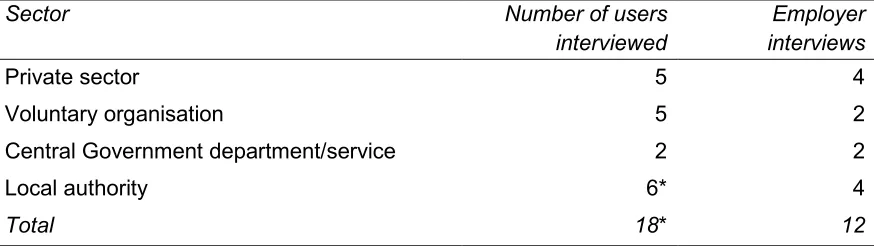
Users were asked to rate on a scale of 1 to100 how far they agreed or disagreed that they would not have taken up the job if Support Worker had not been available. Overall, there is strong evidence from users that Support Worker provision was needed to take up the job (Figure 2.1). Most believed that they could not have taken up the job if unable to communicate fully with colleagues and customers, perform tasks efficiently and with confidence, or physically manage daily activities.
Exceptionally, determination to pursue a much sought-after career would have made it impossible to turn down the job, although the almost full-time support from Access to Work was essential to succeed in a highly competitive profession.
Getting another job would have been impossible, most felt, and for one or two a lack of a Support Worker from Access to Work might even have meant giving up looking for work altogether. Where exceptionally it might have been possible to find an
11
alternative line of work where a communicator was not essential, the rewards of working would have been poor and the social isolation unacceptable.
According to most there would have been no alternative sources of support. Exceptionally, there might have been opportunities for rearranging the work.
Employers’ Views
We interviewed five employers of people taking up a new job. Two gave similar answers to their employees’, one believing that employment would have been unlikely without the Support Worker (a job coach) and the other accepting that an alternative solution might have been found by re-arranging the work.
Otherwise employers believed that, hypothetically, they would have offered the user the job in the absence of Access to Work support. They had appointed the best person for the job and were keen to arrange solutions to their needs. A disability organisation with a strong commitment to removing barriers to employment faced by disabled people might have been prepared to dip into a small budget or put a case to funders, for the sake of equality of opportunity; this would not have been sustainable in the longer term, would have set a precedent with major implications for the
organisation’s viability and would not have been acceptable in principle. Public sector employers pointed to their organisations’ policies in relation to equality of opportunity for disabled people. In their view, possible solutions might have involved obtaining communication support from internal resources or rearranging work allocation as a partial solution. The question was of course hypothetical, particularly as in all cases employers had expected Access to Work help to be forthcoming. However, it seemed to the researchers that employers aspired out of goodwill for solutions that may not have been achievable, and users certainly doubted that satisfactory
alternatives were possible.
Figure 2.1
Likelihood at application of taking up a new job without a Support Worker
0 10 20 30 40 50 60 70 80 90 100
2.5.2 Likely Outcomes for Support Worker Users in Paid Work at Application
Thirteen respondents were established in paid work when they applied for support from Access to Work. These included long-term users of Access to Work or the schemes that preceded it. In some cases, users came to need support because of an acquired impairment or deteriorating health, or when participation at work became harder.
Views on Giving up Working Altogether
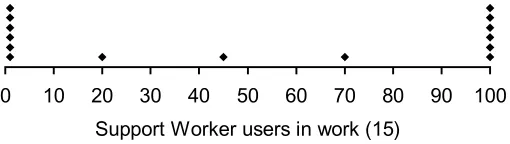
According to users already established in paid work, giving up working altogether would have been a real possibility for some if Support Worker provision had not been available at the time of application (Figure 2.2). Pain and fatigue, later ameliorated by job aides, meant that they were not able to do their jobs and no other source of help was possible. Indeed, users had actually considered retiring on health grounds, returning to sick leave or giving up the attempt to work at all.
The larger number of ratings at the other end of the scale is explained by the importance of work to disabled users: the need to bring in an income and the likely negative impact on family members if they did not, the need to maintain a self-made business or to establish a career. Without the Support Worker, working life would be hard for many but giving up working altogether was just not feasible. One or two volunteered that employers would have intervened to keep them on, but quite how employers might have helped was not clear. If Access to Work support had not been available in the job they had at the time some hoped that they could have resorted to a type of job they had before or ‘survive’ in some capacity elsewhere, driven by the need to work for self-fulfilment or financial security. This would have meant an unplanned career change or abandoning a self-made business, however. A strong commitment to their right to work influenced some people in being certain that they would not give up working.
Employers interviewed generally reflected users’ views on the possibility of giving up. Those who were considerably more pessimistic about the outcome were not thinking of options which the employee was considering. Another was more optimistic than the user believing that ‘ways round’ the absence of Access to Work might have been created.
Figure 2.2
Likelihood at application of giving up working altogether
0 10 20 30 40 50 60 70 80 90 100
Views on Carrying on Without the Support
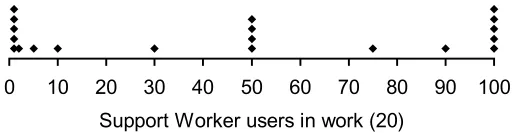
Users tended to either strongly agree or strongly disagree that they would have carried on in the job if Support Worker provision had not been available at the time they applied for it (Figure 2.3).
Deteriorating health and the consequent effect on work performance was the main reason given for possibly not carrying on without the support at the time. But also important was the essential contribution of the Support Worker to making the work viable.
Counted amongst those who agreed they would definitely have carried on without the support were users who could envisage an alternative to be driven to work by a Support Worker and one who had in fact since carried on without the support although performance at work was held back as a result. Otherwise, people would hypothetically have carried on without the Support Worker because of the importance to them of working, having an income, supporting a family or maintaining a business, and not because they felt they could do without the support. On the contrary, users relied on Support Workers to do the job effectively and participate fully at work. One person believed that persevering in the job was the way to effect change, and had faith in their employer’s capacity to find a solution.
Where employers were interviewed their views generally concurred with users’ judgements, though there was a tendency for employers of those who said they would have carried on to be more pessimistic.
Other Outcomes
A minority of people in paid work at the time they applied felt that they would
definitely have taken more sick leave without their Support Worker, because working without it would affect their condition or lead them to take time off as they could not do their job adequately. Giving up work altogether rather than taking sick leave, was a real possibility, because they would not be able fulfil their work obligations.
Others explained that taking more sick leave was not at all likely, as they were not ill and taking time off because of lack of support at work would imply shirking their
Figure 2.3
Likelihood at application of carrying on without a Support Worker
0 10 20 30 40 50 60 70 80 90 100
duties, and there was a worry that taking sick leave because support for communication at work was not available would jeopardise their jobs.
Employers tended to view sick leave as more likely than their employees did, expressing concerns about the viability of sustained employment.
2.5.3 Likely Outcomes Now
Users were asked to speculate on a range of possible outcomes if the Support Worker provision were not available ‘now’. Again they were asked to say how far they agreed or disagreed with a statement on a scale from 1 to 100. By this point in the interview respondents had thoroughly discussed possible alternatives to having Support Worker provision through Access to Work and can be assumed to have taken any into account when thinking about the viability of their current employment situation.
Views on Job Loss Now
Users were asked to rate the possibility of losing their job if a Support Worker from Access to Work were not available ‘now’ and to explain their answer.
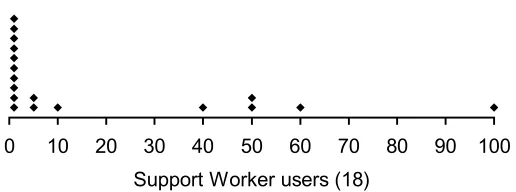
Fifteen users responded to this question (a smaller number as three respondents were not currently using a Support Worker). Views were highly polarised (Figure 2.4). Most people scoring ‘1’ or ‘100’ gave exactly the same scores as to earlier questions relating to the time of application (that is, on not taking up the job and carrying on without the support at the time of application). For those who thought they would lose their job, the job was felt to be untenable because pain or fatigue would prevent the work being done to the required standard, it was not possible to do everyday tasks without personal assistance, or communication and participation at work would not be possible. The importance of the support to business viability was stressed just as highly.
Similarly, most of those who answered previously that they would have taken up the job or carried on despite the absence of Support Worker were certain that they would not lose their job now. As before, pursuing a career in a competitive environment or establishing a new business had to come first, even though the Support Worker was thought essential for success. Again, there might be some alternative to Support Workers whose only role was to drive to work. Some mentioned their rights under employment legislation, and their determination to ask for support needed to do their job.