VOL.6 ISSUE 3, 2018; 384 – 390 ; http://ijpda.com; ISSN: 2348-8948
Research Article
Cognition improving
potential of aqueous
extract of roots of
Asparagus adscendens
Roxb. in mice
*Hanumanthachar Joshi, Majed Abdo Alkanad, Charan C S
Department of Postgraduate studies and Research Division of Pharmacognosy and Photochemistry Sarada Vilas College of Pharmacy, K. M. Puram,
Mysore-04, Karnataka, India
Date Received: 3rd March 2018; Date accepted: 14th
March 2018; Date Published: 17th March 2018
Abstract
The present study involves investigations on the nootropic activity of aqueous extract of dried roots
of Asparagus adscendens Roxb. (AAR) in mice.
Ele-vated plus maze and water maze were the models used for testing learning and memory. Scopola-mine (0.4 mg/kg, i.p.) and natural aging induced amnesia were the interocpetive behavioral models. Piracetam (200 mg/kg, ip) was used as standard drug. AAR (50 and 100 mg/kg, p.o.) significantly attenuated amnesic deficits induced by scopola-mine and natural aging. AAR found to increase whole brain acetyl cholinesterase inhibition activi-ty in mice. Aqueous extract of A. adscendens can be useful in treatment of preliminary symptoms of dementia in elderly.
Keywords: Acetyl cholinesterase, Asparagus
ads-cendens, Amnesia, Memory, Scopolamine.
Introduction
Increasing life expectancy has produced a dramatic rise in the number of cases of age-associated dis-eases, including dementia. Alzheimer’s disease
(AD) is the most frequent cause of dementia, ac-counting for 60–80% of all cases[1] and epidemio-logical studies indicate that AD will become even more incident by midcentury, constituting a major personal and societal tragedy. AD is primarily a condition of late life, roughly doubling in preva-lence every 5 years after age 65 and affects some 47 million people worldwide [2]. This number is pre-dicted to increase in the next two decades [3]. The total cost of dementia was estimated around $818 billion in 2010 and has been projected to hit $1 tril-lion by 2018 worldwide. This becomes even more dramatic because nearly 60% of people affected by dementia live in low- and middle-income countries [4].
From time immemorial, plants and plant products are being used for management of cognitive im-pairment in India. Ayurveda, the Indian system of medicine describes the use of medhyarasayana (intellect promoting) drugs in the treatment of nervous disorders. The Ayurvedic concept of ra-sayana consists of specialized class of drugs which prevent ageing, increase longevity, impart immuni-ty, improve mental functions and add vigor and vitality of the body [5].
Asparagusadscendens is a flowering perennial,
spring plant species in the genus Asparagus [6]; which is a large genus of herbs and under shrubs with stout, tuberous roots and erect or climbing stems. It was once classified in the lily family, like its Allium cousins, onions and garlic, but the Lilia-ceae has been split and the onion-like plants are now in the family Amaryllidaceae and asparagus in the Asparagaceae family [7]. Asparagus adscen-densRoxb.is known by various common names i.e. Shatawari, Safedmusli, Shatavar, Shatamuli, Saha-srapal, Sainsarbuti. It was initially grown in thick forest in natural form, and is a customary medicin-al plant; is an herb with sub-erect lanceolate leaves and tuberous root system. The plant form of
Aspa-ragusadscendens is a shrub of struggling nature
cm across, solitary or fascicled with copious ra-cemes. Fruits are 0.8 cm in diameter, globes, and 3 lobed berries with only one seed [8]. Tubers can grow up to a depth of 10 inch. Asparagus is a sub-erect prickly shrub with white tuberous root that grows well in tropical and sub-tropical climates with heights up to 1,500 meters. Asparagus adscen-dens is usually found throughout India and Hima-layan Mountain ranges. Naturally occurs in forests of western Himalaya, Gujarat, Madhya Pradesh, Karnataka and Maharashtra States that are listed in the endangered species of India [9]. It was initially grown in thick forest in natural form, and is a cus-tomary medicinal plant [11].
In the present study, the nootropic effects of A.
ads-cendenswere investigated by employing both
exte-roceptive and inteexte-roceptive models. The stimulus lies outside the body in exteroceptive behavioral models, whereas, it lies within the body in case of interoceptive behavioral models. Interoceptivebe-havioural models such as scopolamine, diazepam and natural aging induced amnesia are widely cited as models simulating human dementia in general and Alzheimer’s disease in particular[11]
Material and Methods
Plant material
The roots of A. adscendens were collected from Bili-giri Ranga Hills of Chamarajanagar district. The plant material was identified and authenticated by the first author and a voucher specimen (SVCP-214-AA01) was deposited in the department. The shade-dried roots were powdered and passed through 100-mesh sieve. Dried and cleaned root powder (1000 g) was soaked in purified water in the ratio of 1:20 (w/v) and subjected to extraction by maceration. The extract was filtered, concen-trated and dried in freeze drier with high vacuum. A suspension was prepared using distilled water containing 1% (w/v) tween 20 and was adminis-tered orally.
Drugs and reagents
Scopolamine hydrobromide (Sigma Aldrich, USA) was diluted in normal saline and administered intra peritoneally. Volume of administration was 1 ml/ 100 g. 5, 5’-dithiobis nitrobenzoic acid (DTNB, Ellman’s reagent, Sigma, USA) and acetyl thiocho-line (Sigma, USA) were used.
Animals
Swiss mice of either sex weighing around 18- 20 g (younger ones, aged 3-4 months) and more than 30 g (aged ones, aged 12-15 months) were used in the present study. Animals were acclimatized to the laboratory conditions for 5 days before behavioral studies. The animals had free access to food and water and were maintained under 12:12 h light and dark cycles. All experiments were carried out during day time from 0900 to 1400 h. Institutional Animals Ethics Committee (IAEC) had approved the experimental protocol and care of animals was taken as per guidelines of CPCSEA, Govt. of India.
Acute toxicity studies
Organization for Economic Co-operation and De-velopment (OECD) guideline no. 423 was adopted for conducting acute toxicity tests. Aadscendens aqueous extract (AAR) at different doses (10-2000 mg/kg) was administered orally to mice with the help of a specially designed oral needle connected to a polythene tube. AAR was administered at the same time on each day. During the first four hours after the drug administration, the animals were observed for gross behavioral changes if any, for 7 days. The parameters such as hyperactivity, grooming, convulsions, sedation, hypothermia and mortality were observed. The doses selected were 50 and 100 mg/kg/day [12].
Elevated plus-maze
Elevated plus-maze served as the exteroceptive behavioral model to evaluate learning and memo-ry in mice. The procedure, technique and end point for testing learning and memory was followed as reported earlier [13-14]. Transfer latency [TL] was defined as the time taken by the animal to move from the open arm into one of the covered arms with all its four legs. TL was recorded on the first day for each animal. The mouse was allowed to explore the maze for another 2 minutes and then returned to its home cage. Retention of this learned-task was examined 24 h after the first day trial.
Interoceptive behavioral model
Scopolamine induced amnesia: Amnesia was in-duced by administration of scopolamine hydro-bromide (0.4 mg/kg, ip) on 8th day and the TL
and 100 mg/kg, po) and piracetam (200 mg/kg) were administered for 8 days successively. On 8th
day, after 45 min of administration of doses, scopo-lamine was administered and TL was noted after 45 min. SDL was recorded on 9th day [15-17].
Estimation of brain acetyl cholinesterase (AChE) activity
The animals were sacrificed by cervical decapita-tion under light anesthesia on the 8th day, 90 min
after administration of the last dose of. Immediate-ly after decapitation whole brain was carefulImmediate-ly re-moved from the skull. For preparation of brain homogenate, the fresh whole brain was weighed and transferred to a glass homogenizer and homo-genized in an ice bath after adding 10 volumes of 0.9% w/v sodium chloride solution. The homoge-nate was centrifuged at 3000 rpm for 10 min and the resultant cloudy supernatant liquid was used for estimation of brain acetylcholinesterase activity spectroscopically using the Ellman method [18].
Morris water maze (MWM)
The MWM test was employed to assess learning and memory of the animals. MWM is a swimming model where the animals learn to escape on to a hidden platform. In the present study the target quadrant was Q4. The mice were subjected to 4 consecutive trials every day with a gap of 5 minutes for 4 e days continuously, during which they were permitted to escape to the hidden plat-form and to be remained for 20 sec. If the animal was not able to find the hidden platform within 120 seconds, the mouse was gently pushed and guided to the platform and permitted to stay on the platform for further 20 seconds. Escape latency time to identify the hidden platform in Morris wa-ter maze was the index of acquisition (learning). The starting point on every day to conduct 4 acqui-sition trials was changed as described below and Q4 was maintained as the target quadrant in all the acquisition trials. The starting point for dropping the mice into water maze on day 1 for four consec-utive acquisition trials was in the sequence Q1, Q2, Q3 Q4 and so on. The sequence change in starting point was as follows. Day 1: Q1, Q2, Q3, Q4 Day 2: Q2, Q3, Q4, Q1 Day 3: Q3, Q4, Q1, Q2 Day 4: Q4, Q1, Q2, Q3. Mean escape latency time (ELT) was calculated for each day of the trial. On the 5th day
the hidden platform was removed, each mouse
was permitted to explore the pool for 120 seconds. The animal was made to take 4 such trials with 5-minute interval time and every trial had a different starting point covering all the 4 quadrants. The mean of time spent by the animal in all 4 quadrants was recorded. The TSTQ (time spent in target qua-drant) in Q4 as compared to time spent in other quadrants in locating missing platform was consi-dered as an index of retrieval (memory). Utmost care was employed to ensure that relative location of water maze with respect to any other objects in the laboratory serving as visual clues was not dis-turbed during the total duration of the study. All the trials were completed between 09:00 and 17:00 hours [19-20].
Statistical Analysis
All the results were expressed as mean ± Standard error. The data was analyzed using ANOVA fol-lowed by Tukey-kramer test.
Results
Acute toxicity study
No mortality was observed following oral adminis-tration of AAR even with the highest dose (2000 mg/kg). However AR at doses more than 800 mg/kg, produced profuse watery stools in animals. Both the doses of AR did not exert any toxic effect on the normal behavior of the mice.
Effect on transfer latency using elevated plus-maze
Transfer Latency (TL) of second day (day 9th of
drug treatment) reflected retention of learned task or memory. The young animals treated with AAA (50 and 100 mg/kg, p.o.) showed reduction in TL of 9th day, thus enhanced memory, when compared
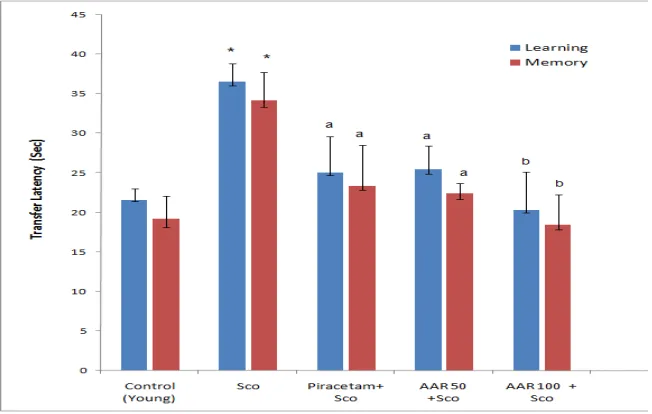
with control group. AR (50 and 100 mg/kg, p.o.) also exhibited significant improvement in memory of aged mice (Fig. 1). Scopolamine (0.4 mg/kg, i.p.) and injected before training significantly increased (P< 0.01) the TL of 9th day indicating amnesia. AR
(50 and 100 mg/kg, p.o.) reversed successfully the amnesia induced by scopolamine (Fig. 2). Pirace-tam (200mg/kg, i.p.) was the standard drug and it significantly improved memory (P < 0.01) of both young and aged mice.
Discussion
in cholinacetyltransferase activity was reported to be a characteristic feature of senile dementia of the Alzheimer’s type [21-22]. Blocking cholinesterase induced hydrolysis of Ach and the subsequent in-crease in ACh concentration in the central synapses
and the enhancement of cholinergic function pro-vides the symptomatic improvements observed in patients with probable AD who are treated with cholinesterase inhibitors [23-24].
Fig. 1 Effect of A. adscendens (AAR, 50 and 100 mg/kg, p.o.) on transfer latency of young and aged mice us-ing elevated plus maze.
Values are mean ±S.E.M. (n=6). * indicates P< 0.01 as compared to control group of young mice. a indicates P< 0.001 as compared to control group of young mice. b indicates P< 0.01 as compared to control group of aged mice. c indicates P< 0.001 as compared to control group of aged mice. (One way ANOVA followed by Tukey-kramer multiple comparison tests)
Fig. 2 Effect of A. adscendens (AAR, 50 and 100 mg/kg, p.o.) on scopolamine (Sco, 0.4 mg/kg, i.p.) induced amnesia
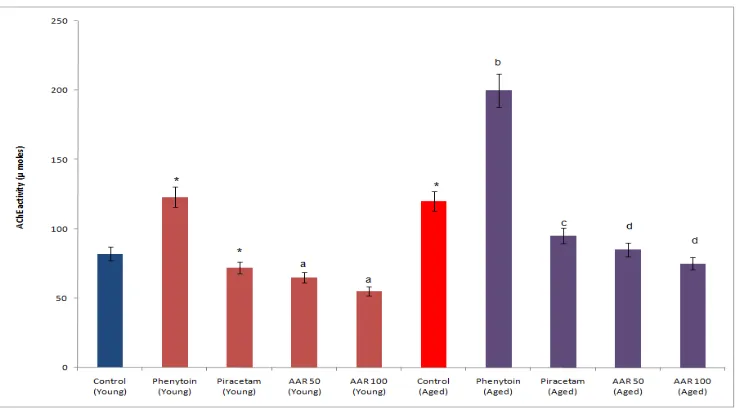
Fig. 3 Effect of A. adscendens (AAR, 50 and 100 mg/kg, p.o.) on brain cholinesterase (AChE) activity
Values are mean ±S.E.M. (n=6). * indicates P< 0.01 as compared to control group of young mice. a indicates P< 0.001 as compared to control group of young mice. b indicates P< 0.01 as compared to control group of aged mice. c indicates P< 0.001 as compared to control group of aged mice.
Table-1: Effect of A. adscendens (AAR, 50 and 100 mg/kg, p.o.) on Escape Latency time (ELT) & Time Spent in Target Quadrant (TSTQ)
Treatment ELT
(21st day)
ELT (24th day)
TSTQ (25th day) Control (10 ml/kg p.o) 95.06±0.49 48.3±0.25 50.05±0.3 Piracetam (200mg/kg i.p.) 75.10±0.7* 39.05±0.4* 70.22+1.1* AAR (50mg/kg p.o) 80.36±0.1 a 47.08±0.8 a 59.65±0.6a AAR (100mg/kg p.o) 77.34±0.5a 40.24±0.6a 37.15±0.6a Scopolamine (0.4mg/kg, i.p.) 130±2.9b 123±3.6b 95±1.4b AAR (50mg/kg p.o) + Sco 85.1±0.5 82.21±0.7b 99.2±0.62 AAR (100mg/kg p.o) + Sco 80.31±0.96 70.18±0.4 117±0.1
Values are mean ±S.E.M. (n=6).* indicates P< 0.01 as compared to control group of young mice. a indicates P< 0.01 as compared to scopolamine (Sco) group. b indicates P< 0.001 as compared to scopolamine (Sco) group.
The present study proves that aqueous extract of
A. adscendens is a anti-cholinesterase agent. It also
exhibited neuroprotective activity due to its facili-tatory effect on retention of learned task. Piracetam (200 mg/kg, i.p.) and AAR (50 and 100 mg/kg, p.o.), on the other hand significantly (P<0.05) lowered this activity indicating the possible counteracting actions of these drugs on the cholinergic system. AAR also attenuated the scopolamine-induced impairment in learning and memory, when as-sessed on Morris water maze. Both piracetam and
A. adscendens improved memory in absence of
cog-nitive deficits. In the present study, AAR
signifi-cantly inhibited the AChE activity in the mice whole brain homogenate, indicating its cognition improving efficacies. Our earlier research findings using Nardostachys jatamansi [25], Foeniculum
vul-gere [26], Asparagus adscendens [27] and Zingiber
officinale [28]have displayed a link between
are required for further confirmation of nootropic potential of A. adscendens in the treatment of vari-ous cognitive disorders.
Acknowledgements
The authors are thankful to the Rajiv Gandhi Uni-versity of Health Sciences, Karnataka, Bangalore for the research grant. Thanks are also due to UCB India Pvt. Ltd., Vapi, Gujarat, India for gift sample of piracetam.
References
1. Prince, M., Bryce, R., Albanese, E., Wimo, A., Ribeiro, W., and Ferri, C. P. The global preva-lence of dementia: a systematic review and meta analysis. Alzheimer’s Dement. (2013). 9, 63–75.
2. Prince, M., Comas-Herrera, A., Knapp, M., Guerchet, M., and Karagiannidou, M. World Alzheimer Report 2016 Improving Healthcare for People Living with Dementia. Coverage, Quality and Costs Now and in the Future.
Available online at:
https://www.alz.co.uk/research/world-report-2016
3. Frozza RL, Lourenco MV, De Felice FG. Chal-lenges for Alzheimer's Disease Therapy: In-sights from Novel Mechanisms Beyond Mem-ory Defects. Front Neurosci. 2018 Feb 6;12: 37.
4. Du X, Wang X, Geng M. Alzheimer's dis-ease hypothesis and related therapies. Transl Neurodegener. 2018, Jan 30;7:2
5. Rogers EJ, Milhalik S, Ortiz D, Shea TB. Apple juice prevents oxidative stress and impaired cognitive performance caused by genetic and dietary deficiencies in mice. JournalNutr. Health Aging 2003, 7: 1-6.
6. Sharma PV. Dravyaguna vijnan, 1982; .2nd ed.,
Chaukambha Bharati Academy, Varanasi, 562.
7. Goyal R, Singh J and Lal H. Asparagus racemo-sus--an update. Indian journal of medical sciences. 2003, 57: 408-410.
8. Hayes PY, Jahidin AH, Lehmann R, Penman K, Kitching W and De Voss JJ. Steroidal sapo-nins from the roots of Asparagus racemosus. Phytochemistry 2008, 69, 796-804.
9. Chauhan N.S. Medicinal and aromatic plants of Himachal Pradesh. Indus Publishing., 1999, 22-24.
10. Bansode FW, Arya KR, Singh RK, Narender T. Dose-dependent effects of Asparagus ex-tract on the anabolic, reproductive, and sexual behavioral activity in rats. Pharmaceutical bi-ology 2014, 6, 1-9.
11. Parle M, Dhingra D, Kulkarni SK. Memory-strengthening activity of Glycyrrhiza glabra in exteroceptive and interoceptive behavioral models. Journal of Medicinal Food . 2004, 7(4), 462.
12. Organization for Economic Co-operation and Development 2001. Guideline 423.Acute oral-
toxici-ty.[https://ntp.niehs.nih.gov/iccvam/suppdocs/ feddocs/oecd/oecd_gl423.pdf]orDiener, W; U Mischke, E Schlede and D Kayser (1995). The biometric evaluation of the OECD modified version of the acute toxic category method (oral). Arch.Toxicol. 2001, 69, 729-734.
13. Itoh J, Nabeshima T, Kameyama T. Utility of an elevated plus maze for the evaluation of nootropics, scopolamine and electro convul-sive shock. Psychopharmacology 1990, 101, 27-33.
14. Parle M, Dhingra D. Ascorbic acid: a promis-ing memory enhancer in mice. Journal of Pharmaceutical Sciences.2003, 93, 129-135.
15. Biradar SM, Joshi H, Chheda TK. Neuro pharmacological effect of Mangiferin on brain cholinesterase and brain biogenic amines in the management of Alzheimer's disease. Euro-pean Journal of Pharmacology. 2012, 683,140-147.
16. Joshi H, Parle M. Nardostachys jatamansi im-proves learning and memory in mice. Journal of Medicinal Food . 2006, 9, 113-118.
17. Joshi H, Parle M. Effects of piperine on memo-ry and behavior mediated via monoamine neurotransmitters. J Trad Med. 2005, 2, 39-43.
19. Morris R. Developments of a water-maze pro-cedure for studying spatial learning in the rat. J Neurosci Methods, 1984, 11(1), 47-60.
20. Hooge D R, Deyn P. Application of the Morris water maze in the study of learning and mem-ory. Brain Research Reviews, 2001, 36(01), 60-90.
21. Joshi H, Parle M. Antiamnesic Effects of
Des-modium gangeticumin Mice. Yakuga kuzasshi
2006, 126, 795-804.
22. Joshi H, Parle M. Antiamnesic potentials of
Foeniculum vulgare Linn. in mice. Oriental
Pharmacy and Experimental Medicine. 2007, 7 (2), 121-129.
23. Agnolli A, Martucci N, Manna V, Conti L. Ef-fect of cholinergic and anticholinergic drugs on short term memory in electroencephalo-graphic study Clinical Neuropharmacology. 1983, 6, 311.
24. White house PJ, Price DL, Struble RG, Clark AW, Coyle JT, Delon MR. Alzheimer’s disease and senile dementia; loss of neurons in the basal forebrain. Science 1982, 215, 1237.
25. Collinge J. Mammalian prions and their wider relevance in neurodegenerative diseas-es.Nature. 2016, 539(7628), 217-226.
26. Hanumanthachar Joshi, Milind Parle,
Nardos-tachys jatamansi improves learning and
memo-ry in mice. J Med Food. 2006, 9, 113-118.
27. Hanumanthachar Joshi, Milind Parle. Antiam-nesic potentials of Foeniculum vulgare Linn. in mice. OPEM 2007, 7,121-129.
28. Hanumanthachar Joshi, Majed Abdo Alkanad, Charan C S. Ameliorative Effects of Roots of
Asparagus adscendens Roxb. on Cognitive
Im-pairments and Brain Aging Induced By Scopo-lamine and Diazepam in Animal Models Rele-vant to Alzheimer's Disease. Journal of Phar-maceutical Research, 2017, 16( 3), 199-207.
29. Joshi H, Parle M. Zingiber officinale: Evaluation of its nootropic effect in mice. African Journal of Traditional, Complementary and Alterna-tive medicines. 2006, 3, 64-74.