Abstract— As the impact of salient supply disparity of seasonal staple food, producer and consumer may experience losses in their transaction with wholesaler. In monopolistic market, it is probable that wholesaler manipulate the market situation to get staple food at the lowest purchasing price and sell them at the highest selling price. An indirect market intervention model is projected to mitigate producer’s revenue loss when selling price plunges and to secure consumer’s need when staple food is scarce. We present a buffer stock scheme under warehouse receive system to develop the instrument of indirect market intervention (IMI). A buffer stock model formulated in MINLP is addressed to determine IMI instrument conforming to the general agreement on trade and tariff. We propose new entity namely BLUPP (a distributor owned by government) for implementing IMI in order to stabilize price and ensure availability of staple food.
Index Term— buffer stock, indirect market intervention, monopolistic market, warehouse receipt system.
I. INTRODUCTION
In Indonesia, sugar commodity that is produced from sugar cane has salient supply disparity during the harvest and planting season [1]. The extreme disparity of supply will trigger an uncertainty of price and availability of staple food and lead the food security problems [2], [3]. There are three causes of salient supply disparity during the harvest and planting season in the sugar distribution in Indonesia. Based on the period of harvest season, there is only six months of sugar cane supply in a whole year that way sugar factory only operate in limited period every year [4], [5]. The amount of sugar supply is lower than demand; the estimated quantity of supply only could fulfill around 80% of total demand in a year [6], [7]. Moreover, the domestic price of sugar commodity is more expensive than global market because the sugar cane industry has several weaknesses such as a low level of productivity per hectare, a low level of sugar plant efficiency, and the price distortion in the global market [7]-[8].
W. Sutopo is with the Department of Industrial Engineering, Sebelas Maret University , Surakarta, 57126, INDONESIA. (Corresponding author: phone/fax:
+62-271-632110; e-mail: sutopo@ uns.ac.id or [email protected]). S. Nur Bahagia, A. Cakravastia, and TMA Arisamadhi are with the Department of
Industrial Engineering, Bandung Institute of Technology, Bandung 40132, INDONESIA (e-mail: senator, andi, [email protected]).
The problem of sugar commodity mentioned above, that can cause price volatility and scarcity, can be seen as a problem in Supply Chain (SC) system. Supply Chain Management (SCM) is required to manage the integration of key business processes from end user through original suppliers that provides products, services, and information for customers and other stakeholders [9]. The integration is considered necessary to achieve suitable economic results together with the desired consumer satisfaction levels [10]. In this work, a strategic level of SC design problem is addressed, that is the decision on SC system of seasonal staple food.
Three entities are involved in this SC system that is producer of sugar commodity, wholesaler and consumer as well as government as regulator. There are only several wholesalers which control the distribution of sugar commodity in Indonesia [11], [12]. It is possible that wholesaler manipulates the market equilibrium to get staple food at the lowest price and sell them at the highest price. The producer is forced to sell staple food at lowest price during the harvest season. On the other hand, the consumer has to deal with the scarcity of staple food and price hikes during the planting season. This situation is caused the opportunity losses and market risksfor producer and consumer [6], [7]. For government, it is unrealistic to provide sufficient staple food for household at rational prices and support the producers to enhance their welfare because high food prices are increasing food insecurity and poverty [12].
There are number of models or instruments of market intervention had been developed by previous researchers to assist the domestic governments reducing the problems of price volatility and scarcity in staple food SC system. The domestic governments had applied to stabilize price of commodities such as the floor-ceiling prices [1], [5], [6], [7], [14], [16], buffer funds [17]-[[21], export or import taxes [22]-[24], and subsidies [25], [26]. Rong et al. [27] proposed the concept of the reverse bullwhip effect (RBWE) for solving supply disruptions. Unfortunately, the previous research results are categorized as direct market intervention (DMI) instruments. Since implementation of general agreement on trade and tariff (GATT) that has been approved by representatives from all member of World Trade Organization (WTO), each member should deduct the implementation of DMI instruments [28], [29]. The government should formulate a new instrument
An Indirect Market Intervention Instrument to
Control Price and Availability of Seasonal Staple
Food using Buffer Stock and Warehouse Receipt
which is not only appropriate to local problems but also able to reduce and eliminate tariff barriers and quota in international trade.
A new instrument of market intervention should be formulated to reduce opportunity losses and market risks for both producer and wholesaler; and to maintain food security for the households. The government can modify the buffer stock schemes as indirect market intervention (IMI). The buffer stock scheme consists of program planning, procurement, inventory, and operation [30]. The buffer stock scheme in accordance with warehouse receipt system (WRS) might be able to solve the problem mentioned above. The WRS is a proven system to obtain financial secured by goods deposited in a warehouse [31]. An indirect market intervention instrument is developed to mitigate producer’s revenue loss when selling price plunges and to secure consumer’s need when staple food is scarce.
This paper is organized as follows. Section 1 describes the background of the research, including the problems in real system, and indicates the research gap. The method for developing instrument is presented in Section 2. Section 3 contains IMI Instrument Formulation. The result and analysis are explained in Section 4. And finally in Section 5, the conclusion and future research are delivered.
II.THE METHOD FOR DEVELOPING INSTRUMENT This paper is an extension of our previous works [1], [5]-[7], [12]. Sutopo et al. [1], [5]-[7] offered the models to develop DMI instruments and Sutopo et al. [12] proposed the framework for developing the DMI instrument as IMI instrument. We extend previous works by testing in real data of sugar commodity in Indonesia, comparing between DMI and IMI result, and proposing the findings as propositions.
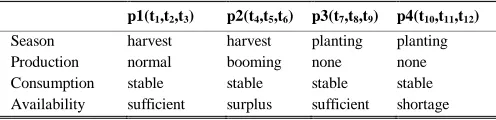
The model is formulated based on the assumptions of market situation and relevant system. Table I lists some relevant market situations along the planning horizon of supply and demand. The staple foods can be stored and no damage occurs during storage.
The planning horizon always begins by the early of harvest season, the end of harvest season, the beginning of planting season, and the end of planting season. The relevant system of problem is illustrated in Fig. 1. It consists of two sub systems as follows (Sutopo et al. 2011): sub system A describes the monopolistic market distribution system of seasonal staple food and sub system B represents the instrument of IMI using the buffer stock model. System relevant (sub system A and sub system B) depicts the IMI by Government.
TABLE I
LIST OF MARKET ASSUMPTIONS IN A FREE MARKET
p1(t1,t2,t3) p2(t4,t5,t6) p3(t7,t8,t9) p4(t10,t11,t12)
Season harvest harvest planting planting
Production normal booming none none
Consumption stable stable stable stable Availability sufficient surplus sufficient shortage
Fig. 1. An overview of relevant system.
In the proposed system, we recommend new entity namely BLUPP (Badan Layanan Umum Penyangga Pangan in Indonesia Language or a distributor owned by government) as wholesaler’s substitute (Fig 1. sub system A). The producer, BLUPP, and customer relationships are based on free market (FM) mechanism. The equilibrium price consists of two level of price including purchasing price to producer and selling price to consumer. The purchasing price is taken from producer and BLUPP, while the selling price is resulted from transaction between BLUPP and consumer. Fig. 1 (sub system B) shows that the subsidy scheme on warehouse receipt system (S-WRS) involves of three institutions namely Registered Warehouse Management (RWM), Bank or Financial Institutions (BFI), and Registration Center for Warehouse Receipt (RCWR) [32], [33]. The RWM refers to management that operates warehouse as a business entity. It has authorized to issue a warehouse receipt (WR). The WR means a document that certifies the ownership of staple food stored in the RWM. The BFI means a commercial bank or a financial company that implements the S-WRS. The RCWR is a legal business entity to administer the WR.
In harvest season, producer sells the staple food to BLUPP and BLUPP sells it to customer and pawns some of their stock to RWM. BLUPP will get WR. The BLUPP gives WR to BFI for accessing loan. In harvest season, BLUPP can obtain back their pawned from the RWM and sell them under profitable selling price. BLUPP are able to return the loan to BFI along with administration and interest charge. The BLUPP has responsibilities not only to stabilize price and ensure availability of staple food but also to maximize producer’s revenue and minimize consumer’s cost under minimum cost of the S-WRS. In order to perform its responsibilities, BLUPP gets privileges to implement the import quota determined by government (IM-1) and access S-WRS (IM-2). A buffer stock scheme must be able to determine the instruments which are required for indirect market program as mentioned above.
TABLE II
THE DEFINITION OF INDICES AND SETS
Notation Indices and sets
j p
set of periods indexed by j, j1,...,4
1
p t1,t2,t3
2
p t4,t5,t6
3
p t7,t8,t9
4
p t10,t11,t12
TABLE III
THE DEFINITION OF DECISION VARIABLES
Notation Decision variables
Min
P the purchasing price in the IM period -t Max
P the selling price in the IM period -t
k
t the beginning of IM periods for producer
j
t the beginning of IM periods for consumer OP
t
Q amount of staple food purchased by BLUPP in the price
support program
WR t
Q the amount of staple food as WR guaranteed OI
Q import quota
TABLE IV
PARAMETERS AND VARIABLES
Notation Parameters and variables
d
c, natural logarithm parameters of price function d
c distribution cost of wholesaler per unit
i
c import cost per unit
h
c holding cost per unit per year
p
c production cost per unit
r
c credit ratio by collateral value
wr
c administration cost to get W/R
n
i normal lending interest rate
wr
i S-WRS lending interest rate
i
p staple food price in the global market
1
p t
p producer selling price in period -t
1
s t
p consumer buying price in period -t
s t
q supplies of staple food in period-t
d t
q demand of staple food in period -t
A t
q market’s availability in period-t
*
A t
q market’s availability before IM period
C t
q amount of consumption in period-t
*
C t
q amount of consumption before IM period
p
CI crisis indicator for producer
c
CI crisis indicator for consumer PB
Q amount of producer and BLUPP transaction BC
Q amount of BLUPP and consumer transaction in FM
period BC
Q amount of BLUPP and consumer transaction in IM
period WR
TQ total amount of WR guaranteed
III. IMI INSTRUMENT FORMULATION
In this section we reformulate model, describe solution method & numerical example, and explain some findings and analysis. The mix integer non linear programming (MINLP) can be used to formulate the buffer stock model:
A.Producer
We define producer’s expectation as to maximize the total benefit in (1), which is calculated by subtracting the first objective by the second objective. In (1), the first and second term represent the total revenue of producer which is the sum of the staple food sale in FM and IM period, while the last term represents the total cost of producer which is the total production cost. s t t p t t t Min OP t t t p t PB t P q c P Q p Q TB s k k
6 1 1 1 (1) B.BLUPPBLUPP as the second entity involved in model expects to maximize its objective in (2) which is defined as the total revenue. Equation (2) has three terms; the first term express revenue that is received by BLUPP from pawning some of its staple food ownership to WR, the second and the last term represent staple food sale in FM and IM periods to consumer respectively.
12 1 1 j j t t o Max OR t t t o s t BC t WR Min c B c P Q c p Q TQ P r TR (2)The second objective of BLUPP is expressed in (3). It consists of payment to WR to redeem the staple food stored in WR, purchasing cost of staple food from producer in FM and IM periods, administrative and interest cost to WR, and import cost of staple food. Finally, theses two objectives are reformulated as total benefit of BLUPP in (4).
OI i i t t wr WR Min c t k Min OP t p t t t PB t WR Min wr B Q c p i TQ P r P Q p Q TQ P c TC k j s j ) ( ) 1 ( 1 1
(3)B B B
TC TR
TB (4)
C.Consumer
The last entity in our model, the consumer, spends two types of cost to fulfill its staple food consumption. First, consumer transacts staple food from BLUPP based on demand quantity by using market price. During the IM periods consumer is using intervention price. Thus, we can formulate consumer objective as to minimize its consumption cost.
1 12
1 j j t t Max d t s t t t d
t p q P
q C
D.Objectives Function
All of the stakeholder’s multi objectives can be formulated as single objective of mixed integer non linear programming (MINLP). The objective of extension model, as expressed in (6), is to maximize revenue of producer and BLUPP and minimize consumer’s cost under minimum cost of S-WRS:
C B P TC TB TB
Max (6)
subject to
6 ,..., 1 ,
1
q q t
q ts
A t A t (7) 12 ,..., 1 ,
1
q q t
qCt tC td (8)
6 1 12 1 0 t s t t d t A OI q q q Q (9) k t t PB t At Q t t
q k ,..., 1 , 1 *
(10)
j t t BC t C
t Q t t
q j ..., , 1 , 1 *
(11)
6 ,..., otherwise, , ln ,..., 1 , if , ln * 0 0 1 0 0 1 k A t p Min k P p t A t p p t t t q c p P t t CI p q c pp (12)
j C t d p t Max j C s t C t d p t s t t t q d c p P t t CI p q d c p p ,..., 1 , otherwise , ln ,..., 1 , if , ln * 0 1 0 1 (13) k s t PBt q t t
Q , 1,..., (14)
6 ,..., , k s t OP
t q t t
Q (15)
j d
t BC
t q t t
Q ,1,..., (16)
12 ,..., , j d t OR
t q t t
Q (17)
6 ,.., , ,..., 1 , k BC t OP t k BC t PB t WR t t t Q Q t t Q Q Q (18)
6 1 t WR t WR t Q TQ (19)
1,...6,
7,...,12
, , , , , 0 OP t WR t OI Max Min j
k t P P Q Q Q
t (20)
The constraints set can be categorized into three elements that describe the model utterly. The first element is staple food equilibrium as depicts (7), (8) and (9), the second is price stabilization using buffer stock scheme under monopolistic market as describes in (10), (11), (12), (13), (14), (15), and (16), and the last element is WRS mechanism as indirect intervention instrument.
First, we describe the staple food equilibrium. In (7) and (8), we define the staple food availability and consumption as supply and demand cumulative function respectively. Since producer is assumed only provides staple food supply in the
first 6 periods, staple food availability constraint is valid from period 1 until 6. Conversely, consumer demand is assumed take place in whole periods. As the result, if staple food consumption is greater than its availability, BLUPP must impose staple food import to ensure its availability. This condition is reflected in (9). Next we determine the availability and consumption before IM are implemented. These two values as expressed in (10) and (11) are used to calculate the selling price in (12) and buying price in (13) for all FM and IM periods. Equation (14), (15), (16), and (17) describe the staple food transaction flows from producer to BLUPP and from BLUPP to consumer. In monopolistic market, BLUPP acts as single player to control staple food distribution. Hence, BLUPP purchases all staple food produced by producer in (14) using
1
p t p
and (15) usingPMin.
The mechanism of WRS system is explained in (18). In FM period when BLUPP purchases all staple food, BLUPP must decide the quantity of staple food that directly sell to customer, QBC , and the pawned quantity to WR so that consumer demand is satisfied. The same mechanism is applied in IM periods. We introduce (19), which is the total staple food pawned and stored in WR. In period 7 until 12 when producer no longer provides the staple food, BLUPP must redeem its staple food to ensure consumer demand is fulfilled. However, administrative and interest are charged besides the lending fund in order to redeem it as expressed in objective function. Finally the last constraint is applied to enforce non negativity and integrality for decision variables.
IV. THE RESULT AND ANALYSIS
In this section, the solution method and the numerical examples are presented. The capability of proposed instrument is demonstrated by provide the findings and proposition. A.The Solution Method
We describe the characteristics of the proposed model by examining concavity and nature of decision variables. Thus we can apply suitable methods to solve the model. If the integer decision variables are relaxed, the MINLP formulation is a concave maximization problem defined over a convex set, thus a global or local solution exists within a polyhedron. The nonlinear terms can be found at (1) and (2), which are the product of two decision variables. The integer decision variables tkandtj, found in (1), (2), and (3), are indices the corresponding objective function. Consider (1), (4), and (5) are reformulated as a new single objective (6). The concavity of (6) can be checked by examining the negative definiteness of the corresponding Hessian matrix. Note that all constraint sets are linear, therefore the linear constraints correspond to a polyhedron.
The MINLP formulation is categorized as
involving integer decision variables can be categorized as NP-hard problem. For the proposed MINLP formulation, note that besides its combinatorial nature, the nonlinear terms in (6) make the model is hard to solve. The integer decision variables in indices of the objective functions even make it harder to solve. Hence we propose that the MINLP formulation can be classified as NP-hard problem.
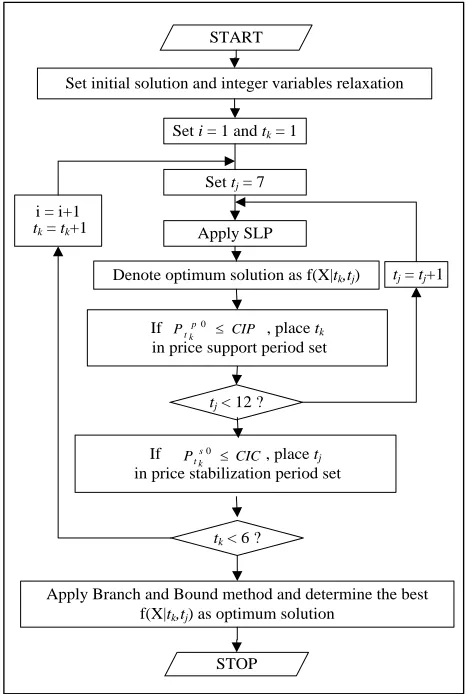
We propose Sequential Linear Programming (SLP) combines with enumeration as the solution method to solve the MINLP formulation. According to Rao [34], SLP method is an efficient technique for solving convex programming problems with nearly linear objective and constraint functions. We enumerate all feasible values for integer variables while applying SLP using relaxed value to find optimum solution. In this case, the MINLP problem has to be solved in each stage using SLP method. The solution procedure is depicted in Fig. 2.
In order to illustrate the capabilities of the proposed model, numerical example is carried out using real data from Indonesian staple food production and consumption. Supply and demand unit are in thousands tons. Supply and demand of staple food are based on Indonesian staple food production and consumption in 20X1 and 20X2 [35]. All unit cost and price measurements are in Indonesian domestic rupiahs (IDR). All related data used for the computational study is presented in Table V to Table VIII.
START
Set initial solution and integer variables relaxation
Set i = 1 and tk = 1
Apply SLP
Denote optimum solution as f(X|tk,tj)
Set tj = 7
tj < 12 ?
tj = tj+1
i = i+1
tk = tk+1
tk < 6 ?
Apply Branch and Bound method and determine the best f(X|tk,tj) as optimum solution
STOP If , place tk
in price support period set
CIP P p
k t
0
If , place tj
in price stabilization period set
CIC Ps
k t
0
Fig. 2. Solution procedure for solving the Mathematical Model.
TABLE V
PARAMETER OF SUPPLY AND DEMAND IN HARVEST SEASON.
Period Unit 1 2 3 4 5 6 20X1 q
s (x 1,000 ton) 324 466 459 530 562 408
qd(x 1,000 ton) 196 225 225 253 280 280
20X2 q
s
(x 1,000ton) 240 480 480 550 630 470
qd(x 1,000 ton) 200 230 230 260 280 280
TABLE VI
PARAMETER OF SUPPLY AND DEMAND IN PLANTING SEASON.
Period Unit 7 8 9 10 11 12 20X1 q
s (x 1,000 ton) 0 0 0 0 0 0
qd(x 1,000 ton) 253 225 232 232 232 203
20X2 q
s (x 1,000ton) 0 0 0 0 0 0
qd(x 1,000 ton) 260 230 240 240 240 210
TABLE VII
PARAMETER OF COSTS AND PRICES.
cp cI ch cd cwr Pp0 CIP CIC
20X1 4,400 250 50 190 30 4,840 4,620 5,280 20X2 6,500 300 200 400 30 7,000 7,500 10,000
TABLE VIII
PARAMETER OF PRICES AND CONSTANT
pI a b c d e in iwr cr
20X1 4,000 1.042 0.009 3 9 2.73 14 5 80
B.The Findings and Proposition
To ensure staple food availability, BLUPP is given privilege to impose import as necessary. In indirect intervention under monopolistic market, BLUPP has full control of staple food distribution. As government agent, BLUPP has two main responsibilities, to ensure staple food availability and to protect producer from selling price plunge and consumer from buying price hike, i.e. price stabilization. These responsibilities are carried out using buffer stock scheme and WRS system; under assumption that supply and demand can affect prices. It is clear that BLUPP gains benefitr because selling imported good, receive revenue from selling domestic good, and benefit from S-WRS schema.
TABLE IX DECISION VARIABLES
Decision variables Unit 20X1 20X2
The purchasing price in the IM period -t
IDR Million/thousand tons
4,817 7,132
The selling price in the IM period -t
IDR Million/thousand tons
5,030 7,549
The beginning of IM periods for producer
Month 1st 1st
The beginning of IM periods for consumer
Month 12th 12th
Amount of staple food purchased by BLUPP in the price support program
thousand tons 2,426 2,610
The amount of staple food as WR guaranteed
thousand tons 128 190
Import quota thousand tons 282 270
From the given supply and demand data, the numerical results of decision variables can be presented in Table IX. It can be inferred that there is a shortage in staple food supply about 282 for 20X1 and 270 for 20X2. BLUPP purchased about 2,426 for 20X1 and 2,610 for 20X2, while the amount of staple food as WR guaranteed is about 128 for 20X1 and 190 for 20X2. Integer decision variable tk which is the beginning of IM periods for producer is 1, means that from period 1 indirect intervention mechanism is applied to selling price. The same mechanism is applied for the price stabilization program for consumer. BLUPP notices CIC to control the buying price in the market. Prices lie above CIC will bring discomfort to the
consumer as the buying price is considered high. Thus, BLUPP must determine the quantity of the staple food redeemed from WRS to be sold to consumer such that buying price decreases due to staple food availability increase in market. Integer decision variable tj
which is the beginning of IM periods for consumer is 12. This means that for period 1 until 11, consumer buy the staple food using non intervention prices because their values are less than crisis indicator. However, consumer buys the staple food in period 12 using intervention pricePMaxsince non intervention price is greater than crisis
indicator.
Fig. 3 describes the impact of BLUPP accessing the S-WRS to support producer selling price during in the harvest season and to stabilize consumer buying price during the harvest and planting season. For period 1 until 6, BLUPP notice CIP to
determine when they should interve market to support purchasing price. Based on this model, BLUPP determines staple food quantity that must be stored in WRS and sold to consumer so that the selling price will rise above CIP. As the
result, the purhasing price and the selling price can be controled to bring advantage to producer. BLUPP also must determine the selling price to be sold to customer such that the staple food availability and price are maintained. As a result, consumer spends less money to buy the staple food using the intervention price which is smaller thanCIC.
Fig. 3.The impact of BLUPP accessing the S-WRS to support producer selling price during in the harvest season and to stabilize consumer buying price during the harvest and planting season.
Fig. 4. The Performance comparison between DMI and IMI for producer (a) and for consumer (b).
support period, BLUPP able to support the producer up to 40% for increasing their welfare. Otherwise, in price stabilization period, they can redeem the staple food in order to fulfill consumer demand in that period. Hence, total cost of consumer is decrease up to19.3% compared with previous DMI as proposed by Sutopo et al. [1].
Hence, the following propositions are developed based on mathematical formulation and numerical results:
Proposition 1. IMI instrument is able to complete the level for the market availability of staple food during the planning period.
Proof. Suppose that s t
q
is the amount of staple food in the period-t, and
d t
q
is the demand in the period-t, the total supply and demand for entire planning period is expressed as (7) and (8). BLUPP can buy a commodity about QtPB from the
producer to run an indirectly price support program, where most are sold directly to consumer and partly stored in the RWM. This is stated in (14) and (19). Further, to ensure the equilibrium and availability of staple food, BLUPP imposes import about
OI t
Q and expresses in (9). During the planting
season in the price stabilization program, BLUPP can sell a commodity that taken from RWM as stated in (18) to overcome the sufficient supply in market. Hence, the IMI instrument can determine the quantity of the staple food sold and bought by BLUPP, and imported by BLUPP which satisfies the quantity of staple food consumed by consumer for entire planning period.
Proposition 2. IMI instrument is able to determine the limitation of price support and price stabilization depend on
P
CI and CIC during the planning period, in which CIP andCICare the price limit setting by the government as a form
of indirect intervention.
Proof. The objective function of BLUPP in (2)-(4) could describe BLUPP activities in the staple food market. Then, the producer selling price in period-t is expressed as (7), otherwise
the consumer buying price in period-t is expressed as (8). To calculate both of price functions, there is required a provision related to the value of Ptp0and CIP also the value of Pts0 and
C
CI . Thus, the IMI instrument is able to set producer prices and
consumer prices in the desired limits.
Proposition 3 IMI instrument can be applied to execute the price support program for producer and the price stabilization program for consumer by utilizing buffer stock scheme under S-WRS system.
Proof. The proof is trivial. First, a formal proof for producer price support program by selling price intervention BLUPP is presented. One can choose arbitrary values for p0
t
P less than
P
CI and p1
t
P . Let,, and denote the value of (1) when the
selling price is Ptp0, CIP, and
1
p t
P respectively. Since (1) is
concave, then is always greater than. If intervention is not conducted, producer will face potential loss in the amount of
-. However by indirect intervention mechanism, producer
will get benefit in the amount of -. Next, the same
procedure is applied for price stabilization program. Let,, and denote the value of (5) when the buying price is Pts0,CIC ,
and s1
t
P respectively. Since (5) is monotonous decreasingly, is always smaller than. If intervention is not conducted, consumer will expedite additional consumption cost in the amount of -. Thus, the IMI instrument is capable to execute the price support program for producer and the price stabilization program for consumer by utilizing buffer stock scheme under S-WRS system.
V.CONCLUSION AND FUTURE RESEARCH
A buffer stock model was addressed to determine the instrument of IMI. The S-WRS facility is a privilege given to BLUPP in order to perform its responsibility i.e. to maximize producer’s revenue and minimize consumer’s cost under minimum cost of the S-WRS. The MINLP approach was used to determine the decision variables of buffer stock scheme for government to control the BLUPP operation indirectly. The numerical analysis showed that the model can be used to determine the stock level and the amount of import, and to solve the buffer stock problem considering the interest of producer and consumer.
For further research, this model could be extended to other characteristics of buffer stock problems such as considering the government budget constraint, providing crisis indicator options, and offering the option of distribution system. Game theory and dynamic programming can be considered as the alternative approaches to describe the transaction model among involved entities in staple food distribution system.
ACKNOWLEDGMENT
The authors gratefully acknowledgment the Directorate General of Higher Education (DGHE), Ministry of Education & Cultural, the Republic of Indonesia for the financial support under Program Hibah Seminar Luar Negeri (Contract No: 235/SP2H/HKI/Dit. Litabmas/X/2011).
REFERENCES
[1] W. Sutopo, S. Nur Bahagia, A. Cakravastia, and T. M. A. Arisamadhi, “A dynamic buffer stocks model for stabilizing price of staple food with volatility target,” International Journal of Logistics and Transport, vol 3, no. 2, pp. 149-160, September 2009.
[2] L. Smith, “Price Stabilization, Liberalization, and Food Security Conflicts and Resolution?”. Food Policy, vol. 22, pp. 379-392, 1997.
[3] D. Brennan “Price dynamics in the Bangladesh rice market: implications for public intervention,”. Agricultural Economic, vol. 29, pp. 5–25, 2003. [4] N.M. Isma’il NM, “Improvement of industry competitiveness national
[5] W. Sutopo, S. Nur Bahagia, A. Cakravastia, and T. M. A. Arisamadhi, “A Buffer stock Model for Stabilizing Price of Commodity under Limited Time of Supply and Continuous Consumption”. In Proc of Asia Pac Ind ustrial Eng & Management Society Conf , Bali, pp. 321-329, 2008.
[6] W. Sutopo, S. Nur Bahagia, A. Cakravastia, and T. M. A. Arisamadhi, “A buffer stocks model for stabilizing price in duopoly-like market,” In Proc. of the 2nd Asia Pacific Conf. on Manufacturing System, Yogyakarta, Indonesia, 2009, pp. IV.9–IV.16
[7] W. Sutopo, S. Nur Bahagia, A. Cakravastia, and T. M. A. Arisamadhi,”Price stabilization using buffer stock in duopoly-like market with consider expectation of stakeholders”. ASOR Bulletin, vol. 29, no. 4, pp. 60-72, 2010.
[8] D. van der Mensbrugghe., JC. Beghin, and D. Mitchell, “Modeling tariff rate quotas in a global context: the case of sugar markets in OECD countries”, www.card.iastate.edu, Accessed 1 Sept. 2010.
[9] S. Chopra and P. Meindl, Supply Chain Management: Strategy, Planning, and Operations, 2nd Edn. Prentice Hall, New Jersey, 2004.
[10] G. Guilléna, F.D., Melea, M.J. Bagajewiczb, A. Espuñaa, and L. Puigjanera, “Multiobjective Supply Chain Design Under Uncertainty”,
Chemical Engineering Science, vol. 60, pp. 1535 – 1553, 2005. [11] Commission for the Supervision of Business Competition/KPPU, the
Republic of Indonesia, Position Paper KPPU toward Policy Analysis on Indonesian Sugar Industry, pp. 25-35, http://www.kppu.go.id/id/kajian/ positioning-paper (Accessed on 25 June 2011).
[12] W. Sutopo, S. Nur Bahagia, A. Cakravastia, and T. M. A. Arisamadhi, ,”Developing a buffer stock model for stabilizing price and ensuring availability of seasonal staple food in monopolistic market using warehouse receipt system”, in Proc. World Academic of Science, Eng, and Technology, vol. 59, pp. 3366-3371, 2011.
[13] J.-J. Dethier and A. Effenberger, “Agriculture and development: a brief review of the literature”. Economic Systems, vol. 36, pp. 175–205, 2012. [14] R. Chand, “Government intervention in food grain markets in the new context,” National Centre for Agricultural Economics and Policy Research, New Delhi, India: Chandu Press, 2003.
[15] Jamhari, “Rice market liberalization and price stability in Indonesia,”
Tohoku Journal of Agricultural Research, vol.54, no. 3, pp. 23-36, March 2004.
[16] Burhan and A. Cakravastia, “A model to control availability and price of white sugar by considering inter regional trade flows,” In Proc. of the 2nd Asia Pacific Conf. on Manufacturing System, Yogyakarta, Indonesia, 2009, pp. IV.37–IV.43.
[17] W. C. Labys, “Survey of latest development-commodity price stabilization models: a review & appraisal,” Journal of Policy Modeling, vol. 2, no. 1, pp. 121-126, January 1980.
[18] D. T. Nguyen, “Partial price stabilization and export earning instability,”
Oxford Economic Papers, vol. 32, no. 2, pp. 340-352, July 1980. [19] R. Edwards and C. P. Hallwood, “The determination of optimum buffer
stock intervention rules,” the Quarterly Journal of Economics, vol. 94, no. 1, pp. 151-166, February 1980.
[20] M. G. D. Newbery and E. J. Stiglitz, “Optimal commodity stock-piling rules,” Oxford Economic Papers, vol. 34, no. 3, pp. 403-427, November 1982.
[21] G. Athanasioua, I. Karafyllisb, and S. Kotsiosa, “Price stabilization using buffer stocks,” Journal of Economic Dynamics & Control, vol. 32, no. 4, pp. 1212-1235, April 2008.
[22] C. C. David, “Food policy-its role in price stability and food security,”
Journal of Philippine Development, vol. 43, no. 1, pp. 171-189, January 1997.
[23] N. P. Khan, “Government intervention in Pakistan's wheat and cotton sectors: concepts, policies and implications,” Asian Journal of Plant Sciences, vol. 1, no. 4, pp. 492-494, 2002.
[24] P. A. Dorosh, S. Dradri, and S. Haggblade, “Regional trade, government policy and food security: recent evidence from Zambia,” Food Policy, 34, vol. 3, pp. 350–366, June 2009.
[25] S. Jha and P. V. Srinivasan, “Food inventory policies under liberalized trade,” International Journal of Production Economics, vol. 71, no. 1-3, pp. 21-29, May 2001.
[26] B. Adao, I. Correia, and P. Teles, “Ensuring price stability with an interest rate rule,” Economic Bulletin, pp. 57-64, 2007.
[27] Y. Rong, Z-JM Shen, and L.V. Snyder “The impact of ordering behavior on order-quantity variability: a study of forward and reverse bullwhip effects,“
Flexibility Service Manufacturing Journal, vol. 20, no. 1, pp. :95–124, 2008. DOI 10.1007/s10696-009-9054-3
[28] K. Ayenagbo, J. N. Kimatu, Z. Jing, S. Nountenin, and W. Rongcheng, “ Analysis of the importance of general agreement on tariffs and trade (GATT)
and its contribution to international trade,” Journal of Economics and International Finance, vol. 3, no. 1, pp. 13-28, January 2011.
[29] K. Anderson and S. Nelgen “Trade barrier volatility and agricultural price stabilization,” World Development, vol. 40, no. 1, pp. 36–48, 2012. [30] Nur Bahagia, S. Inventory System, Bandung: ITB Press, pp. 15-20, 2006. [31] F. Höllinger, L. Rutten, and K. Kiriakov, “The use of warehouse receipt finance in agriculture in transition countries,” Food Agricultural Organization, 2009, http://www.fao.org/tc/tci (Accessed on 01 January 2011).
[32] Law Number 9 of 2006 the Republic of Indonesia concerning on System on Warehouse Receipt, http://www.resigudang.com, (Accessed on 03 August 2010).
[33] Regulation of the Finance Minister Number 171/Pmk.05/2009 on Scheme for Subsidy on Warehouse Receipt, http:// www.resigudang.com (Accessed on 05 August 2010).
[34] S. S. Rao, Engineering Optimization: Theory and Practice, 4th Edition,
New Jersey, USA: John Wiley & Sons, Inc, 2009, pp. 287-393.
[35] W. Sutopo, “Buffer stocks models to ensure price stabilization and availability of seasonal staple food”. Dissertation, Bandung Institute of Technology. Bandung, 2011
Wahyudi Sutopo is an assistant professor in Department of Industrial Engineering, Faculty of Engineering, and University of Sebelas Maret. He obtained his Ph.D degree in Industrial Engineering and Management from Bandung Institute of Technology and his dissertation is at supply chain management area. He has published many papers in several national and international journal i.e. Performa, J@TI, Makara Technology, The International Journal of Logistics and Transport, ASOR Bulletin, and ITB Journal of Engineering Science. His email address is [email protected] and [email protected].
Senator Nur Bahagia is a Professor in the Department of Industrial Engineering, Bandung Institute of Technology. He obtained his Ph.D degree in Logistic System and Production Management from Universite d’Aix-Marseille III, France. His research interest is at logistic and supply chain development. He has published many papers in several national and international logistic system journals. His email address is [email protected].
Andi Cakravastia is an associate professor in Department of Industrial Engineering, Faculty of Industrial technology, Bandung Institute of Technology, Indonesia. He received a Doctoral Degree from the Graduate School of Engineering at Hiroshima University. His teaching and research interests include supply chain management and applied operations research. His email address is [email protected].