~ 5 ~ WWJMRD 2019; 5(10): 05-09
www.wwjmrd.com International Journal Peer Reviewed Journal Refereed Journal Indexed Journal
Impact Factor MJIF: 4.25 E-ISSN: 2454-6615
R.Packyapriya
Department of Electrical Engineering, Mookambigai College of Engineering, Kalamavur, Tamil Nadu, India
B. Gayathri Devi Department of Electrical Engineering, Mookambigai College of Engineering, Kalamavur, Tamil Nadu, India
Correspondence: R.Packyapriya
Department of Electrical Engineering, Mookambigai College of Engineering, Kalamavur, Tamil Nadu, India
IoT Enabled Smart Farming Using Android Phone
R. Packyapriya, B. Gayathri Devi
Abstract
This project explains about an IoT enabled Smart Farming using Android Phone. Internet of Things is described as Interconnection of physical devices through Internet. The physical devices embedded with sensors enables the interaction with physical and logical world in the concept of IoT. The proposed system is based on IoT that uses real time data to monitor and control the irrigation system parameters using Smartphone with Internet. This project focuses on how Agriculture IoT can be used for the better management of natural resources like efficient water usage, optimization of inputs & treatments. The benefits of IoT – Smart Farming include Smart Sensing/Monitoring, Smart Control and Smart Analysis Planning.
Keywords:IoT, Android
1. Introduction
Internet of things (IoT) is the network of physical devices like vehicles, home appliances and other items embedded with electronics, software, sensors, actuators, and connectivity which enables these objects to connect and exchange data. This adds a level of digital intelligence to devices that would be enable them to communicate without a human being involved, and merging the digital and physical world. Adding RFID tags to an equipment to track the location was one of the first IoT applications. But since then, the cost of adding sensors and an internet connection to objects has continued to fall, and experts predict that this basic functionality could one day cost less, making it possible to connect nearly everything to the internet. IoT was initially most interesting to business and manufacturing, where its application is as machine-to-machine (M2M), but the emphasis is now on filling our homes and offices with smart devices, transforming it into something that is relevant to everyone. Today, IoT Applications are widely spread across Smart home, Wearable’s, Connected Cars, Industrial Automation, Smart City, Agriculture, Retail Energy Management, Healthcare, Poultry etc. Smart farming is one of the fastest growing fields in IoT. Sensing for soil moisture and nutrients, controlling water usage for plant growth and determining custom fertilizer are some simple uses of IoT. These nodes were used to monitor a wide range of environmental issues that affect directly to agriculture, for example solar radiation, wind speed and direction, rainfall, ambient temperature, humidity, gases, soil moisture and temperature.
Proposed System
Fig. 1: Block Diagram of Proposed System
The purpose of this project is to help the user to monitor and control the farm located anywhere, with the help of Internet of Things. The user has access to the location using an IoT Screen specifically designed for that farm. Solar Power that is stored in a Battery serves as Power Source for the Circuit located in the farm. Solar Power used in here is controlled using MPPT. The user can monitor and control the below features of the greenhouse located anywhere using the Smart Phone.
Soil Moisture Content and irrigate the plants
Temperature to be maintained with the help of Fan for Cooling purpose
Humidity to be maintained with the help of Water Sprayer with Fan
Height of the plant when it is ready for Harvest
IoT Screen in Mobile Phone
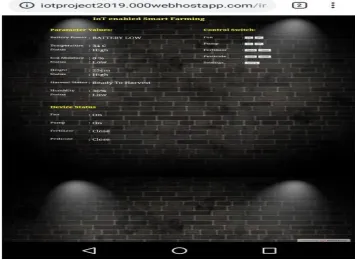
The below page is designed using PHP Programming. The user has to open the below link in Mobile Browser Window.IoTPage:http://iotproject2019.000webhostapp.co m/irrigation%20iot/
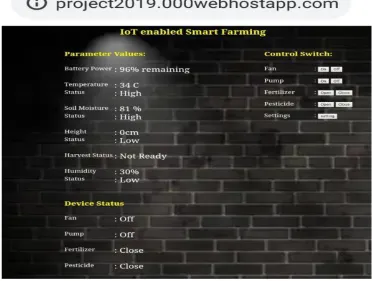
The user can monitor the Values of Soil Moisture, Temperature, Humidity and Plant
Height and control using the button provided to control the values using the Buttons (Fan, Pump). The user can also add fertilizer & Pesticide to the plant by clicking
“Fertilizer” & “Pesticide” Button. Harvest Status will be updated as “Ready for Harvest” when the plant reaches the threshold height. All the threshold values for monitoring the plant can be updated manually in the below screen.
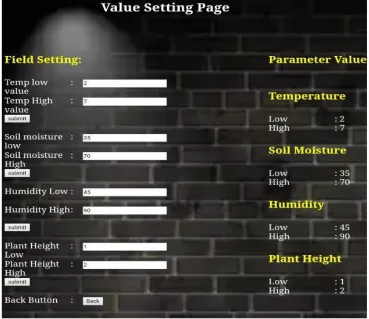
~ 7 ~ By the clicking on the “Settings” page in the above screen it will get directed to the below screen. User can manually set the minimum and maximum values of Temperature,
Soil Moisture, Humidity and Plant Height for Harvest. The minimum and maximum values will be termed as “Low” and “High” in the screen under “Parameter Values”.
Fig. 3: IoT Screen 2
Experimental Resut
The user has to open the Browser Window in Mobile and enter the below IoT Page link. Also, the kit should always be connected to Power Supply 24/7.Once the user opens the IoT below link in Mobile Browser Window. IoT Page:
http://iotproject2019.000webhostapp.com/irrigation%20iot/
The below screen will appear at first. User can login using Mobile or Computer.
This system can be modified for any type of individual Smart Farming based on the Crop Type. Hence user can click on “Setting” Icon. Based in the Crop Type, user enters the threshold values (Maximum and Minimum) for Temperature, Soil Moisture, Humidity, and Plant Height. Click on the Submit Button after entering the values. The values will be uploaded to Internet and it is received by the controller in the kit that is located remotely.
Along with the data sent to the controller, real time update happens in IoT Screen and also the LED Screen in the Kit. It takes around 20 – 25 seconds for the data to get updated
from IoT Screen to the Controller in the Hardware Kit. The Hardware Kit used a 5 V Rechargeable Battery which is charged using Solar Power. This Solar Power is controlled using MPPT Algorithm. Airtel Sim Card is used for Internet Purpose in the Hardware Kit. Once the hardware kit is switched on, we have to ensure that Signal Strength is good, which you can identify from the blinks (Blue Color).The faster the blinks, signal strength is good. Solar Panel gives an output of nearly 15 V. Battery Capacity also can be monitored in the IoT Screen.
Fig. 5: Value Setting Page
Conclusion
Solar Power is along with Battery Storage is used as Power Supply to operate the circuit. It is incorporated with Boost Converter. The sensor in farming location provide information on the Soil Moisture, Temperature, Humidity and Height of the Plant. Fan and Motor Pumps (Water, Fertilizer & Pesticide) are connected to Motor Drive. The above-mentioned data and the Motor Drive can be monitored and controlled from IoT Page in Android Phone. The monitoring values can be changed manually, based on the type of plants to be monitored. This system is sourced by Solar Panel and controlled by MPPT Algorithm.
Future Scope
Also known as precision agriculture, precision farming can be thought of as anything that makes the farming practice more controlled and accurate when it comes to raising livestock and growing of crops. In this approach of farm management, a key component is the use of IT and various items like sensors, control systems, robotics, autonomous vehicles, automated hardware, variable rate technology,
and so on. The adoption of access to high-speed internet, mobile devices, and reliable, low-cost satellites (for imagery and positioning) are few key technologies characterizing the precision agriculture trend. Precision agriculture is one of the most famous applications of IoT in the agricultural sector and numerous organizations are leveraging this technique around the world. Drones are being used in agriculture in order to enhance various agricultural practices. The major benefits of using drones include crop health imaging, integrated GIS mapping, ease of use, saves time, and the potential to increase yields. With strategy and planning based on real-time data collection and processing, the drone technology will give a high-tech makeover to the agriculture industry.
References
1. Andreas Kamilaris, Feng Gao, Francesc X,
~ 9 ~ 2. Anupama Hongal, Jyothi and Prathibha (2017), ‘IOT
Based Monitoring System in Smart Agriculture’, International Conference on Recent Advances in
Electronics and Communication Technology
(ICRAECT)
3. Dhanashri H. Gawali and Shweta B. Saraf (2017), ‘IoT
based smart irrigation monitoring and controlling system’, 2nd IEEE International Conference on Recent Trends in Electronics, Information & Communication Technology (RTEICT)
4. Kale and Patil (2016), ‘A model for smart agriculture using IoT, International Conference on Global Trends in Signal Processing’ Information Computing and Communication (ICGTSPICC)
5. Rob Dolci (2017), ‘IoT Solutions for Precision
Farming and Food Manufacturing: Artificial
Intelligence Applications in Digital Food’, IEEE 41st
Annual Computer Software and Applications