R E S E A R C H
Open Access
Upgrading a high performance
computing environment for massive data
processing
Lucas M. Ponce
1*, Walter dos Santos
1, Wagner Meira Jr.
1, Dorgival Guedes
1, Daniele Lezzi
2and
Rosa M. Badia
2,3Abstract
High-performance computing (HPC) and massive data processing (Big Data) are two trends that are beginning to converge. In that process, aspects of hardware architectures, systems support and programming paradigms are being revisited from both perspectives. This paper presents our experience on this path of convergence with the proposal of a framework that addresses some of the programming issues derived from such integration. Our contribution is the development of an integrated environment that integretes(i)COMPSs, a programming framework for the
development and execution of parallel applications for distributed infrastructures;(ii)Lemonade, a data mining and analysis tool; and(iii)HDFS, the most widely used distributed file system for Big Data systems. To validate our framework, we used Lemonade to create COMPSs applications that access data through HDFS, and compared them with equivalent applications built with Spark, a popular Big Data framework. The results show that the HDFS integration benefits COMPSs by simplifying data access and by rearranging data transfer, reducing execution time. The integration with Lemonade facilitates COMPSs’s use and may help its popularization in the Data Science
community, by providing efficient algorithm implementations for experts from the data domain that want to develop applications with a higher level abstraction.
Keywords: COMPSs, High-performance computing, Big data, HDFS, Lemonade
1 Introduction
Parallel and distributed computing frameworks have proven to be essential for applications that require high performance, usually associated with the processing of large volumes of data. Originally, efforts in that area orig-inated from two different areas, High-Performance Com-puting (HPC) and Big Data. More recently there has been a tendency to combine efforts from both areas to merge their contributions. This work fits in that direction.
HPC applications are those that explore high-level par-allelism and high-performance hardware, including low latency networks, to process mostly structured data with scientific algorithms. On the other hand, Big Data sce-narios involve the processing of massive data volumes
*Correspondence:[email protected]
1Departamento de Ciência da Computação, Universidade Federal de Minas Gerais (UFMG), 31270-901 Belo Horizonte, Minas Gerais, Brazil
Full list of author information is available at the end of the article
(usually unstructured), leveraging the use of conventional hardware and exploiting data parallelism. In this case, data could be processed as multiple individual streams and analyzed collectively in stream or in batch, for the discov-ery of knowledge. In such scenarios, data mining in big data has become one of the key tasks in many fields of Science [1].
Considering the convergence of HPC and Big Data, sev-eral proposals have emerged to address the requirements of those two areas [2–4]. HPC environments generally provide better interfaces for regular data and scientific algorithms based on bag-of-tasks models such as matrix computation. Despite the good performance in those sce-narios, it is often hard to implement applications that handle irregular data and complex data structures in HPC frameworks. Big Data environments offer good solutions to address such kind of data, as well as to facilitate the development of applications by experts in the application
about how abstractions from both areas can benefit each other and how they can be effectively integrated.
COMPSs implements a task-based programming model, a model that has proven to be suitable for HPC applications [5, 6]. It provides a task-based abstraction that is easily understandable by programmers in the HPC community. However, in Big Data scenarios other abstractions have been adopted, like Spark, one of the most widely used Big Data frameworks. In Data Science scenarios, one of the main advantages of Spark is the wide range of available libraries (e.g., MLlib, GrapX, Streaming and SparkSQL, and other integrated tools) [7].
In this context, this paper proposes an extension of COMPSs with two different contributions: first, by adding support for the Hadoop Distributed File System (HDFS), the distributed file system most commonly used for Big Data; second, by integrating it into a massive data-processing application development environment that reduces the user’s need to know the details of a program-ming language to produce applications. Through HDFS integration, we intend to facilitate the use of large vol-umes of data in COMPSs. In addition, by using a visual development environment, we can hide many details of a parallel programming language, making COMPSs acces-sible to a larger number of users. In order to achieve that, we adopted the Lemonade environment, a data mining and analysis tool developed at the Universidade Federal de Minas Gerais (UFMG) [8]. The integration of COMPSs with HDFS and the version of Lemonade that outputs COMPSs code are both open-source and are available on GitHub. We also present a performance comparison of COMPSs and Spark applications, using a cluster usually associated with Big Data scenarios, with virtualized nodes and without shared disks.
To describe our work, the remainder of this paper is structured as follows: Section3introduces the COMPSs framework; Sections4and5present its integration with HDFS and Lemonade, respectively. The evaluation of our solution is discussed in Section 6 and finally Section 7
presents our conclusions and discusses future work.
2 Related work
COMPSs is a framework in constant development, it is receiving several new extensions and APIs to fit Big Data requirements, that vary from cloud connectors [9] to a resource manager integration [10]. In a recent work [3], COMPSs Storage API is presented, an official software interface that allows COMPSs applications and COMPSs
[11], a non-relational (NoSQL) database storage.
Currently, besides HDFS, distributed storage systems have become more diverse with a variety of purposes: file systems such as NFS [12], Alluxio [13], Amazon Sim-ple Storage Service (S3) [14], Microsoft Azure Storage [15], Lustre [16]; object stores such as OpenStack Swift [17] and Ceph [18]; key-value systems such as FAWN-KV [19], Dynamo [20] and Memcached [21]; and NoSQL databases such as Apache Cassandra and Apache HBase [22]. Each of these systems address specific problems, even for storage systems of similar categories. Some of them are specialized to handle large volumes of data (e.g., Amazon S3, Cassandra, HBase and HDFS), while others focus on increasing I/O bandwidth (e.g., Alluxio, Lustre and Memcached). Each of the storage systems mentioned has its particularities, was developed with a specific problem in mind, but often can interact with others. For example, Alluxio (formerly Tachyon) provides an efficient in-memory data sharing layer by using exis-tent storage such as HDFS, NFS or S3 as a persistence layer.
Among all the available systems, we decided to inte-grate COMPSs with HDFS, since it is one of the most widely adopted solution in the market. It supports multi-ple replicas of files, which increases access bandwidth for multiple clients accessing a single file (a known bottleneck in NFS); however, it is not a good solution for handling small files. Besides that, many of the other solutions men-tioned are often implemented on top of it (e.g., HBase, Cassandra and Alluxio). Perhaps the storage system clos-est to HDFS proposal is Amazon S3, a subsidiary service of Amazon Web Services for cloud storage. S3 aims to provide storage at a low cost, as a highly available service using a price model based on “pay-as-you-go”. However, S3 is a proprietary solution and it lacks some functionality often required in scientific projects, such as flexible access control and support for delegation, for example, in large science collaborations groups [23].
Although code-based frameworks, such as Apache Spark, provide a good degree of parallelism and cus-tomization, programming is often complex because needs a high-knowledge from user to understand the syntax and its operators. In Ruffus it is possible to create multi-thread workflows automatically; however, it requires users to encode each function of their pipelines and to explic-itly define how task functions are connected and how data will be exchanged. In Cosmos, it is possible to create flows with the MapReduce paradigm [30]; however, besides the code for all functions, it is also necessary to define their dependency graph, which requires a specific syntax.
Visual data flows tools enables users to construct com-plex data analysis scenarios without programming by sup-porting a visual interface. Besides the different abstraction levels adopted in each tool to represent a workflow, a common feature is the support of drag, drop and con-nect operations to work with the available components. Many of them, such as RapidMiner, Orange and KNIME, are designed to be used locally, making them inappropri-ate to process large data sets that exceed the capabilities of a single machine. ClowdFlows [31] and Orange4WS [32] are popular web-based solutions that support non-local processing, enabling them to execute in a cluster. How-ever, their solution is multithread-based: it allows multiple workflows to execute concurrently by distributing them through nodes, but does not provide distribution or par-allelization of data within a flow to handle Big Data sce-narios. Lemonade is similar to Microsoft Azure Machine Learning (ML) Studio [33] in that both support creation and execution of applications from a visual interface using Apache Spark to handle Big Data. Azure ML, however, is a proprietary solution that requires a subscription with the Microsoft Azure, being restricted to a cloud architecture. Lemonade is an open-source solution that support both cluster and cloud architectures. Originally, the generated codes were expressed in Spark language [8]; in this work it is extend to also be able to create and execute operations in COMPSs.
A recent work [34] compared COMPSs performance in Java applications to Apache Spark, using a cluster archi-tecture normally associated with HPC applications (e.g., low-latency networks and shared network disks). In this work, our integration allow us to take COMPSs into a cluster usually adopted in Data Science scenarios, with only traditional networking hardware and with disks dis-tributed among the cluster nodes.
3 The COMPSs framework
COMPSs is a general data processing framework whose main objective is to ease the development of applica-tions for distributed environments, composed of a pro-gramming model and an execution runtime that supports it. Applications in COMPSs are written following the
sequential paradigm with the addition of annotations in the code that are used to inform that a given method is a task. That means it can be asynchronously offloaded at execution time, and can potentially be executed in parallel with other tasks. In the case of Java and C++, those anno-tations are provided in an interface file that indicates the directionality of the parameters (input or output). In the case of Python, tasks are identified with an annotation in the form of a decorator started with “@task” on top of a method. With that information, the COMPSs runtime generates a task graph at execution time where each node denotes a task, and edges between them represent data dependencies identified based on the tasks’s parameters and return values. The task graph expresses the inher-ent parallelism of the application at task level, which is exploited by the runtime.
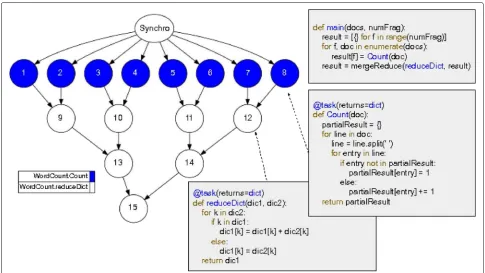
Regarding the programming model, to port an appli-cation to COMPSs, besides requiring the identifiappli-cation of the functions that are tasks, it may require structural changes to the code in order to improve application effi-ciency and achieve more parallelism. A very common case is, for example, an application with a single input, possi-bly a big file, that has to be processed by a task to extract information from it. The first and quick solution would be to assign the entire input file to a task and let it read and compute the data. If there are no dependencies among file data elements, a much more efficient approach in COMPSs, which exploits a higher level of parallelism, is to split the input file into several fragments and invoke multiple tasks, one per fragment. In that way, different resources will be used to execute, in parallel, the differ-ent tasks. Figure1 shows the Python version of a word count application in COMPSs that uses such input frag-mentation technique. The dependency graph produced during execution is also shown. Before the integration with HDFS (which will be presented in Section 4), the programmer needed to explicitly split the input file in the desired number of fragments before the task could be called.
The application’s idea is to have the input broken into fragments and to count the words in each fragment of the file. Then, it uses a COMPSs operator,mergeReduce, to combine all the separate counts as a distributed reduction operation. As shown in Fig.1, the code in Python does not involve any new syntax, different from other distributed programming frameworks, like Spark. In the example, annotations for both tasks (count words in a fragment and perform partial sums during the reduction) are similar: they indicate that bothCountandreduceDictare par-allelizable tasks which return dictionaries as results. The execution graph shows that allCounttasks can be exe-cuted in parallel and partial reductions also have some parallelism, which was controlled by themergeReduce
Fig. 1Wordcount application in PyCOMPSs. The topmost code block shows the main function, that triggers the calls to Count and reduceDict, the two functions defined as tasks, shown in the two other code blocks. The graph shows the tasks created during execution and the dependencies among them, identified based on the parameters and return values of each task
The COMPSs runtime architecture is based on a main component, the master that executes the main code of the application, and a set of worker processes deployed on computational nodes that execute the tasks. Those nodes can be part of a physical cluster, dynamically instantiated virtual machines, or containers. The runtime takes care of data transfers, task scheduling and infrastructure man-agement. It relies on an interoperability layer that makes COMPSs able to communicate with several resource man-agers.
When tasks need to read files stored in a conventional file system without a shared disk, those files need to be available in the central node (which is executing themain
code). The document fragments are read in the main
function, and passed as parameters to the Counttasks. Then, COMPSs runtime would be responsible for trans-ferring the data over the network to each working node that would execute one of the tasks, which implies an over-head on the access to the data. The integration with HDFS presented in this work simplifies the split of the input data and distribution of the blocks to worker nodes, leveraging the COMPSs runtime to use data locality to make better scheduling decisions.
4 COMPSs-HDFS integration
The HDFS file system, distributed under the Hadoop project, was developed to deal with the partioning,
distribution and access of massive file shares with sequential data access patterns, running on clusters of commodity hardware ([35], p. 43). In HDFS, each file is internally divided into blocks (usually, 64 MB or 128 MB in size), which are automatically distributed among the stor-age nodes (datanodes). To achieve fault tolerance, increase data availability and access bandwidth, each block can be replicated on multiple nodes.
When a client needs to access a file, HDFS provides a list identifying all the blocks that compose the file to the client with information about their locations and repli-cas. Using that information, the application can decide the proper way to distribute its blocks (i.e., parts of the file) among the processing nodes (workers). Each worker receives a number of blocks to process and can access HDFS datanodes directly to retrieve, in parallel, the con-tent of such blocks. When a worker needs to access data, it can fetch them from the best source based on location and datanode load. In cases where the data is hosted on the same compute node, HDFS clients are able to access such data directly through a Short-Circuit ([35], p. 308).
abstractions should be made available to the COMPSs programmer.
4.1 Data abstraction
The integration presented here1provides APIs in Python and Java. We chose those two languages because Java is the native language for COMPSs and HDFS, while Python popular in Data Science scenarioes, and it is required for the Lemonade environment, which will be described later. Each API provides two abstractions with well-defined functions for the COMPSs programmer. The first abstrac-tion, represented by the HDFS class, is responsible for dealing with HDFS directly; for instance, to create folders or to retrieve information about a file. The second, repre-sented by theBlockclass, is responsible for the representa-tion of files divided in fragments, which includes methods like readBlock (reads a fragment as a string buffer, which can be read as a common file),readDataframe
(reads a fragment as a DataFrame, a method used in Lemonade) andreadBinary(reads a fragment as binary data).
The idea is that, for reading, the programmer will first use the API to retrieve information about the list of frag-ments of a given file in HDFS. After that, each element of this list will be sent to a worker, which will retch its data. There are two slightly different interfaces that the programmer can use to retrieve the fragment list. In one, the user can request the target file to be represented as a list of exactlynfragments, e.g., matching the number of cores available in the cluster. In the other, the user requests the information about the file as the exact list of blocks that HDFS used to split it during its creation. In this case, we use the COMPSs Storage API extension, discussed in Section2, to schedule the tasks on the work-ers that own each HDFS block to be processed. In both cases, when a COMPSs task reads data, the Block entity will choose, through HDFS, the best provider (Datanode) for each fragment. However, when using the later API, we have a greater chance of activate Short-Circuits to read a block, because COMPSs can access the block location from the list while scheduling tasks.
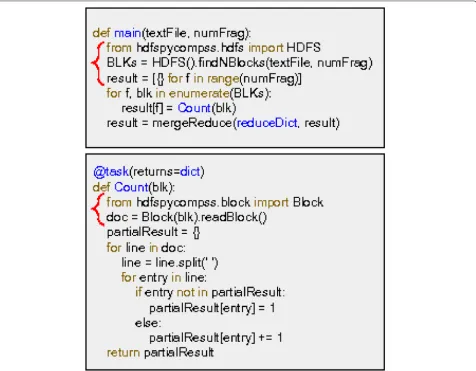
Algorithm 1 illustrates the basic procedure to use the HDFS integration in COMPSs.BLOCKSLIST, in the example, does not contain the HDFS file itself; each block in the loop is a light reference that contains, for example, the offset of the initial byte that marks the beginning of the block. Inside a task, a worker will use the information about its fragment to request the data from HDFS, which will, in turn, coordinate the transfers. Using HDFS, each fragment can be read in parallel by the multiple instances of the task (task1). From there, the next steps are similar to the existing solutions in COMPSs programming, that
1https://github.com/eubr-bigsea/compss-hdfs
Algorithm 1:COMPSs HDFS API usage example.
begin
BLOCKSLIST= retrieves a list with fragments from a file on HDFS;
for BLOCK_INFO∈BLOCKSLISTdo
task1(BLOCK_INFO);
end for end
is, each partial result can be saved to a separate file or can be used as input to a new task.
As previously mentioned, HDFS delimits blocks by number of bytes (physical blocks). However, processing each block in this way might not be practical, because most operations on data impose a logical interpretation of records, delimited by language- or application-specific markers, leading to variable-length records (e.g., records represented as text lines). Even when applications handle fixed-length records, if those have a size that is not the same as the HDFS-defined file block size, their boundaries would not match those defined by HDFS. So, if meth-ods likereadBlockandreadDataframeconsidered only the amount of bytes to read, we could process data improperly. Figure2illustrates the difference between log-ical blocks and physlog-ical blocks for a 350 MB file where each of the seven records (lines) contains 50 MB. When a task is assigned to process the first HDFS block, it has access to three lines, but the bytes that area at the end of Line 3will have to be requested for the Datanodes that holdBlock 2. Similarly, the worker that processesBlock 2 will have to request the last bytes ofLine 6from the datan-ode holdingBlock 3; in this case, it will also to discard the first bytes of the block, which actually represent part of the content ofLine 3.
Fig. 2Difference between logical and physical blocks due to HDFS fixed partition boundaries
data transfer times. ThereduceDictmethod is omitted because there is no difference compared to Fig.1.
When writing to a file, a merged output can be written into HDFS by the master node if it fits in its memory (so it can be collected from the workers). Otherwise, each task can create a partial file in HDFS with its part of the output. If the user wants, those partial files can then be merged using the API. An append function, which would allow every task to write its output to the end of a global file,
is not provided, since it would impose a serialization in the execution, given that HDFS does not allow concurrent writes to a single file.
4.2 Communication with HDFS
To integrate COMPSs with HDFS, we considered the aspects of techniques available to implement the commu-nication between external applications, in particular those written in Java and Python, and HDFS. HDFS provides
interfaces through a direct Java API, a shell command line (CLI), a REST API (webHDFS) and a C API (libhdfs). Because HDFS is written in Java, the most complete inter-face and the most powerful one is the Java API; the others implement many aspects of the service, but do not guar-antee a perfect correspondence to the Java API. While in the communication between Java-COMPSs applications and HDFS it makes sense use the HDFS Java API interface, we had to consider some alternatives for the communi-cation in Python, because HDFS does not offer native support in that language. We sought a solution capable of handling large data transfers, with access to low-level features, such as to open a file from a given position (a byte offset), a feature that was required in our HDFS data abstraction.
WebHDFS is a native HDFS API for communication using HTTP REST ([35], p. 54). Although it has been used in many Python modules as an alternative method to han-dle HDFS files [36–38], its HTTP interface is significantly slower than the native Java client, due both to request tim-ing and the overhead to use the HTTP protocol, so should be avoided for large data transfers. A second approach would be to create a communication service between the Python application and a Java process, similar to what is done by PySpark using the Py4J module [39]. PySpark, which has a hybrid Python and JVM framework, uses Py4J internally only as a request driver for the Spark process in the JVM. In the case of COMPSs, changes in its source code would be needed for that to work and it would not be possible to maintain such a level of integration over version updates. Besides, each thread created in COMPSs would have to communicate with a Java interleaver (which would in turn connect to HDFS) externally to COMPSs to request and receive data. In addition to such external processes increasing memory consumption, data transfers would have to go through the intermediary itself, different from what occurs in PySpark. LibHDFS ([35], p. 55) is the most used approach in Python modules [40,41]; is uses a Java wrapper in C that communicates with Java using the Java Native Interface (JNI), a technology for com-municating applications directly in the Java JVM. Besides the existence popular systems using that solution, such as PyArrow [41], it provides a high-level file abstraction, not giving access to some low-level API features required by our project.
Considering those limitations, our chosen solution uses libhdfs3, an alternative implementation of the libhdfs pro-tocol developed by the Apache HAWQ project [42]. While the original libhdfs uses JNI, the libhdfs3 uses a Hadoop RPC protocol. This difference gets rid of the drawbacks of JNI, provides a lightweight, small memory footprint code base, and is able to exploit features such as Short-Circuit. In turn, Python has, by default, modules capa-ble of interpreting and converting C/C++ language data
types. Based on that, it was possible to use libhdfs3 to create a mapping of the functions and data types to be used in the HDFS integration. Because Python invokes methods in C++ that are run internally, this approach is faster and more efficient than webHDFS or the Py4J module.
5 Lemonade
In the big data area, the application domain experts responsible for analyzing the data often are not com-puter scientists, and usually lack any experience in paral-lel/distributed programming. A recognized challenge for those researchers is to express their queries in a pro-cessing tool. Although COMPSs reduces the demand in terms of parallel programming, it still requires the devel-oper to identify the tasks that can be run in parallel and to program them in a language like Java or Python. To reduce those barriers, we decided to integrate COMPSs with Lemonade, a visual big data programming envi-ronment. As mentioned in Section 2, there are several tools that support visual data flows, such as RapidMiner, Orange and KNIME. However, those are designed to be used locally, making them inappropriate to process large data sets that exceed the capabilities of a single machine. Although other platforms, such as Microsoft Azure Machine Learning (ML) Studio and ClowdFlows support non-local processing, enabling them to use a cluster still presents several challenges.
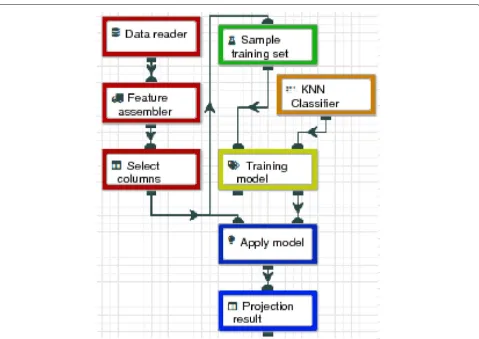
Lemonade2is a visual tool designed for data scientists, targeting users who lack programming skills or who want to develop workflows using the existing modules of that tool [8]. The platform focuses on the creation of analy-sis and mining flows in the cloud or on a private cluster, with authentication, authorization and access accounting guarantees. Using an interface for visual construction of flows, it allows users to choose predefined operations, drag and connect them to compose and execute flows by encapsulating the details of storage, coding, security and distributed processing, allowing them to be used in cloud environments by data domain experts. Figure4is an example of an application created with Lemonade, in that case, a classification application using KNN. Each operation is presented as a box that represents a data manipulation task, for instance, a machine learning algo-rithm. Each box may have a set of parameters that must be specified to control its execution like, for example, the name of a file to be read, or the maximum number of iterations for an algorithm.
In its original version, Lemonade had guidelines to gen-erate Spark 2.0.2 code in Python (PySpark). Once inte-grated with COMPSs, it can now offer its users algorithms written with COMPSs, also in Python (PyCOMPSs). Such
Fig. 4KNN workflow for a KNN classification application created using Lemonade. The data reader extract data from a file; specific features are extracted from records and then only the columns necessary for classification are selected. From that data, a sample is taken to feed the training model, which uses the KNN classifier as its engine. The trained model is then applied to the remainder of the data, and the Projection box provides a visualization of the result. The colors are used to identify modules that can be grouped during code generation (discussed in Section5.3)
algorithms can then be combined to build complex work-flows. Thus, this strategy enables a hierarchical composi-tion of code and promotes code reutilizacomposi-tion.
5.1 The lemonade environment
The Lemonade architecture is composed of seven indi-vidual components that work as micro services, respon-sible for the web interface (Citron), security and pri-vacy (Thorn), workflow execution (Juicer), application monitoring (Stand), management of data sets meta-data (Limonero), algorithms meta-data (Tahiti) and output data visualization (Caipirinha).
To integrate COMPSs with Lemonade, operations and algorithms reflecting the modules already available in its Spark version were implemented in COMPSs and regis-tered in Tahiti, which maintains all information about the available functions. Such meta-data includes, for instance, the category of each operation (e.g., text operations or machine learning algorithms) and their parameters (e.g.,
column names or the maximum iteration for a given algorithm). The Juicer module was extended, since it is responsible for translating the workflow created by the user (stored as a JSON file) into source code, which it then submits for execution in a cluster allocated for that. We created a new source-to-source compiler (transpiler) that reads the JSON file and generates COMPSs code. This code consists of two parts, one that is dynamically generated, which includes a main method responsible for coordinating all the calls to the operations used in the application, and another that is a library with the imple-mentations of operations and algorithms registered in Tahiti.
5.2 Algorithms and operations
the notion of HDFS blocks and to decompose large data files into pieces, so that the algorithm can be broken into smaller tasks, each one processing a data block with little or no dependencies to other tasks, so they can be executed in parallel.
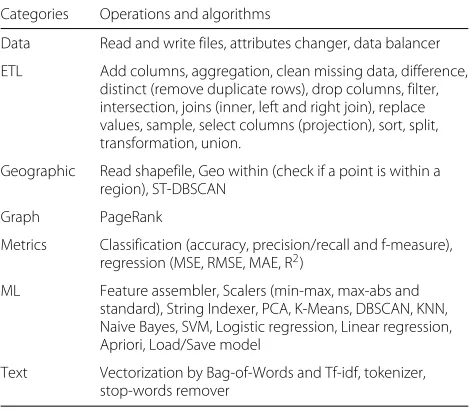
The choice of algorithms to be implemented using COMPSs in Lemonade was based on the ones that had already been made available using Spark. So far, 44 func-tions have been implemented with COMPSs, shown in Table 1. They can be divided into seven major cate-gories: read/write operations and change of data struc-ture (Data); transformation and information extraction operations (ETL); machine learning algorithms (ML); operations on textual data (Text); quality appraisers of the machine learning models (Metrics); operations and algorithms on geo-referenced data (Geographic); and algorithms on graphs (Graph). All the code is available and documented on GitHub3.
To ensure the compatibility of modules inputs and out-puts during code linkage, all functions have a standard interface with a single input data element and a config-uration dictionary as parameters. DataFrame is the data abstraction used in all algorithms and operations. Inter-nally, the data input is a list of Pandas DataFrames [43] where each element is related to an HDFS fragment. The configuration dictionary stores all attributes specified by the user through the interface and input/output data is always a list ofDataFrames(block concept). Internally to the module, the function can be organized as the pro-grammer wishes, using other functions with any number of parameters.
5.3 Code optimization
By its nature, all communication from one task that out-puts some data to another one that consumes that data (as a function input parameter) is mediated by the COMPSs main program. That adds overhead to the execution, that can be avoided in many cases, by optimizing the gen-erated code to avoid that mediation when the intended communication pattern is clearly identified.
The transpiler was implemented in Juicer with initial optimization code guidelines that are based on joining tasks from multiple algorithms and operations into a single task to reduce inter-task communication. Apache Spark implements such optimization internally; each resulting group of operations is called a stage. Such pro-cess minimizes the cost of scheduling, data transfer over the network, and creation/removal of an environment for the COMPSs tasks. For instance, in the KNN workflow shown in Fig.4, the red color operations (Data reader, Feature assemblerandSelect columns) could be grouped as a single stage. In this case, COMPSs will create only
3https://github.com/eubr-bigsea/Compss-Python
Table 1Operations and Algorithms implemented in COMPSs available in Lemonade
Categories Operations and algorithms
Data Read and write files, attributes changer, data balancer
ETL Add columns, aggregation, clean missing data, difference, distinct (remove duplicate rows), drop columns, filter, intersection, joins (inner, left and right join), replace values, sample, select columns (projection), sort, split, transformation, union.
Geographic Read shapefile, Geo within (check if a point is within a region), ST-DBSCAN
Graph PageRank
Metrics Classification (accuracy, precision/recall and f-measure), regression (MSE, RMSE, MAE, R2)
ML Feature assembler, Scalers (min-max, max-abs and
standard), String Indexer, PCA, K-Means, DBSCAN, KNN, Naive Bayes, SVM, Logistic regression, Linear regression, Apriori, Load/Save model
Text Vectorization by Bag-of-Words and Tf-idf, tokenizer, stop-words remover
ntasks (one for each fragment) instead of 3ntasks. The same happens with the blue color boxes,Apply modeland Projection results.
In order for this optimization to work, we look for oper-ations that only use local data to execute. Code from a sequence of tasks that only handle local data can be safely integrated into a single stage. In many cases, complex operations may require internal communication before an output can be generated (e.g., when an average over all elements has to be computed). Every time such a general communication pattern is found, integrated stages have to be limited to the tasks before and after it; there can be no direct integration of operations before and after the communication step.
In our implementation of COMPSs modules, all algo-rithms and operations added to Lemonade were tagged to identify how they manipulate the data from input to out-put: (i) operations that have only one internal step, like Filter (in this case, there is no stage of communication between fragments);(ii)operations where the number of rows is preserved at the end of execution, such as when some value in a column has to be replaced (mapping);(iii) operations that have more than one input (and therefore require communication with more than one box before them, likeJoin);(iv)operations that define or change the nature of the data from input to output, likeSplit(which will usually include at least one step where general com-munication is needed); and, finally, (v) operations that write data to HDFS or return data to the main program, likeSave data.
tification of sequences of operations that can be grouped in a single stage, the transpiler outputs code that include all transformations in a single task.
6 Performance evaluation
The main purpose of this work was validate COMPS integration with HDFS and Lemonade. In particular, we sought to better understand the factors involved in the performance of the HDFS integration API and the effects of using Lemonade’s code optimization guidelines. In addition, we intended to compare the performance of COMPS applications in Python, created by Lemonade, with Spark applications.
In order to achieve that purpose we used three exper-imental techniques:2kr factorial design, Z-pairwise test and linear regression. A 2kr factorial design is used to determine the effect ofk factors, each of which has two alternatives or levels [44]. We used this technique to study the effect of three parameters involved in the use of the HDFS integration API: the interface, the HDFS replication factor and the size of HDFS blocks. The Z-Pairwise test is a technique for comparisons between two systems based
cases, we have used the one-sided confidence interval when the goal was to show the superiority of a system, but when explicit, we have used the two-side confidence inter-val to show that there is no significant difference between systems.
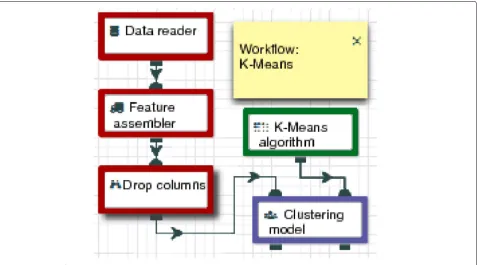
We used four applications in the experiments: Grep, an application for occurrence counting of a particular word in parallel; Wordcount, an application of word count also in parallel, where initially it is made a partial count of the words in each fragment, followed by a reduction step for merging results; KNN workflow (shown in Fig. 4), a flow of operations that comprises a step for reading and preprocessing data, a step for sampling data to be used in the training of a K Nearest Neighbors classifier, fol-lowed by a final step to apply the model over the data; and a KMeans workflow (shown in Fig.5), other flow that comprises reading data, creating of a vector of attributes, removing unnecessary columns and training a model to find the centroids of the input data set.
The use cases have different input data types: for Grep and Wordcount, the applications receive a text file; KMeans and KNN workflows receive a tabular file (csv)
with numeric attributes. The text load was created by concatenating several books from the Gutenberg Project4 multiple times. As for the numerical load, we used the Higgs Data Set5which initially contains 11×106samples with 28 dimensions of simulated signal processes that pro-duce Higgs Bosons. All experiments used a cluster with COMPSs (v. 2.3), HDFS (v. 2.7) and a Spark (v. 2.2), with a dedicated master node and eight workers nodes. The vir-tualized machines had Intel E56xx processors of 2.5 GHz with 4 cores, 8 GB of RAM, with Ubuntu Linux 16.04 LTS.
6.1 HDFS read performance
The use of the COMPSs HDFS API involves some param-eters that can influence the performance of an execution, being important to specify the used interface, i.e., whether or not it uses the COMPSs Storage API (parameter A), the replication factor (parameter B) and the block size (parameter C). It is expected that the execution be faster when using the Storage API, since it directs, whenever possible, the reading of a fragment to a node that owns it, meaning, it improves data locality. The same happens with data replication, where the usage of a replication factor greater than one increases the probability that a block will be found where the code will execute. Finally, larger block sizes decrease the number of requests made to HDFS, but on the other hand, it can increase the amount of trans-ferred data if the block is in another node and, in addition, it increases memory consumption.
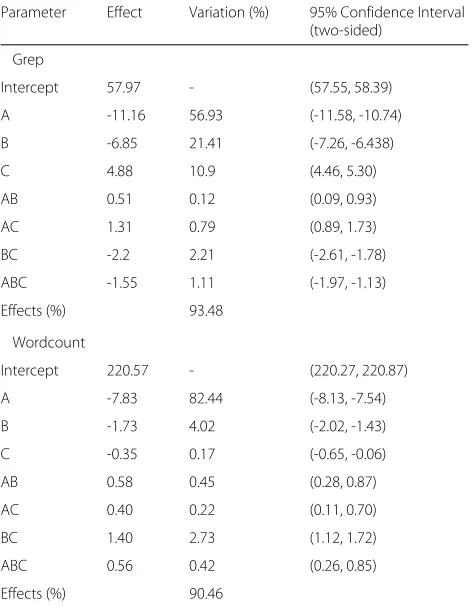
As a first step, we performed a 2kr factorial Project, shown in Table2, wherekcorresponds to three evaluated parameters, and rto the 40 repetitions for each config-uration. For this, we executed scenarios using Grep and Wordcount applications in Python with both interfaces, replications of 1 and 3, and block size of 64 MB and 128 MB.
The result of the factorial project, shown in Table 2, was able to explain approximately 93% of the variation of the execution time for the Grep application; the other 7% may be assigned to experimental errors, like network problems. This analysis shows that the Storage API is the parameter that most impacts the variation of exe-cution time, being responsible for approximately 57% of the variation, where the negative effect means a decreas-ing of the execution time when it is used. Data replica-tion is the second most impacting parameter that assists in decreasing runtime. These results are expected, since both parameters increase data locality. When using the Storage API, we have a greater probability that the data will be directed to right node. The increase in block size, on the other hand, causes an increase in execution time, although not as significant as the previous ones.
4http://www.gutenberg.org
5Available in:https://archive.ics.uci.edu/ml/datasets/HIGGS
Table 2Results of the 2340 factorial design to analyze
configuration aspects of the COMPSs HDFS API
Parameter Effect Variation (%) 95% Confidence Interval
(two-sided)
Grep
Intercept 57.97 - (57.55, 58.39)
A -11.16 56.93 (-11.58, -10.74)
B -6.85 21.41 (-7.26, -6.438)
C 4.88 10.9 (4.46, 5.30)
AB 0.51 0.12 (0.09, 0.93)
AC 1.31 0.79 (0.89, 1.73)
BC -2.2 2.21 (-2.61, -1.78)
ABC -1.55 1.11 (-1.97, -1.13)
Effects (%) 93.48
Wordcount
Intercept 220.57 - (220.27, 220.87)
A -7.83 82.44 (-8.13, -7.54)
B -1.73 4.02 (-2.02, -1.43)
C -0.35 0.17 (-0.65, -0.06)
AB 0.58 0.45 (0.28, 0.87)
AC 0.40 0.22 (0.11, 0.70)
BC 1.40 2.73 (1.12, 1.72)
ABC 0.56 0.42 (0.26, 0.85)
Effects (%) 90.46
From Table2, we can also see the variations caused by the interactions between the parameters, however, since the sum of the interactions represent only about 4% of the variation, we focus only on the individual fac-tors. Since the zero value is not contained in any of the 95% confidence intervals, we can say that all calculated effects, although they come from a sample, are signifi-cant, and they represent well the reality given the observed confidence.
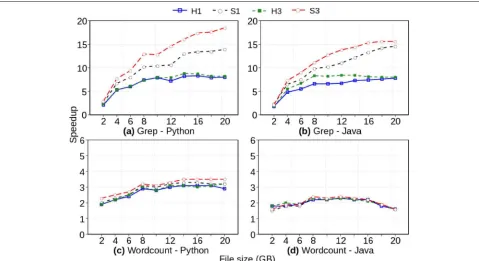
the conventional file system and both HDFS API inter-faces, varying the input load size from 2 to 20 GB, in 2 GB steps and 15 times each. For the executions using HDFS, we also vary the replication factor by 1 and 3 and set the block size to 64 MB. We adopt the following pattern to refer to a COMPSs application: F represents the applica-tion that uses the convenapplica-tional file system; H1 and H3 are versions using the first HDFS interface with replication 1 and 3 respectively; finally, S1 and S3 are versions using the second interface of the API with replication 1 and 3 respectively;
In Fig. 6, we can see that the use of HDFS is prefer-able in all scenarios because the speedup is always greater than one. The speedup is greater for Grep, as expected, because the Wordcount application has several secondary tasks for the sum of the partial counts. There is a sig-nificant difference in runtime between S1 and H1 for simpler applications like Grep, however, the speedups are closer for Wordcount scenarios. For example, using S1 over H1, in Python, increases only 7% in speedup but 1% in Java. For the evaluated workload range, the speedup curves start to stabilize in 14 GB, and at 20 GB, the speedups is approximately 6.9 and 13.9 for the Python Grep application for H1 and S1, respectively. Although the speedup in Wordcount is lower than in Grep, it is still significant. For example, the average Wordcount applica-tion runtime in Python with a convenapplica-tional file system is 577 s, while using H1 or S1 the time is 198 and 184 s, respectively.
There are two reasons for the difference of speedups between Python and Java: the COMPSs architecture and the difference between implementations of Word-count application. PyCOMPSs is a COMPSs binding: all COMPSs orchestration is done in the JVM while task execution is done in Python. For instance, when trans-ferring files through COMPSs in Python, those files are transparently transferred by connectors executed in the JVM, to be later interpreted by Python. This causes a greater overhead compared to an execution in COMPSs native language. In contrast, when using HDFS, the file is transferred directly by HDFS using libhdfs3 (as discussed in Section4), minimizing COMPSs overheads. The sec-ond reason is the different implementation of the merge step reduction of the partial results. While in Python the results are reduced two by two, in Java, the partial results
6A metric that measures the relative performance of two systems processing
the same problem.
performance increase of HDFS is at least 50% faster than the conventional file system.
6.2 HDFS write performance
Besides the read performance, it is still necessary to ana-lyze the behavior of our proposed system during data writes. For this, we execute a micro-benchmark applica-tion for data writing, varying the use of the file system, HDFS replication and output file size. The application in question is a dumps file creator where each task is responsible for creating a file fragment.
In order to create a COMPSs application using the con-ventional file system, where each task produces a file, it is necessary tell COMPSs that this file is an output param-eter. This means that at the end of the execution, the master node must request the files produced by each task. By default, files and tasks are transparently transferred over NIO connectors. Although this connector is recom-mended for its speed, its disadvantage is that at the end of execution, COMPSs request all files at once, and that exhausts the central node memory in cases where the total size of the files is larger than the available memory in the master node. For instance, in our cluster, where the mas-ter node has 8 GB of RAM, when we try to receive 6 GB of output, COMPSs gives an error due to lack of memory. To work around this problem, there are two alternatives: use the GAT connector, that uses ssh to schedule trans-fers, or force the serialization of actions when receiving the files. When using HDFS, we are not susceptible to such problems because, as previously mentioned, COMPSs no longer has the responsibility of transferring files between the nodes: that responsibility is now of HDFS.
Figure7shows the speedup of the solutions using HDFS with a replication factor 1 (H1) and 3 (H3) over the con-ventional system using the GAT connector and using the NIO connector with the serialization of the transfers. For this set of tests, we varied the size of the output file from 6 to 16 GB, running each experiment 15 times. The performance of the interface using the Storage API was not evaluated because the API only impacts data read-ing. Although we only display the results for Python, the results for Java were similar.
Fig. 6Speedup as a function of the workload size for Grep and Wordcount applications, considering Python and Java implementations, when the HDFS API is configured with (S) or without (H) the Storage API, and with no block replication (1) or 3-way replication (3). Speedup is computed compared to the execution times of the same applications executing on a conventional file system.aGrep - Python.bGrep - Java.cWordcount -Python.dWordcount - Java
(serializing file reception). However, the same scenario has a 2x speedup with H3, because internally HDFS was writing 48 GB. In other words, H1 is approximately 3x faster than H3. In that application, it is better to use GAT connector if is necessary to use the conventional file system.
Fig. 7Speedup of file writing using HDFS over the conventional file system, considering no replication (H1) and 3-way replication (H3), against the performance of the traditional file system interfaces using GAT and NIO solutions
The H1 and H3 speedups over the conventional file system version using the GAT connector is 2.7 and 0.9, respectively. Although the speedup of 0.9 means that writ-ing large amounts of data in HDFS with replication factor 3 (H3) is slower than the conventional system using GAT, we believe that the use of the integration API is still preferable for the writing step. The GAT connector has a larger overhead as disadvantage in COMPS executions. For instance, to this same application when creating a 4 GB file, the runtime was on average 142 s using GAT, however, using NIO connector, without serializing the transfer, the average time was 77 s. Considering that a real application will need to read data, processes tasks and write data, the use of GAT will be slower than executing COMPSs with HDFS, which will use the NIO in all other orchestrations steps.
6.3 Network behavior
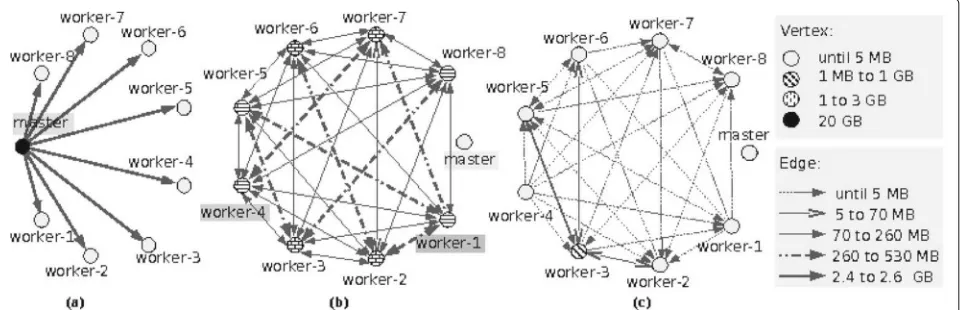
In addition to the performance analysis considering exe-cution times, we also evaluated the network traffic to better understand the performance gains of using HDFS in a COMPSs execution. We ran the Grep application for an input load of 20 GB and captured the traffic using Tcpdump7 in each node of the cluster. We illustrate,
graphs, each vertex pattern represents the volume of data read from that node by other workers, while each edge pattern represents the volume of data transferred between two nodes. In those scenarios, we only consider the traffic related to file access. To select such traffic in executions using the conventional system, we selected connections of the master COMPSs NIO connector (by default, port 43001) that sent the same amount of bytes of a fragment (64 MB). For executions using HDFS, we considered the connections where data was sent by the datanodes (by default, using port 50010).
The topology seen in the common file system case is different from both other graphs. Figure 8a shows that the master is the only node to read data from the file system, transferring it to the workers. Because of that, the master has the darkest pattern and workers have the lightest, while edges represent large upload volumes. In Fig. 8b-c, the master is responsible only for the orches-tration of the tasks, no longer needing to transfer file contents. Because of that, significant data transfers are observed only between workers, but the vertex and edge patterns show that read load is distributed among all nodes, and that there are lower traffic volumes between any two nodes than on scenario (a). Finally, by increasing the locality of the data in scenario (c), data transfers drop drastically. There are still some traffic between nodes, but volumes are much lower, since they are mostly due only
a shared disk, on a conventional file system (case C in the Table3), the input files are transferred from the mas-ter to all requesting workers. In other words, workers do not contribute in the transferring stage (0.0% of worker upload). This means that no fragments were located on the requesting computer, since COMPSs dictates that data be read sent by the main task. On the other hand, when using HDFS, data transfers are distributed over all work-ers (which also act as datanodes). When no locality-aware API was used and file blocks were not replicated (H1), most of the file data is still accessed over the network (89.3%), but each worker has to read only a fraction of that total (11.2%). Theoretically, the chance of a byte being accessed at the node node where it is stored is given by the ratio of favorable cases to total cases. Thus, in this scenario a given byte could be in only one of the eight machines, so it had a theoretical probability of 12.5% of being readin-place. That is close to the measured 10.7%. By increasing the replication factor to 3, there is a higher chance that a read will find a block locally at its own node, and the total traffic decreases (67.9%), as well as the amount of data uploaded by each node (8.6%). On the other hand, when we combine HDFS with the COMPSs storage PI, tasks tend to be assigned to workers located on the same nodes where data reside. Even when there is no replication (S1), only 11.1% of the data is accessed over the network, and on average each datanode has to serve only
Table 3Network traffic of Grep on a cluster with eight workers
Case % worker upload % total traffic % in place
C 0.0 100 0.00
H1 11.2 89.3 10.7
H3 8.6 67.9 32.1
S1 1.4 11.1 88.9
S3 0.16 1.7 98.3
Values are relative to the file size (20 GB). Except for the total traffic, values are the averages over all workers
1.4% of the file data to other nodes. When 3-way replica-tion is considered, 98.3% of the data is read locally (using short-circuit techniques).
By this analysis, the use HDFS (even with the non-conventional use of replication factor 1) is preferable over the conventional file system. Although we only had 10.7% of the bytes executed in the node where they were stored, the transmission of the other data was distributed between all nodes of the cluster, avoiding a bottleneck at the master.
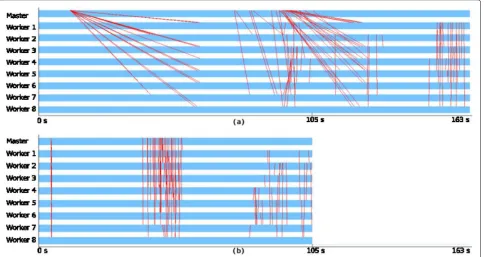
Another way to visualize the difference in performance is by analyzing traces created by COMPSs itself, as those shown in Fig. 9a and b. They represent the mapping of data transfers coordinated directly by COMPSs between
cluster nodes during the execution of the Python versions of Wordcount with the HDFS API (scenario H1) and with a common file system (scenario C), for an 8 GB file. Red lines represent data transfers orchestrated by COMPSs during an execution.
In Fig.9a, when the application uses the traditional file system, the master is responsible for the transfer of all data. We can see that as the set of lines fanning out from the master to all workers, starting soon after the execution starts. By the length of the lines we can see that part of the execution time is due to the wait for the file transfers to complete. All lines starting at the master are data transfers of parts of the input file to the workers. In this example there are more file fragments (64) than worker threads (4 in each worker, so 32 total), the master sends a first set of fragments soon after the application stars. When the tasks associated with those complete and return, the mas-ter goes on to send the 32 remaining fragments. Since the tasks do not complete at the same time, the messages for this second set are spread over a longer period of time (the block of messages around 105 s). Finally, the last set of messages, close to 163 s, are the messages related to the final reduction that adds all the partial counts
In Fig. 9b, the version using the HDFS API, we see only the data transfers orchestrated by COMPSs, since the HDFS access is not controlled directly by the COMPSs
Fig. 9Data transfer traces of COMPSs while running Wordcount.aWordcount on a common file system (C): application ends around 163 s.b
beginning of execution, and the second set, around 50 s). HDFS is the one responsible for delivering the actual data to the multiple compute nodes. The last set of messages represents the reduction step.
6.4 Spark versus COMPSs
As previously mentioned in Section2, a recent work [34] compared COMPSs performance in Java applications to Apache Spark, using a cluster architecture normally asso-ciated with HPC applications. Since our integration allows COMPSs to better interface with a cluster architecture more frequently found in Data Science scenarios, in this study we present a comparison of the two systems under those conditions,
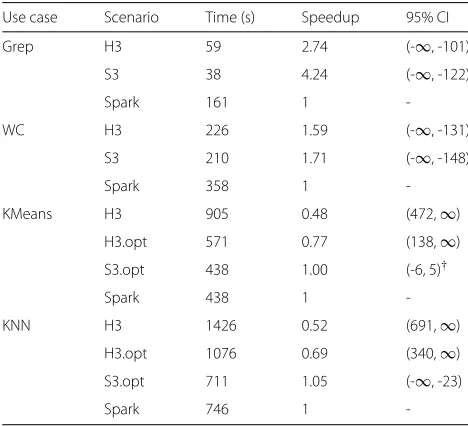
Table 4 presents a performance comparison between COMPSs and Spark using the applications Grep, Word-count, KMeans and KNN. The first two applications were implemented manually in COMPSs and executed in the different configurations mentioned previously (H3 and S3). The KMeans and KNN applications were created by Lemonade and executed in four scenarios, varying the HDFS interface (H3/S3) and the use of the optimiza-tion guidelines discussed in Secoptimiza-tion5.3(identified by the suffix .opt in the table). In our experiments, all Spark applications were implemented manually and used the same HDFS configuration as their COMPSs counterparts; Spark always takes data locality in consideration during
Table 4Performance comparison: COMPSs versus Spark
Use case Scenario Time (s) Speedup 95% CI
Grep H3 59 2.74 (-∞, -101)
S3 38 4.24 (-∞, -122)
Spark 161 1
-WC H3 226 1.59 (-∞, -131)
S3 210 1.71 (-∞, -148)
Spark 358 1
-KMeans H3 905 0.48 (472,∞)
H3.opt 571 0.77 (138,∞)
S3.opt 438 1.00 (-6, 5)†
Spark 438 1
-KNN H3 1426 0.52 (691,∞)
H3.opt 1076 0.69 (340,∞)
S3.opt 711 1.05 (-∞, -23)
Spark 746 1
-†Difference not statistically significant
except for KMeans (S3.opt), which is two-sided because there was no significant difference between those systems. According to the table, we can see that the first two applications had better performance with COMPSs than with Spark, regardless of the API used. The result in that table, with the analysis presented earlier for Fig.6, suggests that HDFS contributes to the increased perfor-mance of COMPSs, making it competitive with the Spark solution. In the Grep application, for example, COMPSs obtained a speedup of 4.24, being at least 122 s faster than Spark.
Spark has well-known mechanisms for code optimiza-tion and data locality since its first versions, while COMPSs has the Storage API to exploit data locality. However, the user is still responsible for tuning the code and, as shown in Table 4, a good implementation can have an impact on COMPSs executions. For instance, a well-implemented, optimized KNN workflow (H3 - opt), is 1.33 faster than a naive implementation (H3). We also showed that Lemonade+COMPSs is able to match the Spark performance in complex scenarios like KMeans or KNN, characterized by several stages of tasks, even with loops. In fact, in the KMeans scenario, when Lemonade generates a better implementation (i.e., with code opti-mization guidelines and using the locality-aware version of the HDFS API), the two-side 95% confidence interval indicates that there was no significant performance differ-ence. In the KNN case, although we obtained a speedup of 1.05, the one-side interval of (-∞, -23) suggests that this COMPSs superiority is significant, although not very large. Those results suggest that COMPSs is a power-ful framework and that the current version of Lemonade, using the initial optimization guidelines and the HDFS API with the locality-aware COMPSs storage API is able to generate good Python implementations in COMPSs with performances comparable to Spark in Big Data scenarios.
7 Conclusion
We have shown that in a typical big data scenario, with a Horizontal scaling architecture, conventional networks and no shared disk solution, the use of HDFS is indis-pensable for better performance. Also, the use of HDFS in COMPSs applications is recommended, not only by the already known HDFS advantages, but also because it pro-vides a data abstraction, the division of data in blocks, that helps to express in COMPSs algorithms from Machine Learning and Data Mining that deal with large volumes of data.
Lemonade has aspects, such as a friendly visual user interface for creating and executing flows using the drag and drop elements, that justify its use. We have shown that Lemonade is able to generate efficient cods in COMPSs that achieve performances comparable to Spark. In addi-tion, beginner or advanced COMPSs programmers can use the algorithms implemented for Lemonade as an external library for their applications, even if they do not want to use Lemonade itself.
Our ongoing work includes experimental tests to eval-uate the HDFS extension with bigger data sets and other real scenarios. We also plan to support more operations and algorithms in Lemonade and to improve our Lemon-ade optimization guidelines. To accomplish that we will examine the possibility to generate more flexible Lemon-ade code to, for example, when possible, re-define the number of fragments in runtime based on the size of the data being produced. We expect that the generated code in that case will be better fitted to what is being processed, optimizing the number of tasks created, which may also be beneficial to COMPSs in general.
Abbreviations
API: Application programming interface; ETL: Extract transform load; HDFS: Hadoop distributed file system; HPC: High-performance computing; KNN: K nearest neighbors; ML: Machine learning
Acknowledgements
Not applicable.
Authors’ contributions
All authors read and approved the final manuscript.
Funding
This work was partially funded by Fapemig, CAPES, CNPq, MCT/CNPq-InWeb, FAPEMIG-PRONEX-MASWeb (APQ-01400-14), and by the collaboration between Brazilian MCT/RNP and the European Union Horizon 2020 research and innovation programme under grants 690116 (EUBra-BIGSEA) and 777154 (EUBra Atmosphere).
Availability of data and materials
As mentioned in the text, the implemented systems are open source, available through GitHub. Readers can contact the corresponding author to request the dataset used in this work.
Competing interests
The authors declare that they have no competing interests.
Author details
1Departamento de Ciência da Computação, Universidade Federal de Minas
Gerais (UFMG), 31270-901 Belo Horizonte, Minas Gerais, Brazil.2Barcelona
Supercomputing Center (BSC-CNS), Barcelona, Spain.3Artificial Intelligence
Research Institute (IIIA), Spanish Council for Scientific Research (CSIC), Barcelona, Spain.
Received: 15 February 2019 Accepted: 5 September 2019
References
1. Kamburugamuve S, et al. Twister2: Design of a big data toolkit. Concurr Comput: Pract Experience. 2019;31(14).https://doi.org/10.1002/cpe.5189. 2. Fox G, et al. Big data, simulations and HPC convergence. In: Big Data
Benchmarking: 6th International Workshop, WBDB 2015, Toronto, ON, Canada, June 16-17, 2015 and 7th International Workshop, WBDB 2015, New Delhi, India, December 14-15, 2015, Revised Selected Papers. Cham, Switzerland: Springer; 2016. p. 3–17. https://doi.org/10.1007/978-3-319-49748-8_1.
3. Tejedor E, et al. PyCOMPSs: Parallel computational workflows in Python. Int High Perform Comput Appl. 2017;31(1):66–82.https://doi.org/10. 1177/1094342015594678.
4. Asch M, et al. Big data and extreme-scale computing: Pathways to convergence-toward a shaping strategy for a future software and data ecosystem for scientific inquiry. Int J High Perform Comput Appl. 2018;32(4):435–79.https://doi.org/10.1177/1094342018778123. 5. Lezzi D, et al. Enabling e-Science applications on the cloud with COMPSs.
In: Parallel Processing Workshops at European Conference on Parallel Processing (Euro-Par 2011). Berlin: Springer; 2011. p. 25–34.https://doi. org/10.1007/978-3-642-29737-3_4.
6. Lordan F, Ejarque J, Sirvent R, Badia RM. Energy-aware programming model for distributed infrastructures. In: 24th Euromicro International Conference on Parallel, Distributed, and Network-Based Processing (PDP 2016). Washington: IEEE Computer Society; 2016. p. 413–7.https://doi. org/10.1109/pdp.2016.39.
7. Zaharia M, et al. Resilient distributed datasets: A fault-tolerant abstraction for in-memory cluster computing. In: Proceedings of the 9th USENIX Symposium on Networked Systems Design and Implementation (NSDI ’12). Berkeley: USENIX Association; 2012. p. 15–28.https://dl.acm.org/ citation.cfm?id=2228301.
8. Santos W, et al. Lemonade: A scalable and efficient Spark-based platform for Data Analytics. In: 17th IEEE/ACM International Symposium on Cluster, Cloud and Grid Computing (CCGRID). Piscataway: IEEE Press; 2017. p. 745–8.https://doi.org/10.1109/CCGRID.2017.142.
9. Marozzo F, et al. Enabling cloud interoperability with COMPSs. In: Parallel Processing Workshops at European Conference on Parallel Processing (Euro-Par 2012). Berlin: Springer; 2012. p. 16–27.https://doi.org/10.1007/ 978-3-642-32820-6_4.
10. Ramon-Cortes C, et al. Transparent orchestration of task-based parallel applications in containers platforms. 2018;16(1):137–60.https://doi.org/ 10.1007/s10723-017-9425-z.
11. Apache Cassandra.http://cassandra.apache.org/. Accessed 4 July 2019. 12. Shepler S, Eisler M, Noveck D. Network file system (NFS) version 4 minor
version 1 protocol. RFC. 2010;5661:1–617.https://doi.org/10.17487/RFC5661. 13. Li H. Alluxio: A virtual distributed file system. EECS Department, University of California, Berkeley, USA. 2018.http://www2.eecs.berkeley.edu/Pubs/ TechRpts/2018/EECS-2018-29.html.
14. Amazon Simple Storage Service (S3).https://aws.amazon.com/s3/. Accessed 4 July 2019.
15. Microsoft Azure Storage.https://azure.microsoft.com/services/storage/. Accessed 4 July 2019.
16. Schwan P. Lustre: Building a file system for 1000-node clusters. In: Proceedings of the Linux Symposium. Ottawa: Linux symposium; 2003. p. 380–6.https://www.kernel.org/doc/ols/2003/ols2003-pages-380-386. pdf.
17. OpenStack Storage (Swift).https://docs.openstack.org/swift/. Accessed 4 July 2019.
18. Weil SA, et al. Ceph: A scalable, high-performance distributed file system. In: Proceedings of the 7th Symposium on Operating Systems Design and Implementation (OSDI ’06). Berkeley: USENIX Association; 2006. p. 307–20.http://dl.acm.org/citation.cfm?id=1298455.1298485.
22. Apache HBase.http://hbase.apache.org/.. Accessed 4 July 2019. 23. Palankar MR, et al. Amazon S3 for science grids: A viable solution? In:
Proceedings of the 2008 International Workshop on Data-aware Distributed Computing (DADC ’08). New York: ACM; 2008. p. 55–64.
https://doi.org/10.1145/1383519.1383526.
24. Wickramasinghe P, et al. Twister2:TSet high-performance iterative dataflow. In: International Conference on High Performance Big Data and Intelligent Systems (HPBD&IS 2019). Piscataway: IEEE Press; 2019. p. 55–60.https://doi.org/10.1109/HPBDIS.2019.8735495. 25. Goodstadt L. Ruffus: a lightweight Python library for computational
pipelines. Bioinformatics. 2010;26(21):2778–9.https://doi.org/10.1093/ bioinformatics/btq524.
26. Gafni E, et al. COSMOS: Python library for massively parallel workflows. Bioinformatics. 2014;30(20):2956–8.https://doi.org/10.1093/ bioinformatics/btu385.
27. Mierswa I, et al. YALE: Rapid prototyping for complex data mining tasks. In: Proceedings of the 12th ACM SIGKDD International Conference on Knowledge Discovery and Data Mining. New York: ACM; 2006. p. 935–40.
https://doi.org/10.1145/1150402.1150531.
28. Demšar J, et al. Orange: Data mining toolbox in Python. J Mach Learn Res. 2013;14(1):2349–53.
29. Berthold MR, et al. KNIME - the konstanz information miner: version 2.0 and beyond. ACM SIGKDD Explor Newsl. 2009;11(1):26–31.https://doi. org/10.1145/1656274.1656280.
30. Dean J, Ghemawat S. Mapreduce: Simplified data processing on large clusters. In: OSDI’04: Sixth Symposium on Operating System Design and Implementation. San Francisco: USENIX Association; 2004. p. 137–50. 31. Kranjc J, et al. ClowdFlows: A cloud based scientific workflow platform. In:
Machine Learning and Knowledge Discovery in Databases: European Conference (ECML PKDD 2012). Berlin: Springer; 2012. p. 816–9.https:// doi.org/10.1007/978-3-642-33486-3_5.
32. Podpeˇcan V, Zemenova M, Lavraˇc N. Orange4WS environment for service-oriented data mining. Comput J. 2012;55(1):82–98.https://doi. org/10.1093/comjnl/bxr077.
33. Microsoft Azure Machine Learning.https://azure.microsoft.com/services/ machine-learning-studio/.. Accessed 4 July 2019.
34. Conejero J, et al. Task-based programming in COMPSs to converge from HPC to big data. Int J Perform Comput Appl. 2018;32(1):45–60.https://doi. org/10.1177/1094342017701278.
35. White T. Hadoop: The Definitive Guide, 4th. Sebastopol: O’Reilly Media, Inc.; 2015.
36. Gonzales SD. PyWebHDFS: a Python wrapper for the Hadoop WebHDFS REST API. 2016.https://pypi.python.org/pypi/pywebhdfs/.. Accessed 4 July 2019.
37. Luckow A. WebHDFS: HDFS Python client based on WebHDFS REST API. 2014.https://pypi.org/project/WebHDFS/.. Accessed 4 July 2019. 38. Kalika M. Python WebHDFS. 2019.https://github.com/mk23/webhdfs..
Accessed 4 July 2019.
39. Rosen J. PySpark Internals. 2016.https://cwiki.apache.org/confluence/ display/SPARK/PySpark+Internals/.. Accessed 4 July 2019.
40. Leo S, Zanetti G. Pydoop: a Python MapReduce and HDFS API for Hadoop. In: Proceedings of the 19th ACM International Symposium on High Performance Distributed Computing. New York: ACM; 2010. p. 819–25.https://doi.org/10.1145/1851476.1851594.
41. Apache Arrow Developers. Pyarrow: Python library for Apache Arrow. 2016.https://pypi.org/project/pyarrow/.. Accessed 4 July 2019. 42. Chang L, et al. HAWQ: A massively parallel processing SQL engine in
Hadoop. In: Proceedings of the 2014 ACM SIGMOD International Conference on Management of Data (SIGMOD ’14). New York: ACM; 2014. p. 1223–34.https://doi.org/10.1145/2588555.2595636.
43. McKinney W. Pandas: a foundational Python library for data analysis and statistics. In: Workshop on Python for High Performance and Scientific Computing Collocated with the 24rd International Conference for High