Enhancing recurrent neural
network‑based language models by word
tokenization
Hatem M. Noaman
1,2*†, Shahenda S. Sarhan
1†and Mohsen. A. A. Rashwan
3†Introduction
Statistical language models estimate the probability for a given sequence of words. Given a sentence s with n words such as s=(w1,w2. . .wn), the language model assigns P(s). Statistical language models assess good word sequence estimations based on the sequence probability estimation. Building robust, fast and accurate language models is one of the main factors in the success of building systems such as machine translation systems and automatic speech recognition systems. Statistical language models can be estimated based on various approaches. Classical language models are estimated based on n-gram word sequences such as P(s)=P(w1,w2. . .wn)=ni=1P(wi|wi−1) and can be approximated based on the Markov concept for shorter contexts (for example, bigram if n = 2 or trigram if n = 3 and so on). Recent researchers have applied neu-ral networks different architectures to build and estimate language models. The classical feed-forward neural network-based language models have been continuously report-ing good results among the traditional n-gram language modelreport-ing techniques [1]. It
Abstract
Different approaches have been used to estimate language models from a given cor-pus. Recently, researchers have used different neural network architectures to estimate the language models from a given corpus using unsupervised learning neural net-works capabilities. Generally, neural netnet-works have demonstrated success compared to conventional n-gram language models. With languages that have a rich morphologi-cal system and a huge number of vocabulary words, the major trade-off with neural network language models is the size of the network. This paper presents a recurrent neural network language model based on the tokenization of words into three parts: the prefix, the stem, and the suffix. The proposed model is tested with the English AMI speech recognition dataset and outperforms the baseline n-gram model, the basic recurrent neural network language models (RNNLM) and the GPU-based recurrent neural network language models (CUED-RNNLM) in perplexity and word error rate. The automatic spelling correction accuracy was enhanced by approximately 3.5% for Arabic language misspelling mistakes dataset.
Keywords: Recurrent neural networks, Statistical language modeling, Automatic speech recognition
Open Access
© The Author(s) 2018. This article is distributed under the terms of the Creative Commons Attribution 4.0 International License (http://creativecommons.org/licenses/by/4.0/), which permits unrestricted use, distribution, and reproduction in any medium, provided you give appropriate credit to the original author(s) and the source, provide a link to the Creative Commons license, and indicate if changes were made.
RESEARCH
*Correspondence: [email protected] †Hatem M. Noaman, Shahenda S. Sarhan and Mohsen. A. A. Rashwan contributed equally to this work
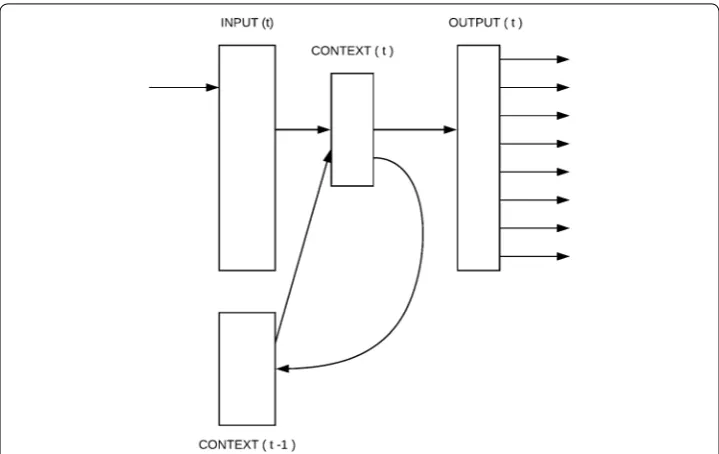
computes the probability of a word given its context. Inputs into the network are the previous n-words according to the language models order. A word feature vector is projected using the word index in the projection layer. The hidden layer output is com-puted using Tanh function [2]. The final network output is computed using the Softmax activation function [3] to ensure that network output is a valid probability between 0 and 1. Network weights are updated using the back-propagation training algorithm [4]. Neural network-based language models offer several advantages. Smoothing is applied implicitly, while in n-gram language models, smoothing must be handled explicitly for an unseen n-gram. Semantically, similar words are clustered due to the projection of the entire vocabulary into a small hidden layer [5]. Recurrent neural network-based lan-guage models [6] are the other proposed models. In them, the feedback between hidden and input layer allows the hidden neurons to remember the history of the previously processed words, as shown in Fig. 1. The results that are reported using recurrent neural network-based language models are always better than those of basic neural network models and other traditional model results. The results reported by this work show that recurrent neural network-based language models results outperform traditional models results for two different tasks: English automatic speech recognition and Arabic auto-matic spelling error correction. The neural network input vector is presented using a binary representation where the current word is set to one in the vector according to its index in the vocabulary, and the other vector values are set to zero. The main problem with this model is the size of both the input and output layer where it needs to be at least as large as the number of words in the language vocabulary. The vocabulary size varies from languages such as English that have simple morphological systems to languages that have richer morphological systems such as the Arabic language [7] (where every
single root can be converted to several other valid forms using morphological deriva-tion rules). Rich morphological system makes this architecture inefficient if it is used in rich morphological language applications since it needs high computational costs to train and use these models within real-time applications, such as speech recognition and automatic machine translation.
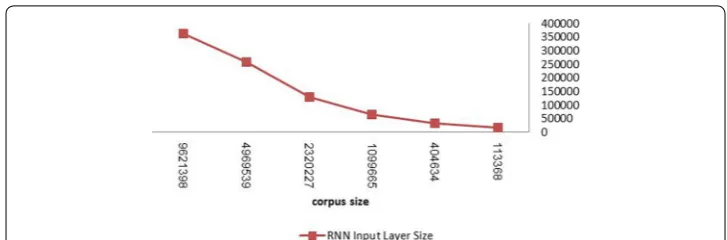
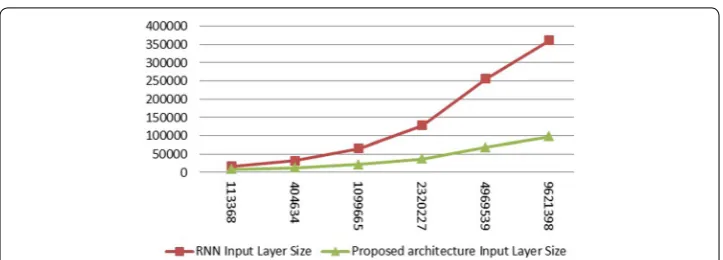
In this work, we try to build recurrent neural network-based language models that can handle the network training speed problem with languages that have rich morphologi-cal systems based on word tokenization. The proposed model input layer size is shown in Fig. 2 for the different training sets extracted from an open source Arabic language corpus [8]. As shown in the figure, the network size remarkably increases as the number of words in the training corpus increases. In real applications, to build a robust language model, a large corpus with several millions of words is needed. Networks with a very large number of neurons have two main problems. The first one is that training time is very long to achieve network learning convergence. It is reported that the network learn-ing process takes several weeks with a corpus size of approximately 6.4 M words [6].
The second problem is the memory size. Recurrent neural networks-based language models with large numbers of neurons are expected to need larger memory sizes than that of other traditional language models. Researchers tried to find solutions to these problems through merging all words that occur less than a given threshold into a special rare token or by adding classes of neurons in the output layer and factorizing the output layer into classes [9]. The main contribution of this work is building a recurrent neural network language modeling model that outperforms the basic RNNLM [6]. It is faster and consumes less memory than the RNNLM and its enhanced versions (the factored
recurrent neural network language model (fRNNLM) [10] and the CUED-RNNLM
[11]). It also adds word features implicitly with no need to add a different vector for each word, as proposed by the related work in the fRNNLM [10] or the FNLM [12]. These features make the proposed model suitable for highly inflected languages and in build-ing models with dynamic vocabulary expansion. It also decreases the number of vocabu-lary words since unseen words can be inferred from other seen words if the words have the same stem. This paper is organized as follows. “Related work” section includes an
overview of the related works. In “Proposed model” section , the researchers discuss the word tokenization process for English and Arabic then the proposed model is presented. The experimental results are discussed in “Experiments and results” section . Finally, the conclusion is presented in “Conclusion” section .
Related work
Neural networks different architectures have been investigated and applied to language model estimations by many researchers. Feed forward neural networks [1] have been adapted in language modeling estimation [1]; feed forward neural network language models simultaneously learn the probability functions for word sequences and build the distributed representation for individual words, but this model has a drawback in that a fixed number of words can be considered as a context window for the current or target word. To enhance the conventional feed forward neural network language models train-ing time, researchers proposed continuous space language modeltrain-ing (CSLM), which is a modular open-source toolkit of feed forward neural network language models [13]; this model introduces support for GPU cards that enable neural networks to build models with corpora that contain more than five billion words in less than 24 hours with about a 20% perplexity reduction [13]. Recurrent neural networks have been applied to estimate language models. However, with this model, there is no need to specify the context win-dow size by using feedback from the hidden to the input layer as a kind of network mem-ory for the word context. Experiment results have proved that recurrent neural networks in language models outperform n-gram language models [5, 6, 9, 14, 15]. An RNNLM toolkit was designed to estimate the class-based language model using recurrent neu-ral networks [5, 6]. It can also provide functions such as an internist model evaluation using perplexity, N-best rescoring and model-based text generation. The training speed is the main RNNLM drawback, especially with large vocabulary sizes and large hidden layers. The RWTHLM [16] is another recurrent neural network-based toolkit with long short-term memory (LSTM) implementation, and the RWTHLM toolkits BLAS library was used to support reduced training time and efficient network training. The
CUED-RNNLM [11] provides an implementation for the recurrent neural network-based
feature-based where RNNLM parameters are static throw users. Recently neural-based language modeling models added as an extension to Kaldi automatic speech recogni-tion (Kaldi-RNNLM) [18] software, this architecture combines the use of subword fea-tures and one-hot encoding of words with high frequency to handle large vocabularies containing infrequent words. Also Kaldi-RNNLM architecture improves cross-entropy objective function to train unnormalized probabilities. In addition to feed forward net-work and the recurrent neural netnet-work-based language models architectures convolu-tion neural network (CNN) [19] was applied to estimate language models with inputs to the network in the form of character and output predictions is at the word-level.
Proposed model
The proposed model is a modified version of the basic recurrent neural network language model [6]. Instead of presenting the full word to the network input layer, we split the word into three parts: the prefix, the stem and the suffix. Both the prefix and the suffix may or may not exist. “Word tokenization” section presents a full description about word tokeni-zation and how we implement it with English and Arabic text using modified versions of two free open source stemmers in “English word tokenization” and “Arabic word tokeni-zation” sections. Next, the proposed models architecture is discussed in “The proposed model” section with full details about the model’s components, inputs and outputs.
Word tokenization
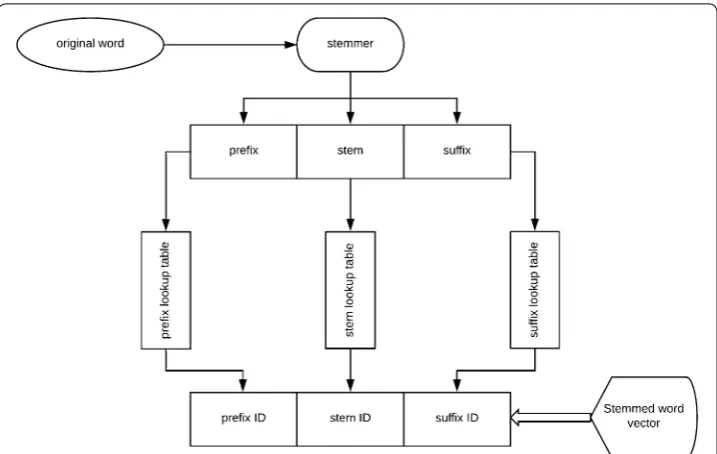
The first step to build the word vector is using a stemmer. Generally, in this step, the input to the stemmer is a complete surface word, and the output is the stemmed word vector consisting of a prefix ID, a stem ID and a suffix ID. The general framework of this process is shown in Fig. 3. As illustrated in the figure, the stemmer has 3 lookup tables. The first one is for the prefixes to get the prefix ID using this table. The second one is for the stems. The last one has the suffix IDs. After splitting the word into its compos-ing parts, the stemmer assigns each part a unique ID. If a word does not have a prefix or a suffix, it has the value − 1 to indicate that this part is not present for the given word. “English word tokenization” section gives a detailed description for the English stem-ming process. “Arabic word tokenization” section shows that the Arabic language has a more different and richer morphological system than English to prove that this proposed model can effectively handle languages with highly inflected systems.
English word tokenization
stemmer output always provides the word in the form of (prefix + stem + suffix). At the end, every part has a unique ID so that it can be used in the neural networks internal representation.
Arabic word tokenization
The Arabic morphological system applies different generation rules on a given root to generate a list of words from the same root. Many approaches have been applied to solve tokenization problem in Arabic. This paper investigates applying the Khoja stem-mer [20] to handle the Arabic word tokenization problem. Khoja stemmer is a java open source tool that finds the roots for Arabic words. To find the root for any given Arabic word, first, the Khoja stemmer attempts to remove definite articles, prefixes, and suf-fixes. It then tries to find the word root using a set of Arabic morphological patterns. If the found root is not applicable, it returns the word as is. We have tried to modify the
Fig. 3 Word tokenization process flowchart. The proposed approach uses stemmer to split the word into 3 parts word prefix, word stem and word suffix, the input to the stemmer is a complete surface word, and the output is the stemmed word vector consisting of a prefix ID, a stem ID and a suffix ID. After splitting the word into its composing parts, the stemmer assigns each part a unique ID. If a word does not have a prefix or a suffix, it has the value − 1 to indicate that this part is not present for the given word.
Table 1 English stemmer original input and output after converting it into prefix, stem and suffix form
Input word Prefix Stem Suffix
Years – Year s
Government – Govern ment
Unless Un Less –
stemmers functionality to fit our needs. The original stemmer produces only one out-put for any word, the word root. To find the word root, Khoja’s algorithm removes any prefix or suffix that is not considered as a part of a word root and compares the rest of the word to the Arabic morphological patterns. If it fits with any given pattern, the word root is then extracted using this pattern. The work in this paper modifies the original Khoja stemmer to generate 3 parts [the words prefix, suffix (if any), and the word stem] by keeping any removed characters from the word if the word roots extracted word is divided into the prefix, stem and suffix. The original Khoja stemmer includes a list of 168 stop words that are removed while preprocessing Arabic words since these words cannot be rooted. In the modified version, the stop words are not removed. Additionally, the word may be normalized by the Khoja stemmer to find its root. In the modified ver-sion, the word stem is not normalized since we try to tokenize the word into parts and not find the valid root for this word. Figure 3 depicts the Arabic word tokenization pro-cess using the modified Khoga stemmer tool. The input is an Arabic word, and the final output is a stemmed word vector that consists of three parts (a prefix ID, a stem ID and a suffix ID). To construct such a vector, the stemmer tries to get an input word root by removing any possible prefixes or suffixes attached to the original root. Finally, the stem-mer tries to extract the root based on different morphological patterns. If the input word cannot be rooted (or there is no prefix or suffix attached to the stem), the prefix ID and suffix ID values are set to − 1, which indicates that there is no prefix or suffix attached to the stem. The stemmer output may be the same as the input word in another case when the input word cannot be stemmed for some words such as stop words and non-Arabic words (i.e., words from other languages that are written in the Arabic alphabet without having an Arabic root). The proposed stemming algorithm can be used to tokenize a single word or to tokenize a complete paragraph. Table 2 shows the modified stemmer input, its corresponding Buckwalter transliteration [21], the English translation and its final output for a selected paragraph from a policy section in the open corpus [8]. As shown, the prefixes and suffixes don’t appear in all words and the stemmer. The stemmer output is the word divided into the prefix that is followed by the (+) Markup, then the stem followed by the (+) Markup, and finally the word suffix.
The proposed model
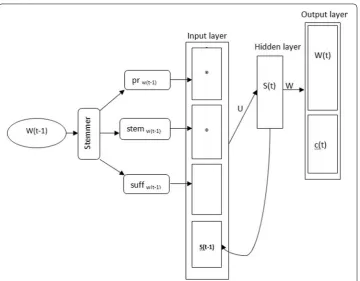
The proposed network architecture (as shown in Fig. 4) splits the input layer into three parts: the word prefix part, the word stem part and the word suffix part. Each part cor-responds to the word input part where each part of the word is presented to the network using a 1-of-n encoding. The input layer size equals the sum of the hidden layer size, Table 2 Arabic stemmer original input and output after scanning words and convert it into prefix + stem + suffix form
Input text
prefix, stem and suffix counts. The training input vector x(t) is formed by concatenat-ing vector w that is representconcatenat-ing the current word and the output from the neurons in context layer s at time t − 1. The current word is split into three parts. The word vector w is concatenated as expressed in Eq. 1. The prefix, the stem and the suffix vectors are encoded with a 1-of-n coding by setting the ith element to 1 and any other values to 0.
After representing the concatenated word vector to the input neurons, the previous time steps hidden layer is copied to its corresponding history neurons in the input layer, Eq. 2. The hidden and output layers are then computed as shown in Eqs. 3 and 4:
(1)
w(t)=pr(t)+stem(t)+suf(t)
(2)
x(t)=w(t)+s(t−1)
(3)
sj(t)=f
i
xi(t)uij
(4)
yk(t)=g
�
j
sj(t)vkj
where f is the sigmoid function [22] and g are Softmax functions [3]. It is computed as follows:
where u is the weight matrix between the input and hidden layer, and v is the weight matrix between the hidden and output layers.
Experiments and results
The proposed model is compared with other language modeling approaches based on three different evaluation approaches. The first one is the model computation com-plexity presented in “Model complexity” section. The second one in “Models perplex-ity results” section is the proposed model perplexity enhancement and word error rate. The results are shown for English automatic speech recognition using the AMI meeting corpus and the model perplexity enhancement plus the entropy reduction result for the Online Open Source Arabic language corpuss experimental results. Finally, in “Arabic automatic spelling correction application” section, the Arabic automatic spelling error correction results are presented using the Qatar Arabic Language Bank (QALP) corpus.
Model complexity
The proposed system shows a very efficient memory and processing performance. To prove this, we have compared the neural network input layer size (i.e.: the number of neurons in the input layer) in the proposed architecture with the basic RNN architec-ture. The results are shown in Fig. 5. It is clear that the number of neurons in the input layer generated by the proposed architecture is always smaller than that in the basic RNN, even with a very limited number of corpus words. This outcome confirms that the tokenization of Arabic words before presenting it to the neural network decreases the (5)
f(z)= 1
1+e−z
(6)
g(zm)= ezm
kezk
memory use and computation time. The values presented in Fig. 5 show that the input layer size is decreased from 360K to only 98K neurons.
Complexity of the RNNLM and factored RNNLM models are (|V| +H)∗H+H∗(C+ |V|) and (|f1| +...+ |fK| +H)∗H+H∗(C+ |V|) , respectively. While proposed model complexity is (|pr| + |stem| + |suff| +H)∗H+H∗(C+ |V|), where V, H, C fi are the vocabulary count, the hidden layer size, the classes count and the ith feature vector respectively. The researchers observe that the sum of the prefix number and the stems count and the suf-fixes count (|pr| + |stem| + |suff|) will be much less than vocabulary words count (|V|) especially for highly inflected language and language with rich morphological system. Also proposed model does not need extra GPU processing capabilities as needed with CUED-RNNLM system.
Models perplexity results
English AMI meeting corpus experiments
Our first experiment evaluates the proposed model against the n-gram, he RNNLM and the CUED-RNNLM using the English AMI meeting corpus [23]; the corpus consists of 100 annotated hours of meeting records. This dataset has various numbers of features that make it good to be used as a benchmarking dataset for language model evaluation. It is a free of charge dataset that can be used for training and testing. Other good fea-tures of this dataset are its annotations that present time and how the annotations are related to the transcription and to each other. This paper divided the English AMI meet-ing corpus [23] into a training set that consists of 78 h, and the remaining part is used as the development and test sets. Table 3 presents the performances of different lan-guage modeling techniques using the AMI meeting corpus. To build an n-gram model, we have used the popular SRILM toolkit [24]; the CRNN and FRNN with the AMI data-set are reported to outperform the basic 3-gram model models that were built using the RNNLM, and the toolkit was used to build the RNNLM [6] and CUED-RNNLM [11]. The proposed language model results are measured by their perplexity and word error rate (WER), as shown in Table 4.
The results show that the proposed token-based recurrent neural network language model has outperformed the n-gram LM by approximately 3% and enhances the basic RNNLM and its GPU version CUED-RNNLM by approximately 1.5% when using the Table 3 English AMI meeting corpus perplexity and WER results using RNNLM and CUED-RNNLM against our proposed model
PPL WER
Dev Eval Dev Eval
3g [25] 93.6 82.8 25.2 25.4
+CRNN (CE) [25] 83.3 75.2 23.9 24.1
+FRNN(CE) [25] 81.0 71.7 23.9 24.0
+FRNN(VR) [25] 80.4 71.6 23.9 23.9
+FRNN(NCE) [25] 81.1 72.8 24.0 24.1
English AMI meeting corpus dataset. While the proposed approach is relatively close to the CUED-RNNLMs reported results with the same dataset, the proposed systems training and decoding times are much improved compared to those of the RNNLM and CUED-RNNLM. Moreover, memory consumption is much lower with our proposed model, which make it much more applicable to be used for rescoring tasks rather than for the models generated by the RNNLM (that have no GPU support and have high memory needs) and the CUED-RNNLM (that relies on the GPU architecture and needs more computational resources).
Online Open Source Arabic language corpus experiments
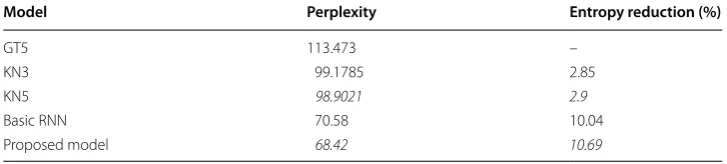
To evaluate the proposed model, we have chosen the Online Open Source Arabic Lan-guage corpus, which is available online. It has an ample amount of words to test and evaluate our proposed model. In this work, the Arabic Open corpus is used as the source of the training, validation and test data. Approximately 1.9 M words are used as training data, and 70K words are used as the test set. To train the models using this dataset, the vocabulary of the 10K most common Arabic words is constructed in the online open source Arabic language corpus. All words outside this vocabulary are counted as out-of-vocabulary (OOV) words and are treated as unknown words (UNK-token). Table 4 shows the results of various language models. To build the N-gram models, the SRILM toolkit [24] and the RNNLM tool [6] are used to build the basic RNN language models. The results have shown that the modified Kneser-Ney smoothing with order 5 (KN5) performs the best among traditional n-gram models. Thus, it was used as the benchmark for our test set. As shown in Table 4, our proposed models perplexity outperforms the baseline n-gram model by up to 30% with about a 2% enhancement compared to basic RNN models.
Arabic automatic spelling correction application
The automatic spelling correction problem involves two main parts. The first part detects the spelling mistake in the written text. The second corrects the spelling errors [26, 27]. Spelling errors can be identified by using a lexicon of Arabic words. If any given word in the text is outside the lexicon, it is considered as a spelling error. We have built an Arabic automatic spelling correction hybrid system based on the confusion matrix and the noisy channel spelling correction model to detect and automatically correct Arabic spelling errors. It searches for the correct word that can generate this misspelled word (typo) using Eq. (7) [20].
Table 4 Perplexity on 70K word as test from Arabic Open Corpus using different smooth-ing techniques against proposed algorithm
Italic values represent proposed model perplexity and entropy reduction against different smoothing techniques
Model Perplexity Entropy reduction (%)
GT5 113.473 –
KN3 99.1785 2.85
KN5 98.9021 2.9
Basic RNN 70.58 10.04
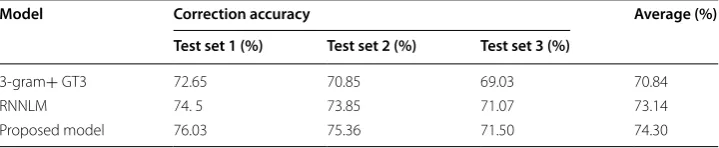
where P(typoword) is computed based on a confusion matrix and P(word) using the language model probability of a given word. In this paper, the proposed algorithm was compared with traditional n-gram language models. The proposed algorithm was used to estimate the probability of a given correction candidate for typos. Table 5 shows the overall correction accuracy using the 3-gram language model with Good–Turing smoothing and the proposed algorithm. The results show that the correction accuracy was enhanced by nearly 3.5% using the 4-gram token-based language model where the test set consists of 1500 test cases extracted from the Qatar Arabic Language Bank (QALP) corpus [28]. It was divided into 3 test sets where each one consists of 500 test cases.
Conclusion
In this paper, we have introduced a modified recurrent neural network-based language model for language modeling. The modification was to segment the network input into three parts. It is observed that the computational complexity is much lower than that in the basic recurrent neural network model. This outcome makes it possible to build language models for highly inflective languages (such as Arabic) from large corpora with smaller training times and memory costs. Using the intrinsic evaluation (perplexity), it is observed that our proposed model outperforms the baseline n-gram model by up to 30% based on the Arabic Open Corpus experimental results shown in Table 4. The results obtained from applying the proposed model to the Arabic automatic spelling correc-tion problem show about a 3.5% total accuracy enhancement. This finding indicates that more complex and advanced Arabic language applications (such as speech recognition and automatic machine translation) can make use of the model described in this paper. Authors’ contributions
HN is the corresponding author, and SS and MR are the co-authors. HN has made substantial contributions in the design and implementation of proposed algorithm. SH was involved in drafting the manuscript or critically revising it. All authors read and approved the final manuscript.
Author details
1 Computer Science Department, Mansoura University, Mansoura, Egypt. 2 Computer Science Department, Beni-Suef University, Beni-Suef, Egypt. 3 Electronics and Communications Department, Cairo University, Cairo, Egypt.
Competing interests
The authors declare that they have no competing interests.
Ethics approval and consent to participate
We confirm that this manuscript has not been published elsewhere and is not under consideration by another journal. All authors have approved the manuscript and agree with its submission.
Funding Not applicable.
(7) ˙
w=argmaxword =P(word|typo)=argmaxwordP(typo|word)∗P(word) Table 5 Automatic Arabic spelling correction application
Model Correction accuracy Average (%) Test set 1 (%) Test set 2 (%) Test set 3 (%)
3-gram+ GT3 72.65 70.85 69.03 70.84
RNNLM 74. 5 73.85 71.07 73.14
Publisher’s Note
Springer Nature remains neutral with regard to jurisdictional claims in published maps and institutional affiliations.
Received: 26 January 2018 Accepted: 9 April 2018
References
1. Bengio Y, Ducharme R, Vincent P, Jauvin C (2003) A neural probabilistic language model. J Mach Learn Res 3:1137–1155
2. Abramowitz M, Stegun IA (1964) Handbook of mathematical functions: with formulas. Graphs Math Tables 55:83 3. Sutton RS, Barto AG (1998) Reinforcement learning: an introduction. MIT Press Cambridge, Cambridge, p 30 4. Rumelhart DE, Hinton GE, Williams RJ (1986) Learning representations by back-propagating errors. Nature
323(6088):533
5. Kombrink S, Mikolov T, Karafiát M, Burget L (2011) Recurrent neural network based language modeling in meeting recognition. In: Twelfth annual conference of the international speech communication association
6. Mikolov T, Karafiát M, Burget L, Černockỳ J, Khudanpur S (2010) Recurrent neural network based language model. In: Eleventh annual conference of the international speech communication association
7. Bousmaha KZ, Rahmouni MK, Kouninef B, Hadrich LB (2016) A hybrid approach for the morpho-lexical disambigua-tion of arabic. J Inf Proces Syst 12(3):358–380
8. Saad MK, Ashour W (2010) Osac: open source arabic corpora. In: 6th ArchEng international symposiums, EEECS, vol. 10
9. Mikolov T, Kopecky J, Burget L, Glembek O et al (2009) Neural network based language models for highly inflective languages. In: IEEE international conference on acoustics, speech and signal processing. ICASSP 2009, pp 4725–4728 10. Wu Y, Yamamoto H, Lu X, Matsuda S, Hori, C, Kashioka H (2012) Factored recurrent neural network language model
in ted lecture transcription. In: International workshop on spoken language translation (IWSLT)
11. Chen X, Liu X, Qian Y, Gales M, Woodland PC (2016) Cued-rnnlman open-source toolkit for efficient training and evaluation of recurrent neural network language models. In: 2016 IEEE international conference on acoustics, speech and signal processing (ICASSP), pp 6000–6004
12. Alexandrescu A, Kirchhoff K (2006) Factored neural language models. In: Proceedings of the human language tech-nology conference of the NAACL, companion volume: short papers. Association for computational linguistics, pp 1–4 13. Schwenk H (2013) Cslm-a modular open-source continuous space language modeling toolkit. In: INTERSPEECH, pp
1198–1202
14. Devlin J, Zbib R, Huang Z, Lamar T, Schwartz R, Makhoul J (2014) Fast and robust neural network joint models for statistical machine translation. In: Proceedings of the 52nd annual meeting of the association for computational linguistics (Vol. 1: long papers), vol. 1, pp 1370–1380
15. De Mulder W, Bethard S, Moens M-F (2015) A survey on the application of recurrent neural networks to statistical language modeling. Comput Speech Lang 30(1):61–98
16. Sundermeyer M, Schlüter R, Ney H (2014) rwthlmthe RWTH Aachen University neural network language modeling toolkit. In: Fifteenth annual conference of the international speech communication association
17. Tseng B-H, Wen T-H (2017) Personalizing recurrent-neural-network-based language model by social network. IEEE/ ACM Trans Audio Speech Lang Proces (TASLP) 25(3):519–530
18. Xu H, Li K, Wang Y, Wang J, Kang S, Chen X, Povey D, Khudanpur S (2018) Neural network language modeling with letter-based features and importance sampling. In: 2018 IEEE international conference on acoustics, speech and signal processing (ICASSP)
19. Kim Y, Jernite Y, Sontag D, Rush AM (2016) Character-aware neural language models. In: AAAI, pp 2741–2749 20. Kernighan MD, Church KW, Gale WA (1990) A spelling correction program based on a noisy channel model. In:
Proceedings of the 13th conference on computational linguistics. Association for computational linguistics, vol. 2, pp 205–210
21. Buckwalter T (2004) Buckwalter arabic morphological analyzer version 2.0. linguistic data consortium, University of Pennsylvania, 2002. ldc cat alog no.: Ldc2004l02. Technical report, ISBN 1-58563-324-0
22. Han J, Moraga C (1995) The influence of the sigmoid function parameters on the speed of backpropagation learn-ing. In: International workshop on artificial neural networks. Springer, Berlin, pp 195–201
23. Carletta J, Ashby S, Bourban S, Flynn M, Guillemot M, Hain T, Kadlec J, Karaiskos V, Kraaij W, Kronenthal M et al (2005) The ami meeting corpus: a pre-announcement. In: International workshop on machine learning for multimodal interaction. Springer, Berlin, pp 28–39
24. Alumäe T, Kurimo M (2010) Efficient estimation of maximum entropy language models with n-gram features: An srilm extension. In: Eleventh annual conference of the international speech communication association 25. Chen X (2015) Cued rnnlm toolkit
26. Noaman HM, Sarhan SS, Rashwan M (2016) Automatic arabic spelling errors detection and correction based on confusion matrix-noisy channel hybrid system. Egypt Comput Sci J 40(2):2016
27. Attia M, Al-Badrashiny M, Diab M (2014) Gwu-hasp: hybrid arabic spelling and punctuation corrector. In: Proceed-ings of the EMNLP 2014 workshop on Arabic natural language processing (ANLP), pp 148–154