JSARD
Journal of
School
Administration
Research and
Development
ISSN: 2470-850X
The Journal of School Administration Research and Development
J
SARD
Editorial Board Members
Editor-in-Chief, James Mullooly, California State University, Fresno
Managing Editor, Joshua Kunnath, Principal Research Center, Inc.
Senior Editor, Brandon Palmer, Principal Research Center, Inc.
Senior Editor, M. Anne Visser, University of California, Davis
Associate Editor, Mariane Doyle, William S. Hart Union High School District, Santa
Clarita, CA
Peer-reviewers
Sanoya Amienyi, Ed.D., Arkansas State University
Karen Bridges, California State University, Sacramento
Jessica Hannigan, Ed.D., California State University, Fresno
Jason Hodgson, Ed.D., Panama-Buena Vista Union School District, Bakersfield, CA
Kara Lasater, Ed.D., University of Arkansas
Randy Schultz, Ed.D., California State University, Bakersfield
Matt Townsley, Ed.D., University of Northern Iowa
Christian Wandeler, Ph.D., California State University, Fresno
Doug Wieczorek, Ed.D., Iowa State University
Copy Editor
The Journal of School Administration Research and Development
J
SARD
Table of Contents
Editor’s Note
Joshua Kunnath, Principal Research Center, Inc. 5
Feature Articles
Exploratory Analysis of Teacher Artifacts as Evidence of Educator Effectiveness 6 Implementation Fidelity
Pete Goldschmidt, California State University Northridge Alia Congdon, no affiliation
A Survey of School Administrators’ Training and Support Related to Evaluating 19 Special Education Teachers
Janelle E. Rodl, San Francisco State University Wes Bonifay, University of Missouri
Rebecca A. Cruz, University of California, Berkeley Sarah Manchanda, University of California, Berkeley
Teacher Absences in the Commonwealth of Virginia: An Analysis of Patterns and 32 Predictors and Implications for Policy
Donna L. Eagle, Henrico County Public Schools William J. Glenn, Virginia Tech University
A Longitudinal Case Study of a School-University Partnership for Training Teachers 42
Susan M. Tracz, California State University, Fresno Paul Beare, California State University, Fresno
Colleen Torgerson, California State University, Fresno
Understanding the Stages of Concerns: Implementation of the Common Core State 57 Standards in Louisiana Schools
The Journal of School Administration Research and Development
J
SARD
Table of Contents
Best Practices
A Model for Selecting Exemplary Mathematics and Science Teacher Leaders 67
Susan D. Nickerson, San Diego State University Meredith Vaughn, San Diego State University Lisa Lamb, San Diego State University Donna Ross, San Diego State University Randolph Philipp, San Diego State University Raymond LaRochelle, University of Delaware Kathy S. Williams, San Diego State University
Making Preparation Practical: Reducing Aspiring Administrator Time to 74 Competence Through Five Types of Leaderly Thinking
James Marshall, San Diego State University Douglas Fisher, San Diego State University
Book Review
Book Review: Ability, Equity, and Culture Sustaining Inclusive Urban Education 81 Reform
Soraya Fallah, California State University, Northridge Cklara Moradian, California State University, Northridge
W
elcome to the Summer 2018 issue of the Journal of School Administration Research and Development (JSARD), our third volume. JSARD is an open-access, peer-reviewed journal that supports the development and dissemina-tion of research and scholarship in the area of K-12 school administradissemina-tion and leadership. Our mission is to pub-lish and disseminate relevant, high-quality literature in educational leadership in order to empower researchers, practitioners, and policy makers to improve K-12 schools. JSARD publications are possible due to the hard work of our editorial board, peer reviewers, copy editors, and authors.In this new issue, we are pleased to present eight articles: five original research articles, two best practice articles, and a book review. These works delve into the topics of educator effectiveness systems, the evaluation of special education teachers, teacher absences, teacher preparation, Common Core State Standards implementa-tion, teacher leader selecimplementa-tion, administrator preparaimplementa-tion, and urban education reform. Our issue begins with the work of Pete Goldschmidt and Alia Congdon in their study of the efficacy of a statewide educator effectiveness system in “Exploratory Analysis of Teacher Artifacts as Evidence of Educator Effectiveness Implementation Fi-delity.” Next, authors Janelle Rodl, Wes Bonifay, Rebecca Cruz, and Sarah Manchanda, in “A Survey of School Administrators’ Training and Support Related to Evaluating Special Education Teacher,” studied California ad-ministrators’ training, confidence, and needs in performing special education teacher evaluation. The issue con-tinues with the work of Donna Eagle and William Glenn in their article “Teacher Absences in the Common-wealth of Virginia: An Analysis of Patterns and Predictors and Implications for Policy,” in which the authors studied the relationship of school and policy variables to teacher absences in order to inform policy that mini-mizes those absences. Following this, Susan Tracz, Paul Beare, and Colleen Torgerson present a longitudinal case study on a teacher preparation program in a school-university partnership. In “Understanding the Stages of Concerns: Implementation of the Common Core State Standards in Louisiana Schools,” the final research arti-cle of the issue, Michelle Abadie and Krishna Bista present their mixed-methods study of the implementation of the Common Core State Standards in public and private schools in a single Louisiana school district.
The first of two best practice articles is Susan Nickerson, Meredith Vaughn, Lisa Lamb, Donna Ross, Ran-dolph Philipp, Raymond LaRochelle, and Kathy Williams’ work that presents a model for selecting teaching leaders in the subjects of math and science in “A Model for Selecting Exemplary Mathematics and Science Teacher Leaders.” This is followed by “Making Preparation Practical: Reducing Aspiring Administrator Time to Competence through Five Types of Leaderly Thinking," in which James Marshall and Douglas Fisher describe a partnership between San Diego State University and several neighboring school districts designed to better pre-pare administrators for leadership roles in credential courses through the emphasis of the realities of school leadership. The final work of the issue is Soraya Fallah, Cklara Moradian, and Wendy Murawski’s review of the text Ability, Equity, and Culture: Sustaining Inclusive Urban Education Reform. The reviewers provide an overview of the text, an analysis, and suggestions for its application to the work of school leaders.
We thank you for your interest in JSARD’s publication, and we hope that you enjoy this issue. Moreover, we invite you to join the ongoing quest of JSARD and the Principal Research Center in working towards K-12 school improvement through the study of school administration and leadership.
Sincerely, Joshua Kunnath
JSARD Managing Editor
Editor’s Note:
Exploratory Analysis of Teacher Artifacts
as Evidence of Educator Effectiveness
Implementation Fidelity
man, & Rockoff, 2014a, b; Kane, McCaffrey, Miller, & Staiger, 2013; Nye, Konstantopoulos, & Hedges, 2004; Rivkin, Hanushek, & Kain, 2005). Historically formal teacher ratings found virtually all teachers equally effective (Weisberg, Sexton, Mulhern, & Keeling, 2009), and results from the Measures of Effective Teaching (MET) indicate variation in teaching effec-tiveness can be meaningfully measured (Kane et al., 2013). States and districts, incentivized by Race to the Top funding and flexibility from No Child Left Behind (NLCB, 2001), embarked on policies emphasizing edu-cator effectiveness systems (EESs) that included both summative and formative indicators of effective teach-ing (Bell et al., 2012; Shepard, 2012; Steinberg & Don-aldson, 2016). Indicators of student learning provide summative evidence of teacher effectiveness, while indicators of instructional and professional practices provide an opportunity for a formative process through principal1 feedback and teacher professional growth plans.
An unintended consequence of new EESs is that they create tension between a principal’s supervisory roles and formal summative evaluation processes that place higher stakes on observation and blur the line between supervision and evaluation (Marshall, 2013). While not explicitly stated, EESs create a greater em-phasis on a principal being an instructional leader–– precisely the area that principals feel the greatest need for mentoring and professional development
(Johnston, Kaufman, & Thompson, 2016). While some argue that formal feedback is an ineffective means of improving instructional quality (DuFour & Marzano, 2009; Marshall, 2013), evidence also suggests that principals matter (Branch, Hanushek, & Rivkin, 2012) and that the impact is generally indirect, though it includes instructional coaching (Hallinger & Heck, 1996).
T
eacher supervision and evaluation through the im-plementation of educator effectiveness systems has emerged as a significant resource that districts and states are using to improve instructional practices and, by extension, student academic outcomes. Notewor-thy contributors to this line of reasoning are the in-creased consensus that teachers matter (Chetty,Fried-Abstract: We collected artifacts from 42 teachers
par-ticipating in a statewide educator effectiveness system to examine the fidelity with which the formative com-ponents of the system were implemented. Specifical-ly, we collected written feedback from principals to teachers and teacher professional growth goals. We developed indicators of quality for each and examined whether there were relationships between these two indicators as well as with observations. Overall, prin-cipal feedback was often aligned with observation scores and the quality was directly related to the num-ber of observation elements scored. Feedback is readi-ly partitioned into two constructs: clarity of
communica-tion and instruccommunica-tional practices. Feedback consistently
demonstrated clarity of communication, but was less likely to address instructional practices. Importantly, novice teachers received poorer quality feedback than experienced teachers. Teacher Professional Growth Goals tended to be superficial and rarely included details such as specific action steps or measurable out-comes. Although exploratory, evidence that both feedback and growth goals varied to some extent by school implies that both feedback and growth goals can be impacted by better guidance.
Keywords: feedback, Professional Growth Goals,
Ed-ucator Effectiveness, implementation fidelity
Consistent with results indicating that reporting summary scores alone is less effective in improving performance than summary scores with feedback (Hattie & Timperley, 2007; Rose & Farrel, 2002), early indicators of EES outcomes imply that summative re-sults alone have had minimal effectiveness (Shepard, 2012) and that the mechanism for success rests to some extent on formative processes (Taylor & Tyler, 2012). This result is not surprising given several dec-ades worth of evidence indicating that supervision and evaluation of instruction is an important element of effective principalship (Hallinger& Murphy, 1985). Although researchers cite good feedback as an im-portant component of supervision and evaluation (Hallinger& Murphy, 1985; Marshall, 2013), there has been no research on the quality of feedback provided to teachers in the current EES environment. Given the renewed emphasis on instructional leadership as a part of supervision and evaluation, we conducted an exploratory study examining the implementation fi-delity of the two formative components of an EES: written feedback to teachers and teacher goal setting.
Although feedback is more productive when de-coupled from evaluation (DuFour & Marzano, 2009; Marshall, 2013; Meyer, 1991), feedback is a mandatory component of EESs and is intended as an intervention to guide improved performance. Feedback and Pro-fessional Growth Plans (PGPs2) purport to be the formative mechanism through which EESs affect changes in teacher and subsequently student out-comes. Meta-analyses of the impact of feedback gen-erally demonstrate positive effects on outcomes (Hysong, 2009; Kluger & DeNisi, 1996), that results are quite varied (Kluger & DeNisi, 1996), and that the con-tent of feedback matters (Cianci, Seijts, & Klein, 2010; Hysong, 2006; Ilgen, Fisher, & Taylor, 1979; Larson, Patel, Evans, & Saiman, 2013; Smither and Walker, 2004). Arguments have been presented that informal feedback as part of supervision is more effective than formal written feedback (DuFour & Marzano, 2009; Marshall, 2013), but this supposition has not been sys-tematically tested.
Feedback as a mechanism to improve perfor-mance depends on several factors: the source of the feedback, the composition of the feedback, and the recipient of the feedback. Although much of the evi-dence related to feedback implies its use is somewhat atheoretical (Larson, Patel, Evans, & Saiman, 2013), evidence related to new EESs suggests that, minimal-ly, a systematized feedback process has gained trac-tion such that it provides more regular feedback (Heneman & Milanowski, 2009). In practice, state sys-tems require some sort of feedback to teachers either
after an observation, at the end of the school year, or both3. Moreover, state EESs also require reflection or PGP, which ought to be directly linked to feedback (Danielson, 1996; Hattie & Timperley, 2007; Ilgen et al., 1979). This is explicitly detailed in the Framework For Teaching (FFT; Danielson, 1996) that is the basis for the teacher practices portion of EESs in many states.
Using artifacts collected from teachers, our goals were to provide preliminary evidence related to the fidelity of implementing feedback and PGPs and to prompt further, more systematic research into this line of evaluation. We focused on describing specific at-tributes of feedback and PGPs, but we did not attempt to test a specific theory4 to potentially identify moder-ating factors related to how teachers respond to feed-back. We developed two indicators based on the rele-vant literature: a Feedback Quality Indicator (FQI) and a Professional Growth Goal Indicator (PGGI). We used these artifacts to address three primary areas: the quality of the feedback that teachers are receiving, the quality of the PGPs that teachers are writing, and the relationships among the measures and observation scores.
Background on EES and Formative Processes
Many states and districts have developed theories of action that link improved student outcomes to ers through an EES that identifies a spectrum of teach-er effectiveness and allows for various intteach-erventions along the effectiveness continuum. Although teacher evaluation has existed in some form for some time, results often suffered from lack of face validity and were considered inconsequential (Stiggins & Duke, 1988) and of insufficient quality to yield reliable indi-cators of teacher performance––in that 98% of teachers were deemed (equally) effective in virtually every state (Weisberg et al., 2009). This literature review focuses on providing support for considering feed-back and PGP quality, along with what quality might look like. Specifically, the review includes the impact of effective teaching, feedback as an improvement mechanism, feedback effects, and elements of effective feedback and PGPs.
The Impact of Effective Teaching
to about 0.5 SDs (Rivkin et al., 2005; Nye, Konstan-topoulos, & Hedges, 2004). Consistent with results identifying teacher effects in general is evidence indi-cating that specific teacher practices impact student outcomes (Black & William, 1988; Hattie & Timperley, 2007). Importantly, emerging evidence indicates that teaching practices, as identified through observation (Kane & Staiger, 2012; Kane, Taylor, Tyler, & Wooten, 2011; Taylor and Tyler, 2012), are related to student outcomes as well. It is important to note that princi-pals demonstrate meaningful effects on student out-comes similar in magnitude to teacher effects and that principal effects are both direct and indirect (Hallinger & Heck, 1996; Johnston, Kaufman, & Thompson, 2016).
Although limited, recent evidence suggests that evaluation systems can have a positive impact on stu-dent outcomes (Kane, Taylor, Tyler, & Wooten, 2011; Kimball et al., 2008; Milanowski, 2004; Taylor & Tyler, 2012). A key component is the fidelity with which principals can manage an evaluation system and pro-vide meaningful guidance to teachers (Milanowski, 2004). This is consistent with previous findings sug-gesting that poorly conducted evaluations can have a negative impact on performance––in that the person evaluated is less clear about their performance be-cause the formal evaluation does not match signals provided by the evaluator (Marshall, 2013; Meyer, 1991). In fact, Marshall (2013) suggests continuous supervision through mini-observations with informal feedback, which then forms the basis for the formal evaluation and feedback. In this way there are no sur-prises because the teacher has been apprised of perfor-mance throughout the year (Marshall, 2013). Goal setting is an important step linked to actualizing con-tinued successful performance, closing performance gaps, and implementing feedback (Ilgen et al., 1979; Kinicki, Wu, Prussia, & McKee-Ryan, 2004). It is im-portant to examine goal setting in conjunction with feedback.
Feedback as an Improvement Mechanism
Individual feedback can either be derived from the task, from oneself, or from a rater (Kluger & DeNisi, 1996). In this analysis, we focused on feedback de-rived from a rater (i.e., a principal). The potential im-pact of feedback is governed by the credibility of the rater, where credibility is related to both expertise and trustworthiness (Ilgen et al., 1979). How the feedback is communicated is also important in engendering acceptance by the recipient (Ilgen et al., 1979; Kinicki et al., 2004). Generally, teachers want instructional feedback (Marshall, 2013). In order for the recipient to accept the feedback, it must be accurate, consistent,
and task-focused (Ilgen et al., 1979; Kinicki et al., 2004; Smither & Walker, 2004). Recipients are more likely to deem feedback as accurate if it is positive and aligns with self-perceived evaluations of the task. For teach-ers, this inclination is exacerbated by discrepancies between ratings and feedback. More affirmative rat-ings received on the observation rubric allow teachers to discount feedback, whereas alignment between the two is positively related with the desire to respond (Kinicki et al., 2004). Feedback should be clear about the gap between standards and performance (Larson et al., 2013). The more feedback that is directed at the task (as opposed to the recipient), the more likely a recipient is to accept the feedback as accurate (Kinicki et al., 2004; Larson et al., 2013). Consistent ongoing feedback is part of supervision and can help inform end of year written feedback, which helps summarize and codify important goals (Marshall, 2013). Re-sponse then takes the form of developing goals that are aligned with feedback (Ilgen et al., 1979).
Feedback potentially provides two mechanisms through which instructional practices may change. In one, feedback enhances reflection (McDonald & Boud, 2003; Winne & Butler, 1994), as feedback equips teach-ers to self-assess with additional information (Sadler, 1989)5 and provides opportunities to reflect on goals and strategies, which is effective in enhancing out-comes (McDonald & Boud, 2003). In another, feed-back provides a concrete mechanism through which teachers can be apprised of standards (Bell et al., 2012) and the gap between their practices and those stand-ards/expectations (Hattie & Timperley, 2007; Ilgen et al., 1979; Kinicki et al., 2004).
Feedback Effects
Analyses of the impact of feedback demonstrate high-ly varied but positive effects (Hysong, 2009; Kluger & DeNisi, 1996) with an average effect size of approxi-mately 0.4 (Kluger & DeNisi, 1996). Written corrective feedback is better than simply providing summary scores (Hattie & Timperley, 2007) and written feed-back is given greater attention than scores alone (Rose & Farrel, 2002). Consistent with the notion of provid-ing more than summary scores is the result that active (formative) evaluation is more useful and effective than passive evaluation (Black & William, 1998) and leads to increased use of effective teaching strategies (Scheeler, Dochy & Janssens, 2004).
ciated with improved student performance. Effect sizes are approximately 0.14 SD (Kane et al., 2011). Similarly, Taylor & Tyler (2012) found effect sizes ranging from .064 SD in the year of evaluation to .112
SD, .158 SD, and .161 SD one, two, and three years
after the evaluation, respectively. The effect sizes are based on student academic progress, and the observa-tions used by Taylor & Tyler (2012) are based on the FFT (Danielson, 1996). Other observation rubrics demonstrate positive relationships with student learn-ing outcomes consistent with the FFT (Kane & Staiger, 2012).
Elements of Effective Feedback
Feedback potential is enhanced in a feedback-rich en-vironment, which affects the perceived accuracy of feedback (Kinicki et al., 2004). Three elements of feed-back are generally taken into consideration: timing, credibility, and utility (Ilgen et al, 1979; Kimball, 2002; Kinicki et al., 2004; Larson et al., 2013; Smither & Walker, 2004). Utility is further refined into non-corrective feedback and non-corrective feedback. Non-corrective feedback, such as praise, has little impact because it carries little information about the task (Hattie & Timperley, 2007), and corrective feedback improves behavior (Scheeler et al., 2004). It is im-portant to note that feedback recipients view feedback as more accurate when it is positive (Kinicki et al., 2004; Smither & Walker, 2004). Specific facets of cor-rective feedback have also been identified: directed and specific, detailed, immediate (Nicol & Macfarlane-Dick, 2006), and focusing on gaps between perfor-mance and expected perforperfor-mance or standards (Larson et al., 2013). Consistent with expectations, feedback that is directed to the task, clear (Black & William, 1998; Hattie & Timperley, 2007; Kinicki etal., 2004; Smither & Walker, 2004), and is specific
(Scheeler et al., 2004) improves behavior. Feedback that identifies the type and the extent of error and is specific in ways to correct it is most effective (Larson et al., 2013; Scheeler et al., 2004). This includes clearly delineating goals, expectations, performance towards meeting those expectations, gaps in performance, and steps to close performance gaps (Hattie & Timperley, 2007; Heneman & Milanowski, 2004; Kimball & Mi-lanowski, 2009; Larson et al., 2013; Morey, 2003; Scheeler, Dochy, & Janssens, 2004; Thurlings, Ver-meulen, Kreijins, Bastiaens, & Stijnen, 2012; White, 2009). Evidence suggests that the more complex the task, the more specific feedback needs to be in order to improve outcomes (Eisner, 1992).
It is also clear that feedback provides guidance towards self assessment and reflection (Hattie & Timperley, 2007; Ilgen et al., 1979), and feedback to
teachers is, in part, intended to facilitate self-reflection (Danielson & McGreal, 2000). Consistent with feed-back, reflection and goals should be structured and consist of elements such as identifying strengths and weaknesses, setting milestones, and requesting feed-back (Nicol & Macfarlane-Dick, 2006). Given this con-nection between feedback and goals and their critical role in engendering action, we developed indicators of feedback and goal quality and described the extent to which facets of feedback and goals are present or ab-sent.
Methods
Our analyses were driven by the goal of examining the implementation fidelity of the two formative pro-cesses of an EES. This provided support for state the-ory of action that instructional practices are malleable and can be impacted by an EES through principal su-pervision and feedback. We operationalized this no-tion by examining written feedback and teacher PGPs to determine, at least preliminarily, the quality of these components. Extant validity evidence (Bell et al., 2012)––particularly g-study evidence of observa-tion rubrics themselves–– exists, but there is little evi-dence related to feedback based on observations. Alt-hough we did not strictly conduct a validation study, Kane’s (2013) argument and use approach coupled with Messick’s (1995) approach of collecting evidence related to intended inferences guided our thinking in this analysis. Consistent with Messick (1995), we ex-amined the tenability of the state’s theory of action using empirical evidence.
correla-tions. We used a one-way analysis of variance (ANOVA) to test whether there was meaningful be-tween-principal or school variation in the indexes. This analysis provided a limited test that supports previous research that principal impacts vary (Branch, Hanushek, & Rivkin, 2012).
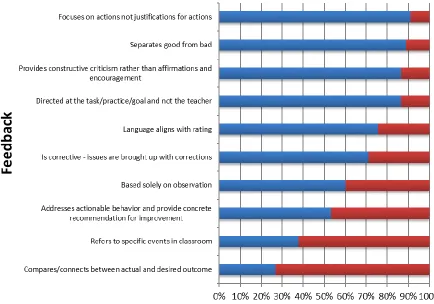
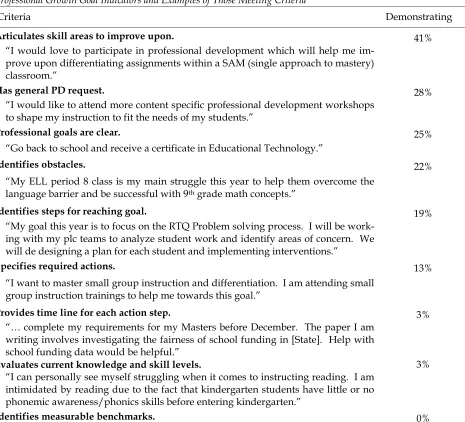
Feedback quality was operationalized by 10 items generally reflecting clarity and utility and qualities that good written feedback ought to exhibit (Heneman & Milanowski, 2004; Ilgen et al., 1979; Kimball & Mi-lanowski, 2009; Kinicki et al., 2004; Meyer, 1991; Smither & Walker, 2004; Thurlings, Vermeulen, Kreijins, Bastiaens, & Stijnen, 2012). The specific items of the FQI are displayed in Figure 1. Although reflec-tions and growth plans are common components of educator effectiveness systems, little research has ex-amined what might constitute a “good” PGP plan. Based on the relevant recent literature (Nicol & MacFarlane-Dick, 2006; Walling, Shapiro, & Ast, 2013) we developed an indicator of PGP quality. The specif-ic items of the PGGI (Professional Growth Goals Indi-cator) are displayed in Table 1.
Data
We received artifacts consisting of formal observation ratings, written feedback from principals, and PGPs from 42 teachers teaching in an eastern state. The state was in the third year of a statewide EES imple-mentation. The participating districts and schools were recommended by the state education depart-ment as being above average impledepart-menters of the sys-tem6. In each school we sought volunteer teachers to provide the requested information, although not all teachers provided all information. Missing data is an important caveat because we had insufficient respons-es to examine the pattern of missingnrespons-ess or to fully determine how well the sample represented the state as a whole, although observation scores were con-sistent with statewide results. We were limited by both a small sample and the potential of both non-response and non-response bias (Babbie, 2013). Given the exploratory nature of these analyses, this is less prob-lematic than it might have been if we attempted to make causal claims. Most teachers (54%) in the sam-ple taught in middle school, were not novice teachers (67%), and did not teach in a STEM field (62%). De-spite the limitations, several interesting patterns
emerged and warrant continued examination or moni-toring.
Results
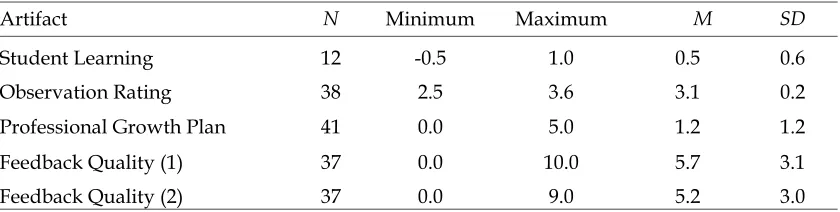
Table 2 summarizes the overall descriptive results for the indicators we developed as well as the state EES results. Very few teachers had student learning re-sults (and none were used), but most teachers did have observation ratings, which are tightly clustered around the mean of about 3 (satisfactory) with little variation. We address the specific findings in turn, but it is important to note that feedback quality (FQI, FQI2) scores generally averaged about 57% (5.7/10) of possible points and professional growth plans about 13% (1.2/9).
Principal Feedback
We rated principal feedback using the FQI, which con-sisted of 10 items (Figure 1). Given the prospective nature of the analysis, we scored each item solely on the presence or absence of the construct identified in the item. Additional iterations might develop a scor-ing rubric that better differentiates feedback on each construct. Overall the FQI appeared to work well. The sample size is insufficient to fully examine the psychometric properties of the indicator; however, internal consistency analysis indicates that the full 10-item FQI has a Cronbach’s alpha of .6, while a 9-10-item version (FQI2) has a reliability of .77.
The difference between FQI and FQI2 is whether feedback made reference to post-observation meeting conversations. This difference reflects variation Table 1
Professional Growth Goal Indicators and Examples of Those Meeting Criteria
Criteria Demonstrating
Articulates skill areas to improve upon. 41%
“I would love to participate in professional development which will help me im-prove upon differentiating assignments within a SAM (single approach to mastery) classroom.”
Has general PD request. 28%
“I would like to attend more content specific professional development workshops to shape my instruction to fit the needs of my students.”
Professional goals are clear. 25%
“Go back to school and receive a certificate in Educational Technology.”
Identifies obstacles. 22%
“My ELL period 8 class is my main struggle this year to help them overcome the language barrier and be successful with 9th grade math concepts.”
Identifies steps for reaching goal. 19%
“My goal this year is to focus on the RTQ Problem solving process. I will be work-ing with my plc teams to analyze student work and identify areas of concern. We will de designing a plan for each student and implementing interventions.”
Specifies required actions. 13%
“I want to master small group instruction and differentiation. I am attending small group instruction trainings to help me towards this goal.”
Provides time line for each action step. 3%
“… complete my requirements for my Masters before December. The paper I am writing involves investigating the fairness of school funding in [State]. Help with school funding data would be helpful.”
Evaluates current knowledge and skill levels. 3% “I can personally see myself struggling when it comes to instructing reading. I am
intimidated by reading due to the fact that kindergarten students have little or no phonemic awareness/phonics skills before entering kindergarten.”
among principals in whether written feedback is a summary of observations and discussion or written feedback is a basis for discussion.
Figure 1 presents the distribution of performance on each of the FQI items. The items in Figure 1 are ordered from “easiest” to “hardest;” that is, elements of the FQI that were most readily observed in the feedback are at the top of the figure. For example, we found that most principals were able to provide feed-back that focused on actions but not the justification for actions.
Principals had a much more difficult time com-paring/connecting actual and desired behavior. The results in Figure 1 clearly indicate that there are attrib-utes to high quality feedback that vary in the propen-sity of their appearance on written teacher feedback.
We next examined whether the individual re-sponses on the FQI formed relevant and meaningful latent factors, which may be helpful in identifying how principals might benefit from professional devel-opment themselves. Although the sample size was small, guidance for conducting exploratory factor analysis varies with recommendations focusing on either an absolute minimum N or a subject-to-variable ratio. Minimum N’s as low as 40 and subject to varia-ble ratios as low as 2:1 have been utilized in the litera-ture, although this is below the common benchmark of 150 (Young & Pearce, 2013). While there is no spe-cific cut-off, the robustness of results depends to a large extent on the empirical results (Zhao, 2009).
We applied principal component exploratory factor analysis and found that the 10 items presented in Fig-ure 1 behave quite well in forming a two-factor solu-tion7. The variance explained for the FQI is consistent with its reliability, about 0.58. The two-factor solution is quite informative and represents two domains: clarity of communication (M = 3.4/4), and instruction-al practices (M = 3.4/6). The instructioninstruction-al practices factor focuses on specific observed classroom
practic-es, areas for improvement, and specific recommenda-tions for improvement. The clarity of communication factor focuses on communication––the feedback lan-guage is aligned to the rating, comments are directed at teachers, and feedback clearly delineates strengths from weaknesses. Results indicate that principals are able to, for the most part, provide feedback that is communicated well, in terms of aligning to the rating and focusing on actions as opposed to the person. However, principals seem less able to consistently provide specific feedback with concrete examples from the classroom that are linked to areas of im-provement and are aligned to desired outcomes and specific recommendations as to how to achieve the desired outcomes.
In order to solidify the concepts presented above, we provide specific examples from the feedback forms. Although principals generally did well in com-munication, and despite language aligning with rat-ings about 75% of the time, there are several examples of misalignment. One principal stated that the teacher “did not get to cover what she wanted in the lesson because time ran short. It has been recommended that she use a visual timer." However, this teacher scored
distinguished in maximizing learning time on the
eval-uation rubric.
In another example of misalignment, a principal communicated,
It is recommended that you use formative assessment to gauge student progress . . . you did not directly assess understanding of the text prior . . . additionally, you did not present a summarizing task . . . rec-ommended that you devote the majority of your instructional time to content-related learning tasks.
Despite this feedback, this teacher scored
pro-ficient across all elements in the evaluation
rubric. Table 2
Mean Indicator and EES Scores
Artifact N Minimum Maximum M SD
Student Learning 12 -0.5 1.0 0.5 0.6
Observation Rating 38 2.5 3.6 3.1 0.2
Professional Growth Plan 41 0.0 5.0 1.2 1.2
Feedback Quality (1) 37 0.0 10.0 5.7 3.1
In terms of feedback related to instructional prac-tices, principals had a significantly more difficult time providing concrete guidance. For example, in terms of constructive criticism rather than affirmations and encouragement, one principal stated, "It is recom-mended that you continue this program with fidelity." This provides no constructive criticism and focuses on affirmation.
Some principals did provide a straightforward example of meeting this criterion, as one asserted, “In order to move to a distinguished level have students plan to ask 1-2 questions after they compared their markings.”
Although occurring less than 40% of the time, some feedback did refer to specific events in class-room, such as when a principal stated,
As we discussed in the post-conference, you not only gave students recall ques-tions to answer as they read, but you told them exactly where to find the answers. When giving students an important text to read, determine your purpose first and then provide an appropriate graphic or-ganizer and/or require the use of an effec-tive reading strategy that promotes deep-er unddeep-erstanding of the text.
Principals also did present concrete issues with corrective actions, as in a principal’s feedback:
Prepare to move the lesson along when/if students are able to grasp concepts more quickly than anticipated. Students ap-peared to quickly understand the signifi-cance of a PSA and the components of an effective PSA. More time can be spent on student production of their PSA related to toxins.
While occurring about a quarter of the time in written feedback, comparison/connection between actual and desired outcome was present in some feed-back. For example, a principal suggested, “Have the students to share their data for finding right angles instead of her sharing that information. That would have given students who did not finish the activity [opportunity] to complete the task as well.”
We examined both characteristics of the teachers and of the observation to determine whether there were any systematic relationships with FQI scores. Overall, the average teacher rating on the observation protocol (FFT) was inversely related to the FQI (r = -.27, p < .10)8, despite the lack of variability in the FFT9. Principal feedback was not qualitatively different
whether the observation was announced (40% of the observations) or unannounced. Overall, feedback quality did not differ between novice and experienced teachers; however, feedback related to instructional practice (the instructional practices factor) was of sig-nificantly lower quality for novice teachers (d = .15, p < .05).
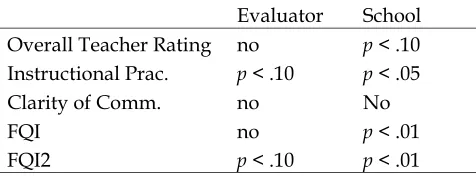
Importantly there is evidence that the number of elements of the FFT scored relates to both teacher overall ratings10 and the quality of feedback they re-ceive. Teachers scored on fewer elements of the FFT tended to have higher overall ratings (r = -.32, p < .05). The overall FQI is positively related to the number of elements scored (r = .51, p < .01). Each domain of the FQI is related to the number of elements scored. The instructional practices factor is positively related to the number of elements scored (r = .50, p < .01), and the clarity of communication factor is positively relat-ed to the number of elements scorrelat-ed (r = .49, p < .01). Table 3 summarizes the variability of the quality of feedback. In other words, Table 3 provides some evidence as to whether there are statistically signifi-cant differences in feedback among evaluators and schools11. There is suggestive evidence that the quali-ty of feedback, particularly instructional feedback quality, varies by evaluator. The results in Table 3 suggest that there tends to be systematic differences among schools in teacher ratings as well as the quality of the feedback. Differences among schools represent either mean differences in teachers, rater stringency, or feedback quality12.
Table 3
Variation in Principal Feedback
Evaluator School
Overall Teacher Rating no p < .10
Instructional Prac. p < .10 p < .05
Clarity of Comm. no No
FQI no p < .01
FQI2 p < .10 p < .01 Note.As variation assessed by a one-way ANOVA with evaluators or schools as the groups.
Professional Growth Goals
describe aspects of quality related to goal setting. Each teacher’s goal was scored on the nine items pre-sented in Table 1. Given the limited sample size and the exploratory nature of this construct, we simply coded for the presence or absence of the element. In this way, we were able to determine the extent to which teachers, without guidance, were able to devel-op a quality growth plan.
The results in Table 1 clearly indicate that teach-ers’ reflections only loosely develop professional plans. Less than 50% of the plans identified a specific skill area to improve upon. In terms of specific actions required to meet goals, less than 20% of plans speci-fied actions, and no plan identispeci-fied a measurable benchmark that would provide evidence that the goal had been met. These results provide evidence as much for the need to provide concrete direction as they do for teachers’ inability to develop coherent growth goals.
Overall, the average PGG scored about a 1.2 out of a possible 9 points. These low scores impact the relia-bility of the instrument because the modal score was 0. Additional research is required to determine whether the instrument is incapable of identifying the distribution of quality in growth plans, or whether, in fact, growth plans are not developed with fidelity across the state.
While unequivocal claims about plans would be unjustified, substantive evidence does indicate that the plans are not completed with fidelity. For exam-ple, one plan’s articulated goal was to “be the best teacher I can,” while another plan indicated that the goals were to “continue to learn as a teacher . . . and attend workshops.”
On the other hand, there were examples of plans meeting specific criteria. Table 3 presents representa-tive samples from growth plans and the proportion of plans that met the criteria. In some instances, there were few exemplars from which to choose. In addi-tion, providing measurable benchmarks was not indi-cated on any plan consistently13.
Despite the limited range in overall teacher rat-ings and scores on the PGGI, there is evidence that more effective teachers wrote stronger growth goals, shown by a positive correlation between overall teach-er ratings and growth goal scores (r = .37, p < .05). Likely consistent with expectations is that principal feedback was inversely related to growth goal scores (r = -.35, p < .05). This indicates that teachers who wrote better plans (who tend to be more highly rated teachers) received lower quality feedback.
It is also interesting to note that the strength of goals did not vary systematically among the schools in the sample, but that two schools in the sample had means that were two to three times higher than the other two schools in the sample. The difference be-tween the two pairs of schools was significant (p < .05). Again we note that these results are not based on simple random sample and that inferences based on statistical tests should be considered with caution.
Although there is insufficient evidence to support the notion that growth goals vary systematically among schools, in general, there are suggestive pat-terns to the results. For example, while the majority of plans at School A articulated a skill area to improve upon, all School A plans missed the same six criteria. A similar (yet different) pattern existed for School B. Additional investigation can examine whether teach-ers in these schools were provided specific direction or guidance (that coincidentally met some of the crite-ria applied in this evaluation). The other two schools seemed to demonstrate more variability among the plans––with less concentration on particular aspects, but broader coverage. Together the results suggest that there may be differences among the schools in how they approached growth plans and that develop-ing guidance and policy can impact how teachers ad-dress this task. While there was a positive relation-ship between overall teacher rating and the quality of plans, there were no significant correlations within schools. The point estimates of the correlations varied from .23 to .45, but there was insufficient sample size within schools to detect relationships. Again, the re-sults provide suggestive evidence for school-wide dif-ferences in approaching PGGs.
Discussion
There has been a recent emphasis on transformational leadership skills of principals (Bluestein, 2011), and current EESs renew a focus on supervision and evalu-ation to facilitate improvement in instructional quali-ty. Recent research indicates that EESs can impact instruction quality, as measured by student outcomes.
toring and professional development specifically on providing feedback (Johnston, J. Kaufman, & L. Thompson, 2016).
Our initial examination of feedback indicates that feedback tends to fall along two dimensions. One di-mension focuses on clarity of communication. This dimension of feedback provides results related to how well principals’ feedback is written––whether it is clear and objective. This is an important dimension since clearly communicated feedback focusing on tasks rather than traits enhances recipients’ perception of accuracy (Kinicki et al., 2004; Kluger & DeNisi, 1996); principals generally do a good job in this di-mension. The second dimension emphasizes instruc-tional practices. This dimension focuses on feedback using specific classroom practices to highlight strengths and weaknesses and to develop concrete recommendations for improvement as well as strate-gies to engender that improvement. This dimension is important because it is through focusing attention that feedback engenders change (Larson et al., 2013); prin-cipals were less successful at providing this sort of feedback. Both more effective teachers and novice teachers received lower quality instructional feedback. Our evidence suggests that the fewer FFT elements scored, the poorer the quality of the feedback. This suggests that a series of mini-observations (Marshall, 2013) may facilitate principals’ abilities to observe a broader array of FFT elements over the course of time, increasing the potential for effective feedback. Over-all, these results suggest that districts should provide additional mentoring and support specific to instruc-tional practices. This might include helping the prin-cipal develop additional knowledge about strategies to address specific instructional issues or creating a clearinghouse or repository to which principals have ready access.
More concrete feedback, which is included in do-main four of the FFT (Danielson, 1996), specifically to provide guidance to teachers as well as to provide support in developing growth goals, could lead to more concrete actionable and monitorable goals that can meaningfully guide teachers to professional im-provement. Our results indicate that, based on the criteria applied, teachers generally did not develop succinct growth goals that incorporated concrete steps as well as measureable benchmarks for success.
Limitations and Recommendations
This exploration into the fidelity of implementing the formative components of an EES is limited by several key factors. One is the sampling plan, which relied on volunteer responses. Although the results suggest
that teacher observation scores were in-line with state performance, it is unknown what unobserved factor related to feedback is related to teachers volunteering their feedback for study. Additionally, the sample size was relatively small given the number of analyses we conducted. As noted, we view the results provi-sionally, but we also believe that they are consistent with anecdotal evidence from the field. A final limita-tion is the lack of raw student performance data. We had access to principals’ ratings of teachers (based on various student learning results and algorithms), but these ratings included a subjective element, were at-tenuated, and lacked variability.
The preliminary results do highlight areas for con-sideration by states. If, in fact, feedback is generally lacking in specifics for improving instructional prac-tices, then this clearly limits the ability of an EES to impact student outcomes. Professional development for principals would be warranted. This is consistent with previous research suggesting that guidance for providing feedback would be beneficial (Johnston, Kaufman, & Thompson, 2016; Scheeler et al., 2004). Importantly, teachers need access to resources and training (Kimball, 2002), and feedback is only helpful if teachers have enabling conditions (DuFour & Mar-zano, 2009; McLaughlin & Pfeifer, 1988. The variabil-ity in qualvariabil-ity by principals and schools warrants addi-tional research to determine which principal and dis-trict factors contribute to this variation. The lack of fidelity with which growth goals were completed clearly points to a need for additional thinking in providing opportunities and rationale to solidify growth goals as concrete actionable plans with meas-urable objectives that teachers meaningfully ascribe to and use to monitor their own success towards contin-ued improvement. The systematic variation in PGPs by schools provides some evidence that guidance var-ied systematically, and it implies that teachers re-sponded to that guidance.
Moreover, if EESs explicitly followed feedback and growth goals as a basis for subsequent evaluation cycles and if principals were also monitored on feed-back quality, this may enhance the fidelity with which each of these elements is implemented, furthering the potential to improve instructional practice.
Notes
1Feedback need not necessarily come from the princi-pal, but given its prevalence we simply use principal to refer to principals or any other evaluator that pro-vides feedback.
3Links refer to a representative sample of five states:
http://www.mde.k12.ms.us/docs/teacher-center/ teacher-evaluation-modifications-for-2014-2015.pdf? sfvrsn=2; http://www.nj.gov/education/AchieveNJ/ teacher/approvedlist.pdf; http://
www.connecticutseed.org/wp-content/ uploads/2014/10/
CCT_Rubric_for_Effective_Service_Delivery_2014.pdf;
http://www.nctq.org/docs/NC_teacher-eval_process.pdf; and http://www.ped.state.nm.us/ ped/NMTeach_EvaluationPlan.html.
4For example, Self-Determination Theory, (Deci and Ryan, 2000) and Control Theory (Taylor, Fisher, & Ilgen, 1984) have been posited to relate to feedback response and goal setting.
5Like the majority of studies on feedback in education, Sadler focuses on teachers and students.
6This introduces a limitation on generalizability. It should be noted however, that the state’s definition of implementation was related to compliance not to fi-delity (to which this study provided some evidence). 7The empirical evidence suggests that the results ap-pear well behaved (Young and Pearce, 2013), particu-larly with no cross-loaded factors and each of the two factors having at least 2 items with loadings over 0.8, and the remaining loadings of around 0.7.
8This relationship is significant when using FQI2 (r = -.32, p < .05).
9There is little variation in observation ratings in the sample: Observations are distributed with M = 3.05 (effective) and SD = .17.
10We use the average score on the 4-point rubric and not the classifications used on the EES summative re-ports.
11Results are based on 11 evaluators and 4 schools.
12There is insufficient data to fully examine the struc-ture of the relationships (e.g., the between rater, with-in school variability).
13In a few cases teachers indicated that they intended to get another degree. We did not score these as hav-ing benchmark given the lack of specificity in present-ing this goal. This is an instance where a more sophis-ticated scoring rubric would be beneficial (e.g., no benchmark = 0, loose = 1, and concrete = 2).
References
Allen, M., & Yen, W. (1979). Introduction to
measure-ment theory. Boston: Brooks/Cole.
Babbie, E. (2013). The practice of social science research. Australia: Wadsworth.
Bell, C., Gitomer, D., McCaffrey, D, Hamre, B., Pianta, R., & Qi, Y. (2012). An argument approach to ob-servation protocol validity. Education Assessment,
117, 62-87.
Bjorn, K., Wurth, S., & Hergovich, A. (2013). The im-pact of feedback on goal setting and task perfor-mance. Swiss Journal of Psychology, 72(2), 79-89. Black, P., & William, D. (1998). Assessment and
class-room learning. Assessment in Education: Principals,
Policy, and Practice, 5(1), 7-68.
Bluestein, S. (2011). Principal effectiveness in California
elementary schools (Doctoral dissertation).
Re-trieved from CSUN Electronic Theses and Disser-tations.
Branch, G., E. Hanushek, & Rivkin, S. (2012).
Estimat-ing the effect of leaders on the public sector productivi-ty: The case of school principals. (Working Paper No.
66). Washington, DC: American Institutes for Re-search.
Chetty, R., Friedman, J., & Rockoff, J. (2014a). Measur-ing the impacts of teachers I: EvaluatMeasur-ing bias in teacher value-added estimates. America Economic
Review, 104(9), 2593-2632.
Chetty, R., Friedman, J., & Rockoff, J. (2014b). Measur-ing the impacts of teachers II: Teacher value-added and student outcomes in adulthood.
Ameri-ca Economic Review, 104(9), 2563-2679.
Cianci, A. M., Klein, H. J., & Seijts, G. H. (2010). The effect of negative feedback on tension and subse-quent performance: The main and interactive ef-fects of goal content and conscientiousness.
Jour-nal of Applied Psychology, 95(4), 618-630.
Danielson, C., & McGreal, T. (2000). Teacher evaluation
to enhance professional practice. Alexandria, VA:
Association for Supervision and Curriculum de-velopment.
Danielson, C. (1996). Enhancing professional practice: A
framework for teaching. Alexandria, VA:
Associa-tion for Supervision and Curriculum develop-ment.
Darling-Hammond, L. (2004). Inequality and the right to learn: Access to qualified teachers in Califor-nia’s public schools. Teachers College Record, 106 (10), 1936-1966.
DuFour, R., & Marzano, R. (2009). High-leverage strategies for principal leadership. Educational
Leadership, 66(5), 62-68.
Eisner, E. (1992). Education reform and the ecology of schooling. Teachers College Record, 93, 610-627. Greene J., Valerie, J., & Caracelli, G. (1989). Toward
a conceptual framework for mixed-method evalu-ation designs. Educevalu-ational Evaluevalu-ation and Policy
Hahnel, C., & Jackson, O. (2012). Learning denied: The
case for equitable access to effective teaching in Califor-nia’s largest school district. Oakland, CA: The
Edu-cation Trust.
Hallinger, P., & Heck, R. H. (1996). Reassessing the principal’s role in school effectiveness: A review of empirical research, 1980-1995. Educational
Ad-ministration Quarterly, 32, 5-44.
Hallinger, P., & Murphy, J. (1985). Assessing the in-structional management behavior of principals.
The Elementary School Journal, 66(2), 217-247.
Hattie, J., & Timperley, H. (2007). The power of feed-back. Review of Educational Research, 77(1), 81-112. Heneman III, H., & Milanowski, A. (2004). Alignment
of human resource practices and teacher perfor-mance competency. Peabody Journal, 79(4), 108-125. Hill, H., Charalambous, C., Blazar, D., McGinn, D.,
Kraft, M., Beisiegel, M., Hunnez, A., Litke, E., & Lynch, K. (2012). Educational Assessment, 17, 83-106.
Hysong, S., Best, R., & Pugh, J. (2006). Audit and feed-back and clinical practice guideline adherence: making feedback actionable. Implementation
Sci-ence, 1,9.
Hysong, S. (2009). Meta-analysis: Audit and feedback features impact effectiveness on care quality.
Med-Care, 47(3), 356-63.
Ilgen, D., Fisher, C., & Taylor, S. (1979). Consequences of individual feedback on behavior in organiza-tions. Journal of Applied Psychology, 64(4), 349-371. Johnston, W., Kaufman, J., & Thompson, L. (2016).
Support for instructional leadership: Supervision, men-toring and professional development for US school leaders: Findings from the American School Leader Panel. Santa Monica, CA: RAND Corporation.
Kane, M. (2013). Validating the Interpretation and Use of Test Scores. Journal of Educational Measurement,
50(1), 1-73.
Kane, T., McCaffrey, D., Miller, T., & Staiger, D. (2013). Have we identified effective teachers?
Validat-ing measures of effective teachValidat-ing usValidat-ing random as-signment. Seattle, WA: Bill & Melinda Gates
Foun-dation.
Kane, T., & Staiger, D. (2012). Gathering feedback for
teaching: Combining high-quality observations with student surveys and achievement gains. Seattle: Bill &
Melinda Gates Foundation. Retrieved from
http://www.metproject.org/downloads/MET_ Gathering_Feedback_Practioner_Brief.pdf
Kane, T., Taylor, E., Tyler, J., & Wooten, A. (2011). Identifying effective classroom practices using student achievement data. Journal of Human
Re-sources, 46(3), 587-613.
Kimball, S., & Milanowski, A. (2009). Examining teacher evaluation validity and the leadership de-cision making within a standards-based evalua-tion system. Educaevalua-tional Administrative Quarterly,
45(1), 34-70.
Kimball, S. (2002). Analysis of feedback, enabling con-ditions and fairness perceptions of teachers in three school districts with new standards-based evaluation systems. Journal of Personnel Evaluation
in Education, 16(4), 241-268.
Kinicki, A., Wu, B., Prussia, G., & McKee-Ryan, F. (2004). A covariance structure analysis of employ-ees’ response to performance feedback. Journal of
Applied Psychology, 89(6), 1057-1069.
Kluger, A., & DeNisi, A. (1996). The effects of feed-back interventions on performance: A historical review, a meta-analysis, and a preliminary feed-back intervention theory. Psychological Bulletin,
119(2), 254-284.
Larson, E., Patel, S., Evans, D., & Saiman, L. (2013). Feedback as a strategy to change behavior: The devil is in the details. Journal of Evaluation in
Clini-cal Practice, 19(2), 230–234.
McLaughlin, M. & Pfeifer, R. (1988). Teacher evaluation:
Improvement, accountability, and effective learning.
NY, NY: Teachers College Press.
Marshall, K. (2013). Rethinking teacher supervision and
evaluation (2nd ed.). San Francisco: Jossey-Bass. Messick, S. (1995). Validity of psychological assess-ment: Validation of inferences from persons’ re-sponses and performances as scientific inquiry into score meaning. American Psychologist, 50, 741-749.
Meyer, H. (1991). A solution to the performance ap-praisal feedback enigma. Academy of Management
Executive, 5(1), 68-76.
Milanowski, A. (2004). The relationship between teacher performance evaluation scores and stu-dent achievement: Evidence from Cincinnati. Pea-body Journal of Education, 79(4), 33-53.
Morey, E. (2003). Feedback research revisited. In D. Jonasson (ed.), Handbook of research for educational
communication and technology (pp.745-784). New
York: McMillan.
Nicol, D., & Macfarlane-Dick, D. (2006). Formative assessment and self-regulated learning: A model and seven principles of good feedback practice.
Studies in Higher Learning, 31(2), 199-218.
National Quality Forum (2013). Composite performance
measure evaluation guidance. Washington, DC:
Na-tional Quality Forum.
Nye, B., Konstantopoulos, S., & Hedges, L. (2004). How large are teacher effects? Educational
OECD. (2008). Handbook on Constructing Composite
In-dicators: Methodology and Users Guide. Paris: OECD.
Porter, A. (1991). Creating a system of school process indicators. Educational Evaluation and Policy
Analy-sis, 13(1), 13-29.
Rivkin, S., Hanushek, E., & Kain. J. (2005). Teachers, schools, and academic achievement. Econometrica,
73(2), 417-458.
Rose, D., & Farrell, T. (2002). The use and abuse of
com-ments in 360-degree feedback. Paper presented at the
18th Annual Conference of the Society for Indus-trial and Organizational Psychology, Toronto, Canada.
Sadler, R. (1989). Formative assessment and the design of instructional systems. Instructional Science, 18 (2), 119-144.
Scheeler, W., Dochy, F., & Janssens, S. (2004). Provid-ing performance feedback to teachers: A review.
Teacher Education and Special Education, 27(4),
59-70.
Shepard, L. (2012). Evaluating the use of tests to measure
teacher effectiveness: Validity as a theory-of-action framework. Paper presented at the National
Coun-cil of Measurement in Education Meeting, Van-couver, Canada.
Shwartz, M. & Ash, A. (2008). Composite measures:
Matching the method to the purpose. Agency for
Healthcare Research and Quality. Retrieved from http://www.qualitymeasures.ahrq.gov/expert/ expert- commentary.aspx?id=16464
Smither, J., & Walker, A. (2004). Are the characteristics of comments related to improvement in multirater feedback ratings over time?. Journal of Applied
Psy-chology, 89(3), 575-581.
Steinberg, M., & Donaldson, M. (2016). The new edu-cational accountability: Understanding the land-scape of teacher evaluation in the post-NCLB era.
Education Finance and Policy, 11(3), 340–359.
Stiggins, R., & Duke, D. (1988). The case for commitment
to teacher growth: Research on teacher evaluation.
Al-bany, NY: State University of New York Press. Taylor, E., & Tyler, J. (2012). The effect of evaluation
on teacher performance. American Economic
Re-view, 102(7), 3628-3651.
Thurlings, M, Vermeulen, K., Kreijins, K., Bastiaens, T., & Stijnen, S. (2012). Development of the teacher feedback observation scheme: Evaluating the quality of feedback in peer groups. Journal of
Edu-cation for Teaching: International Research and Peda-gogy, 38(2), 193-208.
Walling, A., Shapiro, J., & Ast, T. (2013). What makes a good reflective paper?. Family Medicine, 34(1), 7-12.
Weisberg, D., Sexton, S., Mulhern, J., & Keeling, D. (2009). The widget effect: Our national failure to
acknowledge and act on differences in teacher effective-ness. New York, NY: The New Teacher Project.
White, S. (2009). Articulation and re-articulation: De-velopment of a model for providing quality feed-back to pre-service teachers on practicum. Journal
of Education for Teaching, 35(2), 123-132.
Young, A., & Pearce, S. (2013). A beginner’s guide to factor analysis: Focusing on exploratory analysis.
Tutorials in Quantitative Methods for Psychology, 9
(2), 79-94.
Zhao, N. (2009). The minimum sample size in factor
anal-ysis. Retrieved from https://
www.encorewiki.org/display/~nzhao/
A Survey of School Administrators’
Training and Support Related to
Evaluating
Special Education Teachers
2015; Grissom, Loeb, & Master, 2014; Holdheide, Goe, Croft, & Reschly, 2010). Goldring et al. argue that rig-orous, observation-focused evaluation systems are becoming the main driver of principals’ human capital decisions (e.g., hiring, evaluating, and rewarding) and that teacher observations may be a more important source of data for principals than value-added or oth-er student growth measures. The Evoth-ery Student
Suc-ceeds Act (ESSA, 2015) allocates resources to states and
school districts to support activities related to observa-tions and evaluaobserva-tions. These activities can include developing and disseminating high-quality evaluation tools such as observation rubrics, developing and providing training to principals and other school lead-ers on how to accurately differentiate performance and provide useful feedback, and providing training on how to use evaluation results to inform personnel decisions.
This paper discusses principals and other school leaders, whom we collectively refer to as school ad-ministrators, as individuals responsible for observing and evaluating special education teachers. We fo-cused on special education teachers because questions have arisen regarding whether school administrators, who typically are not licensed or trained in teaching students with disabilities, can reliably and meaning-fully observe and evaluate the special education teach-ers at their school sites (Jones & Brownell, 2013). As follows, we discuss school administrators’ back-ground, training, and preparation related to evaluat-ing special education teachers. We also discuss the implications of each for informing both school admin-istrators’ high-stakes decisions (e.g., retention and ten-ure) and low-stakes decisions (e.g., professional devel-opment opportunities).
S
chool administrators (i.e., principals and other in-structional leaders) are tasked with directly observing teachers’ classroom practice, determining a summary judgment of a teacher’s quality and efficacy, and providing feedback to teachers for the purpose of pro-fessional growth and development (Goldring et al.,Abstract: School administrators are often responsible
for observing and evaluating special education teach-ers. The current study examined the training school administrators received, their needed knowledge and supports, and their confidence in performing job func-tions related to special education teacher evaluation. A total of 929 school administrators in California com-pleted a 26-item survey in which they reported the training they had received, the usefulness of the train-ing for informtrain-ing practice, and the confidence they felt in evaluating special educators. Results indicated that most school administrators did not have a back-ground in special education, did not receive training related to evaluating special educators, and felt less confident evaluating special educators than general educators. School administrators, especially those without a background in special education, may need more training and support related to evaluating spe-cial education teachers during preparation and in the early years of administration. Training and support should focus on evidenced-based practices for teach-ing students with disabilities.
Keywords: special education teacher evaluation,
school administrator preparation, school administra-tor training, observation instruments, evaluation sys-tems
Janelle E. Rodl
,
San Francisco State UniversityWes Bonifay
,
University of MissouriRebecca A. Cruz
,
University of California, BerkeleyEvaluator Background
Direct observation of classroom practice is the prima-ry form of evaluative data used in many teacher eval-uation systems (Goldring et al., 2015; Holdheide, Goe, Croft, & Reschly, 2010). School administrators are typically responsible for conducting classroom obser-vations of all teachers on their school sites, including special education teachers, but principals and other instructional leaders often lack knowledge regarding evidenced-based instructional strategies recommend-ed for teaching students with disabilities (e.g., explicit and intensive instruction) (Sledge & Pazey, 2013; Steinbrecher, Fix, Mahal, Serna, & McKeown, 2015). A lack of knowledge may adversely impact a school ad-ministrator’s ability to provide an accurate score of a special education teacher’s classroom performance (Sledge & Pazey, 2013), and it may systematically bias ratings of special education teachers (i.e., administra-tors may systematically score special education teach-ers higher or lower on certain elements) (Jones & Brownell, 2013).
Research on school administrators, who may not have a background in teaching students with disabili-ties, as observers and scorers of special education teachers’ classroom performance is extremely limited. Lawson and Cruz (2017) conducted a small study in which school administrators and peers were asked to score special education teachers’ video-recorded les-sons using seven rubric items that reflected domains of special education teachers’ expected teaching skills (e.g., sequencing, scaffolding, student practice and review, and skill development). The authors found that the school administrators who did not possess licensure in special education and did not have experi-ence teaching students with disabilities demonstrated greater agreement in scores when rating teachers on rubric items that reflected instructional strategies that might be expected of all teachers (e.g., articulating a lesson objective). However, they were less reliable when scoring on items that were arguably unique to special education instruction (e.g., instruction that is focused on essential concepts, strategies, and skills with an emphasis on repeated practice). In addition, peer raters, who were experienced special education teachers, were more reliable raters overall than the school administrators, which suggests that adminis-trators may need training and calibration to ensure agreement on scores for special education teachers’ observations and evaluations.
School administrators may also encounter limita-tions in observing and evaluating special education teachers when using observation instruments that were designed for the general education teacher
pop-ulation. In a national survey of state- and district-level administrators, 85.6% of respondents reported using the same observation protocol for all teachers including special educators, but administrators report-ed the nereport-ed to make modifications when evaluating special education instruction (Holdheide et al., 2010). Some researchers have compared rubric items includ-ed in commonly usinclud-ed instruments, such as the Frame-work for Teaching (FFT) Evaluation Instrument (Danielson, 2011), with research-validated instruction-al strategies expected of speciinstruction-al educators and found that the instruments may not be an appropriate match to special educators’ expected teaching skills (Jones & Brownell, 2013).
Information gathered from classroom observa-tions and other performance data should be used to provide teachers with clear and specific feedback, which has been shown to lead to substantial gains in students’ achievement (e.g., Kane & Staiger, 2012; Tay-lor & Tyler, 2011). However, research suggests that the feedback process may be more effective when admin-istrators possess knowledge of a teacher’s specific dis-cipline. Tuytens and Devos (2011) found that a teach-er’s perception of the utility of feedback—determined through a belief regarding the evaluator’s knowledge of relevant content—impacted the undertaking of pro-fessional learning activities to improve practice. Lochmiller (2016) found that when providing feed-back to teachers, administrators often drew from their own experiences as classroom teachers; if the adminis-trator’s subject subculture—formed from his or her own prior teaching experience—was not perceived as relevant, the teacher receiving feedback would instead turn to colleagues for more support. Glowacki and Hackmann (2016) found that elementary principals reported a higher skill/comfort level when providing feedback to general education teachers than special education teachers, and principals with special educa-tion certificaeduca-tion rated their skills in providing feed-back more highly than those without a special educa-tion certificaeduca-tion. The aforemeneduca-tioned studies suggest that administrators who do not have a background in special education, and, thus, do not share the same subculture as their special education teachers, may require additional support in better understanding how to provide feedback specific to teaching students with disabilities.
School Administrator Training and Preparation