Volume 11, Number 1, March 2016
Perceptions of Information Technology Processes
Among IT Decision Makers in Thailand
Sakuna Samithisomboon*
IT in Business Program, Chulalongkorn Business School, Chulalongkorn University, Bangkok, Thailand
*Corresponding Author
Wachara Chantatub
Department of Statistics, Chulalongkorn Business School, Chulalongkorn University, Bangkok, Thailand
ABSTRACT
Information technology (IT) has become an essential part of organizations and a pervasive element in all business processes. Because IT is so critical to business in today’s dynamic environment, it is essential that organizations align their business processes with IT strategy in order to facilitate business changes and to cope with other developments in the global economy. Complete synchronization calls for a business-IT alignment that can be achieved through effective IT governance. The adoption of proper IT governance processes can enhance an organization’s strategic gain. Among businesses in Thailand, however, fewer than half have fully adopted IT governance processes. This study explores the concerns of IT decision makers in Thailand with regard to these processes, using four stages of the perceptual process: exposure, attention, interpretation, and response. The study used a semi-structured interview to solicit the opinions of IT decision makers with experience in IT management and with the authority to make decisions relating to IT governance. The results indicate that, although not all governance processes are implemented because of time and cost factors, the governance processes that are implemented are those with a high impact and high importance level. The results show, furthermore, that the four factors influencing an organization’s selection processes are organization size, strategy, structure, and industry.
International Journal of Business and Information
1. INTRODUCTION
Information technology (IT) is used to support organizations in business process improvement, sustainability, and growth. By facilitating business change in today’s dynamic environment, IT has become an essential part of organizations at every business level and a pervasive element in flexible business procedures. In today’s world, IT plays an increasingly proactive role in developing long-term business strategy. To ensure that business processes and IT strategy are completely synchronized, business-IT alignment is essential [12].
The alignment of business with IT can essentially improve overall business performance and help businesses achieve profitable growth [26]. Moreover, such alignment not only can generate business value from the IT investment, but also can enable organizations to achieve competitive advantage [3]. To accomplish business-IT alignment, organizations must have not only effective IT management, but also IT governance implementation [8].
The term IT governance refers to the processes that ensure the effective and efficient use of IT to order to enable an organization to achieve its strategies and objectives [15]. Since 2003, IT governance has been ranked among the Top 10 CIO technology priorities by Gartner Inc. (NYSE: IT), the world’s leading information technology research and advisory company. To support the implementation of IT governance, a variety of international standards, best practices, guidelines, and frameworks have been developed. The most widely used framework is COBIT (Control Objectives for Information and Related Technology) [25]. It was designed in 1996 by Information System Audit and Control Association (ISACA) to support IT governance in managing and understanding the risks and benefits of IT. In 2012, the latest version of COBIT (namely, COBIT5) was released to provide a broader view of end-to-end responsibilities in IT governance [14].
Volume 11, Number 1, March 2016
of the fact that IT governance adoption offers apparent benefits in terms of business-IT alignment, it is debatable why it has not been widely implemented in Thailand.
Academic literature indicates that people will select or make a decision to adopt something, depending on their perception [31]. Perceptual process can be divided into four stages: exposure, attention, interpretation, and response [30]. Exposure is a personal experience. Attention is an understanding. Interpretation is information analysis. Response is decision making. Perceptual process is mostly applied in marketing, where marketers try to appeal to the consumers' senses, thus drawing their attention, interpreting these stimuli, and generating a response to selecting/buying a product or service [11]. In the current study, we applied this perceptual process to explain how IT decision makers in Thailand would perceive the adoption of IT governance processes.
Understanding the perceptions of IT decision makers may help to explain why organizations in Thailand have not yet extensively implemented IT governance processes. This leads us to the main intention of this research, which is to interpret the perceptions regarding IT governance process adoption by using the perceptual process constructs described above. More specifically, the four objectives of this research are:
To assess the implementation of each IT governance process
To examine the importance level of each IT governance process to the organization
To evaluate the impact level of each IT governance process in supporting business-IT alignment
To investigate whether there are any other factors relating to the selection of IT governance processes
To achieve these objectives, we used a semi-structured interview of IT decision makers with experience in IT management and also with authority to make the decision to implement the IT governance process. The interview questions were based on the IT governance process described in the COBIT5 framework.
International Journal of Business and Information applied it to the IT governance area, we gained a fresh perspective on conducting research in the area of IT governance.
2. BACKGROUND
This section discusses the concept, benefits, and principles of IT governance, describes the IT governance process, explains business-IT alignment, reviews IT governance process implementation, and presents an overview of IT governance perceptions.
2.1. Concept, Benefits, and Principles of IT Governance
IT governance is an integral part of enterprise governance and consists of the leadership and organizational structures and processes necessary to ensure that the organization's IT sustains and extends the organization's strategies and objectives [15]. The concept of IT governance emerged in the late 1990s with main support from the IT Governance Research Institute (ITGI). Since then, the demand to implement and to improve IT governance has become a key issue for senior IT executives across the world [7]. Understanding the IT governance concept is important because it gives practitioners a better view of the functions, scope, and boundary of the subject.
The adoption of IT governance has several benefits; namely, it ensures efficiency, reduces costs, and increases control of IT [32]. Organizations adopt IT governance in order to improve organizational accountability, which results in higher returns on IT investments [23]. In a 2002 study by Weill and Woodham [35], organizations increased their returns on IT investment as much as 40%, with the help of well-organized IT governance, and companies with better IT governance earned at least 20% higher returns. Other studies have found that IT governance is critical to achieving corporate success by providing information through the application of technology [18], and that it can help an organization ensure business-IT alignment through an appropriate level of IT control [33].
Volume 11, Number 1, March 2016
With regard to IT governance, there are a variety of international standards, frameworks, reference models, and proprietary methods, which are often referred to as “best practices.” During the last two decades, a number of best practice frameworks have been developed to encourage effective IT governance and to help organizations improve their accountability and manage their IT operations [19].
2.2. IT Governance Processes
The IT governance process mechanism includes formal processes for ensuring that IT daily operations are consistent with IT policies [1]. Currently, there are many best practice frameworks that provide processes and controls to encourage effective IT governance; for example, ITIL, TOGAF, ISO/IEC38500, and COBIT. Many companies have used one or more of these frameworks to improve their management and governance of IT. The most widely used framework is COBIT [25], a high-level governance and control framework for global business community domains.
In 1996, COBIT was originally designed by the Information System Audit and Control Association (ISACA) to support IT governance in managing and understanding the risks and benefits associated with information and related technology. Today, it is widely accepted as the most appropriate control framework to help an organization ensure alignment between the use of IT and its business goals [5]. For this reason, COBIT is accepted as a highly successful tool for auditors since many large audit firms have adopted audit checklists and the internal control objectives of COBIT to correspond with the international standard [24].
At present, COBIT is in its 5th edition, which was released in 2012. This version identifies 37 processes across five domains (Figure 1) [13]:
Evaluate, direct, and monitor (EDM) Align, plan, and organize (APO) Build, acquire, and implement (BAI) Deliver, service, and support (DSS) Monitor, evaluate, and assess (MEA)
International Journal of Business and Information requirements, acquire the technology, and implement it to support business processes. The DSS domain focuses on the delivery phase of IT to make sure that IT systems are at their most effective and efficient performance. The MEA domain covers the area of IT control and IT compliance with regulatory requirements.
Figure 1. COBIT Process Reference Model [13]
Volume 11, Number 1, March 2016
governance processes from best practice frameworks like COBIT might have a greater impact on business-IT alignment.
2.3. Business-IT Alignment
Alignment of IT with business objectives is an important issue in the IT management literature. Since the 1990s, the subject has been addressed by many conceptualizations and empirical methods [22]. Henderson and Venkatraman [12] defined business-IT alignment as the degree of fitness and integration between business strategy, IT strategy, business infrastructure, and IT infrastructure. The Society for Information Management (SIM), in a joint effort with other research leaders, conducted an annual survey of the key issues facing IT executives globally and found that the business-IT alignment issue had been in the Top Three management concerns since 2003 [20]. This fact demonstrates that IT executives place emphasis on the need to align IT strategies with business in order to advance the organization.
Previous research has found that the benefits of accomplishing business-IT alignment include, for instance, escalating business performance [2, 6, 4] and providing competitive advantage for the organization [16]. The literature also suggests that governance of IT can support the organization in achieving business-IT alignment and in expanding business value creation [8]. In view of the large benefit and outcome of business-IT alignment, it seems that IT governance would be implemented extensively.
2.4. IT Governance Process Implementation
The importance and benefits of IT governance have been suggested in several ways in the literature. For example, IT governance can produce business profitability growth [34] and increase operational efficiency and improve business performance [9]. Studies have also shown that IT governance implementation can leverage the alignment of an organization’s IT operations with its business strategies [36]. Adopting IT governance is not so difficult as it appears to be, primarily because there are quite a few international standards, best practices, and frameworks available to support implementation. For this reason, it would seem that more and more organizations would adopt IT governance processes.
International Journal of Business and Information not applied an IT governance framework because they were not familiar with, or did not clearly understand, the framework concept. Our finding is in line with the results of a study by Winniford et al. [37] that indicate that the main barrier to the adoption of IT governance adoption is insufficient information about the IT governance framework.
Concerning COBIT, generally accepted as the most widely used IT governance framework, in 2013, we conducted out an online survey of organizations in Thailand to investigate the maturity of implementation of IT governance processes. The questionnaire was based on six maturity levels and five IT governance domains, as required by COBIT5. The results revealed that 37% of the respondents had fully adopted the IT governance process and that 86% of them encountered problems in selecting appropriate processes [28].
Even though IT governance is important and beneficial, it has not been extensively adopted by businesses in Thailand. Moreover, a large number of organizations still encounter obstacles and struggle to select appropriate IT governance processes.
2.5. IT Governance Perceptions
According to the Oxford English Dictionary, perception refers to the ability to understand the true nature of something. In philosophy, psychology, and cognitive science, perception is the process of acquiring awareness or understanding of sensory information [10]. Sensory usually refers to information resulting from stimulation of the eyes, ears, nose, mouth, or skin receptors [29]. In organizational behavior, perception is described as the process by which people select, organize, interpret, retrieve, and respond to information [31]. The perception process is divided into four components: exposure, attention, interpretation, and response, as shown in Figure 2 [30].
Volume 11, Number 1, March 2016
The perceptual process has been widely applied in marketing, where it refers to the influence of stimuli such as sights, sounds, smells, tastes, and textures, which produce sensations in the consumer. Once the consumer’s attention has been caught in this way, he or she starts interpreting these stimuli and generating responses [11]. In other words, marketers apply the perceptual process to appeal to consumers’ senses, prompt them to interpret the stimuli, and encourage them to respond by making a decision to buy a product or service.
According to Solomon [30], the four components of the perceptual process derive from the stimulation of sensory receptors or one’s ultimate experience. The first component, exposure, occurs when stimuli act on sensory receptor nerves. This experience involves both the recognition of environmental stimuli and actions in response to the stimuli. The second component, attention, occurs after a person has already experienced something and the brain considers it. This stage leads to a person’s understanding. The third component, interpretation, is a way of thinking and believing, based on experience and understanding. The fourth component, response, occurs when the person makes a decision to select something by considering the information he or she has received.
3. METHODOLOGY
This section discusses the research design of the current study and explains the data collection process that was used.
3.1. Research Design
The main objective of this study is to interpret the perception of the adoption of the IT governance process in light of the four perceptual components (experience, understanding, interpretation, and response). To achieve our objective, we designed a questionnaire that adapted these components to fit the IT governance aspect.
For the first component, exposure, we considered the experience of IT decision makers in adopting IT governance processes. For the second component, attention, we considered IT decision makers’ perception of the importance of IT governance processes. For interpretation, we considered their belief in the degree of impact of business-IT alignment. For response, we considered any factors that are related to the selection or the decision to adopt IT governance processes.
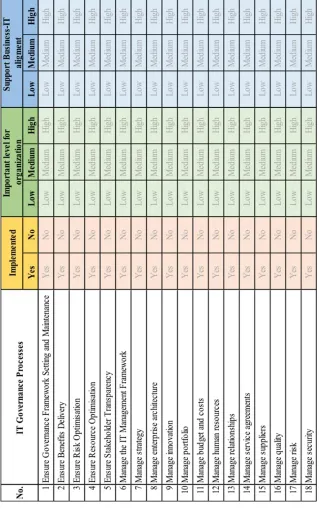
International Journal of Business and Information “align, plan, and organize (APO).” The questionnaire we developed (Figure 3) combined IT governance processes with perceptual components.
We used a semi-structured interview to ask in-depth questions and gather other data and evidence. The interview included open-ended questions so as to encourage meaningful answers from the respondents. Because the purpose of our study is to explain how IT decision makers perceive IT governance processes, we interviewed IT leaders with much experience in IT management and with the authority to make a decision to implement the IT governance process. Such leaders might include, for example, a senior management executive, a governance board member, or an IT committee member who has authority in IT decision-making.
3.2. Data Collection
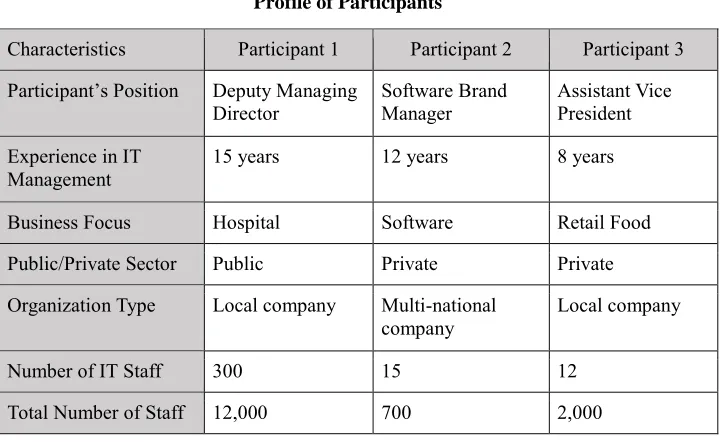
The semi-structured interviews were conducted with three IT leaders from different industries, designated here as Participant 1, Participant 2, and Participant 3 (Table 1). All three have at least eight years of experience in IT management, and are at either the executive or senior management level. All three are in large companies with between 700 and 12,000 employees and from 12 to 300 IT staff.
Table 1 Profile of Participants
Characteristics Participant 1 Participant 2 Participant 3 Participant’s Position Deputy Managing
Director Software Brand Manager Assistant Vice President
Experience in IT
Management 15 years 12 years 8 years
Business Focus Hospital Software Retail Food Public/Private Sector Public Private Private Organization Type Local company Multi-national
company
Local company
Number of IT Staff 300 15 12
Volume 11, Number 1, March 2016
International Journal of Business and Information Participant 1 in our study works in one of the largest hospital groups in Southeast Asia. He is a deputy managing director in charge of research and innovation. He is in charge of creating IT innovation and solutions and has more than 15 years of IT management experience. He has implemented and supported many IT strategies and IT projects for this hospital chain. He has a master’s degree in computer information systems from San Francisco State University.
Participant 2 is an executive at a multi-national corporation that sells computer hardware/software and offers both solutions and consulting services. He has experience in managing many key industries (e.g., manufacturing, retail, distribution, and travel and transportation) across Asia, and in numerous large IT software firms. He has a Ph.D. in IT in business and has 12 years of IT management experience.
Participant 3 has two bachelor’s degrees in computer science and a master’s degree in IT in business. He is an assistant vice president of a well-known food company in Thailand. He has eight years of experience in software development and project management in many industries, such as telecommunications and the automobile and retail industries.
The interview guide and questionnaire were provided to all three participants prior to the interview session. A semi-structured interview was conducted with each participant. Each interview session took approximately 90 minutes and was guided by the questionnaire (Figure 3). During the interview, we explained the details and gave each participant examples of each IT governance process. Then, each participant was asked to answer the questionnaire and explain his response. With each participant’s prior knowledge and consent, we audio-recorded each interview session and took observation notes in order to create an extended transcript for research reliability. After conducting each interview, we transcribed the audio recording and asked each participant to confirm its accuracy in order to improve respondent validation. We also checked the results from the questionnaire against the audio transcript and observation notes to enhance their validity.
Volume 11, Number 1, March 2016
4. RESULTS
This section presents our findings with respect to the four components of the perception process. Subsections 4.1. through 4.3. present the results of the questionnaire. Subsection 4.4. explains the factors that we found to be related to IT governance selection. To demonstrate the validity of the findings, we include some quotations from the interview transcripts.
4.1. Component 1: Exposure
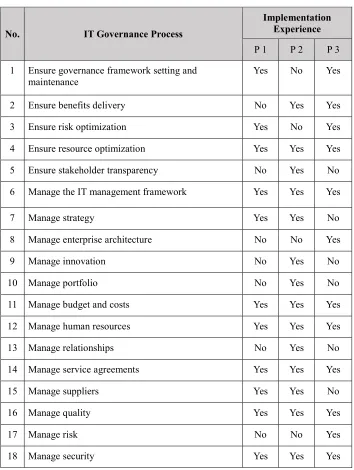
The first component, exposure, refers to a personal experience. In this study, exposure means each participant’s experience in adopting IT governance processes. All three participants were asked whether they had previously had any experience with implementing IT governance processes. The findings (Table 2) revealed that all of them had previously had experience on most IT governance processes.
As shown in Table 2, none of the three participants had experience in implementing all 18 of the IT governance processes. Seven of the processes (No. 4, 6, 11, 12, 14, 16, and 18), however, were implemented by all three. We asked each participant to explain in greater detail why his organization did not implement all of the processes. Following are their responses:
“Based on my experience, selecting these IT governance processes mostly depends on consultant’s recommendation. Big organizations in Thailand usually hire consultants from those audit firms. Consultants generally do the assessment of the current state, analyze the gap, prioritize the IT governance processes and determine which would be appropriate to the organization.” (Participant 1)
“From my viewpoint, organizations implemented many processes but not all. To adopt these processes, organizations have to put more effort into it.” (Participant 2)
International Journal of Business and Information Table 2
Participants’ Experience in Implementing IT Governance Processes
No. IT Governance Process
Implementation Experience
P 1 P 2 P 3 1 Ensure governance framework setting and
maintenance Yes No Yes
2 Ensure benefits delivery No Yes Yes
3 Ensure risk optimization Yes No Yes
4 Ensure resource optimization Yes Yes Yes
5 Ensure stakeholder transparency No Yes No
6 Manage the IT management framework Yes Yes Yes
7 Manage strategy Yes Yes No
8 Manage enterprise architecture No No Yes
9 Manage innovation No Yes No
10 Manage portfolio No Yes No
11 Manage budget and costs Yes Yes Yes
12 Manage human resources Yes Yes Yes
13 Manage relationships No Yes No
14 Manage service agreements Yes Yes Yes
15 Manage suppliers Yes Yes No
16 Manage quality Yes Yes Yes
17 Manage risk No No Yes
Volume 11, Number 1, March 2016
4.2. Component 2: Attention
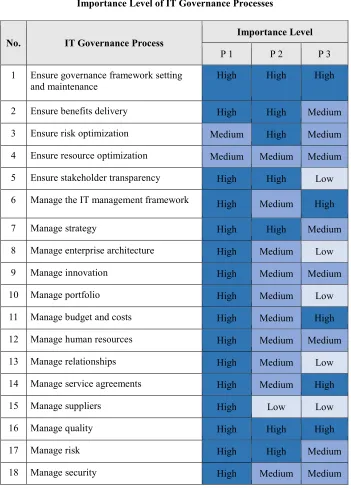
Attention occurs when a person gathers information and analyzes it thoroughly. Then, it becomes his or her own understanding. In this study, attention means understanding the degree of importance of the IT governance processes. The participants were asked to evaluate the importance level of each process. We used a 3-point Likert scale (high, medium, and low) to quantify the level of importance (Table 3). The results indicate that, overall, the importance of IT governance processes is at the high and medium levels. Two of the 18 processes (No. 1 and No. 16) were assigned high importance by all three participants. To enhance reliability, we asked each participant to explain why he ranked No. 16 (manage quality) as being of high importance. Following are their responses:
“I think Manage Quality process is highly important because software needs to be evaluated in order to improve quality and hardware always has to be managed to ensure availability as promised . . . .” (Participant 1)
“If organization sees IT as an essential part, IT quality is very important. However, which level to be implemented is another chapter . . . .” (Participant 2)
“Software quality is very important because business requirements tend to change from time to time. IT has the supporting role to serve the business needs. It has to guarantee the success rate of deployment . . . .” (Participant 3)
4.3. Component 3: Interpretation
International Journal of Business and Information Table 3
Importance Level of IT Governance Processes
No. IT Governance Process Importance Level
P 1 P 2 P 3
1 Ensure governance framework setting
and maintenance High High High
2 Ensure benefits delivery High High Medium
3 Ensure risk optimization Medium High Medium
4 Ensure resource optimization Medium Medium Medium
5 Ensure stakeholder transparency High High Low
6 Manage the IT management framework High Medium High
7 Manage strategy High High Medium
8 Manage enterprise architecture High Medium Low
9 Manage innovation High Medium Medium
10 Manage portfolio High Medium Low
11 Manage budget and costs High Medium High
12 Manage human resources High Medium Medium
13 Manage relationships High Medium Low
14 Manage service agreements High Medium High
15 Manage suppliers High Low Low
16 Manage quality High High High
17 Manage risk High High Medium
Volume 11, Number 1, March 2016
Table 4
Impact of IT Governance Processes on Business-IT Alignment
No. IT Governance Process
Impact on Business-IT Alignment
P 1 P 2 P 3
1 Ensure governance framework setting and
maintenance High High High
2 Ensure benefits delivery High Low High
3 Ensure risk optimization Medium Low High
4 Ensure resource optimization High Medium High 5 Ensure stakeholder transparency High High Medium
6 Manage the IT management framework High Medium High
7 Manage strategy High High Medium
8 Manage enterprise architecture High High Medium
9 Manage innovation High Low Medium
10 Manage portfolio High High Medium
11 Manage budget and costs High Low High
12 Manage human resources High Low Medium
13 Manage relationships High Medium Medium
14 Manage service agreements High Medium High
15 Manage suppliers High Low Low
16 Manage quality High Medium High
17 Manage risk High Low Medium
International Journal of Business and Information
4.4. Component 4: Response
Response occurs when a person makes a decision to select something by considering the information he or she has received. In this study, response indicate those factors related to selecting or making a decision to adopt IT governance processes. We asked open-ended questions and let each participant express his opinion about selection of IT governance processes. The interview transcripts were analyzed by coding method. We read through the responses to find patterns and grouped them into categories. Following are the findings and quotations from the participants.
Participant 1 said that IT governance process selection and implementation mostly depended on the firm size, strategy, structure, and industry.
“I am sure that small companies do not care much about IT governance process adoption. In contrast, large companies have to follow external rules and regulations. That is the reason why they have to be concerned about IT governance process implementation. From my point of view, organization size is one of the important factors to take into consideration in IT governance process selection . . . .” (Participant 1)
“Which IT governance process to be implemented are based on organization strategies because it is a direction for all business units . . . .” (Participant 1)
“Companies in banking and financial service industry have many rules and regulations. They need IT governance not only for IT but also for corporate governance . . . .” (Participant 1)
“The nature of organizations must also be considered in selecting IT governance processes to be implemented. If the company is an affiliate firm, its processes must be carried out in compliance with the regulations from the headquarters. In Thailand, however, small local companies do not care much about IT governance . . . .” (Participant 1)
Participant 2 believed that size was the direct factor to determine whether an organization would or would not implement the IT governance process. He said that industry is another factor that impacts IT governance implementation.
Volume 11, Number 1, March 2016
processes. For big firms to do business, they not only constantly change and grow their businesses but also compete all the time . . . .” (Participant 2)
“As a matter of fact, industry also determines whether it is appropriate to implement these IT processes. For example, Digital Company absolutely gives priority to IT, so it tends to give more IT budget . . . .” (Participant 2)
Participant 3 said that many factors are related to the selection of IT governance processes. Based on his experience, he said that size, structure, and industry are factors that should be taken into consideration in adopting the IT governance process.
“When company was small we had a small number of employees. We need only a few processes to control IT. As business grows, we need more internal process control to manage IT effectively and efficiently . . . .” (Participant 3)
“If organizations depend heavily on IT, as in the case of telecommunications and banking industries, IT has to be managed effectively with good governance . . . .” (Participant 3)
“Sometimes it depends on an organizational structure. If the company is managed as a family business, the driving force usually comes from what the company owner sees fit . . . .” (Participant 3)
In summary, this study found that four factors (size, strategy, structure, and industry) essentially influence the selection of IT governance processes. Based on the opinions expressed by the participants, we can define the terms as follows:
Size refers to the total number of employees in an organization.
Strategy means the organizational strategy that defines the direction of the organization.
Structure is a type of ownership structure that includes, for example, affiliate firms and family business firms.
Industry represents a sector of the economy, such as financial, service, technology, or property.
International Journal of Business and Information
5. DISCUSSION
The findings of this study answered all four of our research objectives. The first objective was to assess the implementation of each IT governance process. Our results show that all participants had implementation experience, but did not implement all IT governance processes at once. Instead, they selected and implemented only some of the processes. All participants were concerned with the importance of each process, as evidenced by the fact that they chose to evaluate each to a high degree.
The second research objective was to examine the importance level of each IT governance process with regard to the organization. Our findings concur with the results of scholarly studies that suggest the many benefits of IT governance particularly with regard to achieving business-IT alignment [8].
The third objective of our study was to evaluate the impact level of each IT governance process through business-IT alignment. We found that each process could be leveraged to business-IT alignment at various levels. We found that implementing all IT governance processes at the same time would highly affect organizational resources because such an effort would require much time, extra budget, and more manpower. We found, therefore, that it is necessary to select the appropriate IT processes for the organization.
These issues led us to address the fourth research objective, which was to identify factors that are related to the selection of IT governance processes. We identified four factors; namely, size, strategy, structure, and industry.
This research adapted perceptual components in order to interpret IT leadership perception. Perception concept is widely used in marketing by applying the relationship of perceptual components to encourage consumer response [30]. After analyzing the interrelation of the various results of the current study, we developed a bubble chart to represent relevant data pertaining to several components. In a bubble chart, the data points are replaced with bubbles and a data set is visualized in many dimensions.
Volume 11, Number 1, March 2016
is Participant 2, and red is Participant 3. The fourth dimension is the number embedded within each bubble, with indicates the number of IT governance processes implemented.
Figure 4. Population Size of IT Governance Implementation
As shown in the chart, Participant 1 (green) and Participant 3 (red) implemented IT governance processes at mostly the high impact/high importance level. Although Participant 2 (yellow) declared a fewer number of implemented processes at the high impact/high importance level, he had the largest number of IT governance processes spread across various levels. The overall picture is that the most implemented IT governance processes were at both the high impact and high importance level.
International Journal of Business and Information
6. CONCLUSION
This study achieved its main goal of interpreting the perspectives of the IT governance process based on perceptual components. It collected preliminary data and knowledge from IT decision makers with regard to the IT governance implementation experience, importance level, and impact level to business-IT alignment. The findings provide some initial insight into IT governance adoption for practitioners to exemplify their viewpoint of IT governance awareness. The study illustrates how to adapt the perception concept with regard to IT governance research, and could thus be of help to other IT governance researchers in extending this concept to describe other relevant topics in the field of IT governance.
We recognize the limitation in generalizability of this study because of the small number of participants in the data collection stage. To statistically generalize the findings, future research should expand the data collection phase to include more participants. Despite the limitation, however, our findings provide an interesting starting point for any future research in IT governance process selection.
REFERENCES
[1] Almeida R.; R. Pereira; and M.M. DaSilva. 2013. IT governance mechanisms -- A literature review, In Exploring Services Science, Vol. 143, Berlin Heidelberg: Springer.
[2] Bergeron F.; L. Raymond; and S. Rivard. 2004. Ideal patterns of strategic alignment and business performance, Information & Management 41: 1003-1020.
[3] Bharadwaj, A.S. 2000. A resource-based perspective on information technology capability and firm performance: An empirical investigation, MIS Quarterly: 169-196.
[4] Chan Y.E.; R. Sabherwal; and J.B. Thatcher. 2006. Antecedents and outcomes of strategic IS alignment: An empirical investigation, Engineering Management, IEEE Transactions 53: 27-47.
[5] Colbert J.L.; and P. Bowen. 1996. A comparison of internal control: COBIT, SAC, COSO and SAS, IS Audit and Control Journal: 26-35.
Volume 11, Number 1, March 2016
[7] De Haes, S., and W. Van Grembergen. 2009. An exploratory study into IT governance implementations and its impact on business/IT alignment, Information Systems Management 26: 123-137.
[8] De Haes, S., and W. Van Grembergen. 2015. Enterprise Governance of Information Technology -- Achieving Alignment and Value Featuring COBIT 5, 2nd ed.,
Switzerland: Springer International Publishing.
[9] Gacenga, F.; A. Cater-Steel; and M. Toleman. 2010. An international analysis of IT service management benefits and performance measurement, Journal of Global Information Technology Management 13: 28-63.
[10] Gibson, J.J. 1966. The Senses Considered as Perceptual Systems, Westport, Conn.: Greenwood Press.
[11] Hawkins, D., and D. Mothersbaugh. 2009. Consumer Behavior Building Marketing Strategy, 12th ed., New York: McGraw-Hill.
[12] Henderson, J.C., and N. Venkatraman. 1993. Strategic alignment: Leveraging information technology for transforming organizations, IBM Systems Journal 32: 4-16.
[13] ISACA. 2012. COBIT5 : Enabling Processes, Rolling Meadows, Ill.: ISACA. [14] ISACA. 2012. COBIT5: A Business Framework for the Governance and
Management of Enterprise IT, Rolling Meadows, Ill.: ISACA..
[15] IT Governance Institute (ITGI). 2003. Board Briefing on IT Governance, 2nd ed.,
Information Technology Governance Institute.
[16] Kearns, G.S., and A.L. Ledere. 2000. The effect of strategic alignment on the use of IS-based resources for competitive advantage, The Journal of Strategic Information Systems 9: 265-293.
[17] Ko, D., and D. Fink. 2010. Information technology governance: An evaluation of the theory-practice gap, Corporate Governance 10: 662-674.
[18] Korac-Kakabadse, N., and A. Kakabadse. 2001. IS/IT governance: Need for an integrated model, Corporate Governance 1: 9-11.
[19] Larsen, M.H.; M.K. Pedersen; and Andersen K. Viborg. 2006. IT governance: Reviewing 17 IT governance tools and analysing the case of Novozymes A/S, System Sciences, Proceedings of the 39th Hawaii International Conference on
Systems Sciences, pp. 195c-195c.
International Journal of Business and Information [21] Marrone, M.; L. Hoffman; and L.M. Kolbe. 2010. IT executives' perception of
COBIT: Satisfaction,business-IT alignment and benefits, AMCIS: 216.
[22] Niederman, F.; J.C. Brancheau; and J.C. Wetherbe. 1991. Information systems management issues for the 1990s, MIS Quarterly 15: 475-500.
[23] Patel, N.V. 2002. Emergent forms of IT governance to support global e-business models, Journal of Information Technology Theory and Application 4: 33-48. [24] Payne, N. 2003. IT governance and audit, Accountancy SA: 35-36.
[25] Ridley, G.; J. Young; and P. Carroll. 2004. COBIT and its utilization: A framework from the literature, Proceedings of the 37th Hawaii International Conference on
Systems Sciences.
[26] Sabherwal, R,. and Y.E. Chan. 2001. Alignment between business and IS strategies: A study of prospectors, analyzers, and defenders, Information Systems Research 12: 11-33.
[27] Samithisomboon, S., and W. Chantatub. 2013. Understanding IT governance frameworks adoption in Thailand, International Conference on Commerce, e-Administration, e-Society, e-Education, and e-Technology, Kitalyushu, Japan. [28] Samithisomboon, S., and W. Chantatub. 2014. An exploration of IT governance
processes adoption in Thailand, International Conference on Commerce, e-Administration, e-Society, e-Education, and e-Technology, Nagoya, Japna. [29] Shergill, H.K. 2012. , Experimental Psychology, PHI Learning Ltd.
[30] Solomon, M.; R. Russell-Bennett; and J. Previte. 2012. Consumer Behaviour, Pearson Higher Education AU.
[31] Uhl-Bien, M.; J.R. Schermerhorn Jr.; and R.N. Osborn. 2013. Organizational Behavior, Wiley Global Education.
[32] Van Grembergen, W.; S. DeHaes; and I. Amelinckx. 2003. Using COBIT and the balanced scorecard as instruments for service level management, Information Systems Control Journal 4: 56-62.
[33] Van Grembergen, W.: S. DeHaes; and E. Guldentops. 2004. Structures, processes, and relational mechanisms for IT governance, Strategies for Information Technology Governance 2: 1-36.
[34] Weill, P., and J.W. Ross. 2004. IT governance on one page, CISR WP, 349. [35] Weill P., and R. Woodham. 2002. Don't just lead, govern: Implementing effective
Volume 11, Number 1, March 2016
[36] Wessels E., and J. Loggerenberg. 2006. IT governance: theory and practice, Conference on Information Technology in Tertiary Education, Pretoria, South Africa, Citeseer.
[37] Winniford M.; S. Conger; and L. Erickson-Harris. 2009. Confusion in the ranks: IT service management practice and terminology, Information Systems Management 26:. 153-163.
ABOUT THE AUTHORS
Sakuna Samithisomboon is a Ph.D. student in the Information Technology in Business Program, Chulalongkorn Business School, Chulalongkorn University, Bangkok, Thailand. She graduated with a master’s degree in management information system (MIS) from Chulalongkorn University and a bachelor’s degree in applied statistics from King Mongkut's Institute of Technology Ladkrabang. Her Ph.D. study focuses on IT management and the IT governance framework.
![Figure 1. COBIT Process Reference Model [13]](https://thumb-us.123doks.com/thumbv2/123dok_us/8391349.1682319/6.504.72.428.148.427/figure-cobit-process-reference-model.webp)
![Figure 2. Components of Perception Process [30]](https://thumb-us.123doks.com/thumbv2/123dok_us/8391349.1682319/8.504.72.434.482.592/figure-components-perception-process.webp)