Keywords
Highlights
Abstract
Graphical abstract
33
Research Paper
Received 2018-02-02 Revised 2018-07-14 Accepted 2018-07-24 Available online 2018-07-24
Polyurethane
Gas separation membranes TiO2/SiO2
MMMs
• The effect of SiO2 and TiO2 nanoparticles on the gas separation
performance of the polyurethane (PU) membranes investigated.
• The fabricated membranes characterized by FTIR, SEM and DSC analyses.
• Permeability of membranes measured using CO2, CH4, N2 and O2 gases.
• SiO2 and TiO2 increase permeability of all gases when used
separately or in combination.
Polyurethane Mixed Matrix Membranes for Gas Separation: A Systematic Study on Effect of
SiO
2/TiO
2Nanoparticles
1 Caspian Faculty of Engineering, College of Engineering, University of Tehran, Tehran, Iran 2 Department of Chemical engineering, Isfahan University of Technology, Isfahan, 84156-83111, Iran
3 Membrane Research Laboratory, School of Chemical Engineering, College of Engineering, University of Tehran, Tehran, Iran 4 Department of Chemical and Biological Engineering, University of Ottawa, Ottawa, Ontario, Canada K1N 6N5
Manijeh Azari Monsefi
1, Morteza Sadeghi
2,*, Mohammad Ali Aroon
1,3, Takeshi Matsuura
4Article info
© 2019 MPRL. All rights reserved.
* Corresponding author at: Phone: +983133915645; fax: +983133912677 E-mail address: [email protected] (M. Sadeghi)
DOI: 10.22079/JMSR.2018.80692.1175
1. Introduction
In order to overcome polymeric membranes permeability-selectivity trade-off [1], mixed matrix membranes (MMMs) have developed for gas separation applications [2-10]. In the MMM concept, inorganic particles (e.g. zeolites, silica, alumina, titanium dioxide, carbon molecular sieves, and carbon nanotubes) are distributed uniformly inside the polymer matrix
to use their excellent separation properties along with the processability and flexibility of polymers [2, 4, 6-11]. Among the different permeable or impermeable inorganic materials used for MMMs fabrication, Silica nanoparticles have been used extensively in different polymer matrix (polyimide, polyamide, polyurethane, polysulfone, polybenzimidazole, ethyl
Journal of Membrane Science & Research
journal homepage: www.msrjournal.com
In this study, the effect of SiO2 and TiO2 nanoparticles on the gas separation performance of the polyurethane (PU) membranes has investigated. Polyurethanes were synthesized by bulk
two step polymerization of polytetramethyleneglycol (PTMG)/polycaprolactone (PCL): isophorone diisocyanate (IPDI)/hexamethylene diisocyanate (HMDI): 4,4'-methylenebis(2-chloroaniline) (MOCA) in mole ratios of 1:3:2. Silica nanoparticles were synthesized using the sol-gel method by hydrolysis of tetraethoxysilane (TEOS) while commercial TiO2
nanoparticles were used. The neat PU membrane and PU-SiO2, PU-TiO2 and PU-SiO2-TiO2 flat sheet asymmetric mixed matrix membranes (MMMs) were fabricated by phase
inversion and characterized by Fourier transform infrared (FTIR) spectroscopy, scanning electron microscopy (SEM) and differential scanning calorimetry (DSC) analyses. Although SEM observation showed uniform distribution of SiO2 and TiO2 nanoparticles inside the polymer matrix, agglomerated nanoparticles were observed at high silica contents in the
MMMs of different SiO2/TiO2 ratios. Permeability of membrane samples were measured using pure CO2, CH4, N2 and O2 as test gases. The experimental results revealed that SiO2 and TiO2 could increase permeability of all gases when used separately or in combination. It was shown that when SiO2 and TiO2 were added in combined form, the separation
performance of MMMs could be improved significantly; either permeability increased up to 120 barrer or CO2/N2 selectivity up to 34, although the individual effect of SiO2 and TiO2
on the selectivity of gas pairs was different.
vinyl acetate) because of their great effect on separation properties (especially on gas selectivity), mechanical strength and thermal stability of the polymeric membranes [11-22]. For example, Pinnau et al. [22] showed that silica particles would increase the gas permeability of polysulfone membranes significantly.
In addition to silica, the researchers showed that TiO2 impermeable
nanoparticles can also affect gas separation properties of polymeric membranes drastically [23-26]. In our recent research, we prepared PU/TiO2
MMM and evaluated its gas separation properties. Our results showed that TiO2 nanoparticles could enhance the gas separation performance of the PU
membranes [23]. Hu et al. [26] fabricated the polyimide/TiO2 MMMs using
sol-gel method and reported a significant increase in gas selectivity of test gases. Matteuci et al. [24] also studied the gas separation properties of poly(1-trimethylsilyl-1-propyne)/TiO2 nanocomposite membranes and showed at
high TiO2 loadings the permeability of N2, O2 and CO2 gases increased by
nearly four times.
In MMMs fabrication, in addition to inorganic particles, which play an important role in separation and morphological properties of the resultant membranes, selection of polymer matrix, is also a key parameter. Although researchers used different kinds of glassy and rubbery polymers for MMMs preparation, rubbery polyurethanes have seldom used despite their unique properties that can be used in gas separation membranes development [27-29]. They are block copolymers consisting of urethane, or urea, hard segments and polyol soft segments. It has shown by some researchers that, gas permeability of polyurethane membranes increases as the hard segment decreases and the soft segment increase [30, 31]. Furthermore, the chemical nature of polyols and chain extenders in polyurethane polymers not only can affect crystallinity, density and the glass transition temperature of the polymer but also can change phase separation behavior, morphology and gas separation properties of the prepared membranes directly [32-38].
The effect of type and length of chain extenders, type, length and content of the soft and hard segments; the effect of the urethane and urea groups; different types of polyol, diisocyanate and chain extenders and also the effect of silica nanoparticles on morphology and separation properties of polyurethane membranes have been studied by our group earlier [14, 36, 39-40]. In the present work, the interaction effects of TiO2 and SiO2 on
separation performance of PU (PTH) membranes (separately or in combination) has studied to find theirsynergic effects on each other.
2. Experimental
2.1. Materials
Polytetramethylene-glycol (PTMG, Mw=2000 g mole-1) was purchased
from Arak petrochemical complex (Arak, Iran). Polycaprolacton (PCL, Mw = 2000 g mole-1) was supplied by Perstorp Co. Hexamethylene diisocyanate
(HMDI), isophorone diisocyanat (IPDI), 4,4'-methylenebis(2-chloroaniline) (MOCA), Tetraethylorthosilicate (TEOS), hydrochloric acid (HCl), ethanol (EtOH), 3-glycidyloxypropyltrimethoxysilane (GOTMS) and N-dimethylformamide (DMF) were supplied by Merck. TiO2 nano-powder with
nominal size of 10-15 nm was purchased from TECNAN Co. CO2, N2 and O2
gases (purity 99.99%) were purchased from Ardestan Gas Co. (Tehran, Iran) and CH4 (purity 99.99%) was obtained from air Products Co. (Tehran, Iran).
2.2. Polyurethane synthesis
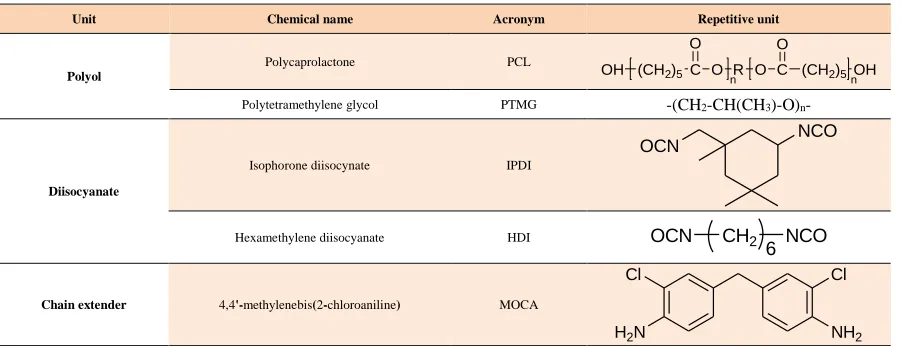
Polyurethane (PU) was synthesized by bulk two-step polymerization method as described elsewhere [33]. Briefly, PTMG or PCL has incubated with HMDI or IPDI for 2 h at 85-90ºC under nitrogen atmosphere to obtain macro-diisocyanate pre-polymer. The chain extension of pre-polymer has performed by addition of MOCA at room temperature. In order to obtain linear polymer, the molar ratio of NCO:OH was kept constant at 1:1. The molar ratios of the used components were as follows: PTMG (or PCL): IPDI (or HMDI): MOCA = 1:3:2. Table 1 shows the chemical properties and molecular structures of the materials which have been used for polyurethane synthesis. Table 2 represents the structure and thermal properties of synthesized polyurethanes.
2.3. Preparation of neat and mixed matrix membranes
Polyurethane membranes were fabricated by the solution casting solvent evaporation technique. Polyurethanes were dissolved in DMF at 70 °C to obtain a 10 wt.% homogenous solution. Then the polymer solution (dope) was poured in a petri dish and heated at 65 °C for 24 h. The obtained film was then dried in a vacuum oven at 70 °Cfor further 5 h to complete solvent removal.
To fabricate the TiO2–polyurethane mixed matrix membranes, TiO2
nano-particles were well mixed in DMF by agitation with a stirrer, and the mixture was further sonicated for 15 minutes in an ultrasonic bath to obtain a white homogenous suspension. Then a predetermined amount of polymer (PU) was dissolved in DMF and the resulting polymeric solution was added to the TiO2/DMF suspension gradually. The polymer/nanoparticle mixture
was well stirred overnight to produce a homogeneous polymeric solution containing nanoparticles. Polyurethane/TiO2 mixed matrix membranes
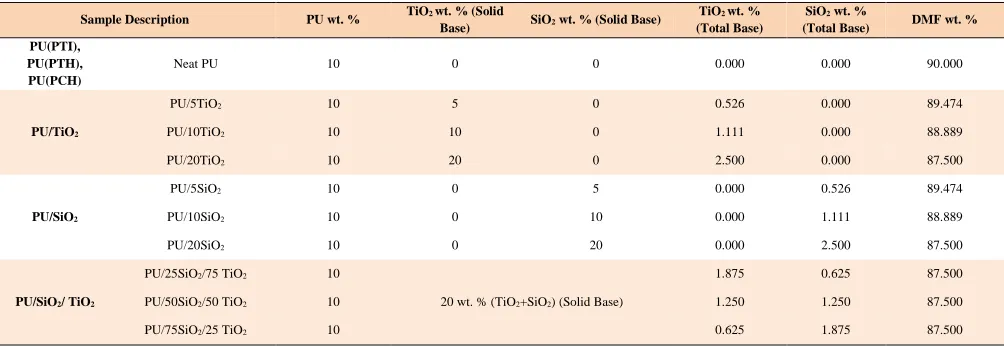
fabrication technique was the same as described earlier for the neat polymeric membrane fabrication. Table 3 presents dope compositions containing TiO2
nanoparticles.
The silica (SiO2) nanoparticles were synthesized by using sol-gel method
as follows: Tetraethylorthosilicate (TEOS, 25 g) and 3-glycidyloxypropyltrimethoxysilane (GOTMS, 4g) as coupling agent was added to 30 ml ethanol (EtOH) and mixed at 70 °Cfor 1 hr. Then a mixture of 30 ml EtOH, 7.5 g H2O and 0.83 g HCl was added drop wise to the
TEOS/GOTMS/EtOH solution and mixed under vigorous stirring at 70 °C for 1 hr to form a clear silica sol. The silica content in the silica sol was determined by evaporating a predetermined amount of silica sol in an oven.
Silica-polyurethane suspensions were prepared by mixing different ratios of the silica sol and polyurethane-DMF solution (Table 3 for composition). It is necessary to note that during solution preparation, ethanol is evaporated and silica remains as solid inorganic dispersed phase in the polyurethane-DMF solution. Silica–polyurethane mixed matrix membranes fabrication technique was the same as described earlier for neat polymeric membrane fabrication.
Table 1
Chemicals used as the polyol, diisocyanate, and chain extenders in this study.
Repetitive unit Acronym
Chemical name Unit
OH (CH2)5C O
O R n O C
O
(CH2)5nOH
PCL Polycaprolactone
Polyol
-(CH2-CH(CH3)-O)n-
PTMG Polytetramethylene glycol NCO OCN IPDI Isophorone diisocynate Diisocyanate
OCN
CH
2NCO
6
HDI Hexamethylene diisocyanate
Cl
H2N NH2
Cl
MOCA 4,4'-methylenebis(2-chloroaniline)
Table 2
Structure and thermal properties of the synthesized polyurethanes.
Sample Code Components Molar Ratio Glass Transition Temperature (°C)
PU(PTI) PTMG-IPDI-MOCA 1:3:2 -79
PUP(PTH) PTMG-HMDI-MOCA 1:3:2 -79.9
PU(PCH) PCL-HMDI-MOCA 1:3:2 -60.8
Table 3
Dope compositions of membrane samples
Sample Description PU wt. % TiO2 wt. % (Solid
Base) SiO2 wt. % (Solid Base)
TiO2 wt. %
(Total Base)
SiO2 wt. %
(Total Base) DMF wt. %
PU(PTI), PU(PTH), PU(PCH)
Neat PU 10 0 0 0.000 0.000 90.000
PU/TiO2
PU/5TiO2 10 5 0 0.526 0.000 89.474
PU/10TiO2 10 10 0 1.111 0.000 88.889
PU/20TiO2 10 20 0 2.500 0.000 87.500
PU/SiO2
PU/5SiO2 10 0 5 0.000 0.526 89.474
PU/10SiO2 10 0 10 0.000 1.111 88.889
PU/20SiO2 10 0 20 0.000 2.500 87.500
PU/SiO2/ TiO2
PU/25SiO2/75 TiO2 10
20 wt. % (TiO2+SiO2) (Solid Base)
1.875 0.625 87.500
PU/50SiO2/50 TiO2 10 1.250 1.250 87.500
PU/75SiO2/25 TiO2 10 0.625 1.875 87.500
SiO2–TiO2–PU dopes were prepared by mixing different ratios of the
silica sol with TiO2-DMF suspension and PU-DMF solution. Table 3 shows
composition of polymeric solutions containing different amounts of TiO2
nanoparticles and SiO2 sol. It is necessary to note that the nanoparticles (SiO2
sol+TiO2) content was kept constant at 20 wt.% (solid base) while the weight
ratios of silica sol/ TiO2 were set at 25/75, 50/50 and 75/25 (wt./wt.). SiO2–
TiO2 polyurethane MMM fabrication technique was as described earlier for
neat and mixed matrix membranes.
2.4. Membrane characterization
2.4.1. FTIR spectroscopy
A BIO-RAD FTS-7 Fourier Transform Infrared spectroscopy was used to characterize the polyurethane (PU) and PU/SiO2, PU/TiO2 and PU/SiO2/TiO2
mixed matrix membranes at room temperature.
2.4.2. Thermal analysis
Thermal properties of the membrane samples were analyzed by differential scanning calorimeter (DSC) using Metler-Toledo DSC 822 at heating rate of 5 °C /min and the temperature range of -120 to 300 °C.
2.4.3. Scanning electron microscopy (SEM)
Morphology of the neat polymeric and mixed matrix membranes and dispersion of nanoparticles (SiO2+TiO2) inside the membrane were
investigated using scanning electron microscopy (SEM: KYKY EM3200). All samples were cut in liquid nitrogen and coated by gold/palladium before scanning.
2.4.4. Gas permeation test
Permeabilities of the membranes were measured by using pure O2, N2,
CH4 and CO2 as test gases at 10 barg of feed pressure and room temperature.
A constant pressure permeation cell with effective membrane area 13.2 cm2
was used.Eq. 1 was used to calculate the gas permeability of penetrants.
(1)
where P is permeability in Barrer (1 Barrer = 10-10 cm3 (STP).cm.cm-2.s-1
cmHg-1), q is penetrant volumetric flow rate (cm3(STP)/s), l is the membrane
thickness (cm), p1 and p2 are the absolute pressures of the feed side and
permeate side, respectively (cmHg) and A is the effective membrane area(cm2). The ideal selectivity, αA/B, of membranes was calculated by using
Eq. 2.
αA/B=PA/PB (2)
where PA and PB are the permeabilities of penetrants A and B respectively.
3. Results and discussion
3.1. Pure polyurethane membrane characterization
3.1.1. FTIR results
Figure 1 a shows FTIR spectra of the polyurethanes synthesized by using two different types of polyol (PTMG and PCL) and two different diisocyanates (IPDI and HMDI) and MOCA as the chain extender. As shown in Figure 1a, NCO absorption peak (at 2270 cm-1) is not observable in the
spectrum of all the synthesized polyurethanes; PUs (e.g. PU(PTH), PU(PTI) and PU(PCH)), which implies the completion of the polymerization reaction. The N-H stretching vibration of urethane occurs at 3313 cm-1 (for all PUs).
The peaks at 1620-1670 cm-1 and 1730 cm-1 can be attributed to bonded and
free carbonyl groups, respectively. The peak that appears at 1112-1106 cm-1is
also attributed to urethane ether linkage.
Properties of the polyurethanes (PUs) are mostly affected by the amount and micro-phase separation of the hard and soft segments [30]. On the other hand, change of the polyurethane components can affect the micro-phase separation of hard and soft segments. Therefore, the properties of the polyurethanes are directly affected by their components. Hence, in this work the effect of polyol on the structure and micro-phase separation of PUs was investigated by using two different kinds of polyols (PTMG and PCL) to find the better structure to prepare the MMM. As shown in Figure 1b, the absorption peaks of carbonyl groups in PTMG containing polyurethane (PU(PTH)) and PCL containing polyurethane (PU(PCH)) are different. It is necessarty to note that diisocyanate agent (hexamethylene diisocyanate (HMDI)) and chain extender (4,4'-methylenebis (2-chloroaniline) (MOCA))
are the same in these two synthesized polymers.
containing PU (PU (PTH)) is higher than its free form (1730 cm-1). While in
PCL containing PU (PU (PCH)), the free carbonyl group has an intensive peak and its bonded one is not distinctive. This effect is attributed to the formation of strong hydrogen bond between carbonyl groups and NH groups in urethane linkage of hard segments in the PTMG based polyurethane (PU (PTH)), which leads to higher phase separation in polymer. The hydrogen bonding index (HBI), the ratio of carbonyl bonds, of the studied polymers was calculated (by using Eq. 3) to examine the phase interaction.
(3)
where AC=O,bonded and AC=O,free are the absorbance of bonded and free carbonyl
groups respectively.
The results revealed that PU (PTH) showed higher HBI value (HBI=2) than that (HBI=0.26) of PU(PCH). Existence of polar ester groups in PU (PCH) increase the capacity of hydrogen bonding between C=O groups in soft segments and NH groups in hard segments, which leads to higher phase mixing in this polymer. While PTMG containing PU, because of lack of C=O groups in its repeat unit, cannot create intersegmental hydrogen bonds as much as PU (PCH). Therefore the phase separation in PU (PTH) is more than that of PU(PCH).
To evaluate the effect of diisocyanate agent on phase behavior of PUs, two samples of PTMG based polyurethanes containing two different kinds of diisocyanates (HMDI and IPDI) were studied. As shown in Figure 1c, the absorption peak of free carbonyl group for HMDI containing polyurethane (PU(PTH)) shifted to the lower frequencies. Also, it should be noted that the bonded carbonyl's peak broadened toward lower frequencies. This phenomenon can be attributed to existence of linear aliphatic diisocyanate (HMDI) which can create more hydrogen bonds in hard segments and thus causes further micro-phase separation, whereas the IPDI containing polyurethane (PU (PTI)) has less ability to micro-phase separation because of cyclic structure of IPDI [36].
3.1.2. DSC results
Glass transition temperature (Tg) of polymeric membranes is a criterion to evaluate the chain mobility of polymers. Usually chain mobility increases as glass transition temperature decreases and vice versa. Hence, thermal properties and chain mobility of the pure polyurethane membranes synthesized in this work were analyzed by DSC results. Glass transition temperature of PU (PTH), PU (PCH) and PU(PTI) is reported in Table 2.
As shown in Table 2, glass transition temperatures (Tg) of PTMG containing PUs(PU(PTI) and PU(PTH)) are nearly the same (-79 and -79.9
oC) while glass transition temperature of the PCL containing PU (PU(PCH));
-60.8 °C; is higher than that of PTMG containing PUs. This confirms that the
chain mobility of the PCL containing PU is less than that of PTMG containing PUs. As discussed earlier in FTIR results, PTMG containing PUs undergo more phase separation in their hard and soft segments, which leads to a higher chain mobility of PTMG soft segments in polymer. Therefore, the DSC results are in accordance with the FTIR results. Considering above discussions, one can conclude that in contrast to diisocyanate agents (e.g. IPDI and HMDI), polyols (here PTMG and PCL) can affect thermal properties of polyurethane drastically.
Fig. 1. (a)FTIR spectra of pure polyurethanes, (b) FTIR spectra of PU(PTH) and PU(PCH) in the carbonyl stretching range, (c) FTIR spectra of PU(PTH) and PU(PTI) in the carbonyl stretching range.
Table 4
Gas separation properties of PUs.
Pressure (barg)
Permeability (Barrer) Ideal selectivity
CO2 CH4 O2 N2 αCO2/N2 αCO2/CH4 αO2/N2
PU(PTH)
4 85.76 10 9.96 3.72 23.05 8.57 2.67
6 88.7 10.41 9.17 3.51 25.27 8.52 2.61
8 83.4 10.63 8.92 3.17 26.31 7.84 2.81
10 89.79 11.79 9.43 3.23 27.80 7.61 2.92
PU(PTI)
4 59.56 6.8 7 2.2 27.07 8.75 3.18
6 60.53 7.36 6.9 2.3 26.32 8.22 3
8 61.5 7.5 7.1 2.88 21.35 8.2 2.46
10 62.07 7.63 7.15 2.86 21.70 8.13 2.5
PU(PCH)
4 40.57 2.67 3.81 1.16 34.97 15.19 3.28
6 43.17 2.81 3.60 1.06 40.73 15.36 3.39
8 43.59 3.4 3.93 1.1 39.63 12.82 3.57
3.1.3. Gas permeation test results
Separation properties of neat polyurethane membranes (PU(PTH), PU(PTI) and PU(PCH)) were investigated at 30 °C and 4-10 barg using pure O2, N2, CO2 and CH4 as test gases. As shown in Table 4, the gas permeability
of the PU(PTH) membrane is higher than that of the PU(PCH) membrane. This can be due to the polyol and the diisocyanate used to synthesize this polymer. As discussed earlier and confirmed by FTIR and DSC results, in comparison to PCL, using PTMG as polyol can increase the phase separation between soft and hard segments, which implies higher chain mobility and greater penetrant diffusivity and permeability. Also gas permeability of HMDI containing polyurethane (PU(PTH)) is more than IPDI containing one (PU(PTI)). This effect is in accordance with FTIR and DSC results and can be explained by comparing diisocyanate structure of the PU(PTH) and PU(PTI). As discussed earlier in FTIR results, changing diisocyanate structure from aromatic (IPDI) to aliphatic (HMDI), increases the hydrogen bonds in hard segments and thus causes further micro-phase separation, which leads to an increase in chain mobility, a decrease in glass transition and an increase in gas penetrants permeability. Table 4 shows the PCL containing polyurethane membrane has the highest selectivity for all gas pairs under consideration (CO2/N2, CO2/CH4 and O2/N2). It can be interpreted by the least phase
separation behavior and the least chain mobility of the PU(PCH) membranes. Although the decrease in chain mobility will decrease the permeabilities of both small and large penetrants, the latter permeability is affected more strongly (see Table 4, columns 2-5), yielding higher selectivities for the gas pairs (small/big). In other words, since the chain mobility of soft segments of the PCL containing PU is lower than the other ones, PU(PCH) membrane acts as the membrane of the highest selectivity and is expected to separate gas pairs most effectively (Table 4, columns 6-8). In order to select the best polyurethane for further investigation of mixed matrix membrane, CO2/N2
selectivity and CO2 permeability of the synthesized polyurethanes were
depicted on Robeson’s upper bound plot (revisited 2008) [1]. As shown in Figure 2, among different polyurethanes synthesized in this work, PU (PCH) and PU (PTH) are located closest to Robeson’s upper bound. Between these two polyurethanes, PU (PTH) was selected for MMMs fabrication due to its higher permeability.
3.2. Mixed matrix membranes characterization
3.2.1. PU (PTH)-TiO2MMMs characterization
Chemical properties of the pure titanium dioxide (TiO2), PU(PTH)
membrane and TiO2 containing MMMs were characterized by FTIR analysis.
The results are shown in Figure 3a.
As could be observed in Figure 3a, an intensive peak is observable at 600
cm-1 which can be interpreted by Ti-O-Ti asymmetric stretching in pure
titanium dioxide. This peak is also distinguishable in MMMs spectra (except pure PU(PTH)). Figure 3a shows that the band at 600 cm-1 increases as TiO
2
content in MMMs increases and it can be attributed to the presence of a broad band associated with the vibration of the Ti-O-Ti bond.
Further investigation on the effect of TiO2 nanoparticles on PU(PTH)
polyurethane chemical structure was done by FTIR analysis of the N-H stretching region of the PU(PTH) and PU(PTH)-TiO2 membranes.
As could be observed in Figure 3b, the urethane N-H groups of the MMMs shifted to the lower frequencies in the presence of TiO2. This is
probably due to the formation of hydrogen bonding between hydrogen donner NH groups and hydrogen acceptor (e.g. Ti-O-Ti and Ti-O-H) in TiO2
nanoparticles. The hydrogen bonding enhances the adhesion between the nanoparticles (TiO2) and polymer matrix [18].
Morphology and distribution of nanoparticles (TiO2) inside the polymer
matrix of a mixed matrix membrane (PU(PTH)-TiO2 20wt.%)) was
investigated by scanning electron microscopy (SEM). Figure 4(a,aa) shows the cross sectional SEM micrographs of the PU(PTH)-TiO2 20 wt.% mixed
matrix membrane.
Fig. 2. CO2/N2 separation property of different synthesized polyurethanes in comparison to Robeson’s upper bound.
Fig. 3. (a) FTIR spectra of PU(PTH),TiO2 and PU(PTH)-TiO2 membranes (5, 10 and 20 numbers represent TiO2 wt. % (solid base) in the MMMs), (b) FTIR spectra of PU(PTH) and
Fig. 4. (a,aa) SEM cross-sectional microphotographs (different magnifications) of the PU(PTH)-TiO2 20 wt.% MMM, (b,bb) Cross sectional SEM micrographs of the PU(PTH)-SiO2 20 wt. % MMMs.
As shown in Figure 4a, the fabricated mixed matrix membrane is dense and completely symmetric, and no voids or defects are distinguishable between polymer matrix and nanoparticles. High magnification cross-sectional SEM (see Figure 4aa) shows good distribution of TiO2
nanoparticles. It is necessary to note that the agglomerates of TiO2
nanoparticles are hardly observable inside the polymer matrix (see Figure 4aa). This is due to the enhanced adhesion between the polymer chains and TiO2 nanoparticles as proved earlier by FTIR analysis.
Figure 4(b, bb) shows the SEM micrographs of PU(PTH)-SiO2 MMM
containing 20 wt.% SiO2.
As shown in Figure 4b, fabricated membrane is totally dense and symmetric. Good distribution of SiO2 nanoparticles in the polymer matrix is
distinguishable at high magnification images (see Figure 4bb). 10000 times magnification (see Figure 4bb) obviously demonstrates the presence of nano-sized SiO2 particles in the polymer matrix. In contrast to MMM containing TiO2 nanoparticles, agglomerated silica particles in polymer are also
observable at high magnification micrographs. This phenomenon can be due to the lower interaction between SiO2 and polymer chains, in comparison to
TiO2 distribution in polymer.
DSC analysis was carried out to investigate the thermal properties of the PU(PTH) and PU(PTH)-TiO2 and PU(PTH)-SiO2 and PU(PTH)-SiO2
(50)-TiO2(50) membranes. Table 5 presents the glass transition temperature of the
PU(PTH) and PU(PTH)-TiO2 and PU(PTH)-SiO2 and PU(PTH)-SiO2
(50)-TiO2(50) membrane samples.
As shown in Table 5, glass transition temperatures of the mixed matrix membranes are nearly equal to or lower than that of the neat polyurethane membrane. This indicates that the mobility of chains in soft domains increased by TiO2 loading in polymer matrix, which can be caused by either
the increase of phase separation and lower soft-hard chain interactions [22, 42]. As it already discussed, in SEM and FTIR results, because of the hydrogen bonds between NH groups of urethane and TiO2 nanoparticles, a
strong interaction between nanoparticles and polymer chains is formed in hard domains. This interaction and proper distribution of nanoparticles inside the polymer increase the phase separation of hard and soft domains, which can lead to increase the free volume in polymer. The increase of free volume provides more space for chain motion and ultimately results in the decrease of glass transition temperature [16, 22]. The interaction between NH groups of
urethane and TiO2 nanoparticles decreases the available NH groups required
for formation of hydrogen bonding with ethereal groups of soft segments, hence the soft segments mobility increases due to the decrease of hydrogen bonds with hard segments and subsequently leads to the decrease of the glass transition temperature of polymer. The DSC results and decrease in the glass transition temperature of the MMMs containing nanoparticles are consistent with FTIR analysis, which showed the interactions between TiO2 and NH
groups of urethane and enhanced phase separation of hard and soft segments. Permeabilities of the PU(PTH) and PU(PTH)-TiO2 membrane samples
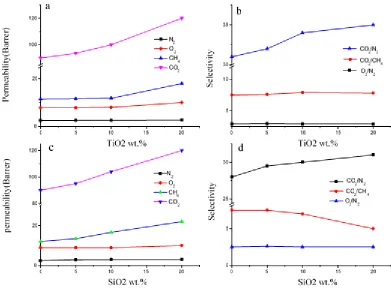
were measured at 10 barg and 30 °C using pure nitrogen, methane, oxygen and carbon dioxide as test gases. Figure 5 shows gas permeability of the neat PU(PTH) and TiO2 containing PU(PTH) membranes as a function of TiO2
content.
As could be observed in Figure 5, permeability of CO2 is considerably
higher than that of the other gases in all membrane samples. It can be due to the high condensability, the small kinetic diameter, and more interaction of this polar gas with polar groups in the polymer [15, 17].
Table 5
Glass transition temperature of the PU (PTH) and PU (PTH)-TiO2 and PU(PTH)-SiO2 and PU(PTH)-SiO2(50)-TiO2(50) membrane samples.
Sample description Glass transition temperature (°C)
PU(PTH) -79.1ºC
PU (PTH)- TiO2(5wt.%) -83.3ºC
PU (PTH)-TiO2 (20wt. %) -80ºC
PU (PTH)-SiO2 (5 wt. %) -81.1
PU (PTH)-SiO2 (20 wt. %) -79.9
Fig. 5. (a) Gas permeability of the neat PU(PTH) and PU(PTH)-TiO2 membranes,(b) Ideal selectivity of the neat PU(PTH) and PU(PTH)-TiO2 membranes, (c) Gas permeability of the
PU (PTH) and PU (PTH)-SiO2 membranes, (d) Ideal selectivity of PU(PTH) and PU(PTH)-SiO2 membranes.
Moreover, methane permeability is higher than that of oxygen and nitrogen despite of its bigger kinetic diameter. This phenomenon is due to the higher condensability of methane in comparison with nitrogen and oxygen gases. Therefore, one can confirm that the dominant mechanism for gas permeation through rubbery polymers (PU(PTH)) is solution mechanism as discussed elsewhere [28].
Figure 5a shows that permeability of the penetrants increases as TiO2
content increases in MMMs. For example permeabilities of the N2, O2, CH4
and CO2 increase by 14 %, 11 %, 17 % and 24 % respectively as TiO2 content
increases from zero to 20 wt. %. This can interpret as follows. As it already discussedin FTIR analysis, more soft and hard segment phase separation is expected due to polar interactions between TiO2 nanoparticles and -NH
groups in hard segments, weakening the intermolecular hydrogen bonds. Phase separation makes the polymer chain segment more mobile, which results in a decrease in glass transition temperature and an increase in gas permeabilities.
Among different gases, permeability of CO2 increases more than the other
gases most likely because:
1. The interaction between residual OH groups on the surface of TiO2
nanoparticles and CO2 increases its solubility in mixed matrix membrane.
2. TiO2 nanoparticles in the polymer matrix increase free volume in the region
surrounding the nanoparticles, which allows CO2 of the smallest
molecular size to diffuse readily through the membrane matrix.
Figure 5b shows ideal selectivity of the PU(PTH) polymeric membranes containing different amounts of TiO2 nanoparticles.
As shown in Figure 5b, CO2/N2 selectivity increases as TiO2 content
increases while the selectivities of CO2/CH4 and O2/N2 are nearly constant.
The increase in CO2/N2 selectivity can be due to the small molecular size of
CO2 and its high solubility in membranes, caused by its interactions with polar
OH groups on TiO2 surface. On the other hand, CO2/CH4 and O2/N2 selectivity
remains nearly constant most likely due to the similar thermodynamic behaviour of the gaseous components involved in each gas pair [41]. That is, both CO2 and CH4 are condensable while O2 and N2 are non-condensable.
Moreover, the effects of TiO2 nanoparticles on their permeabilities are nearly
the same.
3.2.2. PU(PTH)-SiO2 MMMs characterization
FTIR spectra of the PU(PTH) and the PU(PTH)-SiO2membranes are
presented in Figure 6a. The most intensive peak at 1107 cm-1 in Figure 6a
represents the Si-O-Si asymmetric stretching in the PU(PTH)-SiO2 mixed
matrix membranes. Also symmetrical vibrations peak of Si-O-Si at 820 cm-1 is
observable in all MMMs.
To investigate the interaction between silica nanoparticles and PU(PTH) polymer, N-H stretching regions were studied more in detail. As shown in Figure 6b the most intensive peak at 3342 cm-1 for PU(PTH), which
represents N-H stretching, shifts gradually as the SiO2 content increases and
reaches finally 3325 cm-1. This phenomenon can be attributed to the
formation of hydrogen bonding between N-H groups in PU(PTH) hard segment and OH groups on silica nanoparticle surfaces. Therefore, one can expect a good distribution and dispersion of silica nanoparticles in polymer matrix [18].
As shown in Table 5, glass transition temperature (Tg) of MMMs containing 5 and 20 wt. % SiO2 nanoparticles are slightly lower than that of
neat PU(PTH) membrane. The decreases in Tg of the MMMs can be attributed
to the increase in polymer chains mobility. As was discussed earlier, SiO2
nanoparticles can form hydrogen bonds with NH groups of PU(PTH) and it causes a suitable distribution of SiO2 nanoparticles inside the polymer matrix.
The good distribution of SiO2 nanoparticles inside the polymer and their
Fig.6: (a)FTIR spectra of PU(PTH) and PU(PTH)-SiO2 membranes (5, 10 and 20 numbers represent SiO2 wt. % (solid base) in the MMMs), (b) The FTIR spectra at N-H stretching region for PU(PTH)-SiO2 MMMs (5, 10 and 20 numbers represent SiO2 wt. % (solid base) in the MMMs).
Permeabilities of N2, O2, CH4 and CO2 gases through PU(PTH) and
PU(PTH)-SiO2 membranes were measured at 30 °C and 10 barg. The
permeability results are shown in Figure 5c.
As shown in Figure 5c, permeability of CO2 is higher than that of the
other gases. As mentioned earlier the high permeability of CO2 is due to its
small kinetic diameter and its high condensability. In addition, interaction between this polar gas (CO2) and polymer polar groups and OH groups on
silica nanoparticle surfaces makes CO2 more permeable.
As could be observed in Figure 5c, permeabilities of all test gases increase as silica content increases in MMMs. For example, permeabilities of N2, O2, CH4 and CO2 gases in the PU (PTH) membrane containing 20 wt.%
SiO2 are, respectively, 22 %, 15%, 112% and 36% more than those in neat
PU(PTH) membrane. Gas permeability increased by incorporation of SiO2
nanoparticles for the same reason as incorporation of TiO2 nanoparticles.
The greater permeability increase of condensable gases (CO2 and CH4)
than non-condensable ones (N2 and O2) by the addition of SiO2 nanoparticles
is also for the same reason as the addition of TiO2 nanoparticles.
Ideal selectivity of PU(PTH) and PU(PTH)-SiO2 membrane samples is
presented in Figure 5d. As could be observed in the Figure 5d, in comparison to the neat PU(PTH) membrane, selectivities of CO2/N2 in MMMs containing
silica nanoparticles increase as silica contents increase. O2/N2 selectivity of
the MMMs is also higher than that of the neat PU (PTH). In contrast to PU(PTH)-TiO2 MMMs, PU(PTH) containing SiO2 nanoparticles have
CO2/CH4 selectivities less than that of neat PU(PTH) membrane. The increase
in CO2/N2 selectivity can be due to the smallest molecular size of CO2, its
high solubility and its interaction with the functional groups of polymer and SiO2 nanoparticles as discussed earlier. As shown in Figure 5d, the CO2/CH4
selectivity increases slightly as SiO2 increases by 5 wt.% and then it decreases
as the nanoparticle content increases from 5 to 20 wt.%. The increase in permeability of CH4 and the decrease in CO2/CH4 selectivity in MMMs
containing a large amount of SiO2 nanoparticles are attributed to the
agglomeration of SiO2 nanoparticles (as discussed earlier in SEM results) and
the formation of Knudsen size interfacial voids around them. The slight increase in O2/N2 selectivities of the MMMs from silica content of 0 to 5 wt.%
is most likely because of the non-condensability behavior of O2 and N2 gases,
which makes their separation to be controlled by their molecular size. On the other hand, the diffusion pathways in the polymer matrix, which increases as silica content increase, control the diffusivity of penetrants in the MMMs. Therefore the smaller molecule (O2) diffuses more rapidly than the larger one
(N2) and O2/N2 selectivity of PU(PTH) membrane increases by addition of
SiO2 nanoparticles to the polymer matrix. As well, The O2/N2 and CO2/CH4
selectivities decrease when the silica loading becomes as high as 20 wt. %. This can be attributed to SiO2/PU(PTH) interface defects which likely create
small voids at the polymer-nanoparticle interface.
3.2.3. PU(PTH)-TiO2-SiO2 MMMs characterization
As shown in Figure 7, both TiO2 and SiO2 nanoparticles can improve gas
separation properties of PU(PTH) membranes. Therefore one can expect that combination of TiO2 and SiO2 nanoparticles also improve performance of
PU(PTH) membranes.
Figure 7 shows that PU(PTH) MMMs containing 20 wt. % TiO2 and SiO2
nanoparticles have the best performance (e.g. the highest permeability and selectivity) for CO2/N2 separation. Hence 20 wt. % (solid base) nanoparticles
(TiO2 +SiO2) loading is chosen for further discussion to investigate the
interaction effects of TiO2 and SiO2 on separation properties of PU(PTH)
membranes. It is necessary to note that although the total nanoparticles (TiO2
+SiO2) content was kept constant at 20 wt. % various SiO2/TiO2 ratios (25/75,
50/50 and 75/25 wt. %/wt. %) were used.
FTIR spectra of PU(PTH) and PU(PTH)-TiO2-SiO2 membrane samples
are shown in Figure 8a. As could be observed (see Figure 8a), the most intensive peak at the frequency of 1109 cm-1 represents the asymmetric
Si-O-Si bonds in the MMMs. In addition, the peak at 600 cm-1 is attributed to TiO 2
nanoparticles in the PU(PTH)-TiO2-SiO2 MMMs. It is obvious that this peak
is intensified as the TiO2 content increases in the membranes.
As shown in Figure 8b, there is no notable change between the NH spectrums of the three prepared membranes.
Fig. 8. (a) FTIR spectra of PU(PTH) and PU(PTH)-SiO2-TiO2 membranes, (b) FTIR spectra at N-H stretching region for PU(PTH) and PU(PTH)-SiO2-TiO2 membranes.
This implies that effect of TiO2 and SiO2 nanoparticles on polymer matrix
is the same and they are mutually exchangeable inside the polymer chains. However, as discussed earlier in FTIR results of the PU(PTH)-TiO2 and
PU(PTH)-SiO2 MMMs, shift of the NH peak to the lower frequency occurred
in the membranes containing TiO2 and SiO2 nanoparticles, which can be
attributed to the hydrogen bonds between polar groups of Si-OH and Ti-OH in the nanoparticles and NH groups in the polymer. This phenomenon reflects the proper distribution and good dispersion of the nanoparticles in the polymer matrix.
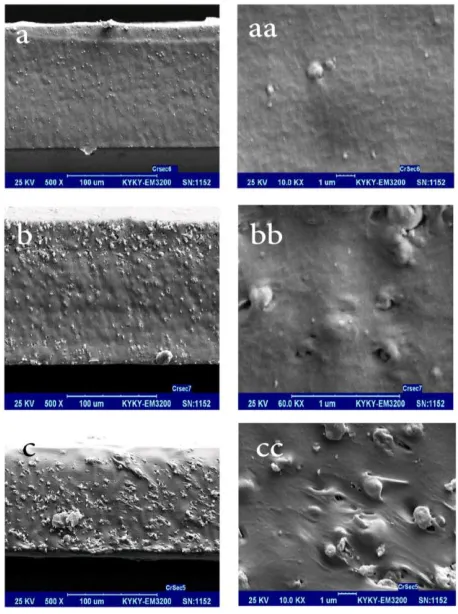
Scanning electron microscope (SEM) was used for morphology observation of MMMs. Figure 9 shows SEM micrographs of the PU(PTH)-TiO2-SiO2 MMMs. As shown in Figure 9, the fabricated MMMs are
symmetric. Well-dispersed TiO2 and SiO2 nanoparticles in the polymer matrix
are observable at high-magnified images of the MMMs containing low nanoparticle loading. In particular, by investigating the high magnification micrographs of the MMMs with different SiO2/TiO2 ratios, it is obvious that
agglomeration of nanoparticles takes place and interfacial voids appear more at the higher silica content. It can be due to SiO2-SiO2 interactions that most
likely are stronger than the SiO2-TiO2 and SiO2–polymer chains interactions.
As presented in Table 5, glass transition temperature of the PU(PTH)-SiO2(50)-TiO2(50) MMM is slightly less than the neat PU(PTH) membrane.
The decrease in the glass transition temperature can be due to the increased chain mobility of the polymer surrounding the embedded nanoparticles.
Gas permeability of the PU(PTH) and PU(PTH)-SiO2-TiO2 membranes
were measured at 10 barg and 30 °C using pure O2, N2, CH4 and CO2 gases.
As shown in Figure 10, gas permeability of all test gases in the MMMs are higher than those in the pure PU(PTH) membrane.
The increase in gas permeability of MMMs containing SiO2-TiO2
nanoparticles can be due to the void spaces formed at the polymer/particle interface and the increased free volumes around the embedded nanoparticles that enhanced polymer chain mobility as discussed already in the earlier sections. As shown in Figure 10, permeabilities of all test gases increase as SiO2/TiO2 ratio increases and the PU(PTH)-SiO2(75)-TiO2(25) sample has the
maximum gas permeability values. This effect can be due to the behaviour of silica nanoparticles inside the polymer matrix.
Ideal selectivity of the PU(PTH) and PU(PTH)-SiO2-TiO2 membranes is
presented in Figure 11. As could be observed in Figure 11, CO2/CH4, CO2/N2
and O2/N2 selectivities of PU(PTH)-SiO2-TiO2 MMMs remain nearly
constant with only slight increase from the neat PU(PTH). This is most likely because the total nanoparticle solid contents that are kept constant in all MMMs. From the above experimental results, one can conclude that the SiO2
and TiO2 nanoparticles have no synergic effect on each other but they behave
rather in their own ways. Usually SiO2 nanoparticles tend to increase
permeability more than TiO2 while TiO2 nanoparticles increase selectivity
more than SiO2. Therefore, one can improve both permeability and selectivity
of MMMs by combining these nanoparticles, as shown in Figure 12 for CO2/N2 separation.
4. Conclusions
In this study, three different polyurethanes have synthesized by using two different types of polyol (PTMG and PCL) and two different diisocyanates (IPDI and HMDI) with MOCA as the chain extender. Among those, PTMG containing polyurethane (PU(PTH)) membrane was used for further investigation because of its intrinsically high permeability. The effect of incorporation of SiO2 and TiO2 nanoparticles on the gas separation and
morphological properties of PU(PTH) membranes was further investigated. Silica nanoparticles have synthesized by sol-gel method while commercial TiO2 nanoparticles were used. The fabricated mixed matrix membranes
(MMMs) have characterized by using FTIR, SEM and DSC. FTIR and SEM results proved that SiO2 and TiO2 nanoparticles are well-dispersed inside the
polymer matrix (except at high silica contents in the MMMs containing different SiO2/TiO2 ratios). DSC analysis showed that the nanoparticles
loading decreases the glass transition temperature of MMMs. Gas permeabilities of the neat PU(PTH) and PU(PTH)-TiO2, PU(PTH)-SiO2 and
PU(PTH)-TiO2-SiO2 membranes were measured at 10 barg and 30oC by using
pure oxygen, nitrogen, carbon dioxide and methane as test gases. The results showed that the permeabilities of all test gases in the MMMs were higher than those in the neat PU(PTH) membrane. However, the effect of nanoparticles on the selectivity of fabricated MMMs was different. Effect of nanoparticle contents on performance of PU(PTH) membranes was also investigated and it was found that addition of 20 wt. % (solid base) of both TiO2 and SiO2 to
PU(PTH) matrix could increase permeabilities of all test gases drastically without sacrificing their selectivities.
Nomenclatures
Mw [g mol-1] Molecular weight
P [Barrer] permeability
q [cm3s-1] penetrant volumetric flow rate
l [cm] membrane thickness
p1 [cmHg] absolute pressures of the feed side
p2 [cmHg] absolute pressures of the permeate side
A [cm2] effective membrane area
αA/B ideal selectivity
PA [Barrer] permeabilities of penetrants A
PB [Barrer] permeabilities of penetrants B
HBI hydrogen bonding index
AC=O,bonded absorbance of bonded
AC=O,free free carbonyl groups Tg [oC] Glass transition temperature
PU(PCH) PCL containing PU
PU (PTH) PTMG based polyurethane
Fig. 9: (a, aa)Cross sectional SEM micrographs of PU(PTH)-SiO2(25)-TiO2(75) MMMs, (b, bb) Cross sectional SEM micrographs of PU(PTH)-SiO2(50)-TiO2(50) MMMs, (c, cc) Cross sectional SEM micrographs of PU(PTH)-SiO2(75)-TiO2(25) MMMs.
Fig. 10. Gas permeability of the PU (PTH) and PU (PTH)-SiO2-TiO2 membrane samples.
Fig. 11. Ideal selectivity of the PU (PTH) and PU (PTH)-SiO2-TiO2 membrane samples.
Fig. 12. CO2/N2 separation properties of PU(PTH) MMMs containing SiO2, TiO2 and SiO2-TiO2 nanoparticles on Robeson’s upper bound plot.
References
[1] L. M. Robeson, The upper bound revisited, J. Membr. Sci. 320 (2008) 390-400. [2] R.W Baker, E.L.Cussler, Membrane separation systems- Recent developments and
future directions, 1st ed., William Andrew Publishing/Noyes, New Jersey, USA,
1991.
[3] H. Rabiee, S. Meshkat Alsadat, M. Soltanieh, S.A. Mousavi, A. Ghadimi, Gas
permeation and sorption properties of
poly(amide-12-b-ethyleneoxide)(Pebax1074)/SAPO-34 mixed matrix membrane for CO2/CH4 and
CO2/N2 separation, J. Ind. Eng. Chem. 27 (2015) 223-239.
[4] M. Arruebo, J. Coronas, M. Menéndez, J. Santamarı́a, Separation of hydrocarbons
from natural gas using silicalite membranes , Sep. Purif. Technol. 25 (2001) 275-286.
[5] R.W. Baker, Membrane technology and applications, 2nd ed., John Wiley & Sons,
Inc., England, 2004.
[6] T.T. Moore, R. Mahajan, D.Q. Vu, W.J. Koros, Hybrid membrane materials comprising organic polymers with rigid dispersed phases, AIChE. J. 50 (2004) 311-321.
[7] T.T. Moore, W.J. Koros, Non-ideal effects in organic–inorganic materials for gas separation membranes, J. Mol. Struct. 739 (2005) 87-98.
[8] A. Dehghani Kiadehi, A. Rahimpour, M. Jahanshahi, A.A. Ghoreyshi, Novel carbon nano-fibers (CNF)/polysulfone (PSf) mixed matrix membranes for gas separation, J. Ind. Eng. Chem. 22 (2015) 199-207.
[9] D. Bastani, N. Esmaeili, M. Asadollahi, Polymeric mixed matrix membranes containing zeolites as a filler for gas separation applications: A review, J. Ind. Eng. Chem. 19 (2013) 375-393.
[10] M.A. Aroon, A.F. Ismail, T. Matsuura, M.M. Montazer-Rahmati, Performance studies of mixed matrix membranes for gas separation: A review, Sep. Purif. Technol. 75 (2010) 229-242.
[11] J. Bae, J. Lee, C.S. Park, O.S. Kwon, C.S. Lee, Fabrication of photo-crosslinkable polymer/silica sol–gel hybrid thin films as versatile barrier films, J. Ind. Eng. Chem. 38 (2016) 61-66.
[12] M. Naghsh, M. Sadeghi, A. Moheb, M.P. Chenar, M. Mohagheghian, Separation of ethylene/ethane and propylene/propane by cellulose acetate–silica nanocomposite membranes, J. Membr. Sci. 423-424 (2012) 97-106.
[13] S.M. Davoodi, M. Sadeghi, M. Naghsh, A. Moheb, Olefin–paraffin separation
performance of polyimide Matrimid®/silica nanocomposite membranes, RSC Adv.
6 (2016) 23746-23759.
[14] M. Sadeghi, M.M. Talakesh, B. Ghalei, M.R. Shafiei, Preparation, characterization and gas permeation properties of a polycaprolactone based polyurethane-silica nanocomposite membrane, J. Membr. Sci. 427 (2013) 21-29.
[15] M. Moaddeb, W.J. Koros, Gas transport properties of thin polymeric membranes in the presence of silicon dioxide particles, J. Membr. Sci. 125 (1997) 143-163. [16] T.C. Merkel, B.D. Freeman, R.J. Spontak, Z. He, I. Pinnau, P. Meakin, A.J. Hill,
Ultrapermeable, reverse-selective nanocomposite membranes, Science 296 (2002) 519-522.
[17] D.W. Lee, B.R. Yoo, Advanced silica/polymer composites: Materials and
applications, J. Ind. Eng. Chem. 38 (2016) 1-12.
[18] J.H. Kim, Y.M. Lee, Gas permeation properties of poly(amide-6-b-ethylene oxide)–
silica hybrid membranes, J. Membr. Sci. 193 (2001) 209-225.
[19] C. Joly, S. Goizet, J.C. Schrotter, J. Sanchez, M. Escoubes, Sol-gel polyimide-silica
composite membrane: Gas transport properties, J. Membr. Sci. 130 (1997) 63-74.
[20] I. Pinnau, Z. He, Filled superglassy membrane, US Patent 6 316 684, 2001. [21] Z. He, I. Pinnau, A. Morisato, Nanostructured poly(4-methyl-2-pentyne)/silica
hybrid membranes for gas separation, Desalination 146 (2002) 11-15.
[22] J. Ahn, W.J. Chung, I. Pinnau, M.D. Guiver, Polysulfone/silica nanoparticle mixed-matrix membranes for gas separation, J. Membr. Sci. 314 (2008) 123-133. [23] M. Sadeghi, H.T. Afarani, Z. Tarashi, Preparation and investigation of the gas
separation properties of polyurethane-TiO2 nanocomposite membranes, Korean J.
[24] S. Matteucci, V.A. Kusuma, D. Sanders, S. Swinnea, B.D. Freeman, Gas transport
in TiO2 nanoparticle-filled poly(1-trimethylsilyl-1-propyne), J. Membr. Sci. 307
(2008) 196-217.
[25] Y. Kong, H. Du, J. Yang, D. Shi, Y. Wang, Y. Zhang, W. Xin, Study on
polyimide/TiO2 nanocomposite membranes for gas separation, Desalination 146
(2002) 49-55.
[26] Q. Hu, E. Marand, S. Dhingra, D. Fritsch, J. Wen, G. Wilkes,
Poly(amide-imide)/TiO2 nano-composite gas separation membranes: Fabrication and
characterization, J. Membr. Sci. 135 (1997) 65-79.
[27] H. Xiao, Z. H. Ping, J.W. Xie, T.Y. Yu, Permeation of CO2 through polyurethane, J.
Appl. Polym. Sci. 40 (1990) 1131-1139.
[28] P.M. Knight, D.J. Lyman, Gas permeability of various block copolyether-urethanes, J. Membr. Sci. 17 (1984) 245-254.
[29] N. Cao, M. Pegoraro, F. Bianchi, L. Di Landro, L. Zanderighi, Gas transport properties of polycarbonate–polyurethane membrance, J. Appl. Polym. Sci. 48 (1993) 1831-1842.
[30] A. Wolińska-Grabczyk, Effect of the hard segment domains on the permeation and separation ability of the polyurethane-based membranes in benzene/cyclohexane separation by pervaporation, J. Membr. Sci. 282 (2006) 225-236.
[31] A. Pournaghshband, B. Ghalei, R. Bagheri, Y. Kinoshita, H. Kitagawa, E. Sivaniah, M. Sadeghi, Polyurethane gas separation membranes with ethereal bonds in the hard segments, J. Membr. Sci. 513 (2016) 58-66.
[32] J.M. Yang, H.T. Lin, S.J. Yang, Evaluation of poly(N-isopropylacrylamide) modified hydroxyl-terminated polybutadiene based polyurethane membrane, J. Membr. Sci. 258 (2005) 97-105.
[33] A. Wolińska-Grabczyk, A. Jankowski, Gas transport properties of segmented polyurethanes varying in the kind of soft segments, Sep. Purif. Technol. 57 (2007) 413-417.
[34] A. Wolińska-Grabczyk, W. Bednarski, A. Jankowski, S. Waplak, Permeable domains of segmented polyurethanes studied with paramagnetic spin probe, Polymer, 45 (2004) 791-798.
[35] L.S. Teo, J.F. Kuo, C.Y. Chen, Study on the morphology and permeation property of amine group-contained polyurethanes, Polymer, 39 (1998) 3355-3364. [36] E. Ameri, M. Sadeghi, N. Zarei, A. Pournaghshband, Enhancement of the gas
separation properties of polyurethane membranes by alumina nanoparticles, J. Membr. Sci. 479 (2015) 11–19.
[37] H.B. Park, Y.M. Lee, Separation of toluene/nitrogen through segmented polyurethane and polyurethane urea membranes with different soft segments, J. Membr. Sci. 197 (2002) 283-296.
[38] M. Khoshkam, M. Sadeghi, M. Pourafshari, M. Naghsh, M.J. Namazifard, M.R. Shafiei, Synthesis, characterization and gas separation properties of novel copolyimide membranes based on flexible etheric–aliphatic moieties, RSC Adv. 6 (2016) 35751-35763.
[39] A. Khosravi, M. Sadeghi, H. Zare and M. Talakesh, Polyurethane-Silica
Nanocomposite Membranes for Separation of Propane/Methane and
Ethane/Methane, Ind. Eng. Chem. Res. 53 (2014) 2011-2021.
[40] A. Pournaghshband, M. Sadeghi, A.H. Saeedi, M.A. Aravand, Enhancement of the gas separation properties of polyurethane membrane by epoxy nanoparticles, J. Ind. Eng. Chem. 44 (2016) 67-72.
[41] T.T. Moore, W.J. Koros, Gas sorption in polymers, molecular sieves, and mixed matrix membranes, J. Appl. Polym. Sci. 104 (2007) 4053–4059.
[42] H.F. Naguib, M.S. Abdel Aziz, G.R. Saad, Synthesis, morphology and thermal properties of polyurethanes nanocomposites based on poly(3-hydroxybutyrate) and organoclay, J. Ind. Eng. Chem. 19 (2013) 56-62.
[43] S. Pourjafar, A. Rahimpour, M. Jahanshahi, Synthesis and characterization of PVA/PES thin film composite nanofiltration membrane modified with
TiO2nanoparticles for better performance and surface properties, J. Ind. Eng. Chem.