GSJ: Volume 7, Issue 10, October 2019, Online: ISSN 2320-9186 www.globalscientificjournal.com
RELATIVE EFFECTIVENESS OF ASSERTIVENESS TRAINING AND SELF MANAGEMENT TECHNIQUES ON SHYNESS AMONG SECONDARY SCHOOL STUDENTS
IN ANAMBRA STATE
Ogugua, G.U. (Ph.D) Dell International School,
Asaba, Delta State &
Professor Nwokolo, C. (Ph.D)
DEPARTMENT OF GUIDANCE AND COUNSELLING,
NNAMDI AZIKIWE UNIVERSITY, AWKA, ANAMBRA STATE, NIGERIA &
NWOYE, J. A. National Gallery of Art Igboukwu, Anambra State
ABSTRACT
This study sought to determine the relative effectiveness of assertiveness training and self -management techniques on shyness among secondary school students in Aguata L.G.A of Anambra State. Five research questions guided the study and five null hypotheses were tested at 0.05 level of significances. The design for the study was a quasi- experimental. The population of students with shyness was 1355. A sample of 120 students with shyness were selected for the study, and purposive sampling technique was used in choosing three schools in the area of the study. Cheek and Melichor shyness questionnaire was used for data collection. Cheek & Melichor shyness questionnaire have both validity and reliability index of 0.93 that was established by Zanab in 2010. Mean scores were used in answering the seven research questions and ANCOVA was used in testing the seven null hypotheses at 0.05 level of significance. The findings of the study showed that assertiveness training technique was slightly more effective than self-management technique in treating students‟ shyness. Also there was no significant difference in the effectiveness of assertiveness training and self-management techniques on secondary school students‟ shyness. Recommendations included that the use of assertiveness training technique and self -management technique should commence in full force in secondary schools irrespective of students‟ gender and age as a way of reducing students ‟ shyness.
Background to the Study
Many students have found themselves in a situation where they feel a little worried about meeting new people or being in an unfamiliar situation. Shyness according to Buss (2005) is an inhibition and awkwardness in a social situation, particularly in situations with unfamiliar people. Durmus (2007) sees shyness as a character trait, an attitude or a state of inhibition. Leary (2009) defines shyness as an affective-behaviour syndrome characterized by public apprehension and interactive reticence which results from the viewpoint or existence of others in an interpersonal assessment. Leary further posits that shyness is completely a social occurrence, and that it should be defined as together social anxiety and self-consciousness. It may range from insignificant social clumsiness to totally inhibiting social phobia. The responses for shyness can occur at any of the following levels; cognitive, affective, physiological and behavioural.
Subsequently, shyness is fundamentally an inescapable emotion, specified that it is directly related to many aspects of human nature, Pilkonis (2013), like many other emotions, shyness is learned in social relationships and experienced mostly in connection to others. Shyness is most likely to occur during unfamiliar situations, though in severe cases it may hinder an individual in his or her most familiar situations and relationships as well. In addition, shyness may manifest when one is in the company of certain people and completely disappear when with others. For example, one may be outgoing with friends and family but feels shy when in the presence of authority figures. An extreme case of shyness is identified as a psychiatric illness. In 2013, the new edition of Diagnostic and Statistical Manual of Mental Disorders (DSM- V) listed shyness as „social phobia‟ and described it as rare (Lane, 2008). However, the DSM -IV, which was published in 2013 in the month of March, listed it as “Social Anxiety Disorder” in parentheses and described it as relatively common, affecting between 3% and 13% of the population at some point during their lifetime (American Psychiatric Association, 2013).
According to Ahmad, Zeb, Ullah and Ali (2013), shyness is a highly deciding factor in the overall developmental process of a child. This factor can potentially harm or help a student in his/her social life. For example, students with high level of shyness may have complicated the relationship with peers or teachers. Even such students create problems for parents at home.
Although there is nothing wrong with shyness in itself, as it is an aspect of personality, the fact remains that school, along with many other social situations, can be torturous for inhibited/shy students. Furthermore, communication is central to learning in classrooms, shy students can be disadvantaged from an educational perspective (Oakley 2007). Hence, shyness can be painful for both parents and students. Parents, however, need to realize that some children are just born to be quiet and less outgoing than other children who are extrovert, therefore, it is important for parents to see whether a child‟s shyness is becoming a problem and interfering with his/her daily life situations such as problems with school and social interactions. Also, Findlay (2009) reports that despite knowing that shyness is a threat factor for psychosocial disturbance in childhood and that shyness is connected with greater internalizing difficulties and lower well-being, less is known about the conceptual mechanisms that may underlie these associations. The causes of shyness have not been demonstrated adequately to justify any firm statements on the issue. Muqaddas, Samra Muhammad, and Fazalur (2011) observes that some children are dispositional shy: they are more probable than other children to respond to new social situations with shy behaviour. Even these children, however, may show shyness only certain kinds of in social encounters. Shy children tend to engage in significantly less social misbehaviour than other children. This may occur because shy children care so much about what others contemplate of them.
Moreover, Dupper (2011) describes a number of factors that may contribute to the feeling of loneliness and problematic shyness in young children which include moving to a new school or neighborhood, losing a friend , losing an object or possession, experiencing the divorce of parents, experiencing the death of a pet or significant person being rejected by peers, lacking the social skills to make friends or possessing personal characteristics as shyness, anxiety and low self-esteem that contribute to the difficulty in making friends.
Thus, it may be more socially acceptable for females than males to be shy. Although few teachers may prefer to have shy behaviours in their classroom because the classroom can be more orderly (Bosacki, & Rose-Krasnor, 2011); these researchers view shy students as less capable of performing at a high level compared to their less shy peers. Shyness has a major effect on internalizing behaviours for students. For instance, they are much more likely to experience anxiety disorders (Kasper, 2012).
Consequently, shyness is not a problem for the environment of a shy person, but for the shy person. So, in the study of Sanson (2008) it was found that at 9 to 12 children experience more shyness than peers between the age of 13 to 17, that is shyness is not connected with negative characteristics in general, but it was connected with the absence of externalizing problems (aggression and hyperactivity) and with the presence of internalizing problems (shyness, anxiety and stress). Gilmartin (2014) found a connection between shyness and negative relationships with peers. Approximately 88% of the extremely shy men, who were included in his research, were mistreated and abused in childhood and adolescence. The leaning institution is also a place of much distress for shy students, as such shy student manifest the following behavioural sign of shyness, they are unwilling to interact with peers, and they also feel shy when interacting with their peers (Hughes & Coplan, 2010). There are many expectations for students to actively participate in classes; shy students will feel anxious when such expectations are placed on them. Bosacki and Rose-Krasnor (2011) argues that class instructors hold lower expectations for shy students. Not only do they believe that shy students cannot obtain high grades, many teachers hold stereotypes that shy children have inferior cognitive abilities. They expect shy students to lack the skills necessary for performing well in the classroom.
punitive measure to compel students with shyness behaviour to be active in the teaching -learning process. But it does not reduce the shyness of the students rather it makes them feel threatened about their selves. Despite attempt made by other researchers to reduced shyness among secondary school student, it has not yielded the desired result. The researcher is interested in determining the relative effectiveness of assertiveness training and self- management techniques on shyness among secondary school students in Aguata local government area of Anambra State, Nigeria.
The word assertiveness is used to describe behaviour which helps individuals to communicate clearly the wants, needs and feelings to other people without abusing their rights as human beings. It is not about 'getting what you want' all the time, but about negotiating life without constant anxiety or lack of self-confidence. Assertiveness training technique lie at the heart of good interpersonal communication and poor assertiveness can lead to the development of a variety of problems. If one is unable to say 'no' to other people, the individual runs the risk of being overwhelmed by their demands. If one fail to speak up for himself, express personal feelings or thoughts then they are unlikely to feel comfortable, thus resulting to shyness. However, in the opinion of William (2008), assertiveness is the quality of being self-assured and confident without being shy or aggressive. In the field of psychology and psychotherapy, it is a learnable skill and mode of communication. Assertiveness training technique involves respect for the boundaries of oneself and others. It also presumes an interest in the fulfillment of needs and wants through cooperation. Speer (2005), opined that assertiveness training techniques emphasizes expressing feelings forthrightly, but in a way that will not spiral into aggression. In the course of this study, assertiveness training technique will be defined as being open and confident in expressing one‟s desire in an appropriate manner and techniques.
Self-management technique, is a counselling technique that has been used to modify behavioural problems. Self-management technique is a cognitive therapy which emphasises cognitive restructuring. The technique was based on the Social Cognitive Theory developed by Bandura (1986) which provided a theoretical basis for the development of model of self-regulated learning in which personal contextual and behavioural factors interact in such a way that gives students an opportunity to control their learning. Bandura went on to describes self-management learning as an active and constructive process whereby learner set goals for their learning, plan actions, monitor, regulate and control their cognition, and behaviour.
Self- management technique represent an individual exerting control over some aspect of his or her decision making and selected behaviour. To do this, the person must define specific behaviour related to identified goals and take appropriate actions. Clore and Gaynor (2006) research on the effect of self-management technique on distressed college students with low self-esteem and depressive symptoms. Strategies, such as self- monitoring, self -reward and self- recording are examples of contingency based self- management procedures.
In the same vein, self-management is referred to as individual abilities, regardless of how they were acquired and does not specify a relationship with healthcare providers: self-management refers to the individual‟s ability to manage the symptoms, treatment, physical and psychosocial consequences and life style changes inherent in living with a chronic condition. Efficacious self-management encompasses ability to monitor one‟s condition and to effect the cognitive, behavioral and emotional responses necessary to maintain a satisfactory quality of life.
This was why the researcher was motivated to use the two techniques;(Assertiveness training and self Management techniques in order to find out the one that would be more effective on shyness among secondary school students in Anambra state. It is against this background that the researcher is motivated to determine the relative effectiveness of assertiveness training and self -management techniques on shyness among secondary school students in Aguata Local Government Area of Anambra state.
Statement of the Problem
socially with peers and teachers. These situations bring about high levels of shyness for some secondary school students with shyness. Shyness is a risk factor for psychosocial maladjustment in secondary schools among students and that shyness is connected with greater internalizing difficulties and lower well-being. Within the school systems, various attempt have being made by school personnel in dealing with students that exhibit shyness. One of such approaches include punitive measures such as, corporal punishment, rustication and expulsion, which have not yielded the desired result. This technique being utilized by the teacher is behaviourally based, it does not curtail erroneous cognition responsible for shyness among secondary school students.
Despite numerous effort made by the previous researcher in finding a lasting solution to the problem of shyness, among secondary school students, the problems no doubts still posed serious challenges to guidance counsellors and other allied professionals in seeing that an effective solution to the problem is realized. To achieve this, something needs to be done to curtail this problem. Also, many researchers in the bid to provide solution to the problem or amerliorating this situation of shyness among secondary school students have used some techniques. For instance Scott (2006) used cognitive behavioural therapy to treat shyness among secondary school students but the problem of shyness still exist among students. Despite efforts made by various stakeholders, the problem of shyness is not totally solved. Thus if this trend is not addressed and checked, it will totally hinder the students from adjusting to the school setting. The above scenario no doubt reveals the urgent need for a more permanent and practically effective solution to shyness among secondary school students.
This has necessitated this study, that intend to determine the relative effectiveness of two techniques; Studies have shown that a lot has been done to the effect of assertiveness training and self- management techniques in handling shyness but none of the existing work from available literature have indicated the relative effectiveness of the two techniques on shyness among secondary school students in Aguata Local Government Area of Anambra state. This is why, it is paramount for the researcher to embark on this study, to bridge the gap in the literature that exist in this area of the study. Hence, the choice of a relative effectiveness of assertive training technique and self -management technique on shyness among secondary student in the area.
Scope of the Study
government area of Anambra State. The independent variables of this study were assertiveness training technique and self management technique while shyness among secondary school students was the dependent variable. The scope was also limited to gender of students.
Research Questions
The study was guided by the following research questions.
1. What are the differences in the pretest and posttest of shyness mean scores of students treated with assertiveness training techniques and those exposed to conventional counselling?
2. What are the differences in the pretest and posttest of shyness mean scores of students treated with self management technique and those exposed to conventional counselling?
3. What are the differences in the pretest and posttest of shyness mean scores of students treated with assertiveness training technique and those treated with self management technique?
4. What are the differences in the pretest and posttest of shyness mean scores of male and female students treated with assertiveness training technique?
5. What are the differences in the pretest and posttest of shyness mean scores of male and female students treated with self management technique?
Hypotheses
The following hypotheses were tested at 0.05 levels of significance.
1. There is no significant difference in the effect of assertiveness training technique on secondary school students‟ shyness when compared with those exposed to conventional counselling using their mean scores.
2. There is no significant difference in the effect of self management technique on secondary school students‟ shyness when compared with those exposed to conventional counselling using their mean scores.
3. There is no significant difference in the effects of assertiveness training techniques and self management techniques secondary school students‟ shyness using their mean scores.
4. There is no significant difference in the effectiveness of assertiveness training in reducing secondary school students‟ shyness of male and female students.
Research Design
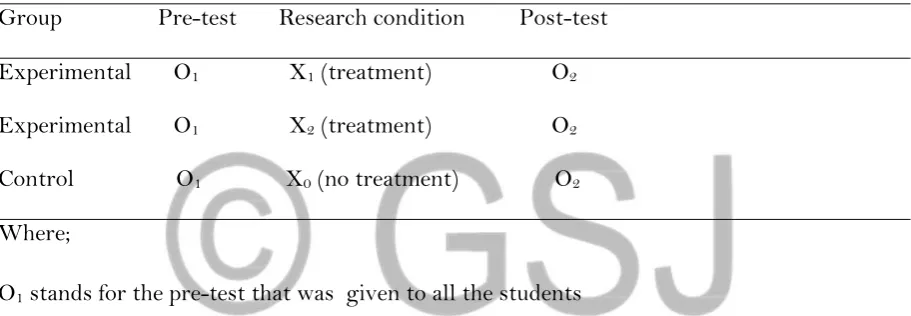
The design for this study was a quasi experimental design. Bearing in mind that Akuezulo and Agu (2007) pointed out that quasi experimental research design could be used in school setting where it is not always possible to use pure experimental design which they consider as a disruption of school activities. Specifically, the study utilized the non- randomized pretest, post test and control group design comprising three main groups (Experimental group I, Experimental group II and Control group). The treatment groups were Assertiveness Training Techniques (ATT) group I, and Self Management Technique (SMT) group II, and the control group III. Table1, presents the summary of the design of the study.
Table 1: Presentation of the Research design
Group Pre-test Research condition Post-test
Experimental O1 X1 (treatment) O2
Experimental O1 X2 (treatment) O2
Control O1 X0 (no treatment) O2
Where;
O1 stands for the pre-test that was given to all the students
X1 stands for the treatment (assertive training techniques) which was given to the
experimental group 1.
X2 stands for the treatment (self management techniques) which was given to the
experimental group 2.
X0 stands for no exceptional treatment given to the control group.
O2 stands for the post-test which were given to both the experimental and control groups.
Population of the Study
Commission HQ: Awka, See Appendix B). The population of students was identified through a pretest administration of Cheek & Melichor Shyness instrument. This is how the researcher obtained population of students with shyness in the area of study. Students that score above 47 indicate the present of shyness in that student.
Sample and Sampling Technique
The sample for this is 120 secondary school students with shyness. The sample comprises of junior and senior secondary school students that were identified with shyness from the (3) selected public secondary schools. A purposive sampling technique was used in selecting three secondary schools because they have the highest number of students with shyness. Through the Cheek & Melichor shyness questionnaire, secondary school students with shyness were identified in each school. Male scores that were above 47 and female scores that were above 47 were identified as secondary school students with shyness. Forty students each were selected from the three schools, from the forty students in each school twenty students from the junior secondary and twenty from the senior secondary schools were selected using a Simple random sampling technique by balloting method with replacement.
The researcher after the pre-test apportioned 40 participants to each of the group by placing 20 students in the junior and 20 students in the senior secondary school each, to represent the experimental group 1 and experimental group II and 40 students from the other school formed the control group with 20 junior and 20 senior secondary students.
Instrument for Data Collection
The instrument that was used for measurement of student‟s shyness is Cheek & Melichor shyness questionnaire developed in 1985 but revalidated in Nigeria by Zanab in 2010. Cheek and Melichor shyness questionnaire report psychometric scale was developed to measure individual‟s shyness as it relate to self, school and social settings. The instrument is one page and contains twenty items. The instrument is on a five point scale, ranging from very uncharacteristic, uncharacteristic, neutral, characteristic and very characteristic. The researcher adopted the instrument.
and actions. All responses for the twenty items on Cheek & Melichor shyness questionnaire scale were summated to yield a total score of one hundred and twenty. For both male and female students any score above 47.0 indicate the presence of shyness and any score below 47 indicate the absence of shyness respectively.
Validation of the Instrument
The instrument Cheek and Melichor shyness questionnaire was revalidated in Nigeria by Zanab in 2010. The instrument has both face and constructs validity. Therefore, no more validation was done.
Reliability of the Instrument
Cheek and Melichor shyness in 1985 obtained a coronbach alpha internal consistency reliability 0.71 coefficient. In Nigeria Zanab used Cheek and Melichor shyness questionnaire to obtained a reliability coefficient of 0.93. This study is adopting the Nigeria version whose reliability coefficient of 0.93 has been determined, there was no need for further reliability estimation. This study is adopting the Nigeria version of reliability coefficient of 0.93., therefore, no further reliability estimation was done
Method of Data Collection
Training of Research Assistants
Three research assistant were trained to participate in the study. The research assistants were regular Guidance counsellors in the participating schools. The counsellors were assigned in pairs to assist the researcher in conducting activities in self management techniques group, assertiveness training techniques groups and control group respectively. The research assistants were informed about the purpose of the study and the methods to be used. The materials to be used in facilitating the sessions in their group was given to guidance counsellors (research assistant) two weeks before the tutorial and they were required to read through the materials before attending the training session. During each training session, the researcher discussed the materials with them and supplies answers to their questions. The research assistants met weekly with the main researcher as a supervisor. The purpose of these meetings was to coordinate the session plans and activities, both for the counsellor and students. In addition, these sessions enabled the counsellor to interact with each other and share ideas, experiences and obstacles as well as planning to coordinate the various counselling methods.
Experimental Procedures
This was the procedure the researcher adopted to ensure a successful implementation of the programme of self management techniques and assertiveness training techniques. The researcher visited the schools, solicited for the cooperation of the school principals so as to build in the programme in the schools‟ activities. The researcher explained the purpose and benefits derivable from the treatment to the principals of the schools (see Appendix E for letter of approval to the principal). After obtaining the permission, the researcher also got three Guidance Counsellors in the schools to assist in the study. The guidance counsellor introduced the researcher to the group as a guest counsellor during the period of the treatment. Prior to the commencement of the treatment, Cheek and Melichor shyness questionnaire were administered on the students in the experimental and control group. The tests were administered by the researcher assistants with the researcher monitoring the exercise, making sure that the test was taken under the same conditions and then collected the entire completed questionnaire.
eight weeks, and then the students were post-tested. For the experimental groups, self management techniques and assertive techniques was designed to last for eight weeks. Each session started with the counsellor‟s introduction to the issues to be addressed in the session and samples questions to elicit students‟ participation in the session. After the treatment, the Cheek and Melichor shyness questionnaire were re-administered to the experimental and control groups. The instrument was disguised by reshuffling before they were be re-administered. This was done the eight week treatment. The researcher monitored the exercise and make sure the students were under the same conditions and then, collected all completed questionnaire. The students‟ responses were scored and data generated was collected for statistical analysis.
Control of Extraneous
The researcher made attempts to control the following variables in order to neutralize or minimize their influence or avoid their interference with the research.
1. Counsellor bias
The research assistants were the school counsellors who were trained on how to instruct students and administer the instruments. The counsellors were trained to control bias on the research work. They were choose because already they have experiences in counselling and communicating with students. This was to avoid any bias or communication problems. They were specially trained on how to assist the researcher in implementing the treatment programme and the questionnaire.
2. Class interaction
The researcher was limited to the evaluation and exercise that took place during class work. She was not allow much homework that will necessitate exchange of ideas with member of other groups to control influence on class interaction on the student‟s responses, thus forestalling the possibility on experimental leakage.
3. Use of analysis of co-variance (ANCOVA): some extraneous variable may still remain uncontrolled, in spite of the measure the researcher must have put in place. Such possible leakages could be taken care of through careful application of the analysis of co-variance (ANCOVA) in data analysis, thereby isolating the distorting variable as covariates.
Method of Data Analysis
the hypotheses at 0.05 levels of significance. All responses for the twenty items on Cheek and Melichor shyness questionnaire scale was summated to yield a total score of 120. The instrument for data collection has both direct and reverse scoring pattern. For both male and female students any score above 47 indicate the presence of shyness and any score below 47 indicate the absence of shyness.
Result
Research Question 1: What are the differences in the pretest and posttest of shyness mean
scores of students treated with assertiveness training techniques and those exposed to
conventional counselling?
Table 1: Pretest and Posttest shyness mean scores of students treated assertiveness training techniques and those exposed to conventional counselling
Source of Variation N Pretest Mean Posttest Mean Lost Mean Remark
Assertiveness training 40 73.9 41.3 32.6 Effective
Conventional counselling 40 70.1 58.8 11.3
The data contained in Table 1 shows pre-test mean score of 73.9 and post-test mean score of 41.3 with mean loss of 32.6 for the students treated with assertiveness training technique, while the students in the control group who received conventional counselling had pre-test mean score of 70.1 and post-test mean score of 58.8 with mean loss of 11.3. Therefore assertiveness training technique is effective in reducing shyness among secondary school students. Since the post-mean score of students is below the norm 47.00
Research Question 2: What are the differences in the pretest and posttest of shyness mean scores of students treated with self management technique and those exposed to conventional counselling?
Table 2: pretest and posttest of shyness mean scores of students treated with self management and those exposed to conventional counselling
Source of Variation N Pretest Mean Posttest Mean Lost Mean Remark
Self management 40 71.7 40.98 30.7 Effective
The data contained in Table 2 above shows pre-test mean score of 71.7 and post-test mean score of 40.98 with mean loss of 30.7 for the students treated with Self management technique, while the students in the control group who received conventional counselling had pre-test mean score of 70.1 and post-test mean score of 58.8 with mean loss of 11.3. Therefore self management technique is effective in reducing shyness among secondary school students. Since the post-mean score is below the norm 47.00
Research Question 3: What are the difference in the pretest and posttest of shyness mean scores of students treated with assertiveness training techniques and those treated with self management?
Table 3: pretest and posttest of shyness mean scores of students treated with assertiveness training techniques and those treated with self management Source of Variation N Pretest Mean Posttest Mean Lost Mean Remark
Assertiveness training 40 73.9 41.3 32.6 More effective
Self management 40 71.7 40.98 30.7
Table 3 indicated that with the mean loss of 32.6 and 30.7for students who received Assertiveness training and self management respectively, there was a mean difference of 1.9. Therefore, assertiveness training technique was more effective than self management in reducing shyness. Since the post-mean score is below the norm 47.00
Research Question 4 :What are the differences in the pretest and posttest of shyness mean scores of male and female students treated with assertiveness training techniques?
Table 4: pretest and posttest of shyness mean scores of male and female students treated with assertiveness training techniques
Source of Variation N Pretest Mean Posttest Mean Lost Mean Remark
MALE 20 75.7 41.7 34.0 More effective
FEMALE 20 72.2 40.95 31.3
Research Question 5: What are the differences in the pretest and posttest of shyness mean scores of male and female students treated with self management?
Table 5: pre-test and post-tests of shyness mean scores of male and female students treated with self management
Source of Variation N Pretest Mean Posttest Mean Lost Mean Remark
MALE 20 72.2 41.0 31.2 More effective
FEMALE 20 71.2 40.9 30.3
Table 5 indicates that male students treated with self management had pretest mean score of 72.2 and posttest mean score of 41.0 with mean Loss 31.2, while the female students in the group had pretest mean score of 71.2 and posttest mean score of 40.9 with mean loss of 30.3. Therefore self management is more effective in reducing male shyness. Since the post mean score is below the norm 47.00
Hypothesis 1
There is no significant difference in the effect of assertiveness training technique in
reducing secondary school students‟ shyness when compared with those in the control
group using their mean scores.
Table 6: ANCOVA on the posttest shyness mean scores of students treated with assertiveness training and those who received conventional counselling
Source of variation SS df MS Cal. F Crit. F P ≥ 0.05
Corrected Model 15359.740 2 7679.870
Intercept 3725.989 1 3725.989
Pretest Scores 453.940 1 453.940
Treatment Models 15356.226 1 15356.226 181.967 3.96 S
Error 6498.060 77 84.390
Residual 263418.000 80
In table 6, it was observed that at 0.05 level of significance, 1df numerator and 79df
denominator, the calculated F 181.967 is greater than the critical F 3.96. Therefore, the first
null hypothesis is rejected. So, There is significant difference in the effect of assertiveness
training techniques in reducing secondary school students‟ shyness when compared with
those in the control group.
Hypothesis 2
There is no significant difference in the effect of self management in reducing secondary school students‟ shyness when compared with those in the control group using their mean scores.
Table 7: ANCOVA on the posttest shyness mean scores of students treated with self management and those who received conventional counselling
Source of variation SS df MS Cal. F Crit. F P ≥ 0.05
Corrected Model 15756.391 2 7878.195
Intercept 3849.823 1 3849.823
Pretest Scores 493.578 1 493.578
Treatment Models 15562.798 1 15562.798 188.033 3.96 S
Error 6372.997 77 82.766
Residual 262263.000 80
Corrected Total 22129.388 79
In table 7, it was observed that at 0.05 level of significance, 1df numerator and 79df
second null hypothesis is rejected. So, there is significant difference in the effect of self
management in reducing secondary school students‟ shyness when compared with those in
the control group.
Hypothesis 3
There is no significant difference in the effects of assertiveness training techniques and self management in reducing secondary school students‟ shyness using their mean scores
Table 8: ANCOVA on the mean scores of students treated with assertiveness training and those who received self management
Source of variation SS df MS Cal. F Crit. F P ≥ 0.05
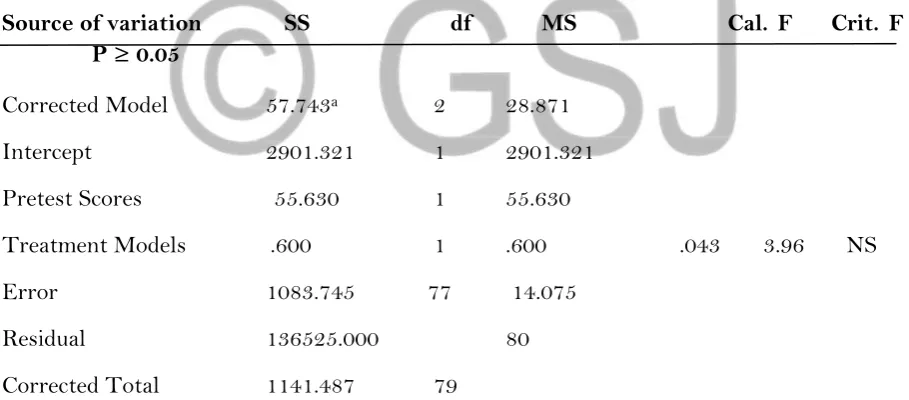
Corrected Model 57.743a 2 28.871
Intercept 2901.321 1 2901.321
Pretest Scores 55.630 1 55.630
Treatment Models .600 1 .600 .043 3.96 NS
Error 1083.745 77 14.075
Residual 136525.000 80
Corrected Total 1141.487 79
Table 8 reveals that at 0.05 level of significance, 1df numerator and 79df denominator, the calculated F 0.043 is less than the critical F 3.96. Therefore, the third null hypothesis is not rejected. So, there is no significant difference in the effects of assertiveness training techniques and self management in reducing secondary school students‟ shyness.
Hypotheses 4
There is no significant difference in the effectiveness of assertiveness training techniques in
reducing secondary school students‟ shyness of male and female students.
Table 9: ANCOVA on the posttest shyness mean scores of male and female students treated with assertiveness training
Source of variation SS df MS Cal. F Crit. F P ≥ 0.05
Corrected Model 22.842a 2 11.421
Intercept 1424.694 1 1424.694
Pretest Scores 17.942 1 17.942
Gender 2.469 1 2.469 .155 4.09 NS
Error 589.558 37 15.934
Residual 68840.000 40
Corrected Total 612.400 39
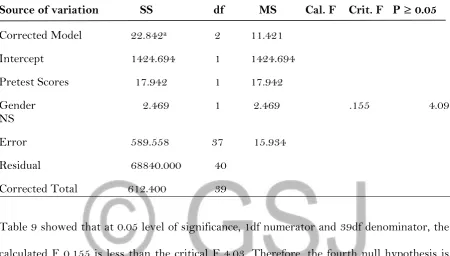
Table 9 showed that at 0.05 level of significance, 1df numerator and 39df denominator, the
calculated F 0.155 is less than the critical F 4.03. Therefore, the fourth null hypothesis is
upheld. So, there is no significant difference in the effectiveness of assertiveness training
Hypotheses 5
There is no significant difference in the effectiveness of self management in reducing
secondary school students‟ shyness of male and female students.
Table 10: ANCOVA on the posttest shyness mean scores of male and female students treated with self management
Source of variation SS df MS Cal. F Crit. F P ≥ 0.05
Corrected Model 103.990a 2 51.995
Intercept 2239.522 1 2239.522
Pretest Scores 93.990 1 93.990
Gender .081 1 .081 .000 4.09 NS
Error 11439.910 37 309.187
Residual 139008.000 40
Corrected Total 11543.900 39
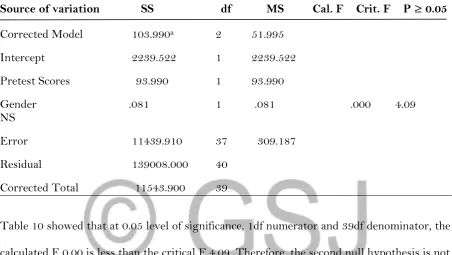
Table 10 showed that at 0.05 level of significance, 1df numerator and 39df denominator, the
calculated F 0.00 is less than the critical F 4.09. Therefore, the second null hypothesis is not
rejected. So, there is no significant difference in the effectiveness of self management in
reducing secondary school students‟ shyness of male and female students.
Discussion of Findings
Furthermore, the experimental group reported a significantly decreased in their shyness than the control group. This may indicate that secondary school students in the treatment group gained a better understanding of their shyness as a result of receiving assertiveness training technique. This finding is consistent with prior researchers that suggested that assertiveness training technique is effective in reducing secondary school students‟ shyness (Animasahun & Oladeni, 2012). Also Nnodum (2010), affirmed the finding that assertiveness training technique is effective in the treatment of psychological problems such as shyness among secondary school students in Nigeria. Solitary reason for decrease in students‟ shyness in the experimental group over and above those in the control group might be due to the thought changing process in assertiveness. Since student might have been amazed how their thought effects their feelings and actions and as such it affected their shyness so much within the few weeks. This result supports the findings by Crozier and Hostettler (2003), which portrays the differential effects of assertiveness training technique in the reduction of shyness of secondary school students.
The result of the findings confirmed that self management is effective on combating, the finding specifies that students in both experimental and control group possessed shyness before the initiation of the study as measured by their score on the pre-test. The finding also indicated that the degree of the mean difference between the experimental and control group was significant in the post-test. This is so, because in the self- management group, shy students were trained on how to handle shyness in their peer interaction. In the self- management class, students are given the opportunity to learn how to handle shyness through self- management in expression, thereby raising their boldness in peer interaction and reducing their shyness.
active involvement in the self-management group affects their feelings and actions and as such positively affected their toward shyness so much within this few weeks.
This result support the finding of Ojediran, Oludipe, and Ehindero (2014), which portrays the differentials effects of self-management on shyness among secondary school students. Thus in the present study self-management technique is effective on reducing shyness among secondary school students when compared with the control group.
The finding of the study pointed out there is no significant difference in the effectiveness of assertiveness training and self management techniques in reducing secondary school students‟ shyness. Both assertiveness training and self management techniques are effective in the reduction of shyness among secondary school student. These could be to due to both techniques are behaviour modification techniques which are based on the principle of modifying undesirable behaviour to a desirable one. The finding of this study is supported by Speer (2015) that assertiveness training techniques is an effective therapy for the treatment of shyness among secondary school students. That is Speer, opine that assertive training techniques emphasizes expressing feelings forthrightly, but in a way that will not spiral into shyness. Similar to these finding Bandy and Moore (2010) affirm that self management which is also one of the behaviour modification technique is effective in the treatment of shyness among secondary school students. In order words, Self-management help an individual to regulate their emotions and resulting behaviours in ways that society considers acceptable. This includes how the individual copes with unmet wants or needs, perseveres when faced with obstacles, and sets goals for himself/herself .
This study further observed that self management is effective in enhancing both male and female students shyness secondary students‟ shyness. The test of null hypothesis confirmed that, the effects of self management on combating male and female student shyness secondary school students‟ shyness is not significant. Even though there was a slight difference in the post-test mean scores. This indicated that although the present study found a little difference in the post-test mean score of students with respect to gender, this difference was only marginal and not significant. Thus the little difference in the post- test mean scores of students with respect to gender in the experimental group was not due to class per se, but may be due to chance. So being either male or female, students actually benefitted equally from the technique.
This finding supported the work of Kasper (2012), posit that when children become older, they may not only experience shyness, but also embarrassment in new social situations. Coplan, (2011) also observe that females are more likely to experience shyness, especially in adulthood, than males. Thus, it may be more socially acceptable for females than males to be shy. That means more consequences that are negative for shy males. This findings support Salman (2007) his study that examine the effectiveness of group self management guidance and bibliotherapy techniques in reducing study behaviour problems among undergraduate students of Ahmadu Bello University, Zaria with respect to gender and age. His finding shows there was no significant difference with regard to the gender of the students.
Conclusions
Implications of the Study
The study shows that assertiveness training technique and self management technique are effective on shyness in secondary school students. In the light of this, there is need for guidance counsellors who are working to reduce students‟ shyness to familiarize themselves with assertiveness training technique and self management technique used in this study. Since the techniques border on thought and behavioural changes and role play of behaviour, secondary school students can be taught on how to use them naturally and in therapeutic settings in solving their day to day life problems in and outside their classrooms. When the students (who are mostly adolescents) are equipped with appropriate behavioural techniques, they will be in a position to adapt to realistic and appropriate behaviour so that their transition from school to work will be hitch-free. The result obtained from this study showed that the intervention technique was effective when used to treat students with shyness.
Recommendations
Based on the findings, the following recommendations are hereby made:
1. The use of assertiveness training technique and self management technique have been shown to be effective secondary school students‟ shyness behaviour. It should be encouraged, practising school Guidance and Counsellor should learn to use the both techniques to assist students develop boldness.
2. The use of assertiveness training technique and self management technique should be commenced in full force in secondary schools irrespective of students‟ gender and age as a way of handling students ‟ shyness.
REFERENCE
Ahmad, A., Zeb, R., Ullah, W.& Ali, F. (2013) Shyness ratings: Stability and correlates in early childhood. International Journal of Behavioural Development, 19(3), 705-724.
Akponye, E.A. (1999). Differential efficacy of two Behaviour modification strategies in reducing shyness among some Nigeria adjustment: Unpublished Ph.D thesis. University of Ibadan, Nigeria
Akuezuilo, E.O., & Agu, N.(2007). Research and Statistic in Education and Social Science. Awka : Nuel Centre Publishers and Academic
American Psychiatric Association (2013). Anxiety Disorders. In Diagnostic and Statistical Manual of mental disorders. 4th ed. Washington DC.
Animasahun, R. A. & Oladeni, O. O. (2012). Effects of Assertiveness Training and Marital Communication Skills In Enhancing Marital Satisfaction among Baptist Couples in Lagos. State, Nigeria. Global Journal Of Human Social Science Arts & Humanities,12(14),1-13
Bandura, A. (1986). Social foundations of thought and action: A social cognitive theory. Englewood Cliffs, NJ: Prentice- Hall, Inc
Bandy, T., & Moore, K. A. (2010). What works for promoting and reinforcing positive social skills: Lessons from experimental evaluations of programs and interventions. Washington, DC: Child Trends
Bosacki, W. & Rose-Krasnor. L. (2011). Interviewing Strategies for helpers.(2nd .ed). California: Brooks – Cole Publishing Company
Buss, A. H. (2005). Self-consciousness and social anxiety. San Francisco: FreemanDurmus, E. (2007). perceptions of shy and non-shy students. Ankara Üniversitesi Eğitim Bilimleri Fakultesi Dergisi, 40(1), 243 – 268.
Cheek, J. M. & Melichor, L. A. (1985). Measuring the three components of shyness, in M. H. Davis & S. L. Franzoi (Co-chairs), emotion, Personality, and Personal Well-being II. Retrieved from: http://academics.wellesley.edu/psychology/cheek/howshy20_text.html
Clore, J & Gaynor, S. (2006). Self-Statement Modification Techniques for Distressed College
Students with Low Self-Esteem and Depressive Symptoms. International Journal of
Behavioural Consultation and Therapy 2( 3), 314-331
Coplan, J. (2011). Towards a curriculum that matters to children. Paper presented at the European
Early Childhood Education Research Association‟s 16th Annual Conference, Democracy and
culture in early childhood education, Reykjavik, Iceland, Aug 30th – Sept 2nd.
Crozier, W. R. & Hostettler, K. (2003). The influence of shyness on children‟s test performance. British Journal of Educational Psychology, 73( 3), 317 – 328
Dupper, W. R. (2011) Understanding shyness: Psychological Perspectives. London: Palgrave.
Findlay, D. L. (2009) Perceptions of intelligence in leaderless groups: The dynamic effects of shyness and acquaintance. Journal of Personality and Social Psychology, 72, 581-591.
Gibbons, J.L. (2007). Strategies comparison among people with low self-esteem: Self-protection and self-enhancement. Journal of personality and social psychology, 67(1), 713-731
Gilmartin, B.M. (2014). Social skills training for children and youth with emotional and behavioural disorders: Validity considerations and future directions. Behavioural Disorders. Special Issue: Elucidating Precision and Rigor in EBD Research, 30(1), 32-46.
Hammed, T.A. (1999). Fostering Interpersonal Skills among Selected Bank Workers through Assertiveness Training and Transational Analysis. Unpublished PhD Thesis, University of Ibadan, Ibadan, Nigeria.
Hughes, A., C. S. & Coplan, J. (2010). A Nationwide Study of Challenging Behaviour in Special Schools in Ireland, National Association of Boards of Management in Special Education.
Kasper, W. K. (2012). Education, health, and behaviour. London: Longman.
Lane, C. (2008). Shyness: How Normal Behaviour Became a Sickness. New Haven: Yale University Press.
Leary, M. R. (2009). Affective and Behavioural Components of Shyness: Implications for Theory, Measurement, and research. New :York : Plenum.
Miraei, S. T. (2005). Shyness: Protective Armor or Social Barrier? New York: Basic Books.
Muqaddas, K. L., Samra- Muhammad, J. H, & Fazalur, M.B.(2011) Perceptions of intelligence in leaderless groups: The dynamic effects of shyness and acquaintance. Journal of Personality and Social Psychology, 72 (6), 581-591.
Nnodum, B. I. (2010). Differential Effectiveness of Assertive Training and Modelling Techniques in Improving the Social Skill of Primary School Isolate. An Unpublished Ph.D. Thesis. Abia State University Uturu.
Nnodum, B. I. (2002). The Effect of Assertive Training Technique in Reducing Social Withdrawal Tendencies in Students: Implication for Quality Education. An Unpublished paper presented at 26th Annual Conference of Counselling Association of Nigeria (CASSON).
Norcross, J.C., Santrock, J.W., Zuckerman, F.I., Sommer, R., & Campbell, L.F (2013). Seff help that works: resources to improve emotional health and strengthen relationship. New York: Oxford University Press.
Oakley, G. (2007). I don’t feel shy when I don’t feel shy!’ (aresearch on shyness of children). From <http:// www.highbeam.com/> (Retrieved October 10, 2015).
Ojediran, I. A., Oludipe, D. I., & Ehindero, O. J. (2014). Impact of Laboratory-Based Instructional Intervention on the Learning Outcomes of Low Performing Senior Secondary Students in Physics. Creative Education, 5, 197-206. http://dx.doi.org/10.4236/ce.2014.54029
Pilkonis, P. A. (2013). Shyness, public and private, and its relationship to other measures of social behaviour. Journal of Personality, 49(2), 585-595.
Salman A. A. (2007).Effectiveness Of Group Guidance And Bibliotherapy Techniques In Reducing Study Behaviour Problems Among Undergraduates Of Ahmadu Bello University,Doctor Of Philosophy (Ph.D) In Guidance And Counselling Department Of Education Faculty Of Education Ahmadu Beelo University, Zaria
Sanson, A.V. (2008). Temperament in early adolescence. In: N Allen, L Sheeber (Eds.): Adolescent Emotional Development and the Emergence of Depressive Disorders. New York: Guildford Press,
Speer, J. (2005), The Assertiveness Workbook: How to Express Your Ideas and Stand Up for Yourself at Work and in Relationships.
Volbrecht, C. & Goldsmith, C. T. (2014). A Study of Children and Young People who present Challenging Behaviour, University of Birmingham, School of Education
William, T.(2008). Cognitive Behaviour Therapy. London: Oxford University Press
Zanab, G. (2010). Emotional Problems of Childhood and adolescence. Studies Psychological,50 (3), 267-275.