Predictive channel selection: Practical implementation
and a social-aware vision for spectrum use
Marko Höyhtyä
1,*, Juha Korpi
1, and Mikko Hiivala
11VTT Technical Research Centre of Finland Ltd, Oulu, Finland
Abstract
This paper demonstrates a predictive channel selection method by implementing it in software-defined radio (SDR) platforms and measuring the performance using over-the-air video transmissions. The method uses both long term and short term history information in selecting the best channel for data transmission. Controlled interference is generated in the used channels and the proposed method is compared to reference methods. The achieved results show that the predictive method is a practical one, able to increase the throughput and reduce number of collisions and channel switches by using history information intelligently. The method is developed further and a cellular assisted social-aware method that enables efficient use of D2D links is defined in the end of this paper.
Keywords:cognitive radio, spectrum sharing, spectrum databases.
Received on 25 May 2016, accepted on 09 December 2016, published on 23 February 2017
Copyright © 2017 M. Höyhtyä et al., licensed to EAI. This is an open access article distributed under the terms of the Creative Commons Attribution licence (http://creativecommons.org/licenses/by/3.0/), which permits unlimited use, distribution and reproduction in any medium so long as the original work is properly cited.
doi: 10.4108/eai.23-2-2017.152186
1. Introduction
Cognitive radio (CR) techniques have been studied intensively for over a decade, focusing mainly on dynamic spectrum access oriented operation. Numerous techniques have been developed and analysed, including spectrum sensing, power and frequency allocations, beacon signalling, and spectrum databases. Only a subset of the proposed techniques have been implemented and tested in real systems to see their practicality. This paper focuses on channel selection problem in a changing radio environment and demonstration of the proposed method in a practical system.
Importance of history information and knowledge on primary traffic patterns in channel selection was shortly discussed already in [1]. Later, the problem has been studied intensively and prediction methods for both stochastic and deterministic traffic have been developed [2]–[8]. For example, a deterministic long-term component can be seen in several bands such as cellular mobile communication systems due to daily rhythm of the users [3]. Traffic pattern estimation method for exponential traffic has
been proposed in [4]. A more general method able to classify traffic patterns and select the prediction method based on this information is proposed in [5]. Switching delay has been included in the channel selection to decide whether to switch a channel or not based on channel prediction and switching overhead in [6]. The method is developed further in [7] where an adaptive sensing policy is developed to detect the primary user appearance as fast as possible. Sequential channel sensing policy is studied also in [8]. The sensing procedure and channel selection can be made faster by reducing the number of channels to sense in the first place. Both short term and long term information can be used to guide the process. A channel selection method that was described in [9] and [10] uses long term information on the use of primary channels to select the most promising ones to be sensed and exploited by cognitive radios at the requesting time. These channels are investigated in more detail over short term to find the best channels for data transmission. Both long term and short term data are stored in databases to be able to predict which channels look most promising for secondary use.
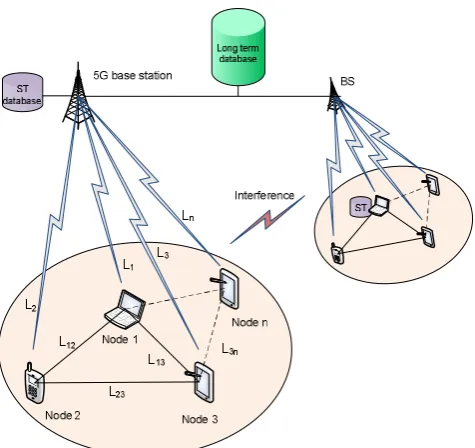
Figure 1. Network model for social-aware D2D communications.
The proposed hybrid method that uses both sensing and databases is a promising approach to be used e.g., in different spectrum sharing scenarios of future fifth generation (5G) systems, and also in military environments. A hybrid method is the most probable step in-between pure database access and sensing based access to the spectrum. This paper demonstrates the described method by implementing it in a software-defined radio system. Verification is performed by transmitting video over a cognitive link and measuring the performance regarding error rates, channel switches, and throughput. Achieved results are compared to reference methods that are not using prediction in the channel selection. A fundamental change in mobile networks from network-centric to emerging device-network-centric system design is facilitating the revolution in how mobile communication systems are used [11]. Intelligent user equipment is becoming involved in decision making on par with the network infrastructure. It is more and more common for users to wirelessly share their content in close proximity. This is inherently intertwined with human social behavior. Future 5G systems have to efficiently bridge physical and virtual communities by taking into account both physical distances and social connections between those users. Thus, we will propose a social-aware enhancement to our implemented spectrum sharing method in the end of the paper.
This paper is an extended version of [12], providing more detailed time domain analysis, a vision how to use social information [11] in improving the channel selection process and also defining research challenges for future.
The paper is organized as follows. Section 2 describes the network model and used channel selection methods starting from the intelligent hybrid one. Section 3 defines the demonstration environment and measurement results are presented in Section 4. Time domain analysis and discussions
demonstrator are given in Section 5. Social-aware vision and future research challenges are discussed in Sections 6 and 7, respectively and conclusions are drawn in Section 8.
2. Network model and description of
channel selection methods
We consider a network model that is depicted in Figure 1 where wireless mobile users are connected to the base station using a cellular interface. Nodes can communicate also directly using device-to-device (D2D) communication links between nodes that are in proximity to each other. There are
N nodes in the network. We assume that links L12 (between Node 1 and Node 2), L13, L23, L3n can be either cellular or short range links. The links can use both licensed and unlicensed channels and the system is able to use spectrum sharing methods to increase the system capacity. The links possess different physical distances and social links between users can be strong, weak, or even nonexistent.
The operation of the network is partly dependent on the resource management databases that include both long term (LT) and short term (ST) information of resources. Information in the LT database has to be local to its users since otherwise it cannot offer relevant information. The LT database can be shared with several base stations (BSs) located near each other, and it can provide spectrum use information and assistance to avoid interference between cells. Only the spectrum use spatially close to requesting nodes is important to be known to assist the operation of them. The LT database can also include policy database, which includes information about different QoS parameters for the channels to be used in channel selection, e.g., interference levels and parameters for different licensed systems.
Short term database gives more detailed information over the bands of interest. The information about local channel use is gathered by periodical sensing and stored into the ST database. It can be located at the base station to serve a single cell resource management or also in a cluster head that can serve users even if the connection to a BS is lost. Using pattern recognition and classification techniques that are crucial parts of an intelligent system, a spectrum sharing radio can recognize and classify traffic patterns in different channels. This allows the system to use specific prediction methods for different types of traffic to make idle time prediction of channels as accurate as possible.
Start
End
Obtain promising channels based on long term occupancy
Obtain the best channel(s) based on short term data
Reduce sensing time
Reduce interference and channel switching rate
N out of M channels
P out of N channels, 1 P<N
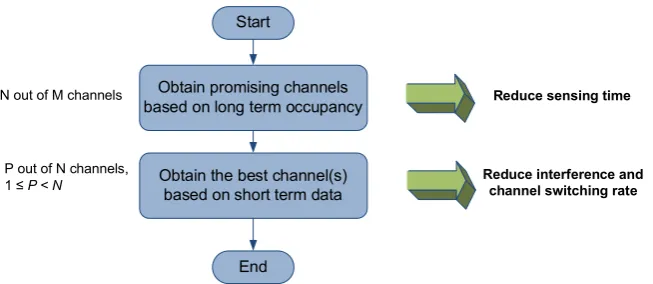
Figure 2. Simplistic view of the proposed method.
2.1 The smart channel selection method
Simplistic view of the method* is shown in Figure 2. In the first phase a radio or base station sends query to the long term database to receive a set of promising channels among M
possible ones. The set is selected e.g., based on the long term spectrum occupancy data. Time and capacity estimations can be used to define channels that are suitable, offering needed time for the requested transmission. Given N channels are sensed to know whether they are free or not and the sensing information is stored in the ST database.
The short term database classifies the type of traffic in different channels which enables use of specific prediction methods for each traffic type, making prediction results accurate. Then, future idle times are predicted using the classification result and the history data. ThePchannels with the longest idle times are selected into use and the restN–P
channels are returned to be offered to other users requesting access to spectrum. After channel selection is made, the CR can send data for predefined period of time, sensing periodically the channel to be sure that it is still free for transmission. Thus, use of long term database shortens the sensing time by reducing the channels to be sensed. The use of short term database reduces the channel switching rate and collisions with primary users. Therefore, more time is left for data transmission and consequently, capacity of the system is increased.
2.2 Methods to compare
In order to study the effect of the proposed approach with other existing ideas we need to define methods to which the approach can be compared with. The following approaches are used both in practical systems and in the literature.
*A more detailed description of the method including block diagram and different phases can be found in [9] and [10].
No channel switching at all. The simplest way to operate in the spectrum is to stay always in the same channel. Thus, the first method to compare is no channel switching at all – method. If there is interference in the channel, the system suffers and there is degraded quality of service during that period of time. The system may also be required to stop transmitting totally and wait until the channel is free again.
Change to the next predefined frequency. An improved step to the previous method is to change frequency when there is interference in the current channel. This can be done in many different ways. The simplest one is to predefine the next frequency to switch into. The advantage of this method is to be able to find a good channel to operate. A disadvantage is that it may take several switches since the channel to switch into may also be under interference.
Change to the free frequency.It is wise to switch into a
channel that is available for transmission even though it requires more resources in sensing and finding those potential channels. This method may randomly select any of the free frequencies or jump into next free frequency whenever interference occurs at the current operational channel. This kind of reactive channel switching is proposed e.g., in [13] and [14]. Since only instantaneous information about the availability of channels is used, switching may need to be performed quite often, depending on the primary user spectrum use.
3. Demonstration environment
Figure 3.Block diagram of the measurement setup.
Figure 4. Demonstration setup.
Interference generation is made using Matlab controlled
SDR-platforms. We use USRP B200 and X310 platforms from Ettus Research [15] together with the EBRACE SDR platform which, like the USRPs, is also a field-programmable gate array (FPGA) based SDR platform. The SDR platforms are used to generate continuous data to five different frequency bands. The type of the platforms is not important for the measurements. In fact, many other controllable interference sources could be used with the same effect. The transmission powers of the interfering
transmitters have been set high enough to cause strong interference to the selected band. The lengths of the continuous busy and idle times are both parametrized for each frequency separately.
In general, data traffic transmitted in a network can be characterized by traffic patterns. These patterns can be classified as [1]: 1) deterministic patterns, where the transmission is ON, then OFF during the fixed time slot, and 2) stochastic patterns, where traffic can be described only in statistical terms. Thus, values for busy and idle times in the demonstrator can be set either with fixed values or e.g. exponentially distributed random values.
Suppose we have a vector ofnsamples of idle times from
the channel , = ( , , … , ). Assuming exponentially distributed idle times with traffic parameter > 0 the probability density function of the exponential distribution is
( ) = 0, , < 00. (1)
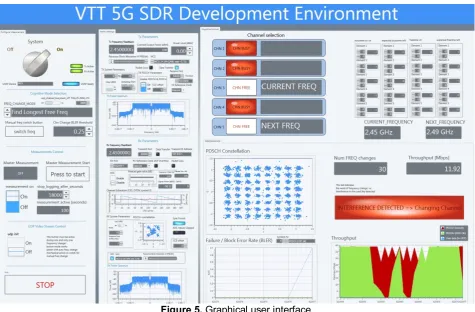
Figure 5. Graphical user interface.
Interference detection for the used channelis done by
measuring the block error rates (BLER) in the receiver. BLER is defined as the ratio of the number of erroneous blocks received to the total number of blocks sent, expressed as a percentage. It is used in 3GPP Long Term Evolution (LTE) systems during link radio monitoring, typically aiming to have the BLER below 10 %. It can be improved e.g., by adaptive modulation and coding or by changing to a new frequency. In our proof-of-concept implementation, once the block error rate exceeds a threshold value we decide to change the channel. The next channel is selected according to methods presented in Section 2.
Spectrum measurement for other channelsis done in
100MHz bandwidth, and by also selecting the system bandwidth to be 100MHz, all of the used channels can be monitored simultaneously. This keeps the spectrum sensing simple in our measurement set-up. For each used frequency, after averaging over a few measurements, we use a simple threshold to decide whether the channel is interfered or not. If the measured power level is above the threshold, the channel is considered interfered. Measurement control reads this binary (busy/free) information and decides the next free frequency where to jump to if a channel change is needed.
Actual data linkis in our case a modified real-time LTE
link based on National Instruments LabVIEW Communications LTE Application Framework version 1.0 [16] where we have added the frequency switching algorithms. With the data link we can measure the throughput, error rate and number of frequency changes. Measurements were done with LTE Modulation and Coding Scheme (MCS) number 24, i.e. with 64QAM and code rate 3/4, and using 20MHz bandwidth. Throughput was recorded both for all of the physical downlink shared channel (PDSCH) data and for the user data, which in our case was video data streamed over the link. The graphical user-interface (GUI) of the measurement control is presented in Figure 5. User interface shows in real-time which channel is currently used, which channels are under interference, and what is the next channel to switch into when interference occurs. The GUI shows also spectrum information and enables selecting the different channel selection methods on the fly.
Figure 6. Measured throughput and number of channel changes with all the methods, random
interference traffic.
Table I.Idle and busy periods for used channels.
Channel
1 Channel2 Channel3 Channel4 Channel5 Idle
time 11 s 5 s 37 s 8 s 56 s
Busy
time 17 s 8 s 10 s 5 s 21 s
divided into five equal size channels. Especially, channels 1, 2 and 3 were slightly interfered but the channels 4 and 5 were mostly free of other traffic. The other traffic was mostly general WiFi traffic in the office environment. The measurements were made during the night time and during the weekends when the amount of this other, uncontrolled traffic was very small. Our radio link used a turbo code with 3/4 code rate, and frame error rate (FER) was low on all channels if we ourselves were not generating any controlled interference with our interference generators.
4. Measurement results
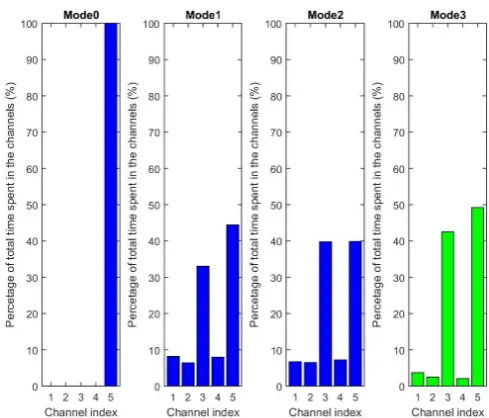
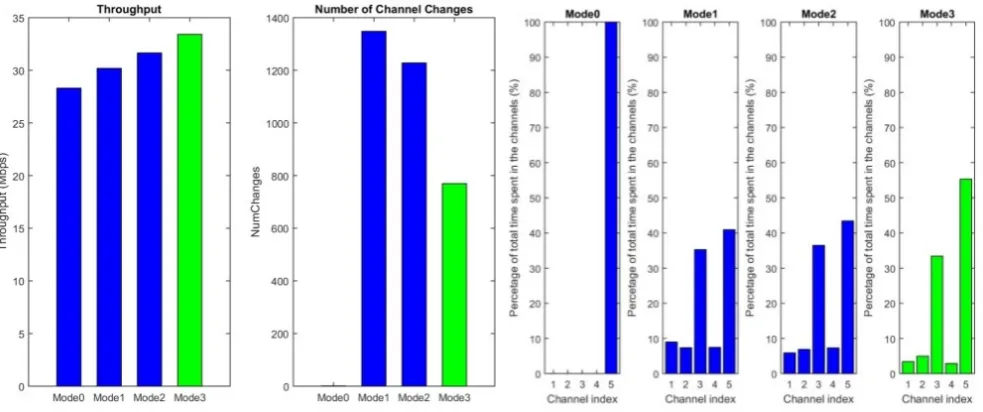
Measurement results for video transmission with different channel selection methods are given in Figure 6 and Fig. 7. Measurements were conducted for each method over a 13500 second period. The presented results are average results over four consecutive measurement periods. For brevity, the used methods are named as:
Figure 7. Percentage of time used in channels, random traffic.
Mode0: No channel changes
Mode1: Change to next (predefined) frequency Mode2: Change to next free frequency
Mode3: Change to the best free frequency
Figure 6 shows the measured throughput and number of channel changes for all the channel selection methods with the random interference. The busy and idle periods for used channels are given in Table I. The given values represent both mean values for exponentially distributed interference traffic and fixed values for deterministic traffic. Same values are used with each mode to have a fair comparison. As is seen in the figure, the more intelligence is added to the channel selection method the higher the achieved throughput is. Mode0 suffers during the interference since it is not able to change the channel. Ability to switch improves right away the performance. The proposed method, i.e., Mode3 achieves the highest throughput since it is able to predict and select the channels offering longest idle times for transmission and thus, minimize the number of channel changes over the experiment.
Figure 8. Performance results with deterministic traffic.
Figure 9. Impact of the method: a) original frame b) with the intelligent method.
results with the deterministic traffic shown in Figure 8 confirm the same conclusions. The advantage of the intelligent method is roughly the same regardless the type of the interference traffic in the channels.
The previous results were achieved with two good and three bad channels. We made also experiments with one, three, and four good channels to see the impact. When there are three good channels the trend looks still the same. However, the advantage is not that large anymore since the random methods also tend to select good channels more often. With four good channels the intelligent method still concentrates on three best ones since almost all the time some of them is available. When there is only one good channel to be used the performance is heavily dependent on the quality difference between channels. Purely from the throughput perspective the Mode0 can be better than other random methods since waiting in the good channel can be better than switching all the time among bad ones. Also in this case the intelligent method provided the best performance in measurements. From the quality of experience point of view, it is often better to change the channel since the waiting times and related video stoppage can be quite long. This is especially true if the interference
is strong and continuously occurring in periods of several seconds.
5. Time domain analysis
The impact of the intelligent method in time domain can be seen in Figure 9. The use of the long term database shortens the sensing time due to reduced number of sensed channels. The short term data reduces the number of channel switching by concentrating the operation on the channels with longest idle times. Thus, more time is left for data transmission. This combination of databases is the main advantage of the proposed method when compared to other predictive approaches such as ones in [2]–[8].
5.1 Sensing time with the long term
database
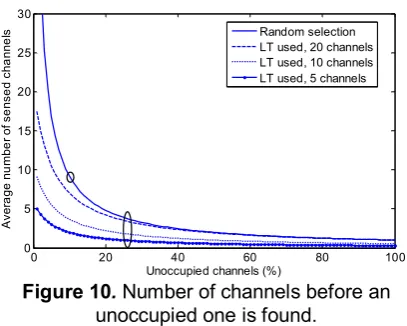
The performance of the LT database can be measured with the sensing time that depends on the amount of channels to be sensed before an unoccupied one is found. Average number of sensed channels in random search is [17]:
= , (2)
Figure 10. Number of channels before an unoccupied one is found.
Assuming wider coverage than in our implemented system such as 100 channels, we can estimate the number of sensed channels depending on the way the LT database operates. Figure 10 shows the results for random selection and for intelligent selection using the LT database for different percentages of unoccupied channels. If all the 100 channels have to be covered, tens of channels are needed to be sensed in high occupancy situation before an unoccupied one is found. When the LT database prioritizes and proposes lower amount of channels, time needed to find a channel reduces considerably. This means that in equation (2) parameterNwill have a smaller value and parameter K will have proportionally higher value. However, it is seen in the figure that the difference e.g., with 100 and 20 channels is very small when percentage of unoccupied channels is over 20 %. This means that in this case the LT database has to make a considerable reduction in the number of sensed channels to improve the performance.
The beauty of this idea is that in addition to smaller number of channels, the percentage of unoccupied channels is higher when the channels are selected by the LT database. Thus, one should compare random method with the LT one with a clearly higher percentage of unoccupied channels.
One example is marked with ovals in Figure 10. When percentage of unoccupied channels in random selection case is 10 %, it can be clearly more than 20 % among the channels intelligently selected by the LT database. This would mean that required number of sensed channels to find an available one drops down to a fraction of the original. As an example, if there are 10 available channels originally among 100 possible ones, these 10 available channels can be included in the set of 50 channels proposed by the LT database. In that case the percentage of unoccupied channels is doubled. The results indicate that the LT information always improves the performance, especially when the number of channels is restricted to 10 or below.
5.2 Time domain operation in the
implemented system
The operation in the demonstration setup is presented in more detail in Figure 11, showing the steps needed with from the occurrence of the interference to synchronized data transmission in a new channel. There are multiple steps needed to perform a single channel switch. The performance of the system could be improved through optimization of the sensing and switching times which could be achieved e.g., with a fully FPGA based decision making since FPGA processing speed is much faster than software based processing. This would speed up the procedures T1-T3 in Figure 11 also by eliminating the need to exchange control data through the interface between software and hardware layers in the LabVIEW framework. In the current setup the switching decisions are made with software which makes the total decision cycle clearly longer. Thus, optimally the cognitive system would use history information in reducing the number of sensing and switching periods as well as implement needed functions with HW to perform a single sensing and switching process as fast as possible.
Figure 11. Details of the time domain operation during a channel switch.
0 20 40 60 80 100
0 5 10 15 20 25 30
Unoccupied channels (%)
A
ve
ra
g
e
n
u
m
b
e
r
o
fs
e
n
se
d
ch
a
n
n
e
ls Random selection
Figure 12. Dependence between social distance and social trust.
6. Social-aware spectrum access
Active use of online social networks have broadened the social connections among people and made it possible to extract the social structure between them. In addition, location information and mobility patterns can provide interesting data and provide opportunities for resource management algorithms also in wireless mobile networks. According to a recent survey on social aware networking [18], obtaining the relevant data comes through sensing personal operations of users, contacts between users, and environment sensing. Then, learning and analysis of the data are used to deduce important social properties such as community, similarity, centrality, tie strength, and human mobility patterns.
Spectrum use may often be correlated both in temporal and spatial domains [19], [20]. As discussed also in this paper, recent observations can be used in predicting future availability and additionally spectrum users located close to each other may experience similar spectrum availabilities. Joint use of physical and social characteristics can be used to assist spectrum access [21] and device-to-device (D2D) communications [22]–[24].
Therefore, users can jointly optimize and improve the probability of finding best available channels for transmission by social-aware cooperation principles. For example, correlated spectrum use data can be disseminated among trusted users in order to predict the spectrum use more reliably and make spectrum access decisions intelligently. Each secondary user in a cognitive network can recommend the channels she successfully accessed to the users who have social trust with her. Channel recommendations provide additional information to often limited sensing capability of users and help making intelligent decisions. Before visioning how social-awareness could be included in our predictive channel method in a D2D communications scenario, let us take a look at some social properties.
6.1 Social properties
Centrality is a basic concept in social networks, affecting considerably the effectiveness of data dissemination strategies. It is a metric that can be used to find important and prominent nodes in a social network with a strong capability in connecting with other nodes. Closeness centrality measures how close a node is to all other nodes in the network [18] and is defined for useri as
= ( , ) (3)
where ( , ) is the distance between nodesiandj. This means that the node with the largest closeness has the shortest path to other nodes in the network, providing efficient data propagation to other nodes in the network, being thus a natural choice for selection of a relay node.
Tie strengthindicates the strength between nodes in a
social-aware network. It can be defined using indicators such as frequency, longevity, closeness, and social trust. Mobility patterns of users have a clear effect on frequency and longevity of encounters. For example, students at a class, family members at home, or workers inside office follow same kind of patterns in daily and weekly basis which can be used in predicting the possible D2D connections in a wireless environment. Important concepts for data dissemination are Social trust and social distance. Social distance between users or nodes can be calculated based on the social trust [22] as
( , ) log ( ( , )), (4)
where ( , ) [0,1] is the social trust between usersjand k. The shorter the distance is the larger the probability of D2D connection. The dependence between these metrics is shown in Fig. 12. This metric partly defines the probability that certain users select each other as partners for D2D communications. It can also be used as a way to control the quality of D2D links, i.e., users with shortest social distances are awarded with highest quality communications.
6.2 Cellular assisted social-aware predictive
method
Discussed social properties can be used in enhancing routing and data dissemination when combined with D2D principles. This extends the predictive channel selection method from link level operation to network level resource management.
0 0.2 0.4 0.6 0.8 1
0 1 2 3 4 5 6 7
Social trustp(j,k)
S
o
ci
a
ld
is
ta
n
ce
s(
Table II. Data to be included in databases.
Long term database Short term database
Historical sensing data Recent sensing data Social trust between users Available D2D
connections
Policy data, regulations Social recommendations Interference map over an
area Social distances ofavailable D2D connections
D2D communication is centrally controlled by the base station which enables interference management and assures quality of service (QoS) to the end users. Nodes can form a cluster around the cluster head which may be the only node discussing with the base station. Selection of a cluster head is assumed to be made according to (3) among users having social trust with each other. Thus, the selection takes into account both physical and social distances between users. It is also an option that a cluster head can control the local use of frequencies instead of the full base station control.
The social distance metric given in (4) is used in defining the quality of D2D connections so that when ( , ) 1, the connection can be opened without any restrictions in the data rate. Users are not as willing to share their resources with users having large social distances. We assume that when the social trust is0 < ( , ) <0.5, the data rate of a related D2D connection is scaled as
, = / ( , ) (5)
which affects also to the time needed to transmit the data as well as overall ability to support QoS requirements. Without any social trust the D2D connection is not available.
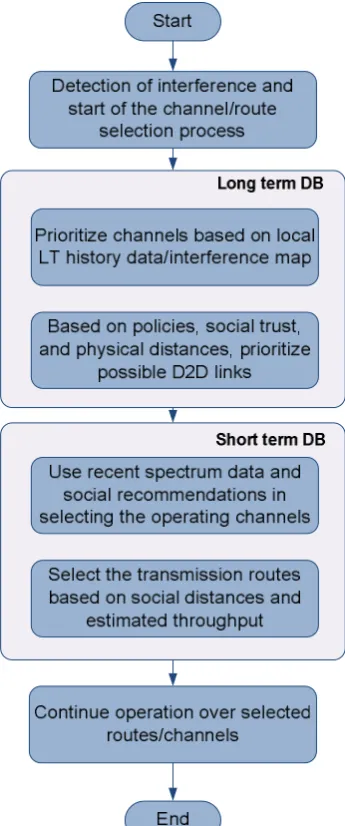
Social-aware predictive method can be developed in this network model by taking our original implemented method and enhancing it by the social principles. In this concept the long term database is enhanced by inclusion of social trust between users. This is not very frequently changing information. The required long term and short term data is shown in Table II. In addition, policies and regulations provide e.g., information about allowed maximum power levels that can be transmitted in certain frequency band at a certain location. Spectrum data from multiple sensors and locations has to be processed and combined in order to assess the spectrum use over an area and to create an interference map [25]. This information is stored for a longer period of time.
In short term database we have the most recent spectrum data. Also available D2D connections can be defined in cellular-controlled fashion by using the social trust data from the LT database as well as physical proximity of devices. Social recommendations from the devices provide an optional feature to improve the channel selection process for D2D connections. Recommendations are seen
Figure 13. Social-aware predictive method.
to provide useful information especially when the users are located at the edge of coverage in a frequency band that includes heterogeneous air interface options. Finally, social distances of available connections may prioritize D2D connections and help in deciding whether to connect over a cellular link or using the D2D link.
Even though there is a direct relation between social trust and social distance, the logic behind having these values in different databases is as follows. The LT database may have all social trust values of a certain user, provided voluntarily in order to be able to use D2D services and connections. These values may cover tens of people. The ST database includes only social distance values between currently active nodes in the network.
data of the spectrum use over the area of interest, available channels are prioritized and pre-selection of the most promising channels made. In order to find possible routes/D2D links for operation, social trust information that enables direct connection between nodes is used together with physical parameters to find a set of possible D2D links over which the requested service can be fulfilled.
Short term database uses more detailed spectrum data together with social recommendations in selecting the best operating channels for possible D2D links. Then, final transmission routes and associated channels are selected using partially the social distance information since it affects the throughput according to (5). Thus, prediction of availability time is partially based on that data which may be needed e.g., in selecting a channel that can fulfill transmission time requirements.
7. Research challenges
It is foreseen that dense 5G networks and Internet of Things (IoT) environments will need spectrum sharing methods and D2D communications in order to find enough capacity for the applications and services. A crucial part of this is spectrum awareness, i.e., knowing where users are located in frequency, time, and spatial domains in order to build dense systems that can co-exist without interfering with each other. Spectrum databases and predictive channel selection methods provide solutions to this problem. We identified some interesting research challenges in this area for the future.
Dynamic environments: Database based operation is mostly based on the instantaneous information. Current implementations of spectrum database systems such as TV white space databases or licensed shared access (LSA) concept [26] that introduces additional licensed users on bands with existing incumbent licensed users while providing guaranteed QoS for both are good for environments that are quite static. In order to work well in a dynamic, dense, small cell environment the database should provide some predictive information to assist the channel and mobility management. In addition to spectrum data, location data can be used to assist in connecting the mobile node to right access points or base stations proactively.
Hybrid database and sensing: Most proposals for obtaining spectrum awareness consider either spectrum sensing or a database separately. Also hybrid approaches are needed. Especially in military applications, it is not reasonable to rely only on shared databases that can be destroyed, providing a single point of failure for whole system which is not acceptable. In fact, soldiers carry multiple different wireless devices that can be used to measure spectrum use around them. Sensing gives reliability, works anywhere, and can be used as a back-up system for database based operation that still provides good opportunities both during crisis and especially peace time. Sensing information stored in the database provides ability
to identify signals, find spectrum use patterns, and predict what channels to avoid, use, or even jam.
Social-aware methods for predictive spectrum access: The concept of D2D communications is advancing in standardization forums and it is seen to provide significant capacity gains in the future. In wireless environment users will have a role in defining who will be able to connect to their devices directly. When D2D concept is used in a shared frequency band, there is a clear need to develop methods that are able to combine social properties such as social trust and social distance in a spectrum database system and predictive channel and route selection. The vision given in this article is only a first step to that direction. Future work on that includes definition of the most relevant social properties to be used, performance analysis, and also implementation challenges associated in inclusion of this aspect to real systems.
8. Conclusions
Use of history information enables a radio system to operate efficiently in a spectrum sharing radio environment. This paper has studied the channel selection problem by implementing a predictive method in a software-defined radio demonstrator and comparing its performance in the same system to several reference methods. Achieved results show that the proposed method increases the throughput and decreases interference towards other sharing systems. The quality of experience was clearly better for video streaming studied in the demonstration setup when the proposed predictive method was used.
Time domain analysis conducted in the paper shows clearly the advantage of using the history data in channel selection since it reduces considerably the time needed to find the best channels for operation. Optimally the cognitive system would use history information in reducing the number of sensing and switching periods as well as implement HW functions to perform a single sensing and switching process as fast as possible.
As a possible future step, the setup can be developed further by inclusion of steerable antenna techniques such as the method proposed in [27] to improve the sharing in spatial domain. In addition, current implementation did not include the classification algorithm to be able to recognize the traffic pattern in the channels and select the optimal prediction method accordingly. An improvement to the operation would be also the speed-up of frequency switching by implementing a fully FPGA based decision making. Finally, the measurements could be made in totally interference-controlled environments with a channel emulator and/or in an isolated chamber.
considered. Finally, research challenges for future were identified.
Acknowledgment
The work was performed in the framework of CODENAME project, funded by VTT and the SOCRATE project, partly funded by the Finnish Funding Agency of Technology and Innovation.
References
[1] Haykin S.: Cognitive radio: Brain-empowered wireless communications. IEEE J. Sel. Area Comm. 23, 201–220 (2005).
[2] Clancy T. C., Walker B. D.: Predictive dynamic spectrum access. In: SDR Forum Technical Conference, Orlando (2006).
[3] Lόpez-Benitez M., Casadevall F.: An overview of spectrum occupancy models for cognitive radio networks. In: IFIP TC 6th international conference on Networking, 32–41, Valencia (2011).
[4] Gabran W., Liu C. H., Pawelczak P., Cabric D.: Primary user traffic estimation for dynamic spectrum access. IEEE J. Sel. Area Comm. 31, 544–558 (2013).
[5] Höyhtyä M., Pollin S., Mämmelä A.: Improving the performance of cognitive radios through classification, learning, and predictive channel selection. Advances in Electronics and Telecommunications. 2 (2011).
[6] Kahraman B., Buzluka F.: A novel channel handover strategy to improve the throughput in cognitive radio networks. In: International Wireless Communications and Mobile Computing Conference, 107–112 (2011)
[7] Zhang C., Shin K. G.: What should secondary users do upon incumbents return? IEEE J. Sel. Area Comm. 31, 417–428 (2013).
[8] Shokri-Ghadikolaei H., Fischione C.: Analysis and optimization of random sensing order in cognitive radio networks, IEEE J. Sel. Area Comm. 33, 803–819 (2015). [9] Höyhtyä, M., Vartiainen, J., Sarvanko, H., Mämmelä, A.:
Combination of short term and long term database for cognitive radio resource management. In: 3rd International Symposium on Applied Sciences and Communication Technologies, Rome (2010).
[10] Höyhtyä, M., Sarvanko, H., Vartiainen, J.: Method and device for selecting one or more resources for use from among a set of resources. U. S. Pat. Appl. US20130203427 A1 (2013).
[11] Andreev S. et al.: A unifying perspective on proximity-based cellular-assisted mobile social networking. IEEE Commun. Mag. 54, 108–116 (2016).
[12] Höyhtyä, M., Korpi, J., Hiivala, M.: Predictive channel selection for over-the-air video transmission using software-defined radio platforms. In: 11th International Conference on Cognitive Radio Oriented Networks, Grenoble (2016). [13] Jing, X., Mau S.-C., Raychaudri, D., Matyas, R.: Reactive
cognitive algorithms for co-existence between 802.11b and 802.16a networks. In: IEEE Global Telecommunications Conference, 2465–2649, St. Louis, (2005).
[14] Feng, S., Zhao, D.: Supporting real-time CBR traffic in a cognitive radio sensor network. In: IEEE Wireless Communications and Networking Conference, Sydney (2010).
[15] Ettus Research http://www.ettus.com/ [16] National Instruments http://www.ni.com/
[17] Homier E. A., Scholz R. A.: Rapid acquisition of ultrawideband signals in the dense multipath channel. In: Conference on Ultra-Wideband Systems and Technologies, Baltimore (2002).
[18] Xia F., Liu L., Li J., Ma J., Vasilakos A. V.: Socially aware networking: A survey. IEEE Sys. J. 9, 904–921 (2015). [19] Chen Y., Oh H-S.: A survey of measurement-based
spectrum occupancy modelling for cognitive radios. IEEE Commun. Surveys Tuts. 18, 848–859 (2016).
[20] Yin S., Chen D., Zhan Q., Liu M., Li S.: Mining spectrum usage data: A large-scale spectrum measurement study. IEEE Trans. Mobile Comput., 11, 1033–1046 (2012). [21] Chen X., Gong X., Yang L., Zhang J.: A social group utility
maximization framework with applications in database assisted spectrum access. In: IEEE Conference on Computer Communications, Toronto (2014).
[22] Wang L., Araniti G., Cao C., Wang W., Liu Y.: Device-to-device users clustering based on physical and social characteristics.Int. J. Dist. Sens. Netw. Article ID 165608, (2015).
[23] Höyhtyä M., Mämmelä A., Celentano U., Röning J.: Power-efficiency in social-aware D2D communications. In: 22nd European Wireless conference, Oulu (2016).
[24] Wang L., Liu L., Cao X., Tian X., Cheng Y.: Sociality-aware resource allocation for device-to-device communications in cellular networks, IET Comm. 9, 342– 349 (2015).
[25] Kim S.-J., Dall’Anese E., Giannakis G. B.: Cooperative spectrum sensing for cognitive radios using Kriged Kalman filtering. IEEE J. Sel. Topics Signal Process. 5, 24–36 (2011).
[26] Mustonen M. et al.: Cellular architecture enhancement for supporting European licensed shared access (LSA) concept. IEEE Wireless Commun. Mag. 21, 37–43 (2014).